Isogeometric Shape Optimization of Multi-Tapered Coaxial Baluns Simulated by an Integral Equation Method
Pith reviewed 2026-05-24 00:19 UTC · model grok-4.3
The pith
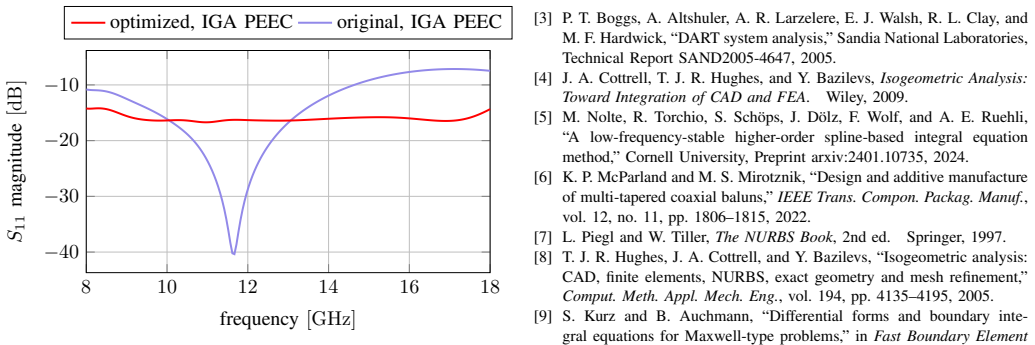
Spline-based freeform optimization of a multi-tapered coaxial balun, simulated by an isogeometric integral equation method, reduces the magnitude of its scattering parameter over a wide frequency range.
A machine-rendered reading of the paper's core claim, the machinery that carries it, and where it could break.
Core claim
When the isogeometric integral equation formulation supplies the forward model, spline-based freeform shape optimization produces a multi-tapered coaxial balun whose scattering parameter magnitude is substantially smaller over a wide frequency interval than the starting geometry.
What carries the argument
Spline-based freeform shape optimization driven by an isogeometric integral equation formulation (high-order generalization of the partial element equivalent circuit method) that evaluates the electromagnetic response of the balun geometry.
If this is right
- The optimized geometry achieves lower reflection over the operating band of the connected spiral antenna.
- Freeform spline control points allow shape changes that are not restricted to a small number of design parameters.
- The same simulation and optimization workflow applies directly to other coaxial or transmission-line components.
Where Pith is reading between the lines
- The approach could be tested on baluns with different taper counts or material properties to map the range of geometries that benefit from the method.
- If the optimized shapes prove manufacturable, the reduction in scattering could translate into lower insertion loss in integrated RF front-ends.
- Coupling the isogeometric model to a fabrication constraint set would show whether the performance gain survives real-world production tolerances.
Load-bearing premise
The isogeometric integral equation model must be accurate enough that the computed scattering parameter improvements correspond to real physical behavior.
What would settle it
Laboratory measurement of the fabricated optimized balun that fails to show lower scattering parameter magnitude than the initial design across the same frequency interval.
Figures


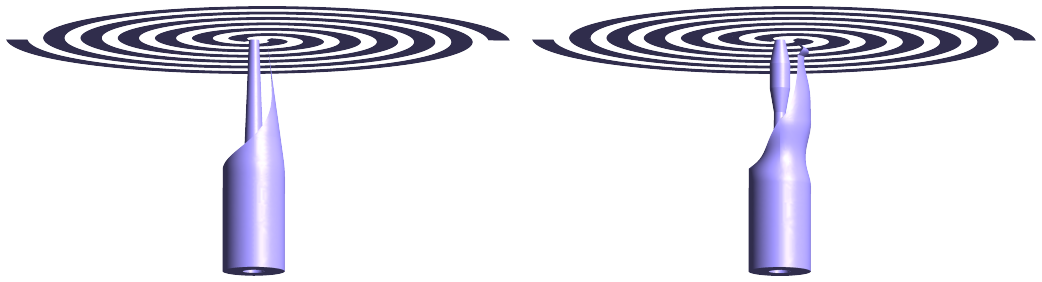
read the original abstract
We discuss the advantages of a spline-based freeform shape optimization approach using the example of a multi-tapered coaxial balun connected to a spiral antenna. The underlying simulation model is given in terms of a recently proposed isogeometric integral equation formulation, which can be interpreted as a high-order generalization of the partial element equivalent circuit method. We demonstrate a significant improvement in the optimized design, i.e., a reduction in the magnitude of the scattering parameter over a wide frequency range.
Editorial analysis
A structured set of objections, weighed in public.
Referee Report
Summary. The paper presents a spline-based freeform shape optimization approach for a multi-tapered coaxial balun connected to a spiral antenna. The forward model is an isogeometric integral equation formulation (high-order generalization of the PEEC method). The central claim is a demonstrated significant reduction in the magnitude of the scattering parameter over a wide frequency range for the optimized design relative to the initial geometry.
Significance. If the forward model accuracy holds, the work would illustrate the practical value of isogeometric analysis for electromagnetic shape optimization, enabling smooth freeform geometries and high-order discretization without traditional meshing. The approach could be relevant for antenna and balun design where geometry parameterization directly affects broadband performance.
major comments (1)
- [Numerical results / optimization section] The central claim (reduction in |S| after optimization) is load-bearing on the physical accuracy of the isogeometric IEM forward model for both initial and optimized geometries. No benchmark comparisons of the initial design's S-parameters against reference MoM, FEM solvers, or measurements are reported. Without such validation, reported improvements cannot be distinguished from possible discretization or kernel approximation artifacts.
minor comments (1)
- [Abstract] Abstract states a 'significant improvement' and 'reduction in the magnitude of the scattering parameter' but supplies no quantitative values, frequency range details, or baseline comparisons.
Simulated Author's Rebuttal
We thank the referee for highlighting the importance of forward-model validation. We agree this is a substantive point and will revise the manuscript accordingly.
read point-by-point responses
-
Referee: [Numerical results / optimization section] The central claim (reduction in |S| after optimization) is load-bearing on the physical accuracy of the isogeometric IEM forward model for both initial and optimized geometries. No benchmark comparisons of the initial design's S-parameters against reference MoM, FEM solvers, or measurements are reported. Without such validation, reported improvements cannot be distinguished from possible discretization or kernel approximation artifacts.
Authors: We agree that the physical accuracy of the isogeometric IEM must be demonstrated to support the optimization claims. The current manuscript does not contain benchmark comparisons of the initial design against reference MoM or FEM solvers. In the revised version we will add such comparisons for the initial geometry (and, where feasible, the optimized geometry) to confirm that the reported reduction in |S| is not an artifact of the discretization or kernel approximation. revision: yes
Circularity Check
No circularity: optimization result is a numerical outcome from external forward model
full rationale
The manuscript applies a spline-based shape optimization to a multi-tapered coaxial balun using an isogeometric integral-equation forward model and reports a reduction in |S| magnitude. No equations, fitted parameters, or self-referential definitions are present that would make the reported improvement equivalent to its inputs by construction. The method is referenced as recently proposed, but this citation supports the simulation tool rather than forcing the optimization outcome itself. The derivation chain remains self-contained against external benchmarks with no load-bearing self-citation chains or ansatz smuggling identified.
Axiom & Free-Parameter Ledger
Reference graph
Works this paper leans on
-
[1]
C. A. Balanis, Antenna Theory: Analysis and Design , 4th ed. Wiley, 2016
work page 2016
-
[2]
J. Nocedal and S. J. Wright, Numerical optimization , 2nd ed., ser. Springer Series in Operations Research and Financial Engineering. Springer, 2006
work page 2006
-
[3]
P. T. Boggs, A. Altshuler, A. R. Larzelere, E. J. Walsh, R. L. Clay, and M. F. Hardwick, “DART system analysis,” Sandia National Laboratories, Technical Report SAND2005-4647, 2005
work page 2005
-
[4]
J. A. Cottrell, T. J. R. Hughes, and Y . Bazilevs, Isogeometric Analysis: Toward Integration of CAD and FEA . Wiley, 2009
work page 2009
-
[5]
M. Nolte, R. Torchio, S. Sch ¨ops, J. D ¨olz, F. Wolf, and A. E. Ruehli, “A low-frequency-stable higher-order spline-based integral equation method,” Cornell University, Preprint arxiv:2401.10735, 2024
work page internal anchor Pith review Pith/arXiv arXiv 2024
-
[6]
Design and additive manufacture of multi-tapered coaxial baluns,
K. P. McParland and M. S. Mirotznik, “Design and additive manufacture of multi-tapered coaxial baluns,” IEEE Trans. Compon. Packag. Manuf. , vol. 12, no. 11, pp. 1806–1815, 2022
work page 2022
- [7]
-
[8]
Isogeometric analysis: CAD, finite elements, NURBS, exact geometry and mesh refinement,
T. J. R. Hughes, J. A. Cottrell, and Y . Bazilevs, “Isogeometric analysis: CAD, finite elements, NURBS, exact geometry and mesh refinement,” Comput. Meth. Appl. Mech. Eng. , vol. 194, pp. 4135–4195, 2005
work page 2005
-
[9]
Differential forms and boundary inte- gral equations for Maxwell-type problems,
S. Kurz and B. Auchmann, “Differential forms and boundary inte- gral equations for Maxwell-type problems,” in Fast Boundary Element Methods in Engineering and Industrial Applications , ser. Lecture Notes in Applied and Computational Mechanics, U. Langer, M. Schanz, O. Steinbach, and W. L. Wendland, Eds. Springer, 2012, no. 63, pp. 1–62
work page 2012
-
[10]
J. A. Stratton, Electromagnetic Theory. IEEE Press, 1941
work page 1941
-
[11]
An augmented electric field integral equation for high-speed interconnect analysis,
Z. G. Qian and W. C. Chew, “An augmented electric field integral equation for high-speed interconnect analysis,” IEEE Trans. Antenn. Propag., vol. 50, no. 10, pp. 2658–2662, 2008
work page 2008
-
[12]
Multipatch Approximation of the de Rham Sequence and its Traces in Isogeometric Analysis
A. Buffa, J. D ¨olz, S. Kurz, S. Sch ¨ops, R. V ´azquez, and F. Wolf, “Multipatch approximation of the de Rham sequence and its traces in isogeometric analysis,” Numer . Math., vol. 144, no. 1, pp. 201–236, 06 2019, arxiv:1806.01062
work page internal anchor Pith review Pith/arXiv arXiv 2019
-
[13]
Quadrature over a pyramid or cube of integrands with a singularity at a vertex,
M. G. Duffy, “Quadrature over a pyramid or cube of integrands with a singularity at a vertex,” SIAM J. Numer . Anal. , vol. 19, no. 6, pp. 1260–1262, 1982
work page 1982
-
[14]
Wavelet Galerkin Schemes for Bound- ary Integral Equations—Implementation and Quadrature,
H. Harbrecht and R. Schneider, “Wavelet Galerkin Schemes for Bound- ary Integral Equations—Implementation and Quadrature,” SIAM J. Sci. Comput., vol. 27, no. 4, pp. 1347–1370, 2006
work page 2006
-
[15]
Equivalent circuit models for three-dimensional multi- conductor systems,
A. E. Ruehli, “Equivalent circuit models for three-dimensional multi- conductor systems,” IEEE Trans. Microw. Theor . Tech. , vol. 22, no. 3, pp. 216–221, 1974
work page 1974
-
[16]
A. E. Ruehli, G. Antonini, and L. Jiang, The Partial Element Equivalent Circuit Method for Electro-Magnetic and Circuit Problems, 1st ed. John Wiley & Sons, 2017
work page 2017
-
[17]
J. D ¨olz, H. Harbrecht, S. Kurz, M. Multerer, S. Sch ¨ops, and F. Wolf, “Bembel: The fast isogeometric boundary element C++ library for Laplace, Helmholtz, and electric wave equation,” Software X , vol. 11, p. 100476, 04 2020, arxiv:1906.00785
work page internal anchor Pith review Pith/arXiv arXiv 2020
-
[18]
Results of a iga-peec-based multi-tapered coaxial balun optimization,
B. Balouchev, J. D ¨olz, M. Nolte, S. Sebastian, and R. Torchio, “Results of a iga-peec-based multi-tapered coaxial balun optimization,” 2024. [Online]. Available: https://github.com/temf/igapeec balun opt
work page 2024
-
[19]
The BOBYQA algorithm for bound constrained opti- mization without derivatives,
M. J. D. Powell, “The BOBYQA algorithm for bound constrained opti- mization without derivatives,” Cambridge University, Technical Report DAMTP 2009/NA06, 08 2009
work page 2009
-
[20]
Improving the Flexibility and Robustness of Model-Based Derivative-Free Optimization Solvers
C. Cartis, J. Fiala, B. Marteau, and L. Roberts, “Improving the flexibility and robustness of model-based derivative-free optimization solvers,” ACM Trans. Math. Software , vol. 45, no. 3, pp. 1–41, 08 2019, arxiv:1804.00154
work page internal anchor Pith review Pith/arXiv arXiv 2019
-
[21]
Escaping local minima with local derivative-free methods: a numerical investigation,
C. Cartis, L. Roberts, and O. Sheridan-Methven, “Escaping local minima with local derivative-free methods: a numerical investigation,”Optimiza- tion, vol. 71, no. 8, p. 2343–2373, Feb. 2021
work page 2021
- [22]
-
[23]
On the computation of analytic sensitivities of eigenpairs in isogeometric analysis,
A. Ziegler, M. Merkel, P. Gangl, and S. Sch ¨ops, “On the computation of analytic sensitivities of eigenpairs in isogeometric analysis,” Comput. Meth. Appl. Mech. Eng., vol. 409, p. 115961, 05 2023, arxiv:2212.10347
-
[24]
Gradient- based eigenvalue optimization for electromagnetic cavities with built-in mode matching,
A. Ziegler, R. Hahn, V . Isensee, A. D. Nguyen, and S. Sch¨ops, “Gradient- based eigenvalue optimization for electromagnetic cavities with built-in mode matching,” IET Sci. Meas. Tech. , 10 2023, arxiv:2310.15751
discussion (0)
Sign in with ORCID, Apple, or X to comment. Anyone can read and Pith papers without signing in.