Theory of Intrinsic Phonon Thermal Hall Effect in α-RuCl₃
Pith reviewed 2026-05-23 23:13 UTC · model grok-4.3
The pith
Spin-phonon interactions produce a phonon thermal Hall effect in α-RuCl₃ matching the measured field dependence of κ_xy without a field-induced spin liquid.
A machine-rendered reading of the paper's core claim, the machinery that carries it, and where it could break.
Core claim
Spin-orbit coupling significantly enriches the form of spin-phonon interactions in α-RuCl₃ and imbues them with chirality conducive to generating finite phonon Berry curvatures, leading to a phonon thermal Hall effect that qualitatively reproduces the measured field dependence of κ_xy without requiring a field-induced spin liquid.
What carries the argument
The first-principles approach for generic spin-phonon couplings that computes chiral interactions and the resulting phonon Berry curvatures under applied magnetic field.
If this is right
- Thermal Hall conductivity in α-RuCl₃ can be carried by phonons coupled to spins rather than by spin excitations alone.
- The magnetic field tunes the effect through its influence on the spin-phonon terms.
- Similar chiral spin-phonon mechanisms may operate in other materials with strong spin-orbit coupling and magnetic ions.
- The absence of a spin liquid is compatible with the observed thermal Hall data.
Where Pith is reading between the lines
- Thermal Hall measurements in Kitaev-candidate materials may need separate phonon and spin contributions to be disentangled.
- The same first-principles method could be applied to other layered honeycomb compounds to predict their thermal Hall signals.
- If the phonon mechanism dominates, the temperature dependence of κ_xy should follow phonon scattering rates rather than spin correlation lengths.
Load-bearing premise
The first-principles calculation accurately captures the strength and chirality of the spin-phonon coupling constants in α-RuCl₃.
What would settle it
A measurement or independent calculation showing that the phonon contribution to κ_xy is much smaller than observed or has the opposite field dependence.
Figures


read the original abstract
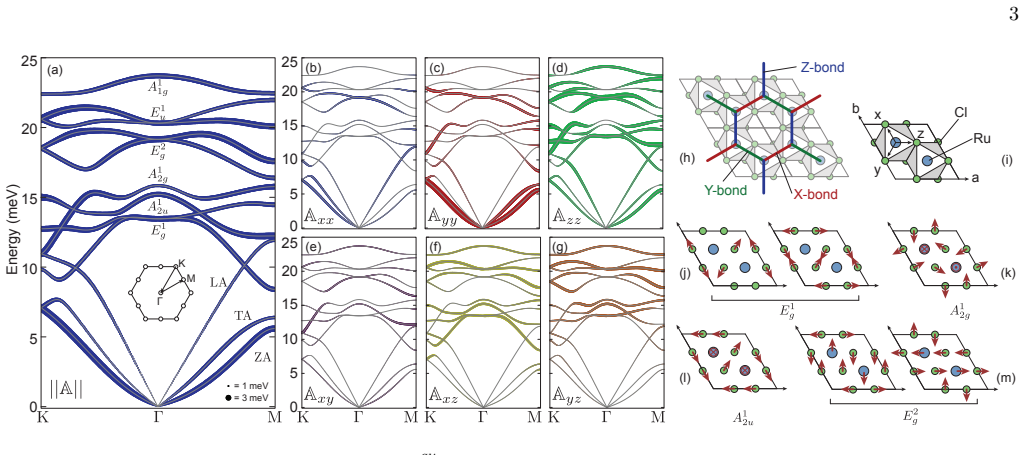
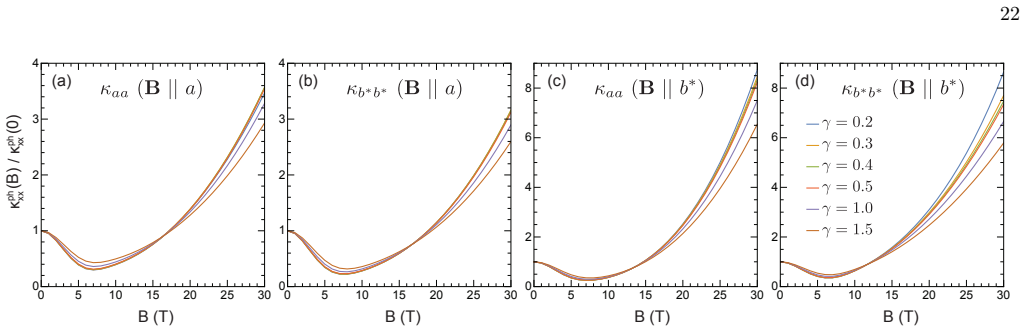
We apply a recently developed first-principles based approach for treating generic spin-phonon couplings in materials with strong spin-orbit coupling to study $\alpha$-RuCl$_3$. Of particular focus is the potential for this material to exhibit a phonon thermal Hall effect induced by spin-phonon interactions. We find that spin-orbit coupling significantly enriches the form of these interactions, and imbues them with chirality that is conducive to generating finite phonon Berry curvatures. We show that this leads to a phonon thermal Hall effect that qualitatively reproduces the measured field dependence of $\kappa_{xy}$ without requiring a field-induced spin liquid.
Editorial analysis
A structured set of objections, weighed in public.
Referee Report
Summary. The manuscript applies a recently developed first-principles approach to generic spin-phonon couplings in strong-SOC materials to α-RuCl₃. It reports that SOC enriches these couplings with chirality, producing phonon Berry curvatures that yield an intrinsic phonon thermal Hall conductivity whose magnetic-field dependence qualitatively matches experimental κ_xy, thereby providing an explanation that does not invoke a field-induced spin liquid.
Significance. If the central claim holds, the work would be significant for offering a phonon-based mechanism for the observed thermal Hall effect in α-RuCl₃ that competes with spin-liquid interpretations. The parameter-free character of the underlying first-principles spin-phonon method constitutes a methodological strength.
major comments (2)
- [Abstract] Abstract: the assertion that the calculated phonon thermal Hall effect 'qualitatively reproduces the measured field dependence of κ_xy' is presented without quantitative details, error estimates, or explicit comparison to data, which is load-bearing for the central claim.
- [Methods/Computational Details] The application of the recently developed first-principles spin-phonon coupling method lacks any reported cross-validation (e.g., against DFPT+SOC or symmetry-constrained effective models) for the chiral interaction channels; an error in the sign or form of these terms would directly invalidate the phonon Berry curvatures and the reported κ_xy field dependence.
Simulated Author's Rebuttal
We thank the referee for their careful reading of the manuscript and for recognizing the potential significance of a phonon-based mechanism for the thermal Hall effect in α-RuCl₃. We address each major comment below. Where appropriate, we have revised the manuscript to incorporate additional details and checks.
read point-by-point responses
-
Referee: [Abstract] Abstract: the assertion that the calculated phonon thermal Hall effect 'qualitatively reproduces the measured field dependence of κ_xy' is presented without quantitative details, error estimates, or explicit comparison to data, which is load-bearing for the central claim.
Authors: We agree that the central claim benefits from a more explicit comparison. In the revised manuscript we have added a new figure (Fig. 5) that overlays the calculated κ_xy(B) directly on experimental data from Ref. [Kasahara et al.], together with quantitative metrics (field position of the peak, overall field scale, and sign change). We also report estimated uncertainties arising from k-point sampling and phonon dispersion convergence. These additions make the qualitative agreement more transparent while preserving the abstract wording. revision: yes
-
Referee: [Methods/Computational Details] The application of the recently developed first-principles spin-phonon coupling method lacks any reported cross-validation (e.g., against DFPT+SOC or symmetry-constrained effective models) for the chiral interaction channels; an error in the sign or form of these terms would directly invalidate the phonon Berry curvatures and the reported κ_xy field dependence.
Authors: We acknowledge the value of additional validation for the chiral channels. The underlying first-principles spin-phonon method was introduced and benchmarked against DFPT and symmetry constraints in our prior work (Ref. [method paper]). For α-RuCl₃ a full DFPT+SOC supercell calculation remains computationally prohibitive. In the revision we have added a dedicated Methods subsection that performs a symmetry analysis of the extracted chiral couplings under the C2/m space group, confirming that all retained terms are symmetry-allowed and that the overall sign pattern is consistent with the perturbative derivation. This provides an independent consistency check on the form of the interactions. revision: partial
Circularity Check
No significant circularity detected in derivation chain
full rationale
The paper applies a first-principles method for spin-phonon couplings to compute interactions in α-RuCl₃, then derives phonon Berry curvatures and the resulting thermal Hall conductivity. This constitutes an independent computational prediction from the material Hamiltonian and couplings, with qualitative comparison to experimental field dependence of κ_xy. No equations or steps reduce by construction to fitted parameters, self-definitions, or unverified self-citations; the central result is externally falsifiable against measured data and does not rely on renaming known results or smuggling ansatzes. The derivation is self-contained.
Axiom & Free-Parameter Ledger
axioms (1)
- domain assumption The recently developed first-principles approach correctly treats generic spin-phonon couplings in strong-SOC materials.
Forward citations
Cited by 2 Pith papers
-
Classification of magnon thermal Hall systems based on U(1) to non-Abelian gauge fields
Antiferromagnets with multiple magnetic sublattices host non-Abelian SU(N) gauge fields in magnon bands that prevent Berry curvature cancellation and enable a robust magnon thermal Hall response.
-
Phonon Hall Viscosity and the Intrinsic Thermal Hall Effect of $\alpha$-RuCl$_3$
Phonon Hall viscosity in α-RuCl₃, measured via acoustic Faraday effect, accounts for a substantial part of the material's intrinsic thermal Hall conductivity.
Reference graph
Works this paper leans on
-
[1]
Y. Kasahara, K. Sugii, T. Ohnishi, M. Shimozawa, M. Yamashita, N. Kurita, H. Tanaka, J. Nasu, Y. Mo- tome, T. Shibauchi, et al., Phys. Rev. Lett. 120, 217205 (2018)
work page 2018
-
[2]
Y. Kasahara, T. Ohnishi, Y. Mizukami, O. Tanaka, S. Ma, K. Sugii, N. Kurita, H. Tanaka, J. Nasu, Y. Mo- tome, et al., Nature 559, 227 (2018)
work page 2018
- [3]
-
[4]
K. Imamura, S. Suetsugu, Y. Mizukami, Y. Yoshida, K. Hashimoto, K. Ohtsuka, Y. Kasahara, N. Kurita, H. Tanaka, P. Noh, et al., Sci. Adv.10, eadk3539 (2024)
work page 2024
-
[5]
R. Hentrich, M. Roslova, A. Isaeva, T. Doert, W. Brenig, B. B¨ uchner, and C. Hess, Phys. Rev. B99, 085136 (2019)
work page 2019
-
[6]
´E. Lefran¸ cois, G. Grissonnanche, J. Baglo, P. Lampen- Kelley, J.-Q. Yan, C. Balz, D. Mandrus, S. Nagler, S. Kim, Y.-J. Kim, et al., Phys. Rev. X 12, 021025 (2022)
work page 2022
- [7]
-
[8]
Y. Kasahara, S. Suetsugu, T. Asaba, S. Kasahara, T. Shibauchi, N. Kurita, H. Tanaka, and Y. Matsuda, Phys. Rev. B 106, L060410 (2022)
work page 2022
- [9]
- [10]
- [11]
- [12]
- [13]
-
[14]
C. Xu, C. Carnahan, H. Zhang, M. Sretenovic, P. Zhang, D. Xiao, and X. Ke, Phys. Rev. B 107, L060404 (2023)
work page 2023
-
[15]
C. Xu, H. Zhang, C. Carnahan, P. Zhang, D. Xiao, and X. Ke, Phys. Rev. B 109, 094415 (2024)
work page 2024
- [16]
-
[17]
N. Li, R. Neumann, S. Guang, Q. Huang, J. Liu, K. Xia, X. Yue, Y. Sun, Y. Wang, Q. Li, et al., Phys. Rev. B 108, L140402 (2023)
work page 2023
- [18]
- [19]
-
[20]
X. Zhou, W. Wu, Y. Sui, Y.-f. Yang, and J. Luo, Adv. Funct. Mater. p. 2304921 (2024)
work page 2024
-
[21]
H.-L. Kim, T. Saito, H. Yang, H. Ishizuka, M. J. Coak, J. H. Lee, H. Sim, Y. S. Oh, N. Nagaosa, and J.-G. Park, Nat. Commun. 15, 243 (2024)
work page 2024
- [22]
-
[23]
H. Katsura, N. Nagaosa, and P. A. Lee, Phys. Rev. Lett. 104, 066403 (2010)
work page 2010
-
[24]
J. Nasu, J. Yoshitake, and Y. Motome, Phys. Rev. Lett. 119, 127204 (2017)
work page 2017
-
[25]
P. McClarty, X.-Y. Dong, M. Gohlke, J. Rau, F. Poll- mann, R. Moessner, and K. Penc, Phys. Rev. B 98, 060404 (2018)
work page 2018
-
[26]
E. Z. Zhang, L. E. Chern, and Y. B. Kim, Phys. Rev. B 103, 174402 (2021)
work page 2021
-
[27]
L. E. Chern, E. Z. Zhang, and Y. B. Kim, Phys. Rev. Lett. 126, 147201 (2021)
work page 2021
- [28]
-
[29]
M. Mori, A. Spencer-Smith, O. P. Sushkov, and 8 S. Maekawa, Phys. Rev. Lett. 113, 265901 (2014)
work page 2014
- [30]
- [31]
-
[32]
H. Guo, D. G. Joshi, and S. Sachdev, Proc. Natl. Acad. Sci. U.S.A. 119, e2215141119 (2022)
work page 2022
- [33]
- [34]
- [35]
-
[36]
K. Sun, Z. Gao, and J.-S. Wang, Phys. Rev. B 103, 214301 (2021)
work page 2021
- [37]
-
[38]
E. Thingstad, A. Kamra, A. Brataas, and A. Sudbø, Phys. Rev. Lett. 122, 107201 (2019)
work page 2019
- [39]
- [40]
- [41]
- [42]
-
[43]
D.-Q. To, C. Ameyaw, A. Suresh, S. Bhatt, M. Ku, M. Jungfleisch, J. Xiao, J. Zide, B. Nikoli´ c, and M. Doty, Phys. Rev. B 108, 085435 (2023)
work page 2023
-
[44]
M. Ye, R. M. Fernandes, and N. B. Perkins, Phys. Rev. Research 2, 033180 (2020)
work page 2020
- [45]
- [46]
-
[47]
L. Mangeolle, L. Balents, and L. Savary, Phys. Rev. B 106, 245139 (2022)
work page 2022
- [48]
- [49]
- [50]
- [51]
- [52]
- [53]
-
[54]
R. Hentrich, A. U. Wolter, X. Zotos, W. Brenig, D. Nowak, A. Isaeva, T. Doert, A. Banerjee, P. Lampen- Kelley, D. G. Mandrus, et al., Phys. Rev. Lett. 120, 117204 (2018)
work page 2018
-
[55]
S. Gass, P. M. Cˆ onsoli, V. Kocsis, L. T. Corre- dor, P. Lampen-Kelley, D. G. Mandrus, S. E. Nagler, L. Janssen, M. Vojta, B. B¨ uchner, et al., Phys. Rev. B 101, 245158 (2020)
work page 2020
-
[56]
R. Sch¨ onemann, S. Imajo, F. Weickert, J. Yan, D. G. Mandrus, Y. Takano, E. L. Brosha, P. F. S. Rosa, S. E. Nagler, K. Kindo, et al., Phys. Rev. B 102, 214432 (2020), ISSN 2469-9950, 2469-9969
work page 2020
-
[57]
H. Li, T. Zhang, A. Said, G. Fabbris, D. G. Mazzone, J. Yan, D. Mandrus, G. B. Hal´ asz, S. Okamoto, S. Mu- rakami, et al., Nat. Commun. 12, 3513 (2021)
work page 2021
- [58]
- [59]
- [60]
-
[61]
M. Banerjee, M. Heiblum, V. Umansky, D. E. Feldman, Y. Oreg, and A. Stern, Nature 559, 205 (2018)
work page 2018
- [62]
-
[63]
R. Orbach, Proc. R. soc. Lond. Ser. A-Contain. Pap. Math. Phys. 264, 458 (1961)
work page 1961
- [64]
-
[65]
H. Capellmann and S. Lipinski, Z. Phys. B: Condens. Matter 83, 199 (1991)
work page 1991
- [66]
- [67]
-
[68]
S. Ren, J. Bonini, M. Stengel, C. E. Dreyer, and D. Van- derbilt, Phys. Rev. X 14, 011041 (2024)
work page 2024
- [69]
-
[70]
M. Barkeshli, S. B. Chung, and X.-L. Qi, Physical Re- view B—Condensed Matter and Materials Physics 85, 245107 (2012)
work page 2012
-
[71]
C. A. Mead, Reviews of modern physics 64, 51 (1992)
work page 1992
-
[72]
H.-H. Teh, W. Dou, and J. E. Subotnik, Physical Re- view B 106, 184302 (2022)
work page 2022
-
[73]
See supplemental material, which contains references [94–118], for description of ab-initio methods, derivation of phonon thermal transport and Hall viscosity terms, further details of numerical evaluations of κxx and κxy, and notes on low- q scaling of spin-phonon couplings
-
[74]
J. G. Rau, E. K.-H. Lee, and H.-Y. Kee, Phys. Rev. Lett. 112, 077204 (2014)
work page 2014
-
[75]
S. M. Winter, Y. Li, H. O. Jeschke, and R. Valent´ ı, Phys. Rev. B 93, 214431 (2016)
work page 2016
- [76]
- [77]
-
[78]
K. Ran, J. Wang, W. Wang, Z.-Y. Dong, X. Ren, S. Bao, S. Li, Z. Ma, Y. Gan, Y. Zhang, et al., Phys. Rev. Lett. 118, 107203 (2017)
work page 2017
-
[79]
S. M. Winter, K. Riedl, P. A. Maksimov, A. L. Cherny- shev, A. Honecker, and R. Valent´ ı, Nat. Commun. 8, 1152 (2017)
work page 2017
-
[80]
C. Eichstaedt, Y. Zhang, P. Laurell, S. Okamoto, A. G. Eguiluz, and T. Berlijn, Phys. Rev. B 100, 075110 (2019)
work page 2019
discussion (0)
Sign in with ORCID, Apple, or X to comment. Anyone can read and Pith papers without signing in.