Fair Money -- Public Good Value Pricing With Karma Economies
Pith reviewed 2026-05-23 22:48 UTC · model grok-4.3
The pith
Karma economies allocate public resources like road space more fairly than money by balancing giving and taking without fees.
A machine-rendered reading of the paper's core claim, the machinery that carries it, and where it could break.
Core claim
Karma is a non-monetary, fair, and efficient resource allocation mechanism that employs an artificial currency different from money, that incentivizes cooperation amongst selfish individuals, and achieves a balance between giving and taking. Where money does not do its job, Karma achieves socially more desirable resource allocations by being aligned with consumers' needs rather than their financial power.
What carries the argument
The Karma mechanism, an artificial currency system that records and enforces balance between individual giving and taking of the shared resource.
If this is right
- Karma reduces overuse of roads without imposing fees that burden lower-income groups.
- Allocations shift toward users who need the resource more rather than those who can pay more.
- A provided software framework allows prediction of behavior and testing of design choices before deployment.
- The same approach applies to other public goods where monetary pricing creates fairness issues.
Where Pith is reading between the lines
- Karma could combine with existing traffic sensors to adjust balances in real time.
- Repeated use might train cooperative habits that persist even if the system is later removed.
- The balance requirement might create new forms of strategic behavior around timing of use.
Load-bearing premise
Individuals will respond to the Karma incentives by cooperating and balancing giving and taking in the intended way.
What would settle it
A simulation or field test in which users accumulate Karma imbalances that produce allocations as skewed toward high-wealth participants as under monetary pricing.
Figures


read the original abstract
City road infrastructure is a public good, and over-consumption by self-interested, rational individuals leads to traffic jams. Congestion pricing is effective in reducing demand to sustainable levels, but also controversial, as it introduces equity issues and systematically discriminates lower-income groups. Karma is a non-monetary, fair, and efficient resource allocation mechanism, that employs an artificial currency different from money, that incentivizes cooperation amongst selfish individuals, and achieves a balance between giving and taking. Where money does not do its job, Karma achieves socially more desirable resource allocations by being aligned with consumers' needs rather than their financial power. This work highlights the value proposition of Karma, gives guidance on important Karma mechanism design elements, and equips the reader with a useful software framework to model Karma economies and predict consumers' behaviour. A case study demonstrates the potential of this feasible alternative to money, without the burden of additional fees.
Editorial analysis
A structured set of objections, weighed in public.
Referee Report
Summary. The paper claims that Karma, a non-monetary artificial currency, provides a fair and efficient alternative to monetary congestion pricing for public goods such as road infrastructure. It incentivizes cooperation among selfish individuals, achieves a balance between giving and taking, and produces allocations aligned with needs rather than financial power. The work supplies mechanism design guidance, a software framework for modeling agent behavior, and a case study to illustrate feasibility without additional fees.
Significance. If the incentive properties hold, the proposal addresses equity concerns in congestion management, a relevant topic in multi-agent systems and mechanism design. The software framework for simulating Karma economies is a concrete contribution that supports reproducibility and further modeling of consumer responses.
major comments (2)
- [Case study] Case study section: the reported outcomes rely on assumed agent responses to Karma incentives without sensitivity analysis or comparison to monetary baselines, leaving the central efficiency and fairness claims without quantitative support.
- [Mechanism design elements] Mechanism design guidance: the description of how Karma enforces balance between giving and taking is presented at a high level without explicit update rules, equilibrium analysis, or conditions under which selfish agents converge to the claimed cooperative behavior.
minor comments (2)
- The abstract and introduction could more explicitly separate the conceptual value proposition from the simulation-based demonstration.
- Provide direct links or repository details for the software framework to enable reader replication.
Simulated Author's Rebuttal
We thank the referee for the constructive feedback and the recommendation of minor revision. We address each major comment below and will incorporate clarifications and expansions in the revised manuscript where appropriate.
read point-by-point responses
-
Referee: [Case study] Case study section: the reported outcomes rely on assumed agent responses to Karma incentives without sensitivity analysis or comparison to monetary baselines, leaving the central efficiency and fairness claims without quantitative support.
Authors: We agree that the case study relies on assumed agent responses and does not perform sensitivity analysis or direct comparisons against monetary baselines. The case study is intended solely as an illustration of how the provided software framework can be used to model Karma economies, rather than as quantitative validation of the efficiency and fairness claims. Those claims rest on the conceptual mechanism design discussion in the paper. In the revision we will explicitly state the illustrative scope of the case study, clarify the modeling assumptions, and note that the framework supports users in conducting sensitivity analyses themselves. revision: partial
-
Referee: [Mechanism design elements] Mechanism design guidance: the description of how Karma enforces balance between giving and taking is presented at a high level without explicit update rules, equilibrium analysis, or conditions under which selfish agents converge to the claimed cooperative behavior.
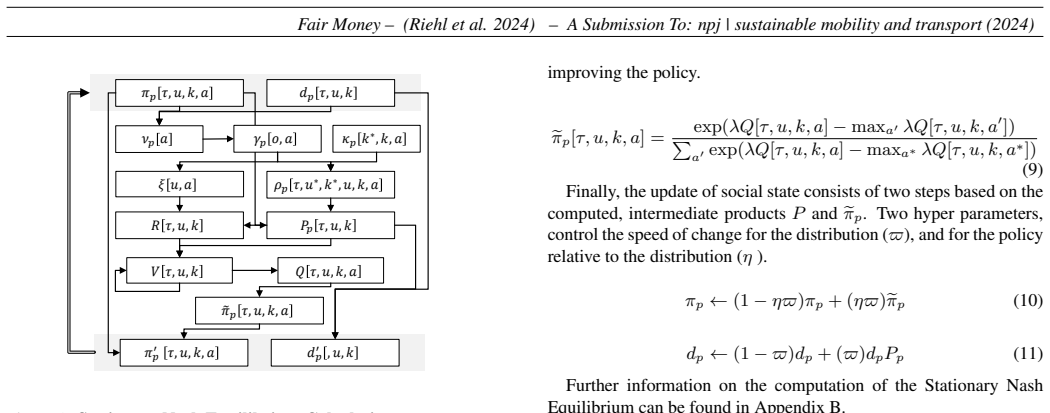
Authors: The mechanism design section deliberately focuses on high-level guidance for key design elements such as balance enforcement. Explicit update rules and simulation-based equilibrium analysis are implemented inside the accompanying software framework, which is the primary vehicle for readers to explore convergence conditions. In the revision we will add pseudocode for the core balance update rules and cross-reference the framework's simulation capabilities so that the guidance is more concrete while remaining within the paper's intended scope. revision: yes
Circularity Check
No significant circularity identified
full rationale
The paper is a conceptual proposal for Karma economies as an alternative to congestion pricing, supported by mechanism design guidance, a software framework for agent modeling, and a case study. No load-bearing derivation chain, equations, fitted parameters presented as predictions, or self-citation chains that reduce claims to inputs by construction are present in the provided text. Central statements define Karma's properties as a value proposition rather than deriving them from prior results or self-referential fits.
Axiom & Free-Parameter Ledger
invented entities (1)
-
Karma artificial currency
no independent evidence
Reference graph
Works this paper leans on
-
[1]
Hardin, G. The tragedy of the commons: the population problem has no technical solution; it requires a fundamental extension in morality. Science 162, 1243–1248 (1968)
work page 1968
-
[2]
Kaul, I., Grunberg, I. & Stern, M. Global public goods (New York- Oxford, 1999)
work page 1999
-
[3]
Arnott, R. & Small, K. The economics of traffic congestion. American scientist 82, 446–455 (1994)
work page 1994
-
[4]
Koetse, M. J. & Rietveld, P. The impact of climate change and weather on transport: An overview of empirical findings. Transportation Re- search Part D: Transport and Environment14, 205–221 (2009)
work page 2009
-
[5]
Zhang, K. & Batterman, S. Air pollution and health risks due to vehicle traffic. Science of the total Environment 450, 307–316 (2013)
work page 2013
-
[6]
Gentile, G., Papola, N. & Persia, L. Advanced pricing and rationing policies for large scale multimodal networks. Transportation Research Part A: Policy and Practice39, 612–631 (2005)
work page 2005
-
[7]
Schmalensee, R. & Stavins, R. N. Lessons learned from three decades of experience with cap and trade. Review of Environmental Economics and Policy (2017)
work page 2017
-
[8]
Barnett, A. H. The Pigouvian tax rule under monopoly. The American Economic Review 70, 1037–1041 (1980)
work page 1980
-
[9]
Small, K. A. & Yan, J. The value of “value pricing” of roads: Second- best pricing and product differentiation. Journal of Urban Economics 49, 310–336 (2001)
work page 2001
-
[10]
Santos, G. & Fraser, G. Road pricing: lessons from London. Economic Policy 21, 264–310 (2006)
work page 2006
-
[11]
Nie, Y . Why is license plate rationing not a good transport policy? Transportmetrica A: Transport Science13, 1–23 (2017)
work page 2017
-
[12]
Provoost, J., Cats, O. & Hoogendoorn, S. Design and classification of tradable mobility credit schemes. Transport Policy136, 59–69 (2023)
work page 2023
-
[13]
Lindsney, R. & Verhoef, E. in Handbook of transport systems and traffic control 77–105 (Emerald Group Publishing Limited, 2001)
work page 2001
-
[14]
Wang, X., Rodríguez, D. A. & Mahendra, A. Support for market-based and command-and-control congestion relief policies in Latin Ameri- can cities: Effects of mobility, environmental health, and city-level fac- tors. Transportation Research Part A: Policy and Practice146, 91–108 (2021)
work page 2021
-
[15]
Moeinaddini, A. & Habibian, M. Acceptability of transportation de- mand management policy packages considering interactions and socio- economic heterogeneity. Research in Transportation Economics 103, 101374 (2024)
work page 2024
- [16]
-
[17]
The combinatorial assignment problem: Approximate com- petitive equilibrium from equal incomes
Budish, E. The combinatorial assignment problem: Approximate com- petitive equilibrium from equal incomes. Journal of Political Economy 119, 1061–1103 (2011)
work page 2011
-
[18]
Dutot, P.-F., Pascual, F., Rzadca, K. & Trystram, D. Approximation al- gorithms for the multiorganization scheduling problem. IEEE Transac- tions on Parallel and Distributed Systems 22, 1888–1895 (2011)
work page 2011
-
[19]
Skowron, P. & Rzadca, K. Non-monetary fair scheduling: a cooperative game theory approach in Proceedings of the twenty-fifth annual ACM symposium on Parallelism in algorithms and architectures(2013), 288– 297
work page 2013
-
[20]
Stable Allocations and the Practice of Market Design
Gale, D & Shapley, L. Stable Allocations and the Practice of Market Design. The Royal Swedish Academy of Sciences (2012)
work page 2012
-
[21]
Nguyen, T., Peivandi, A. & V ohra, R. Assignment problems with com- plementarities. Journal of Economic Theory 165, 209–241 (2016)
work page 2016
-
[22]
Karaenke, P., Bichler, M., Merting, S. & Minner, S. Non-monetary co- ordination mechanisms for time slot allocation in warehouse delivery. European Journal of Operational Research286, 897–907 (2020)
work page 2020
-
[23]
Resource Allocation with Karma Mechanisms
Riehl, K., Kouvelas, A. & Makridis, M. Resource Allocation with Karma Mechanisms. arXiv preprint arXiv:2406.14728 (2024)
work page internal anchor Pith review Pith/arXiv arXiv 2024
-
[24]
Censi, A., Bolognani, S., Zilly, J. G., Mousavi, S. S. & Frazzoli, E. To- day me, tomorrow thee: Efficient resource allocation in competitive set- tings using karma games in 2019 IEEE Intelligent Transportation Sys- tems Conference (ITSC) (2019), 686–693
work page 2019
-
[25]
arXiv preprint arXiv:2208.07113
Elokda, E., Cenedese, C., Zhang, K., Lygeros, J. & Dörfler, F. CARMA: Fair and efficient bottleneck congestion management with karma.arXiv preprint arXiv:2208.07113 (2022)
-
[26]
Elokda, E., Bolognani, S., Censi, A., Dörfler, F. & Frazzoli, E. A self- contained karma economy for the dynamic allocation of common re- sources. Dynamic Games and Applications, 1–33 (2023)
work page 2023
-
[27]
The allocation of food to food banks
Prendergast, C. The allocation of food to food banks. Journal of Politi- cal Economy 130, 1993–2017 (2022)
work page 1993
-
[28]
Roth, A. E., Sönmez, T. & Ünver, M. U. Kidney exchange. The Quar- terly journal of economics 119, 457–488 (2004)
work page 2004
-
[29]
Sönmez, T., Ünver, M. U. & Yenmez, M. B. Incentivized kidney ex- change. American Economic Review 110, 2198–2224 (2020)
work page 2020
-
[30]
Kim, J., Li, M. & Xu, M. Organ donation with vouchers. Journal of Economic Theory 191, 105159 (2021)
work page 2021
-
[31]
De Palma, A. & Lindsey, R. Traffic congestion pricing methodologies and technologies. Transportation Research Part C: Emerging Technolo- gies 19, 1377–1399 (2011)
work page 2011
-
[32]
Vishnumurthy, V ., Chandrakumar, S. & Sirer, E. G. Karma: A secure economic framework for peer-to-peer resource sharing. Workshop on Economics of Peer-to-peer Systems, Cornell University 35, 1–6 (2003)
work page 2003
-
[33]
Elokda, E. et al. Karma Priority lanes for fair and efficient bottle- neck congestion management in 2023 31st Mediterranean Conference on Control and Automation (MED) (2023), 458–463
work page 2023
-
[34]
Van de Sanden, D. Data-driven Toll Pricing for Optimal Routing Through an Artificial Currency.Eindhoven University (2022)
work page 2022
-
[35]
Pedroso, L., Heemels, W. & Salazar, M. Urgency-aware routing in single origin-destination itineraries through artificial currencies, 4142– 4149 (2023)
work page 2023
- [36]
-
[37]
Shen, C., Xu, J. & van der Schaar, M. Silence is gold: Strategic small cell interference management using tokens in 2014 IEEE Global Com- munications Conference (2014), 4359–4365
work page 2014
-
[38]
Elokda, E. Karma games: A decentralized, efficient and fair resource allocation scheme MA thesis (ETH Zurich, 2020)
work page 2020
-
[39]
Auction theory (Academic press, 2009)
Krishna, V . Auction theory (Academic press, 2009)
work page 2009
-
[40]
On strategy-proofness and single peakedness
Moulin, H. On strategy-proofness and single peakedness. Public Choice 35, 437–455 (1980)
work page 1980
-
[41]
Oliveira, P., Ferreira, P. & Veiga, L. Gridlet economics: resource man- agement models and policies for cycle-sharing systems in Advances in Grid and Pervasive Computing: 6th International Conference, GPC 2011, Oulu, Finland, May 11-13, 2011. Proceedings 6 (2011), 72–83
work page 2011
-
[42]
Substrate Support for Peer-to-Peer Applications (2008)
Vishnumurthy, V . Substrate Support for Peer-to-Peer Applications (2008)
work page 2008
-
[43]
Mitra, A. & Maheswaran, M. A Secure Trust Management Framework for Public-Resource Based Computing Utilities. Dept. of Computer Sci- ence, University of Manitoba (2005)
work page 2005
-
[44]
Efstathiou, E. C. A Peer-to-Peer Approach to Sharing Wireless Local Area Networks. Ph. D. Thesis (2006)
work page 2006
-
[45]
Mastronarde, N., Patel, V ., Xu, J., Liu, L. & Van Der Schaar, M. To relay or not to relay: Learning device-to-device relaying strategies in cellular networks. IEEE Transactions on Mobile Computing 15, 1569– 1585 (2015)
work page 2015
-
[46]
Xu, J. & van der Schaar, M. Token System Design for Autonomic Wire- less Relay Networks. IEEE Transactions on Communications61, 2924– 2935 (2013)
work page 2013
-
[47]
Buttyán, L. & Hubaux, J.-P. Nuglets: a virtual currency to stimulate co- operation in self-organized mobile ad hoc networks. EPFL Lausanne (2001)
work page 2001
-
[48]
Buttyán, L. & Hubaux, J.-P. Stimulating cooperation in self-organizing mobile ad hoc networks. Mobile Networks and Applications 8, 579–592 (2003)
work page 2003
-
[49]
arXiv preprint arXiv:2104.14662
Elokda, E., Censi, A. & Bolognani, S. Dynamic population games. arXiv preprint arXiv:2104.14662 (2021)
-
[50]
New York City bridge traffic volumes 2016
De Blasio, B. New York City bridge traffic volumes 2016. New York, NY: New York City Department of Transportation(2016). 13 Fair Money – (Riehl et al. 2024) – A Submission To: npj | sustainable mobility and transport (2024)
work page 2016
-
[51]
Wardrop, J. G. & Whitehead, J. I. Correspondence. some theoretical aspects of road traffic research. Proceedings of the institution of civil engineers 1, 767–768 (1952)
work page 1952
-
[52]
Hylland, A. & Zeckhauser, R. The efficient allocation of individuals to positions. Journal of Political economy 87, 293–314 (1979)
work page 1979
-
[53]
Gale, D. & Shapley, L. S. College admissions and the stability of mar- riage. The American Mathematical Monthly 69, 9–15 (1962)
work page 1962
-
[54]
Elokda, E. et al. A Dynamic Population Game Model of Non-Monetary Bottleneck Congestion Management Under Elastic Demand Using Karma in 2023 62nd IEEE Conference on Decision and Control (CDC) (2023), 120–125
work page 2023
-
[55]
Sandholm, W. H. Population games and evolutionary dynamics (MIT press, 2010). 14 Fair Money – (Riehl et al. 2024) – A Submission To: npj | sustainable mobility and transport (2024) A Assumptions of Karma Game Karma is a repeated, dynamic population game, as the Karma game is not played once but multiple times and the time is split into discrete epochs (ro...
work page 2010
discussion (0)
Sign in with ORCID, Apple, or X to comment. Anyone can read and Pith papers without signing in.