PanDORA: Casual HDR Radiance Acquisition of Indoor Scenes for Image-based Lighting
Pith reviewed 2026-05-23 22:52 UTC · model grok-4.3
The pith
PanDORA recovers accurate HDR radiance for indoor image-based lighting from dual-exposure 360 videos captured on a monopod.
A machine-rendered reading of the paper's core claim, the machinery that carries it, and where it could break.
Core claim
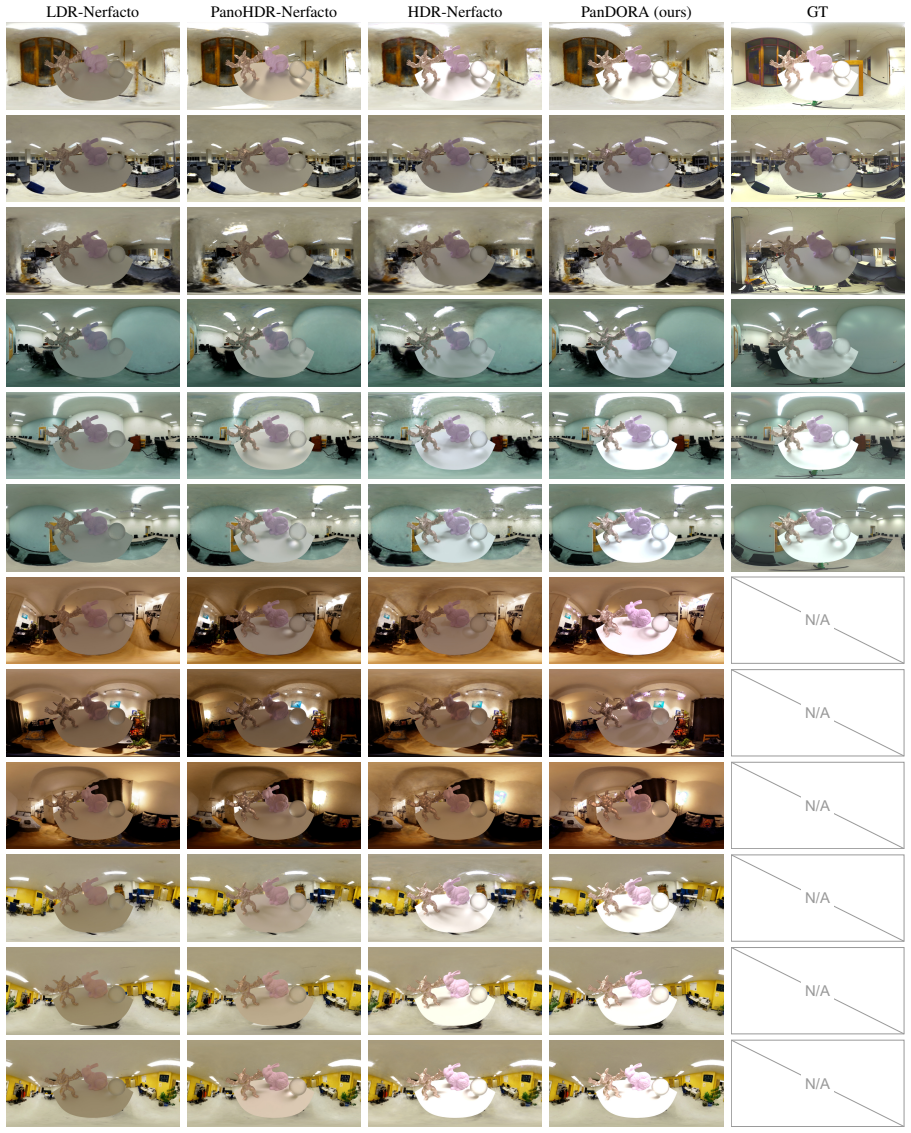
PanDORA captures panoramic dual-observer radiance by mounting two 360-degree cameras on a monopod to record videos at different exposures at the same time. A two-stage NeRF-based algorithm with a novel self-calibrating pipeline processes the videos to estimate parameters and generate non-saturated HDR radiance fields. When tested on a new dataset of real indoor environments that includes HDR ground truth lighting, the approach reconstructs peak intensities with higher fidelity than earlier methods for use in downstream rendering.
What carries the argument
Two-stage NeRF-based algorithm with self-calibrating pipeline that processes dual-exposure 360 videos to estimate camera parameters and produce HDR radiance fields.
If this is right
- Enables capture of HDR radiance maps without the time required for exposure bracketing.
- Delivers radiance fields that preserve the intensity of indoor light sources for image-based lighting.
- Supports scalable acquisition of real-world lighting data through portable hardware and video input.
- Improves fidelity for downstream rendering tasks that rely on accurate peak intensities.
Where Pith is reading between the lines
- The monopod-mounted dual-camera setup could simplify data collection for users without access to specialized lighting rigs.
- Self-calibration within the pipeline might reduce dependence on external calibration targets in other radiance capture workflows.
- Extension to mildly dynamic scenes could be tested by holding the monopod still while processing longer video sequences.
Load-bearing premise
The dual-exposure videos from the two 360 cameras mounted on a monopod provide sufficient overlapping information and dynamic range coverage for the self-calibrating two-stage NeRF pipeline to produce accurate non-saturated HDR radiance without major artifacts or calibration failures in typical indoor scenes.
What would settle it
On the new indoor HDR ground truth dataset, PanDORA produces visible saturation artifacts in bright regions or fails to match or exceed prior methods in peak intensity accuracy.
Figures




read the original abstract
Most novel view synthesis methods -- including Neural Radiance Fields (NeRF) -- struggle to capture the high dynamic range (HDR) radiance required for realistic image-based lighting (IBL). This limitation stems from a reliance on low dynamic range (LDR) imagery, which fails to capture the intensity of light sources found in indoor environments. While exposure bracketing can recover this range, it is often too slow for practical, large-scale acquisition. In this work, we introduce PanDORA: PANoramic Dual-Observer Radiance Acquisition, a system specifically designed for the fast and affordable capture of high-quality HDR radiance maps for IBL. Our approach utilizes two 360{\deg} cameras mounted on a portable monopod to simultaneously record videos at different exposures. These videos are processed by our proposed two-stage NeRF-based algorithm featuring a novel self-calibrating pipeline to estimate camera parameters. This pipeline produces non-saturated HDR radiance fields that accurately capture the radiance of a scene. When evaluated on a new dataset of real indoor environments featuring HDR ground truth lighting, PanDORA demonstrates superior fidelity in reconstructing the peak intensities necessary for downstream rendering tasks, providing a scalable and efficient solution for capturing real-world IBLs.
Editorial analysis
A structured set of objections, weighed in public.
Referee Report
Summary. The paper introduces PanDORA, a capture system that mounts two 360° cameras on a monopod to record simultaneous dual-exposure videos of indoor scenes. These videos are fed into a two-stage NeRF pipeline that includes a novel self-calibrating stage to recover camera intrinsics, relative pose, and exposure ratio, ultimately producing non-saturated HDR radiance fields suitable for image-based lighting. The authors release a new real-world indoor dataset with HDR ground-truth lighting and claim that PanDORA achieves superior fidelity on peak intensities compared with prior methods.
Significance. If the self-calibration recovers absolute radiance without scale ambiguity, the method would provide a practical, bracket-free alternative to existing HDR acquisition pipelines for IBL, directly addressing the dynamic-range limitations of standard NeRF pipelines in indoor environments. The dual-observer hardware and two-stage formulation constitute an engineering contribution whose value depends on whether the recovered radiance values are metrically accurate rather than merely plausible in relative terms.
major comments (2)
- [Method (self-calibrating pipeline)] The central claim that the pipeline recovers accurate non-saturated peak intensities rests on the self-calibrating stage jointly solving for the unknown exposure ratio. No external radiometric anchor (e.g., a calibrated reference or neutral-density filter) is described; if the ratio remains a free parameter, a global scale ambiguity persists and downstream IBL rendering that depends on absolute radiance becomes unreliable. This issue is load-bearing for the fidelity claim.
- [Abstract and Evaluation] The abstract states superior performance on peak intensities on the new HDR-ground-truth dataset, yet the provided text supplies neither quantitative metrics (PSNR, relative error on peaks, etc.), nor the precise loss terms, nor the dataset capture protocol. Without these, the superiority assertion cannot be verified and the evaluation section must be examined for proper controls.
minor comments (2)
- [Acquisition setup] Clarify whether the two 360° videos are assumed to have sufficient overlap for reliable pose and exposure-ratio estimation in typical indoor scenes; a failure case analysis would strengthen the practical claims.
- [Method] Notation for the two radiance fields and the exposure-ratio variable should be introduced explicitly with symbols rather than descriptive prose only.
Simulated Author's Rebuttal
We thank the referee for the detailed and constructive report. Below we respond point-by-point to the two major comments, providing clarifications drawn directly from the manuscript while indicating where revisions will strengthen the presentation.
read point-by-point responses
-
Referee: [Method (self-calibrating pipeline)] The central claim that the pipeline recovers accurate non-saturated peak intensities rests on the self-calibrating stage jointly solving for the unknown exposure ratio. No external radiometric anchor (e.g., a calibrated reference or neutral-density filter) is described; if the ratio remains a free parameter, a global scale ambiguity persists and downstream IBL rendering that depends on absolute radiance becomes unreliable. This issue is load-bearing for the fidelity claim.
Authors: The self-calibrating stage jointly optimizes the exposure ratio together with camera intrinsics, relative pose, and the radiance field by minimizing photometric error across the two simultaneously recorded videos. Because one camera operates at a short exposure chosen to avoid saturation on bright sources, the observed pixel values in that video directly constrain the peak radiance values; the long-exposure video supplies the complementary low-intensity information. The dual-observer geometry therefore fixes the relative scale between the two exposures without requiring an external radiometric reference. The resulting radiance field is expressed in units consistent with the sensor response and is shown to match ground-truth peak intensities on the released dataset. We will add an explicit paragraph in Section 3.2 discussing the scale properties and the role of the short-exposure constraint. revision: partial
-
Referee: [Abstract and Evaluation] The abstract states superior performance on peak intensities on the new HDR-ground-truth dataset, yet the provided text supplies neither quantitative metrics (PSNR, relative error on peaks, etc.), nor the precise loss terms, nor the dataset capture protocol. Without these, the superiority assertion cannot be verified and the evaluation section must be examined for proper controls.
Authors: The Experiments section (Section 4) of the full manuscript reports PSNR and peak-intensity relative-error metrics, tabulates the loss terms used in each stage of the pipeline, and details the capture protocol together with the HDR ground-truth acquisition procedure. The abstract is intentionally concise. To ensure verifiability, we will expand the evaluation section with additional ablation controls on the self-calibration stage and make the quantitative tables and dataset protocol more prominent. revision: yes
Circularity Check
No circularity detected; derivation is self-contained engineering pipeline
full rationale
The provided abstract and description introduce PanDORA as a two-stage NeRF pipeline with self-calibration for dual-exposure 360° video, but contain no equations, derivations, or self-citations that reduce any claimed output (e.g., HDR radiance fields or peak intensities) to fitted inputs by construction. No load-bearing steps match the enumerated circularity patterns; the method is presented as an independent algorithmic contribution evaluated on external ground-truth data. This is the common honest case of a non-circular engineering paper.
Axiom & Free-Parameter Ledger
axioms (1)
- domain assumption NeRF models can be adapted to fuse dual-exposure 360 video into non-saturated HDR radiance fields via a self-calibrating pipeline
Reference graph
Works this paper leans on
-
[1]
The plenoptic function and the elements of early vision , Figure 8
Edward H Adelson, James R Bergen, et al. The plenoptic function and the elements of early vision , Figure 8. Illustration of failure cases. When a scene contains small, yet very powerful light sources such as spotlights (1st row), a perfect alignment between the well-exposed and fast-exposed sequences is required. Otherwise, even the smallest error is the...
work page 1991
-
[2]
Barron, Ben Mildenhall, Matthew Tancik, Peter Hedman, Ricardo Martin-Brualla, and Pratul P
Jonathan T. Barron, Ben Mildenhall, Matthew Tancik, Peter Hedman, Ricardo Martin-Brualla, and Pratul P. Srinivasan. Mip-nerf: A multiscale representation for anti-aliasing neural radiance fields. In Int. Conf. Com- put. Vis., 2021. 2
work page 2021
-
[3]
Barron, Ben Mildenhall, Dor Verbin, Pratul P
Jonathan T. Barron, Ben Mildenhall, Dor Verbin, Pratul P. Srinivasan, and Peter Hedman. Mip-nerf 360: Unbounded anti-aliased neural radiance fields. In IEEE Conf. Comput. Vis. Pattern Recog., 2022. 2
work page 2022
-
[4]
Tensorf: Tensorial radiance fields
Anpei Chen, Zexiang Xu, Andreas Geiger, Jingyi Yu, and Hao Su. Tensorf: Tensorial radiance fields. InEur. Conf. Comput. Vis., 2022. 2
work page 2022
-
[5]
Recovering high dynamic range radiance maps from photographs
Paul Debevec and Jitendra Malik. Recovering high dynamic range radiance maps from photographs. In SIGGRAPH Conf. Proc., 1997. 1, 2, 4, 5
work page 1997
-
[6]
8 Plenoxels: Radiance fields without neural networks
Sara Fridovich-Keil, Alex Yu, Matthew Tancik, Qin- hong Chen, Benjamin Recht, and Angjoo Kanazawa. 8 Plenoxels: Radiance fields without neural networks. In IEEE Conf. Comput. Vis. Pattern Recog., 2022. 2
work page 2022
-
[7]
Artifact-free high dy- namic range imaging
Orazio Gallo, Natasha Gelfandz, Wei-Chao Chen, Marius Tico, and Kari Pulli. Artifact-free high dy- namic range imaging. In 2009 IEEE International Conference on Computational Photography (ICCP) , pages 1–7, 2009. 2
work page 2009
-
[8]
Pulkit Gera, Mohammad Reza Karimi Dastjerdi, Charles Renaud, P. J. Narayanan, and Jean-Franc ¸ois Lalonde. Casual indoor HDR radiance capture from omnidirectional images. In Brit. Mach. Vis. Conf. ,
-
[9]
Omni-NeRF: neural radiance field from 360° image captures
Kai Gu, Thomas Maugey, Sebastian Knorr, and Chris- tine Guillemot. Omni-NeRF: neural radiance field from 360° image captures. In Int. Conf. Multimedia and Expo, 2022. 2
work page 2022
-
[10]
Comparison of single im- age hdr reconstruction methods—the caveats of qual- ity assessment
Param Hanji, Rafal Mantiuk, Gabriel Eilertsen, Saghi Hajisharif, and Jonas Unger. Comparison of single im- age hdr reconstruction methods—the caveats of qual- ity assessment. In SIGGRAPH Conf. Proc., 2022. 5
work page 2022
-
[11]
Hdr-nerf: High dynamic range neural radiance fields
Xin Huang, Qi Zhang, Feng Ying, Hongdong Li, Xuan Wang, and Qing Wang. Hdr-nerf: High dynamic range neural radiance fields. In IEEE Conf. Comput. Vis. Pattern Recog., 2022. 1, 2, 4, 5, 7
work page 2022
-
[12]
HDR-plenoxels: Self-calibrating high dy- namic range radiance fields
Kim Jun-Seong, Kim Yu-Ji, Moon Ye-Bin, and Tae- Hyun Oh. HDR-plenoxels: Self-calibrating high dy- namic range radiance fields. In Eur. Conf. Comput. Vis., 2022. 1, 2, 4
work page 2022
-
[13]
Deep high dynamic range imaging of dynamic scenes
Nima Khademi Kalantari and Ravi Ramamoorthi. Deep high dynamic range imaging of dynamic scenes. ACM Trans. Graph., 36(4), jul 2017. 2
work page 2017
-
[14]
3d gaussian splatting for real-time radiance field rendering
Bernhard Kerbl, Georgios Kopanas, Thomas Leimk¨uhler, and George Drettakis. 3d gaussian splatting for real-time radiance field rendering. ACM Trans. Graph., 42(4), 2023. 2
work page 2023
-
[15]
Alexander Kirillov, Eric Mintun, Nikhila Ravi, Hanzi Mao, Chloe Rolland, Laura Gustafson, Tete Xiao, Spencer Whitehead, Alexander C. Berg, Wan-Yen Lo, Piotr Doll ´ar, and Ross Girshick. Segment anything. arXiv:2304.02643, 2023. 3
work page internal anchor Pith review Pith/arXiv arXiv 2023
-
[16]
Deeplight: Learning illumination for uncon- strained mobile mixed reality
Chloe LeGendre, Wan-Chun Ma, Graham Fyffe, John Flynn, Laurent Charbonnel, Jay Busch, and Paul De- bevec. Deeplight: Learning illumination for uncon- strained mobile mixed reality. In IEEE Conf. Comput. Vis. Pattern Recog., 2019. 5
work page 2019
-
[17]
Barf: Bundle-adjusting neural ra- diance fields
Chen-Hsuan Lin, Wei-Chiu Ma, Antonio Torralba, and Simon Lucey. Barf: Bundle-adjusting neural ra- diance fields. In Int. Conf. Comput. Vis., 2021. 8
work page 2021
-
[18]
Rafal K. Mantiuk and Maryam Azimi. Pu21: A novel perceptually uniform encoding for adapting existing quality metrics for hdr. In 2021 Picture Coding Sym- posium (PCS), 2021. 5
work page 2021
-
[19]
Mantiuk, Dounia Hammou, and Param Hanji
Rafal K. Mantiuk, Dounia Hammou, and Param Hanji. Hdr-vdp-3: A multi-metric for predicting image dif- ferences, quality and contrast distortions in high dy- namic range and regular content, 2023. 5
work page 2023
-
[20]
Opensfm: Open source structure-from- motion pipeline
Mapillary. Opensfm: Open source structure-from- motion pipeline. https://opensfm.org , 2024. 5
work page 2024
-
[21]
F Landis Markley, Yang Cheng, John L Crassidis, and Yaakov Oshman. Averaging quaternions.J. Guidance, Control, and Dynamics, 30(4):1193–1197, 2007. 4
work page 2007
-
[22]
Nerf in the wild: Neural radiance fields for unconstrained photo collections
Ricardo Martin-Brualla, Noha Radwan, Mehdi SM Sajjadi, Jonathan T Barron, Alexey Dosovitskiy, and Daniel Duckworth. Nerf in the wild: Neural radiance fields for unconstrained photo collections. In IEEE Conf. Comput. Vis. Pattern Recog., 2021. 2
work page 2021
-
[23]
Ben Mildenhall, Peter Hedman, Ricardo Martin- Brualla, Pratul P. Srinivasan, and Jonathan T. Barron. Nerf in the dark: High dynamic range view synthesis from noisy raw images. In IEEE Conf. Comput. Vis. Pattern Recog., 2022. 1, 2
work page 2022
-
[24]
Srinivasan, Matthew Tancik, Jonathan T
Ben Mildenhall, Pratul P. Srinivasan, Matthew Tancik, Jonathan T. Barron, Ravi Ramamoorthi, and Ren Ng. Nerf: Representing scenes as neural radiance fields for view synthesis. In Eur. Conf. Comput. Vis., 2020. 1, 2, 4
work page 2020
-
[25]
Instant neural graphics primitives with a multiresolution hash encoding
Thomas M ¨uller, Alex Evans, Christoph Schied, and Alexander Keller. Instant neural graphics primitives with a multiresolution hash encoding. ACM Trans. Graph., 41(4), 2022. 2
work page 2022
-
[26]
Non-uniform sampling strategies for nerf on 360° images
Takashi Otonari, Satoshi Ikehata, and Kiyoharu Aizawa. Non-uniform sampling strategies for nerf on 360° images. In Brit. Mach. Vis. Conf., 2022. 2
work page 2022
-
[27]
Dynamic range improvement through mul- tiple exposures
Mark A Robertson, Sean Borman, and Robert L Stevenson. Dynamic range improvement through mul- tiple exposures. In IEEE Int. Conf. Image Process. , volume 3, pages 159–163. IEEE, 1999. 2
work page 1999
-
[28]
Adop: Approximate differentiable one-pixel point rendering
Darius R ¨uckert, Linus Franke, and Marc Stamminger. Adop: Approximate differentiable one-pixel point rendering. ACM Trans. Graph., 41(4):1–14, 2022. 2
work page 2022
-
[29]
Structure-from-motion revisited
Johannes Lutz Sch ¨onberger and Jan-Michael Frahm. Structure-from-motion revisited. In IEEE Conf. Com- put. Vis. Pattern Recog., 2016. 2, 3
work page 2016
-
[30]
Nerfstudio: A modular framework for neural radiance field development
Matthew Tancik, Ethan Weber, Evonne Ng, Ruilong Li, Brent Yi, Justin Kerr, Terrance Wang, Alexan- der Kristoffersen, Jake Austin, Kamyar Salahi, Ab- hik Ahuja, David McAllister, and Angjoo Kanazawa. Nerfstudio: A modular framework for neural radiance field development. In SIGGRAPH Conf. Proc., 2023. 2, 6, 7 9
work page 2023
-
[31]
Nerfstudio: A modular framework for neural radiance field development
Matthew Tancik, Ethan Weber, Evonne Ng, Ruilong Li, Brent Yi, Justin Kerr, Terrance Wang, Alexan- der Kristoffersen, Jake Austin, Kamyar Salahi, Ab- hik Ahuja, David McAllister, and Angjoo Kanazawa. Nerfstudio: A modular framework for neural radiance field development. In SIGGRAPH Conf. Proc., 2023. 5
work page 2023
-
[32]
Fast high dynamic range radiance fields for dynamic scenes
Guanjun Wu, Taoran Yi, Jiemin Fang, Wenyu Liu, and Xinggang Wang. Fast high dynamic range radiance fields for dynamic scenes. In Int. Conf. 3D Vis., 2024. 2
work page 2024
-
[33]
Vr-nerf: High-fidelity virtualized walkable spaces
Linning Xu, Vasu Agrawal, William Laney, Tony Gar- cia, Aayush Bansal, Changil Kim, Samuel Rota Bul `o, Lorenzo Porzi, Peter Kontschieder, Alja ˇz Bo ˇziˇc, Dahua Lin, Michael Zollh¨ofer, and Christian Richardt. Vr-nerf: High-fidelity virtualized walkable spaces. In SIGGRAPH Asia Conf. Proc., 2023. 3
work page 2023
-
[34]
Attention-guided network for ghost-free high dynamic range imaging
Qingsen Yan, Dong Gong, Qinfeng Shi, Anton van den Hengel, Chunhua Shen, Ian Reid, and Yan- ning Zhang. Attention-guided network for ghost-free high dynamic range imaging. In Proceedings of the IEEE/CVF Conference on Computer Vision and Pat- tern Recognition (CVPR), June 2019. 2
work page 2019
-
[35]
Luminance attentive net- works for HDR image and panorama reconstruction
Hanning Yu, Wentao Liu, Chengjiang Long, Bo Dong, Qin Zou, and Chunxia Xiao. Luminance attentive net- works for HDR image and panorama reconstruction. Comput. Graph. Forum, 2021. 3
work page 2021
-
[36]
Nerf++: Analyzing and improving neural radiance fields
Kai Zhang, Gernot Riegler, Noah Snavely, and Vladlen Koltun. Nerf++: Analyzing and improving neural radiance fields. CoRR, abs/2010.07492, 2020. 2, 5 10
discussion (0)
Sign in with ORCID, Apple, or X to comment. Anyone can read and Pith papers without signing in.