Explaining Graph Neural Networks for Node Similarity on Graphs
Pith reviewed 2026-05-23 22:58 UTC · model grok-4.3
The pith
Gradient-based explanations for GNN node similarities are actionable, consistent, and prunable unlike mutual information ones.
A machine-rendered reading of the paper's core claim, the machinery that carries it, and where it could break.
Core claim
When GNNs compute node similarities, gradient-based explanations exhibit three properties that mutual information explanations lack: they are actionable because choosing inputs based on the explanations produces predictable shifts in similarity scores; they are consistent because the effect of selecting certain inputs overlaps very little with the effect of discarding them; and they can be pruned significantly to yield sparse explanations that still retain their influence on the similarity scores.
What carries the argument
Gradient-based explanations (GB) versus mutual information explanations (MI) when applied to the input features or structure used by GNNs for node similarity scoring.
If this is right
- Selecting inputs according to gradient-based explanations produces predictable changes in node similarity scores.
- The effects of selecting versus discarding inputs according to gradient-based explanations overlap very little.
- Gradient-based explanations can be pruned to sparse versions that retain their effect on similarity scores.
- These properties distinguish gradient-based explanations from mutual information explanations for explainable similarity search on graphs.
Where Pith is reading between the lines
- If the consistency property holds across more settings, gradient-based explanations might support more reliable identification of which graph elements drive similarity decisions in deployed systems.
- The ability to prune explanations while preserving effect could reduce the cost of generating and inspecting explanations on very large graphs.
- The three properties might transfer to other GNN prediction tasks if the underlying computation of similarity scores shares the same gradient structure.
Load-bearing premise
That the two explanation approaches can be directly applied to GNN node similarity and that tests on popular graph benchmarks are enough to establish the three listed properties in general.
What would settle it
An experiment on one of the graph benchmarks in which selecting inputs according to gradient-based explanations fails to produce the expected predictable changes in similarity scores or in which the pruned sparse explanations lose their effect on the scores.
Figures


read the original abstract
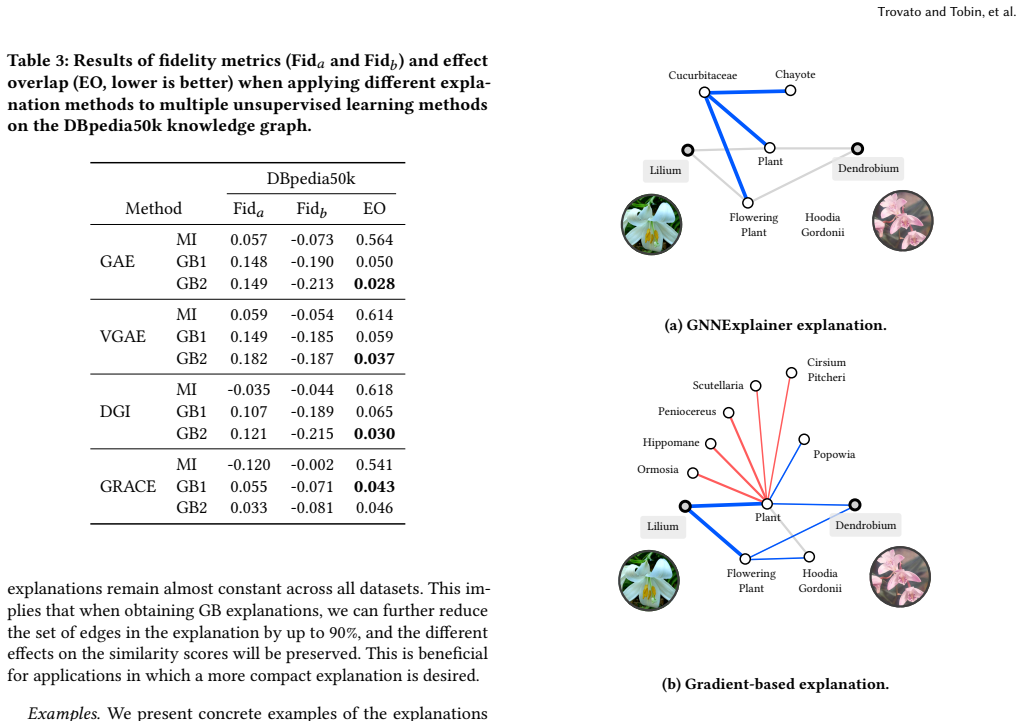
Similarity search is a fundamental task for exploiting information in various applications dealing with graph data, such as citation networks or knowledge graphs. While this task has been intensively approached from heuristics to graph embeddings and graph neural networks (GNNs), providing explanations for similarity has received less attention. In this work we are concerned with explainable similarity search over graphs, by investigating how GNN-based methods for computing node similarities can be augmented with explanations. Specifically, we evaluate the performance of two prominent approaches towards explanations in GNNs, based on the concepts of mutual information (MI), and gradient-based explanations (GB). We discuss their suitability and empirically validate the properties of their explanations over different popular graph benchmarks. We find that unlike MI explanations, gradient-based explanations have three desirable properties. First, they are actionable: selecting inputs depending on them results in predictable changes in similarity scores. Second, they are consistent: the effect of selecting certain inputs overlaps very little with the effect of discarding them. Third, they can be pruned significantly to obtain sparse explanations that retain the effect on similarity scores.
Editorial analysis
A structured set of objections, weighed in public.
Referee Report
Summary. The paper investigates explainable similarity search on graphs using GNNs. It compares two explanation approaches—mutual information (MI) and gradient-based (GB)—and empirically validates on graph benchmarks that, unlike MI explanations, GB explanations are actionable (selecting inputs yields predictable similarity score changes), consistent (low overlap between select and discard effects), and prunable to sparse explanations that retain the effect on similarity scores.
Significance. If the empirical distinctions hold under well-specified models, the work offers practical guidance on selecting explanation methods for GNN node similarity tasks, emphasizing reliability and sparsity advantages of gradient-based approaches in applications such as citation networks and knowledge graphs.
major comments (2)
- [Experimental setup] The experimental setup (methods and results sections) provides no description of the GNN architecture (message-passing type, number of layers, readout) or the node similarity ground truth (labels, embeddings, or other metric). This is load-bearing for the central claim, as the three properties attributed to GB explanations could be artifacts of the unspecified model or similarity definition rather than intrinsic to the explanation method.
- [Abstract] The abstract and results summary report no quantitative metrics, error bars, dataset names, or statistical details supporting the three properties. This weakens the ability to evaluate whether the data actually substantiate the distinctions between GB and MI explanations.
minor comments (1)
- Notation for similarity scores and explanation masks could be clarified with explicit definitions or pseudocode to aid reproducibility.
Simulated Author's Rebuttal
We thank the referee for the constructive feedback on the experimental details and presentation of results. We address each major comment below and will revise the manuscript to improve clarity and completeness.
read point-by-point responses
-
Referee: [Experimental setup] The experimental setup (methods and results sections) provides no description of the GNN architecture (message-passing type, number of layers, readout) or the node similarity ground truth (labels, embeddings, or other metric). This is load-bearing for the central claim, as the three properties attributed to GB explanations could be artifacts of the unspecified model or similarity definition rather than intrinsic to the explanation method.
Authors: We agree that explicit details on the GNN architecture and node similarity definition are essential for assessing whether the reported properties are intrinsic to the explanation methods. The manuscript evaluates the approaches empirically across graph benchmarks, but we acknowledge the current description in the methods and results sections is insufficiently detailed. In the revised manuscript, we will expand the Methods section to fully specify the GNN models (message-passing type, number of layers, readout) and clarify the node similarity ground truth (e.g., how it is computed from embeddings or labels). This addition will strengthen the paper without altering the empirical findings. revision: yes
-
Referee: [Abstract] The abstract and results summary report no quantitative metrics, error bars, dataset names, or statistical details supporting the three properties. This weakens the ability to evaluate whether the data actually substantiate the distinctions between GB and MI explanations.
Authors: We recognize that the abstract provides a qualitative summary and that adding quantitative support would improve evaluability. While abstracts are typically concise, we will revise the abstract to include specific dataset names from the popular graph benchmarks and key quantitative indicators of the three properties. We will also ensure the results section incorporates error bars and statistical details to more rigorously substantiate the distinctions between gradient-based and mutual information explanations. revision: yes
Circularity Check
No circularity: empirical comparison of existing explanation methods
full rationale
The paper evaluates two existing explanation approaches (MI and GB) on GNN node similarity via experiments on standard graph benchmarks. No derivations, fitted parameters renamed as predictions, or self-citation chains are present; the three claimed properties of GB explanations are established directly through empirical measurements of similarity score changes, overlap, and pruning effects. The analysis is self-contained against external benchmarks and does not reduce any result to its inputs by construction.
Axiom & Free-Parameter Ledger
Reference graph
Works this paper leans on
-
[1]
Alejandro Barredo Arrieta, Natalia Díaz Rodríguez, Javier Del Ser, Adrien Ben- netot, Siham Tabik, Alberto Barbado, Salvador García, Sergio Gil-Lopez, Daniel Molina, Richard Benjamins, Raja Chatila, and Francisco Herrera. 2020. Ex- plainable Artificial Intelligence (XAI): Concepts, taxonomies, opportunities and challenges toward responsible AI. Inf. Fusio...
-
[2]
Sören Auer, Christian Bizer, Georgi Kobilarov, Jens Lehmann, Richard Cyga- niak, and Zachary Ives. 2007. Dbpedia: A nucleus for a web of open data. In international semantic web conference . Springer, 722–735
work page 2007
-
[3]
Patrick Betz, Christian Meilicke, and Heiner Stuckenschmidt. 2022. Adversarial Explanations for Knowledge Graph Embeddings. In Proceedings of the Thirty- First International Joint Conference on Artificial Intelligence, IJCAI 2022, Vienna, Austria, 23-29 July 2022 , Luc De Raedt (Ed.). ijcai.org, 2820–2826. https://doi. org/10.24963/ijcai.2022/391
-
[4]
Aleksandar Bojchevski and Stephan Günnemann. 2018. Deep Gaussian Em- bedding of Graphs: Unsupervised Inductive Learning via Ranking. In 6th In- ternational Conference on Learning Representations, ICLR 2018, Vancouver, BC, Canada, April 30 - May 3, 2018, Conference Track Proceedings . OpenReview.net. https://openreview.net/forum?id=r1ZdKJ-0W
work page 2018
-
[5]
Sergey Brin. 1998. The PageRank citation ranking: bringing order to the web. Proceedings of ASIS, 1998 98 (1998), 161–172
work page 1998
-
[6]
Nadia Burkart and Marco F. Huber. 2021. A Survey on the Explainability of Supervised Machine Learning. J. Artif. Intell. Res. 70 (2021), 245–317. https: //doi.org/10.1613/jair.1.12228
-
[7]
Chandrahas, Tathagata Sengupta, Cibi Pragadeesh, and Partha Talukdar. 2020. Inducing Interpretability in Knowledge Graph Embeddings. In Proceedings of the 17th International Conference on Natural Language Processing (ICON) . NLP Association of India (NLPAI), Indian Institute of Technology Patna, Patna, India, 70–75. https://aclanthology.org/2020.icon-main.9
work page 2020
-
[8]
Michael Cochez, Petar Ristoski, Simone Paolo Ponzetto, and Heiko Paulheim
-
[9]
Global RDF Vector Space Embeddings. In The Semantic Web - ISWC 2017 - 16th International Semantic Web Conference, Vienna, Austria, October 21-25, 2017, Proceedings, Part I (Lecture Notes in Computer Science, Vol. 10587) , Claudia d’Amato, Miriam Fernández, Valentina A. M. Tamma, Freddy Lécué, Philippe Cudré-Mauroux, Juan F. Sequeda, Christoph Lange, and J...
-
[10]
Gabriele Corso, Luca Cavalleri, Dominique Beaini, Pietro Liò, and Petar Velick- ovic. 2020. Principal Neighbourhood Aggregation for Graph Nets. In Advances in Neural Information Processing Systems 33: Annual Conference on Neural In- formation Processing Systems 2020, NeurIPS 2020, December 6-12, 2020, virtual , Hugo Larochelle, Marc’Aurelio Ranzato, Raia ...
work page 2020
-
[11]
Thomas M Cover. 1999. Elements of information theory . John Wiley & Sons
work page 1999
-
[12]
Daniel Daza, Michael Cochez, and Paul Groth. 2021. Inductive Entity Repre- sentations from Text via Link Prediction. In WWW ’21: The Web Conference 2021, Virtual Event / Ljubljana, Slovenia, April 19-23, 2021 , Jure Leskovec, Marko Grobelnik, Marc Najork, Jie Tang, and Leila Zia (Eds.). ACM / IW3C2, 798–808. https://doi.org/10.1145/3442381.3450141
-
[13]
Yasha Ektefaie, George Dasoulas, Ayush Noori, Maha Farhat, and Marinka Zitnik
-
[14]
Multimodal learning with graphs. Nat. Mac. Intell. 5, 4 (2023), 340–350. https://doi.org/10.1038/s42256-023-00624-6
-
[15]
Fredo Erxleben, Michael Günther, Markus Krötzsch, Julian Mendez, and Denny Vrandecic. 2014. Introducing Wikidata to the Linked Data Web. In ISWC. 50–65
work page 2014
-
[16]
Charlie Frogner, Farzaneh Mirzazadeh, and Justin Solomon. 2019. Learning Embeddings into Entropic Wasserstein Spaces. In 7th International Conference on Learning Representations, ICLR 2019, New Orleans, LA, USA, May 6-9, 2019 . OpenReview.net. https://openreview.net/forum?id=rJg4J3CqFm
work page 2019
-
[17]
Cooper, Andreas Herzig, Fr ´ed´eric Maris & Julien Vianey (2018): Temporal Epistemic Gossip Problems
Mohamed H. Gad-Elrab, Daria Stepanova, Trung-Kien Tran, Heike Adel, and Gerhard Weikum. 2020. ExCut: Explainable Embedding-Based Clustering over Knowledge Graphs. InThe Semantic Web - ISWC 2020 - 19th International Semantic Web Conference, Athens, Greece, November 2-6, 2020, Proceedings, Part I (Lecture Notes in Computer Science, Vol. 12506) , Jeff Z. Pan...
-
[18]
Mikhail Galkin, Priyansh Trivedi, Gaurav Maheshwari, Ricardo Usbeck, and Jens Lehmann. 2020. Message Passing for Hyper-Relational Knowledge Graphs. In Proceedings of the 2020 Conference on Empirical Methods in Natural Language Processing, EMNLP 2020, Online, November 16-20, 2020 , Bonnie Webber, Trevor Cohn, Yulan He, and Yang Liu (Eds.). Association for ...
-
[19]
Difei Gao, Ke Li, Ruiping Wang, Shiguang Shan, and Xilin Chen. 2020. Multi- Modal Graph Neural Network for Joint Reasoning on Vision and Scene Text. In 2020 IEEE/CVF Conference on Computer Vision and Pattern Recognition, CVPR 2020, Seattle, W A, USA, June 13-19, 2020. Computer Vision Foundation / IEEE, 12743–12753. https://doi.org/10.1109/CVPR42600.2020.01276
-
[20]
Gerritse, Faegheh Hasibi, and Arjen P
Emma J. Gerritse, Faegheh Hasibi, and Arjen P. de Vries. 2020. Graph-Embedding Empowered Entity Retrieval. InAdvances in Information Retrieval - 42nd European Conference on IR Research, ECIR 2020, Lisbon, Portugal, April 14-17, 2020, Proceed- ings, Part I (Lecture Notes in Computer Science, Vol. 12035) , Joemon M. Jose, Emine Yilmaz, João Magalhães, Pablo...
-
[21]
Justin Gilmer, Samuel S. Schoenholz, Patrick F. Riley, Oriol Vinyals, and George E. Dahl. 2017. Neural Message Passing for Quantum Chemistry. In Proceedings of the 34th International Conference on Machine Learning, ICML 2017, Sydney, NSW, Australia, 6-11 August 2017 (Proceedings of Machine Learning Research, Vol. 70) , Doina Precup and Yee Whye Teh (Eds.)...
work page 2017
-
[22]
Aristides Gionis, Piotr Indyk, and Rajeev Motwani. 1999. Similarity Search in High Dimensions via Hashing. In VLDB’99, Proceedings of 25th Interna- tional Conference on Very Large Data Bases, September 7-10, 1999, Edinburgh, Scotland, UK , Malcolm P. Atkinson, Maria E. Orlowska, Patrick Valduriez, Stanley B. Zdonik, and Michael L. Brodie (Eds.). Morgan Ka...
work page 1999
-
[23]
Arthur Colombini Gusmão, Alvaro Henrique Chaim Correia, Glauber De Bona, and Fabio Gagliardi Cozman. 2018. Interpreting embedding models of knowledge bases: a pedagogical approach. arXiv preprint arXiv:1806.09504 (2018)
work page internal anchor Pith review Pith/arXiv arXiv 2018
-
[24]
Hamilton, Rex Ying, and Jure Leskovec
William L. Hamilton, Rex Ying, and Jure Leskovec. 2017. Representation Learning on Graphs: Methods and Applications. IEEE Data Eng. Bull. 40, 3 (2017), 52–74. http://sites.computer.org/debull/A17sept/p52.pdf
work page 2017
-
[25]
Taher H. Haveliwala. 2002. Topic-sensitive PageRank. In Proceedings of the Eleventh International World Wide Web Conference, WWW 2002, May 7-11, 2002, Honolulu, Hawaii, USA, David Lassner, David De Roure, and Arun Iyengar (Eds.). ACM, 517–526. https://doi.org/10.1145/511446.511513
-
[26]
Glen Jeh and Jennifer Widom. 2002. SimRank: a measure of structural-context similarity. In Proceedings of the Eighth ACM SIGKDD International Conference on Knowledge Discovery and Data Mining, July 23-26, 2002, Edmonton, Alberta, Canada. ACM, 538–543. https://doi.org/10.1145/775047.775126
-
[27]
Wei Ju, Zheng Fang, Yiyang Gu, Zequn Liu, Qingqing Long, Ziyue Qiao, Yifang Qin, Jianhao Shen, Fang Sun, Zhiping Xiao, Junwei Yang, Jingyang Yuan, Yusheng Zhao, Xiao Luo, and Ming Zhang. 2023. A Comprehensive Survey on Deep Graph Representation Learning. CoRR abs/2304.05055 (2023). https://doi.org/10.48550/ arXiv.2304.05055 arXiv:2304.05055
-
[28]
Nasrullah Khan, Zongmin Ma, Aman Ullah, and Kemal Polat. 2022. Similarity attributed knowledge graph embedding enhancement for item recommendation. Inf. Sci. 613 (2022), 69–95. https://doi.org/10.1016/j.ins.2022.08.124
-
[29]
Variational Graph Auto-Encoders
Thomas N. Kipf and Max Welling. 2016. Variational Graph Auto-Encoders.CoRR abs/1611.07308 (2016). arXiv:1611.07308 http://arxiv.org/abs/1611.07308
work page internal anchor Pith review Pith/arXiv arXiv 2016
-
[30]
Thomas N. Kipf and Max Welling. 2017. Semi-Supervised Classification with Graph Convolutional Networks. In 5th International Conference on Learning Representations, ICLR 2017, Toulon, France, April 24-26, 2017, Conference Track Proceedings. OpenReview.net. https://openreview.net/forum?id=SJU4ayYgl
work page 2017
-
[31]
Thomas Fel, Ivan Felipe, Drew Linsley, and Thomas Serre
Namkyeong Lee, Dongmin Hyun, Gyoung S. Na, Sungwon Kim, Junseok Lee, and Chanyoung Park. 2023. Conditional Graph Information Bottleneck for Molecular Relational Learning. CoRR abs/2305.01520 (2023). https://doi.org/10.48550/arXiv. 2305.01520 arXiv:2305.01520
work page internal anchor Pith review doi:10.48550/arxiv 2023
-
[32]
Xiao Liu, Fanjin Zhang, Zhenyu Hou, Li Mian, Zhaoyu Wang, Jing Zhang, and Jie Tang. 2023. Self-Supervised Learning: Generative or Contrastive. IEEE Trans. Knowl. Data Eng. 35, 1 (2023), 857–876. https://doi.org/10.1109/TKDE.2021. 3090866
-
[33]
Yixin Liu, Ming Jin, Shirui Pan, Chuan Zhou, Yu Zheng, Feng Xia, and Philip S. Yu. 2023. Graph Self-Supervised Learning: A Survey. IEEE Trans. Knowl. Data Eng. 35, 6 (2023), 5879–5900. https://doi.org/10.1109/TKDE.2022.3172903
-
[34]
Zhenghao Liu, Chenyan Xiong, Maosong Sun, and Zhiyuan Liu. 2019. Explore Entity Embedding Effectiveness in Entity Retrieval. In Chinese Computational Linguistics - 18th China National Conference, CCL 2019, Kunming, China, October 18-20, 2019, Proceedings (Lecture Notes in Computer Science, Vol. 11856) , Maosong Sun, Xuanjing Huang, Heng Ji, Zhiyuan Liu, a...
work page 2019
-
[35]
https://doi.org/10.1007/978-3-030-32381-3_9
-
[36]
ter Hoeve, Gabriele Tolomei, Maarten de Rijke, and Fabrizio Silvestri
Ana Lucic, Maartje A. ter Hoeve, Gabriele Tolomei, Maarten de Rijke, and Fabrizio Silvestri. 2022. CF-GNNExplainer: Counterfactual Explanations for Graph Neural Networks. In International Conference on Artificial Intelligence and Statistics, AISTATS 2022, 28-30 March 2022, Virtual Event (Proceedings of Machine Learning Research, Vol. 151), Gustau Camps-Va...
work page 2022
-
[37]
Dongsheng Luo, Wei Cheng, Dongkuan Xu, Wenchao Yu, Bo Zong, Haifeng Chen, and Xiang Zhang. 2020. Parameterized Explainer for Graph Neural Network. In Advances in Neural Information Processing Systems 33: Annual Conference on Neural Information Processing Systems 2020, NeurIPS 2020, December 6-12, 2020, virtual, Hugo Larochelle, Marc’Aurelio Ranzato, Raia ...
work page 2020
- [38]
-
[39]
Elan Markowitz, Keshav Balasubramanian, Mehrnoosh Mirtaheri, Murali An- navaram, Aram Galstyan, and Greg Ver Steeg. 2022. StATIK: Structure and Text for Inductive Knowledge Graph Completion. In Findings of the Associ- ation for Computational Linguistics: NAACL 2022, Seattle, W A, United States, July 10-15, 2022 , Marine Carpuat, Marie-Catherine de Marneff...
-
[40]
Haggai Maron, Heli Ben-Hamu, Hadar Serviansky, and Yaron Lipman. 2019. Provably Powerful Graph Networks. InAdvances in Neural Information Processing Systems 32: Annual Conference on Neural Information Processing Systems 2019, NeurIPS 2019, December 8-14, 2019, Vancouver, BC, Canada , Hanna M. Wallach, Hugo Larochelle, Alina Beygelzimer, Florence d’Alché-B...
work page 2019
-
[41]
Miller McPherson, Lynn Smith-Lovin, and James M Cook. 2001. Birds of a feather: Homophily in social networks. Annual review of sociology 27, 1 (2001), 415–444
work page 2001
-
[42]
Siqi Miao, Mia Liu, and Pan Li. 2022. Interpretable and Generalizable Graph Learning via Stochastic Attention Mechanism. In International Conference on Machine Learning, ICML 2022, 17-23 July 2022, Baltimore, Maryland, USA (Pro- ceedings of Machine Learning Research, Vol. 162) , Kamalika Chaudhuri, Stefanie Jegelka, Le Song, Csaba Szepesvári, Gang Niu, an...
work page 2022
-
[43]
Tim Miller. 2019. Explanation in artificial intelligence: Insights from the social sciences. Artif. Intell. 267 (2019), 1–38. https://doi.org/10.1016/j.artint.2018.07.007
-
[44]
Shane T Mueller, Robert R Hoffman, William Clancey, Abigail Emrey, and Gary Klein. 2019. Explanation in human-AI systems: A literature meta-review, synopsis of key ideas and publications, and bibliography for explainable AI.arXiv preprint arXiv:1902.01876 (2019)
work page internal anchor Pith review Pith/arXiv arXiv 2019
-
[45]
Galileo Namata, Ben London, Lise Getoor, Bert Huang, and U Edu. 2012. Query- driven active surveying for collective classification. In10th international workshop on mining and learning with graphs , Vol. 8. 1
work page 2012
-
[46]
Maximilian Nickel, Kevin Murphy, Volker Tresp, and Evgeniy Gabrilovich. 2016. A Review of Relational Machine Learning for Knowledge Graphs. Proc. IEEE 104, 1 (2016), 11–33. https://doi.org/10.1109/JPROC.2015.2483592
-
[47]
Natalya Fridman Noy, Yuqing Gao, Anshu Jain, Anant Narayanan, Alan Patterson, and Jamie Taylor. 2019. Industry-scale knowledge graphs: lessons and challenges. Commun. ACM 62, 8 (2019), 36–43. https://doi.org/10.1145/3331166
-
[48]
Zhen Peng, Wenbing Huang, Minnan Luo, Qinghua Zheng, Yu Rong, Tingyang Xu, and Junzhou Huang. 2020. Graph Representation Learning via Graphical Mutual Information Maximization. InWWW ’20: The Web Conference 2020, Taipei, Taiwan, April 20-24, 2020, Yennun Huang, Irwin King, Tie-Yan Liu, and Maarten van Steen (Eds.). ACM / IW3C2, 259–270. https://doi.org/10...
-
[49]
Kostylev, Bernardo Cuenca Grau, and Ian Horrocks
Alina Petrova, Egor V. Kostylev, Bernardo Cuenca Grau, and Ian Horrocks. 2019. Query-Based Entity Comparison in Knowledge Graphs Revisited. In The Seman- tic Web - ISWC 2019 - 18th International Semantic Web Conference , Vol. 11778. Springer, 558–575
work page 2019
-
[50]
Alina Petrova, Evgeny Sherkhonov, Bernardo Cuenca Grau, and Ian Horrocks
-
[51]
In The Semantic Web - ISWC 2017 , Vol
Entity Comparison in RDF Graphs. In The Semantic Web - ISWC 2017 , Vol. 10587. Springer, 526–541
work page 2017
-
[52]
Pouya Pezeshkpour, Yifan Tian, and Sameer Singh. 2019. Investigating Robust- ness and Interpretability of Link Prediction via Adversarial Modifications. In Proceedings of the 2019 Conference of the North American Chapter of the Associa- tion for Computational Linguistics: Human Language Technologies, NAACL-HLT 2019, Minneapolis, MN, USA, June 2-7, 2019, V...
-
[53]
Gabriëlle Ras, Marcel van Gerven, and Pim Haselager. 2018. Explanation meth- ods in deep learning: Users, values, concerns and challenges. Explainable and interpretable models in computer vision and machine learning (2018), 19–36
work page 2018
-
[54]
Marco Túlio Ribeiro, Sameer Singh, and Carlos Guestrin. 2016. "Why Should I Trust You?": Explaining the Predictions of Any Classifier. InProceedings of the 22nd ACM SIGKDD International Conference on Knowledge Discovery and Data Mining, San Francisco, CA, USA, August 13-17, 2016 , Balaji Krishnapuram, Mohak Shah, Alexander J. Smola, Charu C. Aggarwal, Dou...
-
[55]
Petar Ristoski and Heiko Paulheim. 2016. RDF2Vec: RDF Graph Embeddings for Data Mining. In The Semantic Web - ISWC 2016 - 15th International Semantic Web Conference, Kobe, Japan, October 17-21, 2016, Proceedings, Part I (Lecture Notes in Computer Science, Vol. 9981), Paul Groth, Elena Simperl, Alasdair J. G. Gray, Marta Sabou, Markus Krötzsch, Freddy Lécu...
-
[56]
Petar Ristoski, Jessica Rosati, Tommaso Di Noia, Renato De Leone, and Heiko Paulheim. 2019. RDF2Vec: RDF graph embeddings and their applications. Se- mantic Web 10, 4 (2019), 721–752. https://doi.org/10.3233/SW-180317
-
[57]
Andrea Rossi, Donatella Firmani, Paolo Merialdo, and Tommaso Teofili. 2022. Explaining Link Prediction Systems based on Knowledge Graph Embeddings. In SIGMOD ’22: International Conference on Management of Data, Philadelphia, PA, USA, June 12 - 17, 2022 , Zachary G. Ives, Angela Bonifati, and Amr El Abbadi (Eds.). ACM, 2062–2075. https://doi.org/10.1145/35...
-
[58]
Benedek Rozemberczki, Carl Allen, and Rik Sarkar. 2021. Multi-Scale attributed node embedding. J. Complex Networks 9, 2 (2021). https://doi.org/10.1093/ comnet/cnab014
work page 2021
-
[59]
Raeid Saqur and Karthik Narasimhan. 2020. Multimodal Graph Networks for Compositional Generalization in Visual Question Answering. In Advances in Neural Information Processing Systems 33: Annual Conference on Neural In- formation Processing Systems 2020, NeurIPS 2020, December 6-12, 2020, virtual , Hugo Larochelle, Marc’Aurelio Ranzato, Raia Hadsell, Mari...
work page 2020
-
[60]
Kipf, Peter Bloem, Rianne van den Berg, Ivan Titov, and Max Welling
Michael Sejr Schlichtkrull, Thomas N. Kipf, Peter Bloem, Rianne van den Berg, Ivan Titov, and Max Welling. 2018. Modeling Relational Data with Graph Con- volutional Networks. In The Semantic Web - 15th International Conference, ESWC 2018, Heraklion, Crete, Greece, June 3-7, 2018, Proceedings (Lecture Notes in Com- puter Science, Vol. 10843), Aldo Gangemi,...
-
[61]
Grad-CAM: Visual explanations from deep networks via gradient-based localization
Ramprasaath R. Selvaraju, Michael Cogswell, Abhishek Das, Ramakrishna Vedan- tam, Devi Parikh, and Dhruv Batra. 2017. Grad-CAM: Visual Explanations from Deep Networks via Gradient-Based Localization. InIEEE International Conference on Computer Vision, ICCV 2017, Venice, Italy, October 22-29, 2017 . IEEE Computer Society, 618–626. https://doi.org/10.1109/I...
-
[62]
Prithviraj Sen, Galileo Namata, Mustafa Bilgic, Lise Getoor, Brian Gallagher, and Tina Eliassi-Rad. 2008. Collective Classification in Network Data. AI Mag. 29, 3 (2008), 93–106. https://doi.org/10.1609/aimag.v29i3.2157
-
[63]
Baoxu Shi and Tim Weninger. 2018. Open-World Knowledge Graph Completion. In Proceedings of the Thirty-Second AAAI Conference on Artificial Intelligence, (AAAI-18), the 30th innovative Applications of Artificial Intelligence (IAAI-18), and the 8th AAAI Symposium on Educational Advances in Artificial Intelligence (EAAI-18), New Orleans, Louisiana, USA, Febr...
work page 2018
-
[64]
Yuxuan Shi, Gong Cheng, Trung-Kien Tran, Jie Tang, and Evgeny Kharlamov
-
[65]
In Proceedings of the Thirtieth International Joint Conference on Artificial Intelligence, IJCAI
Keyword-Based Knowledge Graph Exploration Based on Quadratic Group Steiner Trees. In Proceedings of the Thirtieth International Joint Conference on Artificial Intelligence, IJCAI. 1555–1562
-
[66]
Larissa Capobianco Shimomura, Rafael Seidi Oyamada, Marcos R. Vieira, and Daniel S. Kaster. 2021. A survey on graph-based methods for similarity searches in metric spaces. Inf. Syst. 95 (2021), 101507. https://doi.org/10.1016/j.is.2020.101507
-
[67]
Avanti Shrikumar, Peyton Greenside, and Anshul Kundaje. 2017. Learning Important Features Through Propagating Activation Differences. In Proceedings of the 34th International Conference on Machine Learning (Proceedings of Machine Learning Research, Vol. 70), Doina Precup and Yee Whye Teh (Eds.). PMLR, 3145–
work page 2017
-
[68]
https://proceedings.mlr.press/v70/shrikumar17a.html
-
[69]
Karen Simonyan, Andrea Vedaldi, and Andrew Zisserman. 2014. Deep Inside Convolutional Networks: Visualising Image Classification Models and Saliency Maps. In 2nd International Conference on Learning Representations, ICLR 2014, Banff, AB, Canada, April 14-16, 2014, Workshop Track Proceedings , Yoshua Bengio and Yann LeCun (Eds.). http://arxiv.org/abs/1312.6034
work page internal anchor Pith review Pith/arXiv arXiv 2014
-
[70]
Striving for Simplicity: The All Convolutional Net
Jost Tobias Springenberg, Alexey Dosovitskiy, Thomas Brox, and Martin A. Riedmiller. 2015. Striving for Simplicity: The All Convolutional Net. In 3rd International Conference on Learning Representations, ICLR 2015, San Diego, CA, USA, May 7-9, 2015, Workshop Track Proceedings, Yoshua Bengio and Yann LeCun (Eds.). http://arxiv.org/abs/1412.6806
work page internal anchor Pith review Pith/arXiv arXiv 2015
-
[71]
Fan-Yun Sun, Jordan Hoffmann, Vikas Verma, and Jian Tang. 2020. InfoGraph: Unsupervised and Semi-supervised Graph-Level Representation Learning via Mutual Information Maximization. In 8th International Conference on Learning Representations, ICLR 2020, Addis Ababa, Ethiopia, April 26-30, 2020 . OpenRe- view.net. https://openreview.net/forum?id=r1lfF2NYvH
work page 2020
-
[72]
Yizhou Sun, Jiawei Han, Xifeng Yan, Philip S. Yu, and Tianyi Wu. 2011. PathSim: Meta Path-Based Top-K Similarity Search in Heterogeneous Information Net- works. Proc. VLDB Endow. 4, 11 (2011), 992–1003. http://www.vldb.org/pvldb/ vol4/p992-sun.pdf
work page 2011
-
[73]
Mukund Sundararajan, Ankur Taly, and Qiqi Yan. 2017. Axiomatic Attribution for Deep Networks. InProceedings of the 34th International Conference on Machine Learning, ICML 2017, Sydney, NSW, Australia, 6-11 August 2017 (Proceedings of Machine Learning Research, Vol. 70) , Doina Precup and Yee Whye Teh (Eds.). PMLR, 3319–3328. http://proceedings.mlr.press/v...
work page 2017
-
[74]
Jie Tang, Jimeng Sun, Chi Wang, and Zi Yang. 2009. Social influence analysis in large-scale networks. In Proceedings of the 15th ACM SIGKDD International Conference on Knowledge Discovery and Data Mining, Paris, France, June 28 - July 1, 2009 , John F. Elder IV, Françoise Fogelman-Soulié, Peter A. Flach, and Mohammed Javeed Zaki (Eds.). ACM, 807–816. http...
-
[75]
Dyer, Rémi Munos, Petar Velickovic, and Michal Valko
Shantanu Thakoor, Corentin Tallec, Mohammad Gheshlaghi Azar, Mehdi Azabou, Eva L. Dyer, Rémi Munos, Petar Velickovic, and Michal Valko. 2022. Large-Scale Representation Learning on Graphs via Bootstrapping. InThe Tenth International Conference on Learning Representations, ICLR 2022, Virtual Event, April 25-29, 2022. OpenReview.net. https://openreview.net/...
work page 2022
-
[76]
Hamilton, Pietro Liò, Yoshua Bengio, and R
Petar Velickovic, William Fedus, William L. Hamilton, Pietro Liò, Yoshua Bengio, and R. Devon Hjelm. 2019. Deep Graph Infomax. In 7th International Conference on Learning Representations, ICLR 2019, New Orleans, LA, USA, May 6-9, 2019 . OpenReview.net. https://openreview.net/forum?id=rklz9iAcKQ
work page 2019
-
[77]
Chun Wang, Shirui Pan, Guodong Long, Xingquan Zhu, and Jing Jiang. 2017. MGAE: Marginalized Graph Autoencoder for Graph Clustering. InProceedings of the 2017 ACM on Conference on Information and Knowledge Management, CIKM 2017, Singapore, November 06 - 10, 2017 , Ee-Peng Lim, Marianne Winslett, Mark Sanderson, Ada Wai-Chee Fu, Jimeng Sun, J. Shane Culpepp...
-
[78]
Quan Wang, Zhendong Mao, Bin Wang, and Li Guo. 2017. Knowledge Graph Embedding: A Survey of Approaches and Applications. IEEE Trans. Knowl. Data Eng. 29, 12 (2017), 2724–2743. https://doi.org/10.1109/TKDE.2017.2754499
-
[79]
Xiang Wang, Ying-Xin Wu, An Zhang, Xiangnan He, and Tat-Seng Chua. 2021. Towards Multi-Grained Explainability for Graph Neural Networks. In Advances in Neural Information Processing Systems 34: Annual Conference on Neural In- formation Processing Systems 2021, NeurIPS 2021, December 6-14, 2021, virtual , Marc’Aurelio Ranzato, Alina Beygelzimer, Yann N. Da...
work page 2021
- [80]
discussion (0)
Sign in with ORCID, Apple, or X to comment. Anyone can read and Pith papers without signing in.