True and apparent motion of optomechanical resonators, with applications to feedback cooling of gravitational wave detector test masses
Pith reviewed 2026-05-23 21:58 UTC · model grok-4.3
The pith
Feedback cooling of gravitational wave test masses can reach occupation numbers below one quantum.
A machine-rendered reading of the paper's core claim, the machinery that carries it, and where it could break.
Core claim
The true test mass motion, when accounting for feedback and noise in the two-photon formalism, permits occupation numbers below 1 in gravitational wave interferometers for the oscillator definition commonly used in the literature, over a frequency range comparable to the bandwidth of the trapped and cooled oscillator.
What carries the argument
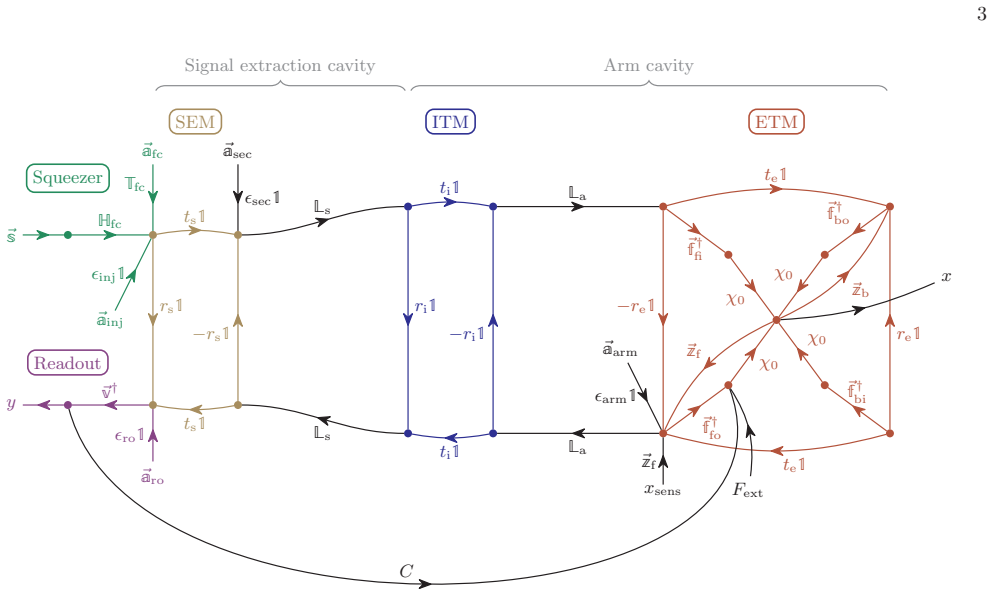
An extension of the two-photon formalism that decomposes the quantum-mechanical noise of the light field into contributions affecting true and apparent motion under feedback control.
If this is right
- Occupation numbers below 1 become achievable in LIGO A+, LIGO Voyager, Cosmic Explorer, and CE Voyager.
- Physically motivated parameters guide the choice of optimal squeezed state and feedback configuration for minimal fluctuations.
- Multi-degree-of-freedom test-mass systems can be meaningfully compared to single degree-of-freedom oscillators.
- Several technical issues arise in cooling experiments with gravitational-wave detectors that must be addressed.
Where Pith is reading between the lines
- Reaching these occupation levels could allow quantum-limited performance in macroscopic mechanical systems.
- Future detector designs might incorporate this formalism to push cooling limits further.
- Similar analysis could apply to other optomechanical setups beyond gravitational wave detectors.
Load-bearing premise
The two-photon formalism and the selected single-oscillator definition together fully capture the effective dynamics and noise coupling once feedback is applied to the multi-degree-of-freedom system.
What would settle it
A direct measurement of the test mass occupation number exceeding 1 across the relevant frequency band in a feedback-cooled gravitational wave detector would contradict the finding.
Figures


read the original abstract
Modern optomechanical systems employ increasingly sophisticated quantum-mechanical states of light to probe and manipulate mechanical motion. Squeezed states are now used routinely to enhance the sensitivity of gravitational-wave interferometers to small external forces, and they are also used in feedback-based trapping and damping experiments on the same interferometers to enhance the achievable cooling of fluctuations in the differential test mass mode (arXiv:2102.12665). In this latter context, an accurate accounting of the true test mass motion, incorporating all sources of loss, the effect of feedback control, and the influence of classical force and sensing noises, is paramount. We work within the two-photon formalism to provide such an accounting, which extends a previously described decomposition of the quantum-mechanical noise of the light field (arxiv:2105.12052). This decomposition provides insight, rooted in physically motivated parameters, into the optimal squeezed state and feedback control configuration that should be employed to achieve the lowest fluctuations. We apply this formalism to feedback damping experiments in current and possible future gravitational-wave interferometers -- LIGO A+, LIGO Voyager, Cosmic Explorer (CE), and CE Voyager -- and discuss how these multi-degree-of-freedom systems might be compared to a single degree-of-freedom oscillator. We find that, for the oscillator definition used most commonly in the literature so far, occupation numbers below 1 are possible in these interferometers over a frequency range comparable to the bandwidth of the trapped and cooled oscillator. We also discuss several technical issues in cooling experiments with gravitational-wave detectors
Editorial analysis
A structured set of objections, weighed in public.
Referee Report
Summary. The manuscript extends the authors' prior two-photon formalism (arXiv:2105.12052) for decomposing quantum noise in optomechanical systems to explicitly incorporate optical losses and feedback control. It applies the extended framework to feedback damping of test-mass motion in current and future gravitational-wave interferometers (LIGO A+, LIGO Voyager, Cosmic Explorer, CE Voyager), discusses the mapping of these multi-DOF systems onto the single-oscillator definition most common in the literature, and reports that thermal occupation numbers below 1 remain achievable over a frequency interval comparable to the bandwidth of the cooled oscillator.
Significance. If the single-oscillator reduction is shown to be faithful, the work supplies a parameter-motivated route to optimizing squeezed-light and feedback configurations for sub-quantum-limited cooling in multi-mode GW detectors and quantifies the technical issues that must be addressed when comparing such systems to idealized single-DOF oscillators.
major comments (2)
- [Applications section] Applications section: the headline result (occupation numbers <1 over a bandwidth comparable to the cooled oscillator) is obtained by reducing the closed-loop, multi-DOF test-mass system to the standard single-oscillator definition. No explicit numerical check is supplied that residual cross-talk between longitudinal/angular modes or differential/common modes, mediated by the shared feedback loop and sensing noises, remains below the claimed noise floor across the quoted frequency range.
- [Two-photon formalism extension] Two-photon formalism extension: the new occupation-number spectra are computed entirely within the extended decomposition of arXiv:2105.12052 rather than against independent external benchmarks or full multi-mode simulations; this makes the absence of an explicit validation of the neglected channels load-bearing for the central claim.
minor comments (1)
- [Applications section] The precise mathematical definition of the single-oscillator mapping (including which quadratures are retained and which are projected out) should be stated explicitly before the numerical results are presented.
Simulated Author's Rebuttal
We thank the referee for their careful review and constructive feedback on our manuscript. We address each major comment below and propose revisions to strengthen the presentation of the multi-DOF reduction and the validation of the extended formalism.
read point-by-point responses
-
Referee: [Applications section] Applications section: the headline result (occupation numbers <1 over a bandwidth comparable to the cooled oscillator) is obtained by reducing the closed-loop, multi-DOF test-mass system to the standard single-oscillator definition. No explicit numerical check is supplied that residual cross-talk between longitudinal/angular modes or differential/common modes, mediated by the shared feedback loop and sensing noises, remains below the claimed noise floor across the quoted frequency range.
Authors: We agree that an explicit numerical check of residual cross-talk would strengthen the central claim. The manuscript discusses the mapping of the multi-DOF system onto the single-oscillator definition via projection of the sensing and feedback noises, but does not include a dedicated numerical validation across the quoted band. In the revised version we will add a new subsection (or appendix) with numerical estimates for LIGO A+, Voyager, CE and CE Voyager, showing that cross-talk contributions from angular/longitudinal and differential/common couplings remain below the reported occupation-number floor over the relevant frequency interval. This will be computed using the same two-photon noise decomposition already employed in the paper. revision: yes
-
Referee: [Two-photon formalism extension] Two-photon formalism extension: the new occupation-number spectra are computed entirely within the extended decomposition of arXiv:2105.12052 rather than against independent external benchmarks or full multi-mode simulations; this makes the absence of an explicit validation of the neglected channels load-bearing for the central claim.
Authors: The extended decomposition is obtained by direct substitution of the lossy input-output relations and the feedback loop into the two-photon quadratures of the prior work; the resulting spectra are therefore exact within the linear, Gaussian, and single-mode-per-port approximations stated in the manuscript. We acknowledge that the absence of an external benchmark makes validation of the neglected channels (higher-order spatial-mode couplings, nonlinearities, and non-Gaussian effects) important. In revision we will (i) explicitly recover the lossless, open-loop limit and show agreement with the known single-oscillator result of arXiv:2105.12052, and (ii) add a short discussion quantifying why the neglected channels lie below the quantum-noise floor under the parameter regimes of current and future GW detectors. A full multi-mode time-domain simulation is beyond the scope of the present analytic framework, but the added limiting-case checks will address the load-bearing concern. revision: partial
Circularity Check
No significant circularity; derivation applies extended formalism to new configurations
full rationale
The paper extends the two-photon decomposition from arXiv:2105.12052 to account for noise, loss, feedback, and multi-DOF effects in GW interferometers, then applies the resulting framework to compute occupation numbers for LIGO A+, Voyager, CE, and CE Voyager. The headline result (occupation numbers <1 over a bandwidth comparable to the cooled oscillator) is obtained by explicit calculation under the most common single-oscillator definition in the literature, using physically motivated parameters. No quoted step reduces a prediction to a fitted input by construction, renames a known result, or makes the central claim depend solely on an unverified self-citation chain. The self-citation supplies the starting formalism but does not force the numerical findings; the work remains externally falsifiable via the stated detector parameters and the chosen oscillator definition. This is the normal case of a self-contained calculation built on prior independent work.
Axiom & Free-Parameter Ledger
Reference graph
Works this paper leans on
-
[1]
C” and then replacing all quantities suffixed with “om
Transfer functions Consider a general optomechanical system in which a mechanical degree of freedom has a true motion x, but also in which the optical fields are used to generate a measurement record y that contains information about the same motion. In this work we use the two-photon formalism [33, 34] where optical fields are described in terms of their...
-
[2]
Spectral densities Having written down the appropriate transfer functions relating the various input fields, displacements, and forces to the true motion x and measurement y, we are now in a position to write down the spectral densities Sxx and Syy. We first tackle the appearance of quantum noise in these quantities. As discussed in Ref. [ 2], the canonic...
-
[3]
C. Whittle et al. , Approaching the motional ground state of a 10-kg object, Science 372, 1333 (2021), arXiv:2102.12665 [quant-ph]
-
[4]
L. McCuller et al. , LIGO’s quantum response to squeezed states, Phys. Rev. D104, 062006 (2021), arXiv:2105.12052 [physics.ins-det]
-
[5]
C. M. Caves, Quantum Mechanical Noise in an Interfer- ometer, Phys. Rev. D 23, 1693 (1981)
work page 1981
-
[6]
Optomechanical Cooling of a Macroscopic Oscillator by Homodyne Feedback
S. Mancini, D. Vitali, and P. Tombesi, Optomechanical cooling of a macroscopic oscillator by homodyne feedback, Phys. Rev. Lett. 80, 688 (1998), arXiv:quant-ph/9802034
work page internal anchor Pith review Pith/arXiv arXiv 1998
-
[7]
Mirror quiescence and high-sensitivity position measurements with feedback
D. Vitali, S. Mancini, L. Ribichini, and P. Tombesi, Mirror quiescence and high sensitivity position measure- ments with feedback, Phys. Rev. A 65, 063803 (2002), arXiv:quant-ph/0111067
work page internal anchor Pith review Pith/arXiv arXiv 2002
- [8]
- [9]
-
[10]
C. Genes, D. Vitali, P. Tombesi, S. Gigan, and M. As- pelmeyer, Ground-state cooling of a micromechanical os- cillator: Comparing cold-damping and cavity-assisted cooling schemes, Phys. Rev. A 77, 033804 (2008), arXiv:0705.1728 [quant-ph]
work page internal anchor Pith review Pith/arXiv arXiv 2008
-
[11]
J. Milatz and J. Van Zolingen, The brownian motion of electrometers, Physica 19, 181 (1953)
work page 1953
-
[12]
P. G. Roll, R. Krotkov, and R. H. Dicke, The Equivalence of inertial and passive gravitational mass, Annals Phys. 26, 442 (1964)
work page 1964
-
[13]
Kittel, Elementary Statistical Physics (John Wiley & Sons, 1958)
C. Kittel, Elementary Statistical Physics (John Wiley & Sons, 1958)
work page 1958
-
[14]
A. Vinante et al. , Feedback Cooling of the Normal Modes of a Massive Electromechanical System to Sub- millikelvin Temperature, Phys. Rev. Lett. 101, 033601 (2008), arXiv:0803.0470 [quant-ph]
work page internal anchor Pith review Pith/arXiv arXiv 2008
-
[15]
B. Abbott et al. (LIGO Scientific), Observation of a kilogram-scale oscillator near its quantum ground state, New J. Phys. 11, 073032 (2009)
work page 2009
-
[16]
Towards quantum superpositions of a mirror
W. Marshall, C. Simon, R. Penrose, and D. Bouwmeester, Towards quantum superpositions of a mirror, Phys. Rev. Lett. 91, 130401 (2003), arXiv:quant-ph/0210001
work page internal anchor Pith review Pith/arXiv arXiv 2003
-
[17]
O. Romero-Isart, A. C. Pflanzer, F. Blaser, R. Kaltenbaek, N. Kiesel, M. Aspelmeyer, and J. I. Cirac, Large Quantum Superpositions and Interference of Massive Nanometer- Sized Objects, Phys. Rev. Lett. 107, 020405 (2011)
work page 2011
-
[18]
Tabletop experiments for quantum gravity: a user's manual
D. Carney, P. C. E. Stamp, and J. M. Taylor, Tabletop experiments for quantum gravity: a user’s manual, Class. Quant. Grav. 36, 034001 (2019), arXiv:1807.11494 [quant- ph]
work page internal anchor Pith review Pith/arXiv arXiv 2019
-
[19]
T. Krisnanda, G. Y. Tham, M. Paternostro, and T. Pa- terek, Observable quantum entanglement due to gravity, npj Quantum Inf. 6, 12 (2020), arXiv:1906.08808 [quant- ph]
- [20]
-
[21]
A. Datta and H. Miao, Signatures of the quantum nature of gravity in the differential motion of two masses, Quan- tum Sci. Technol. 6, 045014 (2021), arXiv:2104.04414 [gr-qc]
-
[22]
S. Bose, A. Mazumdar, G. W. Morley, H. Ulbricht, M. Toroˇ s, M. Paternostro, A. Geraci, P. Barker, M. S. Kim, and G. Milburn, Spin Entanglement Witness for Quantum Gravity, Phys. Rev. Lett. 119, 240401 (2017), arXiv:1707.06050 [quant-ph]
work page internal anchor Pith review Pith/arXiv arXiv 2017
-
[23]
C. Marletto and V. Vedral, Gravitationally-induced en- tanglement between two massive particles is sufficient 19 evidence of quantum effects in gravity, Phys. Rev. Lett. 119, 240402 (2017), arXiv:1707.06036 [quant-ph]
work page internal anchor Pith review Pith/arXiv arXiv 2017
-
[24]
H. J. Kimble, Y. Levin, A. B. Matsko, K. S. Thorne, and S. P. Vyatchanin, Conversion of conventional gravita- tional wave interferometers into QND interferometers by modifying their input and / or output optics, Phys. Rev. D 65, 022002 (2002), arXiv:gr-qc/0008026
work page internal anchor Pith review Pith/arXiv arXiv 2002
-
[25]
H. Miao, N. D. Smith, and M. Evans, Quantum limit for laser interferometric gravitational wave detectors from optical dissipation, Phys. Rev. X 9, 011053 (2019), arXiv:1807.11734 [quant-ph]
work page internal anchor Pith review Pith/arXiv arXiv 2019
-
[26]
A. Buonanno and Y.-b. Chen, Quantum noise in second generation, signal recycled laser interferometric gravita- tional wave detectors, Phys. Rev. D 64, 042006 (2001), arXiv:gr-qc/0102012
work page internal anchor Pith review Pith/arXiv arXiv 2001
-
[27]
L. Barsotti, J. Harms, and R. Schnabel, Squeezed vacuum states of light for gravitational wave detectors, Rept. Prog. Phys. 82, 016905 (2019)
work page 2019
-
[28]
First Long-Term Application of Squeezed States of Light in a Gravitational-Wave Observatory
H. Grote, K. Danzmann, K. L. Dooley, R. Schnabel, J. Slutsky, and H. Vahlbruch, First Long-Term Appli- cation of Squeezed States of Light in a Gravitational- Wave Observatory, Phys. Rev. Lett. 110, 181101 (2013), arXiv:1302.2188 [physics.ins-det]
work page internal anchor Pith review Pith/arXiv arXiv 2013
-
[29]
M. Tse et al., Quantum-Enhanced Advanced LIGO Detec- tors in the Era of Gravitational-Wave Astronomy, Phys. Rev. Lett. 123, 231107 (2019)
work page 2019
-
[30]
F. Acernese et al. (Virgo), Increasing the Astrophysical Reach of the Advanced Virgo Detector via the Application of Squeezed Vacuum States of Light, Phys. Rev. Lett.123, 231108 (2019)
work page 2019
-
[31]
D. Ganapathy et al. (LIGO O4 Detector), Broadband Quantum Enhancement of the LIGO Detectors with Frequency-Dependent Squeezing, Phys. Rev. X13, 041021 (2023)
work page 2023
-
[32]
J. Harms, Y.-b. Chen, S. Chelkowski, A. Franzen, H. Vahlbruch, K. Danzmann, and R. Schnabel, Squeezed input, optical spring, signal recycled gravitational wave detectors, Phys. Rev. D 68, 042001 (2003), arXiv:gr- qc/0303066
-
[33]
Miao, Exploring Macroscopic Quantum Mechanics in Optomechanical Devices (2012)
H. Miao, Exploring Macroscopic Quantum Mechanics in Optomechanical Devices (2012)
work page 2012
-
[34]
S. L. Danilishin and F. Y. Khalili, Quantum Measurement Theory in Gravitational-Wave Detectors, Living Rev. Rel. 15, 5 (2012), arXiv:1203.1706 [quant-ph]
work page internal anchor Pith review Pith/arXiv arXiv 2012
-
[35]
C. M. Caves and B. L. Schumaker, New formalism for two-photon quantum optics. 1. Quadrature phases and squeezed states, Phys. Rev. A 31, 3068 (1985)
work page 1985
-
[36]
B. L. Schumaker and C. M. Caves, New formalism for two-photon quantum optics. 2. Mathematical foundation and compact notation, Phys. Rev. A 31, 3093 (1985)
work page 1985
-
[37]
C. Whittle, L. McCuller, V. Sudhir, and M. Evans, Unifi- cation of Thermal and Quantum Noises in Gravitational- Wave Detectors, Phys. Rev. Lett. 130, 241401 (2023), arXiv:2301.00338 [astro-ph.IM]
-
[38]
J. Aasi et al. (LIGO Scientific), Advanced LIGO, Class. Quant. Grav. 32, 074001 (2015), arXiv:1411.4547 [gr-qc]
work page internal anchor Pith review Pith/arXiv arXiv 2015
-
[39]
Advanced Virgo: a 2nd generation interferometric gravitational wave detector
F. Acernese et al. (VIRGO), Advanced Virgo: a second- generation interferometric gravitational wave detector, Class. Quant. Grav. 32, 024001 (2015), arXiv:1408.3978 [gr-qc]
work page internal anchor Pith review Pith/arXiv arXiv 2015
-
[40]
A Horizon Study for Cosmic Explorer: Science, Observatories, and Community
M. Evans et al. , A Horizon Study for Cosmic Explorer: Science, Observatories, and Community, arXiV (2021), arXiv:2109.09882 [astro-ph.IM]
work page internal anchor Pith review Pith/arXiv arXiv 2021
-
[41]
ET Steering Committee, ET Design Report Update 2020 , Tech. Rep. ET-0007A-20 (Einstein Telescope, 2020)
work page 2020
-
[42]
B. P. Abbott et al. (LIGO Scientific), Calibration of the Advanced LIGO detectors for the discovery of the binary black-hole merger GW150914, Phys. Rev. D 95, 062003 (2017), arXiv:1602.03845 [gr-qc]
work page internal anchor Pith review Pith/arXiv arXiv 2017
-
[43]
Calibration Uncertainty for Advanced LIGO's First and Second Observing Runs
C. Cahillane et al. (LIGO Scientific), Calibration uncer- tainty for Advanced LIGO’s first and second observing runs, Phys. Rev. D 96, 102001 (2017), arXiv:1708.03023 [astro-ph.IM]
work page internal anchor Pith review Pith/arXiv arXiv 2017
- [44]
-
[45]
D. Ganapathy, V. Xu, W. Jia, C. Whittle, M. Tse, L. Bar- sotti, M. Evans, and L. McCuller, Probing squeezing for gravitational-wave detectors with an audio-band field, Phys. Rev. D 105, 122005 (2022), arXiv:2203.03849 [astro- ph.IM]
- [46]
-
[47]
M. Aspelmeyer, T. J. Kippenberg, and F. Marquardt, Cavity Optomechanics, Rev. Mod. Phys. 86, 1391 (2014), arXiv:1303.0733 [cond-mat.mes-hall]
work page internal anchor Pith review Pith/arXiv arXiv 2014
-
[48]
A. A. Clerk, M. H. Devoret, S. M. Girvin, F. Marquardt, and R. J. Schoelkopf, Introduction to quantum noise, measurement, and amplification, Rev. Mod. Phys. 82, 1155 (2010), arXiv:0810.4729 [cond-mat.mes-hall]
work page internal anchor Pith review Pith/arXiv arXiv 2010
- [49]
-
[50]
T. Corbitt, C. Wipf, T. Bodiya, D. Ottaway, D. Sigg, N. Smith, S. Whitcomb, and N. Mavalvala, Optical Dilu- tion and Feedback Cooling of a Gram-Scale Oscillator to 6.9 mK, Phys. Rev. Lett. 99, 160801 (2007)
work page 2007
- [51]
-
[52]
wield.control: linear algebra and control systems tools
-
[53]
S. M. Aston et al., Update on quadruple suspension design for Advanced LIGO, Class. Quant. Grav. 29, 235004 (2012)
work page 2012
- [54]
-
[55]
K. Izumi and D. Sigg, Advanced LIGO: length sensing and control in a dual recycled interferometric gravitational wave antenna, Class. Quant. Grav. 34, 015001 (2017)
work page 2017
-
[56]
G. D. Meadors, K. Kawabe, and K. Riles, Increasing LIGO sensitivity by feedforward subtraction of auxiliary length control noise, Class. Quant. Grav. 31, 105014 (2014), arXiv:1311.6835 [astro-ph.IM]
work page internal anchor Pith review Pith/arXiv arXiv 2014
-
[57]
Towards a first design of a Newtonian-noise cancellation system for Advanced LIGO
M. Coughlin, N. Mukund, J. Harms, J. Driggers, R. Ad- hikari, and S. Mitra, Towards a first design of a Newtonian- noise cancellation system for Advanced LIGO, Class. Quant. Grav. 33, 244001 (2016), arXiv:1606.01716 [gr-qc]
work page internal anchor Pith review Pith/arXiv arXiv 2016
-
[58]
Harms, Terrestrial gravity fluctuations, Living Rev
J. Harms, Terrestrial gravity fluctuations, Living Rev. Rel. 22, 6 (2019)
work page 2019
- [59]
-
[60]
F. Badaracco, J. Harms, and L. Rei, Joint optimization 20 of seismometer arrays for the cancellation of Newtonian noise from seismic body waves in the Einstein Telescope, Class. Quant. Grav. 41, 025013 (2024), arXiv:2310.05709 [astro-ph.IM]
- [61]
discussion (0)
Sign in with ORCID, Apple, or X to comment. Anyone can read and Pith papers without signing in.