Exploring the interplay between star formation efficiency and dust in regulating the UV luminosity of early systems in the JWST and ALMA era
Pith reviewed 2026-05-23 20:50 UTC · model grok-4.3
The pith
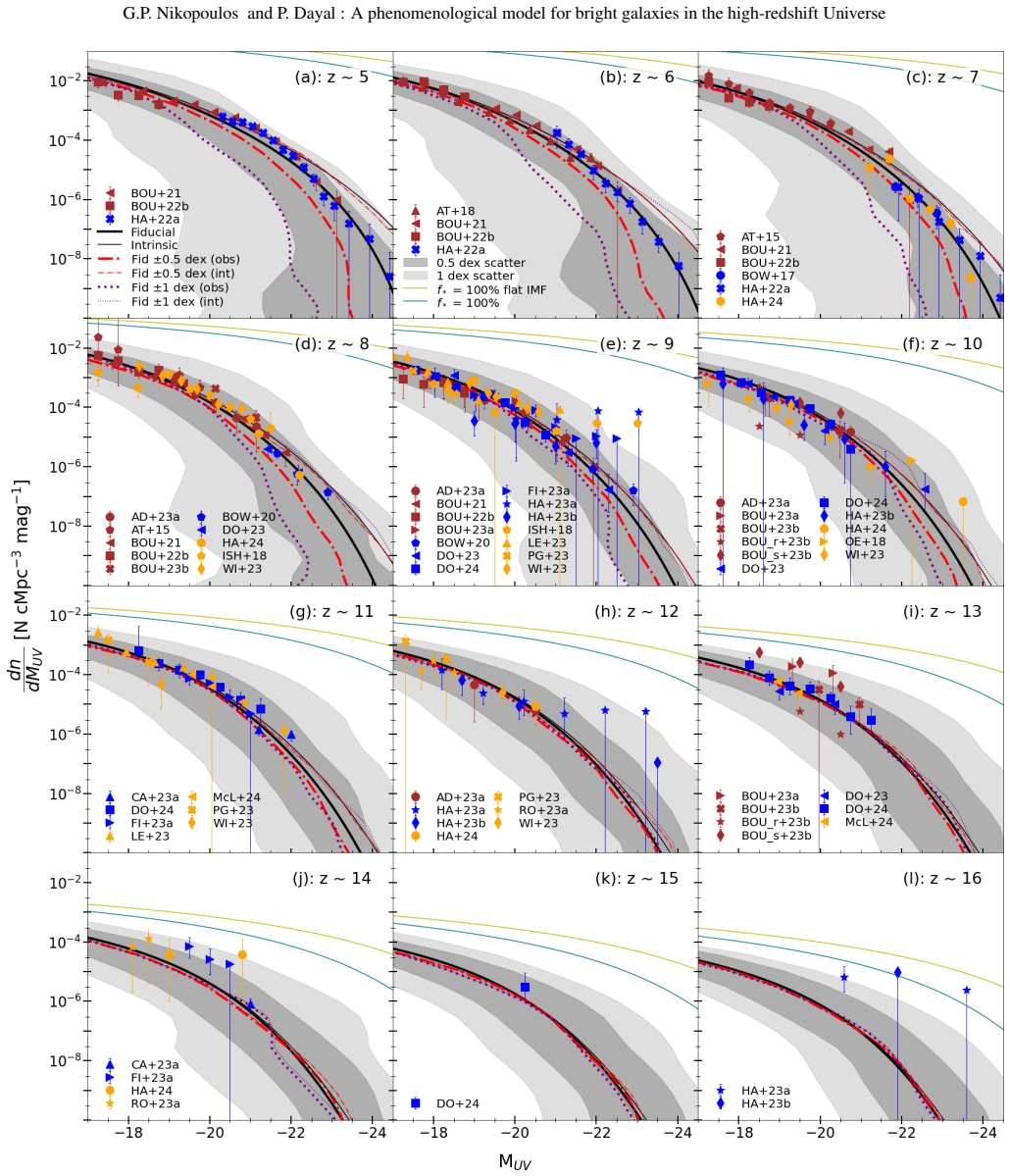
Explaining the UV luminosity function at redshifts 5 to 13 requires an average star formation efficiency that increases with redshift as 10 to the power of 0.13z minus 3.5.
A machine-rendered reading of the paper's core claim, the machinery that carries it, and where it could break.
Core claim
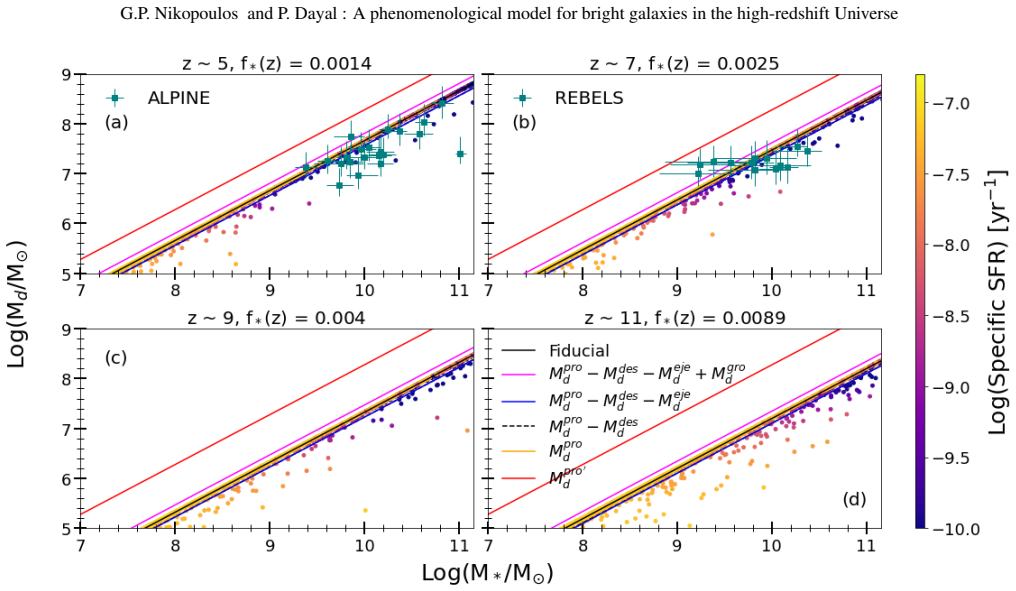
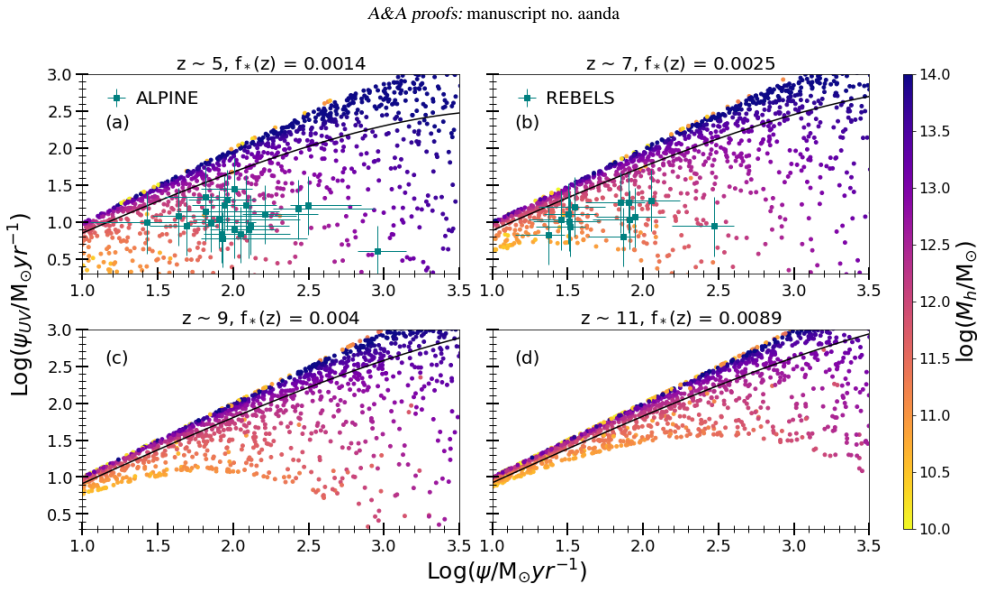
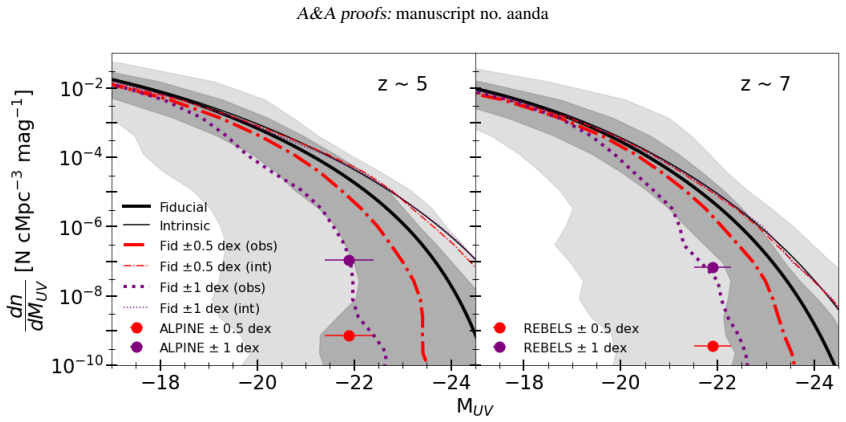
Explaining the UV LF at z ∼ 5 - 13 requires an average star formation efficiency that evolves as f_*(z) = 10^{0.13z-3.5}, with a number of observations exceeding this main sequence by a factor of 10. The dust enrichment of early systems is driven by dust production in SNII ejecta, while growth and sputtering impact the dust mass by 60% and 40% respectively at z ∼ 7. Galaxies at z ≳ 9 can retain significant dust, reaching average dust-to-stellar mass ratios of 0.19% (0.14%) at z ∼ 9 (z ∼ 11). Dust attenuation decreases with redshift as dust becomes increasingly dispersed within halos. Observations by ALMA at z ∼ 5 and 7 are not representative of the average population that makes up the UV LF.
What carries the argument
Analytic formalism tracking redshift-dependent star formation efficiency with scatter around the main sequence, plus dust production in type II supernovae, destruction, ejection, growth, and sputtering.
Load-bearing premise
The dust processes are calibrated to ALMA dust mass estimates at redshifts 5 to 7 even though the model concludes these estimates do not represent the average galaxies contributing to the UV luminosity function.
What would settle it
Direct measurements of star formation efficiency in a complete sample of galaxies at redshifts 10 to 13 that show no increase with redshift or a different functional dependence would falsify the required efficiency evolution.
Figures


read the original abstract
James Webb Telescope (JWST) observations have unveiled numerous galaxy candidates between $z \sim 9 - 16.5$, hinting at an over-abundance of sources at the bright-end of the UV luminosity function (UV LF) at z $\gsim$ 11. Complementarily, the Atacama Large Millimetre Array (ALMA) has been yielding dust mass estimates at $z \sim 5 - 7$. In this work, we develop an analytic formalism baselined against ALMA results, jointly exploring the impact of bursty star formation and its associated dust enrichment, on the visibility of early galaxies, while also modelling sources scattered off the main sequence of star formation. We incorporate dust production in type II Supernovae, dust destruction, ejection, growth and sputtering. Our key results are: (i) explaining the UV LF at $z \sim 5 - 13$ requires an average star formation efficiency that evolves as $f_*(z) = 10^{0.13z-3.5}$, with a number of observations exceeding this main sequence by a factor of 10; (ii) The dust enrichment of early systems is driven by dust production in SNII ejecta, while growth and sputtering impact the dust mass by 60\% and 40\% respectively at $z \sim 7$; (iii) galaxies at $z \gsim 9$ can retain significant dust, reaching average dust-to-stellar mass ratios of 0.19\% (0.14\%) at $z \sim 9$ ($z \sim 11$). Dust attenuation decreases with redshift as dust becomes increasingly dispersed within halos; (iv) observations by ALMA at $z \sim 5$ and 7 are not representative of the average population that makes up the UV LF; (v) assuming all stars to have formed instantaneously results in a high light-to-mass ratio. This naturally results in our model yielding a lower limit on the stellar mass contained in a halo, also under-predicting the observed stellar mass function.
Editorial analysis
A structured set of objections, weighed in public.
Referee Report
Summary. The paper develops an analytic model baselined on ALMA dust-mass estimates to explore how evolving star-formation efficiency f_*(z), bursty star formation, and dust production/growth/sputtering jointly shape the UV luminosity function at z~5-13. It concludes that matching the observed UV LF requires an average efficiency f_*(z)=10^{0.13z-3.5}, that dust growth and sputtering alter dust mass by 60% and 40% at z~7, that ALMA z~5-7 data are unrepresentative of the mean UV-LF population, and that instantaneous star formation yields a lower limit on stellar mass.
Significance. If the dust-attenuation modeling is robust, the work supplies a compact parametrization of average f_* evolution and quantifies the relative roles of SNII dust production versus growth/sputtering, offering a framework for interpreting JWST bright-end excesses and ALMA non-detections. The explicit functional form and percentage impacts constitute concrete, testable outputs.
major comments (1)
- [Abstract, key results (i) and (iv)] Abstract (key result i and baseline statement): the claimed necessity of the specific functional form f_*(z)=10^{0.13z-3.5} rests on dust-attenuation modeling whose parameters (growth 60%, sputtering 40% at z~7) are fixed by ALMA dust-mass estimates at z~5-7; yet key result (iv) states that these same ALMA observations are not representative of the average population that dominates the UV LF. This internal tension directly affects whether the derived f_* evolution applies to the mean population.
Simulated Author's Rebuttal
We thank the referee for their thorough review and for identifying a potential ambiguity in how the calibration and application of the model are presented. We agree that the abstract and key results section would benefit from clearer wording to distinguish the role of ALMA data in calibrating dust physics parameters from the derivation of f_*(z) for the mean UV LF population. We address the comment below and will make revisions to improve clarity.
read point-by-point responses
-
Referee: [Abstract, key results (i) and (iv)] Abstract (key result i and baseline statement): the claimed necessity of the specific functional form f_*(z)=10^{0.13z-3.5} rests on dust-attenuation modeling whose parameters (growth 60%, sputtering 40% at z~7) are fixed by ALMA dust-mass estimates at z~5-7; yet key result (iv) states that these same ALMA observations are not representative of the average population that dominates the UV LF. This internal tension directly affects whether the derived f_* evolution applies to the mean population.
Authors: The dust production, growth, and sputtering efficiencies are physical parameters in the model that are calibrated to reproduce the dust masses reported by ALMA at z~5-7. These efficiencies are assumed to be universal and are not population-specific. With these fixed efficiencies, the model is then applied to the full halo population to compute dust masses, attenuations, and UV luminosities. The f_*(z) = 10^{0.13z-3.5} parametrization is obtained by requiring the resulting UV LF to match observations at z~5-13. The model simultaneously predicts that the ALMA-detected galaxies at these redshifts are the dustier subset, while the UV LF is dominated by systems with lower dust content that fall below ALMA sensitivity; this is the basis for key result (iv). Thus there is no circularity: ALMA constrains the dust physics, which is then used to model the mean population that sets the UV LF. We will revise the abstract and the discussion of key results (i) and (iv) to state this distinction explicitly and to note that the derived f_* applies to the average UV LF population under the calibrated dust model. revision: yes
Circularity Check
f_*(z) functional form fitted to reproduce UV LF; dust model baselined on ALMA data that paper concludes are unrepresentative
specific steps
-
self definitional
[Abstract / Key results (i)]
"explaining the UV LF at z ∼ 5 - 13 requires an average star formation efficiency that evolves as f_*(z) = 10^{0.13z-3.5}"
The quoted functional form is introduced as the requirement needed to reproduce the UV LF; the 'explanation' therefore reduces to the fitting choice itself rather than an independent derivation from halo assembly, feedback, or external constraints.
-
fitted input called prediction
[Abstract]
"we develop an analytic formalism baselined against ALMA results... (iv) observations by ALMA at z ∼ 5 and 7 are not representative of the average population that makes up the UV LF"
Dust enrichment parameters (SNII production, destruction, growth, sputtering) are calibrated on the ALMA z~5-7 sample; the same paper then states those observations do not represent the mean UV-LF population. The resulting dust-attenuation model is therefore used to infer the required f_* for a population whose dust properties were never directly constrained by the calibration data.
full rationale
The central result (i) states that matching the UV LF requires a specific f_*(z) = 10^{0.13z-3.5}. This is presented as an explanation but is obtained by tuning the efficiency parameter to the target LF data. Separately, the analytic model is explicitly 'baselined against ALMA results' at z~5-7, yet result (iv) states those same ALMA observations 'are not representative of the average population that makes up the UV LF'. Because the dust production/destruction/growth parameters (which control attenuation and thus the inferred f_*) are fixed using the non-representative sample, the necessity of that particular f_*(z) form rests on inputs the paper itself flags as unrepresentative. No external benchmark or first-principles derivation is shown for either step.
Axiom & Free-Parameter Ledger
free parameters (1)
- f_*(z) slope and normalization (0.13, -3.5)
axioms (1)
- domain assumption Dust evolution includes production in type II supernovae, destruction, ejection, growth and sputtering with fixed relative efficiencies
Forward citations
Cited by 3 Pith papers
-
Stardust Galaxies at z>9: A Dust-Origin Transition Behind the Excess of UV-Bright Galaxies
A transition to low-opacity SNe-produced dust at z>9 reproduces the observed low attenuation and UV luminosity function excess in early galaxies.
-
How galaxies acquire their stellar mass at high redshift: High star formation efficiencies and the relative roles of dust and initial mass function
A data-driven model using UV luminosity functions and halo accretion matching predicts star formation efficiencies peaking at 0.8-0.9 at z>9, with bursty formation and the need for variable IMF or dust to avoid unphys...
-
Stardust Galaxies at z>9: A Dust-Origin Transition Behind the Excess of UV-Bright Galaxies
A transition to low-opacity supernova-produced dust at z>9 reduces effective UV attenuation in gas-rich galaxies and reproduces the observed UV luminosity function and A_FUV-M_star relation.
Reference graph
Works this paper leans on
-
[1]
Adams, N. J., Conselice, C. J., Ferreira, L., et al. 2022, Monthly Notices of the Royal Astronomical Society, 518, 4755
work page 2022
-
[2]
Algera, H. S. B., Inami, H., Oesch, P. A., et al. 2023, MNRAS, 518, 6142
work page 2023
-
[3]
Atek, H., Richard, J., Kneib, J.-P., & Schaerer, D. 2018, MNRAS, 479, 5184
work page 2018
- [4]
-
[5]
Atek, H. et al. 2015, Astrophys. J., 814, 69
work page 2015
-
[6]
Bakx, T. J. L. C., Tamura, Y ., Hashimoto, T., et al. 2020, MNRAS, 493, 4294 Béthermin, M., Fudamoto, Y ., Ginolfi, M., et al. 2020, A&A, 643, A2
work page 2020
- [7]
- [8]
-
[9]
J., Smit, R., Schouws, S., et al
Bouwens, R. J., Smit, R., Schouws, S., et al. 2022, ApJ, 931, 160
work page 2022
-
[10]
Bowler, R. A. A., Dunlop, J. S., McLure, R. J., & McLeod, D. J. 2017, MNRAS, 466, 3612
work page 2017
-
[11]
Bowler, R. A. A., Jarvis, M. J., Dunlop, J. S., et al. 2020, MNRAS, 493, 2059
work page 2020
-
[12]
D., Coe, D., Brammer, G., et al
Bradley, L. D., Coe, D., Brammer, G., et al. 2023, ApJ, 955, 13
work page 2023
-
[13]
Casey, C. M., Zavala, J. A., Manning, S. M., et al. 2023a, VizieR Online Data Catalog: MORA: ALMA 2mm survey (Casey+, 2021), VizieR On-line Data Catalog: J/ApJ/923/215. Originally published in: 2021ApJ...923..215C
work page 2021
-
[14]
Castellano, M., Fontana, A., Treu, T., et al. 2023, ApJ, 948, L14
work page 2023
-
[15]
Choudhury, T. R. & Dayal, P. 2019, MNRAS, 482, L19
work page 2019
-
[16]
R., Hutter, A., Dayal, P., et al
Cueto, E. R., Hutter, A., Dayal, P., et al. 2024, A&A, 686, A138
work page 2024
-
[17]
Davis, A. J. & Natarajan, P. 2009, MNRAS, 393, 1498
work page 2009
- [18]
- [19]
-
[20]
2022, MNRAS, 512, 989 de Bennassuti, M., Schneider, R., Valiante, R., & Salvadori, S
Dayal, P., Ferrara, A., Sommovigo, L., et al. 2022, MNRAS, 512, 989 de Bennassuti, M., Schneider, R., Valiante, R., & Salvadori, S. 2014, MNRAS, 445, 3039
work page 2022
-
[21]
C., Birnboim, Y ., Mandelker, N., & Li, Z
Dekel, A., Sarkar, K. C., Birnboim, Y ., Mandelker, N., & Li, Z. 2023, MNRAS, 523, 3201
work page 2023
-
[22]
2020, A&A, 643, A5 Di Cesare, C., Graziani, L., Schneider, R., et al
Dessauges-Zavadsky, M., Ginolfi, M., Pozzi, F., et al. 2020, A&A, 643, A5 Di Cesare, C., Graziani, L., Schneider, R., et al. 2023, MNRAS, 519, 4632
work page 2020
-
[23]
Donnan, C. T., McLeod, D. J., Dunlop, J. S., et al. 2023, MNRAS, 518, 6011
work page 2023
-
[24]
Donnan, C. T., McLure, R. J., Dunlop, J. S., et al. 2024, arXiv e-prints, arXiv:2403.03171
- [25]
-
[26]
Ferrara, A., Pallottini, A., & Dayal, P. 2023, MNRAS, 522, 3986
work page 2023
-
[27]
Ferrara, A., Pettini, M., & Shchekinov, Y . 2000, MNRAS, 319, 539
work page 2000
-
[28]
Ferrara, A., Sommovigo, L., Dayal, P., et al. 2022, MNRAS, 512, 58
work page 2022
-
[29]
Fudamoto, Y ., Oesch, P. A., Faisst, A., et al. 2020, A&A, 643, A4
work page 2020
-
[30]
Fudamoto, Y ., Smit, R., Bowler, R. A. A., et al. 2022, ApJ, 934, 144
work page 2022
-
[31]
2023a, arXiv e-prints, arXiv:2309.07834
Fujimoto, S., Bezanson, R., Labbe, I., et al. 2023a, arXiv e-prints, arXiv:2309.07834
-
[32]
Graziani, L., Schneider, R., Ginolfi, M., et al. 2020, MNRAS, 494, 1071
work page 2020
-
[33]
Harikane, Y ., Inoue, A. K., Ellis, R. S., et al. 2024, arXiv e-prints, arXiv:2406.18352
-
[34]
Harikane, Y ., Inoue, A. K., Mawatari, K., et al. 2022, ApJ, 929, 1
work page 2022
-
[35]
Hashimoto, T., Inoue, A. K., Mawatari, K., et al. 2019, PASJ, 71, 71
work page 2019
-
[36]
Hirashita, H. & Aoyama, S. 2018, Monthly Notices of the Royal Astronomical Society, 482, 2555
work page 2018
-
[37]
Hutter, A., Dayal, P., Yepes, G., et al. 2021, MNRAS, 503, 3698
work page 2021
-
[38]
Inami, H., Algera, H. S. B., Schouws, S., et al. 2022, MNRAS, 515, 3126
work page 2022
- [39]
-
[40]
2023, The Open Journal of Astrophysics, 6, 44
Katz, H., Rosdahl, J., Kimm, T., et al. 2023, The Open Journal of Astrophysics, 6, 44
work page 2023
-
[41]
Laporte, N., Ellis, R. S., Boone, F., et al. 2017, ApJ, 837, L21 Le´sniewska, A. & Michałowski, M. J. 2019, A&A, 624, L13
work page 2017
-
[42]
Leung, G. C. K., Bagley, M. B., Finkelstein, S. L., et al. 2023, ApJ, 954, L46
work page 2023
- [43]
-
[44]
Mancini, M., Schneider, R., Graziani, L., et al. 2015, MNRAS, 451, L70
work page 2015
-
[45]
Mason, C. A., Trenti, M., & Treu, T. 2023, Monthly Notices of the Royal Astro- nomical Society, 521, 497
work page 2023
-
[46]
Mauerhofer, V . & Dayal, P. 2023, Monthly Notices of the Royal Astronomical Society, 526, 2196
work page 2023
-
[47]
McKee, C. F. 1989, ApJ, 345, 782
work page 1989
-
[48]
McKinnon, R., Torrey, P., V ogelsberger, M., Hayward, C. C., & Marinacci, F. 2017, MNRAS, 468, 1505
work page 2017
-
[49]
2018, MNRAS, 478, 2851 Article number, page 11 of 12 A&A proofs: manuscript no
McKinnon, R., V ogelsberger, M., Torrey, P., Marinacci, F., & Kannan, R. 2018, MNRAS, 478, 2851 Article number, page 11 of 12 A&A proofs: manuscript no. aanda
work page 2018
-
[50]
McLeod, D. J., Donnan, C. T., McLure, R. J., et al. 2024, MNRAS, 527, 5004
work page 2024
- [51]
- [52]
-
[53]
Naidu, R. P., Oesch, P. A., Setton, D. J., et al. 2022, arXiv e-prints, arXiv:2208.02794
-
[54]
Nozawa, T., Kozasa, T., Umeda, H., Maeda, K., & Nomoto, K. 2003, ApJ, 598, 785
work page 2003
-
[55]
Oke, J. B. & Gunn, J. E. 1983, Astrophysical Journal, 266, 713
work page 1983
- [56]
-
[57]
Pacucci, F., Dayal, P., Harikane, Y ., Inoue, A. K., & Loeb, A. 2022, MNRAS, 514, L6
work page 2022
- [58]
-
[59]
2019, MNRAS, 487, 1689 Pérez-González, P
Pallottini, A., Ferrara, A., Decataldo, D., et al. 2019, MNRAS, 487, 1689 Pérez-González, P. G., Costantin, L., Langeroodi, D., et al. 2023, ApJ, 951, L1
work page 2019
-
[60]
Piana, O., Dayal, P., & Choudhury, T. R. 2022, MNRAS, 510, 5661 Planck Collaboration, Aghanim, N., Ashdown, M., & et. al. 2016, A&A, 596, A107
work page 2022
- [61]
-
[62]
Popping, G., Somerville, R. S., & Galametz, M. 2017, MNRAS, 471, 3152
work page 2017
- [63]
- [64]
-
[65]
Robertson, B., Johnson, B. D., Tacchella, S., et al. 2023a, arXiv e-prints, arXiv:2312.10033
-
[66]
Salpeter, E. E. 1955, ApJ, 121, 161
work page 1955
-
[67]
Seab, C. G. & Shull, J. M. 1983, ApJ, 275, 652
work page 1983
-
[68]
Sheth, R. K. & Tormen, G. 1999, Monthly Notices of the Royal Astronomical Society, 308, 119
work page 1999
- [69]
- [70]
-
[71]
Sommovigo, L., Ferrara, A., Carniani, S., et al. 2022, MNRAS, 517, 5930
work page 2022
- [72]
-
[73]
Topping, M. W., Stark, D. P., Endsley, R., et al. 2022, Monthly Notices of the Royal Astronomical Society, 516, 975
work page 2022
-
[74]
Triani, D. P., Sinha, M., Croton, D. J., Pacifici, C., & Dwek, E. 2020, MNRAS, 493, 2490
work page 2020
-
[75]
Tsai, J. C. & Mathews, W. G. 1995, The Astrophysical Journal, 448, 84
work page 1995
-
[76]
Vijayan, A. P., Clay, S. J., Thomas, P. A., et al. 2019, MNRAS, 489, 4072
work page 2019
-
[77]
Vijayan, A. P., Thomas, P. A., Lovell, C. C., et al. 2024, MNRAS, 527, 7337 V ogelsberger, M., Nelson, D., Pillepich, A., et al. 2020, MNRAS, 492, 5167
work page 2024
- [78]
-
[79]
J., Desprez, G., Asada, Y ., et al
Willott, C. J., Desprez, G., Asada, Y ., et al. 2023, ApJ, 966, 74
work page 2023
-
[80]
Yung, L. Y . A., Somerville, R. S., Finkelstein, S. L., Wilkins, S. M., & Gardner, J. P. 2024, MNRAS, 527, 5929
work page 2024
discussion (0)
Sign in with ORCID, Apple, or X to comment. Anyone can read and Pith papers without signing in.