Chiral Nonlinear Polaritonics with van der Waals Metasurfaces
Pith reviewed 2026-05-23 19:27 UTC · model grok-4.3
The pith
Chiral TMDC metasurface with broken out-of-plane symmetry selects handedness of self-hybridized exciton-polaritons.
A machine-rendered reading of the paper's core claim, the machinery that carries it, and where it could break.
Core claim
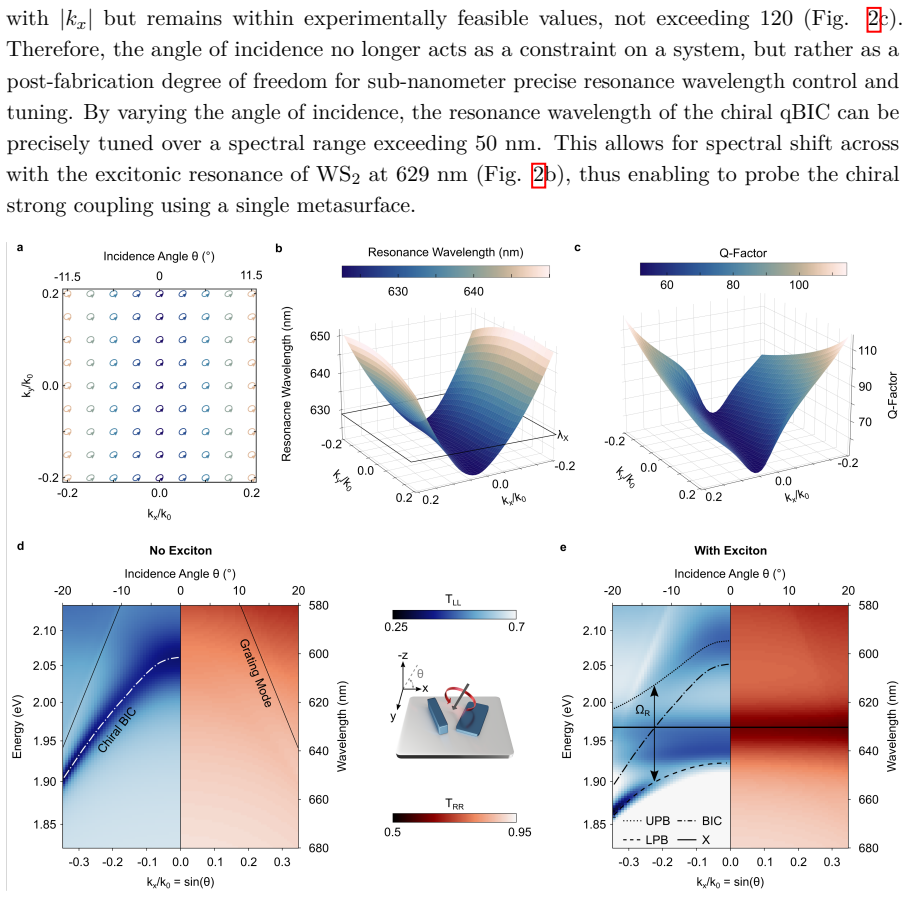
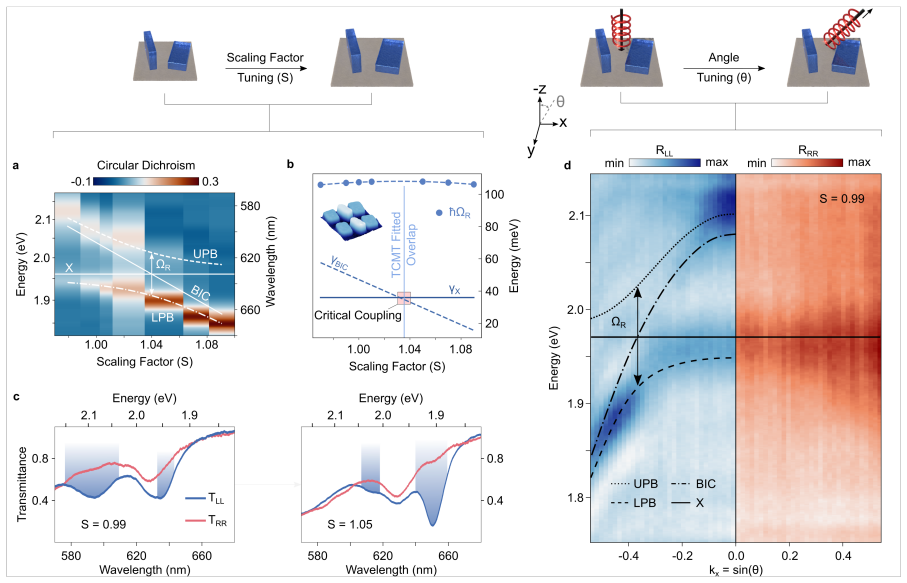
A chiral transition metal dichalcogenide (TMDC) metasurface with broken out-of-plane symmetry allows selective formation of self-hybridized exciton-polaritons with specific handedness. The metasurface maintains maximal chirality for oblique incidence up to 20°, outperforming prior designs and converting the angle of incidence into a degree of freedom for sub-nanometer-precise tuning of the resonant wavelength. In the chiral strong-coupling regime, nonlinear experiments reveal the polariton-driven nature of chiral third-harmonic generation.
What carries the argument
Chiral TMDC metasurface with broken out-of-plane symmetry that discriminates circular-polarization handedness to produce selective self-hybridized exciton-polaritons.
If this is right
- Angle of incidence becomes a controllable tuning parameter for the polariton resonance at sub-nanometer precision.
- Chiral strong coupling can be studied directly through nonlinear optical processes such as third-harmonic generation.
- Van der Waals metasurfaces become a platform for chiral polaritonics applicable to non-reciprocal devices and valleytronics.
- Temporal or spatial symmetry breaking in strong-coupling systems becomes experimentally accessible with simple planar structures.
Where Pith is reading between the lines
- Similar broken-symmetry patterning could be applied to other layered materials to extend handedness control beyond TMDCs.
- The angle-tolerance property may simplify integration of chiral polariton devices into larger photonic circuits where perfect normal incidence is impractical.
- Combining this spatial symmetry breaking with time-varying drives could produce non-reciprocal polariton transport without external magnetic fields.
Load-bearing premise
Broken out-of-plane symmetry in the TMDC metasurface produces handedness discrimination that stays maximal at oblique incidence without degradation.
What would settle it
Observation that circular dichroism or chirality falls significantly below its maximum value at any incidence angle of 20 degrees or smaller would falsify the persistence claim.
Figures


read the original abstract
In the strong-coupling regime, the interaction between light and matter reaches a hybridization state where the photonic and material components are inseparably linked. Using tailored states of light to break symmetries in such systems can facilitate the development of novel non-equilibrium quantum materials. Chiral optical cavities offer a promising approach for this, enabling either temporal or spatial symmetry-breaking, both of which are unachievable with conventional mirror cavities. For spatial symmetry-breaking, a cavity must discriminate the handedness of circularly polarized light, a functionality uniquely provided by chiral metamaterials. Here, we propose and demonstrate experimentally a chiral transition metal dichalcogenide (TMDC) metasurface with broken out-of-plane symmetry, allowing for the selective formation of self-hybridized exciton-polaritons with specific handedness. Our metasurface maintains maximal chirality for oblique incidence up to 20{\deg}, significantly outperforming all previously known designs, thereby transforming the angle of incidence from a constraint into a new degree of freedom for sub-nanometer-precise tuning of the cavity's resonant wavelength. Moreover, we study the chiral strong-coupling regime in nonlinear experiments and reveal the polariton-driven nature of chiral third-harmonic generation. Our results demonstrate a clear pathway towards van der Waals (vdW) metasurfaces as a novel and potent platform for chiral polaritonics with implications in a wide range of photonics research, such as non-reciprocal photonic devices and valleytronics.
Editorial analysis
A structured set of objections, weighed in public.
Referee Report
Summary. The manuscript claims an experimental demonstration of a chiral TMDC metasurface with broken out-of-plane symmetry that enables selective self-hybridized exciton-polariton formation with specific handedness. It further claims that this design maintains maximal chirality for oblique incidence up to 20°, significantly outperforming prior designs and converting incidence angle into a tuning degree of freedom for sub-nm resonant wavelength control, while nonlinear measurements reveal the polariton-driven character of chiral third-harmonic generation.
Significance. If the experimental support for angle-robust maximal chirality holds, the result would be significant for chiral polaritonics by establishing vdW metasurfaces as a platform where incidence angle provides precise tuning, with implications for non-reciprocal devices and valleytronics. The experimental realization of self-hybridized polaritons and the nonlinear studies constitute clear strengths, providing falsifiable, measured optical responses rather than parameter-fitted models.
major comments (2)
- [Abstract and oblique-incidence results section] Abstract and results on oblique incidence: The central claim that broken out-of-plane symmetry produces handedness discrimination (near-unity g-factor or CD) that persists without significant degradation to 20° incidence is load-bearing. The manuscript must include explicit angle-dependent measurements or full-wave simulations isolating the in-plane wavevector component's effect on circular-basis mixing and local-field enhancement at the exciton resonance; symmetry arguments alone do not address this mixing risk.
- [Nonlinear experiments section] Nonlinear experiments section: The assertion that third-harmonic generation is 'polariton-driven' requires quantitative comparison (e.g., power dependence, polarization selectivity, or detuning curves) against non-polaritonic controls to establish the chiral strong-coupling regime contribution; without these, the interpretation of the nonlinear data remains under-supported.
minor comments (2)
- [Figure captions] Figure captions for angle-dependent data should explicitly state the incidence-angle range, polarization convention, and any normalization procedure used to claim 'maximal chirality'.
- [Abstract] The abstract's reference to 'sub-nanometer-precise tuning' should be cross-referenced to a specific figure or table quantifying the wavelength shift per degree with error bars.
Simulated Author's Rebuttal
We thank the referee for their constructive and detailed review. The comments identify areas where additional quantitative support would strengthen the central claims. We address each point below and have prepared revisions to the manuscript.
read point-by-point responses
-
Referee: [Abstract and oblique-incidence results section] Abstract and results on oblique incidence: The central claim that broken out-of-plane symmetry produces handedness discrimination (near-unity g-factor or CD) that persists without significant degradation to 20° incidence is load-bearing. The manuscript must include explicit angle-dependent measurements or full-wave simulations isolating the in-plane wavevector component's effect on circular-basis mixing and local-field enhancement at the exciton resonance; symmetry arguments alone do not address this mixing risk.
Authors: We agree that symmetry arguments alone are insufficient and that explicit isolation of the in-plane wavevector effects is required. In the revised manuscript we add full-wave simulations that vary the in-plane wavevector while holding other parameters fixed, directly quantifying its impact on circular-basis mixing, g-factor, and local-field enhancement at the exciton resonance. We also include new experimental angle-dependent circular dichroism spectra up to 20° that corroborate the simulations. These additions provide the requested quantitative evidence that maximal chirality is maintained. revision: yes
-
Referee: [Nonlinear experiments section] Nonlinear experiments section: The assertion that third-harmonic generation is 'polariton-driven' requires quantitative comparison (e.g., power dependence, polarization selectivity, or detuning curves) against non-polaritonic controls to establish the chiral strong-coupling regime contribution; without these, the interpretation of the nonlinear data remains under-supported.
Authors: We concur that direct comparisons to non-polaritonic controls are necessary to substantiate the polariton-driven interpretation. The revised manuscript now includes power-dependence measurements and polarization-resolved THG data acquired on both the chiral polaritonic metasurface and reference samples lacking strong coupling. These comparisons demonstrate enhanced THG efficiency and handedness selectivity exclusively in the polaritonic regime. Where experimentally accessible, detuning curves are also added to further link the nonlinear response to the strong-coupling condition. revision: yes
Circularity Check
No circularity; experimental results independent of derivations
full rationale
The paper is structured as an experimental demonstration of a chiral TMDC metasurface, with central claims resting on fabricated samples, measured optical spectra, and observed nonlinear responses rather than any derivation chain. No equations, fitted parameters renamed as predictions, or self-citation load-bearing steps appear in the abstract or described content. The persistence of chirality at oblique incidence is presented as a measured property, not a constructed result from symmetry arguments or prior self-citations. This is the expected outcome for a measurement-driven optics paper with no theoretical reduction to its own inputs.
Axiom & Free-Parameter Ledger
axioms (1)
- domain assumption Existence and properties of the strong-coupling regime between light and excitons in TMDCs
Forward citations
Cited by 1 Pith paper
-
Topological Control of Polaritonic Flatbands in Anisotropic van der Waals Metasurfaces
Structuring anisotropic ReS2 into metasurfaces splits qBIC topological charges into momentum-separated half-integers, flattening photonic dispersion and producing two distinct directionally hybridized exciton-polarito...
Reference graph
Works this paper leans on
-
[1]
Gorkunov, M. V., Antonov, A. A., Tuz, V. R., Kupriianov, A. S. & Kivshar, Y. S. Bound states in the continuum underpin near-lossless maximum chirality in dielectric metasurfaces. Advanced Optical Materials 9, 2100797 (2021)
work page 2021
-
[2]
Munkhbat, B., Wróbel, P., Antosiewicz, T. J. & Shegai, T. O. Optical constants of several multilayer transition metal dichalcogenides measured by spectroscopic ellipsometry in the 300–1700 nm range: high index, anisotropy, and hyperbolicity.ACS Photonics 9, 2398–2407 (2022)
work page 2022
-
[3]
Evlyukhin, A. B., Fischer, T., Reinhardt, C. & Chichkov, B. N. Optical theorem and multipole scattering of light by arbitrarily shaped nanoparticles.Physical Review B 94, 205434 (2016)
work page 2016
-
[4]
Baranov, D. G., Schäfer, C. & Gorkunov, M. V. Toward molecular chiral polaritons.ACS Photonics 10, 2440–2455 (2023)
work page 2023
-
[5]
Biechteler, J. et al. Fabrication Optimization of van der Waals Metasurfaces: Inverse Patterning Boosts Resonance Quality Factor.Advanced Optical Materials, 2500920 (2025)
work page 2025
-
[6]
Kühner, L. et al. Unlocking the out-of-plane dimension for photonic bound states in the continuum to achieve maximum optical chirality.Light: Science & Applications 12, 250 (2023)
work page 2023
-
[7]
Fan, S., Suh, W. & Joannopoulos, J. D. Temporal coupled-mode theory for the Fano resonance in optical resonators.Journal of the Optical Society of America A 20, 569–572 (2003)
work page 2003
-
[8]
Weber, T. et al. Intrinsic strong light-matter coupling with self-hybridized bound states in the continuum in van der Waals metasurfaces.Nature Materials 22, 970–976 (2023)
work page 2023
-
[9]
Nan, L. et al. Angular dispersion suppression in deeply subwavelength phonon polariton bound states in the continuum metasurfaces.Nature Photonics, 1–9 (2025). 20
work page 2025
discussion (0)
Sign in with ORCID, Apple, or X to comment. Anyone can read and Pith papers without signing in.