Concurrence-Driven Path Entanglement in Phase-Modified Interferometry
Pith reviewed 2026-05-23 17:32 UTC · model grok-4.3
The pith
Concurrence from beam splitter angle governs joint-detection probabilities in path-entangled interferometry
A machine-rendered reading of the paper's core claim, the machinery that carries it, and where it could break.
Core claim
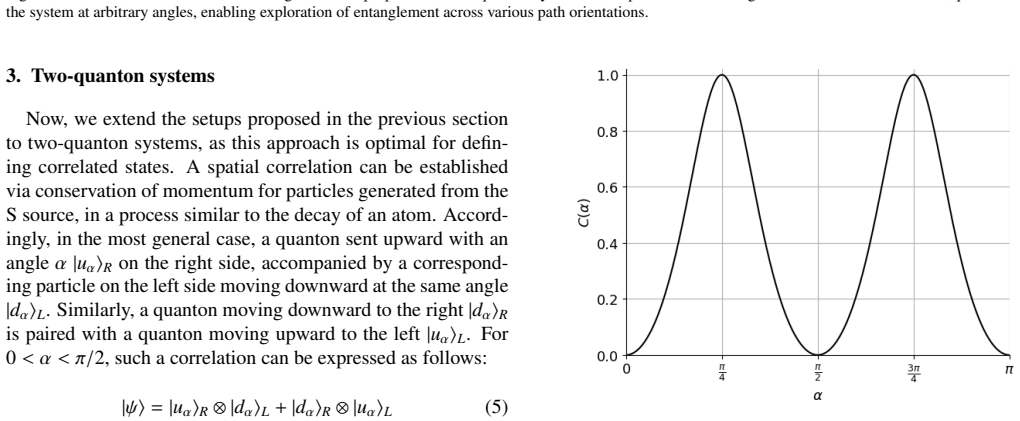
A novel experimental setup is proposed that establishes a direct relationship between path (momentum) entanglement and concurrence in phase-retarder-modified Mach-Zehnder configurations for two-quanton systems. Joint-detection probabilities can be governed not only by phase shifts but also by concurrence arising from the angle between the motion direction of particles from the same source and the Beam Splitter axis. This approach sets a new standard in entanglement measurement by integrating path entanglement within a concurrence-based framework, first examining single-quanton systems then extending to two-quanton systems.
What carries the argument
The concurrence that arises from the angle between the motion direction of particles from the same source and the Beam Splitter axis in phase-retarder-modified Mach-Zehnder interferometers.
If this is right
- Joint-detection probabilities are governed by concurrence in addition to phase shifts.
- The setups function as analogs for spin/polarization measurement experiments.
- Spatial correlations connect directly to concurrence in two-quanton systems.
- Analysis of various beam splitter configurations reveals their potential for entanglement measurement.
Where Pith is reading between the lines
- Varying the angle at the beam splitter could offer a practical way to tune entanglement without changing phases.
- This method might generalize to other types of quantum interferometers or multi-particle states.
- It suggests experiments in systems where particle trajectories can be precisely angled relative to optics.
- The framework could link to existing concurrence measures in quantum information for hybrid path-polarization entanglement.
Load-bearing premise
A direct and usable relationship exists between path entanglement and concurrence in the proposed phase-retarder-modified Mach-Zehnder configurations for two-quanton systems.
What would settle it
An experiment that varies the angle between particle motion directions and the beam splitter axis in the proposed setup and finds no corresponding change in joint-detection probabilities independent of phase would disprove the governing role of concurrence.
Figures




read the original abstract
In this study, a novel experimental setup analogous to joint spin/polarization measurement experiments is proposed by establishing a direct relationship between path (momentum) entanglement and concurrence. The results demonstrate that joint-detection probabilities can be governed not only by phase shifts but also by concurrence, which arises from the angle between the motion direction of particles from the same source and the Beam Splitter (BS) axis. This approach aims to set a new standard in entanglement measurement by integrating path entanglement within a concurrence-based framework. Here, we first examine phase-retarder-modified Mach-Zehnder (MZ) configurations within single-quanton systems, subsequently extending this approach to two-quanton systems to establish a connection between spatial correlations and concurrence. Last, by analyzing joint-detection probabilities across various BS configurations, we evaluate the potential of these setups as analogs for spin/polarization measurement experiments.
Editorial analysis
A structured set of objections, weighed in public.
Referee Report
Summary. The manuscript proposes a novel interferometric setup using phase-retarder-modified Mach-Zehnder configurations to establish a direct relationship between path (momentum) entanglement and concurrence for single- and two-quanton systems. It claims that joint-detection probabilities depend on both phase shifts and concurrence generated by the angle between particle trajectories from a common source and the beam-splitter axis, positioning the setup as an analog to joint spin/polarization measurements.
Significance. If the claimed mapping from beam-splitter axis angle to concurrence and the resulting joint-probability expressions were explicitly derived and verified, the work could supply a geometric handle on path entanglement that complements existing phase-based controls. The absence of any derivations, explicit formulas, or numerical checks in the text, however, prevents evaluation of whether the proposal adds a usable, falsifiable relation beyond existing concurrence definitions.
major comments (2)
- [Abstract / two-quanton systems section] Abstract and the described two-quanton extension: the central claim of a 'direct relationship' between path entanglement and concurrence (arising from the BS-axis angle) is asserted without any supporting equations, state vectors, or probability derivations. This directly undermines the weakest assumption identified in the reader's report and leaves the load-bearing step unaddressed.
- [Abstract / joint-detection analysis] The statement that joint-detection probabilities 'can be governed not only by phase shifts but also by concurrence' is presented as a result, yet no explicit joint-probability formula, concurrence expression, or comparison to standard MZ probabilities appears. Without these, the claim that the setup functions as an analog to spin/polarization experiments cannot be assessed.
minor comments (1)
- [Abstract] The phrase 'set a new standard in entanglement measurement' is promotional and should be replaced by a more precise statement of the intended contribution.
Simulated Author's Rebuttal
We thank the referee for their careful reading and for identifying the need for explicit derivations to support the central claims. We agree that the manuscript requires additional equations, state vectors, and probability expressions to allow evaluation of the proposed relationship and analogy. We will incorporate these in the revised version.
read point-by-point responses
-
Referee: [Abstract / two-quanton systems section] Abstract and the described two-quanton extension: the central claim of a 'direct relationship' between path entanglement and concurrence (arising from the BS-axis angle) is asserted without any supporting equations, state vectors, or probability derivations. This directly undermines the weakest assumption identified in the reader's report and leaves the load-bearing step unaddressed.
Authors: We acknowledge that the two-quanton extension is presented at a conceptual level without the supporting derivations. In the revised manuscript we will add the explicit two-quanton state vectors, the derivation of concurrence from the angle between particle trajectories and the beam-splitter axis, and the step-by-step connection to path entanglement. This will make the load-bearing relationship fully explicit and verifiable. revision: yes
-
Referee: [Abstract / joint-detection analysis] The statement that joint-detection probabilities 'can be governed not only by phase shifts but also by concurrence' is presented as a result, yet no explicit joint-probability formula, concurrence expression, or comparison to standard MZ probabilities appears. Without these, the claim that the setup functions as an analog to spin/polarization experiments cannot be assessed.
Authors: We agree that the joint-detection claim requires explicit formulas. The revised version will include the derived joint-probability expression that incorporates both phase shifts and concurrence, the concurrence expression in terms of the trajectory angle, and a side-by-side comparison with standard Mach-Zehnder probabilities. These additions will substantiate the analogy to joint spin/polarization measurements. revision: yes
Circularity Check
No significant circularity detected
full rationale
The provided abstract and reader's assessment describe a proposed experimental setup establishing a mapping from BS-axis angle to concurrence in two-quanton path-entangled states, but contain no equations, self-citations, or derivations that reduce the central claim to a definition or fitted input by construction. No load-bearing steps match any of the enumerated circularity patterns; the derivation chain is presented as independent and self-contained against external benchmarks.
Axiom & Free-Parameter Ledger
Forward citations
Cited by 1 Pith paper
-
Berry Phase in Pathangled Systems
Pathangled states allow Berry phases and production angles to serve as degrees of freedom for Bell correlations, with an approximate critical angle of 24.97 degrees marking the boundary between local-hidden-variable t...
Reference graph
Works this paper leans on
-
[1]
Physical Review Letters 85(10), 2200–2203 (2000)
W. Wootters, Entanglement of formation of an arbitrary state of two qubits, Phys. Rev. Lett. 80 (1998) 2245. doi:10.1103/PhysRevLett. 80.2245
-
[2]
V . Vedral, M. Plenio, M. Rippin, et al., Quantifying entanglement, Phys. Rev. Lett. 78 (1997) 2275. doi:10.1103/PhysRevLett.78.2275
-
[3]
A computable measure of entanglement
G. Vidal, R. Werner, Computable measure of entanglement, Phys. Rev. A 65 (2002) 032314. doi:10.1103/PhysRevA.65.032314
-
[4]
M. B. Plenio, S. Virmani, An introduction to entanglement measures, Quantum Information & Computation 7 (1) (2007) 1–51
work page 2007
-
[5]
Uhlmann, Fidelity and concurrence of conjugated states, Phys
A. Uhlmann, Fidelity and concurrence of conjugated states, Phys. Rev. A 62 (2000) 032307. doi:10.1103/PhysRevA.62.032307
-
[6]
P. Rungta, V . Bu ˇzek, C. M. Caves, M. Hillery, G. J. Milburn, Universal state inversion and concurrence in arbitrary dimensions, Phys. Rev. A 64 (2001) 042315. doi:10.1103/PhysRevA.64.042315
-
[7]
R. Horodecki, P. Horodecki, M. Horodecki, et al., Quantum en- tanglement, Rev. Mod. Phys. 81 (2009) 865–942. doi:10.1103/ RevModPhys.81.865
work page 2009
-
[8]
R. Raussendorf, D. Browne, H. Briegel, Measurement-based quantum computation with cluster states, Phys. Rev. A 68 (2003) 022312. doi: 10.1103/PhysRevA.68.022312. 7
-
[9]
P. Walther, K. Resch, T. Rudolph, E. Schenck, H. Weinfurter, V . Vedral, M. Aspelmeyer, A. Zeilinger, Experimental one-way quantum comput- ing, Nature (London) 434 (2005) 169. doi:10.1038/nature03347
-
[10]
P. Milman, W. Maineult, S. Guibal, et al., Topologically decoherence- protected qubits with trapped ions, Phys. Rev. Lett. 99 (2007) 020503. doi:10.1103/PhysRevLett.99.020503
-
[11]
M. Foss-Feig, S. Ragole, A. Potter, et al., Entanglement from tensor net- works on a trapped-ion quantum computer, Phys. Rev. Lett. 128 (2022) 150504. doi:10.1103/PhysRevLett.128.150504
-
[12]
C. Degen, F. Reinhard, P. Cappellaro, Quantum sensing, Rev. Mod. Phys. 89 (2017) 035002. doi:10.1103/RevModPhys.89.035002
work page internal anchor Pith review doi:10.1103/revmodphys.89.035002 2017
- [13]
-
[14]
Zeilinger, General properties of lossless beam splitters in interferome- try, Am
A. Zeilinger, General properties of lossless beam splitters in interferome- try, Am. J. Phys. 49 (9) (1981) 882–883. doi:10.1119/1.12387
-
[15]
M. A. Horne, A. Shimony, A. Zeilinger, Two-particle interferometry, Phys. Rev. Lett. 62 (1989) 2209. doi:10.1103/PhysRevLett.62. 2209
-
[16]
Bell, On the Einstein-Podolsky-Rosen paradox, Physics (Long Island City, N.Y .) 1 (1964) 195–200
J. Bell, On the Einstein-Podolsky-Rosen paradox, Physics (Long Island City, N.Y .) 1 (1964) 195–200
work page 1964
-
[17]
D. Bohm, Y . Aharonov, Discussion of experimental proof for the paradox of einstein, rosen, and podolsky, Phys. Rev. 108 (1957) 1070–1076.doi: 10.1103/PhysRev.108.1070
-
[18]
M. E. Tunalioglu, H. O. Cildiroglu, A. Yilmazer, On the geometric phases in entangled states, Commun. Fac. Sci. Univ. Ank. Series A2-A3: Phys. (2023). doi:10.33769/aupse.1286632
-
[19]
H. O. Cildiroglu, Testing Bell–CHSH inequalities using topological Aharonov–Casher and He–McKellar–Wilkens phases, Annals of Physics 465 (2024) 169684. doi:https://doi.org/10.1016/j.aop.2024. 169684
-
[20]
Can quantum-mechanical description of physical reality be considered complete
A. Einstein, B. Podolsky, N. Rosen, Can quantum-mechanical descrip- tion of physical reality be considered complete?, Phys. Rev. 47 (1935) 777–780. doi:10.1103/PhysRev.47.777
-
[21]
R. Fickler, R. Lapkiewicz, M. Huber, M. P. Lavery, M. J. Padgett, A. Zeilinger, Interface between path and orbital angular momentum en- tanglement for high-dimensional photonic quantum information, Nature Communications 5 (2014). doi:10.1038/ncomms5502
- [22]
- [23]
-
[24]
J. E. Runeson, J. O. Richardson, Quantum entanglement from classi- cal trajectories, Phys. Rev. Lett. 127 (2021) 250403. doi:10.1103/ PhysRevLett.127.250403
work page 2021
-
[25]
L.-P. Yang, Y . Chang, Quantum beam splitter as a controller of higher- order quantum coherence, Physical Review A 110 (023722) (2024).doi: 10.1103/PhysRevA.110.023722
-
[26]
R. A. Bertlmann, K. Durstberger, Y . Hasegawa, B. C. Hiesmayr, Berry phase in entangled systems: A proposed experiment with single neutrons, Phys. Rev. A 69 (2004) 032112.doi:10.1103/PhysRevA.69.032112
-
[27]
Y . Hasegawa, R. Loidl, G. Badurek, H. Rauch, Violation of a bell-like inequality in neutron optical experiments: quantum contextuality, Journal of Optics B: Quantum and Semiclassical Optics 6 (3) (2004) S7. doi: 10.1088/1464-4266/6/3/002
-
[28]
S. Sponar, J. Klepp, R. Loidl, S. Filipp, K. Durstberger-Rennhofer, R. A. Bertlmann, G. Badurek, H. Rauch, Y . Hasegawa, Geometric phase in en- tangled systems: A single-neutron interferometer experiment, Physical Review A 81 (2010) 042113. doi:10.1103/PhysRevA.81.042113
- [29]
-
[30]
M. V . Berry, Quantal phase factors accompanying adiabatic changes, Pro- ceedings of the Royal Society of London. A. Mathematical and Physical Sciences 392 (1984) 45–57. doi:10.1098/rspa.1984.0023
-
[31]
Y . Aharonov, A. Casher, Topological quantum effects for neutral particles, Phys. Rev. Lett. 53 (1984) 319–321. doi:10.1103/PhysRevLett.53. 319
-
[32]
B. E. Allman, A. Cimmino, A. G. Klein, G. I. Opat, H. Kaiser, S. A. Werner, Scalar Aharonov-Bohm experiment with neutrons, Physical Re- view Letters 68 (1992) 2409–2412. doi:10.1103/PhysRevLett.68. 2409
-
[33]
X.-G. He, B. H. J. McKellar, Topological phase due to electric dipole mo- ment and magnetic monopole interaction, Phys. Rev. A 47 (1993) 3424–
work page 1993
-
[34]
doi:10.1103/PhysRevA.47.3424
-
[35]
Wilkens, Quantum phase of a moving dipole, Phys
M. Wilkens, Quantum phase of a moving dipole, Phys. Rev. Lett. 72 (1994) 5–8. doi:10.1103/PhysRevLett.72.5
-
[36]
M. Bright, D. Singleton, Time-dependent non-Abelian Aharonov-Bohm effect, Phys. Rev. D 91 (2015) 085010. doi:10.1103/PhysRevD.91. 085010
-
[37]
H. O. Cildiroglu, A. U. Yilmazer, Topological effects of Aharonov-Bohm type and the role of the quantum entanglement, AIP Conference Proceed- ings 2042 (1) (2018) 020045. doi:10.1063/1.5078917
-
[38]
H. O. Cildiroglu, A. U. Yilmazer, Dual scalar Aharonov-Bohm phase, AIP Conference Proceedings 2178 (1) (2019) 030047. doi:10.1063/ 1.5135445
work page 2019
-
[39]
B. Hashemi, H. O. Cildiroglu, A. U. Yilmazer, Scalar He-McKellar- Wilkens effect , AIP Conference Proceedings 2178 (1) (2019) 030046. doi:10.1063/1.5135444
-
[40]
T. N. Ikeda, H. Kono, K. Fujii, Measuring trotter error and its applica- tion to precision-guaranteed hamiltonian simulations, Phys. Rev. Res. 6 (2024) 033285. doi:10.1103/PhysRevResearch.6.033285
-
[41]
S. R. Choudhury, S. Mahajan, Direct calculation of time varying Aharonov-Bohm effect, Physics Letters A 383 (21) (2019) 2467–2471. doi:https://doi.org/10.1016/j.physleta.2019.05.008
-
[42]
J. Jing, L.-B. Kong, Q. Wang, S.-H. Dong, On the noncommutative aharonov-bohm effects, Physics Letters B 808 (135660) (2020). doi: 10.1016/j.physletb.2020.135660. URL https://doi.org/10.1016/j.physletb.2020.135660
- [43]
-
[44]
M. Wakamatsu, Is the Aharonov-Bohm phase shift for a non-closed path a measurable quantity?, The European Physical Journal Plus 139 (2) (2024) 1–19. doi:https://doi.org/10.1140/epjp/ s13360-024-04922-9
-
[45]
K. Wang, S. J. U. White, A. Szameit, A. A. Sukhorukov, A. S. Solnt- sev, Demonstration of lossy linear transformations and two-photon in- terference on a photonic chip, Phys. Rev. Res. 6 (2024) 043076. doi: 10.1103/PhysRevResearch.6.043076
-
[46]
V . Degiorgio, Phase shift between the transmitted and the reflected optical fields of a semireflecting lossless mirror isπ/2, Am. J. Phys. 48 (1) (1980)
work page 1980
-
[47]
doi:10.1119/1.12238. 8
discussion (0)
Sign in with ORCID, Apple, or X to comment. Anyone can read and Pith papers without signing in.