REVIEW 5 major objections 6 minor 103 references
PyGen: A Collaborative Human-AI Approach to Python Package Creation
T0 review · 5 major / 6 minor · reviewed 2026-08-12 · deepseek-v4-flash
Pith's one-line read PyGen turns a one-line prompt into a documented Python package.
desk verdict Real open-source prompt-to-package pipeline, but the headline productivity claim is unmeasured and Table 1's text overstates its own numbers by ~2.5x. read the letter →
The pith
A machine-rendered reading of the paper's core claim, the machinery that carries it, and where it could break.
The reading
What carries the argument
The load-bearing mechanism is prompt enhancement with a persistent context: a user's short description is expanded into detailed feature specifications, condensed into a context prompt (sometimes containing a code template), and then fed to a large language model along with a package-structure template based on Python packaging conventions. A fallback structure generator ensures that even models with small context windows produce a complete set of files, and an exponential-backoff retry wrapper makes API calls reliable. This machinery is what the paper credits for turning raw prompts into coherent, documented packages.
What would settle it
Take the four generated packages, install each in a clean environment, and run their unit tests and a realistic end-to-end usage example; if a majority fail or require substantial human repair, the productivity and quality claims are not supported. A second check would compare a defined package-building task performed with PyGen versus manual development under identical time constraints.
Extended reading notes
Core claim
The central claim is that a three-phase agentic workflow—plan generation, package creation, and documentation generation—can convert a natural-language package description into a structured Python package with minimal manual intervention. The workflow is carried by an enhanced prompt: the user's description is iteratively refined into specific feature descriptions, sometimes with pseudocode and implementation hints, and this context is persisted as a prompt for the code-generation stage. The paper reports that prompt context materially raises CodeBLEU and related scores for smaller models (from 0.75 to 0.81 on average), and that generated documentation receives high agreement between AI and human reviewers. The demonstrations are four packages covering different domains, each produced from an initial prompt, with code and examples released openly.
Load-bearing premise
The evaluation assumes that CodeBLEU scores against a template created inside the pipeline and Likert-style human or LLM ratings are reliable proxies for whether a generated package actually works and saves time in real use.
Editorial extensions
If this is right
- Researchers can go from a one-paragraph idea to an installable, documented package, which lowers the barrier to creating specialized scientific tools.
- Prompt context becomes a cheap lever: smaller, faster models can approach the quality of larger models on code generation when given a condensed context prompt.
- Automated documentation generated from the package structure makes the resulting tools easier to adopt, review, and extend by others.
- An open-source pipeline that runs on freely accessible models makes package scaffolding available to users without a budget for proprietary APIs.
- The same three-phase structure can be extended to other languages or project types by swapping the structure template.
Reading between the lines
- The paper's context-prompt finding suggests a general recipe: for any long-form generation task, pre-compressing requirements into a compact context can substitute for a larger model's longer context window.
- Because documentation is generated from the package structure rather than from execution, the docs inherit any errors in the code; a testable extension would be to run the package's own examples as part of documentation validation.
- The self-reported productivity gains would be stronger if compared against a baseline where a developer builds a package manually; the paper does not make that comparison, so treating the gains as proven would be an overreach.
- The fallback structure used for small-context models means output quality is bounded by the template's coverage; extending the template to more project types is a natural next step.
Editorial analysis
A structured set of objections, weighed in public.
Referee Report
Summary. The paper introduces PyGen, a pipeline that uses open-source large language models to generate complete Python packages (code, tests, documentation) from user-provided descriptions. The system operates in three phases—plan generation, package creation, and documentation generation—and the authors report an ablation study of prompt enhancement, as well as evaluations using CodeBLEU, LLM-based review, and human evaluation for four generated packages (AutoML, AutoVision, AutoSpeech, and QEC). The paper's central claims are that PyGen 'significantly reduced the manual overhead of tool development' and 'considerably enhances the researcher's productivity,' and that prompt context materially improves generation quality for smaller models. The code and generated artifacts are open-sourced on GitHub. The evaluation, however, rests on self-referential CodeBLEU references, internally inconsistent quantitative reporting, and missing details for the human and statistical analyses, leaving the productivity and quality claims unsupported as presented.
Significance. If the evaluation were valid, PyGen would be a useful low-cost scaffolding assistant for researchers who need specialized Python packages without writing boilerplate. The manuscript has concrete strengths: the system is real and open-sourced, the pipeline is described in algorithmic detail (Algorithms 1–4), the prompt-enhancement ablation is a reasonable idea, and the authors acknowledge several honest limitations in Section 7. The open-source release and the reproducibility of the system artifact are credits to the authors. However, the load-bearing evidence for the headline claims is currently not credible: CodeBLEU is computed against a template created within the same pipeline, productivity is never measured directly, and Table 1 contradicts its own caption. These issues mean the reported gains cannot be taken at face value, even though the qualitative direction of the prompt-context effect may be plausible.
major comments (5)
- [§6.4, §6.3, Abstract] The central evaluation metric is self-referential. Section 6.4 states that 'a template code is created, providing the model with a basic skeletal structure, based on which the generated code quality and score are assessed relative to this template,' and Section 6 explains that these templates are generated within the PyGen pipeline from the enhanced descriptions. CodeBLEU thus measures similarity to the system's own scaffolding, not correctness, usability, or real-world productivity. No execution-based check (e.g., whether the packages import, whether unit tests pass) is reported, and no baseline against manual development or existing generators (e.g., GitHub Copilot, plain LLM prompting) is provided. Consequently, the Abstract's claims that PyGen 'significantly reduced the manual overhead of tool development' and 'considerably enhances the researcher's productivity' are not supported by the presented evidence.
- [Table 1 and §6.3] Table 1 and its surrounding text contradict each other. The caption and prose state that improvements range from 3% to 17%, highlighting Dataflow Match (+17%) and CodeBLEU (+16%), while the table's own numbers show CodeBLEU 0.75→0.81 (≈+6%) and Dataflow Match 0.53→0.60 (≈+7%). The listed changes in the table are +6%, +5%, −5%, +4%, +7%, −3%, +3%. The prose therefore overstates the two headline improvements by roughly a factor of 2.5. This internal inconsistency must be corrected before the effect size of prompt context can be assessed.
- [§6.4, Tables 2, 7, 8; Figure 5] The human evaluation is described only in passing. Tables 7 and 8 report human reviewer means, standard deviations, correlations, Cohen's kappa, Cronbach's alpha, ICC, and Fleiss' kappa, while Figure 5 reports human evaluation scores across models, but the manuscript never specifies the number of human raters, their qualifications, the number of packages or items rated, or the exact rating task and scale. Reliability and agreement statistics are uninterpretable without these details. The ablation in Table 2 similarly omits the number of samples, the generation models used, and the evaluation procedure.
- [Table 5] Table 5 reports pairwise comparisons between models with mean differences, confidence intervals, and 'Significant Yes/No' labels, but it does not state which statistical test was used, the sample size per group, or whether any multiple-comparison correction was applied. With at least 16 pairwise tests across seven metrics, uncorrected testing would make many of the 'Yes' labels unreliable. These details are necessary to support the claims about which models differ significantly.
- [§6.2, Figure 8, Table 6] Section 6.2, Figure 8, and Table 6 present an analysis of Python-to-JavaScript translation errors, including error frequencies and a comparison of Python versus JavaScript on comment density, cyclomatic complexity, and functional accuracy. The paper never explains where these JavaScript translations came from, how they were produced, or how they relate to PyGen, which only generates Python packages. This orphaned material is not connected to any stated contribution or research question, and its presence raises concerns about the coherence and provenance of the reported results.
minor comments (6)
- [§5, Eqs. (5), (6), (10)] The mathematical preliminaries introduce free parameters λ, γ, and α in Equations (5), (6), and (10), but no values, estimation procedure, or experimental connection to the implemented pipeline is given; these equations appear decorative rather than load-bearing for any claim in the paper.
- [Throughout] The name 'PyGen' is spelled inconsistently as 'PyGen', 'Pygen', and 'PyGEN' in different places; please unify the spelling.
- [References [79]–[103]] Several references in this block appear to cite non-standard or unverifiable venues (e.g., 'Nature Scientific Insights', 'Journal of Chemical AI', 'Evolutionary Computation Letters', 'Machine Learning Research Letters'); please verify these entries and reformat them according to standard bibliographic sources.
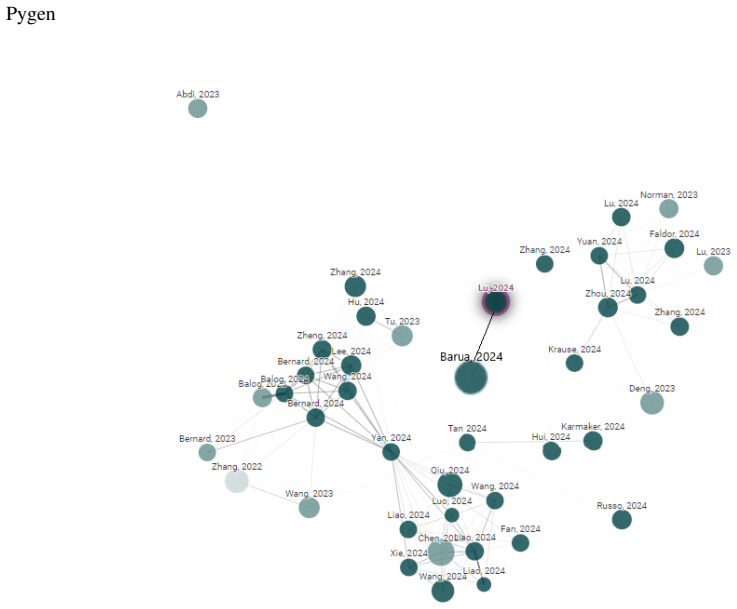
- [Figure 2 caption] The caption states 'The large central node presents our paper,' but the figure does not contain a legend or labeled nodes, so readers cannot identify which node corresponds to the present paper.
- [§7, Safety and Ethical Considerations] The statement 'Pygen does not directly execute code; it simply generates packages' is factually true, but the following sentence 'This ensures that it cannot cause harm to the user or their systems' is too strong: generated code executed by the user can certainly cause harm, and no evidence is provided that the claimed prompt-enhancement filtering or model guardrails are effective.
- [Various] There are several typos and formatting errors, including 'Pygen do just that' (Section 1), 'The graph3 shows' (Section 6.3), and 'Evalaute' in Algorithm 3; a careful proofread is needed.
Circularity Check
CodeBLEU is scored against a template created inside the pipeline, making the headline context-prompt quality improvement partly self-referential; the productivity claim is asserted without direct measurement.
-
self definitional
[Section 6.4 (Assessing the Package Generation Process); Section 6 (Results) opening paragraph]
"During calculating the CodeBLEU score, a template code is created, providing the model with a basic skeletal structure, based on which the generated code quality and score are assessed relative to this template."
CodeBLEU is the quantitative evidence for the headline claim that prompt context 'significantly improves' generation quality (Section 6.3, Table 1). But the reference against which CodeBLEU is computed is 'a template code' created inside the pipeline (Section 6.4), and Section 6 also says that context prompts 'sometimes included code templates for better caching and accuracy.' The model is therefore graded on how closely its output reproduces a scaffold that the pipeline itself supplied; high CodeBLEU partly measures prompt adherence, not external correctness, usability, or productivity. The reported improvement is thus partly by construction rather than by an independent benchmark.
full rationale
The paper's central quantitative claim, that prompt context materially improves generated package quality (Section 6.3, Table 1), rests on CodeBLEU scores computed against a template created inside the pipeline. Section 6.4 states that a template code is created as the reference, and Section 6 says the context prompts sometimes included code templates. This makes the evaluation self-referential: the score measures similarity to a scaffold the system itself supplied. The additional human and LLM Likert evaluations provide some independent, though subjective, support for quality, and the system artifact is open-sourced, so the core engineering claim is not entirely forced. No load-bearing self-citation chain was found: prior works by the same authors (KAXAI, ELMAGIC, RESCUED, the agent review) appear only as background. Separately, Table 1's prose ('spectacular gains of 17% and 16%') contradicts the table's own values (6% and 7% absolute percentage-point changes), and the abstract's productivity-overhead claim has no direct manual-development baseline; these are reporting/correctness concerns rather than circularity. The score of 6 reflects the one partial by-construction evaluation step.
Assumptions & free parameters
free parameters (3)
- lambda in Eq. (5) =
No value specified
- alpha in Eq. (10) =
No value specified
- gamma in Eq. (6) =
No value specified
assumptions (4)
- domain assumption Autoregressive LLMs exposed through Groq, Google AI Studio, or Ollama produce syntactically valid, runnable Python code from enhanced prompts.
- ad hoc to paper CodeBLEU against the pipeline's own template is a valid measure of code quality.
- domain assumption Subjective 1-10 scores from LLMs and humans capture package and documentation quality.
- domain assumption The four author-chosen packages are representative of general package generation workloads.
Cite this review
Pith. "Pith review of PyGen: A Collaborative Human-AI Approach to Python Package Creation." pith.science (2026). https://pith.science/paper/3YXWGMYL
@misc{pith2026241108932,
  author       = {Pith},
  title        = {Pith review of: PyGen: A Collaborative Human-AI Approach to Python Package Creation},
  year         = {2026},
  howpublished = {\url{https://pith.science/paper/3YXWGMYL}},
  note         = {Machine review of arXiv:2411.08932}
}
read the original abstract
The principles of automation and innovation serve as foundational elements for advancement in contemporary science and technology. Here, we introduce Pygen, an automation platform designed to empower researchers, technologists, and hobbyists to bring abstract ideas to life as core, usable software tools written in Python. Pygen leverages the immense power of autoregressive large language models to augment human creativity during the ideation, iteration, and innovation process. By combining state-of-the-art language models with open-source code generation technologies, Pygen has significantly reduced the manual overhead of tool development. From a user prompt, Pygen automatically generates Python packages for a complete workflow from concept to package generation and documentation. The findings of our work show that Pygen considerably enhances the researcher's productivity by enabling the creation of resilient, modular, and well-documented packages for various specialized purposes. We employ a prompt enhancement approach to distill the user's package description into increasingly specific and actionable. While being inherently an open-ended task, we have evaluated the generated packages and the documentation using Human Evaluation, LLM-based evaluation, and CodeBLEU, with detailed results in the results section. Furthermore, we documented our results, analyzed the limitations, and suggested strategies to alleviate them. Pygen is our vision of ethical automation, a framework that promotes inclusivity, accessibility, and collaborative development. This project marks the beginning of a large-scale effort towards creating tools where intelligent agents collaborate with humans to improve scientific and technological development substantially. Our code and generated examples are open-sourced at [https://github.com/GitsSaikat/Pygen]
Figures


Figures from the paper (10 more)


Reference graph
Works this paper leans on
-
[79]
Language Models as Inductive Reasoners
Yang, Z., et al. (2022). "Language Models as Inductive Reasoners." Journal of Artificial Intelligence Research, 63, 521-540
work page 2022
-
[103]
Automated Design of Agentic Systems Using Meta-Agent Programming
Hu, G., et al. (2024). "Automated Design of Agentic Systems Using Meta-Agent Programming." Meta-Agent Systems Journal, 9(2), 70-88. 33
work page 2024
-
[1]
G., & Campbell, D
Carayannis, E. G., & Campbell, D. F. J. (2012). Mode 3 Knowledge Production in Quadruple Helix Innovation Systems. Springer
2012
-
[2]
Brynjolfsson, E., & McAfee, A. (2014). The Second Machine Age: Work, Progress, and Prosperity in a Time of Brilliant Technologies. W. W. Norton and Company
2014
-
[3]
Boden, M. A. (2004). The Creative Mind: Myths and Mechanisms. Routledge
2004
-
[4]
Barrett, T., Fox, J., & Adams, M. (2020). A Taxonomy of Impactful Breakthrough Innovations in Science and Technology.Journal of Innovation Studies
2020
-
[5]
L., Sarachaga, I., Burgos, A., Estévez, E., & Marcos, M
Alvarez, M. L., Sarachaga, I., Burgos, A., Estévez, E., & Marcos, M. (2018). A Methodological Approach to Model-Driven Design and Development of Automation Systems. IEEE Transactions on Automation Science and Engineering, 15, 67–79
2018
-
[6]
Jackson, D. (2006). Software Abstractions - Logic, Language, and Analysis. IEEE Transactions on Automation Science and Engineering, I-XVI, 1–350
2006
Show all 103 references
-
[7]
Shaw, M. (1990). Toward Higher-Level Abstractions for Software Systems. Data Knowl. Eng., 5, 119–128
1990
-
[8]
Yao, S., Yu, D., Zhao, J., Shafran, I., Griffiths, T., Cao, Y ., Narasimhan, K., et al. (2023). Tree of Thoughts: Deliberate Problem Solving with Large Language Models. ArXiv, abs/2305.10601
2023 arXiv
-
[9]
Cai, T., Wang, X., Ma, T., Chen, X., Zhou, D., et al. (2023). Large Language Models as Tool Makers. ArXiv, abs/2305.17126
2023 arXiv
-
[10]
Qin, Y ., Hu, S., Lin, Y ., Chen, W., Ding, N., Cui, G., Zeng, Z., Huang, Y ., Xiao, C., Han, C., Fung, Y ., Su, Y ., Wang, H., Qian, C., Tian, R., Zhu, K., Liang, S., Shen, X., Xu, B., Zhang, Z., Ye, Y ., Li, B., Tang, Z., Yi, J., Dai, Z., Yan, L., Cong, X., Lu, Y .-T., Zhao,...
2023 arXiv
-
[11]
T., Maynord, M., & Perlis, D
Paisner, M., Cox, M. T., Maynord, M., & Perlis, D. (2014). Goal-Driven Autonomy for Cognitive Systems. Cognitive Science, 36
2014
-
[12]
Anthropic. (2024). Advances in Large Language Models and Safety Considerations. Anthropic
2024
-
[13]
Google DeepMind Gemini Team. (2023). Gemini: A Multimodal Approach to Advanced AI Capabilities. ArXiv
2023
-
[14]
Llama Team. (2024). LLaMA 3: Scaling Language Models for Enhanced Understanding and Efficiency. ArXiv. Meta AI
2024
-
[15]
OpenAI. (2023). GPT-4 Technical Report. OpenAI. Retrieved from https://openai.com/research/gpt-4
2023
-
[16]
T., Foerster, J., Clune, J., & Ha, D
Lu, C., Lu, C., Lange, R. T., Foerster, J., Clune, J., & Ha, D. (2024). The AI Scientist: Towards Fully Automated Open-Ended Scientific Discovery. ArXiv, arXiv:2408.06292. Retrieved from https://ar5iv.org/abs/2408. 06292
2024 arXiv
-
[17]
Shneiderman, B. (2000). Creating creativity: User interfaces for supporting innovation. ACM Transactions on Computer-Human Interaction, 7, 114–138
2000
-
[18]
Hwang, A. (2022). Too Late to be Creative? AI-Empowered Tools in Creative Processes. InCHI Conference on Human Factors in Computing Systems Extended Abstracts
2022
-
[19]
Nielsen, M., Tomaselli, K., Mushin, I., & Whiten, A. (2014). Exploring tool innovation: A comparison of Western and Bushman children. Journal of Experimental Child Psychology, 126, 384–394
2014
-
[20]
Stout, D., & Chaminade, T. (2007). The evolutionary neuroscience of tool making. Neuropsychologia, 45, 1091–1100
2007
-
[21]
M., Hauth, A., et al
Team, G., Anil, R., Borgeaud, S., Wu, Y ., Alayrac, J.-B., Yu, J., Soricut, R., Schalkwyk, J., Dai, A. M., Hauth, A., et al. (2023). Gemini: a family of highly capable multimodal models. ArXiv preprint arXiv:2312.11805
2023 arXiv
-
[22]
Touvron, H., Lavril, T., Izacard, G., Martinet, X., Lachaux, M.-A., Lacroix, T., Rozière, B., Goyal, N., Hambro, E., Azhar, F., Rodriguez, A., Joulin, A., Grave, E., & Lample, G. (2023). LLaMA: Open and Efficient Foundation Language Models. ArXiv, abs/2302.13971. Retrieved fro...
2023 arXiv
-
[23]
Talmor, A., Herzig, J., Lourie, N., & Berant, J. (2019). CommonsenseQA: A Question Answering Challenge Targeting Commonsense Knowledge. InProceedings of the 2019 Conference of the North American Chapter of the Association for Computational Linguistics: Human Language Technolog...
2019
-
[24]
H., Le, Q
Wei, J., Wang, X., Schuurmans, D., Bosma, M., Ichter, B., Xia, F., Chi, E. H., Le, Q. V ., & Zhou, D. (2022). Chain of Thought Prompting Elicits Reasoning in Large Language Models. ArXiv preprint arXiv:2201.11903. Retrieved from https://arxiv.org/abs/2201.11903
2022 arXiv
-
[25]
Q., Sablayrolles, A., Mensch, A., Bamford, C., Chaplot, D
Jiang, A. Q., Sablayrolles, A., Mensch, A., Bamford, C., Chaplot, D. S., de Las Casas, D., Bressand, F., Lengyel, G., Lample, G., Saulnier, L., Lavaud, L. R., Lachaux, M.-A., Stock, P., Le Scao, T., Lavril, T., Wang, T., Lacroix, T., & El Sayed, W. (2023). Mistral 7B.ArXiv pre...
2023 arXiv
-
[26]
C., & Stanley, K
Brant, J. C., & Stanley, K. O. (2017). Minimal criterion coevolution: a new approach to open-ended search. In Proceedings of the Genetic and Evolutionary Computation Conference, 67–74
2017
-
[27]
O., Lehman, J., & Soros, L
Stanley, K. O., Lehman, J., & Soros, L. (2017). Open-endedness: The last grand challenge you’ve never heard of. In While open-endedness could be a force for discovering intelligence, it could also be a component of AI itself
2017
-
[28]
Lehman, J., Gordon, J., Jain, S., Ndousse, K., Yeh, C., & Stanley, K. O. (2022). Evolution through Large Models. ArXiv, abs/2206.08896. Retrieved from https://arxiv.org/abs/2206.08896
2022 arXiv
-
[29]
Lester, B., Al-Rfou, R., & Constant, N. (2021). The power of scale for parameter-efficient prompt tuning. ArXiv preprint arXiv:2104.08691
2021 arXiv
-
[30]
L., Du, Z., Yang, Z., & Tang, J
Liu, X., Ji, K., Fu, Y ., Tam, W. L., Du, Z., Yang, Z., & Tang, J. (2021). P-tuning v2: Prompt tuning can be comparable to fine-tuning universally across scales and tasks. ArXiv preprint arXiv:2110.07602
2021 arXiv
-
[31]
Jia, M., Tang, L., Chen, B.-C., Cardie, C., Belongie, S., Hariharan, B., & Lim, S.-N. (2022). Visual prompt tuning. In European Conference on Computer Vision(pp. 709–727). Springer
2022
-
[32]
Zhu, B., Niu, Y ., Han, Y ., Wu, Y ., & Zhang, H. (2023). Prompt-aligned gradient for prompt tuning. InProceedings of the IEEE/CVF International Conference on Computer Vision (pp. 15659–15669)
2023
-
[33]
Zhang, R., Hu, X., Li, B., Huang, S., Deng, H., Qiao, Y ., Gao, P., Li, H., et al. (2023). Prompt, generate, then cache: Cascade of foundation models makes strong few-shot learners. In Proceedings of the IEEE/CVF Conference on Computer Vision and Pattern Recognition(pp. 15211–15222)
2023
-
[34]
Gim, I., Chen, G., Lee, S.-S., Sarda, N., Khandelwal, A., & Zhong, L. (2024). Prompt cache: Modular attention reuse for low-latency inference. Proceedings of Machine Learning and Systems, 6, 325–338
2024
-
[35]
Hellmann, D. (2011). The Python standard library by example. Addison-Wesley Professional
2011
-
[36]
Ahmed, I., Parmar, S., Boyd, M., Beidler, M., Kang, K., Liu, B., Roach, K., Kim, J., & Abts, D. (2022). Answer fast: Accelerating BERT on the tensor streaming processor. In 2022 IEEE 33rd International Conference on Application-specific Systems, Architectures and Processors (A...
2022
-
[37]
Abts, D., Kimmell, G., Ling, A., Kim, J., Boyd, M., Bitar, A., Parmar, S., Ahmed, I., DiCecco, R., Han, D., et al. (2022). A software-defined tensor streaming multiprocessor for large-scale machine learning. In Proceedings of the 49th Annual International Symposium on Computer...
2022
-
[38]
Zhi, J., Garousi-Yusifo˘glu, V ., Sun, B., Garousi, G., Shahnewaz, S., & Ruhe, G. (2015). Cost, benefits and quality of software development documentation: A systematic mapping. J. Syst. Softw., 99, 175–198
2015
-
[39]
N., Kaiser, Ł., & Polosukhin, I
Vaswani, A., Shazeer, N., Parmar, N., Uszkoreit, J., Jones, L., Gomez, A. N., Kaiser, Ł., & Polosukhin, I. (2017). Attention is All You Need. In Advances in Neural Information Processing Systems (pp. 5998–6008)
2017
-
[40]
P., & Ba, J
Kingma, D. P., & Ba, J. (2014). Adam: A Method for Stochastic Optimization. ArXiv preprint arXiv:1412.6980
2014 arXiv
-
[41]
Srivastava, N., Hinton, G., Krizhevsky, A., Sutskever, I., & Salakhutdinov, R. (2014). Dropout: A Simple Way to Prevent Neural Networks from Overfitting. Journal of Machine Learning Research, 15(1), 1929–1958
2014
-
[42]
Radford, A., Wu, J., Child, R., Luan, D., Amodei, D., & Sutskever, I. (2019). Language Models are Unsupervised Multitask Learners. OpenAI Blog
2019
-
[43]
Kwak, B.-J., Song, N.-O., & Miller, L. E. (2005). Performance analysis of exponential backoff. IEEE/ACM transactions on networking, 13(2), 343–355
2005
-
[44]
Lindner, D., Turchetta, M., Tschiatschek, S., Ciosek, K., & Krause, A. (2021). Information directed reward learning for reinforcement learning. Advances in Neural Information Processing Systems, 34, 3850–3862
2021
-
[45]
A., Veness, J., Bellemare, M
Mnih, V ., Kavukcuoglu, K., Silver, D., Rusu, A. A., Veness, J., Bellemare, M. G., & Hassabis, D. (2015). Human-level control through deep reinforcement learning. Nature, 518, 529–533
2015
-
[46]
P., Hermann, K., Welleck, S., Yazdanbakhsh, A., Clark, P
Madaan, A., Tandon, N., Gupta, P., Hallinan, S., Gao, L., Wiegreffe, S., Alon, U., Dziri, N., Prabhumoye, S., Yang, Y ., Gupta, S., Majumder, B. P., Hermann, K., Welleck, S., Yazdanbakhsh, A., Clark, P. (2023). Self- Refine: Iterative Refinement with Self-Feedback. ArXiv prepr...
2023 arXiv
-
[47]
M., Myrzakhan, A., & Shen, Z
Bsharat, S. M., Myrzakhan, A., & Shen, Z. (2024). Principled Instructions Are All You Need for Questioning LLaMA-1/2, GPT-3.5/4. ArXiv preprint arXiv:2312.16171. Retrieved from https://arxiv.org/abs/2312. 16171
2024 arXiv
-
[48]
He, X., Zhao, K., & Chu, X. (2019). AutoML: A Survey of the State-of-the-Art. ArXiv, abs/1908.00709
2019 arXiv
-
[49]
Feurer, M., Eggensperger, K., Falkner, S., Lindauer, M., & Hutter, F. (2020). Auto-Sklearn 2.0: Hands-free AutoML via Meta-Learning. J. Mach. Learn. Res., 23, 261:1–261:61
2020
-
[50]
Waring, J., Lindvall, C., & Umeton, R. (2020). Automated machine learning: Review of the state-of-the-art and opportunities for healthcare. Artificial Intelligence in Medicine, 104, 101822
2020
-
[51]
(Santu), Hassan, M
Karmaker, S. (Santu), Hassan, M. M., Smith, M. J., Xu, L., Zhai, C., & Veeramachaneni, K. (2020). AutoML to Date and Beyond: Challenges and Opportunities. ACM Computing Surveys (CSUR), 54, 1–36
2020
-
[52]
Gijsbers, P., LeDell, E., Thomas, J., Poirier, S., Bischl, B., & Vanschoren, J. (2019). An Open Source AutoML Benchmark. ArXiv, abs/1907.00909
2019 arXiv
-
[53]
Barua, S., & Momen, S. (2023). Kaxai: An integrated environment for knowledge analysis and explainable ai. ArXiv preprint arXiv:2401.00193
2023 arXiv
-
[54]
H., Rahmani, H., Shah, S
Khan, S. H., Rahmani, H., Shah, S. A. A., & Bennamoun. (2018). A Guide to Convolutional Neural Networks for Computer Vision. Morgan & Claypool Publishers
2018
-
[55]
Xu, S., Wang, J., Shou, W., Ngo, T., Sadick, A.-M., & Wang, X. (2020). Computer Vision Techniques in Construction: A Critical Review. Archives of Computational Methods in Engineering, 28, 3383–3397
2020
-
[56]
Feng, X., Jiang, Y ., Yang, X., Du, M., & Li, X. (2019). Computer Vision Algorithms and Hardware Implementa- tions: A Survey. Integration, 69, 309–320
2019
-
[57]
Danuser, G. (2011). Computer Vision in Cell Biology. Cell, 147, 973–978
2011
-
[58]
Moeslund, T., & Granum, E. (2001). A Survey of Computer Vision-Based Human Motion Capture.Computer Vision and Image Understanding, 81, 231–268
2001
-
[59]
U., Islam, R., & Sadek, M
Barua, S., Rahman, M., Saad, M. U., Islam, R., & Sadek, M. J. (2024). ELMAGIC: Energy-Efficient Lean Model for Reliable Medical Image Generation and Classification Using Forward Forward Algorithm. In 2024 IEEE 3rd International Conference on Computing and Machine Intelligence ...
2024
-
[60]
B., Shahin, I., Attili, I
Nassif, A. B., Shahin, I., Attili, I. B., Azzeh, M., & Shaalan, K. (2019). Speech Recognition Using Deep Neural Networks: A Systematic Review. IEEE Access, 7, 19143–19165
2019
-
[61]
Sun, S., Zhang, B., Xie, L., & Zhang, Y . (2017). An unsupervised deep domain adaptation approach for robust speech recognition. Neurocomputing, 257, 79–87
2017
-
[62]
A., Jones, E., Babar, M
Khalil, R. A., Jones, E., Babar, M. I., Jan, T., Zafar, M. H., & Alhussain, T. (2019). Speech Emotion Recognition Using Deep Learning Techniques: A Review.IEEE Access, 7, 117327–117345
2019
-
[63]
Wenger, E., Bronckers, M., Cianfarani, C., Cryan, J., Sha, A., Zheng, H., & Zhao, B. Y . (2021). Hello, It’s Me: Deep Learning-based Speech Synthesis Attacks in the Real World. In Proceedings of the 2021 ACM SIGSAC Conference on Computer and Communications Security
2021
-
[64]
Lloyd, S., & Slotine, J.-J. E. (1997). Analog quantum error correction. Physical Review Letters, 80, 4088–4091
1997
-
[65]
M., Shor, P
Calderbank, A., Rains, E. M., Shor, P. W., & Sloane, N. J. A. (1996). Quantum error correction and orthogonal geometry. Physical Review Letters, 78, 405–408
1996
-
[66]
Schindler, P., Barreiro, J., Monz, T., Nebendahl, V ., Nigg, D., Chwalla, M., Hennrich, M., & Blatt, R. (2011). Experimental repetitive quantum error correction. Science, 332, 1059–1061
2011
-
[67]
Ekert, A., & Macchiavello, C. (1996). Error correction in quantum communication. Physical Review Letters, 77, 2585–2588
1996
-
[68]
Devitt, S., Munro, W., & Nemoto, K. (2009). Quantum error correction for beginners.Reports on Progress in Physics, 76
2009
-
[69]
Barua, S., Shubha, S. E. U., Rahman, M., Uchash, A. J., & Mahdy, M. R. C. (2023). RESCUED: Robust Quantum Error Correction with Surface Code in Noisy Channels Using Ensemble Decoder. In 2023 IEEE International Conference on Telecommunications and Photonics (ICTP)(pp. 01–05). IEEE
2023
-
[70]
Schumacher, B., & Westmoreland, M. D. (2002). Approximate quantum error correction. Quantum Information Processing, 1, 5–12. 31 Pygen
2002
-
[71]
Inan, H., Upasani, K., Chi, J., Rungta, R., Iyer, K., Mao, Y ., Tontchev, M., Hu, Q., Fuller, B., Testuggine, D., Khabsa, M., & others. (2023). Llama Guard: LLM-based Input-Output Safeguard for Human-AI Conversations. ArXiv preprint arXiv:2312.06674. Retrieved from https://arx...
2023 arXiv
-
[72]
Bai, Y ., Jones, A., Ndousse, K., & others. (2022). Constitutional AI: Harmlessness from AI Feedback.ArXiv preprint arXiv:2212.08073
2022 arXiv
-
[73]
Ouyang, L., Wu, J., Jiang, X., & others. (2022). Training language models to follow instructions with human feedback. Advances in Neural Information Processing Systems
2022
-
[74]
Perez, E., Michel, P., Yuan, L., & others. (2022). Red Teaming Language Models with Language Models.ArXiv preprint arXiv:2202.03286
2022 arXiv
-
[75]
Chen, M., Tworek, J., Jun, H., & others. (2021). Evaluating large language models trained on code. ArXiv preprint arXiv:2107.03374
2021 arXiv
-
[76]
Drori, I., Verma, S., & Zhang, Y . (2022). Automated testing and debugging of code generated by large language models. ArXiv preprint arXiv:2206.13162
2022 arXiv
-
[77]
Ren, S., Liu, D., Fang, Y ., & others. (2020). CodeBLEU: a method for evaluating code generation. InProceedings of the 28th International Conference on Computational Linguistics (pp. 4528–4533)
2020
-
[78]
Barua, S. (2024). Exploring autonomous agents through the lens of large language models: A review. arXiv preprint arXiv:2404.04442
2024 arXiv
-
[80]
Goal-Driven Discovery Using Language Descriptions
Zhong, Y ., et al. (2023). "Goal-Driven Discovery Using Language Descriptions." Machine Learning Research Letters, 12(1), 45-58
2023
-
[81]
Symbolic Learning for Self-Evolving Agents
Zhou, H., et al. (2024). "Symbolic Learning for Self-Evolving Agents." Artificial Intelligence Advances, 7, 211-225
2024
-
[82]
AgentVerse: Multi-Agent Framework for Dynamic Adaptation
Chen, X., et al. (2023). "AgentVerse: Multi-Agent Framework for Dynamic Adaptation." Proceedings of the Conference on Collaborative AI, 34-47
2023
-
[83]
Adaptive Team Building in Multi-Agent Systems
Song, L., et al. (2024). "Adaptive Team Building in Multi-Agent Systems." IEEE Transactions on Intelligent Systems, 13(4), 567-578
2024
-
[84]
Generating Interdisciplinary Research Ideas Using Knowledge Graphs and LLMs
Gu, M., and Krenn, M. (2024). "Generating Interdisciplinary Research Ideas Using Knowledge Graphs and LLMs." Nature Scientific Insights, 5, 123-134
2024
-
[85]
MAgIC: Benchmarking LLM Agents on Adaptability and Collaboration
Xu, Y ., et al. (2023). "MAgIC: Benchmarking LLM Agents on Adaptability and Collaboration." Advances in Neural Information Processing Systems, 36, 987-996
2023
-
[86]
ToolLLM: Enabling LLMs to Utilize Real-World APIs
Qin, R., et al. (2023). "ToolLLM: Enabling LLMs to Utilize Real-World APIs." Journal of Computational Methods, 29(2), 185-197
2023
-
[87]
EvoAgent: Evolutionary Extension of Expert Agents into Multi-Agent Systems
Yuan, T., et al. (2024). "EvoAgent: Evolutionary Extension of Expert Agents into Multi-Agent Systems." Evolutionary Computation Letters, 11(3), 345-357
2024
-
[88]
MASAI: Modular Architecture for Software Engineering Agents
Arora, S., et al. (2024). "MASAI: Modular Architecture for Software Engineering Agents." Software Develop- ment and Engineering, 9(1), 22-33
2024
-
[89]
Can LLMs Generate Novel Research Ideas?
Si, K., et al. (2024). "Can LLMs Generate Novel Research Ideas?" Journal of Emerging AI Technologies, 16(4), 441-455
2024
-
[90]
AutoManual: Framework for LLMs to Generate Instruction Manuals
Chen, L., et al. (2024). "AutoManual: Framework for LLMs to Generate Instruction Manuals." Robotics and Autonomous Systems, 55(2), 150-162
2024
-
[91]
Language-Based Agents as Optimizable Graphs
Zhuge, Q., et al. (2024). "Language-Based Agents as Optimizable Graphs." Graph Optimization Advances, 8(1), 301-314
2024
-
[92]
AgentScope: Enhancing Multi-Agent Robustness and Coordination
Gao, F., et al. (2024). "AgentScope: Enhancing Multi-Agent Robustness and Coordination." Journal of Multi- Agent Systems, 21(3), 380-392
2024
-
[93]
SciMON: Generating Research Ideas Grounded in Scientific Literature
Wang, Z., et al. (2023). "SciMON: Generating Research Ideas Grounded in Scientific Literature." IEEE Transac- tions on Knowledge Discovery, 14(5), 189-202
2023
-
[94]
Unlocking Interdisciplinary Research with LLMs
Kumar, V ., et al. (2024). "Unlocking Interdisciplinary Research with LLMs." Journal of Cognitive Systems, 18(1), 78-92
2024
-
[95]
Automated Open-Domain Hypothesis Discovery
Yang, P., et al. (2023). "Automated Open-Domain Hypothesis Discovery." Journal of Scientific Discovery and Methods, 29(3), 112-128. 32 Pygen
2023
-
[96]
CodeAct: Executable Actions for LLM Agents
Wang, H., et al. (2024). "CodeAct: Executable Actions for LLM Agents." Computational Intelligence Journal, 25(2), 95-110
2024
-
[97]
Zero-Shot Hypothesis Generation Using LLMs
Qi, X., et al. (2023). "Zero-Shot Hypothesis Generation Using LLMs." AI Research Communications, 32(7), 222-234
2023
-
[98]
ChemReasoner: AI-Driven Catalyst Discovery Using Quantum Feedback
Sprueill, J., et al. (2024). "ChemReasoner: AI-Driven Catalyst Discovery Using Quantum Feedback." Journal of Chemical AI, 10(4), 250-268
2024
-
[99]
Promptbreeder: Self-Improvement for LLM Prompts
Fernando, J., et al. (2023). "Promptbreeder: Self-Improvement for LLM Prompts." Neural Networks and Reasoning, 18(6), 65-77
2023
-
[100]
The Homogenization Effect of LLMs on Creative Ideation
Anderson, M., et al. (2024). "The Homogenization Effect of LLMs on Creative Ideation." Creativity Support Systems, 19(2), 89-105
2024
-
[101]
Gödel Agent: A Framework for Recursive Self-Improvement
Yin, R., et al. (2024). "Gödel Agent: A Framework for Recursive Self-Improvement." AI Recursive Methods, 15(3), 214-230
2024
-
[102]
MLR-Copilot: Machine Learning Research Assistant Using LLMs
Li, N., et al. (2024). "MLR-Copilot: Machine Learning Research Assistant Using LLMs." Journal of Automated Research, 12(5), 301-312
2024
Reviewed August 12, 2026 · model on record in the stance chip above.
Discussion (0). Continue with ORCID to comment.