REVIEW 4 major objections 6 minor 31 references
A Novel MLLM-based Approach for Autonomous Driving in Different Weather Conditions
T0 review · 4 major / 6 minor · reviewed 2026-08-12 · deepseek-v4-flash
Pith's one-line read A prompt-engineered GPT-4o agent can drive a simulated car well in heavy rain, storm, fog, and wetness.
desk verdict Useful sensor-ablation data for a prompt-engineered GPT-4o driving agent, but undefined and inconsistent evaluation metrics sink the headline claims. read the letter →
The pith
A machine-rendered reading of the paper's core claim, the machinery that carries it, and where it could break.
The reading
What carries the argument
The central object is MLLM-AD-4o, a prompt-engineered agent that couples GPT-4o (a multimodal large language model) to the LimSim++ closed-loop simulation framework, which in turn co-simulates CARLA (the driving simulator) and SUMO (the traffic simulator). At each decision frame, the agent sends a prompt—containing the current camera images, optionally LiDAR data, navigation information, and an action set—to the GPT-4o API, and receives back a single action (idle, accelerate, decelerate, turn left, turn right). The authors also add a 'set weather' function to CARLA that configures eight parameters (cloudiness, precipitation, precipitation deposits, wind intensity, sun altitude angle, fog density, fog distance, wetness) to create the five weather conditions tested.
What would settle it
Re-run the same Town-06 route and weather conditions with the comfort score recomputed from a standard definition (e.g., the 95th percentile of jerk magnitude) and the speed score computed exactly as its prose says (0.9 when speeding, 1 otherwise); if the weather-condition rankings of the CDFs change, the reported safety, comfort, and efficiency conclusions are artifacts of the undefined metric formulas.
Extended reading notes
Core claim
The central claim is that MLLM-AD-4o, a GPT-4o-based agent that receives only a hand-crafted prompt and sensor images, can keep high safety, comfort, efficiency, and speed scores across five weather conditions in the CARLA simulator, and that these scores trade off against each other in a weather-dependent way. In good weather the agent drives more aggressively, being riskier but more efficient; in heavy rain and storm it drives slower, being safer and smoother but less efficient. The agent's sensor configuration matters: adding three rear cameras improves performance, especially in good weather, and combining LiDAR with three front cameras gives the best safety and comfort in heavy rain, while combining LiDAR with all six cameras degrades the results.
Load-bearing premise
The central claim rests on the evaluation metrics in Section V-A being valid measures of safety, comfort, and efficiency; the paper never defines the sub-scores used in the comfort equation, and the speed score's prose description contradicts its equation, so if the metric definitions are wrong or arbitrary the 'high safety and efficiency' result is unsupported.
Editorial extensions
If this is right
- If the central claim holds, prompt-engineered MLLMs can serve as zero-shot driving decision-makers without fine-tuning, suggesting a lower-cost route to simulation-based AD research.
- The sensor-ablation results imply that adding perception channels does not monotonically improve an MLLM agent; the right sensor mix depends on weather conditions.
- The weather-specific trade-offs (e.g., safer and smoother but less efficient in heavy rain) suggest that an MLLM agent can implicitly adapt its risk-taking to environmental conditions.
- The finding that LiDAR with six cameras degrades performance points to a need for careful sensor fusion rather than simply adding more sensors.
Reading between the lines
- An implicit extension is that the same prompt-engineering recipe could be ported to other MLLMs or other simulators, but the paper does not demonstrate this.
- The authors do not compare against a fine-tuned or reinforcement-learned agent; a natural next test would be whether MLLM-AD-4o's weather robustness beats those baselines.
- The observation that rear cameras improve performance mainly in good weather could reflect the model's training distribution rather than a general perceptual benefit; that would be testable by varying the prompt wording.
- The metrics are the load-bearing part; an external reader could re-run the same CDF analysis with standard jerk and TTC definitions to check whether the reported rankings persist.
Editorial analysis
A structured set of objections, weighed in public.
Referee Report
Summary. The paper proposes MLLM-AD-4o, a prompt-engineered autonomous driving agent based on GPT-4o integrated into the LimSim++/CARLA closed-loop simulator. The authors extend LimSim++ with six-camera support, a weather-management function, and semantic LiDAR integration, and they evaluate the agent under five weather conditions and several sensor configurations. The headline claims are that the agent maintains high safety and efficiency across adverse weather and that activating front and rear cameras (and, selectively, LiDAR) changes performance. The evaluation uses CDFs of safety, comfort, efficiency, and speed scores defined in Section V-A.
Significance. If the evaluation were fully specified, the paper would be a useful empirical data point on the feasibility of using a general-purpose MLLM for closed-loop driving control under adverse weather. The authors contribute an open-source modification of the LimSim++ platform, which supports reproducibility. The central quantitative claim, however, is currently unsupported because the metrics used to compute every reported score are incomplete or contradictory, and because no baseline or absolute threshold is provided to justify the phrase 'high levels of safety and efficiency.' The manuscript's conclusions about sensor configurations are qualitative and not backed by statistical tests.
major comments (4)
- [Section V-A, Eqs. (1)-(4)] The four performance scores that underlie every figure and conclusion are not adequately defined. The comfort score in Eq. (2) is the average of 'acc score', 'jerk score', 'lat acc score', and 'lat jerk score', but none of these sub-scores is defined anywhere in the manuscript. The safety score in Eq. (1) requires a threshold τ_th that is never specified. The efficiency score in Eq. (3) depends on v* ∈ {v_avg, v_limit}, but the paper does not state how v_avg is computed, how sparse versus regular traffic is determined, or how the choice between the two targets is made. The speed score's prose states it is '0.9 when the AV exceeds the speed limit and 1 otherwise', which contradicts Eq. (4), an aggregate exponential penalty over the fraction of speeding frames; the two only coincide at exactly 10% speeding frames. Because every headline result is a statement about these scores, the central claim is currently not reproducible or interpretable.
- [Section V-A, parameters] The parameters α1, α2, α3 are assigned values but never appear in any equation or in the analysis. If they are intended for a weighted combination of the four scores, that combination is missing; otherwise they should be removed. Their presence suggests an intended overall performance index that is never defined, and the reader cannot tell which results, if any, depend on these weights.
- [Section V-E, Figs. 4-6] The conclusions are drawn from qualitative comparisons of CDFs without any baseline or statistical significance test. In particular, the abstract's claim that the agent maintains 'high levels of safety and efficiency' is not supported by the data as presented: the safety CDFs in Fig. 4a lie in the range 0.95-1, but without an absolute threshold or a comparison to a reference system there is no basis for calling these values 'high'. Similarly, the statement in Section V-E and the Conclusion that adding rear cameras 'significantly enhances the system's performance' is not backed by any statistical test; 'significantly' appears to be used in a non-statistical sense. The authors should provide a baseline (e.g., a rule-based agent or another MLLM agent) and, ideally, confidence intervals or hypothesis tests for the CDF comparisons.
- [Section II, Table I and Section IV-C] The manuscript claims that no prior work has fully assessed MLLM-based driving agents in a closed-loop framework under harsh environmental conditions, yet Table I already lists Co-driver [27] with foggy/gloomy and rainy/gloomy environments. The novelty claim is therefore overstated, and the related-work comparison should clarify exactly what is new relative to that work: is it the specific agent (GPT-4o), the sensor configuration, the set of weather parameters, or the evaluation metrics?
minor comments (6)
- [Fig. 4d] The caption of Fig. 4d says 'Front cameras' but the figure includes curves labeled 'Good Weather 6 CAMS' and 'Wetness 6 CAMS'; the footnote only partially explains this. The caption should be updated to reflect the inclusion of 6-camera speed scores.
- [Table III] There is inconsistent naming in Table III: 'precipita tion deposits' appears with a space and later as 'precipitation deposits'; 'fog density' is split as 'fog density' in some rows. Unify the parameter names for clarity.
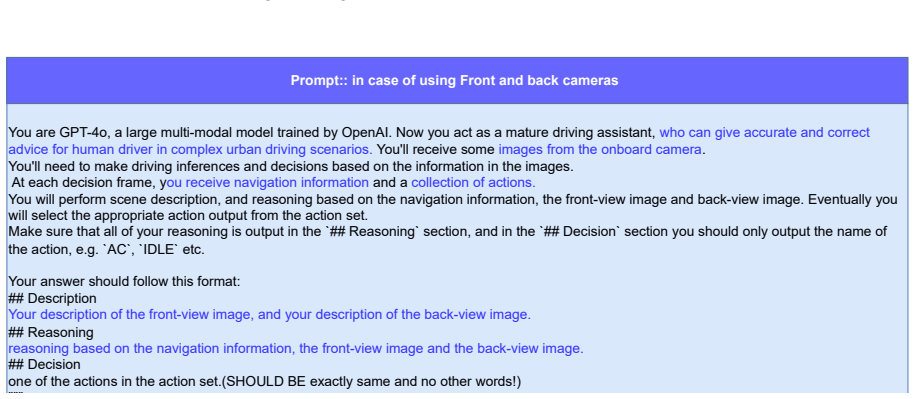
- [Fig. 3] The prompt text in Fig. 3 contains a stray triple-quote (""") after 'SHOULD BE exactly same and no other words!', and the closing delimiter is misaligned. Fix the formatting so the prompt is shown exactly as used.
- [Section IV-A] The description of Town-06 says it is a 'low-density town' but also has 'long highways/roads with multiple lanes (4 to 6) per direction'; please clarify whether this is the only map used in all experiments and how representative it is of the weather scenarios studied.
- [Section V-E] The phrase 'best CDF' is used repeatedly (e.g., 'the best safety CDF is achieved in heavy rain'). Since CDFs are curves, 'best' should be defined in terms of a stochastic order (e.g., first-order stochastic dominance) or a summary statistic (e.g., mean score) to make the comparisons precise.
- [Abstract and Section V-A] The abstract and introduction state that the paper evaluates perception, but no perception-specific metrics (e.g., detection accuracy, segmentation quality) are reported; only driving-level scores are given. Please clarify what 'perception' refers to in this context.
Circularity Check
No significant circularity: the paper is an empirical evaluation with no derivation chain that reduces to its inputs; its main weaknesses are under-specified metrics, not circular reasoning.
full rationale
The paper reports an empirical study of a GPT-4o-based driving agent (MLLM-AD-4o) in the CARLA/LimSim++ simulator across weather and sensor configurations. It does not fit a parameter to a subset of data and then predict a closely related quantity, and it does not invoke an author-imported uniqueness theorem; there is essentially no mathematical derivation chain that could reduce to its own inputs. The self-citations ([2], [22]) are a background review and a code repository, and neither is load-bearing for the experimental claims. The principal analytical weakness is that the evaluation scores are internally defined and partially under-specified: in Section V-A, the comfort sub-scores in Eq. (2) are never defined, Eq. (4) contradicts its accompanying prose for the speed score, Eq. (3) leaves the target speed v* ambiguous, and the safety threshold tau_th is not specified. These issues make the headline safety/efficiency claims hard to reproduce and externally validate, but they are correctness and rigor deficiencies rather than circularity: the conclusions are not equivalent to the definitions by construction, and no quantity is fitted and then renamed as a prediction. The score is therefore 0.
Assumptions & free parameters
free parameters (5)
- TTC threshold tau_th
- Comfort score sub-scores
- Speed score exponent =
10
- Efficiency speed target v* =
v_avg or v_limit (ambiguous)
- Weights alpha1, alpha2, alpha3 =
0.25, 0.25, 0.5
assumptions (4)
- domain assumption CARLA/SUMO simulation faithfully represents real-world driving physics and weather conditions.
- domain assumption The proposed performance scores correctly quantify safety, comfort, efficiency, and speed compliance.
- domain assumption GPT-4o API decisions are stable across calls for the same input frames.
- domain assumption The experimental scenario (single route on Town-06, five discrete actions) covers the complexity needed to assess adverse-weather driving.
Cite this review
Pith. "Pith review of A Novel MLLM-based Approach for Autonomous Driving in Different Weather Conditions." pith.science (2026). https://pith.science/paper/4HDZSKSQ
@misc{pith2026241110603,
  author       = {Pith},
  title        = {Pith review of: A Novel MLLM-based Approach for Autonomous Driving in Different Weather Conditions},
  year         = {2026},
  howpublished = {\url{https://pith.science/paper/4HDZSKSQ}},
  note         = {Machine review of arXiv:2411.10603}
}
read the original abstract
Autonomous driving (AD) technology promises to revolutionize daily transportation by making it safer, more efficient, and more comfortable. Their role in reducing traffic accidents and improving mobility will be vital to the future of intelligent transportation systems. Autonomous driving in harsh environmental conditions presents significant challenges that demand robust and adaptive solutions and require more investigation. In this context, we present in this paper a comprehensive performance analysis of an autonomous driving agent leveraging the capabilities of a Multi-modal Large Language Model (MLLM) using GPT-4o within the LimSim++ framework that offers close loop interaction with the CARLA driving simulator. We call it MLLM-AD-4o. Our study evaluates the agent's decision-making, perception, and control under adverse conditions, including bad weather, poor visibility, and complex traffic scenarios. Our results demonstrate the AD agent's ability to maintain high levels of safety and efficiency, even in challenging environments, underscoring the potential of GPT-4o to enhance autonomous driving systems (ADS) in any environment condition. Moreover, we evaluate the performance of MLLM-AD-4o when different perception entities are used including either front cameras only, front and rear cameras, and when combined with LiDAR. The results of this work provide valuable insights into integrating MLLMs with AD frameworks, paving the way for future advancements in this field.
Figures


Figures from the paper (3 more)


Reference graph
Works this paper leans on
-
[27]
Z. Guo, A. Lykov, Z. Yagudin, M. Konenkov, and D. Tsetserukou, “Co-driver: VLM-based autonomous driving assistant with human-like behavior and understanding for complex road scenes,” arXiv preprint arXiv:2405.05885, 2024
arXiv 2024
-
[1]
A survey on evaluation of large language models,
Y . Chang, X. Wang, J. Wang, Y . Wu, L. Yang, K. Zhu, H. Chen, X. Yi, C. Wang, Y . Wang et al. , “A survey on evaluation of large language models,” ACM Trans. Intelli. Syst. Technol. , vol. 15, no. 3, pp. 1–45, 2024
work page 2024
-
[2]
XLM for au- tonomous driving systems: A comprehensive review,
S. Fourati, W. Jaafar, N. Baccar, and S. Alfattani, “XLM for au- tonomous driving systems: A comprehensive review,” arXiv preprint arXiv:2409.10484, 2024
arXiv 2024
-
[3]
Y . Wang, W. Chen, X. Han, X. Lin, H. Zhao, Y . Liu, B. Zhai, J. Yuan, Q. You, and H. Yang, “Exploring the reasoning abilities of multimodal large language models (MLLMs): A comprehensive survey on emerging trends in multimodal reasoning,” arXiv preprint arXiv:2401.06805 , 2024
arXiv 2024
-
[4]
A survey on multimodal large language models for autonomous driving,
C. Cui, Y . Ma, X. Cao, W. Ye, Y . Zhou, K. Liang, J. Chen, J. Lu, Z. Yang, K.-D. Liao et al. , “A survey on multimodal large language models for autonomous driving,” in Proceed. of the IEEE/CVF Winter Conf. Appl. Comput. Vis. , 2024, pp. 958–979
work page 2024
-
[5]
Dilu: A knowledge-driven approach to autonomous driving with large language models,
L. Wen, D. Fu, X. Li, X. Cai, T. Ma, P. Cai, M. Dou, B. Shi, L. He, and Y . Qiao, “Dilu: A knowledge-driven approach to autonomous driving with large language models,” arXiv preprint arXiv:2309.16292 , 2023
arXiv 2023
-
[6]
X. Ding, J. Han, H. Xu, W. Zhang, and X. Li, “HiLM-D: Towards high-resolution understanding in multimodal large language models for autonomous driving,” arXiv preprint arXiv:2309.05186 , 2023
arXiv 2023
-
[7]
J. Yuan, S. Sun, D. Omeiza, B. Zhao, P. Newman, L. Kunze, and M. Gadd, “RAG-Driver: Generalisable driving explanations with retrieval-augmented in-context learning in multi-modal large language model,” in Proc. Robotics: Science and Syst. (RSS) Conf. , 2024, pp. 1–14
work page 2024
Show all 31 references
-
[8]
Drivecot: Integrating chain-of-thought reasoning with end-to-end driving,
T. Wang, E. Xie, R. Chu, Z. Li, and P. Luo, “Drivecot: Integrating chain-of-thought reasoning with end-to-end driving,” arXiv preprint arXiv:2403.16996, 2024
2024 arXiv
-
[9]
DriveMLM: Aligning multi-modal large language models with behavioral planning states for autonomous driving,
W. Wang, J. Xie, C. Hu, H. Zou, J. Fan, W. Tong, Y . Wen, S. Wu, H. Deng, Z. Li et al., “DriveMLM: Aligning multi-modal large language models with behavioral planning states for autonomous driving,” arXiv preprint arXiv:2312.09245, 2023
2023
-
[10]
DriVLMe: Ex- ploring foundation models as autonomous driving agents that perceive, communicate, and navigate,
Y . Huang, J. Sansom, Z. Ma, F. Gervits, and J. Chai, “DriVLMe: Ex- ploring foundation models as autonomous driving agents that perceive, communicate, and navigate,” in Proc. Vis. and Langua. for Autonom. Driv. and Roboti. Wrkshp. , 2024
2024
-
[11]
VLM2Scene: Self-supervised image-text- LiDAR learning with foundation models for autonomous driving scene understanding,
G. Liao, J. Li, and X. Ye, “VLM2Scene: Self-supervised image-text- LiDAR learning with foundation models for autonomous driving scene understanding,” in Proc. AAAI Conf. on Artifi. Intelli. , vol. 38, no. 4, 2024, pp. 3351–3359
2024
-
[12]
OmniDrive: A holistic LLM-agent framework for autonomous driving with 3D perception, reasoning and planning,
S. Wang, Z. Yu, X. Jiang, S. Lan, M. Shi, N. Chang, J. Kautz, Y . Li, and J. M. Alvarez, “OmniDrive: A holistic LLM-agent framework for autonomous driving with 3D perception, reasoning and planning,” arXiv preprint arXiv:2405.01533, 2024
2024 arXiv
-
[13]
Enhancing autonomous vehicle training with language model integra- tion and critical scenario generation,
H. Tian, K. Reddy, Y . Feng, M. Quddus, Y . Demiris, and P. Angeloudis, “Enhancing autonomous vehicle training with language model integra- tion and critical scenario generation,” arXiv preprint arXiv:2404.08570, 2024
2024 arXiv
-
[14]
A language agent for autonomous driving,
J. Mao, J. Ye, Y . Qian, M. Pavone, and Y . Wang, “A language agent for autonomous driving,” in Proc. Conf. Langua. Model. (COMS) , 2024
2024
-
[15]
Feedback-guided autonomous driving,
J. Z. Z. H. A. Ray and E. Ohn-Bar, “Feedback-guided autonomous driving,” 2024
2024
-
[16]
Lever- aging multimodal large language models (MLLMs) for enhanced object detection and scene understanding in thermal images for autonomous driving systems,
H. I. Ashqar, T. I. Alhadidi, M. Elhenawy, and N. O. Khanfar, “Lever- aging multimodal large language models (MLLMs) for enhanced object detection and scene understanding in thermal images for autonomous driving systems,” Automat., vol. 5, no. 4, pp. 508–526, 2024
2024
-
[17]
Delving into multi-modal multi- task foundation models for road scene understanding: From learning paradigm perspectives,
S. Luo, W. Chen, W. Tian, R. Liu, L. Hou, X. Zhang, H. Shen, R. Wu, S. Geng, Y . Zhou et al. , “Delving into multi-modal multi- task foundation models for road scene understanding: From learning paradigm perspectives,” IEEE Trans. Intelli. Veh. (Accepted) , 2024
2024
-
[18]
Dense multimodal alignment for open-vocabulary 3D scene understanding,
R. Li, Z. Zhang, C. He, Z. Ma, V . M. Patel, and L. Zhang, “Dense multimodal alignment for open-vocabulary 3D scene understanding,” arXiv preprint arXiv:2407.09781 , 2024. JOURNAL OF LATEX CLASS FILES, VOL. 14, NO. 8, AUGUST 20XX 9
2024 arXiv
-
[19]
DriveGPT4: Interpretable end-to-end autonomous driving via large language model,
Z. Xu, Y . Zhang, E. Xie, Z. Zhao, Y . Guo, K.-Y . K. Wong, Z. Li, and H. Zhao, “DriveGPT4: Interpretable end-to-end autonomous driving via large language model,” IEEE Robot. Automat. Lett. , vol. 9, no. 10, pp. 8186–8193, Oct. 2024
2024
-
[20]
Receive, reason, and react: Drive as you say, with large language models in autonomous vehicles,
C. Cui, Y . Ma, X. Cao, W. Ye, and Z. Wang, “Receive, reason, and react: Drive as you say, with large language models in autonomous vehicles,” IEEE Intelli. Transport. Syst. Mag. , 2024
2024
-
[21]
UnifiedMLLM: Enabling unified representation for multi-modal multi-tasks with large language model,
Z. Li, W. Wang, Y . Cai, X. Qi, P. Wang, D. Zhang, H. Song, B. Jiang, Z. Huang, and T. Wang, “UnifiedMLLM: Enabling unified representation for multi-modal multi-tasks with large language model,” arXiv preprint arXiv:2408.02503, 2024
2024 arXiv
-
[22]
MLLM applied to autonomous driving across vari- ous weather conditions,
“MLLM applied to autonomous driving across vari- ous weather conditions,” https://github.com/SondaFourati/ MLLM-applied-to-autonomous-driving-across-various-weather-conditions/ tree/main, accessed: 2024-11-10
2024
-
[23]
GPT-4o: The cutting-edge advancement in multimodal LLM,
R. Islam and O. M. Moushi, “GPT-4o: The cutting-edge advancement in multimodal LLM,” Authorea Preprints, 2024
2024
-
[24]
Driving with LLMs: Fusing object- level vector modality for explainable autonomous driving,
L. Chen, O. Sinavski, J. H ¨unermann, A. Karnsund, A. J. Willmott, D. Birch, D. Maund, and J. Shotton, “Driving with LLMs: Fusing object- level vector modality for explainable autonomous driving,” in Proc. IEEE Int. Conf. Robot. Automat. (ICRA) , May 2024, pp. 14 093–14 100
2024
-
[25]
Surrealdriver: Designing generative driver agent simulation framework in urban contexts based on large language model,
Y . Jin, X. Shen, H. Peng, X. Liu, J. Qin, J. Li, J. Xie, P. Gao, G. Zhou, and J. Gong, “Surrealdriver: Designing generative driver agent simulation framework in urban contexts based on large language model,” arXiv preprint arXiv:2309.13193 , 2023
2023 arXiv
-
[26]
Driving style alignment for llm-powered driver agent,
R. Yang, X. Zhang, A. Fernandez-Laaksonen, X. Ding, and J. Gong, “Driving style alignment for llm-powered driver agent,” arXiv preprint arXiv:2403.11368, 2024
2024 arXiv
-
[28]
Language prompt for autonomous driving,
D. Wu, W. Han, T. Wang, Y . Liu, X. Zhang, and J. Shen, “Language prompt for autonomous driving,” arXiv preprint arXiv:2309.04379 , 2023
2023 arXiv
-
[29]
CARLA: An open urban driving simulator,
A. Dosovitskiy, G. Ros, F. Codevilla, A. Lopez, and V . Koltun, “CARLA: An open urban driving simulator,” in Proc. Conf. Robot Learn. PMLR, 2017, pp. 1–16
2017
-
[30]
Enhancing SUMO simulator for simulation based testing and validation of autonomous vehicles,
A. Kusari, P. Li, H. Yang, N. Punshi, M. Rasulis, S. Bogard, and D. J. LeBlanc, “Enhancing SUMO simulator for simulation based testing and validation of autonomous vehicles,” in Proc. IEEE Intelli. Veh. Symp. (IV). IEEE, 2022, pp. 829–835
2022
-
[31]
LimSim++: A closed-loop platform for deploying multimodal LLMs in autonomous driving,
D. Fu, W. Lei, L. Wen, P. Cai, S. Mao, M. Dou, B. Shi, and Y . Qiao, “LimSim++: A closed-loop platform for deploying multimodal LLMs in autonomous driving,” in Proc. IEEE Intelli. Veh. Symp. (IV) , 2024, pp. 1084–1090
2024
Reviewed August 12, 2026 · model on record in the stance chip above.
Discussion (0). Continue with ORCID to comment.