Beyond the Trigger: Learning Collaborative Context for Generalizable Trigger-Induced Recommendation
Pith reviewed 2026-05-23 17:12 UTC · model grok-4.3
The pith
A contrastive network learns context from user-trigger pairs to generalize recommendations to entirely new scenarios.
A machine-rendered reading of the paper's core claim, the machinery that carries it, and where it could break.
Core claim
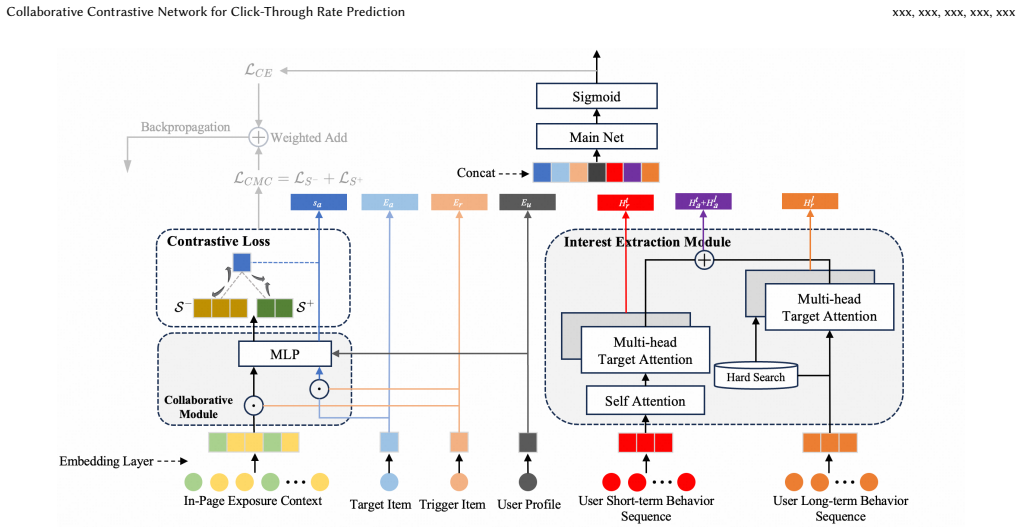
The central claim is that the Collaborative Contrastive Network structures the item latent space by conditioning on user-trigger pairs and applying contrastive learning with collaborative co-click/co-non-click positive signals and mono-click negative signals, thereby producing representations that generalize to unseen scenarios without explicit intent modeling or scenario-specific training data.
What carries the argument
The Collaborative Contrastive Network (CCN), which applies contrastive learning on collaborative feedback signals to structure item representations conditioned on user-trigger pairs.
If this is right
- Models trained on heterogeneous data from many past scenarios can succeed in entirely new ones.
- Recommendations avoid both the trigger-dependency trap and the data-hungry trap for ephemeral promotions.
- Context-specific user preferences can be learned directly from collaborative signals without separate intent modeling.
- Online performance gains of roughly 12 percent in CTR and order volume are achievable in unseen settings.
Where Pith is reading between the lines
- The same collaborative-signal approach might apply to other recommendation tasks where context is defined by a user-action pair rather than long user history.
- Platforms could reduce the frequency of full retraining when new promotions appear, since the model already draws from diverse prior data.
- The method implies that explicit scenario labels or intent categories are less necessary than previously assumed for robust performance.
Load-bearing premise
That collaborative co-click and mono-click signals will reliably shape item representations to capture preferences that transfer to brand-new scenarios.
What would settle it
An A/B test in a fresh scenario that shows no lift in CTR or order volume relative to prior methods would falsify the generalization result.
Figures


read the original abstract
In e-commerce, Trigger-Induced Recommendation (TIR), recommending items after a user clicks a trigger, is an important task. However, modern platforms rely on a continuous stream of diverse and short-lived promotional scenarios (e.g., for Black Friday), creating a significant challenge. Existing methods are less effective here: they either fall into a trigger-dependency trap, recommending overly similar items, or a data-hungry trap, requiring long-term stable data for intent modeling that these ephemeral scenarios cannot provide. To address these limitations, we propose the Collaborative Contrastive Network (CCN), a general and robust framework that approaches the problem from a different perspective. Instead of modeling ambiguous entry intent, CCN learns a user's context-specific preferences by treating the user-trigger pair as a unique condition. It achieves this via a novel contrastive learning scheme, using the collaborative feedback of co-click/co-non-click as a positive signal and mono-click as a negative signal to structure the item representation latent space. To prove its real-world generality, CCN is trained on a heterogeneous dataset spanning over a dozen different scenarios from an entire year, and the online A/B test is conducted in a completely new, unseen scenario on Taobao, where CCN boosts CTR by 12.3\% and order volume by 12.7\%, demonstrating its effectiveness and generalization.
Editorial analysis
A structured set of objections, weighed in public.
Referee Report
Summary. The paper proposes the Collaborative Contrastive Network (CCN) for Trigger-Induced Recommendation (TIR). It treats each user-trigger pair as a unique condition and structures the item latent space via a contrastive scheme using co-click/co-non-click as positive signals and mono-click as negative signals. The model is trained on a year-long heterogeneous dataset spanning over a dozen scenarios and evaluated via an online A/B test in a completely new unseen scenario on Taobao, reporting CTR and order volume lifts of 12.3% and 12.7%.
Significance. If the generalization result holds under more rigorous validation, the work has clear practical value for e-commerce platforms managing ephemeral promotional scenarios. The use of collaborative contrastive signals derived from user logs, rather than explicit intent modeling, is a pragmatic direction that avoids the data-hungry trap described in the abstract.
major comments (2)
- [Abstract] Abstract: The reported 12.3% CTR and 12.7% order volume lifts in the unseen scenario are presented without error bars, statistical significance tests, or baseline comparisons, which is load-bearing for the generalization claim.
- [Abstract] Abstract: No details are provided on the selection criteria for the 'completely new, unseen scenario', the composition of the year-long training dataset, or any ablation studies on the contrastive signals, making it impossible to assess the robustness of the held-out result.
Simulated Author's Rebuttal
We thank the referee for the constructive feedback. We address each major comment below, indicating planned revisions where appropriate to strengthen the abstract's support for the generalization claims.
read point-by-point responses
-
Referee: [Abstract] Abstract: The reported 12.3% CTR and 12.7% order volume lifts in the unseen scenario are presented without error bars, statistical significance tests, or baseline comparisons, which is load-bearing for the generalization claim.
Authors: We agree that the abstract would benefit from additional context on the reported lifts. The full manuscript includes baseline comparisons in the experimental results and describes the online A/B test protocol. We will revise the abstract to explicitly reference the baseline comparisons and note that the lifts were statistically significant per the platform's evaluation. Error bars are not available, as the e-commerce platform reports only aggregate lift metrics without variance estimates. revision: partial
-
Referee: [Abstract] Abstract: No details are provided on the selection criteria for the 'completely new, unseen scenario', the composition of the year-long training dataset, or any ablation studies on the contrastive signals, making it impossible to assess the robustness of the held-out result.
Authors: The manuscript body provides these details: Section 4.1 describes the unseen scenario selection as a novel promotional trigger absent from training data; Section 3.2 details the year-long heterogeneous dataset spanning over a dozen scenarios; and Section 5.3 presents ablation studies on the contrastive signals. We will revise the abstract to include brief references to these elements for improved clarity on robustness. revision: yes
- Inclusion of error bars or platform-provided variance estimates for the online A/B test lifts, as these were not generated or disclosed in the original study.
Circularity Check
No significant circularity detected
full rationale
The paper's derivation relies on an externally defined contrastive learning scheme whose positive/negative signals (co-click/co-non-click and mono-click) are taken directly from user behavior logs rather than being constructed from the model's own outputs or parameters. Training occurs on a year-long heterogeneous dataset across >12 scenarios, with generalization tested via A/B results in a held-out unseen scenario; this empirical separation prevents any reduction of the claimed predictions to fitted inputs or self-definitional loops. No self-citation load-bearing steps, uniqueness theorems, or ansatz smuggling are present in the provided description. The central claim therefore remains independent of its own fitted values.
Axiom & Free-Parameter Ledger
Forward citations
Cited by 1 Pith paper
-
Next Interest Flow: A Generative Pre-training Paradigm for Recommender Systems by Modeling All-domain Movelines
Next Interest Flow models user intent as continuous evolutionary trajectories on a high-dimensional latent interest manifold with kinematic constraints, bidirectional alignment, and temporal causality mechanisms, yiel...
Reference graph
Works this paper leans on
-
[1]
Yi Cao, Sihao Hu, Yu Gong, Zhao Li, Yazheng Yang, Qingwen Liu, and Shouling Ji
-
[2]
In Proceedings of the 31st ACM International Conference on Information & Knowledge Management
Gift: Graph-guided feature transfer for cold-start video click-through rate prediction. In Proceedings of the 31st ACM International Conference on Information & Knowledge Management. 2964–2973
-
[3]
Heng-Tze Cheng, Levent Koc, Jeremiah Harmsen, Tal Shaked, Tushar Chandra, Hrishi Aradhye, Glen Anderson, Greg Corrado, Wei Chai, Mustafa Ispir, et al
-
[4]
In Proceedings of the 1st workshop on deep learning for recommender systems
Wide & deep learning for recommender systems. In Proceedings of the 1st workshop on deep learning for recommender systems . 7–10
-
[5]
Yufei Feng, Fuyu Lv, Weichen Shen, Menghan Wang, Fei Sun, Yu Zhu, and Keping Yang. 2019. Deep session interest network for click-through rate prediction. arXiv preprint arXiv:1905.06482 (2019)
work page internal anchor Pith review Pith/arXiv arXiv 2019
-
[6]
Aaron van den Oord, Yazhe Li, and Oriol Vinyals. 2018. Representation learning with contrastive predictive coding. arXiv preprint arXiv:1807.03748 (2018)
work page internal anchor Pith review Pith/arXiv arXiv 2018
-
[7]
Qi Pi, Xiaoqiang Zhu, Guorui Zhou, Yujing Zhang, Zhe Wang, Lejian Ren, Ying Fan, and Kun Gai. 2020. Search-based User Interest Modeling with Lifelong Se- quential Behavior Data for Click-Through Rate Prediction. CoRR abs/2006.05639 (2020). arXiv:2006.05639 https://arxiv.org/abs/2006.05639
-
[8]
Qijie Shen, Hong Wen, Wanjie Tao, Jing Zhang, Fuyu Lv, Zulong Chen, and Zhao Li. 2022. Deep interest highlight network for click-through rate prediction in trigger-induced recommendation. In Proceedings of the ACM Web Conference 2022. 422–430
work page 2022
-
[9]
Feng Wang and Huaping Liu. 2021. Understanding the behaviour of contrastive loss. In Proceedings of the IEEE/CVF conference on computer vision and pattern recognition. 2495–2504
work page 2021
-
[10]
Yaxian Xia, Yi Cao, Sihao Hu, Tong Liu, and Lingling Lu. 2023. Deep Intention- Aware Network for Click-Through Rate Prediction. In Companion Proceedings of the ACM Web Conference 2023. 533–537
work page 2023
-
[11]
Guorui Zhou, Na Mou, Ying Fan, Qi Pi, Weijie Bian, Chang Zhou, Xiaoqiang Zhu, and Kun Gai. 2019. Deep Interest Evolution Network for Click-Through Rate Prediction. Proceedings of the AAAI Conference on Artificial Intelligence 33 (Jul 2019), 5941–5948. https://doi.org/10.1609/aaai.v33i01.33015941
-
[12]
Guorui Zhou, Xiaoqiang Zhu, Chenru Song, Ying Fan, Han Zhu, Xiao Ma, Yanghui Yan, Junqi Jin, Han Li, and Kun Gai. 2018. Deep Interest Network for Click- Through Rate Prediction. Proceedings of the 24th ACM SIGKDD International Conference on Knowledge Discovery & Data Mining (Jul 2018). https://doi.org/10. 1145/3219819.3219823
discussion (0)
Sign in with ORCID, Apple, or X to comment. Anyone can read and Pith papers without signing in.