REVIEW 4 major objections 6 minor 28 references
AGLP: A Graph Learning Perspective for Semi-supervised Domain Adaptation
T0 review · 4 major / 6 minor · reviewed 2026-08-12 · deepseek-v4-flash
Pith's one-line read By modeling sample structure with an instance graph and a graph convolutional network, AGLP claims to be the first SSDA method to exploit structural information, reporting higher accuracy than prior methods on Office-Home and DomainNet.
desk verdict Competent incremental SSDA paper whose graph claim needs validation: the DSA adjacency is unsupervised, and the ablation can't rule out added capacity. read the letter →
The pith
A machine-rendered reading of the paper's core claim, the machinery that carries it, and where it could break.
The reading
What carries the argument
The engine is a Data Structure Analyzer (DSA), a small network that maps CNN features to structure scores G_sc; the instance-graph adjacency is A = G_sc * G_sc^T. A graph convolutional network (a propagation layer that aggregates features along weighted edges) then processes this graph, and its output is concatenated with the original features. A class centroid alignment loss L_CA = sum_k ||C_S^k - C_T^k||^2 constrains same-class centroids across domains. Together with the CDAC clustering, pseudo-labeling, and consistency losses and the SLA source label adaptation, these terms form the final objective.
What would settle it
Train AGLP on Office-Home 3-Shot with the Data Structure Analyzer replaced by a fixed random adjacency matrix and by a k-nearest-neighbor graph computed from raw features; if average accuracy stays at or above the reported 77.6%, the learned structure scores are not carrying the improvement. A complementary check is to measure whether DSA scores are systematically higher for same-class sample pairs than for cross-class pairs.
Extended reading notes
Core claim
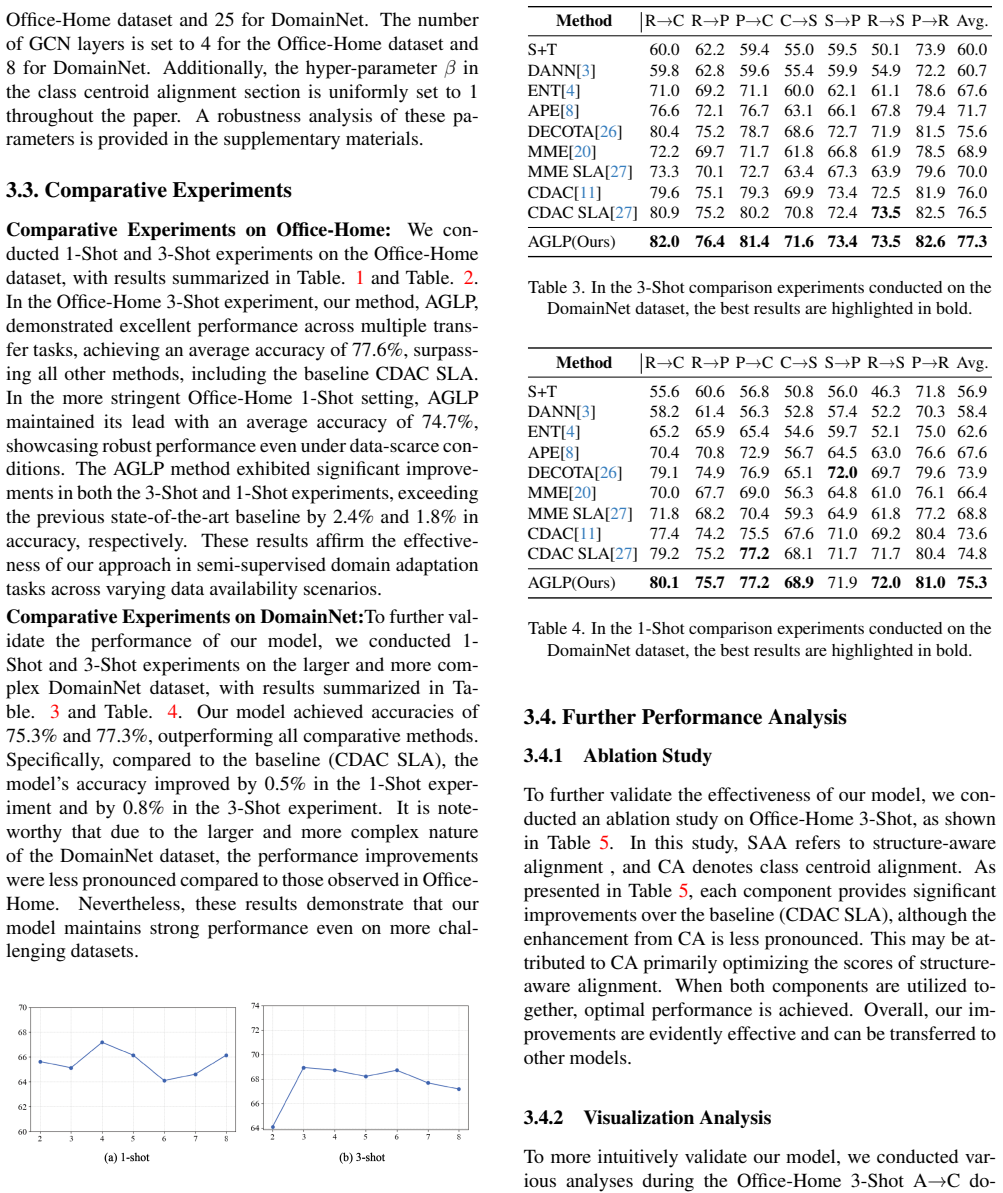
The central claim is that adding structure-aware alignment and class centroid alignment to an existing SSDA method (CDAC with source label adaptation) yields state-of-the-art results. The structure-aware branch predicts structural scores for each mini-batch sample, forms a dense adjacency matrix by an outer product, and runs a graph convolutional network over the instance graph; the resulting structural features are concatenated with the CNN features before classification. The class centroid loss pulls same-class centers across domains together. Across Office-Home and DomainNet in 1-Shot and 3-Shot settings, AGLP outperforms the cited baselines, including gains of 2.4 and 1.8 points in Office-Home 3-Shot and 1-Shot, and 0.5 and 0.8 points on DomainNet, over the CDAC SLA baseline.
Load-bearing premise
The structure scores produced by the Data Structure Analyzer are never supervised directly; they are learned only through the final classification and adaptation losses, so the entire graph branch depends on those scores encoding meaningful sample relationships rather than noise.
Editorial extensions
If this is right
- If AGLP's central claim holds, SSDA should treat sample-level structure as a first-class signal rather than only domain or class labels.
- The reported improvements imply that structural information is especially useful when target labels are extremely scarce, as in the 1-Shot setups.
- Because the graph and centroid modules are additive, they may be combined with other SSDA objectives beyond CDAC SLA.
- The method should transfer to other SSDA benchmarks and backbones if the learned structure scores genuinely encode sample relationships.
Reading between the lines
- A natural test the paper leaves open is whether the same structure-aware branch helps when attached to other SSDA losses, such as entropy minimization or minimax entropy, rather than CDAC SLA.
- The adjacency matrix is a rank-bounded outer product, so without constraints the DSA could collapse to a constant or near-constant structure score; adding a diversity or orthogonality regularizer on G_sc is a testable extension.
- The larger gains on Office-Home than on DomainNet suggest the benefit may depend on dataset scale or class count, though the paper does not isolate that variable.
- A practical extension would be to pretrain or regularize the DSA with explicit structural supervision, such as same-class pair affinities, rather than relying only on downstream losses.
Editorial analysis
A structured set of objections, weighed in public.
Referee Report
Summary. The paper proposes AGLP, a semi-supervised domain adaptation method built on the CDAC+SLA baseline. AGLP adds two components: a structure-aware alignment module in which a Data Structure Analyzer (DSA) produces structure scores used to build a dense instance graph via A_hat = Gsc Gsc^T, followed by a GCN that propagates features over that graph; and a class centroid alignment loss L_CA that draws source and target class centroids together. The method is evaluated on Office-Home and DomainNet under 1-Shot and 3-Shot settings against nine baselines, with an ablation on Office-Home 3-Shot. The paper claims to be the first to model structural/graph information in SSDA and reports improvements over CDAC SLA, e.g., 77.6% vs. 75.2% on Office-Home 3-Shot and 75.3% vs. 74.8% on DomainNet 1-Shot.
Significance. If the structural-learning claim is established, the contribution is a plausible and moderately useful extension of a strong SSDA baseline, with broad benchmark coverage and a clean integration of a GCN and centroid alignment into an existing objective. The paper also ships useful details such as hyperparameter values and a component-level ablation. However, the central attribution of the gains to learned structural information is not yet evidenced: the DSA is trained only through downstream losses, the learned adjacency is never analyzed, no error bars or significance tests are reported, and no code is provided. The reported gains on DomainNet are small enough that run-to-run variance could change the ranking. For these reasons the significance is conditional on additional validation.
major comments (4)
- [§2.2, Eq. (16), Table 5] The central claim that structure-aware alignment learns meaningful data structure is not supported. The DSA produces Gsc and the adjacency A_hat = Gsc Gsc^T, but there is no structural supervision: Gsc is trained only through the downstream classification, pseudo-label, consistency, clustering, and centroid-alignment losses in Eq. (18). Nothing prevents the DSA from encoding a low-rank reparameterization that helps the classifier without reflecting any true sample relationship. The ablation in Table 5 reports +2.1% average accuracy for SAA, but because adding SAA also adds a GCN and the DSA parameters, this experiment cannot distinguish genuine structural learning from added capacity or regularization. To support the paper's main attribution, please provide an analysis of the learned adjacency (e.g., correlation with class/domain labels), a comparison against a fixed graph such as a kNN or cosine-similarity graph with no learned DSA, and an ablation that controls for added GCN capacity.
- [§3.3, Tables 1–4] No measure of variability is reported even though Section 3.2 states that three experiments are conducted per sub-task. This matters because several headline margins are small: 0.5% on DomainNet 1-Shot and 0.8% on DomainNet 3-Shot. Without standard deviations, confidence intervals, or a paired significance test, the claim of consistent improvement over CDAC SLA is not statistically grounded. Please report mean and standard deviation over the three runs, or explain why the comparison is robust without them.
- [§2.2, Eqs. (14) and (16)] The notation in the graph convolution is internally inconsistent and blocks reproducibility. Eq. (14) states A in R^{k×m} and the graph signal G in R^{k×m}, but a convolutional adjacency for an m-node graph must be m×m, and the feature dimension of the nodes must match the propagation rule. The computation Z = D^{-1/2} A_hat D^{-1/2} G^T W with W in R^{k×c} gives an m×c output, while the text says the output is c×m. Eq. (16) then defines A_hat = Gsc Gsc^T with Gsc in R^{w×h}, which is w×w and uses a different node count and feature dimension from Eq. (14). Please rewrite the definitions so that the number of nodes, feature dimension, adjacency dimension, and output shape are all consistent and match the implementation described in Algorithm 1.
- [Algorithm 1 and §2.4] There is a discrepancy in how the graph information is combined with the CNN features. Algorithm 1 says to 'Concatenate A_hat with G and feed the combined features into C(·)', but Section 2.4 says the GCN-extracted structural features are concatenated with the original features to create the final representation. These are different operations, and the dimension of A_hat as defined in Eq. (16) does not match the dimension of G, so the concatenation is unclear as written. Please clarify the exact feature flow used in the experiments.
minor comments (6)
- [§2.1.2, Eq. (4)] Eq. (4) uses P_i^T P_j in the loss, while the text says 'The inner product P_i^T P_i in Eq. 4' and refers to an augmented view. Please align the notation so that the reader can tell whether the clustering loss compares two different unlabeled samples or an original and an augmented sample.
- [§2.1.3, Eq. (8)] The prototype definition uses N_k without defining it; it should be the number of samples of class k. Please define this notation.
- [§4, Conclusion] The conclusion mentions 'a moving centroid strategy to mitigate the influence of incorrect pseudo-labels', but no moving-centroid mechanism is described in Section 2.3 or in Algorithm 1. Either specify the update rule in the method section or remove the phrase from the conclusion.
- [§3.2 and supplementary materials] The text says that a robustness analysis of the parameters is provided in the supplementary materials, but no supplementary material is included with the manuscript. Please include the analysis or state the sensitivity results in the main text.
- [Tables 3 and 4] In Table 4, the CDAC SLA entry for R→P reads '75.277.2'; this appears to be a missing-space typo and should be corrected to '75.2 77.2'.
- [Figure 5] The t-SNE and confusion matrix figures are described only briefly; please state which model each panel corresponds to in the caption so the comparison is unambiguous.
Circularity Check
No circular derivation: AGLP's reported gains are empirical, measured on held-out test sets, and no prediction is equivalent to a fitted input by construction.
full rationale
The paper does not present a derivation chain in which an output quantity reduces by definition to an input quantity. The method starts from a fixed baseline loss (CDAC SLA, Eq. 13) and adds a structure-aware alignment term (SAA, Eq. 16) and a class centroid alignment term (LCA, Eq. 17). The adjacency matrix is defined as  = Gsc Gsc^T, where Gsc is produced by a Data Structure Analyzer network whose only training signal is the downstream classification and adaptation losses (Eq. 18). This is a learned component, but it is not a fitted parameter that is then renamed as a prediction: the paper's headline numbers are accuracies on held-out test sets of Office-Home and DomainNet, not reconstructions of the training losses. The use of pseudo-labels in the centroid alignment and CDAC-style losses is a self-training mechanism, but the final evaluation is independent of those pseudo-labels, so this is not a circularity. The reviewer concern that the DSA/GCN branch may add capacity or regularization rather than meaningful structure is a legitimate empirical attribution question, not a circularity: nothing in the equations forces the reported gains to equal the DSA output by construction. The novelty claim ('first work to model graph information for SSDA') is a literature claim, not a mathematical derivation. There are no load-bearing self-citations: the cited base methods (CDAC [11], SLA [27]) are prior external work, and the GCN formulation follows Kipf and Welling [9]. Accordingly, the circularity score is 0.
Assumptions & free parameters
free parameters (7)
- beta (class centroid alignment weight) =
1
- GCN output channels =
200 (Office-Home), 25 (DomainNet)
- Number of GCN layers =
4 (Office-Home), 8 (DomainNet)
- alpha (SLA mixing ratio) =
0.3
- SLA temperature T =
0.6
- top-k in CDAC similarity =
5
- Pseudo-label confidence threshold tau =
not reported
assumptions (3)
- domain assumption The instance graph adjacency A = Gsc Gsc^T built from Data Structure Analyzer scores captures meaningful sample similarities for SSDA.
- domain assumption Pseudo-labels generated by the model are accurate enough for class centroid alignment to improve features.
- domain assumption A GCN with several layers on a densely connected graph does not destroy the discriminative information needed for classification.
invented entities (1)
-
Data Structure Analyzer (DSA) network
Cite this review
Pith. "Pith review of AGLP: A Graph Learning Perspective for Semi-supervised Domain Adaptation." pith.science (2026). https://pith.science/paper/3DDZLMAW
@misc{pith2026241113152,
  author       = {Pith},
  title        = {Pith review of: AGLP: A Graph Learning Perspective for Semi-supervised Domain Adaptation},
  year         = {2026},
  howpublished = {\url{https://pith.science/paper/3DDZLMAW}},
  note         = {Machine review of arXiv:2411.13152}
}
read the original abstract
In semi-supervised domain adaptation (SSDA), the model aims to leverage partially labeled target domain data along with a large amount of labeled source domain data to enhance its generalization capability for the target domain. A key advantage of SSDA is its ability to significantly reduce reliance on labeled data, thereby lowering the costs and time associated with data preparation. Most existing SSDA methods utilize information from domain labels and class labels but overlook the structural information of the data. To address this issue, this paper proposes a graph learning perspective (AGLP) for semi-supervised domain adaptation. We apply the graph convolutional network to the instance graph which allows structural information to propagate along the weighted graph edges. The proposed AGLP model has several advantages. First, to the best of our knowledge, this is the first work to model structural information in SSDA. Second, the proposed model can effectively learn domain-invariant and semantic representations, reducing domain discrepancies in SSDA. Extensive experimental results on multiple standard benchmarks demonstrate that the proposed AGLP algorithm outperforms state-of-the-art semi-supervised domain adaptation methods.
Figures


Figures from the paper (2 more)


Reference graph
Works this paper leans on
-
[1]
Adamatch: A unified approach to semi-supervised learning and domain adaptation
David Berthelot, Rebecca Roelofs, Kihyuk Sohn, Nicholas Carlini, and Alex Kurakin. Adamatch: A unified approach to semi-supervised learning and domain adaptation. arXiv preprint arXiv:2106.04732, 2021. 1, 2
arXiv 2021
-
[2]
Imagenet: A large-scale hierarchical image database
Jia Deng, Wei Dong, Richard Socher, Li-Jia Li, Kai Li, and Li Fei-Fei. Imagenet: A large-scale hierarchical image database. In CVPR, pages 248–255. Ieee, 2009. 6
2009
-
[3]
Domain-adversarial training of neural networks
Yaroslav Ganin, Evgeniya Ustinova, Hana Ajakan, Pas- cal Germain, Hugo Larochelle, Franc ¸ois Laviolette, Mario March, and Victor Lempitsky. Domain-adversarial training of neural networks. Journal of Machine Learning Research, 17(59):1–35, 2016. 6, 7
work page 2016
-
[4]
Semi-supervised learning by entropy minimization
Yves Grandvalet and Yoshua Bengio. Semi-supervised learning by entropy minimization. NIPS, 17, 2004. 6, 7
work page 2004
-
[5]
Classification-aware semi-supervised domain adaptation
Gewen He, Xiaofeng Liu, Fangfang Fan, and Jane You. Classification-aware semi-supervised domain adaptation. In CVPR, pages 964–965, 2020. 2
work page 2020
-
[6]
Deep residual learning for image recognition
Kaiming He, Xiangyu Zhang, Shaoqing Ren, and Jian Sun. Deep residual learning for image recognition. In CVPR, pages 770–778, 2016. 6
2016
-
[7]
Bidirectional adversarial training for semi-supervised domain adaptation
Pin Jiang, Aming Wu, Yahong Han, Yunfeng Shao, Meiyu Qi, and Bingshuai Li. Bidirectional adversarial training for semi-supervised domain adaptation. In IJCAI, pages 934– 940, 2020. 1
work page 2020
-
[8]
Taekyung Kim and Changick Kim. Attract, perturb, and explore: Learning a feature alignment network for semi- supervised domain adaptation. In ECCV, pages 591–607. Springer, 2020. 6, 7
work page 2020
Show all 28 references
-
[9]
Semi-supervised classi- fication with graph convolutional networks
Thomas N Kipf and Max Welling. Semi-supervised classi- fication with graph convolutional networks. arXiv preprint arXiv:1609.02907, 2016. 4
2016 arXiv
-
[10]
Online meta-learning for multi-source and semi-supervised domain adaptation
Da Li and Timothy Hospedales. Online meta-learning for multi-source and semi-supervised domain adaptation. In ECCV, pages 382–403. Springer, 2020. 2
2020
-
[11]
Cross- domain adaptive clustering for semi-supervised domain adaptation
Jichang Li, Guanbin Li, Yemin Shi, and Yizhou Yu. Cross- domain adaptive clustering for semi-supervised domain adaptation. In CVPR, pages 2505–2514, 2021. 2, 5, 6, 7, 8
2021
-
[12]
Semi-supervised domain adaptation by covariance matching
Limin Li and Zhenyue Zhang. Semi-supervised domain adaptation by covariance matching. TPAMI, 41(11):2724– 2739, 2018. 1
2018
-
[13]
Adjustment and alignment for unbiased open set domain adaptation
Wuyang Li, Jie Liu, Bo Han, and Yixuan Yuan. Adjustment and alignment for unbiased open set domain adaptation. In CVPR, pages 24110–24119, 2023. 4
2023
-
[14]
Semi-supervised domain adaptation for dependency parsing
Zhenghua Li, Xue Peng, Min Zhang, Rui Wang, and Luo Si. Semi-supervised domain adaptation for dependency parsing. In ACL, pages 2386–2395, 2019. 1
2019
-
[15]
Guiding pseudo-labels with uncertainty estimation for source-free un- supervised domain adaptation
Mattia Litrico, Alessio Del Bue, and Pietro Morerio. Guiding pseudo-labels with uncertainty estimation for source-free un- supervised domain adaptation. In CVPR, pages 7640–7650,
-
[16]
Gcan: Graph convolutional adversarial network for unsupervised domain adaptation
Xinhong Ma, Tianzhu Zhang, and Changsheng Xu. Gcan: Graph convolutional adversarial network for unsupervised domain adaptation. In CVPR, pages 8266–8276, 2019. 4
2019
-
[17]
Unsupervised domain adap- tation of object detectors: A survey
Poojan Oza, Vishwanath A Sindagi, Vibashan Vishnukumar Sharmini, and Vishal M Patel. Unsupervised domain adap- tation of object detectors: A survey. IEEE TPAMI, 2023. 4
2023
-
[18]
Moment matching for multi-source domain adaptation
Xingchao Peng, Qinxun Bai, Xide Xia, Zijun Huang, Kate Saenko, and Bo Wang. Moment matching for multi-source domain adaptation. In ICCV, pages 1406–1415, 2019. 1, 5
2019
-
[19]
Mul- timatch: Multi-task learning for semi-supervised domain generalization
Lei Qi, Hongpeng Yang, Yinghuan Shi, and Xin Geng. Mul- timatch: Multi-task learning for semi-supervised domain generalization. ACM Transactions on Multimedia Comput- ing, Communications and Applications, 20(6):1–21, 2024. 1
2024
-
[20]
Semi-supervised domain adaptation via minimax entropy
Kuniaki Saito, Donghyun Kim, Stan Sclaroff, Trevor Darrell, and Kate Saenko. Semi-supervised domain adaptation via minimax entropy. In ICCV, pages 8050–8058, 2019. 2, 6, 7
2019
-
[21]
Clda: Contrastive learning for semi-supervised domain adaptation
Ankit Singh. Clda: Contrastive learning for semi-supervised domain adaptation. NIPS, 34:5089–5101, 2021. 1
2021
-
[22]
Rethinking domain generalization for face anti- spoofing: Separability and alignment
Yiyou Sun, Yaojie Liu, Xiaoming Liu, Yixuan Li, and Wen- Sheng Chu. Rethinking domain generalization for face anti- spoofing: Separability and alignment. In CVPR, pages 24563–24574, 2023. 4
2023
-
[23]
Deep hashing network for unsupervised domain adaptation
Hemanth Venkateswara, Jose Eusebio, Shayok Chakraborty, and Sethuraman Panchanathan. Deep hashing network for unsupervised domain adaptation. In CVPR, pages 5018– 5027, 2017. 1, 5
2017
-
[24]
Ssda3d: Semi-supervised domain adaptation for 3d object detection from point cloud
Yan Wang, Junbo Yin, Wei Li, Pascal Frossard, Ruigang Yang, and Jianbing Shen. Ssda3d: Semi-supervised domain adaptation for 3d object detection from point cloud. InAAAI, pages 2707–2715, 2023. 2
2023
-
[25]
Multi-level consistency learning for semi-supervised domain adaptation
Zizheng Yan, Yushuang Wu, Guanbin Li, Yipeng Qin, Xi- aoguang Han, and Shuguang Cui. Multi-level consistency learning for semi-supervised domain adaptation. arXiv preprint arXiv:2205.04066, 2022. 5
2022 arXiv
-
[26]
Deep co-training with task decomposition for semi- supervised domain adaptation
Luyu Yang, Yan Wang, Mingfei Gao, Abhinav Shrivas- tava, Kilian Q Weinberger, Wei-Lun Chao, and Ser-Nam Lim. Deep co-training with task decomposition for semi- supervised domain adaptation. In ICCV, pages 8906–8916,
-
[27]
Semi-supervised domain adaptation with source label adaptation
Yu-Chu Yu and Hsuan-Tien Lin. Semi-supervised domain adaptation with source label adaptation. In CVPR, pages 24100–24109, 2023. 2, 3, 6, 7, 8
2023
-
[28]
Make the u in uda matter: Invariant consistency learning for unsuper- vised domain adaptation
Zhongqi Yue, Qianru Sun, and Hanwang Zhang. Make the u in uda matter: Invariant consistency learning for unsuper- vised domain adaptation. NIPS, 36:26991–27004, 2023. 2
2023
Reviewed August 12, 2026 · model on record in the stance chip above.
Discussion (0). Continue with ORCID to comment.