REVIEW 4 major objections 5 minor 3 cited by
An Ensemble Approach for Brain Tumor Segmentation and Synthesis
T0 review · 4 major / 5 minor · reviewed 2026-08-12 · deepseek-v4-flash
Pith's one-line read The paper proposes an ensemble of four MRI segmentation architectures, trained with MRI-artifact data augmentation and finished with volume-based relabeling, as the route to accurate brain tumor segmentation across data domains, and…
desk verdict Useful BraTS 2024 benchmark numbers, but the headline ensemble claim is not backed by the reported tables. read the letter →
The pith
A machine-rendered reading of the paper's core claim, the machinery that carries it, and where it could break.
The reading
What carries the argument
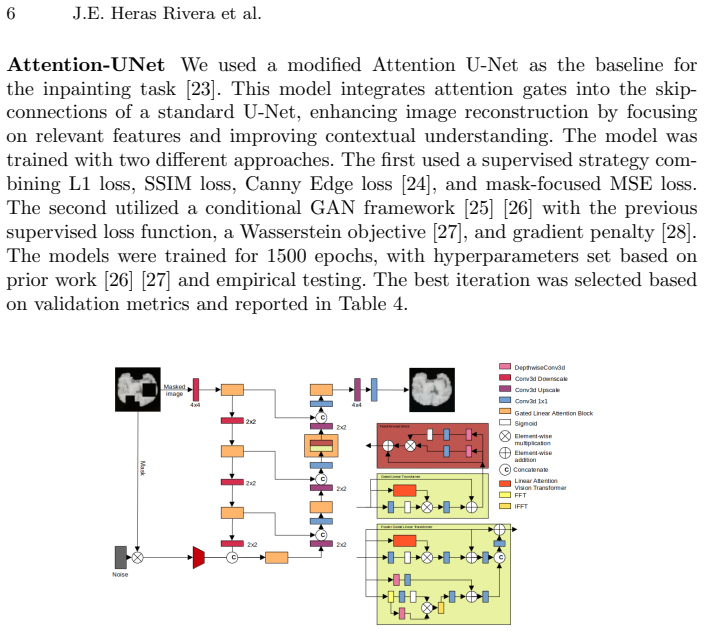
Four backbones carry the segmentation claim: the optimized U-Net (a five-level encoder-decoder used as baseline), nnU-Net (a self-configuring segmentation method), Swin-UNETR (a Swin-transformer encoder feeding a CNN decoder), and U-Mamba (a state-space-model encoder-decoder). The transferable mechanisms around them are probabilistic MRI-artifact augmentation—motion, spike, bias field, elastic deformation, and anisotropy, each applied with probability 0.1—and a postprocessing rule that removes small connected components, relabels enhancing tissue to necrotic core when the ET/WT ratio is below 0.03, and relabels non-enhancing FLAIR hyperintensity when the SNFH/WT ratio equals 1. For the Africa task the key object is a domain-adversarial network (DANN) on the optimized U-Net backbone, with a domain classifier at the bottleneck that is trained to be fooled so that features become domain-invariant. For synthesis the central object is MA3T-Former, a 3D masked transformer that replaces standard attention with gated linear attention, optionally adds a gated Fourier block, and is trained with a Wasserstein GAN objective and the GrokFast gradient-amplification algorithm.
What would settle it
On the BraTS 2024 generalizability test set, compute the full ensemble's lesion-wise whole-tumor Dice and HD95; if the ensemble does not beat the best individual model in Table 1 (nnU-Net at 88.11% Dice or U-Mamba at 14.51 mm HD95), the paper's ensemble claim is not supported.
Extended reading notes
Core claim
On the paper's own terms, the central claim is that no single modern architecture wins on every segmentation metric, and a pipeline that exploits their complementarity—four trained backbones combined with artifact-aware augmentation and adaptive postprocessing—is the route to accurate brain tumor segmentation across data domains. The reported per-model numbers on the generalizability test set support the premise of complementarity: nnU-Net posts the best Dice scores (whole-tumor 88.11), U-Mamba the best HD95 values (whole-tumor 14.51 mm), with the optimized U-Net and Swin-UNETR filling out the ensemble. For the Africa challenge, the paper asserts that a domain-adversarial network trained on adult glioma plus African 1.5T data, and an ensemble of its variants, reaches whole-tumor Dice of 94.4–94.5% while reducing HD95 to about 4 mm. For inpainting, the paper claims that MA3T-Former—a 3D transformer with gated linear attention, an optional Fourier block, and mask-embedding noise—converges faster than a 1500-epoch Attention U-Net and can scale to 2.35 billion parameters.
Load-bearing premise
The load-bearing premise is that the validation-time choices—especially the 10% augmentation probability and the ET/WT and SNFH/WT relabeling thresholds—transfer to hidden test data; the paper does not isolate the ensemble or the postprocessing separately, so if those choices overfit the validation set, the reported gains could evaporate on unseen scans.
Editorial extensions
If this is right
- If the ensemble claim holds, future brain tumor segmentation pipelines should expect complementarity among backbones: nnU-Net for overlap accuracy, U-Mamba for boundary accuracy, rather than a single winner on all metrics.
- The 10% augmentation-probability result gives a concrete default for MRI artifact augmentation: mild application improves boundary metrics, while 20–30% probabilities can degrade Dice on some folds.
- The relabeling rules (ET/WT below 0.03, SNFH/WT equal to 1) are a plug-in postprocessing recipe that can be applied on top of any model to suppress false positives from small enhancing regions and whole-FLAIR non-enhancing regions.
- For small, low-field-strength datasets like BraTS-Africa, the DANN-based transfer recipe—train on a large source dataset plus the small target dataset, then ensemble DANN variants—can reach whole-tumor Dice above 94%.
- If the MA3T-Former convergence claim is correct, the combination of gated linear attention, Fourier blocks, and GrokFast offers a path to training very large inpainting models with less compute than conventional transformer inpainting.
Reading between the lines
- The augmentation and postprocessing recipe is model-agnostic, so a reader can transplant it onto any future segmentation backbone; the paper itself does not claim this transfer.
- The Africa experiment suggests a testable rule for other low-resource imaging settings: pair a small local dataset with a large public source dataset, use domain-adversarial training, and ensemble the DANN variants.
- The 20-epoch MA3T-Former result raises the question of which component—gated linear attention, the Fourier block, or GrokFast—drives the speedup; an ablation would isolate it.
- The relabeling rules embody a prior about tumor composition, so applying them to metastases or pediatric tumors is a natural next test of their limits.
Editorial analysis
A structured set of objections, weighed in public.
Referee Report
Summary. The paper describes the authors' submission to the 2024 Brain Tumor Segmentation (BraTS) challenge, covering the Adult Glioma Post-Treatment, BraTS-Africa, Generalizability (GoAT), and Inpainting sub-challenges. The proposed framework combines four segmentation architectures (optimized U-Net, nnU-Net, Swin-UNETR, U-Mamba) with data augmentation, ensembling, and post-processing, and separately introduces MA3T-Former, a novel transformer-based inpainting model trained with a WGAN-style objective and GrokFast acceleration. The paper reports test metrics for the GoAT and Africa sub-challenges and validation metrics for the inpainting task. The central claim in the abstract and introduction is that the ensemble of these architectures achieves accurate segmentation and fine image synthesis.
Significance. If the ensemble claim were substantiated, the paper would provide a useful benchmark of modern segmentation architectures on the new BraTS 2024 sub-challenges. The empirical comparison of nnU-Net, U-Mamba, Swin-UNETR, and optimized U-Net on the GoAT test set is informative even though it reports only individual models. The Africa sub-challenge results, including the DANN transfer-learning approach, add data points on domain adaptation for low-resource settings. However, the paper's distinguishing contribution—the ensemble—is never demonstrated to improve over its components, and the inpainting results clearly fall below the baselines the authors themselves provide. The paper therefore has value as a challenge report but does not currently establish the stated central claim.
major comments (4)
- [Section 3.1, Table 1] The GoAT results report each architecture individually, with no ensemble prediction. Since the abstract and Section 1 state that the framework ensembles the four architectures, the absence of any ensemble result for GoAT means the central claim cannot be evaluated. Please report the ensemble result for the GoAT sub-challenge, or revise the paper's claims to describe the work as an evaluation of four architectures rather than an ensemble framework.
- [Section 3.2, Table 3] The DAEnsemble result is worse than the single DANN model on ET Dice (75.78 vs 81.68), TC Dice (73.86 vs 77.30), and lesion-wise HD95 for TC (36.54 vs 31.90). This directly contradicts the statement in Section 4 that 'ensemble techniques can greatly boost the robustness of the models.' No quantitative evidence for ensemble benefit is provided anywhere in the paper; please either provide such evidence or temper the discussion to reflect the measured outcome.
- [Section 3.3, Table 4] The MA3T-F result after 20 epochs has PSNR 16.24 and MSE 0.0015, substantially worse than the Attention-UNet baselines (PSNR ~20.2–20.5, MSE 0.0002). The text itself concedes these results are 'not state of the art.' This does not support the abstract's claim of 'finely synthesized images.' The synthesis claim should be either removed or supported by results from a trained model that reaches competitive performance.
- [Section 2.3, Postprocessing; Section 3.2/3.1] The data augmentation probability (10%, selected in Table 2) and the post-processing thresholds (ET/WT < 0.03, SNFH/WT == 1) are chosen on validation, and no ablation isolates the contribution of the ensemble or the post-processing to the final test scores. Because the paper's central claim is about the ensemble, the lack of an ablation makes it impossible to attribute any reported gain to the ensemble itself. Please include an ablation (e.g., with/without ensemble, with/without post-processing) or explicitly state that the contributions of these components are not separated.
minor comments (5)
- [Section 2.3, Learning rate schedule] The learning rate formula uses 'epochi' and 'epochN' without defining the index range; please write it as α_i = α_0 × (1 − i/N)^0.75 for i = 1, …, N to avoid ambiguity.
- [Section 2.3, References] Reference [23] is cited for the Attention-UNet inpainting baseline, but the reference list entry for [23] is the U-Mamba paper (Jun Ma et al.). The Attention-UNet baseline should instead cite Oktay et al. (2018) or another appropriate source.
- [Table 1] There is a typo in the header: 'Leasion-Wise' should be 'Lesion-Wise'.
- [Table 4 and Section 3.3] The table refers to 'MA3T-Fv1' while the text refers to 'MA3T-F with GrokFast'; please make the model naming consistent.
- [Section 2.3] The phrase 'state of art model' should be 'state-of-the-art model' in the nnU-Net paragraph.
Circularity Check
No significant circularity: the paper is an empirical challenge report whose central claims are benchmarked on held-out data, with only provenance-style self-citations.
full rationale
The paper is an empirical BraTS 2024 challenge report rather than a derivation, so no step equates an output with an input by construction. Segmentation claims are evaluated on held-out challenge data (Sections 3.1-3.2) using externally published architectures (nnU-Net, U-Mamba, Swin-UNETR, and the optimized U-Net); these results do not reduce to assumptions in the paper. Self-citations (refs 11, 20, 22, 24) appear as provenance for the optimized-U-Net adaptation, a loss combination, and the DANN-without-gradient-reversal variant; they are descriptive rather than load-bearing, and no self-cited uniqueness or forbidden-alternative claim is invoked. The selection of a 10% augmentation probability (Table 2) and post-processing ratios is performed on validation folds and then applied to the hidden test set, which is ordinary model selection, not a fitted parameter renamed as a prediction. The manuscript does contain overclaims that its own tables contradict: Section 3.1 gives no ensemble result for BraTS-GoAT; Table 3 shows DAEnsemble underperforming DANN alone on ET and TC Dice (75.78 vs 81.68 and 73.86 vs 77.30); and Section 3.3/Table 4 reports MA3T-F PSNR 16.24 versus Attention-UNet 20.46 while the text concedes 'these results are not state of the art.' These are correctness or evidence gaps, not circularity, and therefore do not raise the circularity score.
Assumptions & free parameters
free parameters (4)
- data augmentation probability =
10%
- post-processing ratio thresholds =
ET/WT < 0.03, SNFH/WT == 1
- initial learning rate alpha0 =
6e-5
- number of training epochs =
100 (optimized U-Net), 1500 (AUNet), 20 (MA3T-F)
assumptions (4)
- domain assumption BraTS annotations are reliable ground truth
- domain assumption Validation performance predicts test performance
- domain assumption Hyperparameters from cited literature are appropriate for these tasks
- domain assumption The 'GrokFast' algorithm accelerates generalization without harming final accuracy
invented entities (2)
-
MA3T-Former (Mask Aware 3D T-Former)
-
Gated Fourier Block variant
Cite this review
Pith. "Pith review of An Ensemble Approach for Brain Tumor Segmentation and Synthesis." pith.science (2026). https://pith.science/paper/KEK42DXB
@misc{pith2026241117617,
  author       = {Pith},
  title        = {Pith review of: An Ensemble Approach for Brain Tumor Segmentation and Synthesis},
  year         = {2026},
  howpublished = {\url{https://pith.science/paper/KEK42DXB}},
  note         = {Machine review of arXiv:2411.17617}
}
read the original abstract
The integration of machine learning in magnetic resonance imaging (MRI), specifically in neuroimaging, is proving to be incredibly effective, leading to better diagnostic accuracy, accelerated image analysis, and data-driven insights, which can potentially transform patient care. Deep learning models utilize multiple layers of processing to capture intricate details of complex data, which can then be used on a variety of tasks, including brain tumor classification, segmentation, image synthesis, and registration. Previous research demonstrates high accuracy in tumor segmentation using various model architectures, including nn-UNet and Swin-UNet. U-Mamba, which uses state space modeling, also achieves high accuracy in medical image segmentation. To leverage these models, we propose a deep learning framework that ensembles these state-of-the-art architectures to achieve accurate segmentation and produce finely synthesized images.
Figures
Forward citations
Cited by 3 Pith papers
-
Clinically-Informed Preprocessing Improves Stroke Segmentation in Low-Resource Settings
A clinically-informed preprocessing pipeline improves CT-based ischemic stroke lesion segmentation by 38% Dice over baseline nnU-Net, and further by 21% with CTA vessel maps.
-
GANet-Seg: Adversarial Learning for Brain Tumor Segmentation with Hybrid Generative Models
GANet-Seg couples a pretrained normal-brain GAN with a U-Net for brain tumor segmentation, but its own Table 2 contradicts the abstract's claim of better HD95 than baselines.
-
How We Won the ISLES'24 Challenge by Preprocessing
Skull stripping with SynthStrip and custom CT intensity windowing improved stroke lesion segmentation enough for a standard nnU-Net to win the ISLES'24 challenge.
Reference graph
Works this paper leans on
-
[1]
Survival outcomes and prognostic factors in glioblastoma
NF Brown, D Ottaviani, J Tazare, J Gregson, N Kitchen, S Brandner, N Fersht, and P Mulholland. Survival outcomes and prognostic factors in glioblastoma. Cancers (Basel), 14(13):3161, Jun 2022
work page 2022
-
[2]
Inter-rater agreement in glioma segmen- tations on longitudinal mri
M Visser, DMJ M¨ uller, RJM van Duijn, M Smits, N Verburg, EJ Hendriks, RJA Nabuurs, JCJ Bot, RS Eijgelaar, M Witte, MB van Herk, F Barkhof, PC de Witt Hamer, and JC de Munck. Inter-rater agreement in glioma segmen- tations on longitudinal mri. Neuroimage Clin , 22:101727, 2019. Epub 2019 Feb 22
work page 2019
-
[3]
The 2024 brain tumor segmentation (brats) challenge: Glioma segmentation on post-treatment mri
Maria Correia de Verdier et al. The 2024 brain tumor segmentation (brats) challenge: Glioma segmentation on post-treatment mri. arXiv preprint arXiv:2405.18368, 2024
arXiv 2024
-
[4]
Andr´ e Ferreira et al. How we won brats 2023 adult glioma challenge? just faking it! enhanced synthetic data augmentation and model ensemble for brain tumour segmentation. arXiv preprint arXiv:2402.17317 , 2024
arXiv 2023
-
[5]
Lienkamp, Thomas Brox, and Olaf Ronneberger
¨Ozg¨ un C ¸ i¸ cek, Ahmed Abdulkadir, Soeren S. Lienkamp, Thomas Brox, and Olaf Ronneberger. 3d u-net: Learning dense volumetric segmentation from sparse an- notation. CoRR, abs/1606.06650, 2016
arXiv 2016
-
[6]
Hang Zhang, Jinwei Zhang, Chao Li, Elizabeth M Sweeney, Pascal Spincemaille, Thanh D Nguyen, Susan A Gauthier, Yi Wang, and Melanie Marcille. All-net: Anatomical information lesion-wise loss function integrated into neural network for multiple sclerosis lesion segmentation. NeuroImage: Clinical, 32:102854, 2021
work page 2021
-
[7]
Eric Billet, Andriy Fedorov, and Nikos Chrisochoides. The use of robust local haus- dorff distances in accuracy assessment for image alignment of brain mri. Insight Journal (January-June 2008), http://hdl. handle. net/1926/1354 , 2008
work page 2008
-
[8]
Adversarial inpainting of medical image modalities
Karim Armanious, Youssef Mecky, Sergios Gatidis, and Bin Yang. Adversarial inpainting of medical image modalities. In ICASSP 2019-2019 IEEE International Conference on Acoustics, Speech and Signal Processing (ICASSP) , pages 3267–
work page 2019
Show all 32 references
-
[9]
Deep learning-based 3d inpainting of brain mr images
Seung Kwan Kang, Seong A Shin, Seongho Seo, Min Soo Byun, Dong Young Lee, Yu Kyeong Kim, Dong Soo Lee, and Jae Sung Lee. Deep learning-based 3d inpainting of brain mr images. Scientific reports, 11(1):1673, 2021. 12 J.E. Heras Rivera et al
2021
-
[10]
High-resolution mri brain inpainting
Mohamed Almansour, Nagia M Ghanem, and Soheir Bassiouny. High-resolution mri brain inpainting. In 2021 IEEE EMBS International Conference on Biomedical and Health Informatics (BHI) , pages 1–6. IEEE, 2021
2021
-
[11]
An optimization framework for processing and trans- fer learning for the brain tumor segmentation
Tianyi Ren, Ethan Honey, Harshitha Rebala, Abhishek Sharma, Agamdeep Chopra, and Mehmet Kurt. An optimization framework for processing and trans- fer learning for the brain tumor segmentation. arXiv preprint arXiv:2402.07008 , 2024
2024 arXiv
-
[12]
Op- timized u-net for brain tumor segmentation
Micha l Futrega, Alexandre Milesi, Micha l Marcinkiewicz, and Pablo Ribalta. Op- timized u-net for brain tumor segmentation. In International MICCAI Brainlesion Workshop, pages 15–29. Springer, 2021
2021
-
[13]
Kingma and Jimmy Ba
Diederik P. Kingma and Jimmy Ba. Adam: A method for stochastic optimization. 2017
2017
-
[14]
Rhizonet segments plant roots to assess biomass and growth for enabling self- driving labs
Zineb Sordo, Peter Andeer, James Sethian, Trent Northen, and Daniela Ushizima. Rhizonet segments plant roots to assess biomass and growth for enabling self- driving labs. Scientific Reports, 14(1):12907, Jun 2024
2024
-
[15]
nnu-net: a self-configuring method for deep learning-based biomedical image segmentation
Fabian Isensee, Paul F Jaeger, Simon AA Kohl, Jens Petersen, and Klaus H Maier- Hein. nnu-net: a self-configuring method for deep learning-based biomedical image segmentation. Nature methods, 18(2):203–211, 2021
2021
-
[16]
Fabian Isensee, Tassilo Wald, Constantin Ulrich, Michael Baumgartner, Saikat Roy, Klaus Maier-Hein, and Paul F. Jaeger. nnu-net revisited: A call for rigorous vali- dation in 3d medical image segmentation, 2024
2024
-
[17]
Transform- ers in medical image segmentation: A review
Hanguang Xiao, Li Li, Qiyuan Liu, Xiuhong Zhu, and Qihang Zhang. Transform- ers in medical image segmentation: A review. Biomedical Signal Processing and Control, 84:104791, 2023
2023
-
[18]
Swin unetr: Swin transformers for semantic segmentation of brain tumors in mri images
Ali Hatamizadeh, Vishwesh Nath, Yucheng Tang, Dong Yang, Holger R Roth, and Daguang Xu. Swin unetr: Swin transformers for semantic segmentation of brain tumors in mri images. In International MICCAI Brainlesion Workshop , pages 272–284. Springer, 2021
2021
-
[19]
U-mamba: Enhancing long-range dependency for biomedical image segmentation
Jun Ma, Feifei Li, and Bo Wang. U-mamba: Enhancing long-range dependency for biomedical image segmentation. arXiv preprint arXiv:2401.04722 , 2024
2024 arXiv
-
[20]
Re-diffinet: Modeling discrepancy in tumor segmentation using diffusion models
Tianyi Ren, Abhishek Sharma, Juampablo E Heras Rivera, Lakshmi Harshitha Rebala, Ethan Honey, Agamdeep Chopra, and Mehmet Kurt. Re-diffinet: Modeling discrepancy in tumor segmentation using diffusion models. InMedical Imaging with Deep Learning, 2024
2024
-
[21]
Domain-adversarial training of neural networks
Yaroslav Ganin et al. Domain-adversarial training of neural networks. Journal of Machine Learning Research, 17(59):1–35, 2016
2016
-
[22]
J. E. H. Rivera, H. Rebala, T. Ren, A. Sharma, and M. Kurt. Improving glioma segmentation in low-resolution domains with transfer learning. In Medical Imaging with Deep Learning, 2024
2024
-
[23]
U-mamba: Enhancing long-range dependency for biomedical image segmentation, 2018
Jun Ma, Feifei Li, and Bo Wang. U-mamba: Enhancing long-range dependency for biomedical image segmentation, 2018
2018
-
[24]
3D Inception-Based TransMorph: Pre-and Post-operative Multi-contrast MRI Regis- tration in Brain Tumors
Javid Abderezaei, Aymeric Pionteck, Agamdeep Chopra, and Mehmet Kurt. 3D Inception-Based TransMorph: Pre-and Post-operative Multi-contrast MRI Regis- tration in Brain Tumors. arXiv preprint arXiv:2212.04579 , 2022
2022 arXiv
-
[25]
Goodfellow, Jean Pouget-Abadie, Mehdi Mirza, Bing Xu, David Warde- Farley, Sherjil Ozair, Aaron Courville, and Yoshua Bengio
Ian J. Goodfellow, Jean Pouget-Abadie, Mehdi Mirza, Bing Xu, David Warde- Farley, Sherjil Ozair, Aaron Courville, and Yoshua Bengio. Generative adversarial networks, 2014
2014
-
[26]
Phillip Isola, Jun-Yan Zhu, Tinghui Zhou, and Alexei A. Efros. Image-to-image translation with conditional adversarial networks, 2018
2018
-
[27]
Wasserstein gan, 2017
Martin Arjovsky, Soumith Chintala, and L´ eon Bottou. Wasserstein gan, 2017. An Ensemble Approach for Brain Tumor Segmentation and Synthesis 13
2017
-
[28]
Improved training of wasserstein gans, 2017
Ishaan Gulrajani, Faruk Ahmed, Martin Arjovsky, Vincent Dumoulin, and Aaron Courville. Improved training of wasserstein gans, 2017
2017
-
[29]
T-former: An efficient transformer for image inpainting
Ye Deng, Siqi Hui, Sanping Zhou, Deyu Meng, and Jinjun Wang. T-former: An efficient transformer for image inpainting. In Proceedings of the 30th ACM Inter- national Conference on Multimedia , MM ’22. ACM, October 2022
2022
-
[30]
Fourier neural operator for parametric partial differential equations, 2021
Zongyi Li, Nikola Kovachki, Kamyar Azizzadenesheli, Burigede Liu, Kaushik Bhat- tacharya, Andrew Stuart, and Anima Anandkumar. Fourier neural operator for parametric partial differential equations, 2021
2021
-
[31]
Grokfast: Ac- celerated grokking by amplifying slow gradients, 2024
Jaerin Lee, Bong Gyun Kang, Kihoon Kim, and Kyoung Mu Lee. Grokfast: Ac- celerated grokking by amplifying slow gradients, 2024
2024
-
[32]
Biomedparse: a biomedical foundation model for image parsing of everything everywhere all at once, 2024
Theodore Zhao, Yu Gu, Jianwei Yang, Naoto Usuyama, Ho Hin Lee, Tristan Nau- mann, Jianfeng Gao, Angela Crabtree, Jacob Abel, Christine Moung-Wen, Brian Piening, Carlo Bifulco, Mu Wei, Hoifung Poon, and Sheng Wang. Biomedparse: a biomedical foundation model for image parsing of...
2024
Reviewed August 12, 2026 · model on record in the stance chip above.
Discussion (0). Continue with ORCID to comment.