REVIEW 4 major objections 5 minor 1 cited by
Validated matrix multiplication transform for orthogonal polynomials with applications to computer-assisted proofs for PDEs
T0 review · 4 major / 5 minor · reviewed 2026-08-12 · deepseek-v4-flash
Pith's one-line read The paper proves, via a validated matrix-multiplication transform on Zernike series, that five quadratic nonlinear elliptic PDEs on the unit disk have non-trivial solutions satisfying Dirichlet boundary conditions.
desk verdict Useful, well-built MMT framework for Zernike products with real CAP payoff; the only serious gap is that the Table 1 verification constants are not shown to be rigorous interval enclosures. read the letter →
The pith
A machine-rendered reading of the paper's core claim, the machinery that carries it, and where it could break.
The reading
What carries the argument
The central object is the Matrix Multiplication Transform (MMT), the $(N+1)\times(N+1)$ matrix $M_{j,n}=p_n(x_j)$ that maps coefficients of a polynomial in an orthogonal basis to its values at Gaussian-quadrature nodes, together with its inverse given by $[M^{-1}]_{n,j}=\omega_j p_n(x_j)/W_n$. The argument proceeds by padding coefficients, transforming to grid values, applying the nonlinearity pointwise, and transforming back, with dealiasing built in; because the map is exact for polynomials, all rounding is confined to interval-arithmetic computations of the matrix entries. On the disk, the paper uses Zernike polynomials $Q^{k,m}_n(r,\theta)=e^{im\theta} r^{|m|} P^{k,|m|}_n(2r^2-1)$, whose coefficient space is shown to be a Banach algebra, and whose ladder operators give explicit formulas for the disk Laplacian and its Dirichlet inverse. A Newton–Kantorovich theorem with the finite-rank-plus-tail approximate inverse $A=A_N+\pi_\infty$ then turns the verified product computation into an existence proof for zeros of $F_m$.
What would settle it
Recompute $Y_0$, $Z_1$, $Z_2$ for $m=20$ with directed-rounding interval arithmetic applied to every operation, not only the stored MMT matrices, and check whether the Newton–Kantorovich polynomial $p(r)=Z_2 r^2-(1-Z_1)r+Y_0$ is negative at a radius as small as $1.33\times10^{-6}$; if any rigorous enclosure exceeds the Table 1 value, or $p(r)\ge 0$, the conclusion of Theorem 5.7 for that case fails.
Extended reading notes
Core claim
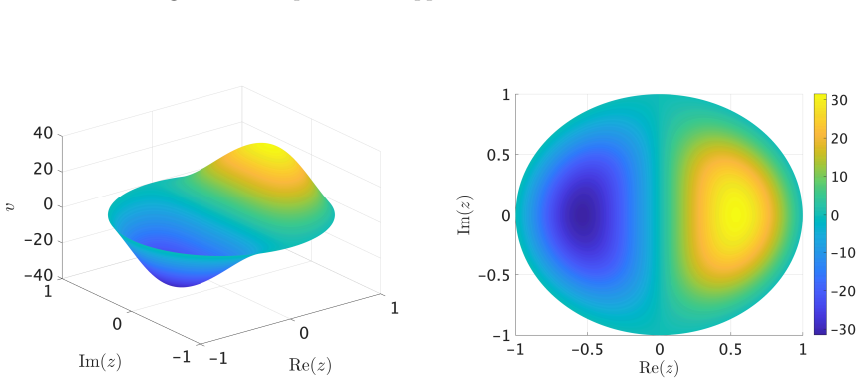
On the paper's own terms, the discovery is Theorem 5.7: for $m\in\{-1,0,1,2,20\}$ there exists $\tilde{U}_m \in V^{0,|m|}$ solving the functional equation $F_m(U)=0$, and hence a smooth non-trivial solution to the boundary-value problem $\triangle v+\bar{z}^m v^2=0$ on the unit disk (with $z^{-1}$ in place of $\bar z^m$ when $m=-1$) subject to Dirichlet conditions, lying inside the ball $B_{r_m}(U_{0,m})$ around a numerically constructed approximate solution. The existence is established not by asymptotic or a priori estimates alone but by verified computation: the constants $Y_0$, $Z_1$, $Z_2$ in Table 1 enter the Newton–Kantorovich inequalities, and the proof is complete once the quadratic $p(r)=Z_2 r^2-(1-Z_1)r+Y_0$ is negative at $r=r_m$. The same pipeline, built from Gaussian quadrature and interval arithmetic, is claimed by the paper to be reusable for any polynomial nonlinearity in an orthogonal polynomial basis, with the Zernike choice being the disk-specific ingredient.
Load-bearing premise
The load-bearing premise is that the verification constants $Y_0$, $Z_1$, $Z_2$ in Table 1 are genuine interval enclosures: the paper states 128-bit precision only for the stored transform matrices and double-precision arithmetic for the rest, so if those constants are merely rounded floating-point estimates, the Newton–Kantorovich conclusion in Theorem 5.7 does not follow.
Editorial extensions
If this is right
- The MMT product is exact up to computed interval enclosures, so polynomial nonlinearities enter PDE verifications without uncontrolled truncation or ad hoc error estimates.
- For each $m\in\{-1,0,1,2,20\}$, Theorem 5.7 yields a certified ball $B_{r_m}(U_{0,m})$ in the coefficient space $V^{0,|m|}$ containing a genuine solution, with radii between $7.65\times10^{-16}$ and $1.33\times10^{-6}$.
- Because the transform is built from general orthogonal polynomials and Gaussian-quadrature nodes, the same validated product machinery applies to other Jacobi-family bases, not only Zernike polynomials.
- The coefficient spaces with admissible weights form Banach algebras, which is what lets the argument control products before any numerics; algebraic weights give Sobolev-type norms and geometric weights give analytic regularity.
- Product evaluation in the MMT costs $O(N^2)$ per nonlinear term, versus $O(N^3)$ for Clebsch–Gordon linearization, making proof runs at truncations $N=36$ and $N=75$ feasible.
Reading between the lines
- Beyond the paper: the Zernike–MMT product should combine with a Fourier basis in the axial direction for cylindrical domains; because the ladder operators stay banded across the tensor product, the axisymmetric Navier–Stokes case the authors flag as future work becomes a concrete test of the same pipeline.
- Beyond the paper: for non-polynomial nonlinearities such as exponentials, a Poisson-style summation formula for Zernike coefficients would be needed; the Banach-algebra and geometric-decay bounds in the paper suggest the tail coefficients could be controlled analytically, which is testable on the exponential spiral-wave models flagged in the conclusion.
- Beyond the paper: rerunning the $m=20$ proof with interval arithmetic throughout—rather than 128-bit precision only for stored matrices and double precision for the rest—would likely shrink the reported radius $1.33\times10^{-6}$; this is a direct consequence of the precision discussion in Section 5.3, not a claim the paper makes.
Editorial analysis
A structured set of objections, weighed in public.
Referee Report
Summary. The paper introduces a validated 'Matrix Multiplication Transform' (MMT) for multiplying polynomials expressed in orthogonal bases, develops the corresponding machinery for Zernike polynomials on the disk, and applies it to computer-assisted existence proofs for two families of semilinear elliptic PDEs: Δv + \bar{z}^m v^2 = 0 for m = 0, 1, 2, 20 and Δv + z^{-1} v^2 = 0, both with Dirichlet boundary conditions. The main existence theorem (Theorem 5.7) is obtained by applying a Newton-Kantorovich theorem (Theorem 3.1) to a functional equation F_m on a weighted sequence space, with a numerically constructed approximate inverse. The analytical framework—Gaussian quadrature formulas for the iMMT, the Banach algebra structure of Zernike coefficient spaces, and the operator bounds in Lemma A.1—is coherent; the main weaknesses lie in the numerical certification and reproducibility of Table 1.
Significance. If the numerical certificates can be made rigorous, the paper would provide a broadly useful O(N^2) validated product algorithm for orthogonal-polynomial spectral methods and one of the first computer-assisted proofs for semilinear PDEs on the disk with a singular 1/r term. The Banach algebra result and the explicit inverse of the multiplication-by-z operators are useful contributions. However, because the final existence proofs depend on three numerical constants whose rigorous computation is not documented, and because the printed table appears internally inconsistent for two parameter values, the central claim is currently not established.
major comments (4)
- [Section 5.3, Table 1] The quantities Y0, Z1, Z2 in Table 1 are asserted to be 'verified quantities of Theorem 3.1,' but Section 5.3 states that the MMT matrices are stored with 128-bit BigFloat precision and that 'the rest of the computations are run in standard double floating point arithmetic.' The conclusion repeats that only products are implemented in extended precision. No statement asserts that Y0, Z1, and Z2 were obtained as outward-rounded interval enclosures. Since Theorem 3.1 requires the inequalities ||AF_m(U0)|| <= Y0, ||I - ADF_m(U0)|| <= Z1, and ||A(DF_m(c) - DF_m(U0))|| <= Z2(r)r for all c in B_r(U0), a double-precision computation without rigorous rounding does not prove these inequalities. This is load-bearing: Theorem 5.7 does not follow from Table 1 as described.
- [Table 1, Theorem 3.1] Even taking Table 1 at face value, the displayed values do not satisfy the condition p(r_m) < 0 required by Theorem 3.1 for two rows. For m = 0, with Y0 = 7.62e-16, Z1 = 4.28e-3, Z2 = 0.71, and r = 7.65e-16, one obtains p(r) = Z2 r^2 - (1 - Z1)r + Y0 ≈ 2.7e-19 > 0. For m = 20, with Y0 = 1.52e-7, Z1 = 8.86e-1, Z2 = 1.3e-3, and r = 1.33e-6, one obtains p(r) ≈ 3.8e-10 > 0. Thus, with the printed rounded bounds, the Newton-Kantorovich hypotheses are not verified; if the true bounds are different, the table must report them with sufficient precision and with a consistent choice of r_m.
- [Section 3 and Section 5.3] The paper never states a formal result guaranteeing that the MMT-based product computed with interval arithmetic produces a rigorous enclosure of the exact product coefficients. Section 3 discusses rigorous computation of nodes, weights, and polynomial values, but Section 3.1 also says that after computing nodes with high precision 'we can subsequently store the computed matrices M and M^{-1} as a double matrix.' Rounding the MMT matrices to double and then multiplying in double cannot, by itself, yield a validated product. A precise statement of the validated MMT algorithm and its error bound is needed before the method can be called 'validated' or used as a black box in Section 5.
- [Reproducibility] The paper cites [Cad24] (a GitHub URL) but includes no commit hash, no versioned code, and no scripts that reproduce Table 1. In a computer-assisted proof, the numerical certificate is part of the proof; without a frozen implementation the reader cannot check that the constants in Table 1 were actually computed as claimed. I ask that the authors ship the code, a commit hash, and a script that recomputes all bounds with interval arithmetic.
minor comments (5)
- [Section 5, Eq. (34)] The boundary condition for the reduced ODE is written as u(1) = 1, but for the Dirichlet problem (4) the correct boundary condition is u(1) = 0.
- [Section 5.2.2, Lemmas 5.4 and 5.5] Several displayed formulas, such as the definitions of Y0 and Z0,m, contain unbalanced parentheses; for example, ||AN(U0 + πN Δ^{-1}_0 ... || is missing a closing parenthesis. Please rewrite these formulas unambiguously.
- [Section 3.1, Figure 4] The caption and text refer to 'N-precision' without specifying the number of bits; the precision should be stated explicitly (for example, in terms of setprecision in Julia).
- [Section 4.3, Definition 4.8] The text says 'we may exactly compute its coefficients with quadrature on N' points,' but the construction uses N' + 1 nodes indexed from 0 to N'; the count should be corrected.
- [Definition 1.1] There is a typographical space in 'Matrix Multiplication T ransform'; this should be corrected throughout.
Circularity Check
No circularity: Theorem 5.7 is a standard a posteriori Newton-Kantorovich certificate with independently computed interval-validated MMT products; the double-precision caveat is a rigor gap, not a circular reduction.
full rationale
The derivation chain is self-contained. The MMT/iMMT entries are defined in Definition 1.1 and Theorem 2.2 from quadrature theory, and their rigorous enclosure is obtained through the Newton-Kantorovich Theorem 3.1 applied to eigenvalue (15) and linear-system (19) zero-finding problems; no target conclusion is assumed as an input. The Zernike Banach algebra (Theorem 4.7) is proved from the non-negative linearization coefficients of Koornwinder (Lemma 4.6), not from the PDE result. The application in Section 5 defines F_m in Definition 5.1, proves equivalence of zeros to PDE solutions in Lemma 5.3, and then applies Theorem 3.1 with bounds Y0, Z1, Z2 whose definitions (Lemmas 5.4–5.6) are explicit operator-norm estimates depending on U0, A, and the inverse Laplacian; this is the standard a posteriori paradigm where U0 and A are numerical inputs and existence is certified by the contraction inequality p(r0)<0. The approximate solution U0 is not a fit of the conclusion; it is an input whose residual is bounded by Y0. No load-bearing argument reduces to a self-citation: [AK19], [VBL+16], [Koo78], and [Jan14] are standard external references, and the only self-citations ([Jaq19], [vdBJ18], [Cad24]) are contextual or used only to locate the numerical construction of U0, not to justify the existence theorem. The caveat that Table 1's verification constants were computed in double precision ('the rest of the computations are run in standard double floating point arithmetic', Section 5.3, with the closing note 'only products are implemented in extended precision') is a correctness/rigor concern about whether Y0, Z1, Z2 are genuine interval enclosures; it does not exhibit any reduction of a prediction to an input by construction, so it does not constitute circularity.
Assumptions & free parameters
assumptions (6)
- standard math Gaussian quadrature with N+1 nodes is exact for polynomials of degree at most 2N+1 (used in Theorem 2.2).
- standard math Koornwinder's positivity theorem for Zernike linearization coefficients (Lemma 4.6).
- domain assumption The inverse Dirichlet Laplacian formula (30) from [Jan14].
- standard math Zernike series of analytic functions converge spectrally and the mapping M: V^k -> C(D,C) is injective with Schauder basis property.
- domain assumption The ansatz v(r,theta) = e^{im theta} u(r) reduces the PDE (33) to the functional equation F_m(U)=0, and any zero of F_m yields a smooth solution.
- standard math Newton-Kantorovich theorem (Theorem 3.1) as stated is valid for Frechet differentiable maps on Banach spaces.
Cite this review
Pith. "Pith review of Validated matrix multiplication transform for orthogonal polynomials with applications to computer-assisted proofs for PDEs." pith.science (2026). https://pith.science/paper/QSG464CM
@misc{pith2026241118361,
  author       = {Pith},
  title        = {Pith review of: Validated matrix multiplication transform for orthogonal polynomials with applications to computer-assisted proofs for PDEs},
  year         = {2026},
  howpublished = {\url{https://pith.science/paper/QSG464CM}},
  note         = {Machine review of arXiv:2411.18361}
}
read the original abstract
In this paper, we achieve three primary objectives related to the rigorous computational analysis of nonlinear PDEs posed on complex geometries such as disks and cylinders. First, we introduce a validated Matrix Multiplication Transform (MMT) algorithm, analogous to the discrete Fourier transform, which offers a reliable framework for evaluating nonlinearities in spectral methods while effectively mitigating challenges associated with rounding errors. Second, we examine the Zernike polynomials, a spectral basis well-suited for problems on the disk, and highlight their essential properties. We further demonstrate how the MMT approach can be effectively employed to compute the product of truncated Zernike series, ensuring both accuracy and efficiency. Finally, we combine the MMT framework and Zernike series to construct computer-assisted proofs that establish the existence of solutions to two distinct nonlinear elliptic PDEs on the disk.
Figures


Figures from the paper (6 more)




Forward citations
Cited by 1 Pith paper
-
Numerical Analysis of differential equations on weighted Sobolev spaces: beyond classical orthogonal polynomials
This paper develops Freud-Sobolev orthogonal polynomials, proves quantitative compactness estimates for the H^1(e^{-V}) embedding, and uses computer-assisted proofs to enclose solutions of the sextic Gross-Pitaevskii ...
Reference graph
Works this paper leans on
-
[1]
Gianni Arioli, Filippo Gazzola, and Hans Koch. Uniqueness and bifurcation branches for planar steady N avier- S tokes equations under N avier boundary conditions. J. Math. Fluid Mech. , 23(3):Paper No. 49, 20, 2021
work page 2021
-
[2]
Integration of dissipative partial differential equations: a case study
Gianni Arioli and Hans Koch. Integration of dissipative partial differential equations: a case study. SIAM J. Appl. Dyn. Syst. , 9(3):1119--1133, 2010
work page 2010
-
[3]
Non-radial solutions for some semilinear elliptic equations on the disk
Gianni Arioli and Hans Koch. Non-radial solutions for some semilinear elliptic equations on the disk. Nonlinear Analysis , 179:294--308, 2019
work page 2019
-
[4]
Periodic and quasiperiodic waves on the sphere
Gianni Arioli and Hans Koch. Periodic and quasiperiodic waves on the sphere. SIAM Journal on Applied Dynamical Systems , 23(4):2769--2792, 2024
work page 2024
-
[5]
Roberto Barrio. Rounding error bounds for the C lenshaw and F orsythe algorithms for the evaluation of orthogonal polynomial series. Journal of computational and applied mathematics , 138(2):185--204, 2002
work page 2002
-
[6]
Constructive proofs for some semilinear PDE s on H ^2(e^ |x|²/4 , R ^d)
Maxime Breden and Hugo Chu. Constructive proofs for some semilinear PDE s on H ^2(e^ |x|²/4 , R ^d) . Preprint, 2024
work page 2024
-
[7]
Smooth imploding solutions for 3D compressible fluids
Tristan Buckmaster, Gonzalo Cao-Labora, and Javier G \'o mez-Serrano. Smooth imploding solutions for 3D compressible fluids. arXiv preprint arXiv:2208.09445 , 2022
arXiv 2022
-
[8]
Julia: A fresh approach to numerical computing
Jeff Bezanson, Alan Edelman, Stefan Karpinski, and Viral B Shah. Julia: A fresh approach to numerical computing. SIAM R eview , 59(1):65--98, 2017
work page 2017
Show all 74 references
-
[9]
Angular momentum in quantum physics: theory and application
Lawrence C Biedenharn, James D Louck, and Peter A Carruthers. Angular momentum in quantum physics: theory and application . 1984
1984
-
[10]
Iteration-free computation of gauss--legendre quadrature nodes and weights
Ignace Bogaert. Iteration-free computation of gauss--legendre quadrature nodes and weights. SIAM Journal on Scientific Computing , 36(3):A1008--A1026, 2014
2014
-
[11]
C hebyshev and F ourier spectral methods
John P Boyd. C hebyshev and F ourier spectral methods . Courier Corporation, 2001
2001
-
[12]
Dedalus: A flexible framework for numerical simulations with spectral methods
Keaton J Burns, Geoffrey M Vasil, Jeffrey S Oishi, Daniel Lecoanet, and Benjamin P Brown. Dedalus: A flexible framework for numerical simulations with spectral methods. Physical Review Research , 2(2):023068, 2020
2020
-
[13]
Principles of Optics: Electromagnetic Theory of Propagation, Interference and Diffraction of Light
Max Born and Emil Wolf. Principles of Optics: Electromagnetic Theory of Propagation, Interference and Diffraction of Light . Cambridge University Press, Cambridge, UK, 7th edition, 1999
1999
-
[14]
John P Boyd and Fu Yu. Comparing seven spectral methods for interpolation and for solving the P oisson equation in a disk: Z ernike polynomials, L ogan-- S hepp ridge polynomials, C hebyshev-- F ourier series, cylindrical R obert functions, B essel-- F ourier expansions, squar...
2011
-
[15]
Zernile P olynomials.jl
Matthieu Cadiot. Zernile P olynomials.jl. 2024. https://github.com/matthieucadiot/ZernikePolynomials.jl
2024
-
[16]
Stable nearly self-similar blowup of the 2D B oussinesq and 3D E uler equations with smooth data
Jiajie Chen and Thomas Y Hou. Stable nearly self-similar blowup of the 2D B oussinesq and 3D E uler equations with smooth data. arXiv preprint arXiv:2210.07191v2 , 2022
2022 arXiv
-
[17]
Computer-assisted proof of heteroclinic connections in the one-dimensional O hta- K awasaki M odel
Jacek Cyranka and Thomas Wanner. Computer-assisted proof of heteroclinic connections in the one-dimensional O hta- K awasaki M odel. SIAM J. Appl. Dyn. Syst. , 17(1):694--731, 2018
2018
-
[18]
Determining the source of period-doubling instabilities in spiral waves
Stephanie Dodson and Bjorn Sandstede. Determining the source of period-doubling instabilities in spiral waves. SIAM Journal on Applied Dynamical Systems , 18(4):2202--2226, 2019
2019
-
[19]
A framework for the numerical computation and a posteriori verification of invariant objects of evolution equations
Jordi-Llu\'is Figueras, Marcio Gameiro, Jean-Philippe Lessard, and Rafael de la Llave. A framework for the numerical computation and a posteriori verification of invariant objects of evolution equations. SIAM J. Appl. Dyn. Syst. , 16(2):1070--1088, 2017
2017
-
[20]
Forsythe
George E. Forsythe. Generation and use of orthogonal polynomials for data-fitting with a digital computer. J. Soc. Indust. Appl. Math. , 5:74--88, 1957
1957
-
[21]
Analytic estimates and rigorous continuation for equilibria of higher-dimensional PDE s
Marcio Gameiro and Jean-Philippe Lessard. Analytic estimates and rigorous continuation for equilibria of higher-dimensional PDE s. J. Differential Equations , 249(9):2237--2268, 2010
2010
-
[22]
I. S. Gradshteyn and I. M. Ryzhik. Table of integrals, series, and products . Academic Press, Inc., San Diego, CA, sixth edition, 2000. Translated from the Russian, Translation edited and with a preface by Alan Jeffrey and Daniel Zwillinger
2000
-
[23]
Computer-assisted proofs in PDE : a survey
Javier G\'omez-Serrano. Computer-assisted proofs in PDE : a survey. SeMA J. , 76(3):459--484, 2019
2019
-
[24]
Golub and John H
Gene H. Golub and John H. Welsch. Calculation of gauss quadrature rules. Mathematics of Computation , 23(106):221--230, 1969
1969
-
[25]
Potential singularity formation of incompressible axisymmetric euler equations with degenerate viscosity coefficients
Thomas Y Hou and De Huang. Potential singularity formation of incompressible axisymmetric euler equations with degenerate viscosity coefficients. Multiscale Modeling & Simulation , 21(1):218--268, 2023
2023
-
[26]
Dynamic stability of the three-dimensional axisymmetric N avier- S tokes equations with swirl
Thomas Y Hou and Congming Li. Dynamic stability of the three-dimensional axisymmetric N avier- S tokes equations with swirl. Communications on Pure and Applied Mathematics: A Journal Issued by the Courant Institute of Mathematical Sciences , 61(5):661--697, 2008
2008
-
[27]
Thomas Y. Hou. Potentially singular behavior of the 3d N avier– S tokes equations. Foundations of Computational Mathematics , 23(6):2251--2299, 2023
2023
-
[28]
Fast and accurate computation of G auss-- L egendre and G auss-- J acobi quadrature nodes and weights
Nicholas Hale and Alex Townsend. Fast and accurate computation of G auss-- L egendre and G auss-- J acobi quadrature nodes and weights. SIAM Journal on Scientific Computing , 35(2):A652--A674, 2013
2013
-
[29]
Zernike expansion of derivatives and L aplacians of the Z ernike circle polynomials
AJEM Janssen. Zernike expansion of derivatives and L aplacians of the Z ernike circle polynomials. JOSA A , 31(7):1604--1613, 2014
2014
-
[30]
A proof of J ones' conjecture
Jonathan Jaquette. A proof of J ones' conjecture. J. Differential Equations , 266(6):3818--3859, 2019
2019
-
[31]
Banach algebra related to disk polynomials
Yūichi Kanjin. Banach algebra related to disk polynomials . Tohoku Mathematical Journal , 37(3):395 -- 404, 1985
1985
-
[32]
Spiral breakup in model equations of action potential propagation in cardiac tissue
Alain Karma. Spiral breakup in model equations of action potential propagation in cardiac tissue. Physical review letters , 71(7):1103, 1993
1993
-
[33]
Electrical alternans and spiral wave breakup in cardiac tissue
Alain Karma. Electrical alternans and spiral wave breakup in cardiac tissue. Chaos: An Interdisciplinary Journal of Nonlinear Science , 4(3):461--472, 1994
1994
-
[34]
Nakao, Yoshitaka Watanabe, and Takaaki Nishida
Myoungnyoun Kim, Mitsuhiro T. Nakao, Yoshitaka Watanabe, and Takaaki Nishida. A numerical verification method of bifurcating solutions for 3-dimensional R ayleigh- B \'enard problems. Numer. Math. , 111(3):389--406, 2009
2009
-
[35]
Positivity proofs for linearization and connection coefficients of orthogonal polynomials satisfying an addition formula
Tom Koornwinder. Positivity proofs for linearization and connection coefficients of orthogonal polynomials satisfying an addition formula. Journal of the London Mathematical Society , 2(1):101--114, 1978
1978
-
[36]
Computer-assisted proofs in analysis and programming in logic: a case study
Hans Koch, Alain Schenkel, and Peter Wittwer. Computer-assisted proofs in analysis and programming in logic: a case study. SIAM Rev. , 38(4):565--604, 1996
1996
-
[37]
Lanford, III
Oscar E. Lanford, III. A computer-assisted proof of the F eigenbaum conjectures. Bull. Amer. Math. Soc. (N.S.) , 6(3):427--434, 1982
1982
-
[38]
Nakao, and Shin'ichi Oishi
Xuefeng Liu, Mitsuhiro T. Nakao, and Shin'ichi Oishi. Computer-assisted proof for the stationary solution existence of the N avier- S tokes equation over 3 D domains. Commun. Nonlinear Sci. Numer. Simul. , 108:Paper No. 106223, 15, 2022
2022
-
[39]
Verified eigenvalue evaluation for the L aplacian over polygonal domains of arbitrary shape
Xuefeng Liu and Shin'ichi Oishi. Verified eigenvalue evaluation for the L aplacian over polygonal domains of arbitrary shape. SIAM J. Numer. Anal. , 51(3):1634--1654, 2013
2013
-
[40]
On the bifurcation structure of axisymmetric vortex breakdown in a constricted pipe
JM Lopez. On the bifurcation structure of axisymmetric vortex breakdown in a constricted pipe. Physics of Fluids , 6(11):3683--3693, 1994
1994
-
[41]
An efficient spectral-projection method for the N avier-- S tokes equations in cylindrical geometries: I
JM Lopez and Jie Shen. An efficient spectral-projection method for the N avier-- S tokes equations in cylindrical geometries: I. axisymmetric cases. Journal of Computational Physics , 139(2):308--326, 1998
1998
-
[42]
Vorticity and incompressible flow
Andrew J Majda and Andrea L Bertozzi. Vorticity and incompressible flow . Cambridge University Press, Cambridge, 2002
2002
-
[43]
A spectral method for polar coordinates
T Matsushima and PS Marcus. A spectral method for polar coordinates. Journal of Computational Physics , 120(2):365--374, 1995
1995
-
[44]
Chaos in the L orenz equations: a computer-assisted proof
Konstantin Mischaikow and Marian Mrozek. Chaos in the L orenz equations: a computer-assisted proof. Bull. Amer. Math. Soc. (N.S.) , 32(1):66--72, 1995
1995
-
[45]
Ramon E. Moore. Interval analysis . Prentice-Hall Inc., Englewood Cliffs, N.J., 1966
1966
-
[46]
Mitsuhiro T. Nakao. Numerical verification methods for solutions of ordinary and partial differential equations. volume 22, pages 321--356. 2001. International Workshops on Numerical Methods and Verification of Solutions, and on Numerical Function Analysis (Ehime/Shimane, 1999)
2001
-
[47]
M. T. Nakao, K. Hashimoto, and Y. Watanabe. A numerical method to verify the invertibility of linear elliptic operators with applications to nonlinear problems. Computing , 75(1):1--14, 2005
2005
-
[48]
R. J. Noll. Z ernike polynomials and atmospheric turbulence. Journal of the Optical Society of America , 66(3):207--211, 1976
1976
-
[49]
Nakao, Michael Plum, and Yoshitaka Watanabe
Mitsuhiro T. Nakao, Michael Plum, and Yoshitaka Watanabe. Numerical verification methods and computer-assisted proofs for partial differential equations , volume 53 of Springer Series in Computational Mathematics . Springer, Singapore, [2019] 2019
2019
-
[50]
The NIST Handbook of Mathematical Functions
Frank Olver, Daniel Lozier, Ronald Boisvert, and Charles Clark. The NIST Handbook of Mathematical Functions . Cambridge University Press, New York, NY, 2010-05-12 00:05:00 2010
2010
-
[51]
Siegfried M. Rump. Verification methods: rigorous results using floating-point arithmetic. Acta Numer. , 19:287--449, 2010
2010
-
[52]
Sanders and Luis Benet
David P. Sanders and Luis Benet. Intervalarithmetic.jl, 2014
2014
-
[53]
A new fast C hebyshev-- F ourier algorithm for P oisson-type equations in polar geometries
Jie Shen. A new fast C hebyshev-- F ourier algorithm for P oisson-type equations in polar geometries. Applied Numerical Mathematics , 33(1-4):183--190, 2000
2000
-
[54]
Bifurcations and dynamics of spiral waves
B Sandstede, A Scheel, and C Wulff. Bifurcations and dynamics of spiral waves. Journal of nonlinear science , 9:439--478, 1999
1999
-
[55]
Verified calculation of the nodes and weights for gaussian quadrature formulas
Ulrike Storck. Verified calculation of the nodes and weights for gaussian quadrature formulas. Interval Computations , 4:114--124, 1993
1993
-
[56]
Spectral methods: algorithms, analysis and applications , volume 41
Jie Shen, Tao Tang, and Li-Lian Wang. Spectral methods: algorithms, analysis and applications , volume 41. Springer Science & Business Media, 2011
2011
-
[57]
Verified computations to semilinear elliptic boundary value problems on arbitrary polygonal domains
Akitoshi Takayasu, Xuefeng Liu, and Shin'ichi Oishi. Verified computations to semilinear elliptic boundary value problems on arbitrary polygonal domains. Nonlinear Theory and Its Applications, IEICE , 4(1):34--61, 2013
2013
-
[58]
The L orenz attractor exists
Warwick Tucker. The L orenz attractor exists. C. R. Acad. Sci. Paris S\'er. I Math. , 328(12):1197--1202, 1999
1999
-
[59]
A rigorous ODE S olver and S male's 14th P roblem
Warwick Tucker. A rigorous ODE S olver and S male's 14th P roblem. Foundations of Computational Mathematics , 2(1):53--117--117, 2002-12-21
2002
-
[60]
Validated numerics
Warwick Tucker. Validated numerics . Princeton University Press, Princeton, NJ, 2011. A short introduction to rigorous computations
2011
-
[61]
Tensor calculus in polar coordinates using jacobi polynomials
Geoffrey M Vasil, Keaton J Burns, Daniel Lecoanet, Sheehan Olver, Benjamin P Brown, and Jeffrey S Oishi. Tensor calculus in polar coordinates using jacobi polynomials. Journal of Computational Physics , 325:53--73, 2016
2016
-
[62]
Computer-assisted proofs for radially symmetric solutions of pdes
Jan Bouwe van den Berg, Istv \'a n Bal \'a zs, Julien Courtois, J \'a nos Dud \'a s, Anett V \"o r \"o s-Kiss, Xi Yuan Yin, JF Williams, and Jean-Philippe Lessard. Computer-assisted proofs for radially symmetric solutions of pdes. Journal of Computational Dynamics , 5(1&2):61-...
2018
-
[63]
Spontaneous periodic orbits in the N avier- S tokes flow
Jan Bouwe van den Berg, Maxime Breden, Jean-Philippe Lessard, and Lennaert van Veen. Spontaneous periodic orbits in the N avier- S tokes flow. J. Nonlinear Sci. , 31(2):Paper No. 41, 64, 2021
2021
-
[64]
Rotation invariant patterns for a nonlinear L aplace- B eltrami equation: A T aylor- C hebyshev series approach
Jan Bouwe van den Berg, Gabriel William Duchesne, and Jean-Philippe Lessard. Rotation invariant patterns for a nonlinear L aplace- B eltrami equation: A T aylor- C hebyshev series approach. Journal of Computational Dynamics , 9(2):253--278, 2022
2022
-
[65]
A proof of W right's conjecture
Jan Bouwe van den Berg and Jonathan Jaquette. A proof of W right's conjecture. J. Differential Equations , 264(12):7412--7462, 2018
2018
-
[66]
Rigorous numerics in dynamics
Jan Bouwe van den Berg and Jean-Philippe Lessard. Rigorous numerics in dynamics. Notices Amer. Math. Soc. , 62(9):1057--1061, 2015
2015
-
[67]
Jan Bouwe van den Berg and J. F. Williams. Rigorously computing symmetric stationary states of the O hta- K awasaki problem in three dimensions. SIAM J. Math. Anal. , 51(1):131--158, 2019
2019
-
[68]
J. L. Walsh. Interpolation and approximation by rational functions in the complex domain , volume Vol. XX of American Mathematical Society Colloquium Publications . American Mathematical Society, Providence, RI, fourth edition, 1965
1965
-
[69]
Yoshitaka Watanabe, Michael Plum, and Mitsuhiro T. Nakao. A computer-assisted instability proof for the O rr- S ommerfeld problem with P oiseuille flow. ZAMM Z. Angew. Math. Mech. , 89(1):5--18, 2009
2009
-
[70]
Computer-assisted Existence Proofs for N avier- S tokes Equations on an Unbounded Strip with Obstacle
Jonathan Matthias Wunderlich. Computer-assisted Existence Proofs for N avier- S tokes Equations on an Unbounded Strip with Obstacle . PhD thesis, Karlsruher Institut f \"u r Technologie (KIT), 2022
2022
-
[71]
A geometric method for infinite-dimensional chaos: symbolic dynamics for the K uramoto- S ivashinsky PDE on the line
Daniel Wilczak and Piotr Zgliczy\'nski. A geometric method for infinite-dimensional chaos: symbolic dynamics for the K uramoto- S ivashinsky PDE on the line. J. Differential Equations , 269(10):8509--8548, 2020
2020
-
[72]
Nobito Yamamoto and Mitsuhiro T. Nakao. Numerical verifications of solutions for elliptic equations in nonconvex polygonal domains. Numer. Math. , 65(4):503--521, 1993
1993
-
[73]
von F. Zernike . Beugungstheorie des schneidenver-fahrens und seiner verbesserten form, der phasenkontrastmethode . Physica , 1(7):689--704, May 1934
1934
-
[74]
Rigorous numerics for partial differential equations: the K uramoto- S ivashinsky equation
Piotr Zgliczy\'nski and Konstantin Mischaikow. Rigorous numerics for partial differential equations: the K uramoto- S ivashinsky equation. Found. Comput. Math. , 1(3):255--288, 2001
2001
Reviewed August 12, 2026 · model on record in the stance chip above.
Discussion (0). Continue with ORCID to comment.