REVIEW 2 major objections 6 minor 27 references
Ergodic optimal liquidations in DeFi
T0 review · 2 major / 6 minor · reviewed 2026-08-12 · deepseek-v4-flash
Pith's one-line read Under a simplified market model, a DeFi exchange's optimal liquidation policy is to sell the fixed fraction $\sqrt{\phi/k}$ of its current inventory per unit time, yielding the closed-form average profit $\gamma = 2 r \lambda \eta S_0…
desk verdict The paper gets the optimal policy right but the headline ergodic-reward formula wrong: it substitutes E[zeta]^2 for E[zeta^2] in the HJB jump terms, so the closed-form gamma in Theorem 2.1 needs correction. read the letter →
The pith
A machine-rendered reading of the paper's core claim, the machinery that carries it, and where it could break.
The reading
What carries the argument
The argument is carried by the ergodic control / Hamilton–Jacobi–Bellman framework. Under the simplifications, the value function decouples from the price level and the problem reduces to a one-dimensional controlled jump-diffusion for inventory $q$. The paper solves the finite-horizon and discounted infinite-horizon versions with a quadratic ansatz $u(t,q) = h_0(t) + h_2(t) q^2$ (and similarly $u(q) = h_0 + h_2 q^2$ in the discounted case), then lets the discount $\beta$ tend to $0$ to obtain the ergodic constant. The optimal feedback control from the first-order condition is $\nu^* = -(b q + \partial_q u)/(2k)$, which with the chosen root $h_2 = -\sqrt{k\phi} - b/2$ collapses to $\nu^*(q) = \sqrt{\phi/k}\, q$. The key mechanism is therefore the quadratic structure of the value function plus the vanishing-discount limit, which turns a stochastic control problem into simple algebra.
What would settle it
Run the same controlled dynamics (4) with $S_0$ varied over a wide range (say from $1$ to $100$) while holding other parameters fixed, compute the long-run average reward under the control $\nu^*(q) = \sqrt{\phi/k}\, q$, and check whether it equals $\gamma$ from (8) within Monte-Carlo error; a systematic drift away from (8), or a clear dependence of the optimal control's coefficient on $S_t$, would refute the central claim's practical validity. A sharper test is to solve the HJB for the original dynamics (4) numerically and compare the optimal feedback map to the linear map $\sqrt{\phi/k}\, q$.
Extended reading notes
Core claim
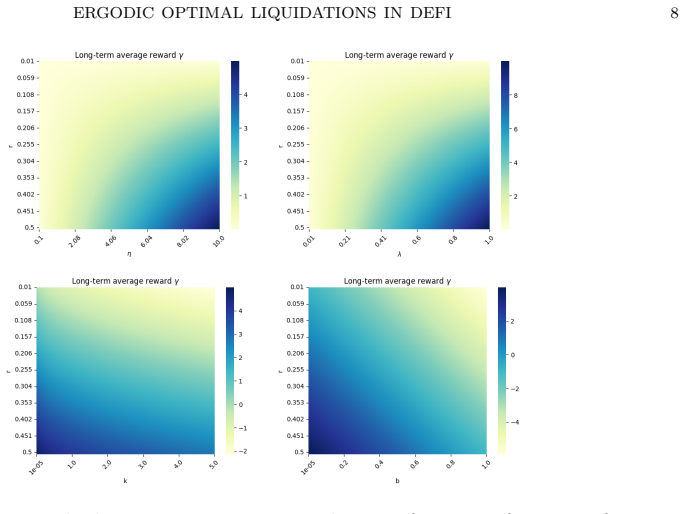
The paper claims that the ergodic optimal liquidation problem in DeFi, after three simplifications (fixed-price cash inflows, symmetric long/short liquidation flows, linear price impacts), has a complete closed-form solution. Theorem 2.1 identifies the ergodic constant, the optimal long-run average reward, as $\gamma = 2 r \lambda \eta S_0 - \lambda \eta^2 b - 2 \lambda \eta^2 \sqrt{k\phi}$, and Corollary 2.1 gives the optimal Markov control $\nu^*(q) = \sqrt{\phi/k}\, q$. In words, whatever inventory $q$ the exchange holds, it should trade the same fraction $\sqrt{\phi/k}$ of that inventory per unit time, and the resulting average profit per unit time is the formula above. The strategy depends only on the risk-aversion parameter $\phi$ and the temporary price-impact coefficient $k$, so it is robust to misspecification of the other parameters; the average reward, meanwhile, is independent of initial state and of volatility $\sigma$.
Load-bearing premise
The load-bearing simplification is that cash inflows from liquidations are valued at the initial price $S_0$ instead of the current market price $S_t$; the paper supports this only with a single-parameter-set numerical comparison, so if that approximation fails over long horizons the closed-form $\gamma$ and the proportional policy may not be optimal in the original model.
Editorial extensions
If this is right
- An exchange that follows the policy will, in the model, sell a fraction $\sqrt{\phi/k}$ of its inventory per unit time at all times, never waiting for better prices.
- The ergodic constant $\gamma$ gives an explicit forecast of the insurance pool's long-run average earnings, letting an exchange set margin levels (inverse leverage $r$) to keep that balance healthy.
- Because the optimal control is independent of $\lambda$, $\eta$, $b$, and $S_0$, an exchange that misestimates liquidation frequency, position sizes, permanent impact, or price level still executes the optimal trading speed, as long as $k$ and $\phi$ are right.
- Volatility $\sigma$ does not appear in $\gamma$, and the numerical experiments indicate this remains approximately true under the original dynamics, meaning higher volatility raises tail risk (VaR/ES) but not average profit.
- The calibration section gives a data pipeline (MLE for $\lambda$, $\eta$; order-book walk for $k$; regression for $b$) so the model can be fitted to real exchange data.
Reading between the lines
- If the proportional-inventory policy survives contact with the original price-dependent dynamics beyond the single parameter set tested here, it would give liquidation desks a rule that is essentially parameter-light: only the temporary price impact and risk aversion matter.
- The fixed-price simplification is most strained in a fast crash, where $S_t$ can be far from $S_0$; a natural stress test would re-solve or simulate the original dynamics with $S_0$ varying over a wide range, or with jumps in the price, to see when the closed-form $\gamma$ breaks down.
- The model's symmetry assumption ($\lambda^+ = \lambda^-$, $\eta^+ = \eta^-$) is convenient but may be violated in practice, e.g. in a one-sided market; an asymmetric extension would likely keep the quadratic ansatz but change the constants $h_0$ and $h_2$, and would be a feasible next step.
- The same framework could be applied to lending-protocol liquidators by reinterpreting $r$ as the liquidation bonus, which the paper itself notes; one could then compare the ergodic reward of a protocol's auction design against this continuous benchmark.
Editorial analysis
A structured set of objections, weighed in public.
Referee Report
Summary. The paper models the gradual liquidation of positions accumulated by a decentralized derivatives exchange as an ergodic stochastic control problem. The setup includes Brownian mid-price dynamics, linear temporary and permanent price impact, Poisson liquidation events with random sizes, and a simplified cash balance dynamics in which liquidation cash inflows are priced at the initial mid-price. Under these simplifications the paper derives candidate closed-form solutions: the ergodic constant γ = 2rληS0 − λη²b − 2λη²√(kϕ) and the optimal Markov control ν*(q)=√(ϕ/k)q. The proofs proceed through finite-horizon and discounted HJB equations with a quadratic ansatz and then pass to the limits T→∞ and β→0. Numerical simulations compare the proposed strategy with a heuristic, study parameter sensitivity, and propose a calibration method from order-book and liquidation data.
Significance. The paper addresses a timely and practically relevant problem, and if the formulas are correct the proportional-inventory policy ν*(q)=√(ϕ/k)q is a clean, implementable benchmark for DeFi liquidation desks. The HJB ansatz and verification structure are mostly transparent, the admissibility checks for the candidate controls are explicit, and the calibration section gives a concrete route to apply the model. A notable strength is that the optimal feedback control is robust to the second-moment issue identified below. However, the quantitative content of the main theorem depends on an unstated substitution of E[ζ²] by η², and the proof of the key ergodic identification is outsourced to a preprint. The central closed-form reward formula and the calibration recipe therefore need correction before the results can be used as stated.
major comments (2)
- [§5.2, Eq. (21)–(22); §5.4, Theorem 2.1; §3] The jump term in the HJB equation (21) is λE[u(t,q+ζ+)−u(t,q)] + λE[u(t,q−ζ−)−u(t,q)]. With the quadratic ansatz u=h0+h2q² and h1=0, this term equals λh2(E[(ζ+)²]+E[(ζ−)²]) after the linear q-terms cancel under η+=η−, not 2λη²h2. The paper's ODE (22) and the subsequent formulas for h0 in (17) and (24) replace the second moment E[ζ²] by η² without any assumption such as Var(ζ)=0. Consequently Theorem 2.1's closed form γ=2rληS0−λη²b−2λη²√(kϕ) is not a consequence of the stated assumptions. For equal second moments m2=E[ζ²] the corrected constant is γ=2rληS0−λm2b−2λm2√(kϕ). This is load-bearing because the formula is the paper's main quantitative result and because the calibration recipe in §3 estimates only η and would be materially wrong for heavy-tailed liquidation sizes. The numerical section uses ζ∼N(10,0.5), for which m2=100.25 is very close to η²=100, so the error is invisible in the reported simulations.
- [§5.4–§5.5, Theorem 2.1 and Corollary 2.1] The proof of Theorem 2.1 computes the limits lim β→0 βvβ(q) and lim T→∞ (1/T)v(0,q;T) and then states that the ergodic constant γ of problem (12) equals this common limit, but the justification is deferred to '[7, Theorem 5]' and the argument is omitted. Since the state process and jump structure here are not identical to those in [7], and since [7] is an unpublished preprint by the authors, this leaves a gap in the proof of the paper's central identification result. The same reliance appears in the proof of Corollary 2.1, which refers to '[7, Appendix A.3]' for the ergodic HJB equation. Please provide a self-contained verification argument, or at minimum state the precise ergodic theorem used and verify its hypotheses for the present model.
minor comments (6)
- [§2.2, Figure 1 caption] The caption contains the typo 'left penal' instead of 'left panel'.
- [§3, parameter calibration] The symbol M is used both for the number of fixed trade sizes Qj and for the number of subintervals in the average defining k; this should be disambiguated, and the formula k=(1/M)Σ k(i) should use the number of subintervals, with a different symbol.
- [§5.2, Proposition 5.1] The condition 'α ≫ b, k' for the terminal penalty is imprecise. The formulas require the denominator in ξ to be positive, i.e. α > b/2 + √(kϕ), so that ξ>1 and the solution has no singularity on [0,T].
- [§5.1, Eq. (16)] In the dimension reduction, the replacement of the random jump sizes ζ by their means η in the compensated Poisson terms should be explained as taking compensators; as written, it may suggest that the jump sizes are deterministic.
- [§2.2, Figure 3 and surrounding text] The conclusion that σ has no effect on γ under the original dynamics (4) is based on a single parameter configuration and a finite number of Monte Carlo trajectories; the text should hedge accordingly.
- [References, [6]] The in-text citation 'Bertsimas and Lo [6]' does not match the three-author reference [6]; please check the bibliographic details.
Circularity Check
No fit-based circularity: ν* and γ are solved from the model's HJB equations, and §2.2's Monte-Carlo under the original dynamics independently checks the formula. Remaining circularity: a load-bearing self-citation to the authors' own preprint [7] for the γ = γ̂ identification, plus an unflagged E[ζ²]→η² substitution making Theorem 2.1 exact only for degenerate liquidation sizes.
-
self citation load bearing
[Section 5.4 (proof of Theorem 2.1) and Section 5.5 (proof of Corollary 2.1)]
"Finally we need to show that the ergodic constant γ given by (12) is equal to ˆγ, which the proof is analogous to that of [7, Theorem 5] and thus omitted here for brevity. ... Hence, by following the proof in [7, Appendix A.3], the ergodic HJB equation for the control problem (12) is ..."
Reference [7] is the authors' own arXiv preprint (Cao, Šiška, Szpruch, Treetanthiploet, arXiv:2409.02025), so the two places where the central ergodic claims are established — γ = γ̂ in Theorem 2.1 and the ergodic HJB equation in Corollary 2.1 — defer to author-overlapping prior work rather than to a proof contained in this paper or to an independent, machine-checked result. The closed-form value γ̂ is, however, computed in-paper from two separate limiting procedures (β→0 and T→∞) that agree, and §2.2's Monte-Carlo under the original dynamics (4) independently checks the number, so the self-citation is load-bearing for the identification step while the central claim retains independent content.
-
other
[Section 5.2, Eqs. (19) and (22); Theorem 2.1, Eq. (8), and Section 5.4]
"the HJB (19) contains λEu(t, q+ζ +)−u(t, q) + λEu(t, q−ζ −)−u(t, q), while the solved ODE (22) states ∂th0 + 1 4k h2 1 + 2λη2h2 + 2rληS0 = 0."
For u(t,q) = h0(t) + h2(t)q², the jump operator in (19) equals λh2(2q(η⁺−η⁻) + E[(ζ⁺)²] + E[(ζ⁻)²]), which under the paper's symmetry assumptions is 2λE[ζ²]h2, not the 2λη²h2 that appears in (22). The same substitution recurs in (17), (24), and the Corollary 2.1 ODE system, so Theorem 2.1's γ = 2rληS0 − λη²b − 2λη²√(kφ) follows from the stated assumptions only if Var ζ = 0 (degenerate sizes); the correct constant is 2rληS0 − λE[ζ²]b − 2λE[ζ²]√(kφ). This is not a fit-to-data reduction but an unflagged moment substitution that makes Eqs. (19)→(22) internally inconsistent under the paper's own finite-second-moment assumption; §2.2's ζ∼N(10,0.5) masks the discrepancy because Eζ² = 100.25 ≈ η² = 100, and §3's calibration of η alone would misstate γ for heavy-tailed sizes.
full rationale
Walking the full derivation chain in Sections 2 and 5: the optimal control ν*(q) = √(φ/k)q and the ergodic constant γ are obtained by solving the model's own HJB equations (finite-horizon Theorem 5.1, discounted Theorem 5.2, then β→0 and T→∞ limits in Theorem 2.1), not by fitting any parameter to the predicted quantity. Section 3's calibration routine estimates only the model inputs (λ, η, k, b), and §2.2 checks the analytic γ against Monte-Carlo simulation under the unsimplified dynamics (4), which is genuine external validation. Hence there is no fitted-input-called-prediction or renaming circularity. Two load-bearing defects remain. First, the equality γ = γ̂ — the identification of the ergodic constant of (12) with the computed limits — and the derivation of the ergodic HJB equation are not proved in the paper: Theorem 2.1's proof says 'analogous to [7, Theorem 5]' and Corollary 2.1's proof 'follow[s] the proof in [7, Appendix A.3]', where [7] is the authors' own arXiv preprint. By the review standard this is a self-citation chain, but the closed form itself is computed twice in-paper from independent limits and numerically reproduced, so the central claim is not exhausted by the citation. Second, the HJB jump term λE[u(q+ζ⁺)−u(q)] + λE[u(q−ζ⁻)−u(q)] is reduced in ODE (22) to 2λη²h2, whereas the exact evaluation under the stated symmetry gives 2λE[ζ²]h2; the paper's η² substitute is exact only for constant liquidation sizes. This internal inconsistency propagates into (8) and the §3 'average-size-only' calibration recipe, so Theorem 2.1's closed form is not, strictly, a consequence of the paper's stated assumptions — a correctness risk that deserves explicit flagging, though it is a moment-substitution error rather than a circular equivalence. The acknowledged S0 simplification (7) is exactly that: an acknowledged approximation supported by a single-parameter-set numerical comparison in §2.2, not a circularity. Overall score 4: self-citation is real and load-bearing in the ergodic-identification step, but the central closed forms carry independent, in-paper content.
Assumptions & free parameters
free parameters (2)
- Risk aversion parameter phi
- Terminal penalty alpha
assumptions (6)
- standard math Standard Ito calculus and dynamic programming for continuous-time stochastic control with Poisson jumps.
- domain assumption Liquidation events are modelled as independent Poisson processes with iid sizes, independent of the Brownian motion.
- domain assumption Symmetry of liquidation intensities and sizes: lambda^+ = lambda^- = lambda and eta^+ = eta^- = eta.
- domain assumption Linear temporary and permanent price impact: f(nu) = k nu and g(nu) = b nu.
- domain assumption Simplified cash balance uses the initial price S0 instead of the current price S_t.
- standard math The ergodic constant gamma equals the limit of discounted and finite-horizon optimal rewards, as stated in [7, Theorem 5].
Cite this review
Pith. "Pith review of Ergodic optimal liquidations in DeFi." pith.science (2026). https://pith.science/paper/ZKXRUZWH
@misc{pith2026241119637,
  author       = {Pith},
  title        = {Pith review of: Ergodic optimal liquidations in DeFi},
  year         = {2026},
  howpublished = {\url{https://pith.science/paper/ZKXRUZWH}},
  note         = {Machine review of arXiv:2411.19637}
}
read the original abstract
We address the liquidation problem arising from the credit risk management in decentralised finance (DeFi) by formulating it as an ergodic optimal control problem. In decentralised derivatives exchanges, liquidation is triggered whenever the parties fail to maintain sufficient collateral for their open positions. Consequently, effectively managing and liquidating disposal of positions accrued through liquidations is a critical concern for decentralised derivatives exchanges. By simplifying the model (linear temporary and permanent price impacts, simplified cash balance dynamics), we derive the closed-form solutions for the optimal liquidation strategies, which balance immediate executions with the temporary and permanent price impacts, and the optimal long-term average reward. Numerical simulations further highlight the effectiveness of the proposed optimal strategy and demonstrate that the simplified model closely approximates the original market environment. Finally, we provide the method for calibrating the parameters in the model from the available data.
Figures


Reference graph
Works this paper leans on
-
[7]
J. Cao, D. ˇSiˇ ska, L. Szpruch, and T. Treetanthiploet. Logarithmic regret in the ergodic Avellaneda–Stoikov market making model. arXiv preprint arXiv:2409.02025 , 2024
arXiv 2024
-
[1]
Aave protocol whitepaper, 2020
Aave. Aave protocol whitepaper, 2020. https://github.com/aave/protocol-v2
work page 2020
-
[2]
Almgren and N
R. Almgren and N. Chriss. Optimal execution of portfolio transactions. Journal of Risk , 3:5–40, 2001
2001
-
[3]
M. Arisawa and P.-L. Lions. On ergodic stochastic control. Communications in partial differential equations, 23(11-12):2187–2217, 1998
work page 1998
-
[4]
W. Barger and M. Lorig. Optimal liquidation under stochastic price impact. International Journal of Theoretical and Applied Finance , 22(02):1850059, 2019
work page 2019
-
[5]
G. Barles and P. E. Souganidis. Space-time periodic solutions and long-time behavior of solutions to quasi-linear parabolic equations. SIAM Journal on Mathematical Analysis , 32(6):1311–1323, 2001
work page 2001
-
[6]
D. Bertimas, A. W. Lo, and P. Hummel. Optimal control of execution costs for portfolios. Computing in Science & Engineering , 1(6):40–53, 1999
work page 1999
-
[8]
´A. Cartea and S. Jaimungal. Incorporating order-flow into optimal execution. Mathematics and Financial Economics, 10(3):339–364, 2016
work page 2016
Show all 27 references
-
[9]
Cartea, S
´A. Cartea, S. Jaimungal, and J. Penalva. Algorithmic and high-frequency trading . Cambridge University Press, 2015
2015
-
[10]
Casella and R
G. Casella and R. Berger. Statistical inference. CRC Press, 2024
2024
-
[11]
S. N. Cohen, M. Sabate-Vidales, L. Szpruch, and M. Gontier Delaunay. The paradox of adversarial liquidation in decentralised lending. Available at SSRN 4540333 , 2023
2023
-
[12]
Compound: The money market protocol, 2019
Compound. Compound: The money market protocol, 2019. https://compound.finance/documents/Compound.Whitepaper.pdf
2019
-
[13]
Fujita, H
Y. Fujita, H. Ishii, and P. Loreti. Asymptotic solutions of Hamilton–Jacobi equations in Euclidean n space. Indiana University mathematics journal , pages 1671–1700, 2006
2006
-
[14]
Gu´ eant.The Financial Mathematics of Market Liquidity: From optimal execution to market making, volume 33
O. Gu´ eant.The Financial Mathematics of Market Liquidity: From optimal execution to market making, volume 33. CRC Press, 2016
2016
-
[15]
Gu´ eant and I
O. Gu´ eant and I. Manziuk. Optimal control on graphs: existence, uniqueness, and long-term behavior. ESAIM: Control, Optimisation and Calculus of Variations , 26:22, 2020
2020
-
[16]
He and H
H. He and H. Mamaysky. Dynamic trading policies with price impact. Journal of Economic Dynamics and Control , 29(5):891–930, 2005. ERGODIC OPTIMAL LIQUIDATIONS IN DEFI 19
2005
-
[17]
Huberman and W
G. Huberman and W. Stanzl. Optimal liquidity trading. Review of finance , 9(2):165–200, 2005
2005
-
[18]
Ichihara
N. Ichihara. Large time asymptotic problems for optimal stochastic control with superlinear cost. Stochastic Processes and their Applications , 122(4):1248–1275, 2012
2012
-
[19]
A. Juliano. dydx: A standard for decentralized margin trading and derivatives. URl: https://whitepaper. dydx. exchange , 2018
2018
-
[20]
Ley and V
O. Ley and V. D. Nguyen. Large time behavior for some nonlinear degenerate parabolic equations. Journal de Math´ ematiques Pures et Appliqu´ ees, 102(2):293–314, 2014
2014
-
[21]
Makerdao: The maker protocol whitepaper, 2021
MakerDAO. Makerdao: The maker protocol whitepaper, 2021. Accessed: 2024-10-31
2021
-
[22]
Perez, S
D. Perez, S. M. Werner, J. Xu, and B. Livshits. Liquidations: Defi on a knife-edge. In Financial Cryptography and Data Security: 25th International Conference, FC 2021, Virtual Event, March 1–5, 2021, Revised Selected Papers, Part II 25 , pages 457–476. Springer, 2021
2021
-
[23]
Protocol
V. Protocol. Vega protocol: A decentralized protocol for creating and trading derivatives on a fully decentralized network, 2020. https://vega.xyz/papers/vega-protocol-whitepaper.pdf
2020
-
[24]
K. Qin, L. Zhou, P. Gamito, P. Jovanovic, and A. Gervais. An empirical study of defi liquidations: Incentives, risks, and instabilities. In Proceedings of the 21st ACM Internet Measurement Conference, pages 336–350, 2021
2021
-
[25]
E. Said, A. B. H. Ayed, A. Husson, and F. Abergel. Market impact: A systematic study of limit orders. Market Microstructure and Liquidity , 3(03n04):1850008, 2017
2017
-
[26]
S. E. Shreve et al. Stochastic calculus for finance II: Continuous-time models , volume 11. Springer, 2004
2004
-
[27]
ˇSiˇ ska
D. ˇSiˇ ska. Margins and credit risk on Vega, 2019. https://vega.xyz/papers/margins-and-credit-risk.pdf
2019
Reviewed August 12, 2026 · model on record in the stance chip above.
Discussion (0). Continue with ORCID to comment.