REVIEW 2 major objections 6 minor 17 references
Extending the atomic decomposition and many-body representation, a chemistry-motivated monomer-centered approach for machine learning potentials
T0 review · 2 major / 6 minor · reviewed 2026-08-12 · deepseek-v4-flash
Pith's one-line read Two-body descriptors capture three-body water physics
desk verdict Genuinely new monomer-centered MLP with real validation; the unresolved long-range cutoff assumption is the main thing to fix in review. read the letter →
The pith
A machine-rendered reading of the paper's core claim, the machinery that carries it, and where it could break.
The reading
What carries the argument
The central machinery is the monomer-centered descriptor pair $G_i^{(\mathrm{self})}$ and $G_i^{(\mathrm{env})}$. $G_i^{(\mathrm{self})}$ is built from 6th-order full-symmetry permutationally invariant polynomials of Morse-like variables $y_{ij}=\exp(-r_{ij}/a_0)$ for the monomer's internal distances, while $G_i^{(\mathrm{env})}$ is a sum over neighbor monomers within a cutoff $R_c$ of 4th-order two-body PIPs $P(X_i,X_j)$ multiplied by a switching function $f_c$. These descriptors feed a two-hidden-layer feed-forward neural network that outputs the perturbed monomer energy $E_i$, and the total energy is $\sum_i E_i$. The PIP bases enforce invariance to translation, rotation, and permutation, and the monomer sum makes the evaluation cost scale with the number of molecules rather than the number of atoms.
What would settle it
Train the same MB-PIPNet descriptor with a 9 Å cutoff on a liquid with strong, nonlocal electrostatics, for example an aqueous NaCl solution, and compare energies and radial distribution functions against a calculation with explicit long-range electrostatics. If errors grow systematically with ion concentration or with the strength of the molecular dipole, the premise that long-range interactions are implicitly captured by training is falsified.
Extended reading notes
Core claim
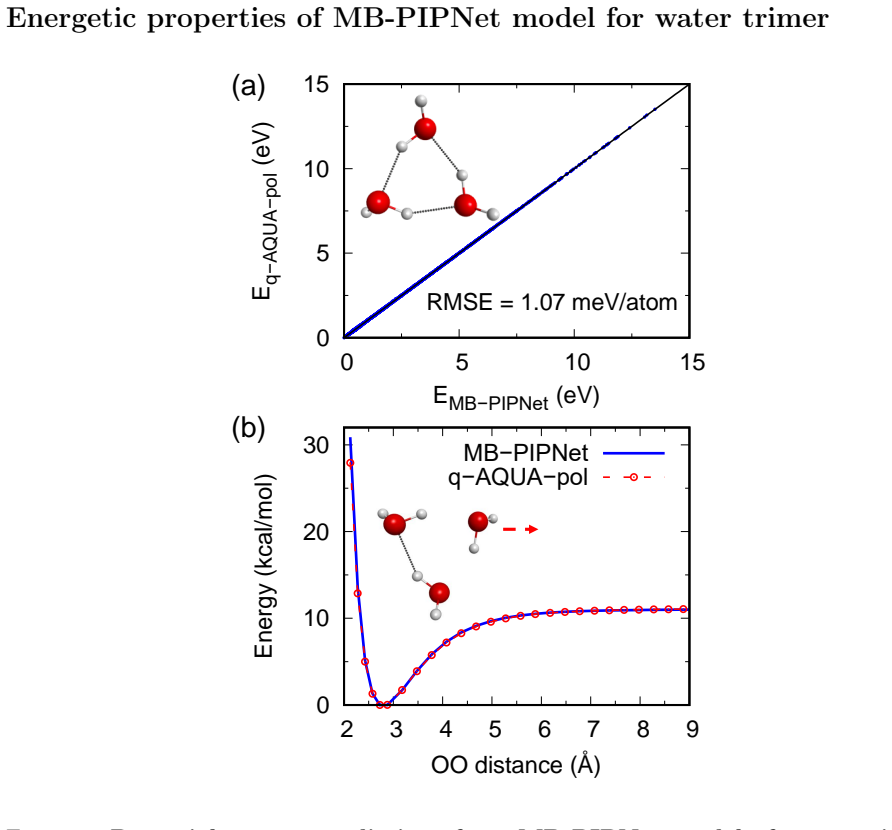
The paper's central claim is that many-body interactions, including 3-body interactions, can be accurately described using only 1-body and 2-body permutationally invariant polynomial (PIP) bases in the neural-network descriptor. MB-PIPNet decomposes the total energy into a sum of monomer energies, with each monomer's descriptor combining a self-structural PIP set built from intramolecular distances and an environment PIP set built from pairwise monomer coordinates within a cutoff. This pair-only descriptor is claimed to be sufficient for condensed-phase systems, avoiding explicit 3-body and 4-body terms and scaling with the number of molecules rather than atoms. The demonstrated test RMSEs are 1.07 meV/atom for the water trimer against q-AQUA-pol, 0.30 meV/atom for liquid water against MB-pol, and 0.26 meV/atom for liquid CO2 against BLYP-D3, with molecular dynamics simulations reproducing experimental radial distribution functions and self-diffusion coefficients.
Load-bearing premise
The fragile premise is that a finite 9 Å pair cutoff, combined with neural-network training, can implicitly absorb all longer-range electrostatics and many-body polarization, so no explicit long-range term is needed for configurations and systems outside the training set.
Editorial extensions
If this is right
- Three-body and higher interactions in the water trimer are reproduced from 1-body and 2-body PIP inputs alone, with a test RMSE of 1.07 meV/atom against q-AQUA-pol energies.
- Liquid water simulated with MB-PIPNet reproduces oxygen-oxygen, oxygen-hydrogen, and hydrogen-hydrogen radial distribution functions, the oxygen-oxygen-oxygen triplet angular distribution, and self-diffusion coefficients in agreement with experiment across 278-320 K.
- The MB-PIPNet water model trained on MB-pol data reaches 0.30 meV/atom test RMSE, lower than the DeePMD model trained on the same data, while its molecular dynamics cost scales with molecule count and is comparable to polarizable force fields.
- MB-PIPNet transfers to liquid CO2 with a small training set of 2,687 configurations at the BLYP-D3 level, giving a test RMSE of 0.26 meV/atom.
- Because the representation outputs per-monomer perturbed energies, it offers chemically interpretable energy decomposition alongside total-energy prediction.
Reading between the lines
- If the pair-descriptor sufficiency holds across hydrogen-bonded liquids, explicit 3-body and 4-body training sets could become unnecessary for similar systems; a direct test would be building MB-PIPNet for methanol or ammonia and checking whether liquid-phase properties match experiments.
- The paper's own caution about long-range interactions suggests a likely failure mode: for ionic solutions or systems where electrostatics are not well screened, a fixed 9 Å cutoff may need explicit correction, such as an Ewald term or a message-passing layer, before the method transfers.
- Combining MB-PIPNet with a many-body expansion, as the discussion suggests, could push condensed-phase accuracy to CCSD(T) level by using high-accuracy 1-body and 2-body terms and fitting only the residual many-body energy with the same 1-body and 2-body PIP descriptors.
- The monomer-energy output could serve as a ready-made MM region in QM/MM simulations, giving ab initio-quality solvation energetics at force-field cost.
Editorial analysis
A structured set of objections, weighed in public.
Referee Report
Summary. MB-PIPNet represents the total potential energy of a molecular system as the sum of per-monomer energies, each produced by a feed-forward neural network. The input to each monomer network is a PIP-based self descriptor of the monomer's internal coordinates (Eq. 4) and a PIP-based environment descriptor built from a sum over 2-body monomer-pair terms within a cutoff Rc (Eq. 5). The paper's central claim is that 1-body and 2-body PIP bases are sufficient to describe many-body interactions, so that the method reaches high accuracy at force-field-like computational cost. The method is applied to a gas-phase water trimer (trained on q-AQUA-pol energies), to liquid water (trained on revPBE0-D3 and MB-pol reference data), and to liquid CO2 (trained on BLYP-D3 data). Validation includes energy/force RMSEs, harmonic frequencies, DMC zero-point energies, OO/OH/HH RDFs, OOO triplet angular distributions, self-diffusion coefficients, and CPU timing comparisons against DeePMD, MACE, and classical water force fields.
Significance. If the central claim is accepted, MB-PIPNet offers a useful new point in the accuracy/cost trade-off: it preserves the interpretability of monomer energies, scales linearly with the number of molecules rather than atoms, and runs at speeds approaching polarizable force fields. The trimer validation using DMC and harmonic frequencies is rigorous, and the liquid-water structural and dynamical properties reproduced from MB-pol are encouraging. The paper also benefits from using publicly available benchmark datasets and from acknowledging the main limitation. However, the condensed-phase significance is not yet fully established: the treatment of long-range electrostatics is an explicit open assumption, and the force accuracy on the DFT liquid-water benchmark is below current equivariant MLPs. These two issues are the main barriers between the present demonstration and the claimed state-of-the-art balance.
major comments (2)
- [Results, Eq. (5); Discussion] This is the load-bearing issue identified in the stress-test. The environment descriptor in Eq. (5) is a sum over monomers within Rc, multiplied by a switching function that vanishes beyond Rc; consequently the model energy is exactly invariant to any change in the positions or identities of molecules farther than Rc from every monomer. The claim that 'long-range interactions are implicitly included during the training process' is therefore an assumption about how the locally supported descriptors encode far-field electrostatics, not a consequence of the architecture. The only evidence presented is a comparison of Rc=9 and 15 Å training errors and OO RDFs on the same liquid-water distribution, and the Discussion explicitly concedes that the method 'lacks an explicit and robust description of the long-range effects.' Since liquid water has long-ranged electrostatics, this gap is central to the condensed-phase claim. I suggest a concrete far-field sensitivity test: take a trained model and a set of liquid configurations, translate/reorient a water molecule initially beyond Rc from each monomer in a way that changes the electrostatic environment but not the local descriptors, and show that the predicted energy/force is correctly unchanged or changes appropriately; alternatively, compare against an explicitly long-range-corrected potential on an out-of-distribution state (e.g., different box size or charged perturbation). Without such a test, the sufficiency of the 9 Å cutoff is not established.
- [Table 2] For the revPBE0-D3 liquid-water benchmark, the MB-PIPNet force RMSE is 93.3 meV/Å, roughly twice the value for NequIP (45 meV/Å) and 2.6 times the MACE value (36.2 meV/Å). The text says MB-PIPNet 'generally outperforms invariant atomistic MLPs,' which is true only next to BPNN/EANN, and it does not report force RMSE for the MB-pol-trained liquid-water model used for the MD property calculations. Because forces are the quantity that controls molecular dynamics trajectories, the claimed 'state-of-the-art balance of accuracy and force field-level speed' needs support from force-error statistics on the main liquid-water model or a tempering of the claim. At minimum, report the force RMSE for the MB-pol-trained model and, if available, a dynamical observable such as a velocity autocorrelation function or vibrational density of states.
minor comments (6)
- [Eqs. (4)-(5), Methods] Please specify the numerical values of the Morse-like exponent a0, the switching function fc, and the exact definition of 'distance between two monomers' used for Rc. These details are required to reproduce the model.
- [Table 1] The statement that harmonic frequency deviations are 'mostly smaller than 5 cm−1' is not supported by the table: modes 6, 10, 12, 13, 14, 15, and 17 differ from q-AQUA-pol by roughly 6–15 cm−1. The claim should be adjusted or the comparison made against the ab initio column.
- [Fig. 3(b), Eq. (6)] The 'monomer energy' obtained from q-AQUA in Eq. (6) is defined by assigning 1/n of each n-body energy to each participating monomer; this is a convention-dependent decomposition, not a uniquely defined physical quantity. The agreement in Fig. 3(b) is therefore a consistency check of the MB-PIPNet monomer decomposition, not a validation that MB-PIPNet predicts the chemically unique monomer energy.
- [Fig. 5] The timing comparison places MB-PIPNet on a single CPU core against MACE on an Nvidia A100 GPU. This is not an apples-to-apples benchmark; please state this limitation in the main text and, if possible, report CPU timings for MACE or GPU timings for MB-PIPNet.
- [Liquid CO2] For liquid CO2, only energy RMSEs are reported; no force RMSE or MD-based property validation is given. The manuscript's claim of 'systematic assessments' of liquid CO2 in the Abstract is stronger than the evidence provided.
- [General] There are minor typographical errors, including 'using using' in the liquid-water results section and 'physic' in the Discussion, which should be corrected during revision.
Circularity Check
No significant circularity: MB-PIPNet's central claims are empirical fits validated against external references; minor self-citations are not load-bearing.
full rationale
MB-PIPNet's total energy is a neural-network sum over monomer energies whose only structural inputs are 1-body and 2-body PIP descriptors (Eqs. 3-5). The paper does not derive the accuracy of this representation from the representation itself; it fits the NN to total energies from q-AQUA-pol (trimer), revPBE0-D3 and MB-pol (liquid water), and BLYP-D3 (liquid CO2), then tests on held-out configurations, harmonic frequencies, DMC zero-point energies, RDFs, and diffusion coefficients. The trimer reference q-AQUA-pol and the liquid-water reference MB-pol are in part the authors' own potentials, but the harmonic frequencies are also compared with CCSD(T)-F12a/aug-cc-pVTZ and the DMC ZPE with the independent WHBB PES, and liquid properties are compared with experiment. The monomer-energy comparison in Fig. 3(b) is genuinely predictive: MB-PIPNet was trained only on total energies, not monomer labels, so the agreement with the q-AQUA decomposition is an emergent check, not a fitted target. The paper's explicit caveats about long-range interactions ('long-range interactions are implicitly included during the training process'; 'the current MB-PIPNet method lacks an explicit and robust description of the long-range effects') are acknowledged limitations, not circular steps. The only self-citations are the authors' own q-AQUA/q-AQUA-pol potentials and PIP software, used as reference and implementation tools; because external validation is present, these are not load-bearing. No equation is equivalent to its input by construction.
Assumptions & free parameters
free parameters (6)
- PIP Morse-like exponent a0 =
not stated in text
- Environment descriptor cutoff Rc =
9.0 Å (also 6 Å and 15 Å tested)
- Self-descriptor PIP order =
6th order
- Environment descriptor PIP order =
4th order
- NN hidden layer sizes =
[30,60] trimer; [15,30] water; [10,30] CO2
- Switching function parameters =
not specified
assumptions (5)
- domain assumption Total energy can be decomposed as a sum of monomer energies (Eq. 3) without loss of accuracy.
- domain assumption A neural network with the chosen 1-body and 2-body PIP descriptors can represent the target PES, including many-body effects.
- ad hoc to paper Long-range interactions beyond the 2-body cutoff are implicitly captured during training.
- domain assumption The reference datasets (revPBE0-D3, BLYP-D3, MB-pol, q-AQUA-pol) are accurate enough to serve as training labels for the claimed 'first-principles accuracy'.
- domain assumption The monomer assignment (fragmentation into H2O or CO2 molecules) is known and unambiguous for the tested systems.
Cite this review
Pith. "Pith review of Extending the atomic decomposition and many-body representation, a chemistry-motivated monomer-centered approach for machine learning potentials." pith.science (2026). https://pith.science/paper/7RLV4X3D
@misc{pith2026241200522,
  author       = {Pith},
  title        = {Pith review of: Extending the atomic decomposition and many-body representation, a chemistry-motivated monomer-centered approach for machine learning potentials},
  year         = {2026},
  howpublished = {\url{https://pith.science/paper/7RLV4X3D}},
  note         = {Machine review of arXiv:2412.00522}
}
read the original abstract
Most widely used machine learned (ML) potentials for condensed phase applications rely on many-body permutationally invariant polynomial (PIP) or atom-centered neural networks (NN). However, these approaches often lack chemical interpretability in atomistic energy decomposition and the computational efficiency of traditional force fields has not been fully achieved. Here, we present a novel method that combines aspects of both approaches, and achieves state-of-the-art balance of accuracy and force field-level speed. This method utilizes a monomer-centered representation, where the potential energy is decomposed into the sum of chemically meaningful monomeric energies. Without sophisticated neural network design, the structural descriptors of monomers are described by 1-body and 2-body effective interactions, enforced by appropriate sets of PIPs as inputs to the feed forward NN. We demonstrate the performance of this method through systematic assessments of models for gas-phase water trimer, liquid water, and also liquid CO2. The high accuracy, fast speed, and flexibility of this method provide a new route for constructing accurate ML potentials and enabling large-scale quantum and classical simulations for complex molecular systems.
Figures


Figures from the paper (3 more)


Reference graph
Works this paper leans on
-
[1]
(1) Gkeka, P.; Stoltz, G.; Barati Farimani, A.; Belkacemi, Z.; Ceriotti, M.; Chodera, J. D.; Dinner,A.R.; Ferguson,A.L.; Maillet,J.-B.; Minoux,H.; othersMachinelearningforce fields and coarse-grained variables in molecular dynamics: application to materials and biological systems.J. Chem. Theory Comput.2020, 16, 4757–4775. (2) Deringer, V. L.; Caro, M. A....
work page 2020
-
[14]
31 (60) Chen, R.; Shao, K.; Fu, B.; Zhang, D. H. Fitting potential energy surfaces with funda- mental invariant neural network. II. Generating fundamental invariants for molecular systems with up to ten atoms.J. Chem. Phys.2020,
work page 2020
-
[131]
(54) Fanourgakis, G. S.; Xantheas, S. S. Development of Transferable Interaction Poten- tials for Water. V. Extension of the Flexible, Polarizable, Thole-Type Model Potential (TTM3-F, v. 3.0) to Describe the Vibrational Spectra of Water Clusters and Liquid Water.J. Chem. Phys.2008, 128, 074506. (55) Cheng, B. Cartesian atomic cluster expansion for machine...
work page 2008
-
[135]
(29) Medders, G. R.; Götz, A. W.; Morales, M. A.; Bajaj, P.; Paesani, F. On the represen- tation of many-body interactions in water.J. Chem. Phys.2015,
work page 2015
-
[141]
Quantum Differences Between Heavy and Light water.Phys
(48) Soper, A.; Benmore, C. Quantum Differences Between Heavy and Light water.Phys. Rev. Letts.2008, 101, 065502. (49) Reddy, S. K.; Straight, S. C.; Bajaj, P.; Huy Pham, C.; Riera, M.; Moberg, D. R.; Morales, M. A.; Knight, C.; Götz, A. W.; Paesani, F. On the Accuracy of the MB-pol Many-body Potential for Water: Interaction Energies, Vibrational Frequenc...
work page 2008
-
[143]
(30) Yu, Q.; Bowman, J. M. Communication: VSCF/VCI vibrational spectroscopy of H7 O 3+ and H9 O 4+ using high-level, many-body potential energy surface and dipole moment surfaces.J. Chem. Phys.2017,
work page 2017
-
[146]
(31) Heindel, J. P.; Xantheas, S. S. The many-body expansion for aqueous systems revisited: I. Water–water interactions.J. Chem. Theory Comput.2020, 16, 6843–6855. (32) Zhu, X.; Riera, M.; Bull-Vulpe, E. F.; Paesani, F. MB-pol(2023): Sub-chemical Accu- racy for Water Simulations from the Gas to the Liquid Phase.J. Chem. Theory Comput 2023, 19, 3551–3556. ...
work page 2023
-
[150]
(64) Babin, V.; Medders, G. R.; Paesani, F. Development of a “First Principles” Water Potential with Flexible Monomers. II: Trimer Potential Energy Surface, Third Virial Coefficient, and Small Clusters.J. Chem. Theory Comput.2014, 10,
work page 2014
Show all 17 references
-
[152]
S.; Riley, P
(61) Gilmer, J.; Schoenholz, S. S.; Riley, P. F.; Vinyals, O.; Dahl, G. E. Neural message passing for quantum chemistry. International conference on machine learning. 2017; pp 1263–1272. (62) Schütt, K. T.; Arbabzadah, F.; Chmiela, S.; Müller, K. R.; Tkatchenko, A. Quantum- ch...
2017
-
[157]
L.; Paesani, F
(56) Sciortino, F.; Zhai, Y.; Bore, S. L.; Paesani, F. Pinpointing the Location of the Elusive Liquid-Liquid Critical Point in Water.ChemRxiv. 2024, doi:10.26434/chemrxiv–2024– dqqws. (57) Senn, H. M.; Thiel, W. QM/MM methods for biomolecular systems.Angew. Chem. Int. Ed. 2009...
2024 doi
-
[158]
first-principles
29 (44) Medders, G. R.; Babin, V.; Paesani, F. Development of a “first-principles” water po- tential with flexible monomers. III. Liquid phase properties.J. Chem. Theory Comput. 2014, 10, 2906–2910. (45) Kapil, V. et al. i-PI 2.0: A Universal Force Engine for Advanced Molecula...
2014
-
[159]
short blanket
(43) Zhai, Y.; Caruso, A.; Bore, S. L.; Luo, Z.; Paesani, F. A “short blanket” dilemma for a state-of-the-art neural network potential for water: Reproducing experimental properties or the physics of the underlying many-body interactions?J. Chem. Phys. 2023,
2023
-
[579]
S.; Fedorov, D
(24) Gordon, M. S.; Fedorov, D. G.; Pruitt, S. R.; Slipchenko, L. V. Fragmentation methods: A route to accurate calculations on large systems.Chem. Rev.2012, 112, 632–672. (25) Hodges, M. P.; Stone, A. J.; Xantheas, S. S. Contribution of many-body terms to the energy for small...
2012
-
[1977]
(66) Anderson, J
2006; pp 105–116. (66) Anderson, J. B. A Random-walk Simulation of the Schrödinger Equation: H + 3 . J. Chem. Phys.1975, 63, 1499–1503. (67) Kosztin, I.; Faber, B.; Schulten, K. Introduction to the Diffusion Monte Carlo Method. Am. J. Phys.1996, 64, 633–644. 32 Author contribu...
2006
-
[2453]
P.; Simm, G.; Ortner, C.; Csanyi, G
(22) Batatia, I.; Kovacs, D. P.; Simm, G.; Ortner, C.; Csanyi, G. MACE: Higher Order Equivariant Message Passing Neural Networks for Fast and Accurate Force Fields. Advances in Neural Information Processing Systems. 2022; pp 11423–11436. (23) Musaelian, A.; Batzner, S.; Johans...
2022
-
[3887]
(15) Bartók,A.P.; Payne,M.C.; Kondor,R.; Csányi,G.Gaussianapproximationpotentials: The accuracy of quantum mechanics, without the electrons.Phys. Rev. Lett.2010, 104, 136403. (16) Uteva, E.; Graham, R. S.; Wilkinson, R. D.; Wheatley, R. J. Interpolation of inter- molecular pot...
2010
-
[4618]
H.; Li, X.-Z
(36) Zhu, Y.-C.; Yang, S.; Zeng, J.-X.; Fang, W.; Jiang, L.; Zhang, D. H.; Li, X.-Z. Torsional Tunneling Splitting in a Water Trimer.J. Am. Chem. Soc.2022, 144, 21356–21362. (37) Jiang, B.; Li, J.; Guo, H. Potential energy surfaces from high fidelity fitting of ab initio point...
2022
Reviewed August 12, 2026 · model on record in the stance chip above.
Discussion (0). Continue with ORCID to comment.