REVIEW 4 major objections 7 minor 55 references
CtrlNeRF: The Generative Neural Radiation Fields for the Controllable Synthesis of High-fidelity 3D-Aware Images
T0 review · 4 major / 7 minor · reviewed 2026-08-12 · deepseek-v4-flash
Pith's one-line read CtrlNeRF shows that a single MLP with shared weights can represent multiple 3D scenes and control shape and color through label-embedded latent codes, keeping storage flat as scenes grow.
desk verdict A plausible GRAF extension for label-controlled multi-scene 3D generation whose central storage-quality claim outruns its evidence; worth a serious referee but needs a real baseline comparison. read the letter →
The pith
A machine-rendered reading of the paper's core claim, the machinery that carries it, and where it could break.
The reading
What carries the argument
The load-bearing object is the label-embedded conditional radiance field: a GRAF-style MLP whose input is $\gamma(x)+z'_s$ and $\gamma(d)+z'_a$, where $z'_s$ and $z'_a$ are the latent codes multiplied by learned embeddings of the class and color labels, and whose output is a density array and a color array instead of a single density and color. The output arrays let one shared network expose separate slots for classes and styles, and the VGG-based discriminator supplies the classification signal that pushes those slots apart. Volume rendering of the arrays yields the 3D-consistent images, and linear interpolation between array entries yields the unseen features.
What would settle it
Render the density slot for one class while feeding the color embedding of another class into the same trained model; if the output geometry changes, the claimed independence of shape and appearance fails. Equivalently, if the FID-versus-class-count curve on the CARs dataset is flat rather than rising, the reported capacity degradation is not the real mechanism.
Extended reading notes
Core claim
CtrlNeRF's central claim is that a generative radiance field can be made controllable across multiple scenes without adding networks. By multiplying the shape code $z_s$ and appearance code $z_a$ by label-embedding vectors, and by changing the MLP output into a density array and a color array, a single weight-shared MLP learns to separate scenes by class and style; volume rendering then produces 3D-consistent images, and feature interpolation creates colors and shapes never seen in training. The paper reports that the output modification is essential because training does not converge without it, and that both the label embedding and the VGG discriminator improve FID scores. In quantitative comparisons, the method is said to perform on par with CLIP-NeRF and to exceed GRAF and GIRAFFE in PSNR and SSIM, while keeping model storage and training time constant as the number of scenes increases.
Load-bearing premise
The argument rests on the assumption that multiplying the shape and appearance latent codes by learned label embeddings gives one shared MLP enough capacity and separation to keep many distinct scenes from interfering with one another; the paper itself reports that FID worsens as classes and styles grow, so this capacity assumption is the fragile load-bearing premise.
Editorial extensions
If this is right
- Storage and training cost for a generative 3D model no longer scale with the number of scenes; the same single MLP is reused for all classes and styles.
- A user can explicitly choose object class and color at inference time, replacing the unpredictable latent-code sampling of GRAF.
- Novel views can be rendered by changing camera pose, radius, or translation without retraining.
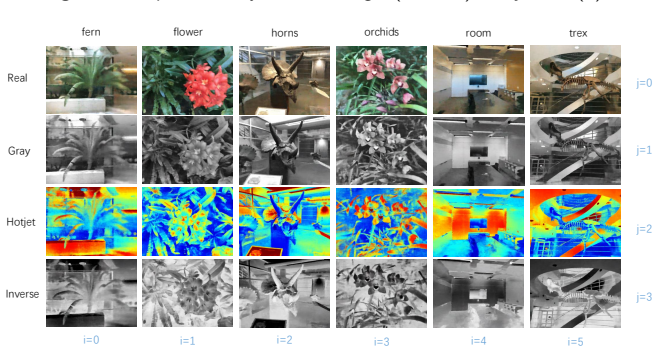
- Linear interpolation between density or color array entries synthesizes shapes and colors absent from the training set.
- The reported quality drop with more classes and styles marks a capacity limit of the shared MLP, so the approach is most effective when the number of scenes is moderate.
Reading between the lines
- The same label-multiplication mechanism could plausibly extend to other attributes the paper lists as future features, such as texture, material, and illumination, by adding more embedding vectors and output slots, at the cost of the same entanglement-induced degradation.
- Because the output modification is what makes training converge, a useful stress test would be to compare multiplicative label embeddings against additive conditioning or feature-wise modulation within this architecture; the paper does not run that comparison.
- The constant-storage advantage over CLIP-NeRF becomes more attractive as the number of scenes grows, but the declining image quality suggests an upper bound on scene count before per-scene models become preferable; that crossover point is not measured in the paper.
Editorial analysis
A structured set of objections, weighed in public.
Referee Report
Summary. The paper introduces CtrlNeRF, a GRAF-based generative neural radiance field that aims to use a single MLP with shared weights to represent multiple scenes, conditioned on class labels (shape) and color labels (appearance). The generator is described as taking label-embedded latent codes and outputting density and color arrays indexed by labels, with a VGG-based discriminator as an auxiliary classifier. Experiments on a synthetic CARs dataset, NeRF-Synthetic, and LLFF report FID/KID, PSNR/SSIM, qualitative results for label-controlled generation, novel view synthesis, and interpolation, together with an ablation study.
Significance. If the central claim held, representing multiple scenes in one MLP with explicit control would be a useful efficiency result for 3D-aware generative models. The paper has strengths: it reports quantitative FID/KID per class and style, includes an ablation, and honestly documents degradation with scene count in Fig. 10, which is a falsifiable observation. However, the evidence does not currently establish the central claim: the scaling results show substantial quality loss, no per-scene baseline at matched storage is provided, and the PSNR/SSIM comparison to CLIP-NeRF is not a matched comparison. The contribution is incremental over GRAF, but the direction is reasonable.
major comments (4)
- [Table 2, §5.5] The PSNR/SSIM comparison in Table 2 is not a matched comparison: CLIP-NeRF is a per-scene reconstruction and manipulation method trained separately on posed images of each scene, whereas CtrlNeRF is a generative model with a single MLP across scenes. Reporting that CLIP-NeRF achieves higher PSNR/SSIM and then concluding that CtrlNeRF is 'on par' or 'marginally less impressive' is misleading because the methods solve different tasks. To support the multi-scene claim, the authors should compare against per-scene GRAF models (or a per-scene variant of CtrlNeRF) at matched total storage and report FID per scene, and use PSNR/SSIM only against equally generative baselines.
- [§5.1, Fig. 10, §6] The scaling experiments show FID rising steeply as the number of classes N and styles M increases; for example, the mean FID on LLFF is roughly 80 versus about 46.6 on CARs. The text in §5.5 asserts that the method stores multiple scenes 'without significantly sacrificing image quality,' but no comparison against per-scene baselines at matched storage is given, and §6 concedes that image quality diminishes as scene quantity and complexity increase. The central claim of efficient multi-scene representation therefore lacks quantitative support. Provide a matched-storage comparison (e.g., N per-scene GRAF models versus one CtrlNeRF) reporting FID and per-scene quality, and report error bars across seeds.
- [§5.4, Table 1] The ablation shows that removing the per-label output arrays (Model II) causes training not to converge, meaning these arrays are load-bearing. This indicates that the model is a shared backbone with per-class density heads and per-style color heads, rather than a fully shared representation. The contribution of the label-embedding multiplication (the input modification) is not isolated: there is no variant that keeps the output arrays but removes the multiplication, for example by using concatenation or no embedding at all. Please add such an ablation and clarify exactly which parameters are shared across scenes.
- [§3, Discriminator] The sentence 'To further improve image quality, we adopted posed images for training and replaced adversarial loss with reconstruction loss' contradicts the rest of the method: Equation 6 includes L_adv, Algorithm 1 updates both D_phi and D_vgg, and the positioning of CtrlNeRF as a GRAF-derived generative model suggests training without pose supervision. If posed images are indeed used, this is a major deviation that must be stated in the setup; if not, the sentence should be removed. Please clarify the exact training objective and data requirements.
minor comments (7)
- [§3, Output] M and N are swapped in the array definitions: the density array is written as [σ(i)]_{i=0}^{N-1} while M denotes the number of classes and N the number of styles, but labels i and j index classes and styles, respectively, in Algorithm 1 and Fig. 4; make the notation consistent.
- [Eq. (1), §4.3] Equation 1 has mismatched parentheses, and the FID score is attributed to 'Kanazawa et al.' although the standard reference is Heusel et al.; please correct both.
- [§3, References] Unresolved reference placeholders appear for pixelNeRF and VGG16 in Section 3, and 'GRIFFEE' should be 'GIRAFFE' throughout the text and figure captions.
- [§6] The statement that the authors 'successfully entangled and disentangled the label codes into and out of the latent code' is contradictory and should be rephrased to describe the intended conditioning mechanism.
- [§3, GRAF review] The GRAF description swaps the roles of z_s and z_a, calling z_a the shape code and z_s the appearance code, which conflicts with the notation in the abstract and Figure 2; please unify the notation.
- [Table 1, Figs. 8–10] FID and KID values are reported without standard deviations or the number of seeds; for a GAN evaluation, results from at least three training runs should be reported as mean ± std.
- [§5.5, Table 2] The paper does not specify the resolution, training iterations, or data used to train GRAF and GIRAFFE for the Table 2 comparison, so it is unclear whether the comparison is on the same scenes and settings; please document the protocol.
Circularity Check
No significant circularity: all reported outputs are forward renderings or explicitly defined interpolations from the learned radiance field, not fitted values renamed as predictions.
full rationale
CtrlNeRF is an empirical generative system rather than a derivation chain. Label-conditioned images are produced by feeding label-embedded latent codes through the MLP and volume-rendering the resulting density/color arrays (Eqs. 4 and 6), so class/style control is architectural conditioning, not a quantity fitted to a subset and then 'predicted' on a closely related subset. Novel-view results (Figs. 11-13) are direct forward passes at new camera poses through the same radiance field; no held-out pose is fit and then read off. The interpolation demos (Figs. 14-15) are explicitly defined as c=(1-λ)c[i]+λc[j], so the 'new' color/shape is a linear combination of already-rendered outputs; this is a construction rather than an independent prediction, which limits significance but is not circular. The ablation (Table 1) openly shows the per-label output arrays are necessary (Model II does not converge), a caveat on the 'single shared MLP' claim rather than a circular justification. The only self-reference ([48], by one author) is not cited as evidence for any premise. The stated limitation in Sec. 6 that image quality diminishes with scene quantity and complexity is an empirical scaling observation and further confirms the results are not forced by definition.
Assumptions & free parameters
free parameters (6)
- lambda1 =
2.0
- lambda2 =
3.0
- latent_code_dim =
128
- num_rays_per_image =
1024
- num_points_per_ray =
64
- learning_rates =
0.0001 (D), 0.0005 (G)
assumptions (4)
- standard math Volume rendering integral and stratified sampling are valid approximations of the radiance field equation.
- domain assumption GRAF's generative radiance field pipeline is a sound starting point.
- ad hoc to paper Label-embedded latent codes obtained by multiplication provide sufficient conditioning for class and style control.
- ad hoc to paper A single shared-parameter MLP can represent multiple scenes without unacceptable interference.
Cite this review
Pith. "Pith review of CtrlNeRF: The Generative Neural Radiation Fields for the Controllable Synthesis of High-fidelity 3D-Aware Images." pith.science (2026). https://pith.science/paper/RLRDVPOK
@misc{pith2026241200754,
  author       = {Pith},
  title        = {Pith review of: CtrlNeRF: The Generative Neural Radiation Fields for the Controllable Synthesis of High-fidelity 3D-Aware Images},
  year         = {2026},
  howpublished = {\url{https://pith.science/paper/RLRDVPOK}},
  note         = {Machine review of arXiv:2412.00754}
}
read the original abstract
The neural radiance field (NERF) advocates learning the continuous representation of 3D geometry through a multilayer perceptron (MLP). By integrating this into a generative model, the generative neural radiance field (GRAF) is capable of producing images from random noise z without 3D supervision. In practice, the shape and appearance are modeled by z_s and z_a, respectively, to manipulate them separately during inference. However, it is challenging to represent multiple scenes using a solitary MLP and precisely control the generation of 3D geometry in terms of shape and appearance. In this paper, we introduce a controllable generative model (i.e. \textbf{CtrlNeRF}) that uses a single MLP network to represent multiple scenes with shared weights. Consequently, we manipulated the shape and appearance codes to realize the controllable generation of high-fidelity images with 3D consistency. Moreover, the model enables the synthesis of novel views that do not exist in the training sets via camera pose alteration and feature interpolation. Extensive experiments were conducted to demonstrate its superiority in 3D-aware image generation compared to its counterparts.
Figures


Figures from the paper (10 more)




Reference graph
Works this paper leans on
-
[1]
Wu,XianandXu,KunandHall,Peter.Asurveyofimagesynthesisand editing with generative adversarial networks Tsinghua Science Tech- nology, 22(006),660-674, 2018. DOI:10.23919/TST.2017.8195348
-
[2]
GRAF: Generative Radiance Fields for 3D-Aware Image Synthesis
Schwarz, Katja and Liao, Yiyi and Niemeyer, Michael and Geiger, Andreas. GRAF: Generative Radiance Fields for 3D-Aware Image Synthesis, arXiv e-prints, 2020. DOI:10.48550/arXiv.2007.02442. : Page 9 of 12 Table 1 The results of FID/KID scores in the ablation studies. Model/Class Classic Sporty Roadster Wagon Mean FID/KID Model I 68.83 71 .07 80 .18 74 .92 ...
work page Pith review arXiv doi:10.48550/arxiv.2007.02442 2020
-
[3]
and Tancik, Matthew and Barron, Jonathan T
Mildenhall, Ben and Srinivasan, Pratul P. and Tancik, Matthew and Barron, Jonathan T. and Ramamoorthi, Ravi and Ng, Ren. NeRF: Representing Scenes as Neural Radiance Fields for View Synthesis, arXiv e-prints, 2020. DOI:10.48550/arXiv.2003.08934
-
[4]
Goodfellow,IanJ.andPouget-Abadie,JeanandMirza,MehdiandXu, BingandWarde-Farley,DavidandOzair,SherjilandCourville,Aaron andBengio,Yoshua.GenerativeAdversarialNetworks,.arXive-prints,
-
[5]
Recent Progress on Generative Adver- sarial Networks (GANs): A Survey, IEEE Access, 36322-36333,2019
Pan,ZhaoqingandYu,WeijieandYi,XiaokaiandKhan,Asifullahand Yuan, Feng and Zheng, Yuhui. Recent Progress on Generative Adver- sarial Networks (GANs): A Survey, IEEE Access, 36322-36333,2019. DOI:10.1109/ACCESS.2019.2905015
-
[6]
Yu, Yang and Gong, Zhiqiang and Zhong, Ping and Shan, Jiaxin. UnsupervisedRepresentationLearningwithDeepConvolutionalNeu- ral Network for Remote Sensing Images, International Conference on Image & Graphics, 2017
work page 2017
-
[7]
Conditional Generative Adversarial Nets, Computer Science, 2672-2680, 2014
Mirza, Mehdi and Osindero, Simon. Conditional Generative Adversarial Nets, Computer Science, 2672-2680, 2014. DOI:10.48550/arXiv.1411.1784
-
[8]
Condi- tionalImageSynthesisWithAuxiliaryClassifierGANs,arXive-prints,
Odena, Augustus and Olah, Christopher and Shlens, Jonathon. Condi- tionalImageSynthesisWithAuxiliaryClassifierGANs,arXive-prints,
Show all 55 references
-
[9]
InfoGAN:InterpretableRepre- sentationLearningbyInformationMaximizingGenerativeAdversarial Nets, arXiv e-prints,2016
Chen, Xi and Duan, Yan and Houthooft, Rein and Schulman, John andSutskever,IlyaandAbbeel,Pieter. InfoGAN:InterpretableRepre- sentationLearningbyInformationMaximizingGenerativeAdversarial Nets, arXiv e-prints,2016. DOI:10.48550/arXiv.1606.03657
-
[10]
Wasserstein generativeadversarialnetworks,InternationalConferenceonMachine Learning, 2017
Arjovsky,MartinandChintala,SoumithandBottou,On. Wasserstein generativeadversarialnetworks,InternationalConferenceonMachine Learning, 2017. DOI:10.1088/1742-6596/2586/1/012157
2017 doi
-
[11]
Improved Training of Wasser- stein GANs, 2017
Gulrajani, Ishaan and Ahmed, Faruk and Arjovsky, Martin and Du- moulin, Vincent and Courville, Aaron. Improved Training of Wasser- stein GANs, 2017. DOI:10.48550/arXiv.1704.00028. : Page 10 of 12 Table 2 The quantitative assessment of our model with state-of-the-art methods in...
- [12]
- [13]
-
[14]
IEEE ICCV, 2017
Zhang, Han and Xu, Tao and Li, Hongsheng and Zhang, Shaot- ing and Wang, Xiaogang and Huang, Xiaolei and Metaxas, Dim- itris. IEEE ICCV, 2017. StackGAN: Text to Photo-realistic Image Synthesis with Stacked Generative Adversarial Networks, DOI:10.1109/ICCV.2017.629
2017 doi
-
[15]
IEEE Transactions on Pattern Analysis and Ma- chine Intelligence,PP,99, 2017
StackGAN++: Realistic Image Synthesis with Stacked Generative Adversarial Networks, Han, Zhang and Tao, Xu and Hongsheng, Li and Shaoting, Zhang and Xiaogang, Wang and Xiaolei, Huang and Metaxas, Dimitris N. IEEE Transactions on Pattern Analysis and Ma- chine Intelligence,PP,9...
2017
-
[16]
High-ResolutionImage Synthesis and Semantic Manipulation with Conditional GANs, 2017
Wang, Ting Chun and Liu, Ming Yu and Zhu, Jun Yan and Tao, AndrewandKautz,JanandCatanzaro,Bryan. High-ResolutionImage Synthesis and Semantic Manipulation with Conditional GANs, 2017. DOI:10.48550/arXiv.1711.11585
-
[17]
A Style-Based Gen- erator Architecture for Generative Adversarial Networks, Conference on Computer Vision and Pattern Recognition (CVPR), IEEE, 2019
Karras, Tero and Laine, Samuli and Aila, Timo. A Style-Based Gen- erator Architecture for Generative Adversarial Networks, Conference on Computer Vision and Pattern Recognition (CVPR), IEEE, 2019. DOI:10.1109/TPAMI.2020.2970919
2019
-
[18]
High-Fidelity Synthesis with Disentangled Representation,
Lee,WonkwangandKim,DonggyunandHong,SeunghoonandLee, Honglak. High-Fidelity Synthesis with Disentangled Representation,
- [19]
-
[20]
and Sohn, K
Reed, S. and Sohn, K. and Zhang, Y. and Lee, H. Learning to Dis- entangle Factors of Variation with Manifold Interaction, International Conference on Machine Learning, 2014
2014
-
[21]
Advances in Neural Rendering, arXiv e-prints,
Tewari, Ayush and Thies, Justus and Mildenhall, Ben and Srini- vasan, Pratul and Tretschk, Edgar and Wang, Yifan and Lassner, Christoph and Sitzmann, Vincent and Martin-Brualla, Ricardo and Lombardi, Stephen. Advances in Neural Rendering, arXiv e-prints,
-
[22]
M and Weston, Nick
Brock, Andrew and Lim, Theodore and Ritchie, J. M and Weston, Nick. Generative and Discriminative Voxel Modeling with Convolu- tional Neural Networks, Computer Science, 2016
2016
-
[23]
Rezende, Danilo Jimenez and Eslami, S. M. Ali and Mohamed, Shakir and Battaglia, Peter and Jaderberg, Max and Heess, Nicolas. Unsupervised Learning of 3D Structure from Images In Advances in Neural Information Processing Systems (NeurIPS), 2016
2016
-
[24]
OctNet: Learning Deep 3D Representations at High Resolutions, 2017 IEEE Conference on Computer Vision and Pattern Recognition (CVPR),
Riegler,GernotandUlusoy,AliOsmanandGeiger,Andreas. OctNet: Learning Deep 3D Representations at High Resolutions, 2017 IEEE Conference on Computer Vision and Pattern Recognition (CVPR),
2017
-
[25]
andTenenbaum, Joshua B
Wu, Jiajun and Zhang, Chengkai and Xue, Tianfan and Freeman, William T. andTenenbaum, Joshua B. Learning a Probabilistic Latent Space of Object Shapes via 3D Generative-Adversarial Modeling, In AdvancesinNeuralInformationProcessingSystems(NeurIPS),2016. DOI:10.48550/arXiv.1610.07584
-
[26]
AtlasNet: A Papier-Mché Approach to Learning 3D Surface Generation, In Proc
Groueix, Thibault and Fisher, Matthew and Kim, Vladimir G and Russell, Bryan C and Aubry, Mathieu. AtlasNet: A Papier-Mché Approach to Learning 3D Surface Generation, In Proc. IEEE Con- ference on Computer Vision and Pattern Recognition (CVPR), 2018. DOI:10.48550/arXiv.1802.05384
-
[27]
Deep March- ing Cubes: Learning Explicit Surface Representations, IEEE/CVF Conference on Computer Vision and Pattern Recognition,2018
Liao, Yiyi and Simon Donné and Geiger, Andreas. Deep March- ing Cubes: Learning Explicit Surface Representations, IEEE/CVF Conference on Computer Vision and Pattern Recognition,2018. DOI:10.1109/CVPR.2018.00308
2018
-
[28]
Deep Mesh Reconstruction From Single RGB Images via Topology Modification Networks, IEEE/CVF International Conference on Computer Vision (ICCV), 2020
Pan, Junyi and Han, Xiaoguang and Chen, Weikai and Tang, Jiapeng and Jia, Kui. Deep Mesh Reconstruction From Single RGB Images via Topology Modification Networks, IEEE/CVF International Conference on Computer Vision (ICCV), 2020. DOI:10.1109/ICCV.2019.01006
2020
-
[29]
Pixel2Mesh: Generating 3D Mesh Models from Single RGB Images, In Proc
Wang, Nanyang and Zhang, Yinda and Li, Zhuwen and Fu, Yanwei and Liu, Wei and Jiang, Yu Gang. Pixel2Mesh: Generating 3D Mesh Models from Single RGB Images, In Proc. of the European Conf. on ComputerVision(ECCV),2018. DOI:10.1007/978-3-030-01252-6_4
2018 doi
-
[31]
title=Convolutional Occupancy Networks, Peng, Songyou and Niemeyer, Michael and Mescheder, Lars and Pollefeys, Marc and Geiger, Andreas. In Proc. of the European Conf. on Computer Vision (ECCV),2020. DOI:10.1007/978-3-030-58580-8_31
2020 doi
-
[33]
Differentiable Volumetric Rendering: Learning Implicit3DRepresentationsWithout3DSupervision,IEEE/CVFCon- ference on Computer Vision and Pattern Recognition (CVPR), 2020
Niemeyer, Michael and Mescheder, Lars and Oechsle, Michael and Geiger, Andreas. Differentiable Volumetric Rendering: Learning Implicit3DRepresentationsWithout3DSupervision,IEEE/CVFCon- ference on Computer Vision and Pattern Recognition (CVPR), 2020. DOI:10.1109/CVPR42600.2020.00356
2020
-
[34]
SceneRepresentationNetworks:Continuous3D-Structure-Aware NeuralSceneRepresentations,InAdvancesinNeuralInformationPro- cessing Systems (NeurIPS), 2019
Sitzmann, Vincent and Zollhfer, Michael and Wetzstein, Gor- don. SceneRepresentationNetworks:Continuous3D-Structure-Aware NeuralSceneRepresentations,InAdvancesinNeuralInformationPro- cessing Systems (NeurIPS), 2019. DOI:10.48550/arXiv.1906.01618
-
[35]
Pix2Vox: Context-Aware 3D Reconstruction From Single and Multi-View Images, Inter- national Conference on Computer Vision (ICCV), IEEE, 2020
Xie, Haozhe and Yao, Hongxun and Sun, Xiaoshuai and Zhou, Shangchen and Zhang, Shengping. Pix2Vox: Context-Aware 3D Reconstruction From Single and Multi-View Images, Inter- national Conference on Computer Vision (ICCV), IEEE, 2020. DOI:10.1109/ICCV.2019.00278
2020
-
[36]
Es- caping Plato’s Cave: 3D Shape From Adversarial Rendering, In- ternational Conference on Computer Vision (ICCV), IEEE, 2019
Henzler, Philipp and Mitra, Niloy and Ritschel, Tobias. Es- caping Plato’s Cave: 3D Shape From Adversarial Rendering, In- ternational Conference on Computer Vision (ICCV), IEEE, 2019. DOI:10.1109/ICCV.2019.01008
2019
-
[37]
HoloGAN: Unsupervised learning of 3D representations from natural images, ICCV, 2019
Nguyen-Phuoc, Thu and Li, Chuan and Theis, Lucas and Richardt, Christian and Yang, Yong Liang. HoloGAN: Unsupervised learning of 3D representations from natural images, ICCV, 2019. DOI:10.1109/ICCVW.2019.00255
2019
-
[38]
BlockGAN: Learning 3D Object-aware Scene Representations from Unlabelled Images, 2020
Nguyen-Phuoc, Thu and Richardt, Christian and Mai, Long and Yang, Yong Liang and Mitra, Niloy. BlockGAN: Learning 3D Object-aware Scene Representations from Unlabelled Images, 2020. DOI:10.48550/arXiv.2002.08988
-
[40]
GIRAFFE: Representing ScenesasCompositionalGenerativeNeuralFeatureFields,IEEE/CVF Conference on Computer Vision and Pattern Recognition (CVPR),
Niemeyer, Michael and Geiger, Andreas. GIRAFFE: Representing ScenesasCompositionalGenerativeNeuralFeatureFields,IEEE/CVF Conference on Computer Vision and Pattern Recognition (CVPR),
- [41]
- [42]
- [43]
- [44]
-
[45]
and Martin-Brualla, Ricardo and Snavely, Noah and Funkhouser, Thomas
Wang, Qianqian and Wang, Zhicheng and Genova, Kyle and Srinivasan, Pratul and Zhou, Howard and Barron, Jonathan T. and Martin-Brualla, Ricardo and Snavely, Noah and Funkhouser, Thomas. IBRNet: Learning Multi-View Image-Based Rendering,
-
[47]
StylizedNeRF: Consistent 3D Scene Stylization as Stylized NeRF via 2D-3D Mutual Learning, IEEE/CVF Conference on Computer Vision and Pattern Recognition (CVPR), 2022
Yi-Hua Huang, Yue He, Yu-Jie Yuan, Yu-Kun Lai and Lin Gao. StylizedNeRF: Consistent 3D Scene Stylization as Stylized NeRF via 2D-3D Mutual Learning, IEEE/CVF Conference on Computer Vision and Pattern Recognition (CVPR), 2022
2022
-
[48]
Liu and T
J. Liu and T. H. Lin. A framework for the synthesis of X-ray security inspectionimagesbasedongenerativeadversarialnetworks,IEEEAc- cess, 11, 63751-63760, 2023. DOI:10.1109/ACCESS.2023.3288087
2023
-
[49]
Image quality assessment: From error visibility to structural similarity, 2013
Wang,Z.andPan,W.andCuppens-Boulahia,N.andCuppens,F.and Roux, C. Image quality assessment: From error visibility to structural similarity, 2013
2013
-
[50]
HeadNeRF: A Real-time NeRF-based Parametric Head Model, IEEE/CVF Conference on Computer Vision and Pattern Recognition (CVPR), 2022
Hong, Yang and Peng, Bo and Xiao, Haiyao and Liu, Ligang and Zhang, Juyong. HeadNeRF: A Real-time NeRF-based Parametric Head Model, IEEE/CVF Conference on Computer Vision and Pattern Recognition (CVPR), 2022. DOI:10.48550/arXiv.2112.05637
-
[51]
GRAM: Generative Radiance Manifolds for 3D-Aware Image Gener- ation, IEEE/CVF Conference on Computer Vision and Pattern Recog- nition (CVPR), 2022
Deng, Yu and Yang, Jiaolong and Xiang, Jianfeng and Tong, Xin. GRAM: Generative Radiance Manifolds for 3D-Aware Image Gener- ation, IEEE/CVF Conference on Computer Vision and Pattern Recog- nition (CVPR), 2022. DOI:10.48550/arXiv.2112.08867
-
[52]
DOI:10.1109/CVPR46437.2021.00466
2021
- [53]
-
[59]
CLIP-NeRF: Text-and-Image Driven Manipulation of Neural Radiance Fields, arXiv e-prints, 2021
Wang, Can and Chai, Menglei and He, Mingming and Chen, Dongdong and Liao, Jing. CLIP-NeRF: Text-and-Image Driven Manipulation of Neural Radiance Fields, arXiv e-prints, 2021. DOI:10.48550/arXiv.2112.05139. : Page 12 of 12
-
[2014]
https://arxiv.org/pdf/1406.2661
- [2016]
-
[2017]
DOI:10.1109/CVPR.2017.701
2017 doi
-
[2020]
DOI:10.1007/978-3-030-58574-7_10
- [2021]
Reviewed August 12, 2026 · model on record in the stance chip above.
Discussion (0). Continue with ORCID to comment.