EnFed: An Energy-aware Federated Learning in Resource Constrained Environments for Human Activity Recognition
Pith reviewed 2026-05-23 08:12 UTC · model grok-4.3
The pith
A mobile device builds an accurate human activity recognition model by requesting local updates from nearby devices that accept an incentive, then aggregating and fitting them locally to cut energy and time.
A machine-rendered reading of the paper's core claim, the machinery that carries it, and where it could break.
Core claim
EnFed lets a requesting device obtain an accurate prediction model at lower time and energy by receiving local model updates from nearby devices that agree to an incentive, aggregating those updates into a global model, and then fitting the result to its own local dataset.
What carries the argument
Incentive-driven collection of local model parameters from nearby devices, followed by aggregation to a global model and local fitting on the requester's data.
If this is right
- Resource-limited devices achieve above 95 percent accuracy for human activity recognition without heavy local computation.
- Response time drops by more than 90 percent relative to cloud-only frameworks.
- The method outperforms existing human activity recognition approaches in direct comparisons.
- Privacy is preserved because raw data never leaves the contributing devices.
- Energy consumption on the requesting device stays lower than in centralized alternatives.
Where Pith is reading between the lines
- The incentive structure could be adapted for other sensor-driven mobile tasks if participation rates remain high.
- Real-world connectivity drops or device heterogeneity might require fallback mechanisms not detailed in the current design.
- Scaling the approach to larger groups of devices could introduce new aggregation overhead that needs separate measurement.
- Combining the local fitting step with on-device hardware accelerators might further reduce energy use in future versions.
Load-bearing premise
Nearby devices will accept the incentive, maintain connectivity to send updates, and the resulting aggregated and fitted model will outperform alternatives despite possible differences in data or participation levels.
What would settle it
An experiment in which the majority of nearby devices decline the incentive or lose connectivity, leaving the requesting device with a model no better than what it could train alone on its limited data.
Figures




read the original abstract
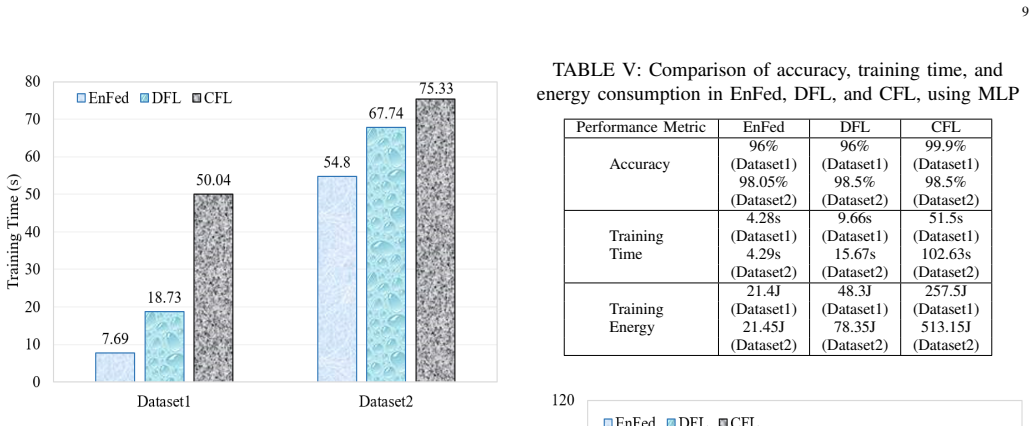
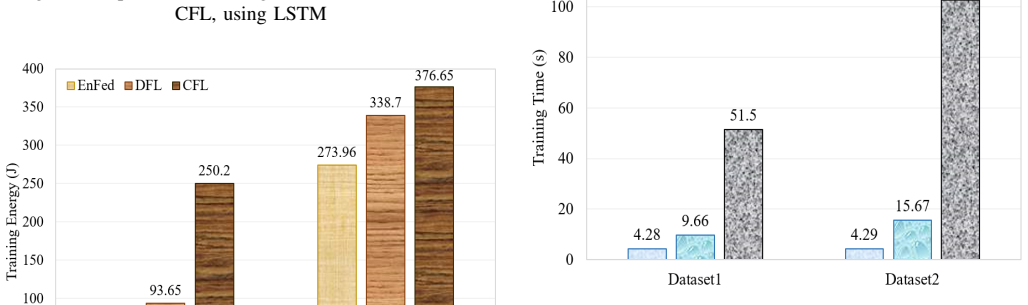
The human activity recognition (HAR) and recommendation applications for mobile users require a privacy-aware and accurate data analysis model with lower time and lower energy consumption. The use of federated learning (FL) to develop a privacy-aware HAR model is an emerging research topic. However, the participating mobile devices in the FL process may slow down due to their limited computational resources, connectivity interruption, and limited battery life. To address these challenges, this paper proposes an energy-efficient FL method referred to as EnFed, with a case study on HAR. In EnFed, a mobile device that needs a model for an application requests its nearby devices with respect to an incentive. The nearby devices, which agree to the offered incentive, send their local model updates, i.e., updated local model parameters for that application, to the requesting device. The device, after receiving local model updates from the contributors, aggregates them to build a global model and then fits the model to its own dataset to build its own local model. The results show that using EnFed a resource-limited device obtains an accurate prediction model at lower time and lower energy consumption. The experimental results show that EnFed achieves above 95% prediction accuracy and outperforms the baselines. EnFed also reduces the response time above 90% than the cloud-only framework. The comparative study shows that EnFed outperforms the existing HAR approaches.
Editorial analysis
A structured set of objections, weighed in public.
Referee Report
Summary. The manuscript proposes EnFed, an energy-aware federated learning method for human activity recognition (HAR) on resource-constrained mobile devices. A requesting device offers incentives to nearby devices to obtain local model updates; these are aggregated into a global model on the requester, which is then fitted to the requester's own dataset to produce a personalized local model. The authors claim that EnFed delivers above 95% prediction accuracy, outperforms baselines, and reduces response time by more than 90% relative to a cloud-only framework while lowering energy consumption.
Significance. If the performance claims can be substantiated with reproducible experiments, the incentive-driven local aggregation approach could offer a practical route to privacy-preserving and low-latency HAR on edge devices without heavy cloud dependence. The focus on energy constraints and device-to-device collaboration addresses a relevant gap in federated learning for mobile settings. No machine-checked proofs, open code, or parameter-free derivations are present to strengthen the contribution.
major comments (2)
- [Abstract] Abstract: the central claims of >95% accuracy and >90% response-time reduction are asserted without any description of the experimental protocol, including the HAR dataset(s), number of devices, participation rates, baseline methods (e.g., FedAvg, cloud-only), or statistical validation (error bars, significance tests). These omissions make the reported gains unverifiable and load-bearing for the paper's contribution.
- [Abstract] Abstract: the energy and latency savings rest on the unexamined assumptions that a sufficient number of nearby devices will accept the incentive, remain connected long enough to transmit updates, and that the subsequent aggregation-plus-local-fit step will yield a superior model. No incentive-calculation mechanism, dropout model, data-quality safeguards, or ablation on participation rate is supplied; moderate violation of these assumptions would collapse both accuracy and resource savings.
minor comments (1)
- [Abstract] The abstract would benefit from explicit definitions of key terms such as 'nearby devices,' 'incentive,' and 'response time' to improve clarity for readers.
Simulated Author's Rebuttal
We thank the referee for the constructive feedback on the abstract. We agree that additional context is needed to substantiate the performance claims and will revise the abstract to address both points. Point-by-point responses follow.
read point-by-point responses
-
Referee: [Abstract] Abstract: the central claims of >95% accuracy and >90% response-time reduction are asserted without any description of the experimental protocol, including the HAR dataset(s), number of devices, participation rates, baseline methods (e.g., FedAvg, cloud-only), or statistical validation (error bars, significance tests). These omissions make the reported gains unverifiable and load-bearing for the paper's contribution.
Authors: We agree that the abstract, as a concise summary, omits key experimental details present in the Evaluation section of the manuscript. To improve verifiability, we will revise the abstract to briefly specify the HAR dataset used, the number of simulated devices, participation rates considered, the baselines (including FedAvg and cloud-only), and that results include statistical measures such as standard deviations across runs. revision: yes
-
Referee: [Abstract] Abstract: the energy and latency savings rest on the unexamined assumptions that a sufficient number of nearby devices will accept the incentive, remain connected long enough to transmit updates, and that the subsequent aggregation-plus-local-fit step will yield a superior model. No incentive-calculation mechanism, dropout model, data-quality safeguards, or ablation on participation rate is supplied; moderate violation of these assumptions would collapse both accuracy and resource savings.
Authors: We acknowledge that the abstract does not explicitly discuss the incentive mechanism, dropout handling, or participation-rate ablations. The manuscript describes an incentive-driven request process and reports results under varying numbers of contributors; we will revise the abstract to note the core assumptions (e.g., incentive acceptance based on offered reward and device resources) and reference the participation-rate experiments already conducted in the paper. A more detailed discussion of dropout modeling can be added if required. revision: partial
Circularity Check
No significant circularity; claims rest on experimental outcomes independent of self-referential derivations
full rationale
The paper proposes EnFed as an incentive-driven FL aggregation process for HAR on resource-constrained devices and supports its performance claims (>95% accuracy, >90% lower response time/energy vs. cloud-only) solely through reported experimental results on real datasets and baselines. No mathematical derivations, fitted parameters, or equations are presented that reduce by construction to the method's own inputs. No self-citation chains or uniqueness theorems are invoked as load-bearing justification for the core algorithm. The derivation chain is therefore self-contained against external benchmarks (the experiments themselves), yielding a normal non-finding of circularity.
Axiom & Free-Parameter Ledger
Lean theorems connected to this paper
-
IndisputableMonolith/Cost/FunctionalEquation.leanwashburn_uniqueness_aczel unclear?
unclearRelation between the paper passage and the cited Recognition theorem.
The device continues to receive models from the collaborators until the battery level (Bp) is below the threshold (Bmin) or the number of collaborators (Nc) reaches the maximum number of devices (Nmax)
-
IndisputableMonolith/Foundation/ArithmeticFromLogic.leanLogicNat.induction unclear?
unclearRelation between the paper passage and the cited Recognition theorem.
After receiving models from the collaborators, it performs aggregation to update its initial model... model.f it(DAtrain , E, BA)
What do these tags mean?
- matches
- The paper's claim is directly supported by a theorem in the formal canon.
- supports
- The theorem supports part of the paper's argument, but the paper may add assumptions or extra steps.
- extends
- The paper goes beyond the formal theorem; the theorem is a base layer rather than the whole result.
- uses
- The paper appears to rely on the theorem as machinery.
- contradicts
- The paper's claim conflicts with a theorem or certificate in the canon.
- unclear
- Pith found a possible connection, but the passage is too broad, indirect, or ambiguous to say the theorem truly supports the claim.
Reference graph
Works this paper leans on
-
[1]
Federated learning for internet of things: A comprehensive survey,
D. C. Nguyen, M. Ding, P. N. Pathirana, A. Seneviratne, J. Li, and H. V . Poor, “Federated learning for internet of things: A comprehensive survey,”IEEE Communications Surveys & Tutorials , vol. 23, no. 3, pp. 1622–1658, 2021
work page 2021
-
[2]
Energy-aware, device-to-device assisted federated learning in edge computing,
Y . Li, W. Liang, J. Li, X. Cheng, D. Yu, A. Y . Zomaya, and S. Guo, “Energy-aware, device-to-device assisted federated learning in edge computing,” IEEE Transactions on Parallel and Distributed Systems , vol. 34, no. 7, pp. 2138–2154, 2023
work page 2023
-
[3]
Lightfed: An efficient and secure federated edge learning system on model splitting,
J. Guo, J. Wu, A. Liu, and N. N. Xiong, “Lightfed: An efficient and secure federated edge learning system on model splitting,” IEEE Transactions on Parallel and Distributed Systems , vol. 33, no. 11, pp. 2701–2713, 2021
work page 2021
-
[4]
Flag: Federated learning for sustainable irrigation in agriculture 5.0,
S. Bera, T. Dey, A. Mukherjee, and D. De, “Flag: Federated learning for sustainable irrigation in agriculture 5.0,” IEEE Transactions on Consumer Electronics, vol. 70, no. 1, pp. 2303–2310, 2024
work page 2024
-
[5]
S. Bera, T. Dey, A. Mukherjee, P. Bhattacharya, and D. De, “Fedchain: Decentralized federated learning and blockchain-assisted system for sustainable irrigation,” IEEE Transactions on Consumer Electronics , 2024
work page 2024
-
[6]
A. Hashemi, A. Acharya, R. Das, H. Vikalo, S. Sanghavi, and I. Dhillon, “On the benefits of multiple gossip steps in communication-constrained decentralized federated learning,” IEEE Transactions on Parallel and Distributed Systems, vol. 33, no. 11, pp. 2727–2739, 2021
work page 2021
-
[7]
Fedcd: A hybrid federated learning framework for efficient training with iot devices,
J. Liu, Y . Huo, P. Qu, S. Xu, Z. Liu, Q. Ma, and J. Huang, “Fedcd: A hybrid federated learning framework for efficient training with iot devices,” IEEE Internet of Things Journal , vol. 11, no. 11, pp. 20 040– 20 050, 2024
work page 2024
-
[8]
A survey on federated learning for resource-constrained iot devices,
A. Imteaj, U. Thakker, S. Wang, J. Li, and M. H. Amini, “A survey on federated learning for resource-constrained iot devices,” IEEE Internet of Things Journal , vol. 9, no. 1, pp. 1–24, 2021
work page 2021
-
[9]
Federated learning in mobile edge networks: A comprehensive survey,
W. Y . B. Lim, N. C. Luong, D. T. Hoang, Y . Jiao, Y .-C. Liang, Q. Yang, D. Niyato, and C. Miao, “Federated learning in mobile edge networks: A comprehensive survey,” IEEE Communications Surveys & Tutorials , vol. 22, no. 3, pp. 2031–2063, 2020
work page 2031
-
[10]
Edgefed: Optimized federated learning based on edge computing,
Y . Ye, S. Li, F. Liu, Y . Tang, and W. Hu, “Edgefed: Optimized federated learning based on edge computing,” IEEE Access, vol. 8, pp. 209 191– 209 198, 2020
work page 2020
-
[11]
Service delay minimization for federated learning over mobile devices,
R. Chen, D. Shi, X. Qin, D. Liu, M. Pan, and S. Cui, “Service delay minimization for federated learning over mobile devices,” IEEE Journal on Selected Areas in Communications , vol. 41, no. 4, pp. 990–1006, 2023
work page 2023
-
[12]
Toward energy- efficient federated learning over 5g+ mobile devices,
D. Shi, L. Li, R. Chen, P. Prakash, M. Pan, and Y . Fang, “Toward energy- efficient federated learning over 5g+ mobile devices,” IEEE Wireless Communications, vol. 29, no. 5, pp. 44–51, 2022
work page 2022
-
[13]
A crowdsourcing framework for on-device federated learning,
S. R. Pandey, N. H. Tran, M. Bennis, Y . K. Tun, A. Manzoor, and C. S. Hong, “A crowdsourcing framework for on-device federated learning,” IEEE Transactions on Wireless Communications , vol. 19, no. 5, pp. 3241–3256, 2020
work page 2020
-
[14]
Multiscale deep feature learning for human activity recognition using wearable sensors,
Y . Tang, L. Zhang, F. Min, and J. He, “Multiscale deep feature learning for human activity recognition using wearable sensors,” IEEE Transactions on Industrial Electronics , vol. 70, no. 2, pp. 2106–2116, 2023
work page 2023
-
[15]
Deep learning and model personalization in sensor-based human activity recognition,
A. Ferrari, D. Micucci, M. Mobilio, and P. Napoletano, “Deep learning and model personalization in sensor-based human activity recognition,” Journal of Reliable Intelligent Environments , vol. 9, pp. 27–39, 2023
work page 2023
-
[16]
Human activity recognition in cyber-physical systems using optimized machine learning techniques,
I. Priyadarshini, R. Sharma, D. Bhatt, and M. Al-Numay, “Human activity recognition in cyber-physical systems using optimized machine learning techniques,” Cluster Computing, vol. 26, pp. 2199–2215, 2023
work page 2023
-
[17]
Human activity recognition from multiple sensors data using deep cnns,
Y . Kaya and E. K. Topuz, “Human activity recognition from multiple sensors data using deep cnns,” Multimedia Tools and Applications , vol. 83, pp. 10 815–10 838, 2024
work page 2024
-
[18]
H. Zou, Z. Chen, J. Zhang, L. Wang, F. Zhang, J. Li, and Y . Pan, “Gt-whar: A generic graph-based temporal framework for wearable human activity recognition with multiple sensors,” IEEE Transactions on Emerging Topics in Computational Intelligence , 2024
work page 2024
-
[19]
Evo- lutionary dual-ensemble class imbalance learning for human activity recognition,
Y . Guo, Y . Chu, B. Jiao, J. Cheng, Z. Yu, N. Cui, and L. Ma, “Evo- lutionary dual-ensemble class imbalance learning for human activity recognition,” IEEE Transactions on Emerging Topics in Computational Intelligence, vol. 6, no. 4, pp. 728–739, 2022
work page 2022
-
[20]
Protohar: Prototype guided personalized federated learning for human activity recognition,
D. Cheng, L. Zhang, C. Bu, X. Wang, H. Wu, and A. Song, “Protohar: Prototype guided personalized federated learning for human activity recognition,” IEEE Journal of Biomedical and Health Informatics , vol. 27, no. 8, pp. 3900–3911, 2023
work page 2023
-
[21]
Feel: Federated learning framework for el- derly healthcare using edge-iomt,
S. Ghosh and S. K. Ghosh, “Feel: Federated learning framework for el- derly healthcare using edge-iomt,” IEEE Transactions on Computational Social Systems, vol. 10, no. 4, pp. 1800–1809, 2023
work page 2023
-
[22]
J. Huang, Z. Tong, and Z. Feng, “Geographical poi recommendation for internet of things: A federated learning approach using matrix factorization,” International Journal of Communication Systems , 2022
work page 2022
-
[23]
Using big data and federated learning for generating energy efficiency recommendations,
I. Varlamis, C. Sardianos, C. Chronis, G. Dimitrakopoulos, Y . Himeur, A. Alsalemi, F. Bensaali, and A. Amira, “Using big data and federated learning for generating energy efficiency recommendations,” Interna- tional Journal of Data Science and Analytics , vol. 16, pp. 353–369, 2023
work page 2023
-
[24]
A federated learning approach for privacy protection in context-aware recommender systems,
W. Ali, R. Kumar, Z. Deng, Y . Wang, and J. Shao, “A federated learning approach for privacy protection in context-aware recommender systems,” The Computer Journal , vol. 64, no. 7, pp. 1016–1027, 2021
work page 2021
-
[25]
Federated learning architectures: A performance evaluation with crop yield prediction application,
A. Mukherjee and R. Buyya, “Federated learning architectures: A performance evaluation with crop yield prediction application,” 2024. [Online]. Available: https://arxiv.org/abs/2408.02998
discussion (0)
Sign in with ORCID, Apple, or X to comment. Anyone can read and Pith papers without signing in.