REVIEW 4 major objections 6 minor 60 references
Image Forgery Localization via Guided Noise and Multi-Scale Feature Aggregation
T0 review · 4 major / 6 minor · reviewed 2026-08-12 · deepseek-v4-flash
Pith's one-line read The paper claims that guided-filter noise residuals, fused with RGB features by dynamic convolution and widened by an atrous residual pyramid, localize forged regions — above all small and post-processed ones — more accurately than prior…
desk verdict Plausible IFL combination with honest ablations, but the headline F1 gains are not yet defensible until baselines are controlled and NIST16 is checked for calibration artifacts. read the letter →
The pith
A machine-rendered reading of the paper's core claim, the machinery that carries it, and where it could break.
The reading
What carries the argument
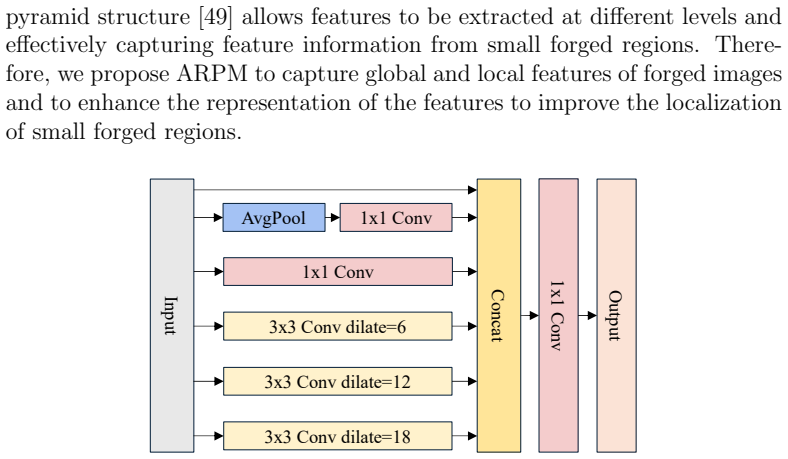
The argument is carried by three modules and one identity. The decomposition $I = I_c + I_f$ turns localization into residual estimation, and the guided noise extractor materializes it as $I_g = |I - \mathrm{Guide}(I)| + \mathrm{Sobel}(I)$: the guided filter (an edge-preserving local-linear filter) is assumed to strip tampering content while keeping genuine content, and the Sobel term re-injects edges that post-processing weakens. The Feature Aggregation Module (FAM) enhances the RGB stream by a Sobel pass, a $1\times1$ convolution, a $3\times3$ dynamic convolution — whose kernel adapts to the input, so different forgery types get different filters — and a $5\times5$ convolution; it enhances the noise stream by a $1\times1$ convolution, max pooling, and a $7\times7$ convolution; then it concatenates the two streams through a $1\times1$ convolution with batch norm and ReLU. The Atrous Residual Pyramid Module (ARPM) pools the aggregated feature globally and runs three $3\times3$ atrous convolutions at dilations 6, 12, and 18, fusing everything with a $1\times1$ convolution so that global and local features coexist. The final masks come from four progressive Spatial-Channel Correlation Modules, each supervised by binary cross-entropy.
What would settle it
Replace the guided filter with a generic high-pass operator (Laplacian or difference-of-Gaussians) under identical training: if AUC on CASIA and NIST16 stays within the reported margins, the guided decomposition is not the source of the gains. Second, measure the residual energy on pristine images — the assumption predicts the residual of an unedited image is near-silent, so strong activation on authentic texture would falsify the noise-isolation story.
Extended reading notes
Core claim
The central claim is that the guided filter turns forgery detection into a residual problem. Writing the image as $I = I_c + I_f$, the paper asserts that the guided filter output approximates the genuine content $I_c$, so the residual $I_f = |I - \mathrm{Guide}(I)|$ concentrates tampering traces, and adding Sobel edges preserves the weakened boundary artifacts. A shared EfficientNetV2 backbone then learns RGB and noise features at four scales, and the Feature Aggregation Module fuses them with dynamic convolution instead of naive concatenation, which the authors argue prevents the two streams from hiding each other's forgery information. The Atrous Residual Pyramid Module, using dilations of 6, 12, and 18 alongside a global pooling branch, keeps both small local traces and wide context. On its own terms, the paper establishes that this combination beats state-of-the-art dual-branch methods on four of five public benchmarks, with the strongest margin on the small-forgery dataset NIST16, and that it holds the top robustness score on seven of eight post-processing settings on Columbia.
Load-bearing premise
Everything rests on the assumption that the guided-filter residual $|I - \mathrm{Guide}(I)|$ is a faithful portrait of forgery traces, and that what the filter removes from a forged image is tampering evidence rather than ordinary texture, sensor noise, or compression artifacts.
Editorial extensions
If this is right
- Small forged regions become the method's strongest suit: on images whose forged area is under 1% of the picture, the model reports AUC 87.1 versus 82.9 for PSCC-Net and 81.2 for HiFi-Net.
- Post-processing robustness follows from the fusion, not from heavier denoising: on the Columbia dataset with resizing, blurring, Gaussian noise, and JPEG compression, the model keeps the best AUC on seven of the eight distorted settings.
- The noise branch is parameter-free at extraction time — a guided filter and a Sobel filter — so the claimed gains do not depend on training a learned noise estimator.
- The ablations indicate the specific design choices matter: swapping the guided filter's Sobel edge term for BayarConv or SRM drops AUC by about 3.6–3.7%, and swapping EfficientNetV2 for HRNet drops AUC by 7.9% on CASIA.
Reading between the lines
- A testable extension is to feed the guided noise branch alone (no RGB stream) through a segmentation head: the paper's decomposition predicts the residual alone should trace splicing boundaries, so a standalone-noise run would isolate how much of the gain is forensic signal versus aggregated texture.
- Because the residual is computed without learned parameters, one could swap the guided filter for any learned or fixed denoiser and re-measure the same benchmarks; if the gains survive the swap, the claim is about residual high-frequency content generally, not about guided filtering specifically.
- The paper never quantifies how much of $|I - \mathrm{Guide}(I)|$ on authentic images is non-forgery texture; a direct editor-level check would compare residual statistics of pristine versus forged images with matched content, which would tell whether the noise branch risks flagging natural detail as tampering.
- If the small-region gains are mainly from the pyramid, a natural probe is to replace ARPM with a standard feature pyramid network under identical training and see whether the atrous dilations, rather than multi-scale fusion per se, are what recover tiny forged regions.
Signed reviews
Editorial analysis
A structured set of objections, weighed in public.
Referee Report
Summary. The paper proposes an end-to-end image forgery localization network with two branches: an RGB branch and a guided-noise branch. The guided noise is defined as the absolute residual after guided filtering plus Sobel edge maps, based on the decomposition I = Ic + If. Features from four EfficientNetV2 layers are aggregated by a dynamic-convolution-based Feature Aggregation Module (FAM), then processed by an Atrous Residual Pyramid Module (ARPM) with dilation rates 6, 12, and 18. Localization is performed by PSCC-Net's spatial-channel correlation module in a progressive manner, and the total loss is the sum of four BCE losses. Experiments are reported on five public datasets with AUC, F1, and IoU, including small-region and robustness studies, plus an ablation study on CASIA. The central claim is that the proposed model outperforms several state-of-the-art IFL methods, especially on small forged regions and under post-processing.
Significance. If the reported results hold, the paper offers a modular architecture that is simple to describe and appears competitive on multiple public benchmarks. The manuscript's strengths are the systematic ablation on CASIA, which shows that each proposed component contributes to the final score, and the use of three complementary metrics. However, the empirical headline depends on uncontrolled comparisons with published baseline numbers, and the NIST16 F1 improvement is not mirrored by AUC or IoU. No code, model weights, or training data are released. The architectural novelty is incremental, but the empirical claim, if verified under a controlled protocol, would still be a useful contribution to the forgery localization literature.
major comments (4)
- [§5.1 and §4.1.1] The claim of state-of-the-art performance is not supported by a controlled comparison. The proposed model is trained from scratch on the 376k-image PSCC-style set at 256×256 resolution, whereas Section 5.1 states that 'all model results are taken from the original paper or run the publicly available source code.' The baselines were therefore trained on different data, at different resolutions, with different augmentation and fine-tuning protocols; none is retrained on the shared training set. As a result, the reported F1 improvements of 8.1, 2.7, 19.3, and 5.7 points on Coverage, CASIA, NIST16, and IMD20 (Table 3) conflate architectural differences with training-protocol differences. This is load-bearing for the main claim and should be addressed by retraining baselines under a shared protocol or by a tightly specified reproduction procedure.
- [§5.1, Tables 3-4] The NIST16 result is internally inconsistent across metrics: the F1 gain over HiFi-Net is +19.3 points, while the corresponding AUC gain over PSCC-Net is +1.4 and the IoU gain over HiFi-Net is +0.7. F1 at a fixed threshold is sensitive to calibration, so this pattern is compatible with a threshold artifact rather than a genuine localization-quality gain. The explanation offered in Section 5.1 (small forged regions make F1 emphasize precision and recall) does not address why the global metrics move so little. Please report the threshold used for F1, provide PR curves, or include a threshold-independent metric to substantiate the NIST16 claim.
- [§5.2, Table 6] The small-forged-region experiment is not reproducible as specified. It is unclear whether the 1157, 3428, and 4667 selected images were chosen per dataset or globally, how the forged-area percentage was computed (relative to image area, bounding-box area, or ground-truth ROI), and whether images with extremely small masks were excluded. Because the comparison uses only methods with publicly available code, the exact baseline configurations and checkpoint versions also need to be pinned down. The small-region claim, which is one of the paper's central contributions, cannot be verified without this information.
- [§5.3, Table 7] The robustness comparison is reported as single numbers without variance or significance tests, and the undistorted baseline shows the proposed method at 93.8 AUC versus 98.2 for PSCC-Net and 98.4 for HiFi-Net. The table's parenthetical deltas (e.g., '0.3↓', '6.0↓') are not defined in the text. The robustness claim would be strengthened by reporting multiple runs or seeds with error bars, and by clarifying whether the same operating point is used for all methods, especially given the apparent calibration difference on the undistorted Columbia set.
minor comments (6)
- [§3.2.2, Eqs. (2)-(4)] The decomposition I = Ic + If and the claim that guided filtering removes only If while preserving Ic are asserted without discussing other high-frequency content such as texture, sensor noise, or compression artifacts; a sentence situating this as a heuristic and referring to the ablation evidence (Table 8) would help the reader calibrate the assumption.
- [Throughout] There are multiple typos and inconsistencies, including 'Spectifically', 'Expensive experiments', 'modifing', 'guiede niose', 'artous convolution', 'resourece', and 'Soble(·)' in Eq. (4) and Figure 2.
- [Eqs. (7) and (15)] Both equations have unbalanced parentheses: Eq. (7) is missing a closing parenthesis at the end, and Eq. (15) lacks a closing parenthesis after ReLU(C3×3(F)).
- [§4.3] The F1 score is used throughout, but the threshold used to binarize the predicted probability mask is not reported; please state it explicitly.
- [Table 7] The parenthetical deltas in the 'Ours' column (e.g., '0.3↓', '6.0↓') are not explained in the table caption or the text.
- [§9, Data availability] The data availability statement says 'Data will be made available on request'; given the empirical nature of the claims, releasing code, model weights, and the exact evaluation scripts is important for verification.
Circularity Check
No circularity: the paper's performance claims are external benchmark measurements, and no equation reduces a prediction to a fitted parameter or self-citation.
full rationale
The paper's central claim is an empirical state-of-the-art comparison on public datasets (Tables 3-5 and 7), and no equation in the manuscript constructs a prediction from a fitted parameter or from an assumption. The guided-noise input (Eqs. 2-4) is a fixed pre-processing definition, namely the residual of guided filtering plus Sobel edges, and it is not fitted to test labels; the FAM, ARPM, and the loss in Eq. 16 are architectural choices trained end-to-end on a separate PSCC-style training set described in Section 4.1.1. Baseline results are taken from original papers or public code, which raises comparability concerns, and the ablations in Section 5.4 are performed on CASIA, which also appears in the headline results; these are validity and robustness risks, not circularity. There is no load-bearing self-citation chain: the method cites standard external components such as the guided filter, Sobel filter, dynamic convolution, and EfficientNetV2. The reported improvements are therefore not equivalent to the paper's inputs by construction.
Assumptions & free parameters
free parameters (4)
- Guided filter radius and regularization epsilon =
not reported
- EfficientNetV2 variant and selected output layers (2, 6, 10, 25) =
not reported
- ARPM dilation rates =
6, 12, 18
- Localization loss weights =
equal weights (1 for each of M1-M4)
assumptions (4)
- domain assumption The forged image decomposes as I = Ic + If, and guided filtering recovers Ic.
- domain assumption Sobel edge maps preserve forgery boundaries after post-processing.
- domain assumption Dynamic-convolution aggregation and atrous residual pyramids improve localization.
- domain assumption The 376k-image synthetic training set transfers to the five public test sets.
Cite this review
Pith. "Pith review of Image Forgery Localization via Guided Noise and Multi-Scale Feature Aggregation." pith.science (2026). https://pith.science/paper/52UG3DLG
@misc{pith2026241201622,
  author       = {Pith},
  title        = {Pith review of: Image Forgery Localization via Guided Noise and Multi-Scale Feature Aggregation},
  year         = {2026},
  howpublished = {\url{https://pith.science/paper/52UG3DLG}},
  note         = {Machine review of arXiv:2412.01622}
}
read the original abstract
Image Forgery Localization (IFL) technology aims to detect and locate the forged areas in an image, which is very important in the field of digital forensics. However, existing IFL methods suffer from feature degradation during training using multi-layer convolutions or the self-attention mechanism, and perform poorly in detecting small forged regions and in robustness against post-processing. To tackle these, we propose a guided and multi-scale feature aggregated network for IFL. Spectifically, in order to comprehensively learn the noise feature under different types of forgery, we develop an effective noise extraction module in a guided way. Then, we design a Feature Aggregation Module (FAM) that uses dynamic convolution to adaptively aggregate RGB and noise features over multiple scales. Moreover, we propose an Atrous Residual Pyramid Module (ARPM) to enhance features representation and capture both global and local features using different receptive fields to improve the accuracy and robustness of forgery localization. Expensive experiments on 5 public datasets have shown that our proposed model outperforms several the state-of-the-art methods, specially on small region forged image.
Figures


Figures from the paper (3 more)


Reference graph
Works this paper leans on
-
[1]
I. T. Young, L. J. van Vliet, Recursive implementation of the Gaussian filter, Signal Processing 44 (2) (1995) 139–151. doi:https://doi.org/ 10.1016/0165-1684(95)00020-E
-
[2]
M. Huh, A. Liu, A. Owens, A. A. Efros, Fighting Fake News: Image Splice Detection via Learned Self-Consistency, in: Proceedings of the European Conference on Computer Vision (ECCV), 2018. doi:https: //doi.org/10.1007/978-3-030-01252-6_7
-
[3]
G. Gani, F. Qadir, A robust copy-move forgery detection technique based on discrete cosine transform and cellular automata, Journal of Information Security and Applications 54 (2020) 102510. doi:https: //doi.org/10.1016/j.jisa.2020.102510. 28
arXiv 2020
- [4]
-
[5]
M. Krichen, Generative Adversarial Networks, in: 2023 14th Interna- tional Conference on Computing Communication and Networking Tech- nologies (ICCCNT), 2023, pp. 1–7. doi:10.1109/ICCCNT56998.2023. 10306417
arXiv 2023
-
[6]
C. Dong, X. Chen, R. Hu, J. Cao, X. Li, MVSS-Net: Multi-View Multi- Scale Supervised Networks for Image Manipulation Detection, IEEE Transactions on Pattern Analysis and Machine Intelligence 45 (3) (2023) 3539–3553. doi:10.1109/TPAMI.2022.3180556
arXiv 2023
-
[7]
X. Liu, Y. Liu, J. Chen, X. Liu, PSCC-Net: Progressive Spatio-Channel Correlation Network for Image Manipulation Detection and Localiza- tion, IEEE Transactions on Circuits and Systems for Video Technology 32 (11) (2022) 7505–7517. doi:10.1109/TCSVT.2022.3189545
arXiv 2022
-
[9]
K. He, J. Sun, X. Tang, Guided Image Filtering, IEEE Transactions on Pattern Analysis and Machine Intelligence 35 (6) (2013) 1397–1409. doi:10.1109/TPAMI.2012.213
Show all 60 references
-
[10]
R. E. Twogood, F. G. Sommer, Digital Image Processing, IEEE Trans- actions on Nuclear Science 29 (3) (1982) 1075–1086. doi:10.1109/TNS. 1982.4336327
1982
- [11]
-
[12]
Y. Chen, X. Dai, M. Liu, D. Chen, L. Yuan, Z. Liu, Dynamic Convolu- tion: Attention Over Convolution Kernels, in: 2020 IEEE/CVF Confer- ence on Computer Vision and Pattern Recognition (CVPR), 2020, pp. 11027–11036. doi:10.1109/CVPR42600.2020.01104
2020
-
[13]
F. Yu, V. Koltun, Multi-Scale Context Aggregation by Dilated Convolu- tions, in: International Conference on Learning Representations (ICLR),
-
[14]
K. He, X. Zhang, S. Ren, J. Sun, Deep Residual Learning for Image Recognition, in: 2016 IEEE Conference on Computer Vision and Pattern Recognition (CVPR), 2016, pp. 770–778. doi:10.1109/CVPR.2016.90
2016 doi
-
[15]
Vaswani, N
A. Vaswani, N. Shazeer, N. Parmar, J. Uszkoreit, L. Jones, A. N. Gomez, L. Kaiser, I. Polosukhin, Attention is all you need, in: Proceedings of the 31st International Conference on Neural Information Processing Systems, NIPS’17, Curran Associates Inc., Red Hook, NY, USA, 2017,...
-
[16]
J. H. Bappy, A. K. Roy-Chowdhury, J. Bunk, L. Nataraj, B. Manjunath, Exploiting Spatial Structure for Localizing Manipulated Image Regions, in: 2017 IEEE International Conference on Computer Vision (ICCV), 2017, pp. 4980–4989. doi:10.1109/ICCV.2017.532
2017 doi
-
[17]
P. Zhou, X. Han, V. I. Morariu, L. S. Davis, Learning Rich Features for Image Manipulation Detection, in: 2018 IEEE/CVF Conference on Computer Vision and Pattern Recognition, 2018, pp. 1053–1061. doi: 10.1109/CVPR.2018.00116
2018
-
[18]
J. H. Bappy, C. Simons, L. Nataraj, B. S. Manjunath, A. K. Roy- Chowdhury, Hybrid LSTM and Encoder–Decoder Architecture for De- tection of Image Forgeries, IEEE Transactions on Image Processing 28 (7) (2019) 3286–3300. doi:10.1109/TIP.2019.2895466
2019
-
[19]
Y. Wu, W. AbdAlmageed, P. Natarajan, ManTra-Net: Manipulation Tracing Network for Detection and Localization of Image Forgeries With Anomalous Features, in: 2019 IEEE/CVF Conference on Com- puter Vision and Pattern Recognition (CVPR), 2019, pp. 9535–9544. doi:10.1109/CVPR.2019...
2019
-
[20]
X. Hu, Z. Zhang, Z. Jiang, S. Chaudhuri, Z. Yang, R. Nevatia, SPAN: Spatial Pyramid Attention Network for Image Manipulation Localiza- tion, in: A. Vedaldi, H. Bischof, T. Brox, J.-M. Frahm (Eds.), Computer Vision – ECCV 2020, Springer International Publishing, Cham, 2020, pp....
2020 doi
-
[21]
Kwon, I.-J
M.-J. Kwon, I.-J. Yu, S.-H. Nam, H.-K. Lee, CAT-Net: Compression Ar- tifact Tracing Network for Detection and Localization of Image Splicing, in: 2021 IEEE Winter Conference on Applications of Computer Vision (W ACV), 2021, pp. 375–384. doi:10.1109/WACV48630.2021.00042
2021
-
[22]
X. Lin, S. Wang, J. Deng, Y. Fu, X. Bai, X. Chen, X. Qu, W. Tang, Image manipulation detection by multiple tampering traces and edge artifact enhancement, Pattern Recognition 133 (2023) 109026. doi: https://doi.org/10.1016/j.patcog.2022.109026
2023
-
[24]
Y. Zhou, H. Wang, Q. Zeng, R. Zhang, S. Meng, Exploring weakly- supervised image manipulation localization with tampering Edge-based class activation map, Expert Systems with Applications 249 (2024) 123501. doi:https://doi.org/10.1016/j.eswa.2024.123501
2024
-
[25]
Z. Lin, J. He, X. Tang, C.-K. Tang, Fast, automatic and fine-grained tampered JPEG image detection via DCT coefficient analysis, Pat- tern Recognition 42 (11) (2009) 2492–2501. doi:https://doi.org/ 10.1016/j.patcog.2009.03.019
2009 doi
-
[26]
Ferrara, T
P. Ferrara, T. Bianchi, A. De Rosa, A. Piva, Image Forgery Local- ization via Fine-Grained Analysis of CF A Artifacts, IEEE Transac- tions on Information Forensics and Security 7 (5) (2012) 1566–1577. doi:10.1109/TIFS.2012.2202227
2012
-
[27]
Cozzolino, G
D. Cozzolino, G. Poggi, L. Verdoliva, Splicebuster: A new blind image splicing detector, in: 2015 IEEE International Workshop on Information 31 Forensics and Security (WIFS), 2015, pp. 1–6. doi:10.1109/WIFS. 2015.7368565
2015
-
[28]
Vaishnavi, T
D. Vaishnavi, T. Subashini, Application of local invariant symmetry features to detect and localize image copy move forgeries, Journal of Information Security and Applications 44 (2019) 23–31. doi:https: //doi.org/10.1016/j.jisa.2018.11.001
2019 doi
-
[29]
K. B. Meena, V. Tyagi, A copy-move image forgery detection technique based on tetrolet transform, Journal of Information Security and Ap- plications 52 (2020) 102481. doi:https://doi.org/10.1016/j.jisa. 2020.102481
2020
-
[30]
B. Soni, P. K. Das, D. M. Thounaojam, Geometric transformation in- variant block based copy-move forgery detection using fast and efficient hybrid local features, Journal of Information Security and Applications 45 (2019) 44–51. doi:https://doi.org/10.1016/j.jisa.2019.01. 007
2019 doi
-
[31]
Lecun, L
Y. Lecun, L. Bottou, Y. Bengio, P. Haffner, Gradient-based learning applied to document recognition, Proceedings of the IEEE 86 (11) (1998) 2278–2324. doi:10.1109/5.726791
1998 doi
-
[32]
S. Ren, K. He, R. Girshick, J. Sun, Faster R-CNN: Towards Real-Time Object Detection with Region Proposal Networks, IEEE Transactions on Pattern Analysis and Machine Intelligence 39 (6) (2017) 1137–1149. doi:10.1109/TPAMI.2016.2577031
2017
-
[33]
Fridrich, J
J. Fridrich, J. Kodovsky, Rich Models for Steganalysis of Digital Images, IEEE Transactions on Information Forensics and Security 7 (3) (2012) 868–882. doi:10.1109/TIFS.2012.2190402
2012
-
[34]
Bayar, M
B. Bayar, M. C. Stamm, Constrained Convolutional Neural Networks: A New Approach Towards General Purpose Image Manipulation Detec- tion, IEEE Transactions on Information Forensics and Security 13 (11) (2018) 2691–2706. doi:10.1109/TIFS.2018.2825953
2018
-
[35]
J. Wang, K. Sun, T. Cheng, B. Jiang, C. Deng, Y. Zhao, D. Liu, Y. Mu, M. Tan, X. Wang, W. Liu, B. Xiao, Deep High-Resolution Representation Learning for Visual Recognition, IEEE Transactions on 32 Pattern Analysis and Machine Intelligence 43 (10) (2021) 3349–3364. doi:10.1109/...
2021
-
[36]
Bharathiraja, B
S. Bharathiraja, B. R. Kanna, S. Geetha, M. Hariharan, Exposing dig- ital image forgeries from statistical footprints, Journal of Information Security and Applications 69 (2022) 103273. doi:https://doi.org/ 10.1016/j.jisa.2022.103273
2022
-
[37]
Cozzolino, L
D. Cozzolino, L. Verdoliva, Noiseprint: A CNN-Based Camera Model Fingerprint, IEEE Transactions on Information Forensics and Security 15 (2020) 144–159. doi:10.1109/TIFS.2019.2916364
2020
-
[38]
Guillaro, D
F. Guillaro, D. Cozzolino, A. Sud, N. Dufour, L. Verdoliva, TruFor: Leveraging All-Round Clues for Trustworthy Image Forgery Detection and Localization, in: 2023 IEEE/CVF Conference on Computer Vision and Pattern Recognition (CVPR), 2023, pp. 20606–20615. doi:10. 1109/CVPR5272...
2023
-
[39]
Zhang, H
J. Zhang, H. Liu, K. Yang, X. Hu, R. Liu, R. Stiefelhagen, CMX: Cross- Modal Fusion for RGB-X Semantic Segmentation With Transformers, IEEE Transactions on Intelligent Transportation Systems 24 (12) (2023) 14679–14694. doi:10.1109/TITS.2023.3300537
2023
-
[40]
X. Xia, L. C. Su, S. P. Wang, X. Y. Li, DMFF-Net: Double-stream multilevel feature fusion network for image forgery localization, Engi- neering Applications of Artificial Intelligence 127 (2024) 107200. doi: https://doi.org/10.1016/j.engappai.2023.107200
2024
-
[41]
X. Ding, Y. Deng, Y. Zhao, W. Zhu, AFTLNet: An efficient adaptive forgery traces learning network for deep image inpainting localization, Journal of Information Security and Applications 84 (2024) 103825.doi: https://doi.org/10.1016/j.jisa.2024.103825
2024
-
[42]
Hochreiter, J
S. Hochreiter, J. Schmidhuber, Long Short-Term Memory, Neural Com- putation 9 (8) (1997) 1735–1780. doi:10.1162/neco.1997.9.8.1735
1997 doi
-
[43]
Z. Shi, X. Shen, H. Chen, Y. Lyu, PL-GNet: Pixel Level Global Net- work for detection and localization of image forgeries, Signal Processing: Image Communication 119 (2023) 117029. doi:https://doi.org/10. 1016/j.image.2023.117029. 33
2023
-
[44]
F. Li, H. Zhai, X. Zhang, C. Qin, Image Manipulation Localization Us- ing Spatial–Channel Fusion Excitation and Fine-Grained Feature En- hancement, IEEE Transactions on Instrumentation and Measurement 73 (2024) 1–14. doi:10.1109/TIM.2023.3338703
2024
- [45]
-
[46]
J. Chen, X. Liao, W. Wang, Z. Qian, Z. Qin, Y. Wang, SNIS: A Sig- nal Noise Separation-Based Network for Post-Processed Image Forgery Detection, IEEE Transactions on Circuits and Systems for Video Tech- nology 33 (2) (2023) 935–951. doi:10.1109/TCSVT.2022.3204753
2023
-
[47]
Z. Guo, G. Yang, J. Chen, X. Sun, Exposing Deepfake Face Forgeries With Guided Residuals, IEEE Transactions on Multimedia 25 (2023) 8458–8470. doi:10.1109/TMM.2023.3237169
2023
-
[48]
Chierchia, D
G. Chierchia, D. Cozzolino, G. Poggi, C. Sansone, L. Verdoliva, Guided filtering for PRNU-based localization of small-size image forgeries, in: 2014 IEEE International Conference on Acoustics, Speech and Signal Processing (ICASSP), 2014, pp. 6231–6235. doi:10.1109/ICASSP. 2014.6854802
2014
-
[49]
T.-Y. Lin, P. Doll´ ar, R. Girshick, K. He, B. Hariharan, S. Belongie, Feature Pyramid Networks for Object Detection, in: 2017 IEEE Con- ference on Computer Vision and Pattern Recognition (CVPR), 2017, pp. 936–944. doi:10.1109/CVPR.2017.106
2017 doi
-
[50]
X. Wang, R. Girshick, A. Gupta, K. He, Non-local Neural Networks, in: 2018 IEEE/CVF Conference on Computer Vision and Pattern Recogni- tion, 2018, pp. 7794–7803. doi:10.1109/CVPR.2018.00813
2018
-
[51]
J. Hu, L. Shen, G. Sun, Squeeze-and-Excitation Networks, in: 2018 IEEE/CVF Conference on Computer Vision and Pattern Recognition, 2018, pp. 7132–7141. doi:10.1109/CVPR.2018.00745
2018
-
[52]
T.-Y. Lin, M. Maire, S. Belongie, J. Hays, P. Perona, D. Ramanan, P. Doll´ ar, C. L. Zitnick, Microsoft COCO: Common Objects in Context, 34 in: D. Fleet, T. Pajdla, B. Schiele, T. Tuytelaars (Eds.), Computer Vi- sion – ECCV 2014, Springer International Publishing, Cham, 2014, ...
2014 doi
-
[53]
Y. Wu, W. Abd-Almageed, P. Natarajan, BusterNet: Detecting Copy- Move Image Forgery with Source/Target Localization, in: V. Ferrari, M. Hebert, C. Sminchisescu, Y. Weiss (Eds.), Computer Vision – ECCV 2018, Springer International Publishing, Cham, 2018, pp. 170–186. doi: https...
2018 doi
-
[54]
Hsu, S.-F
Y.-F. Hsu, S.-F. Chang, Detecting Image Splicing Using Geometry Invariants and Camera Characteristics Consistency, in: International Conference on Multimedia and Expo, 2006. doi:10.1109/ICME.2006. 262447
2006 doi
-
[55]
B. Wen, Y. Zhu, R. Subramanian, T.-T. Ng, X. Shen, S. Winkler, COV- ERAGE — A novel database for copy-move forgery detection, in: 2016 IEEE International Conference on Image Processing (ICIP), 2016, pp. 161–165. doi:10.1109/ICIP.2016.7532339
2016
-
[56]
J. Dong, W. Wang, T. Tan, CASIA Image Tampering Detection Eval- uation Database, in: 2013 IEEE China Summit and International Conference on Signal and Information Processing, 2013, pp. 422–426. doi:10.1109/ChinaSIP.2013.6625374
2013
-
[57]
H. Guan, M. Kozak, E. Robertson, Y. Lee, A. N. Yates, A. Delgado, D. Zhou, T. Kheyrkhah, J. Smith, J. Fiscus, MFC Datasets: Large-Scale Benchmark Datasets for Media Forensic Challenge Evaluation, in: 2019 IEEE Winter Applications of Computer Vision Workshops (W ACVW), 2019, pp...
2019
-
[58]
Novoz´ amsk´ y, B
A. Novoz´ amsk´ y, B. Mahdian, S. Saic, IMD2020: A Large-Scale An- notated Dataset Tailored for Detecting Manipulated Images, in: 2020 IEEE Winter Applications of Computer Vision Workshops (W ACVW), 2020, pp. 71–80. doi:10.1109/WACVW50321.2020.9096940
2020
- [59]
-
[60]
K. Guo, H. Zhu, G. Cao, Effective Image Tampering Localization Via Enhanced Transformer and Co-Attention Fusion, in: ICASSP 2024 - 2024 IEEE International Conference on Acoustics, Speech and Signal Processing (ICASSP), 2024, pp. 4895–4899. doi:10.1109/ ICASSP48485.2024.10446332
2024
-
[61]
J. Wang, Z. Wu, J. Chen, X. Han, A. Shrivastava, S.-N. Lim, Y.-G. Jiang, ObjectFormer for Image Manipulation Detection and Localiza- tion, in: 2022 IEEE/CVF Conference on Computer Vision and Pattern Recognition (CVPR), 2022, pp. 2354–2363. doi:10.1109/CVPR52688. 2022.00240. 36
2022
- [2016]
Reviewed August 12, 2026 · model on record in the stance chip above.
Discussion (0). Continue with ORCID to comment.