REVIEW 2 major objections 5 minor 1 cited by
Intertwined order of generalized global symmetries
T0 review · 2 major / 5 minor · reviewed 2026-08-11 · deepseek-v4-flash
Pith's one-line read A topological coupling locks the breaking of zero-form and one-form $\mathbb{Z}_N$ symmetries in 2+1 dimensions.
desk verdict A strong, checkable lattice model that realizes oblique phases and non-invertible symmetry breaking; the only real caveat is an explicitly stated assumption about nonzero-Theta robustness. read the letter →
The pith
A machine-rendered reading of the paper's core claim, the machinery that carries it, and where it could break.
The reading
What carries the argument
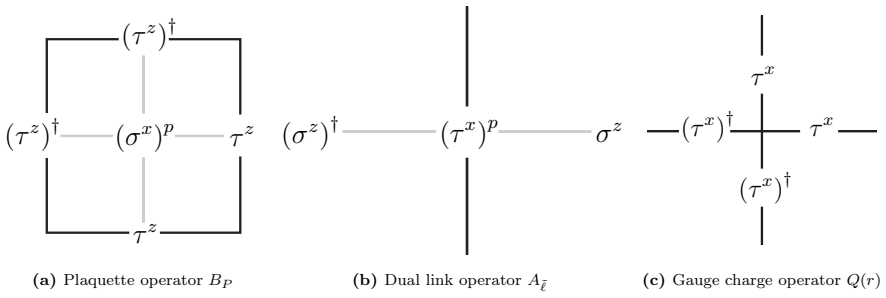
The load-bearing object is the topological interaction of Eq. (2.4), a lattice analogue of the $\theta$ term that implements the generalized Witten effect: it shifts quantum numbers to $(n+\frac{\Theta}{2\pi}m,\,m)$ for spins and monopoles and similarly for electric charges and vortices, so that vortices carry electric charge and monopoles carry fractional $\mathbb{Z}_N$ spin. The second engine is the pair of dualities $S$ and $T$ -- Kramers-Wannier-like duality and periodicity/SPT-stacking -- acting on the coupling $\tau=\frac{\Theta}{2\pi}+i\frac{2\pi}{Nge}$ and on the charges of condensed operators; tracking these charges locates the oblique phases and the SPTs in the phase diagram. Deep inside an oblique phase the effective field theory is the gauged BF-type action $S=\frac{iNp}{2\pi}\int c\wedge b+\cdots$, whose gauge-invariant operators produce the $\mathbb{Z}_{N/L}$ clock-shift algebra, the topological order, and the boundary anomalies.
What would settle it
Run a direct numerical simulation of the Villain lattice action, Eq. (2.1), at $\Theta/2\pi=-1/p$ with small couplings $e,g$ on a torus: if the ground-state degeneracy is not $[\gcd(N,p)]^3$, or if the Wilson-loop and order-parameter correlators do not show $\mathbb{Z}_N^{(0)}\times\mathbb{Z}_N^{(1)}\to\mathbb{Z}_{N/L}^{(0)}\times\mathbb{Z}_{N/L}^{(1)}$, the central claim fails.
Extended reading notes
Core claim
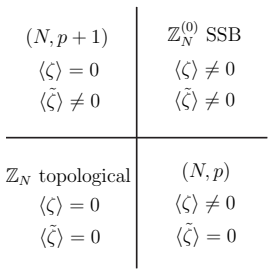
On its own terms, the paper claims that the phases of the model in Eq. (2.1) are controlled by the generalized Witten effect plus $\mathrm{SL}(2,\mathbb{Z})$ duality. Condensing bound states with spin charge $N$ and magnetic charge $p$, and loop operators with electric charge $N$ and vorticity $p$, produces the oblique phase $(N,p)$: the full symmetry $G=\mathbb{Z}_N^{(0)}\times\mathbb{Z}_N^{(1)}$ is broken to $H=\mathbb{Z}_{N/L}^{(0)}\times\mathbb{Z}_{N/L}^{(1)}$ with $L=\gcd(N,p)$, and the unbroken $H$ carries the SPT response $S_{\rm resp}=-\frac{iNk}{2\pi L}\int A\wedge B$, implying ground state degeneracy $L^{2g+1}$ on a genus-$g$ surface. The same mechanism yields, at $\Theta=2\pi p$ and strong coupling, every $\mathbb{Z}_N^{(0)}\times\mathbb{Z}_N^{(1)}$ SPT with response $\frac{iNp}{2\pi}\int A\wedge B$. Promoting $\Theta$ to a dynamical $\mathbb{Z}_N$ axion and gauging $G$ turns the axion symmetry into a non-invertible surface operator $U_p$ with fusion $U_{p_1}\times U_{p_2}=(\mathbb{Z}_N)^2\,U_{p_1+p_2}$; in the large-$J$ phase this non-invertible symmetry is spontaneously broken, with ground state degeneracy $\sum_{p=0}^{N-1}[\gcd(N,p)]^{2g+1}$.
Load-bearing premise
The analysis leans on the assumption that the phase diagram at $\Theta=0$, where the clock model and gauge theory decouple, continues to describe the model over a finite nonzero region of the topological coupling, so that the $S$-$T$ duality orbits of those phases are the actual phases of the model.
Editorial extensions
If this is right
- If the central claim holds, the single lattice model of Eq. (2.1) microscopically realizes every $\mathbb{Z}_N^{(0)}\times\mathbb{Z}_N^{(1)}$ SPT with response $\frac{iNp}{2\pi}\int A\wedge B$, for every $p$ mod $N$.
- In every oblique phase, the unbroken subgroup $H$ has both topological order and SPT response, so any gapped boundary that preserves $H$ must break the zero-form part of $H$ spontaneously; the paper gives explicit electric and magnetic boundary states realizing this.
- For $L=\gcd(N,p)\ge 4$, the gapless boundary state of the SPT is a quantum critical point or critical line with enhanced $U(1)\times U(1)\times\mathbb{Z}_N^{(0)}\times\mathbb{Z}_N^{(1)}$ symmetry between two gapped boundary phases.
- Gauging the $\mathbb{Z}_N$ axion model produces a non-invertible symmetry $U_p$ whose spontaneous breaking means its domain walls separate different oblique phases and obey the fusion rule $U_{p_1}\times U_{p_2}=(\mathbb{Z}_N)^2 U_{p_1+p_2}$.
- The intertwined breaking pattern -- zero-form and one-form symmetries break to the same subgroup -- holds for every phase reachable by the general $\mathrm{SL}(2,\mathbb{Z})$ word of Eq. (2.39), not just the special point $\Theta/2\pi=-1/p$.
Reading between the lines
- In the gauged axion phase, the fusion rule implies that the integer $p$ labeling domain walls is conserved mod $N$ even though the symmetry is not invertible; a numerical tensor-network calculation of the surface operator $U_p$ acting on the low-energy spectrum could test this selection rule directly.
- If the intertwined-breaking pattern is generic, then scanning the phase diagram at rational values of $\Theta/2\pi$ given by the continued fraction (2.40) should reveal oblique phases with the same $\mathbb{Z}_N\to\mathbb{Z}_{N/L}$ locking; a Monte Carlo study of the Villain action at small couplings could look for the predicted $L^3$ degeneracy on a torus.
- The half-gauging recipe used here -- turn one member of a mixed-anomalous pair into a non-invertible defect -- should apply to other mixed-anomaly pairs, e.g. two zero-form symmetries, yielding lattice models with non-invertible one-form symmetries and non-Abelian topological order.
- The electric boundary condition for oblique phases, which preserves the bulk $G$ while breaking $H$ at the boundary, may serve as a template for anomaly-free boundary theories of symmetry-enriched topological orders, since the boundary operators realize precisely the clock-shift algebra needed to cancel the bulk anomaly.
Editorial analysis
A structured set of objections, weighed in public.
Referee Report
Summary. This paper studies a three-dimensional Euclidean lattice model, Eq. (2.1), in which a Z_N clock model and a Z_N gauge theory are coupled only through a topological interaction, a lattice analogue of a theta term. The central claim is that the zero-form symmetry Z_N^(0) and the one-form symmetry Z_N^(1) are intertwined throughout the phase diagram: in any phase, if Z_N^(0) is spontaneously broken to a nontrivial subgroup, then Z_N^(1) is broken to the same subgroup. Using S and T duality transformations, the authors identify oblique phases labeled by (N,p), with L = gcd(N,p), whose low-energy theory is a gauged BF-type action, Eq. (2.37), and whose unbroken subgroup H = Z_{N/L}^(0) × Z_{N/L}^(1) carries an SPT response, Eq. (4.6), with ground-state degeneracy L^{2g+1}. The paper also constructs gapped boundary states, a Hamiltonian lattice realization in Section 7, gapless boundary criticality in Section 8, and Z_N axion extensions whose gauged version exhibits a spontaneously broken non-invertible symmetry with fusion rule Eq. (9.22).
Significance. If the central claims hold, this is a substantial contribution to the theory of generalized symmetries in lattice models. The paper provides a microscopic lattice realization of every Z_N^(0) × Z_N^(1) SPT of the form Eq. (1.1), a classification of oblique phases with intertwined symmetry breaking and topological order, explicit boundary constructions, and a lattice example of non-invertible symmetry breaking. The derivations are largely explicit and checkable: the lattice duality in Appendix B is presented in detail, the Hamiltonian ground-state correlations in Eqs. (7.14), (7.16), and the boundary algebra Eq. (7.23) are exact commuting-projector computations, and the fusion rule Eq. (9.22) is derived from a half-gauging construction. These concrete, verifiable computations are a notable strength of the manuscript. The main weakness is that the universal intertwining claim rests on an assumption about the persistence of the Θ = 0 phase diagram to nonzero Θ, which is explicitly stated as an expectation rather than proven.
major comments (2)
- [§2.4–§3 (footnote 6)] The universal intertwining statement is not fully established by the argument given. Footnote 6 of Section 3 justifies the claim by "observing the action of the most generic transformation, Eq. (2.39), on the phases at Θ = 0," but Section 2.4 explicitly states "We expect these phases and transitions to extend to a finite region for nonzero Θ," and Section 5.1 says that determining the fate of the transitions for small nonzero Θ is beyond the scope of the work. The S/T-orbit argument therefore establishes the intertwining pattern only for phases reachable from the Θ = 0 decoupled phase diagram by duality transformations, under the assumption that these phases persist in a finite neighborhood of nonzero Θ. If a new phase nucleates at arbitrarily small |Θ|, or if the topological term drives a first-order transition that bypasses the intermediate phases, the statement "in every phase of our lattice model" at the end of Section 3 would need modification. The quantitative predictions at the self-dual points Θ/2π = -1/p with large eg are exact duality consequences and are not affected, but the universality claim should either be restricted to duality-reachable phases or supported by a separate argument controlling the Θ ≠ 0 region. This is a domain-of-validity gap, not an internal inconsistency.
- [§9.2, Eq. (9.27)] The ground-state degeneracy formula for the non-invertible symmetry breaking phase, D_GS = Σ_{p=0}^{N-1} [gcd(N,p)]^{2g+1}, is presented as a sum over the known degeneracies of the oblique phases for each p. However, the text does not derive from the dynamics of Eq. (9.13) that the Hilbert space decomposes as a direct sum over p sectors with no additional identifications or mixing. In particular, the p = 0 term requires the convention gcd(N,0) = N, and the unusual gauge transformations of Eq. (9.14) leave some room for redundancy between sectors. The authors should either provide an explicit derivation of the decomposition or state clearly that Eq. (9.27) follows from the assumption that the different axion vacua are exactly degenerate and decoupled. This is a load-bearing point for the claim that the non-invertible symmetry is spontaneously broken, since the extra degeneracy beyond the ordinary oblique phases is the main quantitative signature.
minor comments (5)
- [§3] The phrase "canoncial commutation relations" should read "canonical commutation relations."
- [§1, footnote 1] The phrase "A analogue of this criterion" should read "An analogue of this criterion."
- [§6.2.2] The heading "Z(0)_N p symmetry" is rendered ambiguously; it should be written as Z_{Np}^(0) symmetry to avoid confusion with a p-dependent subgroup.
- [§8, Eqs. (8.10)–(8.18)] The operator eO is notationaly confusing because the coupling e is also used for the gauge coupling; consider renaming it, for example O_v, to avoid confusion with the electric coupling.
- [§9.2, Eq. (9.27)] The sum over p is stated to run from 0 to N-1, and p is implicitly mod N; it would be helpful to say explicitly that L = gcd(N,p) is defined with the convention gcd(N,0) = N.
Circularity Check
No significant circularity: the oblique-phase predictions are derived from explicit duality transformations and an effective field theory, then checked in an independent commuting-projector Hamiltonian; the nonzero-Theta extension is an acknowledged assumption rather than a circular input.
full rationale
The paper's central derivation chain is self-contained in the relevant sense. Starting from the Shapere-Wilczek lattice action (Eq. 2.1), the authors introduce background fields and derive the S and T duality maps (Eqs. 2.26-2.28), including how local and loop quantum numbers transform; these operator maps are obtained in Appendices B and C rather than assumed. The oblique phases are then constructed by applying ST^p to the trivial large-ge phase, giving the effective action Eq. (2.37), from which the unbroken subgroup H = Z_{N/L}^{(0)} x Z_{N/L}^{(1)}, the response coefficient -iNk/(2pi L), and the ground-state degeneracy L^{2g+1} are computed. None of these quantities is fitted to a target; the same results are re-derived in Section 7 from a commuting-projector Hamiltonian whose ground state satisfies exact local constraints (Eq. 7.13), yielding the same L^{2g+1} degeneracy. The only self-citations ([37] for inspiration, and [38] as the external source of the self-dual model) are not load-bearing: the duality used is rederived in the paper and the phase-diagram argument does not rest on an unverified result of the authors' prior work. The statement in Section 2.4 that the Theta=0 phases 'extend to a finite region for nonzero Theta' and the Section 5.1 caveat that determining the fate of transitions at small nonzero Theta is 'beyond the scope of this work' are domain-of-validity assumptions, not reductions of the conclusions to their inputs. The footnote justifying the universal same-subgroup intertwining claim explicitly appeals to checking the action of Eq. (2.39) on the Theta=0 phases, which is a derivation (modulo the stated robustness assumption), not a circular definition. Accordingly, no circular step can be exhibited.
Assumptions & free parameters
assumptions (3)
- ad hoc to paper The Θ=0 phase diagram of the decoupled clock model and gauge theory (ordered/disordered, deconfined/confining) is correct and persists to a finite region of nonzero Θ.
- domain assumption One-form global symmetries cannot be spontaneously broken in (1+1)d, so SPT boundaries must break the zero-form symmetry or be gapless.
- standard math Standard lattice field theory techniques (Poisson summation, Villain form, duality manipulation) are valid for the action of Eq. (2.1).
invented entities (1)
-
Z_N axion field θ(R)
Cite this review
Pith. "Pith review of Intertwined order of generalized global symmetries." pith.science (2026). https://pith.science/paper/U2O2LLCQ
@misc{pith2026241202748,
  author       = {Pith},
  title        = {Pith review of: Intertwined order of generalized global symmetries},
  year         = {2026},
  howpublished = {\url{https://pith.science/paper/U2O2LLCQ}},
  note         = {Machine review of arXiv:2412.02748}
}
abstract
We investigate the interplay of generalized global symmetries in 2+1 dimensions in a lattice model that couples a $\mathbb{Z}_N$ clock model to a $\mathbb{Z}_N$ gauge theory via a topological interaction. This coupling binds the charges of one symmetry to the disorder operators of the other, and when these composite objects condense, they give rise to emergent generalized symmetries with mixed 't Hooft anomalies. These anomalies result in phases with ordinary symmetry breaking, topological order, and symmetry-protected topological (SPT) order, where the different types of order are not independent but intimately related. We further explore the gapped boundary states of these exotic phases and develop theories for phase transitions between them. Additionally, we extend this lattice model to incorporate a non-invertible global symmetry, which can be spontaneously broken, leading to domain walls with non-trivial fusion rules.
Figures


Figures from the paper (10 more)




Forward citations
Cited by 1 Pith paper
-
2d Cardy-Rabinovici model with the modified Villain lattice: Exact dualities and symmetries
The 2d Cardy-Rabinovici model is constructed on a modified Villain lattice, making rescaled theta periodicity and strong-weak duality exact at finite spacing and giving a symmetry-based phase classification.
Reference graph
Works this paper leans on
-
[1]
X. Chen, Z.-C. Gu, Z.-X. Liu and X.-G. Wen, Symmetry-protected topological orders in interacting bosonic systems , Science 338(6114), 1604 (2012), doi:10.1126/science.1227224
-
[2]
X. Chen, Z.-C. Gu, Z.-X. Liu and X.-G. Wen, Symmetry protected topological orders and the group cohomology of their symmetry group , Phys. Rev. B 87, 155114 (2013), doi:10.1103/PhysRevB.87.155114
-
[3]
T. Senthil, Symmetry-protected topological phases of quantum matter , Annual Review of Condensed Matter Physics 6(1), 299 (2015), doi:10.1146/annurev-conmatphys-031214-014740
-
[4]
F. Pollmann, E. Berg, A. M. Turner and M. Oshikawa, Symmetry protection of topological phases in one-dimensional quantum spin systems , Physical Review B - Condensed Matter and Materials Physics 85 (2012), doi:10.1103/PhysRevB.85.075125
-
[5]
L. Fidkowski and A. Kitaev, Topological phases of fermions in one dimension , Physical Review B - Condensed Matter and Materials Physics 83 (2011), doi:10.1103/PhysRevB.83.075103
-
[6]
A. Vishwanath and T. Senthil, Physics of three-dimensional bosonic topological insulators: Surface-deconfined criticality and quantized magnetoelectric effect , Phys. Rev. X 3, 011016 (2013), doi:10.1103/PhysRevX.3.011016
-
[7]
A. Kapustin and N. Seiberg, Coupling a QFT to a TQFT and duality , J. High Energ. Phys. 2014, 001 (2014), doi:10.1007/JHEP04(2014)001
-
[8]
D. Gaiotto, A. Kapustin, N. Seiberg and B. Willett, Generalized global symmetries, J. High Energ. Phys. 2015(2), 172 (2015), doi:10.1007/JHEP02(2015)172
Show all 93 references
- [9]
-
[10]
McGreevy, Generalized symmetries in condensed matter , Annual Review of Condensed Matter Physics 14 (2023), doi:10.1146/annurev-conmatphys-040721-021029
J. McGreevy, Generalized symmetries in condensed matter , Annual Review of Condensed Matter Physics 14 (2023), doi:10.1146/annurev-conmatphys-040721-021029
2023 doi
-
[11]
Nussinov and G
Z. Nussinov and G. Ortiz, Sufficient symmetry conditions for topological quantum order, Proceedings of the National Academy of Sciences of the United States of America 106 (2009), doi:10.1073/pnas.0803726105
2009 doi
-
[12]
Nussinov and G
Z. Nussinov and G. Ortiz, A symmetry principle for topological quantum order , Annals of Physics 324 (2009), doi:10.1016/j.aop.2008.11.002. 78
2009 doi
-
[13]
A. M. Polyakov, Compact gauge fields and the infrared catastroph , Physics Letters B 59, 82 (1978), doi:doi:10.1016/0370-2693(75)90162-8
1978 doi
-
[14]
S. D. Pace and X. G. Wen, Exact emergent higher-form symmetries in bosonic lattice models, Physical Review B 108 (2023), doi:10.1103/PhysRevB.108.195147
2023 doi
-
[15]
Sch ˜A¤fer-Nameki, Ictp lectures on (non-)invertible generalized symmetries , doi:10.1016/j.physrep.2024.01.007 (2024)
S. Sch ˜A¤fer-Nameki, Ictp lectures on (non-)invertible generalized symmetries , doi:10.1016/j.physrep.2024.01.007 (2024)
2024 doi
-
[16]
Shao, What’s done cannot be undone: TASI lectures on non-invertible symmetries, doi:10.48550/arXiv.2308.00747 (2024), https://arxiv.org/abs/2308.00747
S.-H. Shao, What’s done cannot be undone: TASI lectures on non-invertible symmetries, doi:10.48550/arXiv.2308.00747 (2024), https://arxiv.org/abs/2308.00747
-
[17]
Bhardwaj and Y
L. Bhardwaj and Y. Tachikawa, On finite symmetries and their gauging in two dimensions, Journal of High Energy Physics 2018 (2018), doi:10.1007/JHEP03(2018)189
2018 doi
-
[18]
C. M. Chang, Y. H. Lin, S. H. Shao, Y. Wang and X. Yin, Topological defect lines and renormalization group flows in two dimensions , Journal of High Energy Physics 2019 (2019), doi:10.1007/JHEP01(2019)026
2019 doi
-
[19]
Kaidi, K
J. Kaidi, K. Ohmori and Y. Zheng, Kramers-wannier-like duality defects in (3+1) d gauge theories, Physical Review Letters 128 (2022), doi:10.1103/PhysRevLett.128.111601
2022 doi
-
[20]
Y. Choi, C. C´ ordova, P.-S. Hsin, H. T. Lam and S.-H. Shao, Noninvertible duality defects in 3 + 1 dimensions, Phys. Rev. D 105, 125016 (2022), doi:10.1103/PhysRevD.105.125016
2022 doi
-
[21]
Y. Choi, H. T. Lam and S. H. Shao, Noninvertible global symmetries in the standard model, Physical Review Letters 129 (2022), doi:10.1103/PhysRevLett.129.161601
2022 doi
-
[22]
Y. Choi, H. T. Lam and S. H. Shao, Non-invertible Gauss law and axions , Journal of High Energy Physics 2023 (2023), doi:10.1007/JHEP09(2023)067
2023 doi
-
[23]
Fechisin, N
C. Fechisin, N. Tantivasadakarn and V. V. Albert, Noninvertible symmetry-protected topological order in a group-based cluster state , Phys. Rev. X 15, 011058 (2025), doi:10.1103/PhysRevX.15.011058
2025 doi
-
[24]
Eck and P
L. Eck and P. Fendley, From the XXZ chain to the integrable Rydberg-blockade ladder via non-invertible duality defects , SciPost Phys. 16, 127 (2024), doi:10.21468/SciPostPhys.16.5.127
2024 doi
-
[25]
Gorantla, S.-H
P. Gorantla, S.-H. Shao and N. Tantivasadakarn, Tensor networks for non-invertible symmetries in 3+1d and beyond , doi:10.48550/arXiv.2406.12978 (2024), https://arxiv.org/abs/2406.12978
2024 doi
-
[26]
S. D. Pace, G. Delfino, H. T. Lam and ¨Omer M. Aksoy, Gauging modulated 79 symmetries: Kramers-Wannier dualities and non-invertible reflections , SciPost Phys. 18, 021 (2025), doi:10.21468/SciPostPhys.18.1.021
2025 doi
-
[27]
S. D. Pace, H. T. Lam, and ¨Omer M. Aksoy, (SPT-)LSM theorems from projective non-invertible symmetries , SciPost Phys. 18, 028 (2025), doi:10.21468/SciPostPhys.18.1.028
2025 doi
-
[28]
Seifnashri and S.-H
S. Seifnashri and S.-H. Shao, Cluster state as a noninvertible symmetry-protected topological phase, Phys. Rev. Lett. 133, 116601 (2024), doi:10.1103/PhysRevLett.133.116601
2024 doi
-
[29]
Y. Choi, Y. Sanghavi, S.-H. Shao and Y. Zheng, Non-invertible and higher-form symmetries in 2+1d lattice gauge theories , SciPost Physics 18, 008 (2025), doi:10.21468/SciPostPhys.18.1.008
2025 doi
-
[30]
Bhardwaj, L
L. Bhardwaj, L. E. Bottini, D. Pajer and S. Sch ˜A¤fer-Nameki, Gapped phases with non-invertible symmetries: (1+1)d , SciPost Phys. 18, 032 (2025), doi:10.21468/SciPostPhys.18.1.032
2025 doi
-
[31]
Chatterjee, ¨Omer M
A. Chatterjee, ¨Omer M. Aksoy and X.-G. Wen, Quantum phases and transitions in spin chains with non-invertible symmetries , SciPost Phys. 17, 115 (2024), doi:10.21468/SciPostPhys.17.4.115
2024 doi
- [32]
-
[33]
Fradkin, S
E. Fradkin, S. A. Kivelson and J. M. Tranquada, Colloquium: Theory of intertwined orders in high temperature superconductors, In Reviews of Modern Physics , vol. 87, doi:10.1103/RevModPhys.87.457 (2015)
2015 doi
-
[34]
D. F. Agterberg, J. C. Davis, S. D. Edkins, E. Fradkin, D. J. V. Harlingen, S. A. Kivelson, P. A. Lee, L. Radzihovsky, J. M. Tranquada and Y. Wang, The physics of pair-density waves: Cuprate superconductors and beyond , doi:10.1146/annurev-conmatphys-031119-050711 (2020)
2020 doi
-
[35]
C´ ordova, T
C. C´ ordova, T. T. Dumitrescu and K. Intriligator, Exploring 2-group global symmetries, Journal of High Energy Physics 2019 (2019), doi:10.1007/JHEP02(2019)184
2019 doi
-
[36]
Benini, C
F. Benini, C. C´ ordova and P. S. Hsin, On 2-group global symmetries and their anomalies, Journal of High Energy Physics 2019 (2019), doi:10.1007/JHEP03(2019)118
2019 doi
-
[37]
B. Moy, H. Goldman, R. Sohal and E. Fradkin, Theory of oblique topological insulators, SciPost Physics 14 (2023), doi:10.21468/SciPostPhys.14.2.023. 80
2023 doi
-
[38]
Shapere and F
A. Shapere and F. Wilczek, Self-dual models with theta terms , Nuclear Physics, Section B 320 (1989), doi:10.1016/0550-3213(89)90016-3
1989 doi
-
[39]
Witten, Dyons of charge eθ/2π, Physics Letters B 86, 283 (1979), doi:10.1016/0370-2693(79)90838-4
E. Witten, Dyons of charge eθ/2π, Physics Letters B 86, 283 (1979), doi:10.1016/0370-2693(79)90838-4
1979 doi
-
[40]
Yoshida, Topological phases with generalized global symmetries , Phys
B. Yoshida, Topological phases with generalized global symmetries , Phys. Rev. B 93, 155131 (2016), doi:10.1103/PhysRevB.93.155131
2016 doi
-
[41]
Levin and Z
M. Levin and Z. C. Gu, Braiding statistics approach to symmetry-protected topological phases, Physical Review B - Condensed Matter and Materials Physics 86 (2012), doi:10.1103/PhysRevB.86.115109
2012 doi
-
[42]
’t Hooft, Topology of the gauge condition and new confinement phases in non-abelian gauge theories , Nuclear Physics B 190(3), 455 (1981), doi:10.1016/0550-3213(81)90442-9
G. ’t Hooft, Topology of the gauge condition and new confinement phases in non-abelian gauge theories , Nuclear Physics B 190(3), 455 (1981), doi:10.1016/0550-3213(81)90442-9
1981 doi
-
[43]
J. L. Cardy and E. Rabinovici, Phase structure of Zp models with a θ parameter, Nuclear Physics B 205(1), [FS5] 1 (1982), doi:10.1016/0550-3213(82)90463-1
1982 doi
-
[44]
J. L. Cardy, Duality and the θ parameter in Abelian lattice models , Nuclear Physics B 205, [FS5] 17 (1982), doi:10.1016/0550-3213(82)90464-3
1982 doi
-
[45]
Maciejko, B
J. Maciejko, B. Hsu, S. A. Kivelson, Y. Park and S. L. Sondhi, Field theory of the quantum hall nematic transition , Phys. Rev. B 88, 125137 (2013), doi:10.1103/PhysRevB.88.125137
2013 doi
-
[46]
Y. You, G. Y. Cho and E. Fradkin, Theory of nematic fractional quantum hall states , Phys. Rev. X 4, 041050 (2014), doi:10.1103/PhysRevX.4.041050
2014 doi
- [47]
-
[48]
X. Chen, Y. M. Lu and A. Vishwanath, Symmetry-protected topological phases from decorated domain walls, Nature Communications 5 (2014), doi:10.1038/ncomms4507
2014 doi
-
[49]
J. B. Kogut, An introduction to lattice gauge theory and spin systems , Rev. Mod. Phys. 51, 659 (1979), doi:10.1103/RevModPhys.51.659
1979 doi
-
[50]
Savit, Duality in field theory and statistical systems , Rev
R. Savit, Duality in field theory and statistical systems , Rev. Mod. Phys. 52, 453 (1980), doi:10.1103/RevModPhys.52.453
1980 doi
-
[51]
Fradkin, Quantum Field Theory: An Integrated Approach , Princeton University Press, Princeton, N
E. Fradkin, Quantum Field Theory: An Integrated Approach , Princeton University Press, Princeton, N. J., ISBN 9780691149080 (2021)
2021
-
[52]
Fradkin and S
E. Fradkin and S. H. Shenker, Phase diagrams of lattice gauge theories with higgs fields, Physical Review D 19 (1979), doi:10.1103/PhysRevD.19.3682
1979 doi
-
[53]
Banks and E
T. Banks and E. Rabinovici, Finite-temperature behavior of the lattice abelian higgs model, Nuclear Physics B 160, 349 (1979), 81 doi:https://doi.org/10.1016/0550-3213(79)90064-6
1979 doi
-
[54]
F. J. Burnell, C. W. von Keyserlingk and S. H. Simon, Phase transitions in three-dimensional topological lattice models with surface anyons , Phys. Rev. B 88, 235120 (2013), doi:10.1103/PhysRevB.88.235120
2013 doi
-
[55]
Honda and Y
M. Honda and Y. Tanizaki, Topological aspects of 4D Abelian lattice gauge theories with the θ parameter, J. High Energ. Phys. 2020, 154 (2020), doi:10.1007/JHEP12(2020)154
2020 doi
-
[56]
Hayashi and Y
Y. Hayashi and Y. Tanizaki, Non-invertible self-duality defects of Cardy-Rabinovici model and mixed gravitational anomaly , J. High Energ. Phys. 2022, 36 (2022), doi:10.1007/JHEP08(2022)036
2022 doi
-
[57]
Villain, Theory of one- and two-dimensional magnets with an easy magnetization plane
J. Villain, Theory of one- and two-dimensional magnets with an easy magnetization plane. II. The planar, classical, two-dimensional magnet , Journal de Physique 36, 581 (1975), doi:10.1051/jphys:01975003606058100
1975 doi
-
[58]
Banks, R
T. Banks, R. Myerson and J. Kogut, Phase transitions in Abelian lattice gauge theories, Nuclear Physics B 129, 493 (1977), doi:10.1016/0550-3213(77)90129-8
1977 doi
-
[59]
Fradkin, Disorder operators and their descendants , J
E. Fradkin, Disorder operators and their descendants , J. Stat. Phys. 167, 427 (2017), doi:10.1007/s10955-017-1737-7
2017 doi
-
[60]
Gorantla, H
P. Gorantla, H. T. Lam, N. Seiberg and S. H. Shao, A modified Villain formulation of fractons and other exotic theories , Journal of Mathematical Physics 62 (2021), doi:10.1063/5.0060808
2021 doi
-
[61]
S. C. Zhang, T. H. Hansson and S. Kivelson, Effective-field-theory model for the fractional quantum hall effect , Phys. Rev. Lett. 62, 82 (1989), doi:10.1103/PhysRevLett.62.82
1989 doi
-
[62]
E. Witten, SL(2, Z) action on three-dimensional conformal field theories with abelian symmetry, In From Fields to Strings: Circumnavigating Theoretical Physics: Ian Kogan Memorial Collection , vol. 1, pp. 1173–1200. World Scientific, Singapore, ISBN 978-981-238-955-8, doi:10.1...
2005 doi
-
[63]
Bhanot and M
G. Bhanot and M. Creutz, Phase diagram of Z(N ) and U (1) gauge theories in three dimensions, Physical Review D 21 (1980), doi:10.1103/PhysRevD.21.2892
1980 doi
-
[64]
Blankschtein, M
D. Blankschtein, M. Ma, A. N. Berker, G. S. Grest and C. M. Soukoulis, Orderings of a stacked frustrated triangular system in three dimensions , Physical Review B 29 (1984), doi:10.1103/PhysRevB.29.5250
1984 doi
-
[65]
Oshikawa, Ordered phase and scaling in Zn models and the three-state antiferromagnetic potts model in three dimensions , Phys
M. Oshikawa, Ordered phase and scaling in Zn models and the three-state antiferromagnetic potts model in three dimensions , Phys. Rev. B 61, 3430 (2000), doi:10.1103/PhysRevB.61.3430. 82
2000 doi
-
[66]
H. Shao, W. Guo and A. W. Sandvik, Monte carlo renormalization flows in the space of relevant and irrelevant operators: Application to three-dimensional clock models , Phys. Rev. Lett. 124, 080602 (2020), doi:10.1103/PhysRevLett.124.080602
2020 doi
-
[67]
J. Lou, A. W. Sandvik and L. Balents, Emergence of u(1) symmetry in the 3d xy model with Zq anisotropy, Phys. Rev. Lett. 99, 207203 (2007), doi:10.1103/PhysRevLett.99.207203
2007 doi
-
[68]
H. W. J. Bl¨ ote and R. H. Swendsen, First-order phase transitions and the three-state Potts model, Phys. Rev. Lett. 43, 799 (1979), doi:10.1103/PhysRevLett.43.799
1979 doi
-
[69]
Borisenko, V
O. Borisenko, V. Chelnokov, G. Cortese, M. Gravina, A. Papa and I. Surzhikov, Phase transitions in the three-dimensional Z(N ) models, In Proceedings of Science, vol. 29-July-2013, doi:10.22323/1.187.0347 (2013)
2013 doi
-
[70]
A. Apte, A. Ashmore, C. Cord´ ova and T.-C. Huang, Deep learning lattice gauge theories, Physical Review B 110 (2024), doi:10.1103/PhysRevB.110.165133
2024 doi
-
[71]
D. Horn, M. Weinstein and S. Yankielowicz, Hamiltonian approach to Z(N ) lattice gauge theories, Phys. Rev. D 19, 3715 (1979), doi:10.1103/PhysRevD.19.3715
1979 doi
-
[72]
C. Omero, Gauge-invariant variational study of the Hamiltonian U (1) and ZN model and critical space-time dimensionality , Physics Letters B 110 (1982), doi:10.1016/0370-2693(82)91250-3
1982 doi
-
[73]
Campostrini, M
M. Campostrini, M. Hasenbusch, A. Pelissetto, P. Rossi and E. Vicari, Critical behavior of the three-dimensional XY universality class , Physical Review B - Condensed Matter and Materials Physics 63 (2001), doi:10.1103/PhysRevB.63.214503
2001 doi
-
[74]
Seiberg, T
N. Seiberg, T. Senthil, C. Wang and E. Witten, A duality web in 2+1 dimensions and condensed matter physics , Annals of Physics 374, 395 (2016), doi:10.1016/j.aop.2016.08.007
2016 doi
-
[75]
Karch and D
A. Karch and D. Tong, Particle-vortex duality from 3d bosonization , Physical Review X 6 (2016), doi:10.1103/PhysRevX.6.031043
2016 doi
-
[76]
Senthil, D
T. Senthil, D. T. Son, C. Wang and C. Xu, Duality between (2 + 1)d quantum critical points, Physics Reports 827, 1 (2019), doi:https://doi.org/10.1016/j.physrep.2019.09.001
2019 doi
-
[77]
Karch, D
A. Karch, D. Tong and C. Turner, A web of 2d dualities: Z2 gauge fields and Arf invariants, SciPost Physics 7 (2019), doi:10.21468/SciPostPhys.7.1.007
2019 doi
- [78]
-
[79]
P. S. Hsin, H. T. Lam and N. Seiberg, Comments on one-form global symmetries and 83 their gauging in 3d and 4d , SciPost Physics 6, 039 (2019), doi:10.21468/SciPostPhys.6.3.039
2019 doi
- [80]
-
[81]
L. H. Santos, Rokhsar-Kivelson models of bosonic symmetry-protected topological states, Physical Review B - Condensed Matter and Materials Physics 91 (2015), doi:10.1103/PhysRevB.91.155150
2015 doi
-
[82]
Schwinger, Gauge invariance and mass , Physical Review 125, 397 (1962), doi:http://dx.doi.org/10.1103/PhysRev.125.397
J. Schwinger, Gauge invariance and mass , Physical Review 125, 397 (1962), doi:http://dx.doi.org/10.1103/PhysRev.125.397
1962 doi
-
[83]
C´ ordova, D
C. C´ ordova, D. S. Freed, H. T. Lam and N. Seiberg, Anomalies in the space of coupling constants and their dynamical applications i , SciPost Physics 8 (2020), doi:10.21468/SciPostPhys.8.1.001
2020 doi
-
[84]
C´ ordova, D
C. C´ ordova, D. S. Freed, H. T. Lam and N. Seiberg, Anomalies in the space of coupling constants and their dynamical applications ii , SciPost Physics 8 (2020), doi:10.21468/SciPostPhys.8.1.002
2020 doi
- [85]
-
[86]
C´ ordova, S
C. C´ ordova, S. Hong and L.-T. Wang,Axion domain walls, small instantons, and non-invertible symmetry breaking , Journal of High Energy Physics 2024 (2024), doi:10.1007/JHEP05(2024)325
2024 doi
-
[87]
de Wild Propitius, Topological interactions in broken gauge theories , doi:10.48550/arXiv.hep-th/9511195 (1995), https://arxiv.org/abs/hep-th/9511195
M. de Wild Propitius, Topological interactions in broken gauge theories , doi:10.48550/arXiv.hep-th/9511195 (1995), https://arxiv.org/abs/hep-th/9511195
-
[88]
J. C. Wang, L. H. Santos and X. G. Wen, Bosonic anomalies, induced fractional quantum numbers, and degenerate zero modes: The anomalous edge physics of symmetry-protected topological states, Physical Review B - Condensed Matter and Materials Physics 91 (2015), doi:10.1103/Phys...
2015 doi
-
[89]
Z. C. Gu, J. C. Wang and X. G. Wen, Multikink topological terms and charge-binding domain-wall condensation induced symmetry-protected topological states: Beyond Chern-Simons/BF field theories , Physical Review B 93 (2016), doi:10.1103/PhysRevB.93.115136
2016 doi
-
[90]
H. He, Y. Zheng and C. V. Keyserlingk, Field theories for gauged symmetry-protected topological phases: Non-Abelian anyons with Abelian gauge group Z⊗3 2 , Physical Review B 95 (2017), doi:10.1103/PhysRevB.95.035131. 84
2017 doi
-
[91]
Banks and N
T. Banks and N. Seiberg, Symmetries and strings in field theory and gravity , Phys. Rev. D 83, 084019 (2011), doi:10.1103/PhysRevD.83.084019
2011 doi
-
[92]
T. H. Hansson, V. Oganesyan and S. L. Sondhi, Superconductors are topologically ordered, Annals of Physics 313 (2004), doi:10.1016/j.aop.2004.05.006
2004 doi
-
[93]
S. D. Pace, Emergent generalized symmetries in ordered phases and applications to quantum disordering, SciPost Phys. 17, 080 (2024), doi:10.21468/SciPostPhys.17.3.080. 85
2024 doi
Reviewed August 11, 2026 · model on record in the stance chip above.
Discussion (0). Continue with ORCID to comment.