REVIEW 3 major objections 5 minor 58 references
Human Multi-View Synthesis from a Single-View Model:Transferred Body and Face Representations
T0 review · 3 major / 5 minor · reviewed 2026-08-11 · deepseek-v4-flash
Pith's one-line read A two-stage transfer of body and face priors sets a new state of the art in multi-view human synthesis from a single image.
desk verdict A workable combination of existing pieces with a plausible but under-supported SOTA claim; fine to review, needs a tighter evaluation. read the letter →
The pith
A machine-rendered reading of the paper's core claim, the machinery that carries it, and where it could break.
The reading
What carries the argument
The central mechanism is a two-phase knowledge-transfer pipeline built on two UNets. In phase one, a single-view UNet (initialized from CosmicMan) encodes the input image into a set of normalized attention hidden states stored in a memory box; the multi-view UNet (based on Wonder3D) reads these features and concatenates them into its spatial self-attention layers, thereby transferring 2D human appearance knowledge to the multi-view domain, while SMPL normal maps rendered at target poses provide the only geometric condition. In phase two, the face-refinement stage extracts cropped faces, renders 3DMM shape and albedo from predicted coefficients, encodes these renders with a ResBlock, and fuses them with PhotoMaker-style IP embeddings through two MLP layers; the fused features are injected into the multi-view UNet to restore identity-preserving facial detail. The design rests on the complementarity of a 2D semantic prior (identity) and a 3D structural prior (face geometry).
What would settle it
Take a set of test images, estimate SMPL with the paper's pipeline, then deliberately corrupt the estimated pose and shape parameters (for example, by adding noise or swapping in SMPL fits from a different person) and measure PSNR, SSIM, and LPIPS on the generated six views. If the scores do not drop substantially under corrupted SMPL, then the normal-map guidance is not carrying the claimed geometric information; conversely, if using ground-truth SMPL from a scanner does not improve scores beyond the estimated SMPL, then the SMPL-estimation bottleneck is not the limiting factor.
Extended reading notes
Core claim
The paper claims that a single-view human diffusion model, pretrained on large-scale 2D human data, contains transferable appearance knowledge that can be injected into a multi-view UNet via attention-feature memory, and that this transferred body representation—combined with SMPL normal-map guidance—yields coherent multi-view human bodies even with limited 3D human training data. The paper further claims that fine-grained facial fidelity, which the body stage misses, can be recovered by a second stage that treats face refinement as a restoration problem: it integrates 2D IP embeddings (identity semantics) with 3DMM-rendered structure priors and feeds the fused features into the same UNet. On THuman2.1, the method reports PSNR 27.13, SSIM 0.986, LPIPS 0.022, surpassing the strongest baseline Champ (25.26/0.942/0.063) and other multi-view object models, and the model trained on THuman2.1 is applied directly to 2K2K with qualitative consistency, supporting a generalization claim.
Load-bearing premise
The entire method assumes that the SMPL body parameters estimated from a single input image are accurate enough that the rendered normal maps faithfully represent the person's true pose and shape, because those normal maps are the only geometric guide for the multi-view generation process.
Editorial extensions
If this is right
- If the claimed results hold, single-view human models trained on 2D data can be repurposed to build multi-view human generators, reducing the need for large-scale multi-view human capture.
- The two-stage design implies that coarse body generation and fine face restoration can be decoupled, allowing each stage to be improved or swapped independently.
- The normal-map guidance means that any improvement in single-image SMPL estimation should directly translate into better multi-view consistency and shape accuracy.
- The face-refinement stage's reliance on cropped, detectable faces implies the method is most reliable for frontal and near-frontal views and will underperform where face detection fails or is occluded.
- The reported metrics on THuman2.1 (PSNR 27.13, SSIM 0.986, LPIPS 0.022) suggest the method sets a quantitative benchmark that future human multi-view synthesis work will need to beat.
Reading between the lines
- The same transfer recipe—single-view model to multi-view UNet via attention memory—could plausibly extend to other categories with parametric priors (e.g., animals, garments) where a body model provides normal-map guidance.
- The face-fusion module may be replaceable with a stronger 3D face reconstruction backbone, and one could test whether the identity embedding alone (without 3DMM) produces most of the perceptual gain, isolating the contribution of each prior.
- A direct stress test would be to measure output quality as a function of SMPL estimation error: if the method's advantage over baselines shrinks when ground-truth SMPL is substituted, then the geometric guidance is the load-bearing component; if it does not, the transferred body features carry the weight.
- The generalization claim on 2K2K is qualitative only; a quantitative evaluation on 2K2K with held-out identities would determine whether the THuman2.1-trained model truly generalizes or merely produces plausible but unmeasured views.
Editorial analysis
A structured set of objections, weighed in public.
Referee Report
Summary. The paper proposes a two-stage framework for multi-view human synthesis from a single image. In the first stage, a single-view human model pretrained on CosmicMan-HQ is used to transfer 2D body knowledge into a Wonder3D-based multi-view diffusion UNet, with SMPL-derived normal maps providing coarse geometric guidance. In the second stage, facial details are refined by fusing 2D identity embeddings (following PhotoMaker) with 3D face priors from D3DFR/3DMM, and the refined faces are pasted back into the synthesized views. The authors report quantitative results on THuman2.1 (PSNR 27.13, SSIM 0.986, LPIPS 0.022), state that they outperform existing methods, and show qualitative generalization to 2K2K. Ablations cover the body-stage components (knowledge transfer and normal guidance), while the face-stage ablation is qualitative only.
Significance. If the reported results are reproducible and the comparison were controlled, the proposed architecture would be a useful contribution: it demonstrates a practical way to leverage a large-scale single-view human model for multi-view synthesis, which is relevant given the scarcity of 3D human data, and it addresses the underexplored problem of facial detail in multi-view human generation. The use of established external models (CosmicMan, PhotoMaker, D3DFR, SMPL/4D-Humans) as tools is appropriate, and the paper contains no circular reasoning. However, the central empirical claim of state-of-the-art performance is currently supported by an uncontrolled comparison and incomplete ablation evidence, so the significance cannot yet be fully assessed.
major comments (3)
- [Section 4.2, Table 1] The comparison in Table 1 is not controlled. Only Zero123++ and Wonder3D are explicitly fine-tuned on THuman2.1 (marked with †), while SyncDreamer and One2345 are evaluated without any adaptation, and Champ is only 'adapted' from its video-animation framework rather than fine-tuned on the evaluation distribution. Under these conditions, the reported margins (e.g., PSNR 27.13 vs. 25.26 for Champ, and vs. 13.24 for SyncDreamer) conflate method quality with unequal training budgets and evaluation protocols. Please fine-tune all baselines on the same THuman2.1 training split (or, alternatively, report all methods in a matched zero-shot setting), and report the number of validation subjects and views used, as well as error bars or a significance test across subjects.
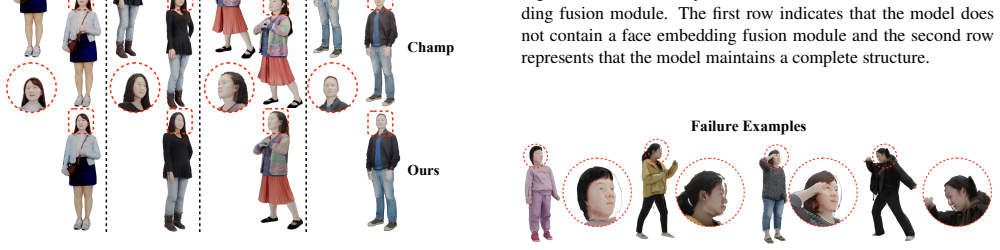
- [Section 4.3, Transferred Face Representation] The face refinement stage, which is one of the two main contributions, has no quantitative ablation. The text refers to 'Figure' without a number (the figure is blank in the manuscript), and the only evidence is a qualitative visual claim. Since the full-model scores in Table 1 cannot be decomposed into body-stage and face-stage contributions, please provide quantitative metrics (PSNR/SSIM/LPIPS, and ideally face-region metrics) for the model with and without the face embedding fusion module, along with the trained-without-face-module model.
- [Section 4.2, Evaluation on 2K2K Datasets] The generalization claim to 2K2K is supported only by qualitative figures and a narrative statement. No quantitative results are reported for the 2K2K dataset. Please add a quantitative evaluation (same metrics as THuman2.1) for the pretrained model and at least the strongest baselines, or explicitly temper the claim of generalization in the abstract and conclusion.
minor comments (5)
- [Section 4.1, Implementation Details] There are typos: 'learning rage' should be 'learning rate', and 'sing-view' should be 'single-view'. Please proofread the manuscript.
- [Section 4.3, Transferred Face Representation] The reference to 'Figure' in the face ablation text is missing a figure number; the manuscript appears to have a blank figure placeholder. Please insert the correct figure reference.
- [Section 3.3.2] The abbreviation 'IP embedding' is introduced without definition; based on context it means identity-preserving embedding, but please define it at first use.
- [Section 3.2.1 and Figure 3] Figure 3 mentions a 'Temporal-Attention' operation, but the text does not explain how temporal attention is used in the knowledge transfer module. Please clarify whether temporal attention is applied across the six views and how it relates to the self-attention layers described in the text.
- [Section 4.2, Baselines] The description of how Champ is adapted for novel-view synthesis is underspecified; please provide details of the input/output modifications and whether any training was performed during adaptation.
Circularity Check
No significant circularity: the multi-view synthesis pipeline is an empirical composition of external pretrained components, and no predicted quantity reduces to a fitted input by construction.
full rationale
The derivation chain is empirical and compositional rather than self-referential. In Section 3.2.1, the method transfers hidden states of a fixed CosmicMan single-view UNet into a Wonder3D-based multi-view UNet; in Section 3.2.2, SMPL normal maps rendered from 4D-Humans estimates are used as conditioning; in Section 3.3.2, PhotoMaker-style 2D identity embeddings and D3DFR 3DMM coefficients are extracted from the input image and fused as priors. None of these quantities is fitted to the evaluation targets and then read back as a prediction: Eq. (2) is the standard DDPM denoising objective, and Eqs. (3)-(6) are the 3DMM linear shape/texture bases and a differentiable renderer, not outputs of the trained model. The Table 1 metrics are computed on held-out THuman2.1 validation scans, and the 2K2K result is a zero-shot transfer experiment, so the score is not forced by the training objective. The SOTA claim rests on Table 1, whose fairness is weakened because Champ is only adapted rather than fine-tuned on THuman2.1, whereas Zero123++ and Wonder3D are fine-tuned, and no error bars or significance tests are reported; the face-stage ablation in Section 4.3 is qualitative only and contains an unresolved blank 'Figure' reference. These are evaluation and completeness deficiencies, not circularity. I found no load-bearing self-citation: CosmicMan, PhotoMaker, D3DFR, SMPL/4D-Humans, Wonder3D, and Champ are independent external prior works, and none is invoked as a uniqueness theorem or ansatz that smuggles in the target claim. Accordingly, the paper is not circular; it is an empirical engineering contribution whose main risks are benchmark fairness and missing quantitative ablations.
Assumptions & free parameters
assumptions (3)
- domain assumption SMPL parameters estimated by 4D-Humans from a single input image accurately reflect the person's body shape and pose.
- domain assumption Attention hidden states of the pretrained single-view CosmicMan UNet carry appearance information that improves multi-view generation when injected into the multi-view UNet.
- domain assumption 2D identity embeddings and 3DMM face coefficients estimated from the input image are accurate enough to restore face details without breaking identity consistency.
Cite this review
Pith. "Pith review of Human Multi-View Synthesis from a Single-View Model:Transferred Body and Face Representations." pith.science (2026). https://pith.science/paper/QZ5IAPKD
@misc{pith2026241203011,
  author       = {Pith},
  title        = {Pith review of: Human Multi-View Synthesis from a Single-View Model:Transferred Body and Face Representations},
  year         = {2026},
  howpublished = {\url{https://pith.science/paper/QZ5IAPKD}},
  note         = {Machine review of arXiv:2412.03011}
}
read the original abstract
Generating multi-view human images from a single view is a complex and significant challenge. Although recent advancements in multi-view object generation have shown impressive results with diffusion models, novel view synthesis for humans remains constrained by the limited availability of 3D human datasets. Consequently, many existing models struggle to produce realistic human body shapes or capture fine-grained facial details accurately. To address these issues, we propose an innovative framework that leverages transferred body and facial representations for multi-view human synthesis. Specifically, we use a single-view model pretrained on a large-scale human dataset to develop a multi-view body representation, aiming to extend the 2D knowledge of the single-view model to a multi-view diffusion model. Additionally, to enhance the model's detail restoration capability, we integrate transferred multimodal facial features into our trained human diffusion model. Experimental evaluations on benchmark datasets demonstrate that our approach outperforms the current state-of-the-art methods, achieving superior performance in multi-view human synthesis.
Figures


Figures from the paper (4 more)


Reference graph
Works this paper leans on
-
[1]
A morphable model for the synthesis of 3d faces
V olker Blanz and Thomas Vetter. A morphable model for the synthesis of 3d faces. Seminal Graphics Papers: Pushing the Boundaries, Volume 2, 1999. 5
work page 1999
-
[2]
Progressive semantic- aware style transformation for blind face restoration
Chaofeng Chen, Xiaoming Li, Lingbo Yang, Xianhui Lin, Lei Zhang, and Kwan-Yee K Wong. Progressive semantic- aware style transformation for blind face restoration. In Pro- ceedings of the IEEE/CVF conference on computer vision and pattern recognition, pages 11896–11905, 2021. 2
work page 2021
-
[3]
Zhengrui Chen, Liying Lu, Ziyang Yuan, Yiming Zhu, Yu Li, Chun Yuan, and Weihong Deng. Blind face restoration under extreme conditions: Leveraging 3d-2d prior fusion for superior structural and texture recovery. InAAAI Conference on Artificial Intelligence, 2024. 5
work page 2024
-
[4]
Inchang Choi, Orazio Gallo, Alejandro Troccoli, Min H Kim, and Jan Kautz. Extreme view synthesis. InProceedings of the IEEE/CVF International Conference on Computer Vi- sion, pages 7781–7790, 2019. 2
work page 2019
-
[5]
Objaverse: A universe of annotated 3d objects
Matt Deitke, Dustin Schwenk, Jordi Salvador, Luca Weihs, Oscar Michel, Eli VanderBilt, Ludwig Schmidt, Kiana Ehsani, Aniruddha Kembhavi, and Ali Farhadi. Objaverse: A universe of annotated 3d objects. ArXiv, abs/2212.08051,
-
[6]
Matt Deitke, Ruoshi Liu, Matthew Wallingford, Huong Ngo, Oscar Michel, Aditya Kusupati, Alan Fan, Christian Laforte, Vikram S. V oleti, Samir Yitzhak Gadre, Eli VanderBilt, Aniruddha Kembhavi, Carl V ondrick, Georgia Gkioxari, Kiana Ehsani, Ludwig Schmidt, and Ali Farhadi. Objaverse- xl: A universe of 10m+ 3d objects. ArXiv, abs/2307.05663,
-
[7]
Accurate 3d face reconstruction with weakly-supervised learning: From single image to image set
Yu Deng, Jiaolong Yang, Sicheng Xu, Dong Chen, Yunde Jia, and Xin Tong. Accurate 3d face reconstruction with weakly-supervised learning: From single image to image set. 2019 IEEE/CVF Conference on Computer Vision and Pattern Recognition Workshops (CVPRW), pages 285–295,
work page 2019
-
[8]
Restoration by generation with constrained priors
Zheng Ding, Xuaner Zhang, Zhuowen Tu, and Zhihao Xia. Restoration by generation with constrained priors. In Pro- ceedings of the IEEE/CVF Conference on Computer Vision and Pattern Recognition, pages 2567–2577, 2024. 3
work page 2024
Show all 58 references
-
[9]
Exemplar guided face image super-resolution without facial landmarks
Berk Dogan, Shuhang Gu, and Radu Timofte. Exemplar guided face image super-resolution without facial landmarks. In Proceedings of the IEEE/CVF conference on computer vi- sion and pattern recognition workshops , pages 0–0, 2019. 3
2019
-
[10]
Humans in 4d: Re- constructing and tracking humans with transformers
Shubham Goel, Georgios Pavlakos, Jathushan Rajasegaran, Angjoo Kanazawa, and Jitendra Malik. Humans in 4d: Re- constructing and tracking humans with transformers. 2023 IEEE/CVF International Conference on Computer Vision (ICCV), pages 14737–14748, 2023. 4
2023
-
[11]
High-fidelity 3d human digitization from single 2k resolution images
Sang-Hun Han, Min-Gyu Park, Ju Hong Yoon, Ju-Mi Kang, Young-Jae Park, and Hae-Gon Jeon. High-fidelity 3d human digitization from single 2k resolution images. In Proceed- ings of the IEEE/CVF Conference on Computer Vision and Pattern Recognition (CVPR), 2023. 6, 7
2023
-
[12]
Jonathan Ho, Ajay Jain, and P. Abbeel. Denoising diffusion probabilistic models. NeurIPS, 2020. 2, 3, 4
2020
-
[13]
Image quality metrics: Psnr vs
Alain Hor ´e and Djemel Ziou. Image quality metrics: Psnr vs. ssim. 2010 20th International Conference on Pattern Recog- nition, pages 2366–2369, 2010. 6
2010
-
[14]
Learning-based view synthesis for light field cameras
Nima Khademi Kalantari, Ting-Chun Wang, and Ravi Ra- mamoorthi. Learning-based view synthesis for light field cameras. ACM Transactions on Graphics (TOG) , 35(6):1– 10, 2016. 2
2016
-
[15]
3d object manipulation in a single photograph us- ing stock 3d models
Natasha Kholgade, Tomas Simon, Alexei Efros, and Yaser Sheikh. 3d object manipulation in a single photograph us- ing stock 3d models. ACM Transactions on Graphics, page 1–12, 2014. 2
2014
-
[16]
3d object manipulation in a single photograph using stock 3d models
Natasha Kholgade, Tomas Simon, Alexei Efros, and Yaser Sheikh. 3d object manipulation in a single photograph using stock 3d models. ACM Transactions on graphics (TOG), 33 (4):1–12, 2014. 2
2014
-
[17]
Kingma and Jimmy Ba
Diederik P. Kingma and Jimmy Ba. Adam: A method for stochastic optimization. CoRR, abs/1412.6980, 2014. 6
2014 arXiv
-
[18]
Multi-concept customization of text-to-image diffusion
Nupur Kumari, Bingliang Zhang, Richard Zhang, Eli Shechtman, and Jun-Yan Zhu. Multi-concept customization of text-to-image diffusion. In Proceedings of the IEEE/CVF Conference on Computer Vision and Pattern Recognition , pages 1931–1941, 2023. 2
1931
-
[19]
Blip-diffusion: Pre- trained subject representation for controllable text-to-image generation and editing
Dongxu Li, Junnan Li, and Steven Hoi. Blip-diffusion: Pre- trained subject representation for controllable text-to-image generation and editing. Advances in Neural Information Pro- cessing Systems, 36, 2024. 2
2024
-
[20]
Cosmicman: A text-to-image foundation model for humans
Shikai Li, Jianglin Fu, Kaiyuan Liu, Wentao Wang, Kwan- Yee Lin, and Wayne Wu. Cosmicman: A text-to-image foundation model for humans. 2024 IEEE/CVF Conference on Computer Vision and Pattern Recognition (CVPR), pages 6955–6965, 2024. 3, 4
2024
-
[21]
Survey on deep face restoration: From non- blind to blind and beyond
Wenjie Li, Mei Wang, Kai Zhang, Juncheng Li, Xiaom- ing Li, Yuhang Zhang, Guangwei Gao, Weihong Deng, and Chia-Wen Lin. Survey on deep face restoration: From non- blind to blind and beyond. arXiv preprint arXiv:2309.15490,
-
[22]
Learning warped guidance for blind face restoration
Xiaoming Li, Ming Liu, Yuting Ye, Wangmeng Zuo, Liang Lin, and Ruigang Yang. Learning warped guidance for blind face restoration. In Proceedings of the European conference on computer vision (ECCV), pages 272–289, 2018. 3
2018
-
[23]
Enhanced blind face 9 restoration with multi-exemplar images and adaptive spatial feature fusion
Xiaoming Li, Wenyu Li, Dongwei Ren, Hongzhi Zhang, Meng Wang, and Wangmeng Zuo. Enhanced blind face 9 restoration with multi-exemplar images and adaptive spatial feature fusion. In Proceedings of the IEEE/CVF Conference on Computer Vision and Pattern Recognition , pages 2706– ...
2020
-
[24]
Photomaker: Customizing realistic human photos via stacked id embedding
Zhen Li, Mingdeng Cao, Xintao Wang, Zhongang Qi, Ming- Ming Cheng, and Ying Shan. Photomaker: Customizing realistic human photos via stacked id embedding. 2024 IEEE/CVF Conference on Computer Vision and Pattern Recognition (CVPR), pages 8640–8650, 2023. 2, 5
2024
-
[25]
Magic3d: High-resolution text-to-3d content creation
Chen-Hsuan Lin, Jun Gao, Luming Tang, Towaki Takikawa, Xiaohui Zeng, Xun Huang, Karsten Kreis, Sanja Fidler, Ming-Yu Liu, and Tsung-Yi Lin. Magic3d: High-resolution text-to-3d content creation. 2023 IEEE/CVF Conference on Computer Vision and Pattern Recognition (CVPR) , pages ...
2023
-
[26]
One-2-3-45: Any single image to 3d mesh in 45 seconds without per-shape optimiza- tion
Minghua Liu, Chao Xu, Haian Jin, Linghao Chen, Mukund Varma T, Zexiang Xu, and Hao Su. One-2-3-45: Any single image to 3d mesh in 45 seconds without per-shape optimiza- tion. Advances in Neural Information Processing Systems , 36, 2024. 2, 7
2024
-
[27]
Zero-1-to-3: Zero-shot one image to 3d object
Ruoshi Liu, Rundi Wu, Basile Van Hoorick, Pavel Tok- makov, Sergey Zakharov, and Carl V ondrick. Zero-1-to-3: Zero-shot one image to 3d object. 2023 IEEE/CVF Interna- tional Conference on Computer Vision (ICCV), pages 9264– 9275, 2023. 2
2023
-
[28]
Sync- dreamer: Generating multiview-consistent images from a single-view image
Yuan Liu, Chu-Hsing Lin, Zijiao Zeng, Xiaoxiao Long, Lingjie Liu, Taku Komura, and Wenping Wang. Sync- dreamer: Generating multiview-consistent images from a single-view image. ArXiv, abs/2309.03453, 2023. 2, 7
2023 arXiv
-
[29]
Wonder3d: Single image to 3d using cross-domain diffusion
Xiaoxiao Long, Yuanchen Guo, Cheng Lin, Yuan Liu, Zhiyang Dou, Lingjie Liu, Yuexin Ma, Song-Hai Zhang, Marc Habermann, Christian Theobalt, and Wenping Wang. Wonder3d: Single image to 3d using cross-domain diffusion. 2024 IEEE/CVF Conference on Computer Vision and Pat- tern Rec...
2024
-
[30]
3d priors-guided diffusion for blind face restoration
Xiaobin Lu, Xiaobin Hu, Jun Luo, Ben Zhu, Yaping Ruan, and Wenqi Ren. 3d priors-guided diffusion for blind face restoration. In Proceedings of the 32nd ACM International Conference on Multimedia, pages 1829–1838, 2024. 3, 5
2024
-
[31]
Moving gradients: a path-based method for plausible image interpolation
Dhruv Mahajan, Fu-Chung Huang, Wojciech Matusik, Ravi Ramamoorthi, and Peter Belhumeur. Moving gradients: a path-based method for plausible image interpolation. ACM Transactions on Graphics (TOG), 28(3):1–11, 2009. 2
2009
-
[32]
Self-supervised 3d shape and viewpoint estimation from single images for robotics
Oier Mees, Maxim Tatarchenko, Thomas Brox, and Wolfram Burgard. Self-supervised 3d shape and viewpoint estimation from single images for robotics. 2019 IEEE/RSJ Interna- tional Conference on Intelligent Robots and Systems (IROS), pages 6083–6089, 2019. 1
2019
-
[33]
Free view synthesis
Gernot Riegler and Vladlen Koltun. Free view synthesis. In Computer Vision–ECCV 2020: 16th European Conference, Glasgow, UK, August 23–28, 2020, Proceedings, Part XIX 16, pages 623–640. Springer, 2020. 2
2020
-
[34]
Dreambooth: Fine tuning text-to-image diffusion models for subject-driven generation
Nataniel Ruiz, Yuanzhen Li, Varun Jampani, Yael Pritch, Michael Rubinstein, and Kfir Aberman. Dreambooth: Fine tuning text-to-image diffusion models for subject-driven generation. 2023 IEEE/CVF Conference on Computer Vi- sion and Pattern Recognition (CVPR), pages 22500–22510,
2023
-
[35]
Hyperdreambooth: Hypernetworks for fast personalization of text-to-image models
Nataniel Ruiz, Yuanzhen Li, Varun Jampani, Wei Wei, Tingbo Hou, Yael Pritch, Neal Wadhwa, Michael Rubinstein, and Kfir Aberman. Hyperdreambooth: Hypernetworks for fast personalization of text-to-image models. In Proceedings of the IEEE/CVF Conference on Computer Vision and Pat...
2024
-
[36]
Fleet, and Mohammad Norouzi
Chitwan Saharia, Jonathan Ho, William Chan, Tim Sali- mans, David J. Fleet, and Mohammad Norouzi. Image super- resolution via iterative refinement. IEEE Transactions on Pattern Analysis and Machine Intelligence , 45:4713–4726,
-
[37]
A benchmark of facial recognition pipelines and co-usability performances of mod- ules
Sefik Serengil and Alper Ozpinar. A benchmark of facial recognition pipelines and co-usability performances of mod- ules. Journal of Information Technologies , 17(2):95–107,
-
[38]
Zero123++: a single image to consistent multi-view dif- fusion base model
Ruoxi Shi, Hansheng Chen, Zhuoyang Zhang, Minghua Liu, Chao Xu, Xinyue Wei, Linghao Chen, Chong Zeng, and Hao Su. Zero123++: a single image to consistent multi-view dif- fusion base model. ArXiv, abs/2310.15110, 2023. 2, 7
2023 arXiv
-
[39]
Self-supervised vis- ibility learning for novel view synthesis
Yujiao Shi, Hongdong Li, and Xin Yu. Self-supervised vis- ibility learning for novel view synthesis. In Proceedings of the IEEE/CVF Conference on Computer Vision and Pattern Recognition, pages 9675–9684, 2021. 2
2021
-
[40]
Weiss, Niru Mah- eswaranathan, and Surya Ganguli
Jascha Narain Sohl-Dickstein, Eric A. Weiss, Niru Mah- eswaranathan, and Surya Ganguli. Deep unsupervised learn- ing using nonequilibrium thermodynamics. ICML, 2015. 3
2015
-
[41]
Denois- ing diffusion implicit models
Jiaming Song, Chenlin Meng, and Stefano Ermon. Denois- ing diffusion implicit models. ArXiv, abs/2010.02502, 2020. 6
2010 arXiv
-
[42]
Kingma, Abhishek Kumar, Stefano Ermon, and Ben Poole
Yang Song, Jascha Narain Sohl-Dickstein, Diederik P. Kingma, Abhishek Kumar, Stefano Ermon, and Ben Poole. Score-based generative modeling through stochastic differ- ential equations. ArXiv, abs/2011.13456, 2020. 3
2011 arXiv
-
[43]
Tarik Tosun, Daniel Yang, Ben Eisner, V olkan Isler, and Daniel D. Lee. Robotic grasping through combined image- based grasp proposal and 3d reconstruction. 2021 IEEE In- ternational Conference on Robotics and Automation (ICRA), pages 6350–6356, 2020. 1
2021
-
[44]
Joint face image restoration and frontalization for recognition
Xiaoguang Tu, Jian Zhao, Qiankun Liu, Wenjie Ai, Guodong Guo, Zhifeng Li, Wei Liu, and Jiashi Feng. Joint face image restoration and frontalization for recognition. IEEE Trans- actions on circuits and systems for video technology , 32(3): 1285–1298, 2021. 2
2021
-
[45]
Toward characteristic- preserving image-based virtual try-on network
Bochao Wang, Huabing Zhang, Xiaodan Liang, Yimin Chen, Liang Lin, and Meng Yang. Toward characteristic- preserving image-based virtual try-on network. ArXiv, abs/1807.07688, 2018. 1
2018 arXiv
-
[46]
Ibr- net: Learning multi-view image-based rendering
Qianqian Wang, Zhicheng Wang, Kyle Genova, Pratul P Srinivasan, Howard Zhou, Jonathan T Barron, Ricardo Martin-Brualla, Noah Snavely, and Thomas Funkhouser. Ibr- net: Learning multi-view image-based rendering. In Pro- ceedings of the IEEE/CVF conference on computer vision and ...
2021
-
[47]
To- wards real-world blind face restoration with generative fa- cial prior
Xintao Wang, Yu Li, Honglun Zhang, and Ying Shan. To- wards real-world blind face restoration with generative fa- cial prior. In Proceedings of the IEEE/CVF conference on 10 computer vision and pattern recognition, pages 9168–9178,
-
[48]
Sheikh, and Eero P
Zhou Wang, Alan Conrad Bovik, Hamid R. Sheikh, and Eero P. Simoncelli. Image quality assessment: from error visibility to structural similarity. IEEE Transactions on Im- age Processing, 13:600–612, 2004. 6
2004
-
[49]
Dr2: Diffusion-based robust degradation remover for blind face restoration
Zhixin Wang, Ziying Zhang, Xiaoyun Zhang, Huangjie Zheng, Mingyuan Zhou, Ya Zhang, and Yanfeng Wang. Dr2: Diffusion-based robust degradation remover for blind face restoration. In Proceedings of the IEEE/CVF Conference on Computer Vision and Pattern Recognition , pages 1704– 1...
2023
-
[50]
Gan prior embedded network for blind face restoration in the wild
Tao Yang, Peiran Ren, Xuansong Xie, and Lei Zhang. Gan prior embedded network for blind face restoration in the wild. 2021 IEEE/CVF Conference on Computer Vision and Pattern Recognition (CVPR), pages 672–681, 2021. 3, 5
2021
-
[51]
Ip- adapter: Text compatible image prompt adapter for text-to- image diffusion models
Hu Ye, Jun Zhang, Sibo Liu, Xiao Han, and Wei Yang. Ip- adapter: Text compatible image prompt adapter for text-to- image diffusion models. arXiv preprint arXiv:2308.06721,
-
[52]
Function4d: Real-time human vol- umetric capture from very sparse consumer rgbd sensors
Tao Yu, Zerong Zheng, Kaiwen Guo, Pengpeng Liu, Qiong- hai Dai, and Yebin Liu. Function4d: Real-time human vol- umetric capture from very sparse consumer rgbd sensors. 2021 IEEE/CVF Conference on Computer Vision and Pat- tern Recognition (CVPR), pages 5742–5752, 2021. 6
2021
-
[53]
Difface: Blind face restoration with diffused error contraction
Zongsheng Yue and Chen Change Loy. Difface: Blind face restoration with diffused error contraction. IEEE Transac- tions on Pattern Analysis and Machine Intelligence, 2024. 2
2024
-
[54]
Efros, Eli Shecht- man, and Oliver Wang
Richard Zhang, Phillip Isola, Alexei A. Efros, Eli Shecht- man, and Oliver Wang. The unreasonable effectiveness of deep features as a perceptual metric. 2018 IEEE/CVF Con- ference on Computer Vision and Pattern Recognition, pages 586–595, 2018. 6
2018
-
[55]
Interactive images: Cuboid proxies for smart image manipulation
Youyi Zheng, Xiang Chen, Ming-Ming Cheng, Kun Zhou, Shi-Min Hu, and Niloy J Mitra. Interactive images: Cuboid proxies for smart image manipulation. ACM Trans. Graph., 31(4):99–1, 2012. 2
2012
-
[56]
Towards robust blind face restora- tion with codebook lookup transformer
Shangchen Zhou, Kelvin Chan, Chongyi Li, and Chen Change Loy. Towards robust blind face restora- tion with codebook lookup transformer. Advances in Neural Information Processing Systems, 35:30599–30611, 2022. 3
2022
-
[57]
Blind face restora- tion via integrating face shape and generative priors
Feida Zhu, Junwei Zhu, Wenqing Chu, Xinyi Zhang, Xi- aozhong Ji, Chengjie Wang, and Ying Tai. Blind face restora- tion via integrating face shape and generative priors. In Pro- ceedings of the IEEE/CVF conference on computer vision and pattern recognition, pages 7662–7671, 2022. 3, 5
2022
-
[58]
Champ: Controllable and consistent human image animation with 3d parametric guidance
Shenhao Zhu, Junming Leo Chen, Zuozhuo Dai, Yinghui Xu, Xun Cao, Yao Yao, Hao Zhu, and Siyu Zhu. Champ: Controllable and consistent human image animation with 3d parametric guidance. ArXiv, abs/2403.14781, 2024. 2, 7 11
2024 arXiv
Reviewed August 11, 2026 · model on record in the stance chip above.
Discussion (0). Continue with ORCID to comment.