REVIEW 4 major objections 4 minor 69 references
PEMF-VTO: Point-Enhanced Video Virtual Try-on via Mask-free Paradigm
T0 review · 4 major / 4 minor · reviewed 2026-08-11 · deepseek-v4-flash
Pith's one-line read This paper proposes a mask-free video try-on method in which sparse point alignments, not inpainting masks, guide garment transfer and temporal coherence.
desk verdict Plausible point-guided mask-free video try-on with two ablated modules, but the empirical superiority claim is compromised by an undisclosed test-time point protocol and absent code. read the letter →
The pith
A machine-rendered reading of the paper's core claim, the machinery that carries it, and where it could break.
The reading
What carries the argument
The load-bearing object is the Point-Enhanced Transformer (PET), inserted into the denoising U-Net of the latent diffusion model. It has two modules. Point-Enhanced Spatial Attention (PSA) uses a small set of matching point pairs between a video frame and the reference garment as anchors: it cross-attends full person features to sparse person-point features, injects matched garment-point features, and uses a point-wise attention bias plus a soft alignment mask to confine the update to the try-on region. Point-Enhanced Temporal Attention (PTA) builds a sequence of matched point features across frames (plus the garment points) and applies sparse self-attention along the temporal dimension, so coherence follows body trajectories instead of static pixel positions. Learning proceeds in three stages: mask-free single-frame training on pseudo data, temporal-attention finetuning, and a hard-sample stage that trains only PSA and PTA on the most difficult pseudo pairs.
What would settle it
Run PEMF-VTO on a set of long, fast-moving videos with frequent occlusions under two inference conditions: point correspondences supplied by an automatic point tracker versus point correspondences manually clicked by a user, and also train the same architecture on real paired try-on videos instead of pseudo pairs. If the automatic points fail to preserve the reported advantages over the mask-free baseline, or if the gap over that baseline vanishes under real paired training, the central claim that pseudo-trained point guidance is reliable and general would be refuted.
Extended reading notes
Core claim
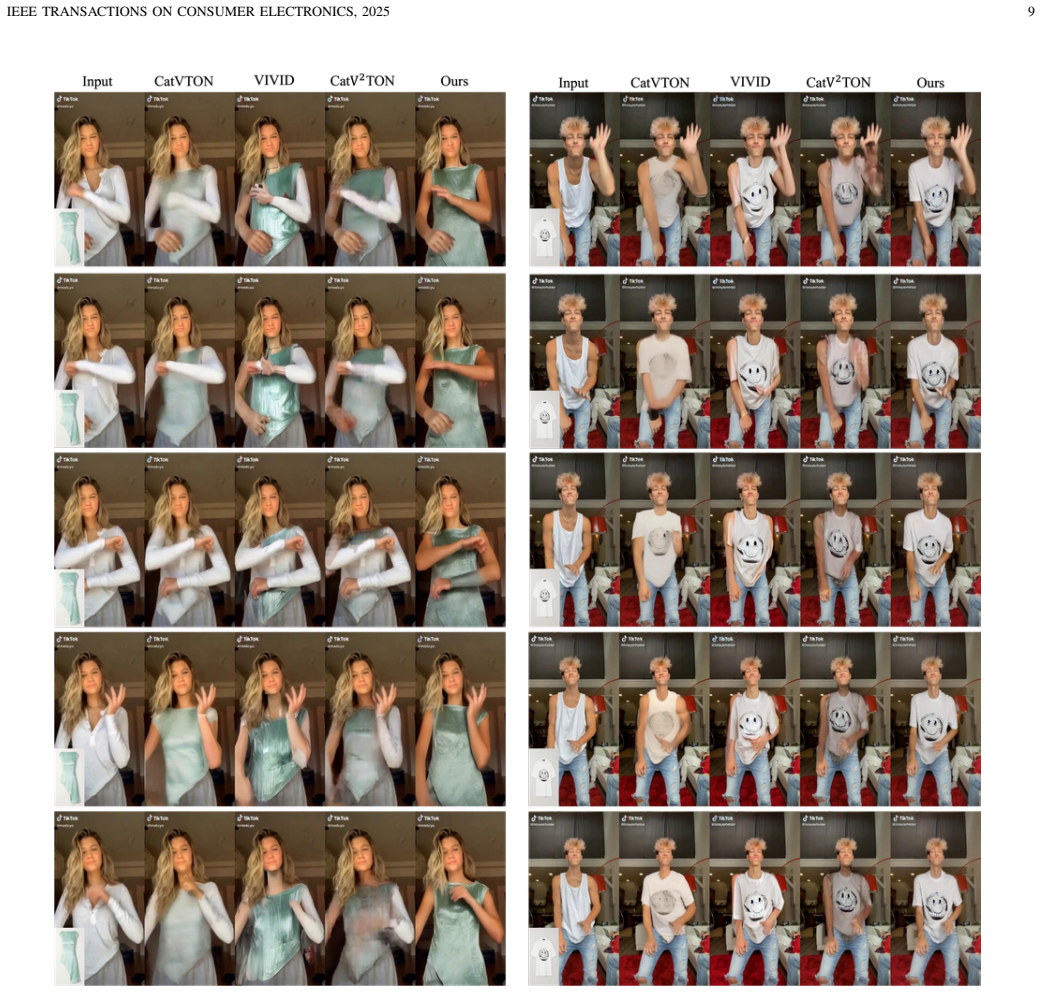
The paper's central claim is that sparse point alignments can supply the explicit guidance video virtual try-on needs, replacing agnostic inpainting masks without sacrificing fidelity or coherence. It constructs paired pseudo-person training videos with a pre-trained mask-based try-on model, trains a mask-free latent-diffusion model on them, then inserts a Point-Enhanced Transformer whose spatial attention moves garment features from matched points on the garment onto matched points on the person, and whose temporal attention tracks those same points across frames so the garment moves with the body rather than with fixed pixel grids. On the paper's reported metrics, the result is that the model outperforms both image- and video-based prior methods on the VVT, ViViD, and TikTok test sets, and also performs competitively on image try-on.
Load-bearing premise
The whole pipeline depends on pseudo-person videos produced by a pre-trained mask-based model and their derived point correspondences being faithful enough to train a mask-free model; if those pseudo labels carry systematic artifacts, or if automatically computed correspondences at test time are much noisier than the manual-click setting the paper demonstrates, the reported gains may not generalize.
Editorial extensions
If this is right
- Video virtual try-on no longer needs a pre-computed agnostic mask; the try-on region is determined by points, so non-clothing details like hands, faces, and background survive intact.
- The same model works on still images, so a single trained pipeline covers image and video try-on.
- Users can steer the result by clicking matching point pairs in one frame, making try-on interactive and controllable.
- Point-enhanced temporal attention should keep garment patterns locked to the body's motion through fast and complex dance sequences, reducing flicker and texture sliding.
Reading between the lines
- A natural extension the paper does not test is whether the same point-guidance mechanism transfers to other point-based diffusion editing tasks, such as dragging or local object replacement, where masks are also fragile.
- If test-time correspondences must come from an automatic matcher rather than user clicks, the method's advantage may depend on matcher quality; the paper reports robustness to perturbed points but does not specify the automatic matching pipeline for its quantitative results.
- Because the pseudo-data generator determines the ceiling of what the mask-free model can learn, the point-enhanced framework could be retrained on pseudo data from a better generator as those improve, likely raising quality without architectural change.
Editorial analysis
A structured set of objections, weighed in public.
Referee Report
Summary. The paper proposes PEMF-VTO, a mask-free video virtual try-on framework that uses sparse point alignments as explicit guidance. Two attention modules are introduced: Point-Enhanced Spatial Attention (PSA), which injects garment features at frame-cloth correspondences, and Point-Enhanced Temporal Attention (PTA), which aligns frame-frame correspondences for temporal coherence. Training relies on pseudo try-on videos generated by the mask-based method ViViD, and the model is evaluated on VVT, ViViD, TikTok, VITON-HD, and DressCode, claiming state-of-the-art quantitative results and favorable qualitative comparisons.
Significance. If the reported results hold, the paper offers a convincing alternative to mask-based video try-on: sparse point alignments provide explicit, flexible spatial and temporal guidance while avoiding the information loss caused by agnostic masks. The contribution is timely and well motivated, and the ablation study in Table III plus the robustness analysis in Fig. 10 provide concrete evidence that the proposed PSA and PTA modules are responsible for the gains. The paper also evaluates on a realistic in-the-wild dataset (TikTok), which strengthens the generalization claim. However, the undisclosed test-time point-acquisition protocol, the absence of any statistical analysis, and the lack of comparison with the closest mask-free baselines substantially temper confidence in the headline numbers.
major comments (4)
- [Section III.C.2 / III.D and Table I] The quantitative evaluation in Table I lacks a specification of how point alignments were obtained at inference. The training-stage protocol in Section III.C.2 samples points from the ground-truth agnostic mask and uses DIFT/TAP-Net, while Section III.D describes inference only in terms of optional manual clicks or 'no points' for simple videos. No automatic pipeline is described for the VVT/ViViD/TikTok tests, and no ablation separates 'PEMF-VTO with zero manual points' from 'PEMF-VTO with user-provided or ground-truth-derived points.' If the reported VFID values used manual clicks or target-frame-derived correspondences, the comparison against autonomous baselines is not like-for-like and the 'significantly outperforms' claim is unsupported.
- [Section IV.A and Table I] Table I reports single-run metrics on small, partially self-selected test subsets: 130 VVT clips, 180 of 1,941 ViViD test videos, and 45 of 340 TikTok videos. No error bars, confidence intervals, or significance tests are provided. Given the paper's abstract and Section IV.B use the phrase 'significantly outperforms,' the reader cannot determine whether the observed differences are beyond run-to-run variability. The authors should provide repeated evaluations or at least report variance and a statistical test.
- [Section III.C.1] The mask-free model is trained exclusively on pseudo-person videos generated by the mask-based method ViViD. The paper does not analyze the distribution gap between pseudo and real videos or the effect of ViViD-specific artifacts. This is a load-bearing issue because the central claim is that mask-free training avoids mask-based limitations, yet the supervision itself inherits those limitations; the authors should quantify pseudo-label quality and show robustness to ViViD errors beyond the TikTok results.
- [Section IV.B and Table I] The paper claims superiority of the mask-free paradigm but does not compare against the closest mask-free try-on methods discussed in Section II (BooW-VTON [65] and AnyDesign [43]), and it does not report a quantitative variant of PEMF-VTO with no point guidance at inference. Without these comparisons, it is unclear whether the gains are due to the mask-free training paradigm, the point-enhanced modules, or both.
minor comments (4)
- [Section I] The phrase 'Extensive qualitative and qualitative experiments' should read 'quantitative and qualitative experiments.'
- [Section III.C.2] There is a typo on the phrase 'effectiveness os our point sampling'; it should be 'effectiveness of our point sampling.'
- [Section IV.A] The abbreviations VFIDI and VFIDR are used in Table I but are not explicitly defined in the text; the metric description in Section IV.A should state which backbone each abbreviation corresponds to (e.g., I3D and ResNext).
- [Section IV.A] The sentence 'we selected the same 180 videos with CatV2TON' should clarify whether these are exactly the same test videos used by CatV2TON and how the identity of the selection was verified.
Circularity Check
No equation-level circularity; one test-set-selected hyperparameter (K=16) creates a mild fitted-input/prediction loop for the headline comparison.
-
fitted input called prediction
[Section IV-D, 'Different maximum number of points' and Fig. 10(a); Table I]
"In Fig. 10 (a), we investigate the effects of the maximum number of points K on the performance of the ViViD and TikTok datasets. ... Therefore, we choose K = 16 in this paper."
The headline results in Table I (e.g., VFIDI 16.67 on ViViD and 31.62 on TikTok) are reported for K=16, but K was selected by inspecting the FID/VFID metrics on those same ViViD and TikTok evaluation datasets. The reported 'prediction' of state-of-the-art performance is therefore partly a selected optimum of the evaluation metric on the evaluation data, not an independent verification of a fixed model. This is a test-set model-selection loop, i.e., a fitted input presented as a fixed design choice.
full rationale
The paper's central claim is empirical and is not derived by definition from its inputs. Point alignments come from external pretrained models DIFT and TAP-Net; pseudo training targets come from the external ViViD model; and the reported gains are benchmarked against external methods on VVT, ViViD, TikTok, VITON-HD, and DressCode. The only self-citation, BooW-VTON [65], appears in related work and is not load-bearing. The mild circular element is the selection of K=16 on the ViViD/TikTok evaluation metrics before reporting the same metrics in Table I; this is a test-set model-selection loop rather than a definitional reduction. The undisclosed inference-time point protocol and the use of ViViD pseudo-labels for training are evaluation-validity concerns, not circularity, and the paper acknowledges residual limitations in Section V.
Assumptions & free parameters
free parameters (4)
- K, maximum number of point correspondences =
16
- SSIM threshold for hard-sample selection =
0.75
- mask-as-garment training ratio =
0.2
- training schedule hyperparameters =
40000/40000/20000 steps, video ratio 0.3/0.9/0.5, batch 128/8, lr 5e-5
assumptions (5)
- standard math LDM denoising objective (Eq. 2) is a valid training objective for garment transfer
- domain assumption ViViD pseudo-person pairs are reliable supervision for mask-free video try-on
- domain assumption DIFT and TAP-Net provide sufficiently accurate point correspondences
- domain assumption SCHP, DensePose, and SAM segmentations are accurate enough for pseudo-data construction
- domain assumption Inflated 2D Stable Diffusion weights and the AnimateDiff motion module transfer to try-on
Cite this review
Pith. "Pith review of PEMF-VTO: Point-Enhanced Video Virtual Try-on via Mask-free Paradigm." pith.science (2026). https://pith.science/paper/47HTKDRM
@misc{pith2026241203021,
  author       = {Pith},
  title        = {Pith review of: PEMF-VTO: Point-Enhanced Video Virtual Try-on via Mask-free Paradigm},
  year         = {2026},
  howpublished = {\url{https://pith.science/paper/47HTKDRM}},
  note         = {Machine review of arXiv:2412.03021}
}
read the original abstract
Video Virtual Try-on aims to seamlessly transfer a reference garment onto a target person in a video while preserving both visual fidelity and temporal coherence. Existing methods typically rely on inpainting masks to define the try-on area, enabling accurate garment transfer for simple scenes (e.g., in-shop videos). However, these mask-based approaches struggle with complex real-world scenarios, as overly large and inconsistent masks often destroy spatial-temporal information, leading to distorted results. Mask-free methods alleviate this issue but face challenges in accurately determining the try-on area, especially for videos with dynamic body movements. To address these limitations, we propose PEMF-VTO, a novel Point-Enhanced Mask-Free Video Virtual Try-On framework that leverages sparse point alignments to explicitly guide garment transfer. Our key innovation is the introduction of point-enhanced guidance, which provides flexible and reliable control over both spatial-level garment transfer and temporal-level video coherence. Specifically, we design a Point-Enhanced Transformer (PET) with two core components: Point-Enhanced Spatial Attention (PSA), which uses frame-cloth point alignments to precisely guide garment transfer, and Point-Enhanced Temporal Attention (PTA), which leverages frame-frame point correspondences to enhance temporal coherence and ensure smooth transitions across frames. Extensive experiments demonstrate that our PEMF-VTO outperforms state-of-the-art methods, generating more natural, coherent, and visually appealing try-on videos, particularly for challenging in-the-wild scenarios. The link to our paper's homepage is https://pemf-vto.github.io/.
Figures


Figures from the paper (6 more)




Reference graph
Works this paper leans on
-
[65]
arXiv preprint arXiv:2408.06047 (2024)
Zhang, X., Song, D., Zhan, P., Chen, Q., Xu, Z., Luo, W., Zhang, K., Liu, A.: Boow-vton: Boosting in-the-wild virtual try-on via mask-free pseudo data training. arXiv preprint arXiv:2408.06047 (2024)
arXiv 2024
-
[43]
arXiv preprint arXiv:2408.11553 (2024)
Niu, Y ., Wu, L., Yi, D., Peng, J., Jiang, N., Wu, H., Wang, J.: Anydesign: Versatile area fashion editing via mask-free diffusion. arXiv preprint arXiv:2408.11553 (2024)
arXiv 2024
-
[1]
In: Proceedings of the IEEE/CVF International Conference on Computer Vision (2023)
Baldrati, A., Morelli, D., Cartella, G., Cornia, M., Bertini, M., Cucchiara, R.: Multimodal garment designer: Human-centric latent diffusion models for fashion image editing. In: Proceedings of the IEEE/CVF International Conference on Computer Vision (2023)
work page 2023
-
[2]
Cao, Z., Simon, T., Wei, S.E., Sheikh, Y .: Realtime Multi-Person 2D Pose Estimation Using Part Affinity Fields (2017)
work page 2017
-
[3]
In: proceedings of the IEEE Conference on Computer Vision and Pattern Recognition
Carreira, J., Zisserman, A.: Quo vadis, action recognition? a new model and the kinetics dataset. In: proceedings of the IEEE Conference on Computer Vision and Pattern Recognition. pp. 6299–6308 (2017)
2017
-
[4]
arXiv preprint arXiv:2403.12965 (2024)
Chen, M., Chen, X., Zhai, Z., Ju, C., Hong, X., Lan, J., Xiao, S.: Wear-any-way: Manipulable virtual try-on via sparse correspondence alignment. arXiv preprint arXiv:2403.12965 (2024)
arXiv 2024
-
[5]
arXiv preprint arXiv:2307.09481 (2023)
Chen, X., Huang, L., Liu, Y ., Shen, Y ., Zhao, D., Zhao, H.: Anydoor: Zero-shot object-level image customization. arXiv preprint arXiv:2307.09481 (2023)
arXiv 2023
- [6]
Show all 69 references
-
[7]
arXiv preprint arXiv:2403.05139 (2024)
Choi, Y ., Kwak, S., Lee, K., Choi, H., Shin, J.: Improving diffusion models for virtual try-on. arXiv preprint arXiv:2403.05139 (2024)
2024 arXiv
-
[8]
arXiv preprint arXiv:2407.15886 (2024)
Chong, Z., Dong, X., Li, H., Zhang, S., Zhang, W., Zhang, X., Zhao, H., Jiang, D., Liang, X.: Catvton: Concatenation is all you need for virtual try-on with diffusion models. arXiv preprint arXiv:2407.15886 (2024)
2024 arXiv
-
[9]
arXiv preprint arXiv:2501.11325 (2025)
Chong, Z., Zhang, W., Zhang, S., Zheng, J., Dong, X., Li, H., Wu, Y ., Jiang, D., Liang, X.: Catv2ton: Taming diffusion transformers for vision-based virtual try-on with temporal concatenation. arXiv preprint arXiv:2501.11325 (2025)
2025 arXiv
-
[10]
arXiv preprint arXiv:2311.16094 (2023)
Cui, A., Mahajan, J., Shah, V ., Gomathinayagam, P., Lazebnik, S.: Street tryon: Learning in-the-wild virtual try-on from unpaired person images. arXiv preprint arXiv:2311.16094 (2023)
2023 arXiv
-
[11]
Advances in Neural Information Process- ing Systems 35, 13610–13626 (2022)
Doersch, C., Gupta, A., Markeeva, L., Recasens, A., Smaira, L., Aytar, Y ., Carreira, J., Zisserman, A., Yang, Y .: TAP-vid: A benchmark for tracking any point in a video. Advances in Neural Information Process- ing Systems 35, 13610–13626 (2022)
2022
-
[12]
arXiv preprint arXiv:2402.00847 (2024)
Doersch, C., Luc, P., Yang, Y ., Gokay, D., Koppula, S., Gupta, A., Heyward, J., Rocco, I., Goroshin, R., Carreira, J., Zisserman, A.: BootsTAP: Bootstrapped training for tracking-any-point. arXiv preprint arXiv:2402.00847 (2024)
2024 arXiv
-
[13]
In: Proceedings of the IEEE/CVF international conference on computer vision
Dong, H., Liang, X., Shen, X., Wu, B., Chen, B.C., Yin, J.: Fw-gan: Flow-navigated warping gan for video virtual try-on. In: Proceedings of the IEEE/CVF international conference on computer vision. pp. 1161– 1170 (2019) IEEE TRANSACTIONS ON CONSUMER ELECTRONICS, 2025 12
2019
-
[14]
In: Proceedings of the IEEE/CVF Conference on Computer Vision and Pattern Recognition
Dong, X., Zhao, F., Xie, Z., Zhang, X., Du, D.K., Zheng, M., Long, X., Liang, X., Yang, J.: Dressing in the wild by watching dance videos. In: Proceedings of the IEEE/CVF Conference on Computer Vision and Pattern Recognition. pp. 3480–3489 (2022)
2022
-
[15]
IEEE Transac- tions on Neural Networks and Learning Systems 35(1), 246–257 (2022)
Dong, X., Song, X., Zheng, N., Wu, J., Dai, H., Nie, L.: Tryoncm2: Try- on-enhanced fashion compatibility modeling framework. IEEE Transac- tions on Neural Networks and Learning Systems 35(1), 246–257 (2022)
2022
-
[16]
arXiv preprint arXiv:2405.11794 (2024)
Fang, Z., Zhai, W., Su, A., Song, H., Zhu, K., Wang, M., Chen, Y ., Liu, Z., Cao, Y ., Zha, Z.J.: Vivid: Video virtual try-on using diffusion models. arXiv preprint arXiv:2405.11794 (2024)
2024 arXiv
-
[17]
In: Proceedings of the IEEE/CVF conference on computer vision and pattern recognition
Ge, Y ., Song, Y ., Zhang, R., Ge, C., Liu, W., Luo, P.: Parser-free virtual try-on via distilling appearance flows. In: Proceedings of the IEEE/CVF conference on computer vision and pattern recognition. pp. 8485–8493 (2021)
2021
-
[18]
In: Advances in neural information processing systems
Goodfellow, I., Pouget-Abadie, J., Mirza, M., Xu, B., Warde-Farley, D., Ozair, S., Courville, A., Bengio, Y .: Generative adversarial nets. In: Advances in neural information processing systems. pp. 2672–2680 (2014)
2014
-
[19]
In: Proceedings of the 31st ACM International Conference on Multimedia (2023)
Gou, J., Sun, S., Zhang, J., Si, J., Qian, C., Zhang, L.: Taming the power of diffusion models for high-quality virtual try-on with appearance flow. In: Proceedings of the 31st ACM International Conference on Multimedia (2023)
2023
-
[20]
G ¨uler, R.A., Neverova, N., Kokkinos, I.: DensePose: Dense Human Pose Estimation In The Wild (2018)
2018
-
[21]
International Conference on Learning Representations (2024)
Guo, Y ., Yang, C., Rao, A., Liang, Z., Wang, Y ., Qiao, Y ., Agrawala, M., Lin, D., Dai, B.: Animatediff: Animate your personalized text-to-image diffusion models without specific tuning. International Conference on Learning Representations (2024)
2024
-
[22]
In: Proceedings of the IEEE/CVF international conference on computer vision
Han, X., Hu, X., Huang, W., Scott, M.R.: Clothflow: A flow-based model for clothed person generation. In: Proceedings of the IEEE/CVF international conference on computer vision. pp. 10471–10480 (2019)
2019
-
[23]
In: CVPR (2018)
Han, X., Wu, Z., Wu, Z., Yu, R., Davis, L.S.: Viton: An image-based virtual try-on network. In: CVPR (2018)
2018
-
[24]
In: Proceedings of the IEEE/CVF Conference on Computer Vision and Pattern Recognition
He, S., Song, Y .Z., Xiang, T.: Style-based global appearance flow for virtual try-on. In: Proceedings of the IEEE/CVF Conference on Computer Vision and Pattern Recognition. pp. 3470–3479 (2022)
2022
-
[25]
arXiv preprint arXiv:2407.10625 (2024)
He, Z., Chen, P., Wang, G., Li, G., Torr, P.H., Lin, L.: Wildvidfit: Video virtual try-on in the wild via image-based controlled diffusion models. arXiv preprint arXiv:2407.10625 (2024)
2024 arXiv
-
[26]
Advances in neural information processing systems 30 (2017)
Heusel, M., Ramsauer, H., Unterthiner, T., Nessler, B., Hochreiter, S.: Gans trained by a two time-scale update rule converge to a local nash equilibrium. Advances in neural information processing systems 30 (2017)
2017
-
[27]
Advances in neural information processing systems 33, 6840–6851 (2020)
Ho, J., Jain, A., Abbeel, P.: Denoising diffusion probabilistic models. Advances in neural information processing systems 33, 6840–6851 (2020)
2020
-
[28]
IEEE Transactions on Consumer Electronics 66(4), 299–307 (2020)
Hong, G., Shin, D.: Virtual connection: Selective connection system for energy-efficient wearable consumer electronics. IEEE Transactions on Consumer Electronics 66(4), 299–307 (2020). https://doi.org/10.1109/TCE.2020.3035689
2020
-
[29]
arXiv preprint arXiv:2311.17117 (2023)
Hu, L., Gao, X., Zhang, P., Sun, K., Zhang, B., Bo, L.: Animate any- one: Consistent and controllable image-to-video synthesis for character animation. arXiv preprint arXiv:2311.17117 (2023)
2023 arXiv
-
[30]
In: Computer Vision–ECCV 2020: 16th European Conference, Glasgow, UK, August 23–28, 2020, Proceedings, Part XX 16
Issenhuth, T., Mary, J., Calauzenes, C.: Do not mask what you do not need to mask: a parser-free virtual try-on. In: Computer Vision–ECCV 2020: 16th European Conference, Glasgow, UK, August 23–28, 2020, Proceedings, Part XX 16. pp. 619–635. Springer (2020)
2020
-
[31]
In: Proceedings of the IEEE/CVF Conference on Computer Vision and Pattern Recognition
Jafarian, Y ., Park, H.S.: Learning high fidelity depths of dressed hu- mans by watching social media dance videos. In: Proceedings of the IEEE/CVF Conference on Computer Vision and Pattern Recognition. pp. 12753–12762 (2021)
2021
-
[32]
In: Proceedings of the IEEE/CVF Conference on Computer Vision and Pattern Recognition
Kim, J., Gu, G., Park, M., Park, S., Choo, J.: Stableviton: Learning semantic correspondence with latent diffusion model for virtual try-on. In: Proceedings of the IEEE/CVF Conference on Computer Vision and Pattern Recognition. pp. 8176–8185 (2024)
2024
-
[33]
arXiv:2304.02643 (2023)
Kirillov, A., Mintun, E., Ravi, N., Mao, H., Rolland, C., Gustafson, L., Xiao, T., Whitehead, S., Berg, A.C., Lo, W.Y ., Doll ´ar, P., Girshick, R.: Segment anything. arXiv:2304.02643 (2023)
2023 arXiv
-
[34]
IEEE Transactions on Consumer Electronics pp
Li, M., Zhang, Y ., Tian, Y ., Wang, J., Du, C.: Humod: High- quality human modeling from monocular virtual try-on image. IEEE Transactions on Consumer Electronics pp. 1–1 (2024). https://doi.org/10.1109/TCE.2024.3416835
2024
-
[35]
IEEE Transactions on Pattern Analysis and Machine Intelligence 44(6), 3260–3271 (2020)
Li, P., Xu, Y ., Wei, Y ., Yang, Y .: Self-correction for human parsing. IEEE Transactions on Pattern Analysis and Machine Intelligence 44(6), 3260–3271 (2020)
2020
-
[36]
IEEE Transactions on Consumer Electronics 70(1), 2244–2256 (2024)
Li, Y ., Shen, J., Vijayakumar, P., Lai, C.F., Sivaraman, A., Sharma, P.K.: Next-generation consumer electronics data auditing scheme to- ward cloud–edge distributed and resilient machine learning. IEEE Transactions on Consumer Electronics 70(1), 2244–2256 (2024). https://doi....
2024
-
[37]
In: Proceedings of the ACM International Conference on Multimedia (2023)
Morelli, D., Baldrati, A., Cartella, G., Cornia, M., Bertini, M., Cucchiara, R.: LaDI-VTON: Latent Diffusion Textual-Inversion Enhanced Virtual Try-On. In: Proceedings of the ACM International Conference on Multimedia (2023)
2023
-
[38]
In: Proceedings of the European Conference on Computer Vision (2022)
Morelli, D., Fincato, M., Cornia, M., Landi, F., Cesari, F., Cucchiara, R.: Dress Code: High-Resolution Multi-Category Virtual Try-On. In: Proceedings of the European Conference on Computer Vision (2022)
2022
-
[39]
arXiv preprint arXiv:2402.02583 (2023)
Mou, C., Wang, X., Song, J., Shan, Y ., Zhang, J.: Diffeditor: Boosting accuracy and flexibility on diffusion-based image editing. arXiv preprint arXiv:2402.02583 (2023)
2023 arXiv
-
[40]
arXiv preprint arXiv:2307.02421 (2023)
Mou, C., Wang, X., Song, J., Shan, Y ., Zhang, J.: Dragondiffusion: Enabling drag-style manipulation on diffusion models. arXiv preprint arXiv:2307.02421 (2023)
2023 arXiv
-
[41]
In: International conference on machine learning
Nichol, A.Q., Dhariwal, P.: Improved denoising diffusion probabilistic models. In: International conference on machine learning. pp. 8162–
-
[42]
In: Proceedings of the IEEE/CVF Conference on Computer Vision and Pattern Recognition
Ning, S., Wang, D., Qin, Y ., Jin, Z., Wang, B., Han, X.: Picture: Pho- torealistic virtual try-on from unconstrained designs. In: Proceedings of the IEEE/CVF Conference on Computer Vision and Pattern Recognition. pp. 6976–6985 (2024)
2024
-
[44]
In: Proceedings of the IEEE/CVF International Conference on Computer Vision
Peebles, W., Xie, S.: Scalable diffusion models with transformers. In: Proceedings of the IEEE/CVF International Conference on Computer Vision. pp. 4195–4205 (2023)
2023
-
[45]
In: Proceedings of the IEEE/CVF conference on computer vision and pattern recognition
Rombach, R., Blattmann, A., Lorenz, D., Esser, P., Ommer, B.: High- resolution image synthesis with latent diffusion models. In: Proceedings of the IEEE/CVF conference on computer vision and pattern recognition. pp. 10684–10695 (2022)
2022
-
[46]
In: Proceedings of the IEEE/CVF Conference on Computer Vision and Pattern Recognition
Shi, Y ., Xue, C., Liew, J.H., Pan, J., Yan, H., Zhang, W., Tan, V .Y ., Bai, S.: Dragdiffusion: Harnessing diffusion models for interactive point- based image editing. In: Proceedings of the IEEE/CVF Conference on Computer Vision and Pattern Recognition. pp. 8839–8849 (2024)
2024
-
[47]
arXiv preprint arXiv:2010.02502 (2020)
Song, J., Meng, C., Ermon, S.: Denoising diffusion implicit models. arXiv preprint arXiv:2010.02502 (2020)
2020 arXiv
-
[48]
In: Thirty-seventh Conference on Neural Information Processing Systems (2023), https://openreview.net/forum?id=ypOiXjdfnU
Tang, L., Jia, M., Wang, Q., Phoo, C.P., Hariharan, B.: Emergent correspondence from image diffusion. In: Thirty-seventh Conference on Neural Information Processing Systems (2023), https://openreview.net/forum?id=ypOiXjdfnU
2023
-
[49]
arXiv preprint arXiv:1812.01717 (2018)
Unterthiner, T., Van Steenkiste, S., Kurach, K., Marinier, R., Michalski, M., Gelly, S.: Towards accurate generative models of video: A new metric & challenges. arXiv preprint arXiv:1812.01717 (2018)
2018 arXiv
-
[50]
In: Proceedings of the European Conference on Computer Vision (ECCV)
Wang, B., Zheng, H., Liang, X., Chen, Y ., Lin, L.: Toward characteristic- preserving image-based virtual try-on network. In: Proceedings of the European Conference on Computer Vision (ECCV). pp. 589–604 (2018)
2018
-
[51]
IEEE Transactions on Consumer Electronics 71(1), 1034–1045 (2025)
Wang, S., Zhou, T., Shen, Y ., Li, Y ., Huang, G., Hu, Y .: Generative ai enables eeg super-resolution via spatio-temporal adaptive diffusion learning. IEEE Transactions on Consumer Electronics 71(1), 1034–1045 (2025). https://doi.org/10.1109/TCE.2025.3528438
2025
-
[52]
In: ACM Multimedia 2024 (2024)
Wang, Y ., Dai, W., Chan, L., Zhou, H., Zhang, A., Liu, S.: Gpd-vvto: Preserving garment details in video virtual try-on. In: ACM Multimedia 2024 (2024)
2024
-
[53]
IEEE transactions on image processing 13(4), 600–612 (2004)
Wang, Z., Bovik, A.C., Sheikh, H.R., Simoncelli, E.P.: Image quality as- sessment: from error visibility to structural similarity. IEEE transactions on image processing 13(4), 600–612 (2004)
2004
-
[54]
IEEE Transactions on Consumer Electronics 69(4), 937–948 (2023)
Wu, C.K., Cheng, C.T., Uwate, Y ., Chen, G., Mumtaz, S., Tsang, K.F.: State-of-the-art and research opportunities for next-generation consumer electronics. IEEE Transactions on Consumer Electronics 69(4), 937–948 (2023). https://doi.org/10.1109/TCE.2022.3232478
2023
-
[55]
arXiv preprint arXiv:2404.17571 (2024)
Xu, Z., Chen, M., Wang, Z., Xing, L., Zhai, Z., Sang, N., Lan, J., Xiao, S., Gao, C.: Tunnel try-on: Excavating spatial-temporal tunnels for high- quality virtual try-on in videos. arXiv preprint arXiv:2404.17571 (2024)
2024 arXiv
-
[56]
IEEE Transactions on Consumer Electron- ics 70(1), 358–370 (2024)
Yan, H., Zhang, H., Shi, J., Ma, J.: Mixing and matching elements for in- telligent fashion design: A generative adversarial network with structure and texture disentanglement. IEEE Transactions on Consumer Electron- ics 70(1), 358–370 (2024). https://doi.org/10.1109/TCE.2023.3329574
2024
-
[57]
IEEE Transactions on Consumer Electronics 69(4), 1152–1163 (2023)
Yan, H., Zhang, H., Shi, J., Ma, J., Xu, X.: Inspiration transfer for intelligent design: A generative adversarial network with fashion at- tributes disentanglement. IEEE Transactions on Consumer Electronics 69(4), 1152–1163 (2023). https://doi.org/10.1109/TCE.2023.3255831 IEE...
2023
-
[58]
In: Proceedings of the IEEE/CVF conference on computer vision and pattern recognition
Yang, H., Yu, X., Liu, Z.: Full-range virtual try-on with recurrent tri-level transform. In: Proceedings of the IEEE/CVF conference on computer vision and pattern recognition. pp. 3460–3469 (2022)
2022
-
[59]
In: Pro- ceedings of the IEEE/CVF Conference on Computer Vision and Pattern Recognition
Yang, X., Ding, C., Hong, Z., Huang, J., Tao, J., Xu, X.: Texture- preserving diffusion models for high-fidelity virtual try-on. In: Pro- ceedings of the IEEE/CVF Conference on Computer Vision and Pattern Recognition. pp. 7017–7026 (2024)
2024
-
[60]
In: Proceedings of the IEEE/CVF Conference on Computer Vision and Pattern Recognition
Zeng, J., Song, D., Nie, W., Tian, H., Wang, T., Liu, A.A.: Cat- dm: Controllable accelerated virtual try-on with diffusion model. In: Proceedings of the IEEE/CVF Conference on Computer Vision and Pattern Recognition. pp. 8372–8382 (2024)
2024
-
[61]
In: Proceedings of the IEEE/CVF Conference on Computer Vision and Pattern Recognition
Zhang, J., Li, K., Lai, Y .K., Yang, J.: Pise: Person image synthesis and editing with decoupled gan. In: Proceedings of the IEEE/CVF Conference on Computer Vision and Pattern Recognition. pp. 7982– 7990 (2021)
2021
-
[62]
In: Proceedings of the IEEE/CVF International Conference on Computer Vision
Zhang, L., Rao, A., Agrawala, M.: Adding conditional control to text-to- image diffusion models. In: Proceedings of the IEEE/CVF International Conference on Computer Vision. pp. 3836–3847 (2023)
2023
-
[63]
In: Proceedings of the IEEE conference on computer vision and pattern recognition
Zhang, R., Isola, P., Efros, A.A., Shechtman, E., Wang, O.: The unreasonable effectiveness of deep features as a perceptual metric. In: Proceedings of the IEEE conference on computer vision and pattern recognition. pp. 586–595 (2018)
2018
-
[64]
arXiv preprint arXiv:2403.08453 (2024)
Zhang, X., Song, D., Zhan, P., Chen, Q., Liu, K., Liu, A.: Better fit: Accommodate variations in clothing types for virtual try-on. arXiv preprint arXiv:2403.08453 (2024)
2024 arXiv
-
[66]
arXiv preprint (2024)
Zheng, J., Zhao, F., Xu, Y ., Dong, X., Liang, X.: Viton-dit: Learning in-the-wild video try-on from human dance videos via diffusion trans- formers. arXiv preprint (2024)
2024
-
[67]
In: Proceedings of the 29th ACM International Conference on Multimedia
Zheng, N., Song, X., Niu, Q., Dong, X., Zhan, Y ., Nie, L.: Collocation and try-on network: Whether an outfit is compatible. In: Proceedings of the 29th ACM International Conference on Multimedia. pp. 309–317 (2021)
2021
-
[68]
In: Proceedings of the IEEE/CVF Conference on Computer Vision and Pattern Recognition
Zhu, L., Li, Y ., Liu, N., Peng, H., Yang, D., Kemelmacher-Shlizerman, I.: M&m vto: Multi-garment virtual try-on and editing. In: Proceedings of the IEEE/CVF Conference on Computer Vision and Pattern Recognition. pp. 1346–1356 (2024)
2024
-
[69]
In: Proceedings of the IEEE/CVF Conference on Computer Vision and Pattern Recognition (CVPR)
Zhu, L., Yang, D., Zhu, T., Reda, F., Chan, W., Saharia, C., Norouzi, M., Kemelmacher-Shlizerman, I.: Tryondiffusion: A tale of two unets. In: Proceedings of the IEEE/CVF Conference on Computer Vision and Pattern Recognition (CVPR). pp. 4606–4615 (June 2023)
2023
Reviewed August 11, 2026 · model on record in the stance chip above.
Discussion (0). Continue with ORCID to comment.