REVIEW 4 major objections 5 minor 24 references
Experimental reservoir computing with diffractively coupled VCSELs
T0 review · 4 major / 5 minor · reviewed 2026-08-11 · deepseek-v4-flash
Pith's one-line read A 24-laser array of diffractively coupled VCSELs can act as a reservoir computer, solving nonlinear benchmark tasks with a linear readout.
desk verdict Genuine step toward parallel optical reservoir computing, but the benchmark numbers need a held-out sequence test before they are taken at face value. read the letter →
The pith
A machine-rendered reading of the paper's core claim, the machinery that carries it, and where it could break.
The reading
What carries the argument
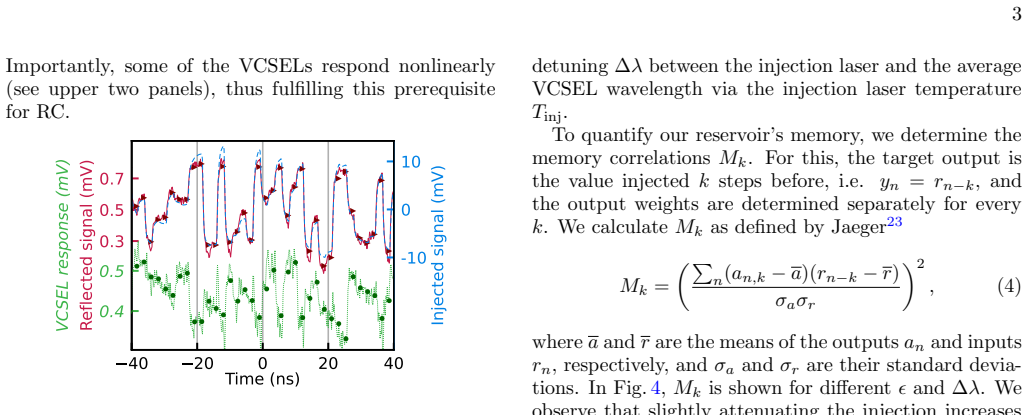
The central object is the diffractively coupled VCSEL array in an external cavity. A diffractive optical element distributes light from every VCSEL to its neighbours, so the recurrent weight matrix $w_{\text{res}}$ is fixed by geometry, with coupling strengths decreasing with lattice distance; injection light enters all nodes at once through the same element. The reservoir state matrix $Q \in \mathbb{R}^{N \times J}$ is built from the response of each VCSEL to a 1000-step pseudo-random input sequence, with $q_{n,j}$ defined as the average of nine samples per step after discarding two transient samples, and the readout is trained by ridge regression $\min_v (\lVert y - Qv \rVert^2 + \alpha \lVert v \rVert^2)$ with $\alpha = 0.1$. The essential nonlinearity comes from the VCSELs' intensity response to optical injection, which deviates from the linear reflection off a deactivated laser surface.
What would settle it
Record all VCSEL outputs simultaneously (for instance with a camera or parallel photodetector array) while injecting a single pseudo-random sequence, train the readout on that simultaneous state matrix, and compare the resulting bit error ratios and memory capacity with the sequential averaged results; substantial degradation would show that the offline training procedure does not represent the network's true real-time state.
Extended reading notes
Core claim
Using a custom 5-by-5 array of GaInAs quantum-well VCSELs with 24 active nodes and 23 measurable outputs, the authors demonstrate that diffractive coupling in an external cavity provides the fixed recurrent connections required for reservoir computing: each laser receives self-feedback and bidirectional coupling to its nearest and second-nearest neighbours, with coupling strengths set by the lattice geometry. An injection laser, modulated by an arbitrary waveform generator, feeds the same pseudo-random input sequence into all VCSELs simultaneously. The authors show the VCSEL responses are nonlinear and node-dependent, assemble the reservoir state matrix $Q$ from sequentially recorded and averaged node signals, and train a linear readout by ridge regression. On the benchmark tasks they report error-free 2-bit header recognition, bit error ratios of 0.008 for 2-bit XOR and 0.007 for 3-bit header recognition, and a root-mean-square error of 0.067 for 2-bit digital-to-analog conversion. The central discovery is that a spatially parallel photonic reservoir with fixed diffractive connections can solve these tasks, pointing toward delay-free optical reservoir computing.
Load-bearing premise
The load-bearing premise is that the snapshots used for training, taken one laser at a time and averaged over 1024 repeats, truly represent how the coupled lasers behave all together during normal operation; if the network drifts or sequential measurement perturbs it, the trained output weights will not work in a real-time system.
Editorial extensions
If this is right
- Because the nodes are physical lasers rather than time-multiplexed virtual nodes, scaling the network to more lasers need not reduce the processing speed, removing the main bottleneck of delay-based photonic reservoirs.
- The same diffractive coupling scheme is argued to scale to many more emitters, so larger arrays (for example of quantum-dot micropillar lasers) could be used for more complex tasks.
- Replacing the single-fiber sequential readout with a spatial light modulator would record all node outputs simultaneously, improving signal-to-noise ratio and enabling online training.
- Injection power ratio and wavelength detuning are controllable operating parameters that strongly affect memory and error rates, giving practical knobs for optimising the reservoir.
- The benchmark performance is comparable to that of other reservoirs with a similar number of physical nodes, supporting the claim that this scale of optical reservoir is competitive.
Reading between the lines
- Beyond the reported results, the transfer question is whether the trained readout survives a real-time simultaneous readout: the training data were recorded one laser at a time and averaged over 1024 repeats, so drift or cross-talk could change performance.
- A related extension is to quantify how much of the computation is linear: reflected light alone already gives memory and solves simple tasks, so comparing a linear model of the cavity against the full nonlinear reservoir would separate the two contributions.
- The quick memory decay suggests limited effective dimensionality; a direct test is to measure the rank of $Q$ and how it scales with the number of coupled lasers.
- The scalability claim implies a concrete experiment: build larger arrays and check whether per-node coupling uniformity and benchmark performance hold as the number of emitters grows.
Signed reviews
Editorial analysis
A structured set of objections, weighed in public.
Referee Report
Summary. The manuscript reports an experimental reservoir computer built from 24 diffractively coupled VCSELs in an external cavity, with injection-locked input and a readout taken from 23 VCSELs. The authors characterize the nonlinear node responses, measure a memory capacity up to 3.6, and report bit error ratios below 1% for 2-bit XOR and 3-bit header recognition, and an RMSE of 0.067 for 2-bit digital-to-analog conversion, using ridge regression readout and 5-fold cross-validation. The paper argues that this demonstrates a spatially parallel, all-optical reservoir without the speed penalty of time-multiplexed delay reservoirs.
Significance. If the results are robust, the paper provides a valuable experimental proof of concept for spatially parallel photonic reservoir computing with fixed diffractive coupling, supported by scalability arguments toward larger emitter arrays. The use of external benchmark tasks, ridge regression, and cross-validation is appropriate, and the comparison with a linear-reflection baseline is a useful control. However, the current evidence does not fully establish the central claim because the evaluation protocol does not demonstrate generalization to new input sequences, the operating point is selected on the same data used for the reported errors, and the sequential, averaged readout scheme may not represent the simultaneous reservoir state. The paper does not ship code or data, but the experimental description is sufficiently concrete to allow reproduction of the measurement procedure.
major comments (4)
- [Basic benchmark tasks (Eq. (2), Fig. 5)] The reported BERs and RMSE are obtained by 5-fold cross-validation on a single fixed pseudo-random sequence of 1000 symbols, and the two operating parameters (epsilon and Delta-lambda) are scanned on the same data without a separate validation split. This can optimistically bias the reported performance. A nested cross-validation or, preferably, a held-out input sequence is needed to support the headline numbers.
- [Dynamic response, Table I] The reflection baseline achieves a 2-bit XOR BER of 0.065 even though the reflected signal is described as linear. A linear readout of a linear channel cannot implement the XOR function as a function of the input bits; the low BER therefore either results from correlations specific to the single repeated sequence or indicates the reflection channel is not purely linear. The authors should test on a held-out input sequence and, if the baseline persists, explain the mechanism; otherwise the reported VCSEL XOR performance does not yet provide evidence of nonlinear computation.
- [Experimental setup and RC scheme (sequential readout)] The reservoir state matrix Q is assembled from signals recorded one node at a time, with the multimode fiber position readjusted between nodes, and each recorded trace is the average of 1024 responses to the same input sequence. The paper assumes these sequential, averaged measurements faithfully represent the simultaneous state of the coupled laser network. This assumption needs validation: for example, a repeatability test showing per-node stability over time, a simultaneous multi-channel measurement for a subset of nodes, or a discussion of how cross-talk during sequential acquisition affects the state estimate.
- [Basic benchmark tasks, Figs. 4 and 5, Table I] The paper reports single performance numbers (e.g., BER 0.008, RMSE 0.067) without error bars or repeated independent runs. Since the operating point is selected from a parameter scan and the VCSEL dynamics may drift, the uncertainty is needed to assess whether differences between configurations, such as the epsilon values in Fig. 5 and Table I, are significant.
minor comments (5)
- [Eq. (3)] The quantity P_inj|tf(j) uses the notation 'tf(j)' which is not defined in the text; it should be stated explicitly that this is the injection power at the top facet of VCSEL j.
- [Discussion] The text refers to 'error-free 2-bit HR' but does not give the exact BER value or the condition; specify which configuration yields zero errors.
- [Dynamic response, Figs. 2 and 3] The captions are slightly inconsistent: Fig. 2 uses green dots for q_n,j of the VCSEL response and red triangles for the reflections, while Fig. 3 uses red circles for individual responses and blue dots for averages. Please unify the symbol descriptions.
- [Conclusion] The abstract and conclusion state that the reservoir consists of 24 physical nodes, but only 23 nodes contribute to the output and the central node is not recorded. Please clarify this distinction, as it matters for understanding the effective readout dimension.
- [Dynamic response, Fig. 4] The memory capacity is computed by summing M_k for k <= 10, with the cutoff chosen to avoid noise-dominated terms; this is reasonable, but the choice of 10 should be justified or shown to be insensitive to the cutoff.
Circularity Check
No significant circularity: benchmark tasks are external, readout is trained by ridge regression, and self-citations are independent hardware characterizations.
full rationale
The paper makes no first-principles derivation; its central claim is an experimental demonstration. The pipeline is: inject a pseudo-random sequence, measure VCSEL responses to form the state matrix Q, train readout weights w_out by ridge regression (Eq. 2) against external target labels (XOR via Eq. 5, DAC via Eq. 6, HR via target-sequence matching, MC via delayed input in Eq. 4), and evaluate with 5-fold cross-validation. Nothing in this chain defines a target in terms of the readout, and no fitted parameter is renamed as a prediction. The surprisingly strong reflection baseline (2-bit XOR BER 0.065 from a 'mostly linear' channel) is a possible confound concerning benchmark validity, but it is not a definitional equivalence; the paper explicitly treats the reflections as a control ('refl.'). Self-citations to refs. 16, 17, and 21 are prior hardware characterizations (array homogeneity, optical locking, DOE coupling) that support the setup rather than the RC result, and the dynamic responses in Figs. 2 and 3 are re-measured here. Thus no circular step reduces the reported BERs or RMSE to the fitted readout or to a self-citation chain.
Assumptions & free parameters
free parameters (5)
- Ridge regularization alpha =
0.1
- Injection power ratio epsilon =
0.20 (best of scanned values 0.02, 0.05, 0.13, 0.20)
- Wavelength detuning Delta-lambda =
0 pm (optimal; detuning reduces memory)
- Memory capacity sum cutoff =
k <= 10
- Samples averaged per symbol =
9 of 11 samples (first 2 discarded)
assumptions (4)
- domain assumption The arithmetic mean of samples 3 to 11 in each symbol interval defines the node state qn,j.
- domain assumption Averaging 1024 responses to the same input sequence yields the reservoir state without distorting input-dependent dynamics.
- domain assumption The offline, sequentially recorded node responses, combined with ridge regression, are equivalent to an online parallel readout for the purpose of evaluating reservoir performance.
- standard math Standard linear algebra for ridge regression (Eq. 2) and the memory correlation definition (Eq. 4) from Jaeger are valid.
Cite this review
Pith. "Pith review of Experimental reservoir computing with diffractively coupled VCSELs." pith.science (2026). https://pith.science/paper/Y3FPQVYM
@misc{pith2026241203206,
  author       = {Pith},
  title        = {Pith review of: Experimental reservoir computing with diffractively coupled VCSELs},
  year         = {2026},
  howpublished = {\url{https://pith.science/paper/Y3FPQVYM}},
  note         = {Machine review of arXiv:2412.03206}
}
read the original abstract
We present experiments on reservoir computing (RC) using a network of vertical-cavity surface-emitting lasers (VCSELs) that we diffractively couple via an external cavity. Our optical reservoir computer consists of 24 physical VCSEL nodes. We evaluate the system's memory and solve the 2-bit XOR task and the 3-bit header recognition (HR) task with bit error ratios (BERs) below 1\,\% and the 2-bit digital-to-analog conversion (DAC) task with a root-mean-square error (RMSE) of 0.067.
Figures


Figures from the paper (1 more)

Reference graph
Works this paper leans on
-
[1]
author author Z. Chen , author A. Sludds , author R. Davis , author I. Christen , author L. Bernstein , author L. Ateshian , author T. Heuser , author N. Heermeier , author J. A. \ Lott , author S. Reitzenstein , author R. Hamerly , \ and\ author D. Englund ,\ 10.1038/s41566-023-01233-w journal journal Nature Photonics \ volume 17 ,\ pages 723 ( year 2023...
-
[2]
author author I. Estébanez , author J. Schwind , author I. Fischer , \ and\ author A. Argyris ,\ doi:10.1515/nanoph-2020-0184 journal journal Nanophotonics \ volume 9 ,\ pages 4163 ( year 2020 ) NoStop
-
[3]
Comment on "All-optical machine learning using diffractive deep neural networks"
author author X. Lin , author Y. Rivenson , author N. T. \ Yardimci , author M. Veli , author Y. Luo , author M. Jarrahi , \ and\ author A. Ozcan ,\ 10.1126/science.aat8084 journal journal Science \ volume 361 ,\ pages 1004 ( year 2018 ) ,\ http://arxiv.org/abs/1809.08360 1809.08360 NoStop
-
[4]
author author Y. Chen , author M. Nazhamaiti , author H. Xu , author Y. Meng , author T. Zhou , author G. Li , author J. Fan , author Q. Wei , author J. Wu , author F. Qiao , author L. Fang , \ and\ author Q. Dai ,\ 10.1038/s41586-023-06558-8 journal journal Nature \ volume 623 ,\ pages 48 ( year 2023 b ) NoStop
-
[5]
author author X. Luo , author S. Dong , author Z. Wei , author Z. Wang , author Y. Hu , author H. Duan , \ and\ author X. Cheng ,\ https://doi.org/10.1002/lpor.202300272 journal journal Laser & Photonics Reviews \ volume 17 ,\ pages 2300272 ( year 2023 ) NoStop
-
[6]
Reinforcement Learning in a large scale photonic Recurrent Neural Network
author author J. Bueno , author S. Maktoobi , author L. Froehly , author I. Fischer , author M. Jacquot , author L. Larger , \ and\ author D. Brunner ,\ 10.1364/OPTICA.5.000756 journal journal Optica \ volume 5 ,\ pages 756 ( year 2018 ) ,\ http://arxiv.org/abs/1711.05133 arXiv:1711.05133 NoStop
-
[7]
author author J. Robertson , author M. Hejda , author J. Bueno , \ and\ author A. Hurtado ,\ 10.1038/s41598-020-62945-5 journal journal Scientific Reports \ volume 10 ,\ pages 6098 ( year 2020 ) NoStop
-
[8]
author author Y. Zhang , author S. Xiang , author X. Cao , author S. Zhao , author X. Guo , author A. Wen , \ and\ author Y. Hao ,\ 10.1364/PRJ.422628 journal journal Photonic Research \ volume 9 ,\ pages 1055 ( year 2021 ) NoStop
Show all 24 references
-
[9]
Porte , author A
author author X. Porte , author A. Skalli , author N. Haghighi , author S. Reitzenstein , author J. A. \ Lott , \ and\ author D. Brunner ,\ 10.1088/2515-7647/abf6bd journal journal J. Phys. Photonics \ volume 3 ,\ pages 024017 ( year 2021 ) ,\ http://arxiv.org/abs/2012.11153 a...
-
[10]
Bueno , author J
author author J. Bueno , author J. Robertson , author M. Hejda , \ and\ author A. Hurtado ,\ 10.1109/LPT.2021.3075095 journal journal IEEE Photonics Technology Letters \ volume 33 ,\ pages 920 ( year 2021 ) NoStop
2021
-
[11]
author author B. L. \ Gu , author S. Y. \ Xiang , author X. X. \ Guo , author D. Z. \ Zheng , \ and\ author Y. Hao ,\ 10.1364/OE.460770 journal journal Optics Express \ volume 30 ,\ pages 30779 ( year 2022 ) NoStop
2022 doi
-
[12]
Jaeger ,\ http://publica.fraunhofer.de/documents/B-73131.html journal journal GMD Report \ volume 148 ( year 2001 a ) NoStop
author author H. Jaeger ,\ http://publica.fraunhofer.de/documents/B-73131.html journal journal GMD Report \ volume 148 ( year 2001 a ) NoStop
2001
-
[13]
Maass , author T
author author W. Maass , author T. Natschläger , \ and\ author H. Markram ,\ 10.1162/089976602760407955 journal journal Neural Computation \ volume 14 ,\ pages 2531 ( year 2002 ) NoStop
2002 doi
-
[14]
Jaeger \ and\ author H
author author H. Jaeger \ and\ author H. Haas ,\ 10.1126/science.1091277 journal journal Science \ volume 304 ,\ pages 78 ( year 2004 ) NoStop
2004 doi
-
[15]
Appeltant , author M
author author L. Appeltant , author M. C. \ Soriano , author G. Van Der Sande , author J. Danckaert , author S. Massar , author J. Dambre , author B. Schrauwen , author C. R. \ Mirasso , \ and\ author I. Fischer ,\ 10.1038/ncomms1476 journal journal Nature Communications \ vol...
-
[16]
Brunner \ and\ author I
author author D. Brunner \ and\ author I. Fischer ,\ 10.1364/OL.40.003854 journal journal Optics Letters \ volume 40 ,\ pages 3854 ( year 2015 ) NoStop
2015 doi
-
[17]
Pfl\" u ger , author D
author author M. Pfl\" u ger , author D. Brunner , author T. Heuser , author J. A. \ Lott , author S. Reitzenstein , \ and\ author I. Fischer ,\ 10.1364/OE.473449 journal journal Opt. Express \ volume 31 ,\ pages 8704 ( year 2023 ) NoStop
-
[18]
Maktoobi , author L
author author S. Maktoobi , author L. Froehly , author L. Andreoli , author X. Porte , author M. Jacquot , author L. Larger , \ and\ author D. Brunner ,\ 10.1109/jstqe.2019.2930454 journal journal IEEE Journal of Selected Topics in Quantum Electronics \ volume 26 ,\ pages 7600...
2019
-
[19]
Heuser , author J
author author T. Heuser , author J. Große , author A. Kaganskiy , author D. Brunner , \ and\ author S. Reitzenstein ,\ 10.1063/1.5050669 journal journal APL Photonics \ volume 3 ( year 2018 ),\ 10.1063/1.5050669 ,\ note 116103 ,\ http://arxiv.org/abs/https://pubs.aip.org/aip/a...
2018 doi
-
[20]
Ma , author J
author author C. Ma , author J. V. \ Kerrebrouck , author H. Deng , author S. Sackesyn , author E. Gooskens , author B. Bai , author J. Dambre , \ and\ author P. Bienstman ,\ 10.1364/OE.502354 journal journal Opt. Express \ volume 31 ,\ pages 34843 ( year 2023 ) NoStop
-
[21]
Heuser , author M
author author T. Heuser , author M. Pfl \" u ger , author I. Fischer , author J. A. \ Lott , author D. Brunner , \ and\ author S. Reitzenstein ,\ 10.1088/2515-7647/aba671 journal journal J. Phys. Photonics \ volume 2 ,\ pages 044002 ( year 2020 ) NoStop
-
[22]
Arlot \ and\ author A
author author S. Arlot \ and\ author A. Celisse ,\ 10.1214/09-SS054 journal journal Statistics Surveys \ volume 4 ,\ pages 40 ( year 2010 ) NoStop
2010 doi
-
[23]
Jaeger ,\ http://publica.fraunhofer.de/documents/B-73131.html journal journal GMD Report \ volume 152 ,\ pages 12 ( year 2001 b ) NoStop
author author H. Jaeger ,\ http://publica.fraunhofer.de/documents/B-73131.html journal journal GMD Report \ volume 152 ,\ pages 12 ( year 2001 b ) NoStop
2001
-
[24]
Sugano , author K
author author C. Sugano , author K. Kanno , \ and\ author A. Uchida ,\ 10.1109/JSTQE.2019.2929179 journal journal IEEE Journal of Selected Topics in Quantum Electronics \ volume 26 ,\ pages 1500409 ( year 2019 ) NoStop
2019
Reviewed August 11, 2026 · model on record in the stance chip above.
Discussion (0). Continue with ORCID to comment.