REVIEW 3 major objections 5 minor 36 references
Variable-Speed Teaching-Playback as Real-World Data Augmentation for Imitation Learning
T0 review · 3 major / 5 minor · reviewed 2026-08-11 · deepseek-v4-flash
Pith's one-line read This paper claims that physically replaying taught motions at different speeds—rather than just rescaling the recorded data—provides real-world augmentation that lets force-controlled imitation learning generalize across speeds from two…
desk verdict A sensible real-world augmentation idea with strong pick-and-place evidence, but the baseline comparison needs to be reported before the central claim holds. read the letter →
The pith
A machine-rendered reading of the paper's core claim, the machinery that carries it, and where it could break.
The reading
What carries the argument
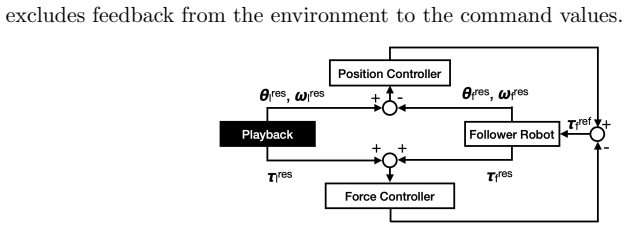
The central mechanism is the motion-copying system, a teaching–playback method that replays recorded position and force commands at altered speeds while the real robot interacts with the environment. During replay the robot is not controlled by a neural network, so the recorded force and position responses are genuine physical reactions to the sped-up or slowed-down motion; these responses are then labeled by the commanded time or frequency and added to the training set of a bilateral control-based imitation-learning LSTM. The load-bearing step is the physical replay: it converts a software speed change into real-world reaction data that the network can learn from.
What would settle it
Train the simple-duplication baseline on the same number of samples, with identical train/validation splits and speed labels, then test on the same held-out objects and speeds; if the success-rate gap disappears, physical reactions are not the cause.
Extended reading notes
Core claim
The paper's claim is that variable-speed teaching–playback works as data augmentation for imitation learning with position–force control, and that the real-world reaction data it collects are worth more than the same command data modified in software. Using the motion-copying system, two fixed-speed demonstrations were replayed at 0.5x, 1x, and 2x speed for pick-and-place and at 0.5x, 1x, and 1.5x speed for wiping, with the resulting follower responses—including contact forces—recorded and labeled by the commanded duration or frequency. Compared with a baseline that simply duplicated and rescaled the original demonstrations, training on these playbacks raised overall pick-and-place success from 30% to 53% (and interpolation-range success from 31% to 88%), and wiping success from 74% to 79%, while also keeping actual completion times and wiping frequencies closer to the label. The paper interprets this as evidence that speed changes in a nonlinear physical environment produce reactions that cannot be reproduced by downsampling or simulation, and that collecting those real reactions is what improves variable-speed imitation.
Load-bearing premise
The load-bearing premise is that the baseline, simple duplication and speed changes applied to the original demonstrations, was matched to the real-world playback method in sample count and training conditions, since the paper does not report how many baseline samples were used.
Editorial extensions
If this is right
- Contact-rich manipulation at variable speeds becomes learnable from as few as two fixed-speed demonstrations, without simulation.
- Interpolation between trained speeds benefits most: pick-and-place success in the interpolated range rose from 31% to 88%.
- Task success and adherence to the commanded duration or frequency both improve when training data include real environmental reactions at the target speeds.
- The augmentation applies to distinct contact-rich tasks—grasping, carrying, placing, and continuous wiping—suggesting it generalizes across manipulation procedures.
- Adding more diverse playbacks or combining with self-supervised learning is a stated path to finer speed control, particularly for extrapolation beyond the trained speeds.
Reading between the lines
- A natural test of the mechanism would be to train the simple-duplication baseline on the same number of samples, with identical train/validation splits and speed labels, to confirm that the success gap is caused by real-world reactions rather than by a difference in data quantity.
- Because the playback method keeps only successful replays as training data, the augmented dataset is also a filtered, higher-quality subset of trajectories; replicating that filter on the baseline would isolate the contribution of physical reactions from the contribution of trajectory selection.
- The method's stated limitation is that it only varies speed, not position, so a plausible extension is to combine the same real-world reaction-collection idea with spatial variation or with simulation-based augmentation for variable positions.
- The wiping results show the largest gain at the higher surface height, while the lower-height condition still fails on force-contact detection, suggesting the method's benefit is strongest when replay data make the contact phases of the task learnable.
Signed reviews
Editorial analysis
A structured set of objections, weighed in public.
Referee Report
Summary. The paper proposes using teaching-playback at variable speeds as real-world data augmentation for bilateral-control-based imitation learning. Starting from two fixed-speed human demonstrations per task, the authors generate additional real-robot trajectories by replaying recorded motion at 0.5x, 1x, and (for pick-and-place) 2x speed, collecting the resulting real force/torque reactions, and retaining only 'successful' playbacks. They compare this dataset against a baseline in which the same human demonstrations are simply duplicated and their speed is changed offline, with identical command values but without the real-world responses. Experiments on pick-and-place and wiping report success rates and label-following accuracy for speed commands inside and outside the training range. The main claims are that the proposed real-world augmentation improves overall task success (53% vs 30% for pick-and-place; 79% vs 74% for wiping) and improves accuracy along the duration/frequency command, especially for interpolation.
Significance. The idea is practically motivated and squarely within the journal's scope: it addresses a real bottleneck in force-controlled imitation learning, namely the scarcity of hard-to-simulate contact data. A notable strength is that the method is evaluated on a physical robot with two distinct contact-rich tasks and unseen objects, rather than only in simulation. The authors are also explicit about limitations (no position diversity, no closed-loop feedback) and about the relationship to prior fast-forward collection work. If the comparison against the within-paper baseline is properly controlled, the pick-and-place results are substantial and would be a useful data-augmentation recipe for the bilateral-control imitation-learning community. The paper does not provide code or data, but the experimental protocol is largely reproducible from the text once the missing baseline details below are supplied.
major comments (3)
- [§5.2, §5.3.1, §5.3.2, Tables 1–4] The central comparison against the 'simple duplication and changes in speed' baseline is under-specified. The proposed method's dataset size and train/validation split are explicit (pick-and-place: 42 training and 18 validation playbacks; wiping: 18 training and 12 validation), but the text never states how many baseline trajectories were generated, how many times the human demonstrations were duplicated at each speed, or how the baseline was split into training and validation. Since the paper's main claim is that real-world reactions at variable speeds, rather than simply more samples or different label coverage, produce the gains in Tables 1–4, the baseline must be matched in sample count, duplication structure, and train/validation proportions. Without these numbers, the 53% vs 30% and 88% vs 31% gaps could in part reflect a data-quantity or label-coverage effect. Please report the full baseline construction and, ideally, run a matched-sample-count baseline.
- [§5.4.1, §5.4.2, Tables 1–4] Every success-rate cell in Tables 1–4 is based on only five trials, and no confidence intervals or significance tests are reported. The pick-and-place improvement is large and fairly consistent across objects, but the wiping result is mixed: the proposed method improves at 15 cm (94% vs 68%) while worsening at 12 cm (63% vs 86%), for an overall 79% vs 74% over 70 trials. Given the small per-cell sample size, the strength of the success-rate claims should be supported with at least binomial confidence intervals or a simple test (e.g., Fisher's exact test on the pooled overall counts), and the mixed height-dependent effect in wiping should be acknowledged in the conclusions rather than only in the results section.
- [§4 and §5.3.2] The text says that playbacks were repeated until a 'certain number of successful playbacks' was reached and that only successful data were used for training, but the success criterion for a playback is never defined for either task. For pick-and-place, the trial-level success criterion (object inside the circle within 40 s) is given, but it is not stated that the same criterion was applied to playbacks; for wiping, no playback-level success definition appears at all. Because success-based filtering can improve training-data quality independently of speed-dependent reactions, the paper should specify the playback success criteria and state whether any analogous selection was applied to the baseline dataset.
minor comments (5)
- [Abstract and §5.4.1] The phrase 'a maximum 55% increase in success rate' is ambiguous: it is not clear whether the increase is in percentage points or relative percentage, and the value does not obviously match any single cell in Tables 1–4 (several cells show larger point differences). Please report the exact source of the 55% figure.
- [§3.1] The statement that scaling time 'clearly collides with the law of cause and effect, rendering it infeasible' is vague; a more precise technical explanation of why temporal scaling is not well posed in four-channel bilateral control would be more informative.
- [Figure 4] The figure caption and the text use both 'simple duplication and speed adjustments' and 'simple fast-forward' to name the baseline; please use one consistent term throughout.
- [§5.4.2, Table 4] The text says the baseline's failures were mainly due to starting periodic movement before pressing, but Table 4 shows the baseline succeeding more at 12 cm than the proposed method (86% vs 63%); a sentence explaining this opposite pattern would help the reader interpret the height-dependent failure modes.
- [§2.2] When discussing Sakaino et al.'s fast-forward data collection [11], the paper says its 'effect and feasibility for variable-speed tasks remain unclear'; since the current work directly builds on that method, it would be helpful to state more concretely what new evidence the current experiments add relative to [11].
Circularity Check
No circular derivation: the paper's central claim is an empirical comparison against a within-paper baseline, not a reduction to its own inputs.
full rationale
The paper proposes teaching--playback at variable speeds as a real-world data-augmentation procedure and then trains bilateral-control-based imitation-learning models on the resulting dataset, comparing against models trained on speed-adjusted duplicates of the original demonstrations. This is an experimental comparison rather than a derivation, so there is no equation or fitted parameter that is being renamed as a prediction. The key comparison in Tables 1--4 is mediated by neural-network training and real-robot evaluation, and the proposed dataset is not constructed from the evaluation outcome. The only identified concerns are methodological: Section 5.3.1 reports 42 training playbacks for pick-and-place and Section 5.3.2 reports 18 for wiping, while the baseline's sample counts and train/validation split are not stated, and Section 4 explains that only successful playbacks were used for training without stating whether an analogous filter was applied to the baseline. These are potential confounds that could affect the empirical conclusion, but they are not circularity, because the success-rate difference is not forced by construction. The paper does cite prior work by overlapping authors (e.g., Saigusa et al. [9] for controller parameters and Sakaino et al. [11] for fast-forward collection), but those citations are used as tools or background and are not invoked to justify the paper's central claim, so they do not constitute load-bearing self-citation. The claim that real-world reactions at variable speeds improve performance remains externally evaluable from the reported experiments.
Assumptions & free parameters
free parameters (6)
- Playback speed set and repetition count =
Pick-and-place: 0.5x, 1x, 2x with 10 playbacks each; wiping: 0.5x, 1x, 1.5x with 5 playbacks each
- LSTM architecture =
8 layers, 200 units, one fully connected layer
- Training hyperparameters =
Learning rate 1e-4, 5000 epochs, Gaussian input noise 0.01 standard deviation
- Playback success criterion =
Not quantitatively specified
- Train-validation split =
Pick-and-place: 7/3 per object-speed condition; wiping: 3/2 per height-speed condition
- Label definition thresholds =
3.7 rad end-effector angle for pick-and-place; 1 Hz metronome-based frequency for wiping
assumptions (6)
- standard math Four-channel bilateral control equations (1) and (2) hold and provide symmetric position and force tracking.
- domain assumption Motion-copying system playback at altered speeds faithfully reproduces the recorded motion and environmental forces.
- domain assumption The comparison baseline is matched to the proposed method except for the real-world response.
- domain assumption Retaining only successful playbacks does not bias the training distribution.
- domain assumption Controller gains and observer parameters from Saigusa et al. 2022 are valid for this robot setup.
- domain assumption The speed of the human demonstrations varied by less than 10%.
Cite this review
Pith. "Pith review of Variable-Speed Teaching-Playback as Real-World Data Augmentation for Imitation Learning." pith.science (2026). https://pith.science/paper/6BE6E6H6
@misc{pith2026241203252,
  author       = {Pith},
  title        = {Pith review of: Variable-Speed Teaching-Playback as Real-World Data Augmentation for Imitation Learning},
  year         = {2026},
  howpublished = {\url{https://pith.science/paper/6BE6E6H6}},
  note         = {Machine review of arXiv:2412.03252}
}
read the original abstract
Because imitation learning relies on human demonstrations in hard-to-simulate settings, the inclusion of force control in this method has resulted in a shortage of training data, even with a simple change in speed. Although the field of data augmentation has addressed the lack of data, conventional methods of data augmentation for robot manipulation are limited to simulation-based methods or downsampling for position control. This paper proposes a novel method of data augmentation that is applicable to force control and preserves the advantages of real-world datasets. We applied teaching-playback at variable speeds as real-world data augmentation to increase both the quantity and quality of environmental reactions at variable speeds. An experiment was conducted on bilateral control-based imitation learning using a method of imitation learning equipped with position-force control. We evaluated the effect of real-world data augmentation on two tasks, pick-and-place and wiping, at variable speeds, each from two human demonstrations at fixed speed. The results showed a maximum 55% increase in success rate from a simple change in speed of real-world reactions and improved accuracy along the duration/frequency command by gathering environmental reactions at variable speeds.
Figures


Figures from the paper (9 more)


Reference graph
Works this paper leans on
-
[1]
Levine S, Pastor P, Krizhevsky A, et al. Learning Hand-Eye Coordination for Robotic Grasping with Deep Learning and Large-Scale Data Collection. The International Journal of Robotics Research. 2018;37(4-5):421–436. Available from:https://doi.org/10.1177/ 0278364917710318
work page 2018
-
[2]
Learning Fine-Grained Bimanual Manipulation with Low-Cost Hardware
Zhao TZ, Kumar V, Levine S, et al. Learning Fine-Grained Bimanual Manipulation with Low-Cost Hardware. In: Proceedings of Robotics: Science and Systems; July; Daegu, Republic of Korea; 2023
work page 2023
-
[3]
Adachi T, Fujimoto K, Sakaino S, et al. Imitation Learning for Object Manipulation Based on Position/Force Information Using Bilateral Control. In: 2018 IEEE/RSJ International Conference on Intelligent Robots and Systems (IROS); 2018. p. 3648–3653
work page 2018
-
[4]
Akagawa T, Sakaino S. Autoregressive model considering low frequency errors in command for bilateral control-based imitation learning. IEEJ Journal of Industry Applications. 2023;12(1):26–32
work page 2023
-
[5]
Yamane K, Saigusa Y, Sakaino S, et al. Soft and rigid object grasping with cross-structure hand using bilateral control-based imitation learning. IEEE Robotics and Automation Letters. 2024 Feb;9(2):1198–1205. Available from: http://dx.doi.org/10.1109/LRA. 2023.3335768
arXiv 2024
-
[6]
Bi-act: Bilateral control-based imitation learning via action chunking with transformer
Buamanee T, Kobayashi M, Uranishi Y, et al. Bi-act: Bilateral control-based imitation learning via action chunking with transformer. In: 2024 IEEE International Conference on Advanced Intelligent Mechatronics (AIM); 2024. p. 410–415
work page 2024
-
[7]
Kobayashi M, Buamanee T, Uranishi Y, et al. Ilbit: Imitation learning for robot using position and torque information based on bilateral control with transformer ; 2024
work page 2024
-
[8]
Imitation learning for variable speed contact motion for operation up to control bandwidth
Sakaino S, Fujimoto K, Saigusa Y, et al. Imitation learning for variable speed contact motion for operation up to control bandwidth. IEEE Open Journal of the Industrial Electronics Society. 2022;3:116–127
work page 2022
Show all 36 references
-
[9]
Imitation Learning for Nonprehensile Manipulation Through Self-Supervised Learning Considering Motion Speed
Saigusa Y, Sakaino S, Tsuji T. Imitation Learning for Nonprehensile Manipulation Through Self-Supervised Learning Considering Motion Speed. IEEE Access. 2022; 10:68291–68306
2022
-
[10]
Motion copying system based on real-world haptics in variable speed
Yokokura Y, Katsura S, Ohishi K. Motion copying system based on real-world haptics in variable speed. In: 2008 13th International Power Electronics and Motion Control Conference; 2008. p. 1604–1609
2008
-
[11]
Practical implementations of bilateral control-based imitation learning at irex2023
Sakaino S, Masuya N, Sato H, et al. Practical implementations of bilateral control-based imitation learning at irex2023. In: the 10th IEEJ International Workshop on Sensing, Actuation, Motion Control, and Optimization; 2024. p. 213–218
2024
-
[12]
Learning Force-Based Manipulation of Deformable Objects from Multiple Demonstrations
Lee AX, Lu H, Gupta A, et al. Learning Force-Based Manipulation of Deformable Objects from Multiple Demonstrations. In: 2015 IEEE International Conference on Robotics and Automation (ICRA); 2015. p. 177–184
2015
-
[13]
Repeatable Folding Task by Humanoid Robot Worker Using Deep Learning
Yang PC, Sasaki K, Suzuki K, et al. Repeatable Folding Task by Humanoid Robot Worker Using Deep Learning. IEEE Robotics and Automation Letters. 2017;2(2):397–403
2017
-
[14]
An algorithmic perspective on imitation learning
Osa T, Pajarinen J, Neumann G, et al. An algorithmic perspective on imitation learning. Foundations and Trends® in Robotics. 2018;7(1-2):1–179. Available from: http://dx. 14 doi.org/10.1561/2300000053
2018 doi
-
[15]
Imitation learning: A survey of learning meth- ods
Hussein A, Gaber MM, Elyan E, et al. Imitation learning: A survey of learning meth- ods. ACM Comput Surv. 2017 Apr;50(2). Available from: https://doi.org/10.1145/ 3054912
2017
-
[16]
Survey of imitation learning for robotic manipulation
Fang B, Jia S, Guo D, et al. Survey of imitation learning for robotic manipulation. Inter- national Journal of Intelligent Robotics and Applications. 2019;3(4):362–369. Available from: https://doi.org/10.1007/s41315-019-00103-5
2019 doi
-
[17]
Robot learning from demonstrations: Emulation learn- ing in environments with moving obstacles
Ghalamzan E AM, Ragaglia M. Robot learning from demonstrations: Emulation learn- ing in environments with moving obstacles. Robotics and Autonomous Systems. 2018; 101:45–56. Available from: https://www.sciencedirect.com/science/article/pii/ S0921889017302981
2018
-
[18]
Deep imitation learning for complex manipula- tion tasks from virtual reality teleoperation
Zhang T, McCarthy Z, Jow O, et al. Deep imitation learning for complex manipula- tion tasks from virtual reality teleoperation. In: 2018 IEEE International Conference on Robotics and Automation (ICRA); 2018. p. 5628–5635
2018
-
[19]
A review on manipulation skill acquisition through teleoperation- based learning from demonstration
Si W, Wang N, Yang C. A review on manipulation skill acquisition through teleoperation- based learning from demonstration. Cognitive Computation and Systems. 2021;3(1):1–16. Available from: https://ietresearch.onlinelibrary.wiley.com/doi/abs/10.1049/ ccs2.12005
2021
-
[20]
Data augmentation: A comprehensive survey of modern ap- proaches
Mumuni A, Mumuni F. Data augmentation: A comprehensive survey of modern ap- proaches. Array. 2022;16:100258. Available from: https://www.sciencedirect.com/ science/article/pii/S2590005622000911
2022
-
[21]
A review: Data pre-processing and data aug- mentation techniques
Maharana K, Mondal S, Nemade B. A review: Data pre-processing and data aug- mentation techniques. Global Transitions Proceedings. 2022;3(1):91–99. International Conference on Intelligent Engineering Approach(ICIEA-2022); Available from: https: //www.sciencedirect.com/science/a...
2022
-
[22]
Gan-based data augmentation and anonymization for skin- lesion analysis: A critical review
Bissoto A, Valle E, Avila S. Gan-based data augmentation and anonymization for skin- lesion analysis: A critical review. In: Proceedings of the IEEE/CVF Conference on Com- puter Vision and Pattern Recognition (CVPR) Workshops; June; 2021. p. 1847–1856
2021
-
[23]
Data augmentation for manipulation
Mitrano P, Berenson D. Data augmentation for manipulation. In: Robotics: Science and Systems 2022; 2022
2022
-
[24]
Scaling Robot Learning with Semantically Imagined Experience
Yu T, Xiao T, Tompson J, et al. Scaling Robot Learning with Semantically Imagined Experience. In: Proceedings of Robotics: Science and Systems; July; Daegu, Republic of Korea; 2023
2023
-
[25]
From virtual demonstration to real- world manipulation using lstm and mdn
Rahmatizadeh R, Abolghasemi P, Behal A, et al. From virtual demonstration to real- world manipulation using lstm and mdn. Proceedings of the AAAI Conference on Artificial Intelligence. 2018 Apr;32(1). Available from: https://ojs.aaai.org/index.php/AAAI/ article/view/12099
2018
-
[26]
Dabi: Evaluation of data augmentation methods using downsampling in bilateral control-based imitation learning with images ; 2024
Kobayashi M, Buamanee T, Uranishi Y. Dabi: Evaluation of data augmentation methods using downsampling in bilateral control-based imitation learning with images ; 2024. Available from: https://arxiv.org/abs/2410.04370
2024 arXiv
-
[27]
Real-time motion generation and data augmen- tation for grasping moving objects with dynamic speed and position changes
Yamamoto K, Ito H, Ichiwara H, et al. Real-time motion generation and data augmen- tation for grasping moving objects with dynamic speed and position changes. In: 2024 IEEE/SICE International Symposium on System Integration (SII); 2024. p. 390–397
2024
-
[28]
Bilateral teleoperation: An historical survey
Hokayem PF, Spong MW. Bilateral teleoperation: An historical survey. Automatica. 2006;42(12):2035–2057. Available from: https://www.sciencedirect.com/science/ article/pii/S0005109806002871
2006
-
[29]
High-fidelity bilateral teleoperation systems and the effect of multimodal haptics
Tavakoli M, Aziminejad A, Patel R V, et al. High-fidelity bilateral teleoperation systems and the effect of multimodal haptics. IEEE Transactions on Systems, Man, and Cyber- netics, Part B (Cybernetics). 2007;37(6):1512–1528
2007
-
[30]
Multi-DOF Micro-Macro Bilateral Controller Using Oblique Coordinate Control
Sakaino S, Sato T, Ohnishi K. Multi-DOF Micro-Macro Bilateral Controller Using Oblique Coordinate Control. IEEE Transactions on Industrial Informatics. 2011;7(3):446–454
2011
-
[31]
Stability analysis and experimental validation of a motion-copying system
Yokokura Y, Katsura S, Ohishi K. Stability analysis and experimental validation of a motion-copying system. IEEE Transactions on Industrial Electronics. 2009;56(10):3906– 3913. 15
2009
-
[32]
Motion-data processing and reproduction based on motion-copying system
Igarashi K, Katsura S. Motion-data processing and reproduction based on motion-copying system. IEEJ Journal of Industry Applications. 2015;4(5):543–549
2015
-
[33]
Motion-copying system with in-tool sensing
Fujisaki K, Katsura S. Motion-copying system with in-tool sensing. IEEJ Journal of In- dustry Applications. 2023;12(4):793–799
2023
-
[34]
Long Short-Term Memory
Hochreiter S, Schmidhuber J. Long Short-Term Memory. Neural computation. 1997 12; 9:1735–80
1997
-
[35]
Long Short-Term Memory Recurrent Neural Network Architectures for Large Scale Acoustic Modeling
Sak H, Senior A W, Beaufays F. Long Short-Term Memory Recurrent Neural Network Architectures for Large Scale Acoustic Modeling. In: Interspeech; 2014. p. 338–342
2014
-
[36]
A New Autoregressive Neural Network Model with Command Compensation for Imitation Learning Based on Bilateral Control
Hayashi K, Sasagawa A, Sakaino S, et al. A New Autoregressive Neural Network Model with Command Compensation for Imitation Learning Based on Bilateral Control. In: 2021 IEEE International Conference on Mechatronics (ICM); 2021. p. 1–7. 16
2021
Reviewed August 11, 2026 · model on record in the stance chip above.
Discussion (0). Continue with ORCID to comment.