REVIEW 3 major objections 5 minor 2 cited by
ACE2-SOM: Coupling an ML atmospheric emulator to a slab ocean and learning the sensitivity of climate to changed CO$_2$
T0 review · 3 major / 5 minor · reviewed 2026-08-11 · deepseek-v4-flash
Pith's one-line read ACE2-SOM—a machine-learned atmospheric emulator coupled to a slab ocean—reproduces equilibrium temperature and precipitation change patterns under CO2 doubling, tripling, and quadrupling, including the unseen tripling case.
desk verdict Good, honest pilot showing an ML atmospheric emulator can hit equilibrium CO2 response patterns, but the flagship 3xCO2 result is bracketed interpolation between training climates, not proof of transferable sensitivity. read the letter →
The pith
A machine-rendered reading of the paper's core claim, the machinery that carries it, and where it could break.
The reading
What carries the argument
The central object is the differentiable coupling of the ACE2 neural atmospheric model to a slab ocean: each 6-hour step the ML model predicts the surface fluxes that make up $F_{\mathrm{net}}$, and the mixed-layer temperature is updated by $\rho_o C_o h\,\partial T_s/\partial t = F_{\mathrm{net}} + Q$, where $Q$ is a prescribed climatological ocean-heat-convergence (Q-flux). This lets the sea surface temperature respond to CO2-driven changes in surface energy fluxes while keeping the whole system trainable by backpropagation. The argument for CO2 sensitivity rides on the model learning to use the prescribed CO2 input to produce radiation and flux responses that match the equilibrium physics-model states it was trained on; the paper's multi-call radiation experiments probe whether those sensitivities are physical, and show that some are not.
What would settle it
Run the trained emulator at a CO2 level between 2x and 4x that was not used in training, for example 2.5x, and compare its equilibrium temperature and precipitation change patterns against a new physics-based reference run at that level; if the pattern errors are comparable to the 3x case, the sensitivity is generalizing, whereas a sharp error spike would indicate interpolation between the quantized training concentrations. A second decisive check is the paper's own radiation multi-call: hold the atmospheric state fixed and vary only CO2; if upward longwave flux at the surface or any shortwave flux changes with CO2, the learned radiative sensitivity is unphysical.
Extended reading notes
Core claim
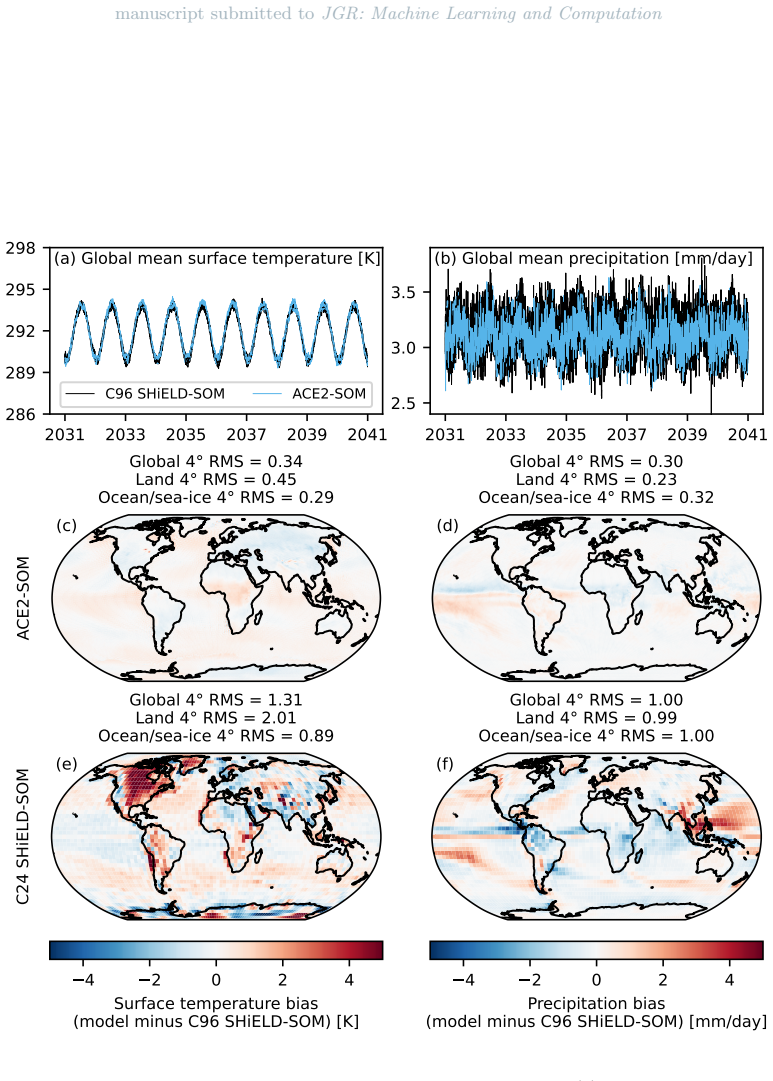
On its own terms, the paper establishes that ACE2-SOM, trained on equilibrium output from a 100-km-resolution physics-based model coupled to a slab ocean, can generalize its learned dynamics to a CO2 concentration between the training values. In the out-of-sample 3xCO2 equilibrium, time-mean surface temperature and precipitation biases are small, and the model reproduces the well-known pattern of greenhouse warming—tropical upper-tropospheric maximum, stratospheric cooling, land warming more than ocean—closely. Precipitation extremes up to the 99.9999th percentile of daily rates also match the target model, and the emulator's climate-change-pattern errors are smaller than or comparable to those of a 400-km physics-based baseline at a fraction of the cost. The same skill does not carry over to transitions: with gradually increasing CO2, stratospheric temperature and water content shift abruptly between values correlated with the quantized training CO2 levels, and with abrupt quadrupling, ML-predicted fields relax to the 4x regime faster than the slab ocean, producing a moist static energy budget imbalance and spurious sensitivity of surface and top-of-atmosphere radiative fluxes to CO2.
Load-bearing premise
The equilibrium skill depends on ACE2-SOM's CO2 response being a physically generalizable forcing mechanism rather than an interpolation among the three training CO2 levels; the paper's own evidence of spurious shortwave and upward-longwave flux sensitivities, and of stratospheric values that jump between quantized training levels, shows this assumption can be violated.
Editorial extensions
If this is right
- If the central claim is correct, equilibrium climate sensitivity experiments—which currently require years of physics-based simulation—could be approximated by a trained ML emulator at roughly 100 times faster simulation speed.
- The skill extends to precipitation extremes up to the 99.9999th percentile, suggesting the emulator captures not just mean shifts but the distributional response of the hydrological cycle to warming.
- The out-of-sample 3x result implies the model has learned some generalizable relationship between CO2 forcing and the equilibrium state, rather than simply memorizing the three training climates.
- The energy-conservation violation in abrupt-CO2 runs shows that autoregressive ML emulators need explicit physical constraints before they can be trusted for transient climate change scenarios.
Reading between the lines
- A natural extension the paper does not pursue is to train on continuously varying CO2 trajectories instead of quantized equilibrium levels; the stratospheric regime shifts suggest this would break the spurious association between CO2 bins and slowly varying fields.
- The spurious radiative sensitivities point toward a hybrid fix: letting a lightweight, differentiable radiation scheme handle CO2-dependent longwave transfer while the ML model learns the rest of the dynamics.
- The same equilibrium-training protocol could be extended to other forcing agents—methane, aerosols, or land-use—as long as enough equilibrium reference climates are generated to span the forcing range.
- One testable consequence of the paper's analysis is that a model trained on only 1x and 4x should fail at 3x if the sensitivity is interpolative; a per-CO2 multi-call diagnostic (net flux versus CO2) could serve as a cheap screening test for physicality.
Editorial analysis
A structured set of objections, weighed in public.
Referee Report
Summary. This manuscript couples the Ai2 Climate Emulator version 2 (ACE2) to a slab ocean model, trains the resulting ACE2-SOM on equilibrium SHiELD-SOM output at 1x, 2x, and 4x CO2, and evaluates it in equilibrium (3x CO2) and non-equilibrium (2%/yr gradual increase, abrupt quadrupling) scenarios. The authors report that ACE2-SOM reproduces equilibrium surface temperature and precipitation change patterns, the vertical structure of warming and stratospheric cooling, and extreme precipitation distributions up to the 99.9999th percentile at 3x CO2, with smaller pattern RMSE than a coarse physics-based baseline in most cases. For non-equilibrium scenarios, ACE2-SOM captures global-mean surface temperature and precipitation trends in the gradual-increase case but shows stratospheric regime shifts, too-rapid adjustment under abrupt 4x CO2, violation of the global moist static energy budget, and spurious CO2 sensitivity of radiative fluxes in radiation multi-call experiments. The paper is transparent about these limitations and frames them as motivation for future work.
Significance. If the equilibrium results transfer beyond the specific 3x test, this is a noteworthy proof-of-concept: a learned 6-hourly atmospheric emulator coupled to a slab ocean can emulate the equilibrium climate response to CO2 changes at about 1500 simulated years per day, with public code, processed data, and model checkpoints provided. The paper also includes multiple ensemble members, a noise-floor estimate, and an explicit out-of-sample test, which are strengths. However, the central 'out-of-sample' claim is not yet fully supported, because 3x CO2 is bracketed by the 2x and 4x training concentrations and the paper's own diagnostics in Section 3.2.3 show that the learned CO2 sensitivity is partly unphysical. The honest reporting of non-equilibrium failures is a strength, but it also sharpens the need to determine whether the equilibrium skill reflects interpolation among training climates rather than a generalizable forcing mechanism.
major comments (3)
- [Section 3.2.3 and Figure 10; Section 3.2.1] The radiation multi-call experiments show that ACE2-SOM predicts CO2-dependent shortwave fluxes and surface-upward longwave flux that are physically spurious, and that it misses the logarithmic dependence of longwave fluxes on CO2. Section 3.2.1 additionally shows stratospheric fields jumping among values correlated with the quantized training CO2 levels. Because 3x CO2 lies between the 2x and 4x training concentrations, and because the equilibrium test states co-vary with CO2 as in training, the low 3x pattern RMSE is consistent with interpolation among neighboring training climates and does not by itself establish that the learned sensitivity is physically generalizable. I ask the authors to add an exterior-extrapolation equilibrium test (for example 1.5x or 5x CO2, or retraining on 1x/3x/4x and reporting 2x), and to either temper the abstract's 'out-of-sample' wording or qualify it as 'unseen intermediate concentration' until such a test is provided.
- [Section 2.2.2 and Section 3.3/Figure 11] The primary equilibrium results in Figures 1-5 are shown for the single best of four random seeds, selected by validation inference. Section 3.3 and Figure 11 reveal non-negligible seed-to-seed spread in the equilibrium climate-change-pattern RMSE for the equilibrium-trained models, but the main text does not quantify this spread for the 3x case or report whether all seeds beat the C24 baseline and remain close to the noise floor. For a central claim about equilibrium skill, the manuscript should report the median and range across seeds for the 3x temperature and precipitation change-pattern RMSE, or present all-seed results in the main text.
- [Section 2.2.3 and Section 3.2.2/Figure 9] The paper labels the gradual-increase and abrupt-4x runs as 'out-of-sample,' but the 3x equilibrium run is out-of-sample only in its CO2 value, whereas the non-equilibrium runs are out-of-sample in the combination of CO2 and atmospheric/surface state. This distinction matters because the abrupt-4x run violates global energy conservation (Figure 9) and shows radiative-flux sensitivities that are not physically consistent (Figure 10d). The authors should state explicitly in the abstract and conclusions that the equilibrium skill is not yet evidence of generalizable transient sensitivity, and should reserve 'out-of-sample' for tests that do not lie inside the convex hull of the training forcings or should clearly define the term if they keep the current usage.
minor comments (5)
- [Abstract] The sentence 'they violate global energy conservation and exhibit unphysical sensitivities of and surface and top of atmosphere radiative fluxes' contains a typo; it should read 'unphysical sensitivities of surface and top-of-atmosphere radiative fluxes.'
- [Figure 3 caption] The caption states 'relative that for C96 SHiELD-SOM'; the phrase should read 'relative to that for C96 SHiELD-SOM.'
- [Section 3.1.1] The noise-floor estimate in Equation (4) is described briefly; it would aid reproducibility to state explicitly that the windows are drawn from the same 50-year reference used as the target, and to note any caveat about non-independence between the emulator's internal variability and the reference variability.
- [Figure 7 caption] The panels labeled 'air_temperature_0' and 'specific_total_water_0' refer to the top atmospheric layer of ACE2's vertical coordinate; the caption should define the numbering convention for the layer index.
- [Table 1] The footnote describing the increasing-CO2 run says 'CO2 increases at a rate of 2% year-1 thereafter up to about 4x CO2 in 2100'; since the run starts in 2030 and rises for 70 years, the compound increase is approximately 3.9x, so 'about 4x' is fine but the arithmetic could be stated explicitly to avoid confusion.
Circularity Check
No significant circularity: ACE2-SOM is an explicitly fitted emulator whose equilibrium-climate claims are tested against a separately simulated physics-based benchmark, with the 3xCO2 case held out of training and in-sample cases labeled as such.
full rationale
The paper does not present a derivation-from-first-principles; it trains an autoregressive ML emulator on SHiELD-SOM reference output at 1x, 2x, and 4x CO2 and evaluates it on a held-out 3xCO2 equilibrium, a gradual-CO2-increase run, and an abrupt-quadrupling run. The central skill metric is RMSE of ACE2-SOM's equilibrated fields against C96 SHiELD-SOM, a separate physics-based model, so the evaluation is not equivalent to the training objective by construction. Section 2.2.3 explicitly labels 2x and 4x as in-sample and 3x as out-of-sample, so the paper is not renaming fitted reproduction as prediction. The main legitimate concern—that 3x skill may partly reflect interpolation between the bracketing 2x and 4x training climates rather than a physically generalizable CO2 forcing mechanism—is a limitation on external validity, not a circularity; the paper itself reports evidence in Sections 3.2.1 and 3.2.3 (stratospheric regime shifts and spurious radiative sensitivities) that the learned CO2 dependence is not fully physical. Self-citations to Watt-Meyer et al. (2024) for ACE2 architecture and training configuration are methodological and not load-bearing for the new claim, which is evaluated on data generated for this study. No equation-level reduction of the claimed prediction to its inputs was found.
Assumptions & free parameters
free parameters (3)
- Neural network weights of ACE2-SOM (SFNO) =
Not enumerated; millions of parameters
- Checkpoint selection among 4 random seeds =
Best inline inference skill on 1x/2x/4x validation
- Training hyperparameters (embedding dimension, vertical levels, epochs) =
384, 8, 30
assumptions (5)
- domain assumption Slab ocean equation (Eq 1) with prescribed Q-flux and mixed layer depth
- domain assumption Prescribed sea ice climatology
- domain assumption SHiELD-SOM reference simulations are treated as ground truth
- domain assumption The 6-hour autoregressive ML state is sufficient to determine the climate response to CO2
- standard math Energy budget equation (Eq 5) from Neelin and Held (1987)
Cite this review
Pith. "Pith review of ACE2-SOM: Coupling an ML atmospheric emulator to a slab ocean and learning the sensitivity of climate to changed CO$_2$." pith.science (2026). https://pith.science/paper/QRTJM3T7
@misc{pith2026241204418,
  author       = {Pith},
  title        = {Pith review of: ACE2-SOM: Coupling an ML atmospheric emulator to a slab ocean and learning the sensitivity of climate to changed CO$_2$},
  year         = {2026},
  howpublished = {\url{https://pith.science/paper/QRTJM3T7}},
  note         = {Machine review of arXiv:2412.04418}
}
abstract
While autoregressive machine-learning-based emulators have been trained to produce stable and accurate rollouts in the climate of the present-day and recent past, none so far have been trained to emulate the sensitivity of climate to substantial changes in CO$_2$ or other greenhouse gases. As an initial step we couple the Ai2 Climate Emulator version 2 to a slab ocean model (hereafter ACE2-SOM) and train it on output from a collection of equilibrium-climate physics-based reference simulations with varying levels of CO$_2$. We test it in equilibrium and non-equilibrium climate scenarios with CO$_2$ concentrations seen and unseen in training. ACE2-SOM performs well in equilibrium-climate inference with both in-sample and out-of-sample CO$_2$ concentrations, accurately reproducing the emergent time-mean spatial patterns of surface temperature and precipitation change with CO$_2$ doubling, tripling, or quadrupling. In addition, the vertical profile of atmospheric warming and change in extreme precipitation rates up to the 99.9999th percentile closely agree with the reference model. Non-equilibrium-climate inference is more challenging. With CO$_2$ increasing gradually at a rate of 2% year$^{-1}$, ACE2-SOM can accurately emulate the global annual mean trends of surface and lower-to-middle atmosphere fields but produces unphysical jumps in stratospheric fields. With an abrupt quadrupling of CO$_2$, ML-controlled fields transition unrealistically quickly to the 4xCO$_2$ regime. In doing so they violate global energy conservation and exhibit unphysical sensitivities of and surface and top of atmosphere radiative fluxes to instantaneous changes in CO$_2$. Future emulator development needed to address these issues should improve its generalizability to diverse climate change scenarios.
Figures


Figures from the paper (9 more)


Forward citations
Cited by 2 Pith papers
-
Samudra: An AI Global Ocean Emulator for Climate
A ConvNeXt UNet trained on OM4 ocean model output reproduces full-depth ocean climatology and variability for centuries, while under-responding to climate-change forcing.
-
The Equilibrium Response of Atmospheric Machine-Learning Models to Uniform Sea Surface Temperature Warming
Under uniform +2 K SST warming, ML atmospheric emulators reproduce precipitation changes but show deficient land warming, upper-tropospheric warming, and radiative responses compared with the AM4 GCM.
Reference graph
Works this paper leans on
-
[1]
apacite url apacite =6pt Acknowledgments. 6pt 1sp \@dates Received \@recvdate\@empty\@rcvaccrule \@recvdate \@revisedate\@empty ; revised \@revisedate; \@accptdate\@empty \@revisedate\@empty; accepted \@accptdate \@pubdate\@empty. ; published \@pubdate. -2pt \@authaddrs @list\@empty =.15in @list 1sp @list =9pt plus 2pt minus 6pt \@sluginfo width 4pc =3000...
2001
-
[2]
\@ifstar \@figbox \@figbox \@figbox#1#2#3 to !#1! #3 [#1][c] !#2!#3 \@tempdima#2 \@tempdima by2 \@tempdima by- \@tempdima by- \@height\@tempdima\@depth\@tempdima\@width @ to @ #3 Bib ??? ??? ??? =0 =0 = @figure=0 @table=0 #1 --#1 -24pt -2ex #1 0= #1 to 0 #1 I NDEX T ERMS: #1 #1 Citation: #1 Feb 9, 2009 Changed name and references to name from agu2001 to a...
arXiv 2009
-
[3]
All2002a APACrefauthors Allen, M R. \ Ingram, W J. APACrefauthors \ 2002 09 . Constraints on future changes in climate and the hydrologic cycle Constraints on future changes in climate and the hydrologic cycle . Nature 419 6903 224--232 . APACrefDOI doi:10.1038/nature01092 APACrefDOI
-
[4]
Bas2024 APACrefauthors Bassetti, S. , Hutchinson, B. , Tebaldi, C. \ Kravitz, B. APACrefauthors \ 2024 . DiffESM : Conditional Emulation of Temperature and Precipitation in Earth System Models With 3D Diffusion Models DiffESM : Conditional Emulation of Temperature and Precipitation in Earth System Models With 3D Diffusion Models . Journal of Advances in M...
-
[5]
Bon2023 APACrefauthors Bonev, B. , Kurth, T. , Hundt, C. , Pathak, J. , Baust, M. , Kashinath, K. \ Anandkumar, A. APACrefauthors \ 2023 06 . Spherical Fourier Neural Operators : Learning Stable Dynamics on the Sphere Spherical Fourier Neural Operators : Learning Stable Dynamics on the Sphere \ ( \ arXiv:2306.03838). arXiv . APACrefDOI doi:10.48550/arXiv....
-
[6]
Che2022 APACrefauthors Cheng, K Y. , Harris, L. , Bretherton, C. , Merlis, T M. , Bolot, M. , Zhou, L. Fueglistaler, S. APACrefauthors \ 2022 . Impact of Warmer Sea Surface Temperature on the Global Pattern of Intense Convection : Insights From a Global Storm Resolving Model Impact of Warmer Sea Surface Temperature on the Global Pattern of Intense Convect...
-
[7]
Cla2024 APACrefauthors Clark, S K. , Watt-Meyer , O. , Kwa, A. , McGibbon, J. , Henn, B. , Perkins, W A. Bretherton, C S. APACrefauthors \ 2024 12 . ai2cm/ace2-som-paper. ai2cm/ace2-som-paper. Zenodo . APACrefDOI doi:10.5281/zenodo.14544672 APACrefDOI
-
[8]
Cre2024 APACrefauthors Cresswell-Clay , N. , Liu, B. , Durran, D. , Liu, A. , Espinosa, Z I. , Moreno, R. \ Karlbauer, M. APACrefauthors \ 2024 09 . A Deep Learning Earth System Model for Stable and Efficient Simulation of the Current Climate . A Deep Learning Earth System Model for Stable and Efficient Simulation of the Current Climate
work page 2024
Show all 63 references
-
[9]
\ Gent, P R
Dan2009 APACrefauthors Danabasoglu, G. \ Gent, P R. APACrefauthors \ 2009 05 . Equilibrium Climate Sensitivity : Is It Accurate to Use a Slab Ocean Model ? Equilibrium Climate Sensitivity : Is It Accurate to Use a Slab Ocean Model ? APACrefDOI doi:10.1175/2008JCLI2596.1 APACrefDOI
2009 doi
-
[10]
, Madec, G
de2004 APACrefauthors de Boyer Mont \'e gut , C. , Madec, G. , Fischer, A S. , Lazar, A. \ Iudicone, D. APACrefauthors \ 2004 . Mixed layer depth over the global ocean: An examination of profile data and a profile-based climatology Mixed layer depth over the global ocean: An e...
2004 doi
-
[11]
, Phillips, A
Des2012 APACrefauthors Deser, C. , Phillips, A. , Bourdette, V. \ Teng, H. APACrefauthors \ 2012 02 . Uncertainty in climate change projections: The role of internal variability Uncertainty in climate change projections: The role of internal variability . Climate Dynamics 38 3...
2012 doi
-
[12]
Dun2024 APACrefauthors Duncan, J P C. , Wu, E. , Golaz, J C. , Caldwell, P M. , Watt-Meyer , O. , Clark, S K. Bretherton, C S. APACrefauthors \ 2024 . Application of the AI2 Climate Emulator to E3SMv2 's Global Atmosphere Model , With a Focus on Precipitation Fidelity Applicat...
2024 doi
-
[13]
, Winton, M
Dun2020 APACrefauthors Dunne, J P. , Winton, M. , Bacmeister, J. , Danabasoglu, G. , Gettelman, A. , Golaz, J C. Wolfe, J D. APACrefauthors \ 2020 . Comparison of Equilibrium Climate Sensitivity Estimates From Slab Ocean , 150- Year , and Longer Simulations Comparison of Equil...
2020 doi
-
[14]
, Bony, S
Eyr2016 APACrefauthors Eyring, V. , Bony, S. , Meehl, G A. , Senior, C A. , Stevens, B. , Stouffer, R J. \ Taylor, K E. APACrefauthors \ 2016 05 . Overview of the Coupled Model Intercomparison Project Phase 6 ( CMIP6 ) experimental design and organization Overview of the Coupl...
2016 doi
-
[15]
, Giani, P
Fre2024 APACrefauthors Freese, L M. , Giani, P. , Fiore, A M. \ Selin, N E. APACrefauthors \ 2024 . Spatially Resolved Temperature Response Functions to CO2 Emissions Spatially Resolved Temperature Response Functions to CO2 Emissions . Geophysical Research Letters 51 15 e2024G...
2024 doi
-
[16]
, Van Roekel, L P
Gol2022 APACrefauthors Golaz, J C. , Van Roekel, L P. , Zheng, X. , Roberts, A F. , Wolfe, J D. , Lin, W. Bader, D C. APACrefauthors \ 2022 . The DOE E3SM Model Version 2: Overview of the Physical Model and Initial Model Evaluation The DOE E3SM Model Version 2: Overview of the...
2022 doi
-
[17]
, Arcomano, T
Gua2024 APACrefauthors Guan, H. , Arcomano, T. , Chattopadhyay, A. \ Maulik, R. APACrefauthors \ 2024 05 . LUCIE : A Lightweight Uncoupled ClImate Emulator with long-term stability and physical consistency for O (1000)-member ensembles. LUCIE : A Lightweight Uncoupled ClImate ...
2024
-
[18]
APACrefauthors \ 2004 04
Hal2004 APACrefauthors Hall, A. APACrefauthors \ 2004 04 . The Role of Surface Albedo Feedback in Climate The Role of Surface Albedo Feedback in Climate . Journal of Climate 17 7 1550--1568 . APACrefDOI doi:10.1175/1520-0442(2004)017<1550:TROSAF>2.0.CO;2 APACrefDOI
2004 doi
-
[19]
, Lacis, A
Han1983 APACrefauthors Hansen, J. , Lacis, A. , Rind, D. , Russell, G. , Stone, P. , Fung, I. Lerner, J. APACrefauthors \ 1983 . Climate sensitivity: Analysis of feedback mechanisms Climate sensitivity: Analysis of feedback mechanisms . Geophysical Monograph Series: Climate Pr...
1983
-
[20]
, Zhou, L
Har2020 APACrefauthors Harris, L. , Zhou, L. , Lin, S J. , Chen, J H. , Chen, X. , Gao, K. Stern, W. APACrefauthors \ 2020 . GFDL SHiELD : A Unified System for Weather-to-Seasonal Prediction GFDL SHiELD : A Unified System for Weather-to-Seasonal Prediction . Journal of Advance...
2020 doi
-
[21]
, Guo, H
Hel2019 APACrefauthors Held, I M. , Guo, H. , Adcroft, A. , Dunne, J P. , Horowitz, L W. , Krasting, J. Zadeh, N. APACrefauthors \ 2019 . Structure and Performance of GFDL 's CM4 .0 Climate Model Structure and Performance of GFDL 's CM4 .0 Climate Model . Journal of Advances i...
2019 doi
-
[22]
\ Soden, B J
Hel2006 APACrefauthors Held, I M. \ Soden, B J. APACrefauthors \ 2006 11 . Robust Responses of the Hydrological Cycle to Global Warming Robust Responses of the Hydrological Cycle to Global Warming . APACrefDOI doi:10.1175/JCLI3990.1 APACrefDOI
2006 doi
-
[23]
\ Bani Shahabadi, M
Hua2014a APACrefauthors Huang, Y. \ Bani Shahabadi, M. APACrefauthors \ 2014 . Why logarithmic? A note on the dependence of radiative forcing on gas concentration Why logarithmic? A note on the dependence of radiative forcing on gas concentration . Journal of Geophysical Resea...
2014 doi
-
[24]
\ Romps, D M
Jee2018 APACrefauthors Jeevanjee, N. \ Romps, D M. APACrefauthors \ 2018 11 . Mean precipitation change from a deepening troposphere Mean precipitation change from a deepening troposphere . Proceedings of the National Academy of Sciences 115 45 11465--11470 . APACrefDOI doi:10...
2018 doi
-
[25]
, Shin, Y
Kan2023 APACrefauthors Kang, S M. , Shin, Y. , Kim, H. , Xie, S P. \ Hu, S. APACrefauthors \ 2023 05 . Disentangling the mechanisms of equatorial Pacific climate change Disentangling the mechanisms of equatorial Pacific climate change . Science Advances 9 19 eadf5059 . APACref...
2023 doi
-
[26]
, Cresswell-Clay , N
Kar2024 APACrefauthors Karlbauer, M. , Cresswell-Clay , N. , Durran, D R. , Moreno, R A. , Kurth, T. , Bonev, B. Butz, M V. APACrefauthors \ 2024 . Advancing Parsimonious Deep Learning Weather Prediction Using the HEALPix Mesh Advancing Parsimonious Deep Learning Weather Predi...
2024 doi
-
[27]
, Shields, C A
Kie2006 APACrefauthors Kiehl, J T. , Shields, C A. , Hack, J J. \ Collins, W D. APACrefauthors \ 2006 11 . The Climate Sensitivity of the Community Climate System Model Version 3 ( CCSM3 ) The Climate Sensitivity of the Community Climate System Model Version 3 ( CCSM3 ) . Jour...
2006
-
[28]
, Yuval, J
Koc2024 APACrefauthors Kochkov, D. , Yuval, J. , Langmore, I. , Norgaard, P. , Smith, J. , Mooers, G. Hoyer, S. APACrefauthors \ 2024 08 . Neural general circulation models for weather and climate Neural general circulation models for weather and climate . Nature 632 8027 1060...
2024 doi
-
[29]
, Marotzke, J
Lee2021 APACrefauthors Lee, J Y. , Marotzke, J. , Bala, G. , Cao, L. , Corti, S. , Dunne, J. Zhou, T. APACrefauthors \ 2021 . Future global climate: Scenario-based projections and near-term information Future global climate: Scenario-based projections and near-term information...
2021
-
[30]
, L'Heureux, M
Lee2022 APACrefauthors Lee, S. , L'Heureux, M. , Wittenberg, A T. , Seager, R. , O'Gorman, P A. \ Johnson, N C. APACrefauthors \ 2022 10 . On the future zonal contrasts of equatorial Pacific climate: Perspectives from Observations , Simulations , and Theories On the future zon...
2022 doi
-
[31]
, Bhouri, M A
Lin2024 APACrefauthors Lin, J. , Bhouri, M A. , Beucler, T. , Yu, S. \ Pritchard, M. APACrefauthors \ 2024 01 . Stress-testing the coupled behavior of hybrid physics-machine learning climate simulations on an unseen, warmer climate Stress-testing the coupled behavior of hybrid...
-
[32]
, Ferrari, R
Lut2024 APACrefauthors L \"u tjens, B. , Ferrari, R. , Watson-Parris , D. \ Selin, N. APACrefauthors \ 2024 08 . The impact of internal variability on benchmarking deep learning climate emulators The impact of internal variability on benchmarking deep learning climate emulator...
2024 doi
-
[33]
\ Wetherald, R T
Man1967 APACrefauthors Manabe, S. \ Wetherald, R T. APACrefauthors \ 1967 05 . Thermal Equilibrium of the Atmosphere with a Given Distribution of Relative Humidity Thermal Equilibrium of the Atmosphere with a Given Distribution of Relative Humidity . Journal of the Atmospheric...
1967
-
[34]
, Covey, C
Mee2007 APACrefauthors Meehl, G A. , Covey, C. , Delworth, T. , Latif, M. , McAvaney, B. , Mitchell, J F B. Taylor, K E. APACrefauthors \ 2007 09 . THE WCRP CMIP3 Multimodel Dataset : A New Era in Climate Change Research THE WCRP CMIP3 Multimodel Dataset : A New Era in Climate...
2007 doi
-
[35]
APACrefauthors \ 2003 10
Mit2003 APACrefauthors Mitchell, T D. APACrefauthors \ 2003 10 . Pattern Scaling : An Examination of the Accuracy of the Technique for Describing Future Climates Pattern Scaling : An Examination of the Accuracy of the Technique for Describing Future Climates . Climatic Change ...
2003 doi
-
[36]
, Lejeune, Q
Nat2022 APACrefauthors Nath, S. , Lejeune, Q. , Beusch, L. , Seneviratne, S I. \ Schleussner, C F. APACrefauthors \ 2022 04 . MESMER-M : an Earth system model emulator for spatially resolved monthly temperature MESMER-M : an Earth system model emulator for spatially resolved m...
2022 doi
-
[37]
\ Held, I M
Nee1987 APACrefauthors Neelin, J D. \ Held, I M. APACrefauthors \ 1987 01 . Modeling Tropical Convergence Based on the Moist Static Energy Budget Modeling Tropical Convergence Based on the Moist Static Energy Budget
1987
-
[38]
, Brandstetter, J
Ngu2023 APACrefauthors Nguyen, T. , Brandstetter, J. , Kapoor, A. , Gupta, J K. \ Grover, A. APACrefauthors \ 2023 12 . ClimaX : A foundation model for weather and climate ClimaX : A foundation model for weather and climate \ ( \ arXiv:2301.10343). arXiv . APACrefDOI doi:10.48...
-
[39]
APACrefauthors \ 2024 09
NOA2024 APACrefauthors NOAA-GFDL . APACrefauthors \ 2024 09 . NOAA-GFDL / FRE-NCtools . NOAA-GFDL / FRE-NCtools . NOAA - Geophysical Fluid Dynamics Laboratory
2024
-
[40]
\ Dwyer, J G
OG2018 APACrefauthors O'Gorman, P A. \ Dwyer, J G. APACrefauthors \ 2018 . Using Machine Learning to Parameterize Moist Convection : Potential for Modeling of Climate , Climate Change , and Extreme Events Using Machine Learning to Parameterize Moist Convection : Potential for ...
2018 doi
-
[41]
\ Schneider, T
OG2009 APACrefauthors O'Gorman, P A. \ Schneider, T. APACrefauthors \ 2009 09 . The physical basis for increases in precipitation extremes in simulations of 21st-century climate change The physical basis for increases in precipitation extremes in simulations of 21st-century cl...
2009 doi
-
[42]
, Tebaldi, C
ON2016 APACrefauthors O'Neill, B C. , Tebaldi, C. , van Vuuren , D P. , Eyring, V. , Friedlingstein, P. , Hurtt, G. Sanderson, B M. APACrefauthors \ 2016 09 . The Scenario Model Intercomparison Project ( ScenarioMIP ) for CMIP6 The Scenario Model Intercomparison Project ( Scen...
2016 doi
-
[43]
, Buehler, S A
Pin2020 APACrefauthors Pincus, R. , Buehler, S A. , Brath, M. , Crevoisier, C. , Jamil, O. , Franklin Evans, K. Tellier, Y. APACrefauthors \ 2020 . Benchmark Calculations of Radiative Forcing by Greenhouse Gases Benchmark Calculations of Radiative Forcing by Greenhouse Gases ....
2020 doi
-
[44]
, Koldunov, N
Rac2024 APACrefauthors Rackow, T. , Koldunov, N. , Lessig, C. , Sandu, I. , Alexe, M. , Chantry, M. Jung, T. APACrefauthors \ 2024 09 . Robustness of AI-based weather forecasts in a changing climate Robustness of AI-based weather forecasts in a changing climate \ ( \ arXiv:240...
2024 arXiv
-
[45]
, Hoyer, S
Ras2023 APACrefauthors Rasp, S. , Hoyer, S. , Merose, A. , Langmore, I. , Battaglia, P. , Russel, T. Sha, F. APACrefauthors \ 2023 . WeatherBench 2: A benchmark for the next generation of data-driven global weather models. WeatherBench 2: A benchmark for the next generation of...
2023
-
[46]
, van Vuuren , D P
Ria2017 APACrefauthors Riahi, K. , van Vuuren , D P. , Kriegler, E. , Edmonds, J. , O'Neill, B C. , Fujimori, S. Tavoni, M. APACrefauthors \ 2017 01 . The Shared Socioeconomic Pathways and their energy, land use, and greenhouse gas emissions implications: An overview The Share...
2017 doi
-
[47]
, Bloch-Johnson , J
Rug2019 APACrefauthors Rugenstein, M. , Bloch-Johnson , J. , Abe-Ouchi , A. , Andrews, T. , Beyerle, U. , Cao, L. Yang, S. APACrefauthors \ 2019 12 . LongRunMIP : Motivation and Design for a Large Collection of Millennial-Length AOGCM Simulations LongRunMIP : Motivation and De...
2019 doi
-
[48]
, Moorthi, S
Sah2014 APACrefauthors Saha, S. , Moorthi, S. , Wu, X. , Wang, J. , Nadiga, S. , Tripp, P. Becker, E. APACrefauthors \ 2014 03 . The NCEP Climate Forecast System Version 2 The NCEP Climate Forecast System Version 2 . APACrefDOI doi:10.1175/JCLI-D-12-00823.1 APACrefDOI
2014 doi
-
[49]
, Po-Chedley , S
San2023 APACrefauthors Santer, B D. , Po-Chedley , S. , Zhao, L. , Zou, C Z. , Fu, Q. , Solomon, S. Taylor, K E. APACrefauthors \ 2023 05 . Exceptional stratospheric contribution to human fingerprints on atmospheric temperature Exceptional stratospheric contribution to human f...
2023 doi
-
[50]
, Wigley, T M L
San1990 APACrefauthors Santer, B D. , Wigley, T M L. , Schlesinger, M E. \ Mitchell, J F B. APACrefauthors \ 1990 03 . Developing Climate Scenarios from Equilibrium GCM Results Developing Climate Scenarios from Equilibrium GCM Results \ . Hamburg, Germany Max-Planck-Institut f...
1990
-
[51]
, Gudmundsson, L
Sch2024 APACrefauthors Sch \"o ngart, S. , Gudmundsson, L. , Hauser, M. , Pfleiderer, P. , Lejeune, Q. , Nath, S. Schleussner, C F. APACrefauthors \ 2024 11 . Introducing the MESMER-M-TPv0 .1.0 module: spatially explicit Earth system model emulation for monthly precipitation a...
2024
-
[52]
\ Burridge, D M
Sim1981 APACrefauthors Simmons, A J. \ Burridge, D M. APACrefauthors \ 1981 04 . An Energy and Angular-Momentum Conserving Vertical Finite-Difference Scheme and Hybrid Vertical Coordinates An Energy and Angular-Momentum Conserving Vertical Finite-Difference Scheme and Hybrid V...
1981
-
[53]
\ Zhang, G J
Son2014 APACrefauthors Song, X. \ Zhang, G J. APACrefauthors \ 2014 10 . Role of Climate Feedback in El Ni \ n o -- Like SST Response to Global Warming Role of Climate Feedback in El Ni \ n o -- Like SST Response to Global Warming . APACrefDOI doi:10.1175/JCLI-D-14-00072.1 APACrefDOI
2014 doi
-
[54]
\ Ellis, T D
Ste2008 APACrefauthors Stephens, G L. \ Ellis, T D. APACrefauthors \ 2008 12 . Controls of Global-Mean Precipitation Increases in Global Warming GCM Experiments Controls of Global-Mean Precipitation Increases in Global Warming GCM Experiments . APACrefDOI doi:10.1175/2008JCLI2...
2008 doi
-
[55]
, Dong, B
Sut2007 APACrefauthors Sutton, R T. , Dong, B. \ Gregory, J M. APACrefauthors \ 2007 . Land/sea warming ratio in response to climate change: IPCC AR4 model results and comparison with observations Land/sea warming ratio in response to climate change: IPCC AR4 model results and...
2007 doi
-
[56]
, Stouffer, R J
Tay2012 APACrefauthors Taylor, K E. , Stouffer, R J. \ Meehl, G A. APACrefauthors \ 2012 04 . An Overview of CMIP5 and the Experiment Design An Overview of CMIP5 and the Experiment Design . APACrefDOI doi:10.1175/BAMS-D-11-00094.1 APACrefDOI
2012 doi
-
[57]
, Rogers, E
Thi2003 APACrefauthors Thi \'e baux, J. , Rogers, E. , Wang, W. \ Katz, B. APACrefauthors \ 2003 05 . A New High-Resolution Blended Real-Time Global Sea Surface Temperature Analysis A New High-Resolution Blended Real-Time Global Sea Surface Temperature Analysis . APACrefDOI do...
2003 doi
-
[58]
, Rao, Y
Wat2022 APACrefauthors Watson-Parris , D. , Rao, Y. , Olivi \'e , D. , Seland, . , Nowack, P. , Camps-Valls , G. Roesch, C. APACrefauthors \ 2022 . ClimateBench v1.0: A Benchmark for Data-Driven Climate Projections ClimateBench v1.0: A Benchmark for Data-Driven Climate Project...
2022 doi
-
[59]
, Dresdner, G
Wat2023a APACrefauthors Watt-Meyer , O. , Dresdner, G. , McGibbon, J. , Clark, S K. , Henn, B. , Duncan, J. Bretherton, C S. APACrefauthors \ 2023 10 . ACE : A fast, skillful learned global atmospheric model for climate prediction. ACE : A fast, skillful learned global atmosph...
2023
-
[60]
, Henn, B
Wat2024 APACrefauthors Watt-Meyer , O. , Henn, B. , McGibbon, J. , Clark, S K. , Kwa, A. , Perkins, W A. Bretherton, C S. APACrefauthors \ 2024 11 . ACE2 : Accurately learning subseasonal to decadal atmospheric variability and forced responses ACE2 : Accurately learning subsea...
-
[61]
, McGibbon, J
Wat2024a APACrefauthors Watt-Meyer , O. , McGibbon, J. , Henn, B. , Dresdner, G. , Duncan, J. \ Perkins, W A. APACrefauthors \ 2024 12 . ai2cm/ace: 2024.12.0. ai2cm/ace: 2024.12.0. Zenodo . APACrefDOI doi:10.5281/zenodo.14503970 APACrefDOI
2024 doi
-
[62]
, Durran, D R
Wey2020 APACrefauthors Weyn, J A. , Durran, D R. \ Caruana, R. APACrefauthors \ 2020 . Improving Data-Driven Global Weather Prediction Using Deep Convolutional Neural Networks on a Cubed Sphere Improving Data-Driven Global Weather Prediction Using Deep Convolutional Neural Net...
2020 doi
-
[63]
, Giani, P
Wom2024 APACrefauthors Womack, C. , Giani, P. , Eastham, S D. \ Selin, N E. APACrefauthors \ 2024 07 . Rapid Emulation of Spatially Resolved Temperature Response to Effective Radiative Forcing Rapid Emulation of Spatially Resolved Temperature Response to Effective Radiative Forcing
2024
Reviewed August 11, 2026 · model on record in the stance chip above.
Discussion (0). Continue with ORCID to comment.