REVIEW 4 major objections 4 minor 75 references
AI-powered Digital Twin of the Ocean: Reliable Uncertainty Quantification for Real-time Wave Height Prediction with Deep Ensemble
T0 review · 4 major / 4 minor · reviewed 2026-08-11 · deepseek-v4-flash
Pith's one-line read A deep-ensemble LSTM plus a single calibration factor predicts wave height up to 3.5 seconds ahead with R2 above 0.9 on real plant data, and cuts its uncertainty-calibration error by more than half.
desk verdict Plausible application of calibrated deep ensembles to wave height prediction, but the headline numbers don't yet survive scrutiny. read the letter →
The pith
A machine-rendered reading of the paper's core claim, the machinery that carries it, and where it could break.
The reading
What carries the argument
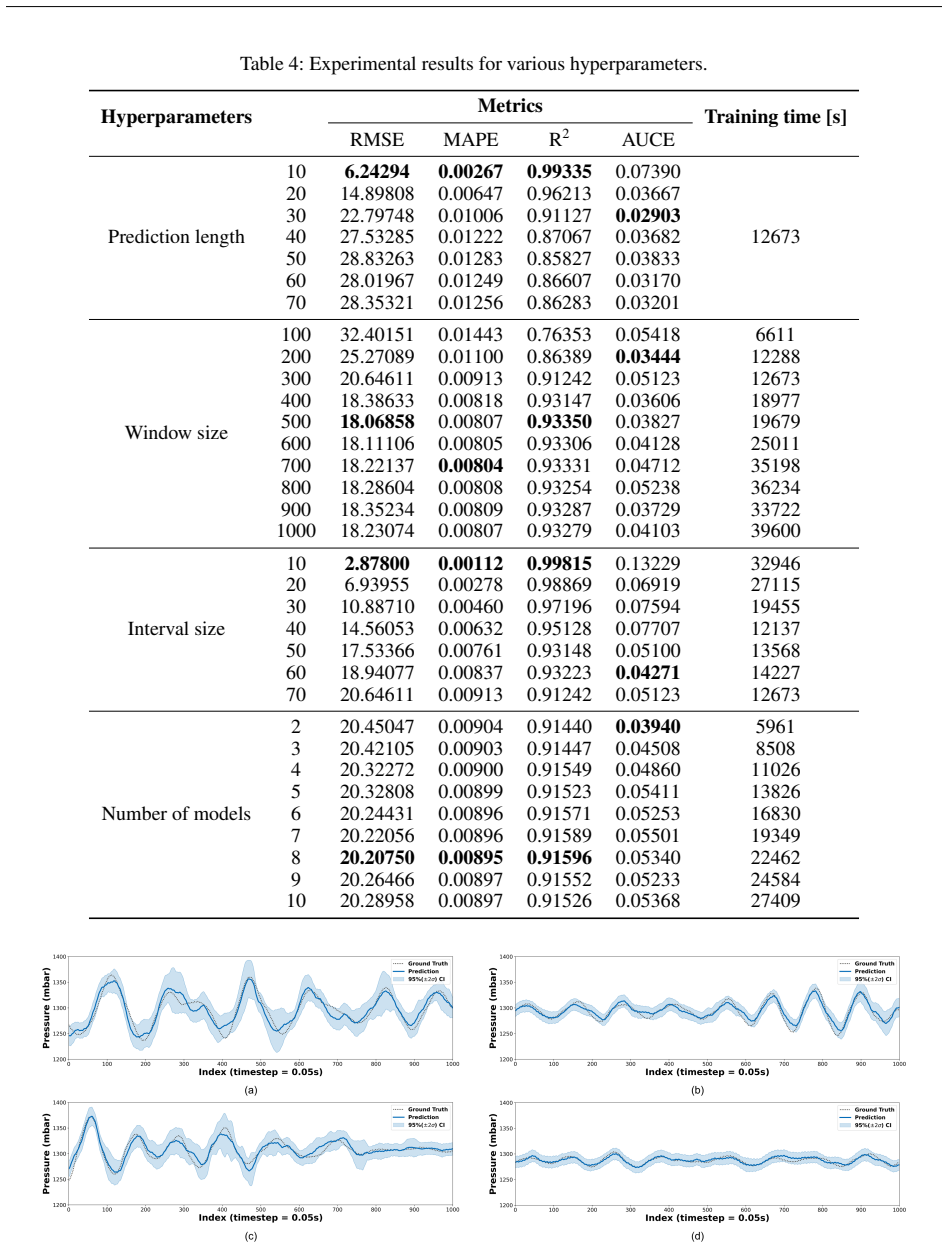
The load-bearing machinery is the LSTM-DE architecture, a chain of three mechanisms plus a design rule. First, the LSTM layer has 70 nodes in a single hidden layer but, unusually, concatenates the entire sequence of hidden states instead of keeping only the last state, and feeds that full temporal summary to two parallel output heads that predict the mean $\mu_i(x)$ and variance $\sigma_i^2(x)$ for $m$ future timesteps at once; this multi-output design sidesteps the error accumulation of autoregressive one-step forecasting. Second, the deep ensemble trains $M$ such networks with identical architecture and different random initializations under the negative log-likelihood loss of Eq. (2) and aggregates them with the Gaussian-mixture formulas of Eq. (3), so the reported variance covers both data noise (aleatoric) and model disagreement (epistemic). Third, STD scaling optimizes the scalar $s$ in Eq. (8) on the held-out validation set to minimize NLL and multiplies the predicted standard deviation by it, a post-hoc step that cannot disturb the point forecast. The design rule that carries much of the experimental design is the domain-knowledge heuristic that the input window should span two to three dominant wave periods and the output horizon about a half period — the parametric study confirms that windows beyond 300 timesteps buy only about 0.02 of $R^2$ at roughly three times the training time.
What would settle it
Run the identical fixed pipeline — same hyperparameters, same ensemble size, same STD-scaling procedure — on a dataset from a different season or a different OWC site and check two numbers: test $R^2$ and post-calibration AUCE. If $R^2$ falls below about 0.9, or the AUCE reduction is far below the reported 51–59 percent without re-learning the scaling factor $s$, the reliability claim is tied to the winter Jeju record rather than to the method. A second, arithmetic check: Section 4.5's text reports a 63.1 percent AUCE decrease for the baseline five-model ensemble while Table 5 records 54.7 percent for the same configuration, so a reproduction should settle which figure holds.
Extended reading notes
Core claim
The central claim is that accuracy and uncertainty quality can be engineered separately: an LSTM with a single hidden layer captures the temporal dynamics of the wave record, a deep ensemble of identically structured networks trained with different random initializations supplies both a predictive mean $\hat\mu(x)$ and predictive variance $\hat\sigma^2(x)$ through the aggregation of Eq. (3), and STD scaling — a single factor $s$ optimized on the validation split to minimize the negative log-likelihood — rescales the predicted standard deviation after training. On the test split the baseline five-member model reaches $R^2 = 0.91242$, RMSE = 20.64611, and MAPE = 0.00913, with $R^2$ above 0.99 at the 0.5-second horizon and above 0.85 out to 3.5 seconds. After calibration, the AUCE drops by 51 to 59 percent across ensemble sizes 2 through 10, and because every fitted scaling factor has $s < 1$, the uncalibrated ensemble is shown to be uniformly underconfident. The paper further claims that ocean-engineering domain knowledge sets near-optimal hyperparameters: roughly 300 timesteps (15 seconds) of history — two to three dominant gravity-wave periods — predicts 70 timesteps (3.5 seconds, about half a winter wave period) ahead with the reported accuracy at a fraction of the training cost of larger windows, and the calibrated model keeps ground truth inside its 95% confidence band across regular, amplifying, damping, and calm wave segments of the operational record.
Load-bearing premise
The load-bearing premise is that a single winter season of pressure readings from one sensor at the bottom of one OWC chamber, converted to wave height hydrostatically, is a sufficiently representative and stationary signal — if those three months at that one site do not stand for other seasons and locations, the reported $R^2$ and calibration gains do not transfer.
Editorial extensions
If this is right
- Short-horizon forecasts are the usable regime: $R^2$ is above 0.99 at 0.5 seconds ahead and remains above 0.85 out to 3.5 seconds, so control decisions should be pegged to the first one to two seconds of the predicted trajectory.
- The ensemble can stay small: accuracy is essentially flat from 2 to 10 members, while uncertainty quality stabilizes at about 5 members, making a five-model ensemble the recommended operating point.
- Domain knowledge, not brute-force tuning, sets the hyperparameters: a 15-second input window achieves $R^2 > 0.9$, and window sizes up to 1000 timesteps add only about 0.02 of $R^2$ while multiplying training time by about three.
- Because the calibration step is post-hoc, scalar, and uses only the validation set, it adds negligible computation in deployment — the property that makes reliable uncertainty usable inside an online control loop or digital twin.
- The calibrated 95% intervals widen at wave peaks, troughs, and direction transitions, which are exactly the instants where a deterministic forecast would be most dangerous, so the uncertainty output points at the risky moments for turbine protection.
Reading between the lines
- Editorial inference: the calibration numbers are demonstrated inside a single winter distribution; the decisive test is distribution shift — summer swell, storms, or a second site — and the fact that every fitted scaling factor is below 1 suggests $s$ would need re-estimation rather than transfer, a point the authors concede when they call for multi-year data in future work.
- Editorial inference: the 'two to three dominant periods' input rule is frequency-domain reasoning in disguise, so the same architecture-plus-calibration recipe should port to any oscillatory signal with a known dominant period, such as tides, structural vibration, or breathing loads — the paper does not make this claim.
- Editorial inference: the paper validates statistical calibration, not operational benefit; a closed-loop test that feeds the calibrated 95% intervals into the plant's control logic and measures whether turbine trips or air-inflow excursions decrease would settle whether the digital-twin promise is realized.
- Editorial inference: with MAPE near 0.9 percent and errors growing with horizon, the residual risk is concentrated in the largest peaks, so pairing the calibrated uncertainty with peak-amplitude alerts would directly serve the turbine-protection use case the paper motivates.
Signed reviews
Editorial analysis
A structured set of objections, weighed in public.
Referee Report
Summary. The paper proposes an LSTM-based deep ensemble (LSTM-DE) model with post-hoc standard-deviation (STD) scaling for real-time wave height prediction using univariate pressure-sensor data from a 500 kW OWC-WEC in Jeju, converted to wave height and min-max normalized. The authors report R2 > 0.9 on a held-out test set and reductions in AUCE of 51–59% after calibration across ensemble sizes of 2 to 10, and they support these results with a parametric study over prediction length, window size, interval size, and ensemble size, as well as qualitative checks on four wave regimes. The paper claims this is the first calibrated deep-ensemble application to real-time wave height prediction and frames the contribution toward digital twin operation of WECs.
Significance. If the quantitative claims were internally consistent, the paper would be a useful applied contribution: it is the first to combine LSTM with deep ensembles and STD scaling for wave-height forecasting on real operational data, and the parametric study could give practitioners practical hyperparameter guidance. The paper also ships a concrete probabilistic architecture (Eq. 3) and a calibration recipe (Eq. 8) that are simple to replicate. However, the quantitative strength of the central claims is currently undercut by unresolved inconsistencies in the reported metrics, the scaling-factor table, and the physical units, so the significance cannot yet be assessed as stated.
major comments (4)
- [§4.3, Table 4 vs. Table 2] The same baseline configuration (M=5, window=300, interval=70) is reported with different metrics in two places: Table 2 gives RMSE=20.64611, MAPE=0.00913, R2=0.91242, AUCE=0.05123, while the 'Number of models' block of Table 4 reports RMSE=20.32808, MAPE=0.00899, R2=0.91523, AUCE=0.05411 for the same hyperparameters. Since no error bars, random-seed control, or repeated-run statistics are provided, these two tables cannot both describe a reproducible single run. This is a load-bearing issue for the abstract's R2 > 0.9 and the >50% AUCE claims, because the exact values of the baseline are not reproducible from the manuscript.
- [§4.5, Table 5] The STD scaling factors in Table 5 are implausible under the stated protocol of Eq. (8), which minimizes NLL on a separate validation set for each ensemble. DE-2 and DE-3 share s=0.86652 to five decimals, and DE-4, DE-6, DE-7, DE-8, DE-9, DE-10 all share s=0.78296 to five decimals, despite having different AUCE values before and after calibration. Exact duplication at this precision is not credible unless the ensembles are degenerate or the values were copied rather than independently optimized. The paper must either show per-ensemble optimization traces or explain why the same s is expected on separate validation sets.
- [§2.1, §4.1, Tables 2–3] The reported RMSE values are physically inconsistent with the stated target. The authors state that pressure (mbar) was converted to wave height in meters and then min-max normalized, but Table 2 reports RMSE=20.646 and MAPE=0.00913 on the test set. If the target were in meters, RMSE ~20 m is implausible for a 3.5 s forecast of OWC chamber water-column height in Jeju winter; if the RMSE is in normalized units or in mbar, then the claim 'wave height prediction' needs the scale and unit of every metric to be stated explicitly. The paper needs to clarify whether RMSE, MAPE, and R2 are computed on normalized or physical scale, because the abstract's 'notable accuracy' is ambiguous without that.
- [§4.2–§4.5] The paper makes strong comparative claims (DE outperforms BNN and MC dropout; calibration improves UQ; the proposed 'lightweight' architecture is effective) but provides no baseline comparisons. There is no deterministic LSTM, no BNN, no MC dropout, and no existing wave-height forecaster evaluated on the same data. The only comparison is among ensemble sizes 2–10, which cannot support the statement that DE is 'more practical' than BNN or that the proposed architecture is superior to standard LSTM last-state approaches. The central novelty claim 'first calibrated DE for wave height prediction' requires at least one direct comparison to a non-ensemble probabilistic baseline.
minor comments (4)
- [§2.2] There is a typo in the text: 'time-seires' should be 'time-series'.
- [§4.5, Fig. 12 vs. Table 5] The narrative states 'AUCE decreases 63.1%' for the baseline model, but Table 5 lists a 54.7% decrease for DE-5, which appears to be the same configuration. Please reconcile the percentage or clarify whether the 63.1% refers to a different index or a different run.
- [§4.2–§4.5] No error bars or standard deviations are reported for any metric, despite the acknowledged stochasticity of neural-network training (different random initializations). Since Table 4 and Table 2 already disagree for the same configuration, the authors should report mean ± std over multiple independent runs for all headline numbers.
- [§2.5, Eq. (8)] The scaling factor s is defined as minimizing the NLL on a 'separate validation dataset,' but the paper does not state how the validation split is separated from the 10% test split used for Table 2, nor whether the same scaling factor is used for all prediction indices. Please specify the exact validation split and whether s is re-estimated per index or globally.
Circularity Check
No significant circularity: the central calibration improvement is evaluated on held-out test data; the only author self-citation is not load-bearing.
full rationale
The derivation chain is self-contained with respect to the main claims. Point predictions are assessed on a test split not used for training (Table 2), and the claimed AUCE reduction is obtained by fitting the scaling factor s on a separate validation set via Eq. (8), then recomputing calibration error on the test set (Table 5). Because s minimizes NLL rather than AUCE, the reported after-calibration AUCE is not equal to the fitted objective by construction, so the >50% improvement is an empirical held-out result rather than a self-definitional consequence. The parametric study and the validation across regular, amplifying, damping, and calm waves are also independent empirical evaluations, not mathematical consequences of the model definition. The one author self-citation, Ref. [61] for the DE calibration framework, is used as background and is not load-bearing: the wave-height conclusions follow from the new OWC-WEC operational data and the reported test metrics, not from the cited framework alone. The reviewer-noted anomalies, such as identical scaling factors in Table 5 for different ensemble sizes and slightly differing baseline metrics between Tables 2 and 4, are internal-consistency and reproducibility concerns, not circularity, since the after-calibration values are still computed from the model outputs rather than stipulated. The stated limitation of using only one winter season from one site is a data-coverage caveat, not a circular step.
Assumptions & free parameters
free parameters (6)
- STD scaling factor s =
0.74425 to 0.86652 across ensemble sizes (Table 5)
- LSTM window size =
300 timesteps (15 seconds)
- LSTM interval size =
70 timesteps (3.5 seconds)
- Step size =
50 timesteps (2.5 seconds)
- Number of ensemble models =
5
- LSTM hidden nodes and epochs =
70 nodes, 3500 epochs
assumptions (6)
- domain assumption Pressure at the chamber bottom converts linearly to water column height via hydrostatic pressure (p = rho g h).
- domain assumption A univariate pressure signal is a sufficient state for predicting future wave height inside the chamber.
- domain assumption Gravity wave period knowledge (energy concentrated in 5-15 s, winter waves 3-7 s in Jeju) guides the choices of window and interval sizes.
- domain assumption The temporal train/validation/test split assumes the December to February data are representative and sufficiently stationary for time extrapolation.
- standard math Heteroscedastic Gaussian output with NLL loss is an adequate probabilistic model for wave height.
- standard math Deep ensemble aggregation via Eq. (3) treats the mixture as a Gaussian for confidence interval construction.
Cite this review
Pith. "Pith review of AI-powered Digital Twin of the Ocean: Reliable Uncertainty Quantification for Real-time Wave Height Prediction with Deep Ensemble." pith.science (2026). https://pith.science/paper/2KZQHFKH
@misc{pith2026241205475,
  author       = {Pith},
  title        = {Pith review of: AI-powered Digital Twin of the Ocean: Reliable Uncertainty Quantification for Real-time Wave Height Prediction with Deep Ensemble},
  year         = {2026},
  howpublished = {\url{https://pith.science/paper/2KZQHFKH}},
  note         = {Machine review of arXiv:2412.05475}
}
read the original abstract
Environmental pollution and fossil fuel depletion have prompted the need for renewable energy-based power generation. However, its stability is often challenged by low energy density and non-stationary conditions. Wave energy converters (WECs), in particular, need reliable real-time wave height prediction to address these issues caused by irregular wave patterns, which can lead to the inefficient and unstable operation of WECs. In this study, we propose an AI-powered reliable real-time wave height prediction model that integrates long short-term memory (LSTM) networks for temporal prediction with deep ensemble (DE) for robust uncertainty quantification (UQ), ensuring high accuracy and reliability. To further enhance the reliability, uncertainty calibration is applied, which has proven to significantly improve the quality of the quantified uncertainty. Using real operational data from an oscillating water column-wave energy converter (OWC-WEC) system in Jeju, South Korea, the model achieves notable accuracy (R2 > 0.9), while increasing uncertainty quality by over 50% through simple calibration technique. Furthermore, a comprehensive parametric study is conducted to explore the effects of key model hyperparameters, offering valuable guidelines for diverse operational scenarios, characterized by differences in wavelength, amplitude, and period. These results demonstrate the model's capability to deliver reliable predictions, facilitating digital twin of the ocean.
Figures


Figures from the paper (10 more)




Reference graph
Works this paper leans on
-
[1]
Sustainable development agenda: 2030
William Colglazier. Sustainable development agenda: 2030. Science, 349(6252):1048–1050, 2015
work page 2015
-
[2]
Jeffrey D Sachs, Guido Schmidt-Traub, Mariana Mazzucato, Dirk Messner, Nebojsa Nakicenovic, and Johan Rockström. Six transformations to achieve the sustainable development goals.Nature sustainability, 2(9):805–814, 2019
work page 2019
-
[3]
A review of energy extraction from wind and ocean: Technologies, merits, efficiencies, and cost
Shafiqur Rehman, Luai M Alhems, Md Mahbub Alam, Longjun Wang, and Zakria Toor. A review of energy extraction from wind and ocean: Technologies, merits, efficiencies, and cost. Ocean Engineering, 267:113192, 2023
work page 2023
-
[4]
A large-scale review of wave and tidal energy research over the last 20 years
Danial Khojasteh, Abbas Shamsipour, Luofeng Huang, Sasan Tavakoli, Milad Haghani, Francois Flocard, Maryam Farzadkhoo, Gregorio Iglesias, Mark Hemer, Matthew Lewis, et al. A large-scale review of wave and tidal energy research over the last 20 years. Ocean Engineering, 282:114995, 2023
work page 2023
-
[5]
Advanced wave energy conversion technologies for sustainable and smart sea: A comprehensive review
Hai Li, Xiaodan Shi, Weihua Kong, Lingji Kong, Yongli Hu, Xiaoping Wu, Hongye Pan, Zutao Zhang, Yajia Pan, and Jinyue Yan. Advanced wave energy conversion technologies for sustainable and smart sea: A comprehensive review. Renewable Energy, page 121980, 2024
work page 2024
-
[6]
Wave energy utilization: A review of the technologies
António F de O Falcão. Wave energy utilization: A review of the technologies. Renewable and sustainable energy reviews, 14(3):899–918, 2010
work page 2010
-
[7]
Energy harvesting: solar, wind, and ocean energy conversion systems
Alireza Khaligh and Omer C Onar. Energy harvesting: solar, wind, and ocean energy conversion systems. CRC press, 2017
work page 2017
-
[8]
Ocean wave energy converters: Status and challenges
Tunde Aderinto and Hua Li. Ocean wave energy converters: Status and challenges. Energies, 11(5):1250, 2018
work page 2018
Show all 75 references
-
[9]
Ocean energy systems wave energy modelling task: Modelling, verification and validation of wave energy converters
Fabian Wendt, Kim Nielsen, Yi-Hsiang Yu, Harry Bingham, Claes Eskilsson, Morten Kramer, Aurélien Babarit, Tim Bunnik, Ronan Costello, Sarah Crowley, et al. Ocean energy systems wave energy modelling task: Modelling, verification and validation of wave energy converters. Journa...
2019
-
[10]
Wave energy conversion
John Brooke. Wave energy conversion. Elsevier, 2003
2003
-
[11]
Ocean wave energy conversion
Michael E McCormick. Ocean wave energy conversion. Courier Corporation, 2013
2013
-
[12]
Ocean wave energy conversion: resource, technologies and performance
Aurélien Babarit. Ocean wave energy conversion: resource, technologies and performance. Elsevier, 2017
2017
-
[13]
Short-term wave forecasting for real-time control of wave energy converters
Francesco Fusco and John V Ringwood. Short-term wave forecasting for real-time control of wave energy converters. IEEE Transactions on sustainable energy, 1(2):99–106, 2010. 20
2010
-
[14]
A study of the prediction requirements in real-time control of wave energy converters
Francesco Fusco and John V Ringwood. A study of the prediction requirements in real-time control of wave energy converters. IEEE Transactions on Sustainable Energy, 3(1):176–184, 2011
2011
-
[15]
Wave energy converter control by wave prediction and dynamic programming
Guang Li, George Weiss, Markus Mueller, Stuart Townley, and Mike R Belmont. Wave energy converter control by wave prediction and dynamic programming. Renewable energy, 48:392–403, 2012
2012
-
[16]
Optimizing ocean-wave energy extraction of a dual coaxial-cylinder wec using nonlinear model predictive control
Daewoong Son and Ronald W Yeung. Optimizing ocean-wave energy extraction of a dual coaxial-cylinder wec using nonlinear model predictive control. Applied energy, 187:746–757, 2017
2017
-
[17]
In-ocean validation of a deterministic sea wave prediction (dswp) system leveraging x-band radar to enable optimal control in wave energy conversion systems
Mirko Previsic, Anantha Karthikeyan, and David Lyzenga. In-ocean validation of a deterministic sea wave prediction (dswp) system leveraging x-band radar to enable optimal control in wave energy conversion systems. Applied Ocean Research, 114:102784, 2021
2021
-
[18]
Experimental and computational analysis of elastomer membranes used in oscillating water column wecs
Farhad Abad, Saeid Lotfian, Saishuai Dai, Guangwei Zhao, Guillermo Idarraga Alarcon, Liu Yang, Yang Huang, Qing Xiao, and Feargal Brennan. Experimental and computational analysis of elastomer membranes used in oscillating water column wecs. Renewable Energy, 226:120422, 2024
2024
-
[19]
Wind waves: their generation and propagation on the ocean surface
Blair Kinsman. Wind waves: their generation and propagation on the ocean surface. Courier Corporation, 1984
1984
-
[20]
On the existence of a fully developed wind-sea spectrum
GJ Komen, Susanne Hasselmann, and Klaus Hasselmann. On the existence of a fully developed wind-sea spectrum. Journal of physical oceanography, 14:1271–1285, 1984
1984
-
[21]
Water waves: The mathematical theory with applications, volume 36
James Johnston Stoker. Water waves: The mathematical theory with applications, volume 36. John Wiley & Sons, 1992
1992
-
[22]
Dynamics and modelling of ocean waves
GK Komen, L Cavaleri, M Donelan, K Hasselmann, S Hasselmann, and PAEM Janssen. Dynamics and modelling of ocean waves. Cambridge Univ. Press, 1996
1996
-
[23]
Significant wave height prediction by using a spatial model
Abdüsselam Altunkaynak. Significant wave height prediction by using a spatial model. Ocean engineering, 32 (8-9):924–936, 2005
2005
-
[24]
Forecasting ocean waves: Comparing a physics-based model with statistical models
Gordon Reikard and W Erick Rogers. Forecasting ocean waves: Comparing a physics-based model with statistical models. Coastal Engineering, 58(5):409–416, 2011
2011
-
[25]
Ocean waves and oscillating systems: linear interactions including wave- energy extraction, volume 8
Johannes Falnes and Adi Kurniawan. Ocean waves and oscillating systems: linear interactions including wave- energy extraction, volume 8. Cambridge university press, 2020
2020
-
[26]
Evaluating the efficacy of svms, bns, anns and anfis in wave height prediction
Iman Malekmohamadi, Mohammad Reza Bazargan-Lari, Reza Kerachian, Mohammad Reza Nikoo, and Mahsa Fallahnia. Evaluating the efficacy of svms, bns, anns and anfis in wave height prediction. Ocean Engineering, 38 (2-3):487–497, 2011
2011
-
[27]
Nonlinear real time prediction of ocean surface waves
Nikolai Köllisch, Jasper Behrendt, Marco Klein, and Norbert Hoffmann. Nonlinear real time prediction of ocean surface waves. Ocean engineering, 157:387–400, 2018
2018
-
[28]
A machine learning framework to forecast wave conditions
Scott C James, Yushan Zhang, and Fearghal O’Donncha. A machine learning framework to forecast wave conditions. Coastal Engineering, 137:1–10, 2018
2018
-
[29]
A novel model to predict significant wave height based on long short-term memory network
Shuntao Fan, Nianhao Xiao, and Sheng Dong. A novel model to predict significant wave height based on long short-term memory network. Ocean Engineering, 205:107298, 2020
2020
-
[30]
Improved short-term prediction of significant wave height by decomposing deterministic and stochastic components
Weinan Huang and Sheng Dong. Improved short-term prediction of significant wave height by decomposing deterministic and stochastic components. Renewable Energy, 177:743–758, 2021
2021
-
[31]
Ocean wave energy forecasting using optimised deep learning neural networks
PMR Bento, JAN Pombo, RPG Mendes, MRA Calado, and SJPS Mariano. Ocean wave energy forecasting using optimised deep learning neural networks. Ocean Engineering, 219:108372, 2021
2021
-
[32]
Application of nested artificial neural network for the prediction of significant wave height
Amin Mahdavi-Meymand and Wojciech Sulisz. Application of nested artificial neural network for the prediction of significant wave height. Renewable Energy, 209:157–168, 2023
2023
-
[33]
Spatial-temporal wave height forecast using deep learning and public reanalysis dataset
Ti Zilong, Song Yubing, and Deng Xiaowei. Spatial-temporal wave height forecast using deep learning and public reanalysis dataset. Applied Energy, 326:120027, 2022
2022
-
[34]
Instantaneous prediction of irregular ocean surface wave based on deep learning
Gang Xu, Siwen Zhang, and Weichao Shi. Instantaneous prediction of irregular ocean surface wave based on deep learning. Ocean Engineering, 267:113218, 2023
2023
-
[35]
Prediction of near-field uni-directional and multi-directional random waves from far-field measurements with artificial neural networks
Tuyen Le Quang, My Ha Dao, and Xin Lu. Prediction of near-field uni-directional and multi-directional random waves from far-field measurements with artificial neural networks. Ocean Engineering, 278:114307, 2023
2023
-
[36]
Prediction of irregular wave (current)-induced pore water pressure around monopile using machine learning methods
Haiyang Cheng, Yongzhou Cheng, Yuwei Zheng, Jing Zhang, and Xing Lyu. Prediction of irregular wave (current)-induced pore water pressure around monopile using machine learning methods. Coastal Engineering, 182:104291, 2023
2023
-
[37]
A novel multivariable hybrid model to improve short and long-term significant wave height prediction
Junheng Pang and Sheng Dong. A novel multivariable hybrid model to improve short and long-term significant wave height prediction. Applied Energy, 351:121813, 2023. 21
2023
-
[38]
Phase-resolved wave prediction with linear wave theory and physics-informed neural networks
Yue Liu, Xiantao Zhang, Qing Dong, Gang Chen, and Xin Li. Phase-resolved wave prediction with linear wave theory and physics-informed neural networks. Applied Energy, 355:121602, 2024
2024
-
[39]
Development of pyramid neural networks for prediction of significant wave height for renewable energy farms
Amin Mahdavi-Meymand and Wojciech Sulisz. Development of pyramid neural networks for prediction of significant wave height for renewable energy farms. Applied Energy, 362:123009, 2024
2024
-
[40]
A wave forecasting method based on probabilistic diffusion lstm network for model predictive control of wave energy converters
Yongxiang Lei. A wave forecasting method based on probabilistic diffusion lstm network for model predictive control of wave energy converters. Applied Soft Computing, page 112006, 2024
2024
-
[41]
A numerical study on hydrodynamic performance of an inclined owc wave energy converter with nonlinear turbine–chamber interaction based on 3d potential flow
Jeong-Seok Kim, Bo Woo Nam, Kyong-Hwan Kim, Sewan Park, Seung Ho Shin, and Keyyong Hong. A numerical study on hydrodynamic performance of an inclined owc wave energy converter with nonlinear turbine–chamber interaction based on 3d potential flow. Journal of Marine Science and ...
2020
-
[42]
A numerical study on hydrodynamic energy conversions of owc-wec with the linear decomposition method under irregular waves
Jeong-Seok Kim, Kyong-Hwan Kim, Jiyong Park, Sewan Park, and Seung Ho Shin. A numerical study on hydrodynamic energy conversions of owc-wec with the linear decomposition method under irregular waves. Energies, 14(6):1522, 2021
2021
-
[43]
Uncertainty analysis of a wec model test experiment
Jarrah Orphin, Jean-Roch Nader, and Irene Penesis. Uncertainty analysis of a wec model test experiment. Renewable Energy, 168:216–233, 2021
2021
-
[44]
Experimental study on hydrodynamic behavior and energy conversion of multiple oscillating-water-column chamber in regular waves
Jeong-Seok Kim, Bo Woo Nam, Sejun Kim, Jiyong Park, Sewan Park, and Kyong-Hwan Kim. Experimental study on hydrodynamic behavior and energy conversion of multiple oscillating-water-column chamber in regular waves. Ocean Engineering, 280:114495, 2023
2023
-
[45]
Experimental and numerical investigations on the solitary wave actions on a land-fixed owc wave energy converter.Energy, 282:128363, 2023
De-zhi Ning, Di Mu, Rong-quan Wang, and Robert Mayon. Experimental and numerical investigations on the solitary wave actions on a land-fixed owc wave energy converter.Energy, 282:128363, 2023
2023
-
[46]
Prediction of air pressure change inside the chamber of an oscillating water column–wave energy converter using machine-learning in big data platform
Dongwoo Seo, Taesang Huh, Myungil Kim, Jaesoon Hwang, and Daeyong Jung. Prediction of air pressure change inside the chamber of an oscillating water column–wave energy converter using machine-learning in big data platform. Energies, 14(11):2982, 2021
2021
-
[47]
A review of uncertainty quantification in deep learning: Techniques, applications and challenges
Moloud Abdar, Farhad Pourpanah, Sadiq Hussain, Dana Rezazadegan, Li Liu, Mohammad Ghavamzadeh, Paul Fieguth, Xiaochun Cao, Abbas Khosravi, U Rajendra Acharya, et al. A review of uncertainty quantification in deep learning: Techniques, applications and challenges. Information f...
2021
-
[48]
Dropout as a bayesian approximation: Representing model uncertainty in deep learning
Yarin Gal and Zoubin Ghahramani. Dropout as a bayesian approximation: Representing model uncertainty in deep learning. In international conference on machine learning, pages 1050–1059. PMLR, 2016
2016
-
[49]
What uncertainties do we need in bayesian deep learning for computer vision? Advances in neural information processing systems, 30, 2017
Alex Kendall and Yarin Gal. What uncertainties do we need in bayesian deep learning for computer vision? Advances in neural information processing systems, 30, 2017
2017
-
[50]
Simple and scalable predictive uncertainty estimation using deep ensembles
Balaji Lakshminarayanan, Alexander Pritzel, and Charles Blundell. Simple and scalable predictive uncertainty estimation using deep ensembles. Advances in neural information processing systems, 30, 2017
2017
-
[51]
Hands-on bayesian neural networks—a tutorial for deep learning users
Laurent Valentin Jospin, Hamid Laga, Farid Boussaid, Wray Buntine, and Mohammed Bennamoun. Hands-on bayesian neural networks—a tutorial for deep learning users. IEEE Computational Intelligence Magazine, 17(2): 29–48, 2022
2022
-
[52]
Phase-resolved real-time ocean wave prediction with quantified uncertainty based on variational bayesian machine learning
Jincheng Zhang, Xiaowei Zhao, Siya Jin, and Deborah Greaves. Phase-resolved real-time ocean wave prediction with quantified uncertainty based on variational bayesian machine learning. Applied Energy, 324:119711, 2022
2022
-
[53]
Deep ensembles: A loss landscape perspective
Stanislav Fort, Huiyi Hu, and Balaji Lakshminarayanan. Deep ensembles: A loss landscape perspective. arXiv preprint arXiv:1912.02757, 2019
1912 arXiv
-
[54]
Probabilistic spatiotemporal solar irradiation forecasting using deep ensembles convolutional shared weight long short-term memory network
Guanjun Liu, Hui Qin, Qin Shen, Hao Lyv, Yuhua Qu, Jialong Fu, Yongqi Liu, and Jianzhong Zhou. Probabilistic spatiotemporal solar irradiation forecasting using deep ensembles convolutional shared weight long short-term memory network. Applied Energy, 300:117379, 2021
2021
-
[55]
Obtaining well calibrated probabilities using bayesian binning
Mahdi Pakdaman Naeini, Gregory Cooper, and Milos Hauskrecht. Obtaining well calibrated probabilities using bayesian binning. In Proceedings of the AAAI conference on artificial intelligence, volume 29, 2015
2015
-
[56]
On calibration of modern neural networks
Chuan Guo, Geoff Pleiss, Yu Sun, and Kilian Q Weinberger. On calibration of modern neural networks. In International conference on machine learning, pages 1321–1330. PMLR, 2017
2017
-
[57]
Accurate uncertainties for deep learning using calibrated regression
V olodymyr Kuleshov, Nathan Fenner, and Stefano Ermon. Accurate uncertainties for deep learning using calibrated regression. In International conference on machine learning, pages 2796–2804. PMLR, 2018
2018
-
[58]
Evaluating scalable bayesian deep learning methods for robust computer vision
Fredrik K Gustafsson, Martin Danelljan, and Thomas B Schon. Evaluating scalable bayesian deep learning methods for robust computer vision. In Proceedings of the IEEE/CVF conference on computer vision and pattern recognition workshops, pages 318–319, 2020. 22
2020
-
[59]
Evaluating scalable uncertainty estimation methods for deep learning-based molecular property prediction
Gabriele Scalia, Colin A Grambow, Barbara Pernici, Yi-Pei Li, and William H Green. Evaluating scalable uncertainty estimation methods for deep learning-based molecular property prediction. Journal of chemical information and modeling, 60(6):2697–2717, 2020
2020
-
[60]
Evaluating and calibrating uncertainty prediction in regression tasks
Dan Levi, Liran Gispan, Niv Giladi, and Ethan Fetaya. Evaluating and calibrating uncertainty prediction in regression tasks. Sensors, 22(15):5540, 2022
2022
-
[61]
Towards reliable uncertainty quantification via deep ensemble in multi-output regression task
Sunwoong Yang and Kwanjung Yee. Towards reliable uncertainty quantification via deep ensemble in multi-output regression task. Engineering Applications of Artificial Intelligence, 132:107871, 2024
2024
-
[62]
Oscillating-water-column wave energy converters and air turbines: A review
António FO Falcão and Joao CC Henriques. Oscillating-water-column wave energy converters and air turbines: A review. Renewable energy, 85:1391–1424, 2016
2016
-
[63]
Recursive distributed representations
Jordan B Pollack. Recursive distributed representations. Artificial Intelligence, 46(1-2):77–105, 1990
1990
-
[64]
A general framework for adaptive processing of data structures
Paolo Frasconi, Marco Gori, and Alessandro Sperduti. A general framework for adaptive processing of data structures. IEEE transactions on Neural Networks, 9(5):768–786, 1998
1998
-
[65]
Learning long-term dependencies with gradient descent is difficult
Yoshua Bengio, Patrice Simard, and Paolo Frasconi. Learning long-term dependencies with gradient descent is difficult. IEEE transactions on neural networks, 5(2):157–166, 1994
1994
-
[66]
Long short-term memory
Sepp Hochreiter and Jürgen Schmidhuber. Long short-term memory. Neural computation, 9(8):1735–1780, 1997
1997
-
[67]
Learning to forget: Continual prediction with lstm.Neural computation, 12(10):2451–2471, 2000
Felix A Gers, Jürgen Schmidhuber, and Fred Cummins. Learning to forget: Continual prediction with lstm.Neural computation, 12(10):2451–2471, 2000
2000
-
[68]
Deep learning, volume 1
Yoshua Bengio, Ian Goodfellow, and Aaron Courville. Deep learning, volume 1. MIT press Cambridge, MA, USA, 2017
2017
-
[69]
Practical time series analysis: Prediction with statistics and machine learning
Aileen Nielsen. Practical time series analysis: Prediction with statistics and machine learning. O’Reilly Media, 2019
2019
-
[70]
End-to-end continuous speech recognition using attention-based recurrent nn: First results
Jan Chorowski, Dzmitry Bahdanau, Kyunghyun Cho, and Yoshua Bengio. End-to-end continuous speech recognition using attention-based recurrent nn: First results. arXiv preprint arXiv:1412.1602, 2014
2014 arXiv
-
[71]
Attention-based models for speech recognition
Jan K Chorowski, Dzmitry Bahdanau, Dmitriy Serdyuk, Kyunghyun Cho, and Yoshua Bengio. Attention-based models for speech recognition. Advances in neural information processing systems, 28, 2015
2015
-
[72]
Deepar: Probabilistic forecasting with autoregressive recurrent networks
David Salinas, Valentin Flunkert, Jan Gasthaus, and Tim Januschowski. Deepar: Probabilistic forecasting with autoregressive recurrent networks. International journal of forecasting, 36(3):1181–1191, 2020
2020
-
[73]
Physics-constrained graph neural networks for spatio-temporal prediction of drop impact on oled display panels
Jiyong Kim, Jangseop Park, Nayong Kim, Younyeol Yu, Kiseok Chang, Chang-Seung Woo, Sunwoong Yang, and Namwoo Kang. Physics-constrained graph neural networks for spatio-temporal prediction of drop impact on oled display panels. arXiv preprint arXiv:2411.01848, 2024
2024 arXiv
-
[74]
Response of wave energy to tidal currents in the western sea of jeju island, korea
Ji-Seok Hong, Jae-Hong Moon, Taekyun Kim, Il-Hyoung Cho, Jongsu Choi, and Ji Yong Park. Response of wave energy to tidal currents in the western sea of jeju island, korea. Renewable Energy, 172:564–573, 2021
2021
-
[75]
Uncertainty quantification and deep ensembles
Rahul Rahaman et al. Uncertainty quantification and deep ensembles. Advances in neural information processing systems, 34:20063–20075, 2021. 23
2021
Reviewed August 11, 2026 · model on record in the stance chip above.
Discussion (0). Continue with ORCID to comment.