REVIEW 4 major objections 8 minor 53 references
Memory-enhanced Invariant Prompt Learning for Urban Flow Prediction under Distribution Shifts
T0 review · 4 major / 8 minor · reviewed 2026-08-11 · deepseek-v4-flash
Pith's one-line read Urban flow forecasting can be made robust to distribution shifts by learning which patterns are causal and which are spurious.
desk verdict A genuinely new prompt-learning combination for OOD urban flow, but the paper's own equations feed variant prompts into the final predictor, and the invariant loss never constrains that path. read the letter →
The pith
A machine-rendered reading of the paper's core claim, the machinery that carries it, and where it could break.
The reading
What carries the argument
The load-bearing object is the trainable memory bank $\Phi \in \mathbb{R}^{M \times d}$ of $M$ prototype vectors that store causal patterns. Invariant prompts are computed as $H_I^t = \mathrm{softmax}(Q^t \Phi^\top)\Phi$ and variant prompts as $H_V^t = \mathrm{softmax}(-Q^t \Phi^\top)\Phi$, so the negation flips the attention to pick patterns the memory bank does not encode. The intervention step randomly swaps entries of the variant prompt tensor across node and time pairs (Algorithm 1), and the invariant learning loss $\mathcal{L}_{inv} = \mathbb{E}[l] + \lambda_1 \mathrm{Var}[l]$ over per-location, per-time prediction errors enforces that predictions do not change when variant patterns change. A semantic adjacency matrix built purely from the memory-bank prototypes supplies a second graph alongside the geographic graph for information propagation.
What would settle it
Take a period of urban flow data with a known external event (e.g., a holiday or a major accident) that changes the relationship between traffic at neighboring sensors and the future flow at a target sensor, so the label genuinely depends on a variant pattern; if MIP's test error on that period does not jump materially compared with baselines, the invariance loss has failed to block the variant signal; a cheaper check is to permute the variant prompts between two distant days at inference time and measure whether the model's predictions shift.
Extended reading notes
Core claim
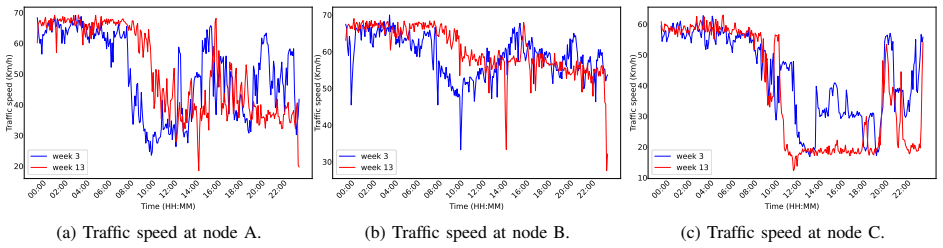
The central claim, stated in the paper's own terms, is that MIP clearly outperforms all competing baselines over the three testing sets for urban flow prediction under distribution shifts, on both the METR-LA traffic-speed dataset and the NYCBike bike-flow dataset. The mechanism is that a trainable memory bank memorizes causal features of the spatial-temporal graph; querying it yields invariant and variant prompts, and swapping a fraction of the variant prompts between nodes and time steps creates synthetic distribution shifts. Training with the invariant learning loss (mean plus variance of the prediction error) then makes predictions depend only on the invariant prompts, which is what gives the model OOD robustness. The paper further claims that this approach bypasses the need to parameterize or enumerate environments, which previous invariant learning methods for spatial-temporal data require.
Load-bearing premise
The assumption that every node's learned features split exactly into an invariant part that fully determines the label and a variant part that is conditionally independent of the label given the invariant part--if real urban flow data has no such clean split, the invariance loss cannot find a stable target and the claimed robustness has no foundation.
Editorial extensions
If this is right
- Deployed traffic models could keep making accurate predictions for a stretch of time after real-world distribution shifts, without retraining or re-estimating environments.
- The method removes the sensitive hyperparameter of the number of virtual environments, which earlier OOD methods for spatial-temporal graphs depend on.
- Semantic connections based on causal prototypes allow information to flow between locations with similar underlying flow behavior, even when they are not geographic neighbors.
- Because inference uses only the backbone model and drops the prompt extractor and intervention machinery, test-time latency remains low enough for near-real-time use.
Reading between the lines
- The intervention's validity rests on the swap being confined to truly label-irrelevant patterns; if some variant prompts are partially label-relevant, the same swap will also corrupt the invariant signal, so the method's success is itself evidence for how cleanly the memory bank separates the two.
- The same memory-bank-and-prompt design could be carried over to other spatial-temporal forecasting settings, such as crowd flow or energy demand, whenever a small set of causal prototypes plausibly summarizes the stable part of the dynamics.
- A direct test of the disentanglement claim would be to freeze a trained MIP and feed it a deliberately 'wrong' variant prompt from a different time and place at inference; predictions that barely change would confirm that only invariant prompts drive the output.
Signed reviews
Editorial analysis
A structured set of objections, weighed in public.
Referee Report
Summary. The paper proposes MIP (Memory-enhanced Invariant Prompt Learning), a framework for urban-flow forecasting under distribution shift. MIP maintains a learnable memory bank of prototype vectors, derives a static semantic adjacency matrix from the bank, and extracts invariant and variant prompt tensors H_I and H_V for each time step by querying the bank with positive and negative softmax scores (Eqs. 8-9). During training, variant prompts are randomly swapped across nodes and time steps (Algorithm 1), and an invariance loss (Eq. 13), computed on a separate auxiliary predictor, is used to encourage H_I to be sufficient for the label. At inference, a GNN/Transformer backbone produces the forecasts. The paper evaluates MIP on METR-LA and NYCBike with three chronologically split OOD test sets, reporting state-of-the-art or near-state-of-the-art results in Table II, along with ablations, hyperparameter sensitivity studies, a case study, and efficiency measurements.
Significance. The problem is timely and the high-level idea, replacing explicit environment enumeration with a latent-space intervention on prompts, is novel and potentially valuable for spatio-temporal OOD learning. The evaluation is honest in one important respect: the OOD test sets are strictly held out and were not used for fitting, so the reported numbers are not circular. The paper also provides ablations and sensitivity analyses and is transparent about its hyperparameters. However, the contribution as written is not established: the deployed backbone is initialized with the variant prompts (Eq. 15), the invariance loss is applied to an auxiliary predictor that is explicitly discarded at inference, and both prompt types are convex combinations of the same memory-bank rows. The invariant-only mechanism promised in the title and abstract is therefore not what the implementation does, and without error bars the SOTA claim is not yet supported. The core idea deserves careful revision; the current manuscript does not substantiate it.
major comments (4)
- [IV-E (Eq. 15); III-B (Eq. 4)] Section IV-E directly contradicts the paper's central claim. The deployed prediction backbone is described as being "fed with ... the invariant prompts H_I," but two sentences later the same section sets the initial node embeddings to G_t^0 = H_t^V, and the propagation rule (15) then carries these variant prompts through the GNN and temporal Transformer to the final MLP (17). No step in Section IV-E feeds H_I into this backbone, so the inference-time predictor's node features are the variant prompts. This contradicts Eq. (4), which defines the prediction model as f_{theta1}(H_I, G) with Y independent of H_V given H_I, and the abstract's statement that "the predictions are only made with invariant features." Furthermore, the invariance loss L_inv in Eq. (13) is computed through the auxiliary predictor pred(H_I || hat_H_V) of Eq. (11), which the paper explicitly says "will not be used for computing the final predictions"; the variance penalty therefore never constrains how the deployed predictor uses H_V. As written, the reported OOD gains cannot be attributed to the advertised invariant-only mechanism; they could equally come from H_V carrying environment-specific predictive signal. The authors must either correct Eq. (15) so that the deployed backbone consumes only H_I, or reformulate the central claim and supply an experiment showing that the final predictor's outputs are unchanged under re-sampling or intervention on H_V.
- [IV-A, IV-B (Eqs. 8-9)] Section IV-A claims that the memory bank Phi "is trained to contain only invariant patterns," yet Section IV-B obtains the variant prompt as H_V = softmax(-Q Phi^T) Phi (Eq. 9), a convex combination of the same bank rows. If Phi stores only invariant prototypes, then H_V is also composed of invariant features, and the negation merely down-weights prototypes that the query deems dissimilar; it does not, by construction, produce environment-dependent, label-independent features. The invariant/variant split therefore rests entirely on the model's own softmax scores, with no external signal (known environments, causal annotations, or distributional tests) verifying the conditional-independence premise of Assumption 1 in Section III-B. This matters because the paper's OOD argument depends on the split being semantically meaningful rather than a reparameterization. Please provide either a formal argument for why negative-softmax combinations of invariant prototypes are label-independent given H_I, or an empirical check (e.g., verify that H_V tracks known shift proxies such as time-of-day or week index while H_I does not).
- [V-C, Table II] The empirical support for the SOTA claim needs strengthening. Table II reports a single run per method with no error bars or significance tests, and several reported differences are small (e.g., METR-LA overall MAE: GMSDR 3.42 vs. MIP 3.46; NYCBike(In) overall MAE: STNorm 4.88 vs. MIP 4.87), so the claimed margins may be within run-to-run variation. The sentence in Section V-C that "MIP clearly outperforms all competing baselines over the three testing sets" is also contradicted by the METR-LA MAE column of the very same table; the paper later acknowledges this in the "sole exception" clause, but the claim sentence should be corrected. In addition, STONE [49], a directly comparable spatio-temporal OOD method reviewed in Section II-B, is absent from the baseline list in Section V-A; either add it or justify its exclusion. Please report multiple seeds with means and standard deviations (or equivalent) and reconcile the claim text with Table II.
- [IV-C, Algorithm 1, Fig. 5] Section IV-C and Algorithm 1 introduce the intervention as a random swap of entries of H_V across nodes and time steps and assert that this "mimics" the effect of data distribution shifts, but no evidence or theoretical justification is given that such swaps correspond to plausible interventional distributions. The sensitivity analysis in Fig. 5 shows that the intervention rate r can vary from 0.05 to 0.95 with negligible effect on RMSE; the explanation offered (that propagation spreads variant patterns to all nodes) is plausible but unverified, and it is in tension with the claim that the spatial-temporal intervention is a key driver of invariance. Please clarify what the intervention is intended to achieve, why its rate is largely inconsequential for the final RMSE, and provide an experiment isolating the contribution of the intervention (e.g., comparing the swap against random noise or against no intervention while keeping the same loss).
minor comments (8)
- [III-B, Eq. (4)] The objective is written as "arg min_{theta1, theta1}"; the second subscript should be theta2 so that the extractor f_{theta2} is actually optimized. The subsequent equations also switch between psi_{theta2} and f_{theta2} for the same object, which should be made consistent.
- [IV-G, Eq. (21)] The decomposition P(Y|X^s) = sum_s P(Y|X, E=E_s) P(E=E_s) is said to follow from "Bayesian rules," but as written the conditioning sets are inconsistent (X^s on the left, X and E on the right); rewrite or remove this equation and the surrounding argument.
- [V-A] The sentence "we number the tree test sets with 0, 1, and 2" contains a typo: "tree" should be "three."
- [V-C, Table II] Several typos appear in this section: "the matrices of the final horizon" should be "the metrics of the final horizon," "METE-LA" should be "METR-LA," and the TESTAM MAPE value "43.63 %" in the NYCBike(Out) block contains a stray space.
- [Abstract] The phrase "under constant distribution shifts" is ambiguous; the intended meaning appears to be continuous or pervasive distribution shifts, and the wording should be clarified.
- [Figs. 1 and 3] Figure 1's legend contains "invariment feature" and Fig. 3's caption contains "Interventioned prompts"; both should be corrected to "invariant" and "intervened," respectively.
- [V-G, Figs. 10-11] The efficiency measurements report sub-millisecond figures without stating the measurement protocol (e.g., warm-up, number of repeated runs, batch composition) or any variance; please add these details or soften the efficiency claim.
- [II-B, IV-G] Since STONE [49] is discussed in the related work as a graph-mask-based OOD method, the "Difference with Other Invariant Learning Methods" paragraph in Section IV-G should explicitly contrast MIP's latent prompt swap with STONE's mask-based environment simulation.
Circularity Check
MIP's invariant-only prediction claim is contradicted by its own Eq. (15): the deployed predictor is seeded with the variant prompt H_V, while the invariance loss is computed on an auxiliary predictor that is not used at inference; the invariant/variant split is itself just a positive/negative softmax of the same memory bank.
-
self definitional
[Section IV-B, Eqs. (8)-(9)]
"St_I = softmax(QtΦ⊤), Ht_I = St_I Φ ... St_V = softmax(−1QtΦ⊤), Ht_V = St_V Φ"
The 'invariant' and 'variant' prompts are produced from the same query Qt and the same memory bank Φ, with the variant score simply the negation of the invariant score before softmax. Thus 'variant' is by construction the complement of 'invariant' under a single attention distribution; no independent criterion (e.g., a stable environment, a causal model, or external environment labels) determines which content is invariant. Calling the positive-softmax branch 'causal/invariant' is a definitional labeling, not a learned disentanglement. The memory bank is then regularized to align with the positive-softmax H_I (Eq.
-
other
[Section IV-E, Eq. (15); Section III-B, Eq. (4); Section IV-D, Eq. (11)]
"Notably, the GNN layer only processes one graph snapshot at a time, and the initial node embeddings are set to G_t^0 = H_t^V when l = 0. ... pred(·) is only responsible for differentiating invariant and variant prompts and will not be used for computing the final predictions."
Eq. (4) defines f_θ1 as 'only fed with the invariant patterns to derive final predictions', and the abstract claims 'predictions are only made with invariant features'. However, the deployed predictor's first GNN layer is initialized with G_t^0 = H_t^V, so the variant prompt is an input to every subsequent layer up to the final MLP (Eq. 17). The invariance loss Linv (Eq. 13) is computed through the auxiliary predictor pred(H_I || hat_H_V) (Eq. 11), which is explicitly 'not be used for computing the final predictions'. Therefore the constraint Y ⊥ H_V | H_I is never enforced on f_θ1; the 'invariant-only' prediction claim is not derived from the optimization but is assigned to the model by fiat.
full rationale
The empirical comparison is not circular: the three OOD test sets are held out chronologically and are not used for fitting, so the SOTA numbers in Table II are independent evidence. The circularity lies in the paper's central mechanism. First, the invariant/variant disentanglement is defined by construction: H_I and H_V are positive and negative softmax aggregations of the same memory bank, so 'invariant' is just a name for one branch rather than a property established by external causal or environmental signal. Second, the deployed prediction backbone is explicitly initialized with H_V (Eq. 15), while the variance penalty that is supposed to guarantee invariance is computed only on an auxiliary predictor that is discarded at inference (Eq. 11 and the text following it). Equation (4)'s premise that f_θ1 receives only H_I is therefore contradicted by the architecture, making the abstract's 'predictions are only made with invariant features' an unenforced label rather than a derived result. Reference [43] is a self-citation but is not load-bearing to the main derivation. Overall score 6: the mechanism claimed for OOD robustness is partially circular/self-definitional, even though the benchmark numbers themselves are independently obtained.
Assumptions & free parameters
free parameters (5)
- Memory bank size M =
30
- Prompt dimension d =
32
- Intervention rate r =
0.25
- Invariant loss weight lambda_1 =
0.3 (METR-LA), 0.1 (NYCBike1)
- Memory regularization weight lambda_2 =
0.1 (METR-LA), 0.01 (NYCBike1)
assumptions (3)
- domain assumption Assumption 1: For any node n and time t, the extracted feature F_t(n) decomposes into invariant F_t^I(n) and variant F_t^V(n), with y ⊥ F_t^V | F_t^I and y recoverable from F_t^I.
- ad hoc to paper Randomly swapping variant prompts across nodes and time produces valid interventional distributions that mimic environment changes.
- domain assumption The memory bank Phi stores causal/invariant patterns, and the semantic adjacency matrix built from it captures causally relevant spatial dependencies.
invented entities (3)
-
Memory bank Phi (M x d prototype vectors)
-
Invariant and variant prompts (H_I, H_V)
-
Semantic adjacency matrix A~
Cite this review
Pith. "Pith review of Memory-enhanced Invariant Prompt Learning for Urban Flow Prediction under Distribution Shifts." pith.science (2026). https://pith.science/paper/646EIJ4W
@misc{pith2026241205534,
  author       = {Pith},
  title        = {Pith review of: Memory-enhanced Invariant Prompt Learning for Urban Flow Prediction under Distribution Shifts},
  year         = {2026},
  howpublished = {\url{https://pith.science/paper/646EIJ4W}},
  note         = {Machine review of arXiv:2412.05534}
}
read the original abstract
Urban flow prediction is a classic spatial-temporal forecasting task that estimates the amount of future traffic flow for a given location. Though models represented by Spatial-Temporal Graph Neural Networks (STGNNs) have established themselves as capable predictors, they tend to suffer from distribution shifts that are common with the urban flow data due to the dynamics and unpredictability of spatial-temporal events. Unfortunately, in spatial-temporal applications, the dynamic environments can hardly be quantified via a fixed number of parameters, whereas learning time- and location-specific environments can quickly become computationally prohibitive. In this paper, we propose a novel framework named Memory-enhanced Invariant Prompt learning (MIP) for urban flow prediction under constant distribution shifts. Specifically, MIP is equipped with a learnable memory bank that is trained to memorize the causal features within the spatial-temporal graph. By querying a trainable memory bank that stores the causal features, we adaptively extract invariant and variant prompts (i.e., patterns) for a given location at every time step. Then, instead of intervening the raw data based on simulated environments, we directly perform intervention on variant prompts across space and time. With the intervened variant prompts in place, we use invariant learning to minimize the variance of predictions, so as to ensure that the predictions are only made with invariant features. With extensive comparative experiments on two public urban flow datasets, we thoroughly demonstrate the robustness of MIP against OOD data.
Figures


Figures from the paper (7 more)


Reference graph
Works this paper leans on
-
[49]
Stone: A spatio-temporal ood learning framework kills both spatial and temporal shifts,
B. Wang, J. Ma, P. Wang, X. Wang, Y . Zhang, Z. Zhou, and Y . Wang, “Stone: A spatio-temporal ood learning framework kills both spatial and temporal shifts,” in Proceedings of the 30th ACM SIGKDD Conference on Knowledge Discovery and Data Mining , 2024, pp. 2948–2959
work page 2024
-
[1]
A novel architecture of parking management for smart cities,
T. Giuffr `e, S. M. Siniscalchi, and G. Tesoriere, “A novel architecture of parking management for smart cities,” Procedia-Social and Behavioral Sciences, vol. 53, pp. 16–28, 2012
work page 2012
-
[2]
B. Vijayalakshmi, K. Ramar, N. Jhanjhi, S. Verma, M. Kaliappan, K. Vi- jayalakshmi, S. Vimal, Kavita, and U. Ghosh, “An attention-based deep learning model for traffic flow prediction using spatiotemporal features towards sustainable smart city,”International Journal of Communication Systems, vol. 34, no. 3, p. e4609, 2021
work page 2021
-
[3]
Spatial-temporal hypergraph self-supervised learning for crime prediction,
Z. Li, C. Huang, L. Xia, Y . Xu, and J. Pei, “Spatial-temporal hypergraph self-supervised learning for crime prediction,” in 2022 IEEE 38th International Conference on Data Engineering (ICDE), 2022, pp. 2984– 2996
work page 2022
-
[4]
Apots: A model for adversarial prediction of traffic speed,
N. Kim, J. Song, S. Lee, J. Choe, K. Han, S. Park, and S.-W. Kim, “Apots: A model for adversarial prediction of traffic speed,” in 2022 IEEE 38th International Conference on Data Engineering (ICDE), 2022, pp. 3353–3359
work page 2022
-
[5]
Roi- demand traffic prediction: A pre-train, query and fine-tune framework,
Y . Cui, S. Li, W. Deng, Z. Zhang, J. Zhao, K. Zheng, and X. Zhou, “Roi- demand traffic prediction: A pre-train, query and fine-tune framework,” in 2023 IEEE 39th International Conference on Data Engineering (ICDE), 2023, pp. 1340–1352
work page 2023
-
[6]
Diffusion convolutional re- current neural network: Data-driven traffic forecasting,
Y . Li, R. Yu, C. Shahabi, and Y . Liu, “Diffusion convolutional re- current neural network: Data-driven traffic forecasting,” arXiv preprint arXiv:1707.01926, 2017
arXiv 2017
-
[7]
Graph wavenet for deep spatial-temporal graph modeling,
Z. Wu, S. Pan, G. Long, J. Jiang, and C. Zhang, “Graph wavenet for deep spatial-temporal graph modeling,” arXiv preprint arXiv:1906.00121 , 2019
arXiv 1906
Show all 53 references
-
[8]
Spatial-temporal pricing for ride-sourcing platform with reinforcement learning,
C. Chen, F. Yao, D. Mo, J. Zhu, and X. M. Chen, “Spatial-temporal pricing for ride-sourcing platform with reinforcement learning,” Trans- portation Research Part C: Emerging Technologies, vol. 130, p. 103272, 2021
2021
-
[9]
Deep spatio-temporal residual networks for citywide crowd flows prediction,
J. Zhang, Y . Zheng, and D. Qi, “Deep spatio-temporal residual networks for citywide crowd flows prediction,” in Proceedings of the AAAI conference on artificial intelligence , vol. 31, no. 1, 2017
2017
-
[10]
Gallat: A spatiotemporal graph attention network for passenger demand prediction,
Y . Wang, H. Yin, T. Chen, C. Liu, B. Wang, T. Wo, and J. Xu, “Gallat: A spatiotemporal graph attention network for passenger demand prediction,” in 2021 IEEE 37th International Conference on Data Engineering (ICDE). IEEE, 2021, pp. 2129–2134
2021
-
[11]
Spatio-temporal graph convolutional networks: A deep learning framework for traffic forecasting,
B. Yu, H. Yin, and Z. Zhu, “Spatio-temporal graph convolutional networks: A deep learning framework for traffic forecasting,” arXiv preprint arXiv:1709.04875, 2017
2017 arXiv
-
[12]
Attention-based spatial-temporal graph convolutional recurrent networks for traffic forecasting,
H. Liu, C. Zhu, D. Zhang, and Q. Li, “Attention-based spatial-temporal graph convolutional recurrent networks for traffic forecasting,” in In- ternational Conference on Advanced Data Mining and Applications . Springer, 2023, pp. 630–645
2023
-
[13]
Adaptive graph convolutional recurrent network for traffic forecasting,
L. Bai, L. Yao, C. Li, X. Wang, and C. Wang, “Adaptive graph convolutional recurrent network for traffic forecasting,” Advances in neural information processing systems, vol. 33, pp. 17 804–17 815, 2020
2020
-
[14]
Con- necting the dots: Multivariate time series forecasting with graph neural networks,
Z. Wu, S. Pan, G. Long, J. Jiang, X. Chang, and C. Zhang, “Con- necting the dots: Multivariate time series forecasting with graph neural networks,” in Proceedings of the 26th ACM SIGKDD international conference on knowledge discovery & data mining , 2020, pp. 753–763
2020
-
[15]
Discrete graph structure learning for forecasting multiple time series,
C. Shang, J. Chen, and J. Bi, “Discrete graph structure learning for forecasting multiple time series,” arXiv preprint arXiv:2101.06861 , 2021
2021 arXiv
-
[16]
Spatio-temporal self-supervised learning for traffic flow prediction,
J. Ji, J. Wang, C. Huang, J. Wu, B. Xu, Z. Wu, J. Zhang, and Y . Zheng, “Spatio-temporal self-supervised learning for traffic flow prediction,” in Proceedings of the AAAI conference on artificial intelligence , vol. 37, no. 4, 2023, pp. 4356–4364
2023
-
[17]
Taming local effects in graph-based spatiotemporal forecasting,
A. Cini, I. Marisca, D. Zambon, and C. Alippi, “Taming local effects in graph-based spatiotemporal forecasting,” Advances in Neural Infor- mation Processing Systems , vol. 36, 2024
2024
-
[18]
Semi-supervised classification with graph convolutional networks,
T. N. Kipf and M. Welling, “Semi-supervised classification with graph convolutional networks,” arXiv preprint arXiv:1609.02907 , 2016
2016 arXiv
-
[19]
Convolutional neural networks on graphs with fast localized spectral filtering,
M. Defferrard, X. Bresson, and P. Vandergheynst, “Convolutional neural networks on graphs with fast localized spectral filtering,” Advances in neural information processing systems , vol. 29, 2016
2016
-
[20]
Spatial-temporal identity: A simple yet effective baseline for multivariate time series forecasting,
Z. Shao, Z. Zhang, F. Wang, W. Wei, and Y . Xu, “Spatial-temporal identity: A simple yet effective baseline for multivariate time series forecasting,” in Proceedings of the 31st ACM International Conference on Information & Knowledge Management , 2022, pp. 4454–4458
2022
-
[21]
Spatio-temporal adaptive embedding makes vanilla transformer sota for traffic forecasting,
H. Liu, Z. Dong, R. Jiang, J. Deng, J. Deng, Q. Chen, and X. Song, “Spatio-temporal adaptive embedding makes vanilla transformer sota for traffic forecasting,” in Proceedings of the 32nd ACM international conference on information and knowledge management, 2023, pp. 4125– 4129
2023
-
[22]
Invariant models for causal transfer learning,
M. Rojas-Carulla, B. Sch ¨olkopf, R. Turner, and J. Peters, “Invariant models for causal transfer learning,” Journal of Machine Learning Research, vol. 19, no. 36, pp. 1–34, 2018
2018
-
[23]
Invariant risk minimization games,
K. Ahuja, K. Shanmugam, K. Varshney, and A. Dhurandhar, “Invariant risk minimization games,” in International Conference on Machine Learning. PMLR, 2020, pp. 145–155
2020
-
[24]
Invariant risk minimization,
M. Arjovsky, L. Bottou, I. Gulrajani, and D. Lopez-Paz, “Invariant risk minimization,” arXiv preprint arXiv:1907.02893 , 2019
1907 arXiv
-
[25]
Handling distribution shifts on graphs: An invariance perspective,
Q. Wu, H. Zhang, J. Yan, and D. Wipf, “Handling distribution shifts on graphs: An invariance perspective,” arXiv preprint arXiv:2202.02466 , 2022
2022 arXiv
-
[26]
Flood: A flexible invariant learning framework for out-of-distribution generalization on graphs,
Y . Liu, X. Ao, F. Feng, Y . Ma, K. Li, T.-S. Chua, and Q. He, “Flood: A flexible invariant learning framework for out-of-distribution generalization on graphs,” in Proceedings of the 29th ACM SIGKDD Conference on Knowledge Discovery and Data Mining, 2023, pp. 1548– 1558
2023
-
[27]
Causality: models, reasoning, and inference, by judea pearl, cambridge university press, 2000,
L. G. Neuberg, “Causality: models, reasoning, and inference, by judea pearl, cambridge university press, 2000,” Econometric Theory, vol. 19, no. 4, pp. 675–685, 2003
2000
-
[28]
Pearl, Causal inference in statistics: a primer
J. Pearl, Causal inference in statistics: a primer . John Wiley & Sons, 2016
2016
-
[29]
Dynamic graph neural networks under spatio-temporal distribution shift,
Z. Zhang, X. Wang, Z. Zhang, H. Li, Z. Qin, and W. Zhu, “Dynamic graph neural networks under spatio-temporal distribution shift,” Ad- vances in neural information processing systems , vol. 35, pp. 6074– 6089, 2022
2022
-
[30]
Causality and independence enhancement for biased node classifica- tion,
G. Chen, Y . Wang, F. Guo, Q. Guo, J. Shao, H. Shen, and X. Cheng, “Causality and independence enhancement for biased node classifica- tion,” in Proceedings of the 32nd ACM International Conference on Information and Knowledge Management , 2023, pp. 203–212
2023
-
[31]
Discov- ering invariant rationales for graph neural networks,
Y .-X. Wu, X. Wang, A. Zhang, X. He, and T.-S. Chua, “Discov- ering invariant rationales for graph neural networks,” arXiv preprint arXiv:2201.12872, 2022
2022 arXiv
-
[32]
Deciphering spatio-temporal graph forecasting: A causal lens and treatment,
Y . Xia, Y . Liang, H. Wen, X. Liu, K. Wang, Z. Zhou, and R. Zimmer- mann, “Deciphering spatio-temporal graph forecasting: A causal lens and treatment,” Advances in Neural Information Processing Systems , vol. 36, 2024
2024
-
[33]
Maintaining the status quo: Capturing invariant relations for ood spatiotemporal learning,
Z. Zhou, Q. Huang, K. Yang, K. Wang, X. Wang, Y . Zhang, Y . Liang, and Y . Wang, “Maintaining the status quo: Capturing invariant relations for ood spatiotemporal learning,” in Proceedings of the 29th ACM SIGKDD Conference on Knowledge Discovery and Data Mining, 2023, pp. 3603– 3614
2023
-
[34]
Long-term occupancy grid prediction using recurrent neural networks,
M. Schreiber, S. Hoermann, and K. Dietmayer, “Long-term occupancy grid prediction using recurrent neural networks,” in 2019 International Conference on Robotics and Automation (ICRA) . IEEE, 2019, pp. 9299–9305
2019
-
[35]
Deep learning: A generic approach for extreme condition traffic forecasting,
R. Yu, Y . Li, C. Shahabi, U. Demiryurek, and Y . Liu, “Deep learning: A generic approach for extreme condition traffic forecasting,” in Pro- ceedings of the 2017 SIAM international Conference on Data Mining . SIAM, 2017, pp. 777–785
2017
-
[36]
Time-series extreme event forecasting with neural networks at uber,
N. Laptev, J. Yosinski, L. E. Li, and S. Smyl, “Time-series extreme event forecasting with neural networks at uber,” in International conference on machine learning , vol. 34. sn, 2017, pp. 1–5
2017
-
[37]
Dnn-based prediction model for spatio-temporal data,
J. Zhang, Y . Zheng, D. Qi, R. Li, and X. Yi, “Dnn-based prediction model for spatio-temporal data,” in Proceedings of the 24th ACM SIGSPATIAL international conference on advances in geographic in- formation systems, 2016, pp. 1–4
2016
-
[38]
Spatiotemporal multi-graph convolution network for ride-hailing de- mand forecasting,
X. Geng, Y . Li, L. Wang, L. Zhang, Q. Yang, J. Ye, and Y . Liu, “Spatiotemporal multi-graph convolution network for ride-hailing de- mand forecasting,” in Proceedings of the AAAI conference on artificial intelligence, vol. 33, no. 01, 2019, pp. 3656–3663
2019
-
[39]
Gman: A graph multi-attention network for traffic prediction,
C. Zheng, X. Fan, C. Wang, and J. Qi, “Gman: A graph multi-attention network for traffic prediction,” in Proceedings of the AAAI conference on artificial intelligence , vol. 34, no. 01, 2020, pp. 1234–1241
2020
-
[40]
Attention based spatial- temporal graph convolutional networks for traffic flow forecasting,
S. Guo, Y . Lin, N. Feng, C. Song, and H. Wan, “Attention based spatial- temporal graph convolutional networks for traffic flow forecasting,” in Proceedings of the AAAI conference on artificial intelligence , vol. 33, no. 01, 2019, pp. 922–929
2019
-
[41]
Pdformer: Propagation delay-aware dynamic long-range transformer for traffic flow prediction,
J. Jiang, C. Han, W. X. Zhao, and J. Wang, “Pdformer: Propagation delay-aware dynamic long-range transformer for traffic flow prediction,” in AAAI. AAAI Press, 2023
2023
-
[42]
Spatio-temporal meta-graph learning for traffic forecasting,
R. Jiang, Z. Wang, J. Yong, P. Jeph, Q. Chen, Y . Kobayashi, X. Song, S. Fukushima, and T. Suzumura, “Spatio-temporal meta-graph learning for traffic forecasting,” in Proceedings of the AAAI conference on artificial intelligence, vol. 37, no. 7, 2023, pp. 8078–8086
2023
-
[43]
Physics-guided active sample reweighting for urban flow prediction,
W. Jiang, T. Chen, G. Ye, W. Zhang, L. Cui, Z. Huang, and H. Yin, “Physics-guided active sample reweighting for urban flow prediction,” arXiv preprint arXiv:2407.13605 , 2024
2024 arXiv
-
[44]
Stden: Towards physics- guided neural networks for traffic flow prediction,
J. Ji, J. Wang, Z. Jiang, J. Jiang, and H. Zhang, “Stden: Towards physics- guided neural networks for traffic flow prediction,” in Proceedings of the AAAI Conference on Artificial Intelligence , vol. 36, no. 4, 2022, pp. 4048–4056
2022
-
[45]
Cost: Contrastive learning of disentangled seasonal-trend representations for time series forecasting,
G. Woo, C. Liu, D. Sahoo, A. Kumar, and S. Hoi, “Cost: Contrastive learning of disentangled seasonal-trend representations for time series forecasting,” arXiv preprint arXiv:2202.01575 , 2022
2022 arXiv
-
[46]
Towards out-of- distribution sequential event prediction: A causal treatment,
C. Yang, Q. Wu, Q. Wen, Z. Zhou, L. Sun, and J. Yan, “Towards out-of- distribution sequential event prediction: A causal treatment,” Advances in neural information processing systems , vol. 35, pp. 22 656–22 670, 2022
2022
-
[47]
Adarnn: Adaptive learning and forecasting of time series,
Y . Du, J. Wang, W. Feng, S. Pan, T. Qin, R. Xu, and C. Wang, “Adarnn: Adaptive learning and forecasting of time series,” in Proceedings of the 30th ACM international conference on information & knowledge management, 2021, pp. 402–411
2021
-
[48]
Dish-ts: a general paradigm for alleviating distribution shift in time series forecast- ing,
W. Fan, P. Wang, D. Wang, D. Wang, Y . Zhou, and Y . Fu, “Dish-ts: a general paradigm for alleviating distribution shift in time series forecast- ing,” in Proceedings of the AAAI conference on artificial intelligence , vol. 37, no. 6, 2023, pp. 7522–7529
2023
-
[50]
Msdr: Multi-step dependency relation networks for spatial temporal forecasting,
D. Liu, J. Wang, S. Shang, and P. Han, “Msdr: Multi-step dependency relation networks for spatial temporal forecasting,” in Proceedings of the 28th ACM SIGKDD conference on knowledge discovery and data mining, 2022, pp. 1042–1050
2022
-
[51]
Graph out-of-distribution generalization via causal intervention,
Q. Wu, F. Nie, C. Yang, T. Bao, and J. Yan, “Graph out-of-distribution generalization via causal intervention,” in Proceedings of the ACM on Web Conference 2024, 2024, pp. 850–860
2024
-
[52]
St-norm: Spatial and temporal normalization for multi-variate time series forecasting,
J. Deng, X. Chen, R. Jiang, X. Song, and I. W. Tsang, “St-norm: Spatial and temporal normalization for multi-variate time series forecasting,” in Proceedings of the 27th ACM SIGKDD conference on knowledge discovery & data mining , 2021, pp. 269–278
2021
-
[53]
Testam: a time-enhanced spatio-temporal attention model with mixture of experts,
H. Lee and S. Ko, “Testam: a time-enhanced spatio-temporal attention model with mixture of experts,” arXiv preprint arXiv:2403.02600, 2024
2024 arXiv
Reviewed August 11, 2026 · model on record in the stance chip above.
Discussion (0). Continue with ORCID to comment.