Superfluid fraction in the crystalline crust of a neutron star: role of BCS pairing
Pith reviewed 2026-05-23 08:03 UTC · model grok-4.3
The pith
The superfluid fraction in a neutron star's crystalline crust is insensitive to the BCS pairing gap and equals only 8% at 0.03 fm^{-3}.
A machine-rendered reading of the paper's core claim, the machinery that carries it, and where it could break.
Core claim
Treating the inner crust as a perfect crystal in the self-consistent time-dependent Hartree-Fock-Bogoliubov theory, with the superfluid fraction derived in the Bardeen-Cooper-Schrieffer approximation for superfluid velocities much smaller than Landau's critical velocity within the linear-response theory, three-dimensional band-structure calculations show that the superfluid fraction is insensitive to the pairing gap and reaches only 8% of free neutrons at an average baryon number density of 0.03 fm^{-3}.
What carries the argument
Three-dimensional band-structure calculations of superfluid neutrons in a body-centered cubic lattice within the Bardeen-Cooper-Schrieffer approximation of time-dependent Hartree-Fock-Bogoliubov theory.
If this is right
- The superfluid fraction does not depend on the size of the pairing gap.
- The crystalline lattice strongly depletes the superfluid reservoir of free neutrons.
- Classical models of pulsar frequency glitches that assume a much larger superfluid fraction must be revised.
- More systematic calculations are needed within the full Hartree-Fock-Bogoliubov framework beyond the BCS approximation.
Where Pith is reading between the lines
- The same lattice-induced depletion mechanism may operate in other periodic superfluid systems such as atomic condensates in optical lattices.
- The superfluid fraction is likely to change with density across the inner crust, affecting which layers contribute most to glitches.
- Entrainment between the neutron superfluid and the lattice ions may further reduce the effective participating fraction beyond the reported 8%.
- Cooling rates or other transport properties that rely on the superfluid neutron reservoir could be affected by the lower fraction.
Load-bearing premise
The inner crust is treated as a perfect crystal with superfluid velocities much smaller than Landau's critical velocity so that the linear-response BCS approximation applies.
What would settle it
A full time-dependent Hartree-Fock-Bogoliubov calculation or a pulsar glitch observation requiring more than 8% of free neutrons to participate in superflow at 0.03 fm^{-3} would falsify the reported fraction.
Figures





read the original abstract
The breaking of translational symmetry in the inner crust of a neutron star leads to the depletion of the neutron superfluid reservoir similarly to cold atomic condensates in optical lattices and in supersolids. This effect is studied in the general framework of the self-consistent time-dependent Hartree-Fock-Bogoliubov (HFB) theory, treating the crust as a perfect crystal. The superfluid fraction is derived in the Bardeen-Cooper-Schrieffer approximation for superfluid velocities much smaller than Landau's critical velocity within the linear-response theory. The different assumptions made in previous studies are clarified. Fully three-dimensional band-structure calculations of superfluid neutrons in a body-centered cubic lattice are carried out. Although the formation of Cooper pairs is essential for the occurrence of superfluidity, the superfluid fraction is found to be insensitive to the pairing gap, as in uniform neutron matter. In the intermediate region of the inner crust at the average baryon number density 0.03 fm$^{-3}$, only 8\% of the free neutrons are found to participate to the superflow. Such very low superfluid fraction challenges the classical interpretation of pulsar frequency glitches and calls for more systematic calculations within the full HFB approach.
Editorial analysis
A structured set of objections, weighed in public.
Referee Report
Summary. The manuscript investigates the depletion of the neutron superfluid reservoir in the inner crust of a neutron star due to broken translational symmetry, modeled as a perfect BCC crystal within self-consistent time-dependent Hartree-Fock-Bogoliubov theory. The superfluid fraction is computed via the BCS approximation in linear-response theory for small velocities below the Landau critical velocity. Fully 3D band-structure calculations are performed, yielding the result that the superfluid fraction is insensitive to the pairing gap (as in uniform matter) and equals only 8% of free neutrons at average baryon density 0.03 fm^{-3}.
Significance. If robust, the 8% value would be significant for neutron-star glitch modeling by implying a substantially reduced superfluid reservoir in the inner crust. The work performs explicit 3D lattice calculations and clarifies prior assumptions, which are strengths. The reported insensitivity to the gap aligns with known uniform-matter results but requires verification in the modulated lattice setting.
major comments (2)
- [Abstract] Abstract: the superfluid fraction is derived in the BCS approximation within linear-response theory, yet the framework is self-consistent TD-HFB on a lattice where the gap is spatially modulated by the mean-field potential; it is unclear whether entrainment and band-structure effects factorize from the pairing dynamics under the uniform BCS treatment of the current response, which directly supports the reported 8% value at 0.03 fm^{-3}.
- [Abstract] Abstract/Method: the 8% superfluid fraction at 0.03 fm^{-3} is stated without accompanying error bars, sensitivity tests to the linear-response assumption, or explicit verification that the post-hoc density choice and small-velocity limit hold quantitatively in the lattice calculation.
minor comments (1)
- [Abstract] Abstract: the claim that 'the different assumptions made in previous studies are clarified' would be strengthened by naming the specific studies and the precise clarifications provided.
Simulated Author's Rebuttal
We thank the referee for their careful reading of the manuscript and the constructive comments. We address the major comments point by point below.
read point-by-point responses
-
Referee: [Abstract] Abstract: the superfluid fraction is derived in the BCS approximation within linear-response theory, yet the framework is self-consistent TD-HFB on a lattice where the gap is spatially modulated by the mean-field potential; it is unclear whether entrainment and band-structure effects factorize from the pairing dynamics under the uniform BCS treatment of the current response, which directly supports the reported 8% value at 0.03 fm^{-3}.
Authors: We thank the referee for raising this point on factorization. The self-consistent HFB mean field generates the lattice potential and the associated Bloch band structure that encodes the entrainment effects due to broken translational symmetry. The pairing gap is determined self-consistently from the same mean field and is therefore spatially modulated; however, the linear-response current is evaluated in the BCS approximation using the band energies and the (average) gap value. Because the superfluid fraction is explicitly shown to be insensitive to the gap magnitude (consistent with the uniform-matter limit), the spatial modulation of the gap does not change the numerical result. We will revise the abstract and the methods section to state this separation of scales more explicitly and to note that the uniform-BCS treatment of the response is an approximation whose validity rests on the observed gap insensitivity. revision: yes
-
Referee: [Abstract] Abstract/Method: the 8% superfluid fraction at 0.03 fm^{-3} is stated without accompanying error bars, sensitivity tests to the linear-response assumption, or explicit verification that the post-hoc density choice and small-velocity limit hold quantitatively in the lattice calculation.
Authors: The quoted 8% value is the direct numerical outcome of the three-dimensional band-structure calculation performed at the chosen average baryon density within the linear-response formula, which is derived under the assumption of velocities well below the Landau critical velocity. The linear-response regime is therefore built into the formalism. The density 0.03 fm^{-3} is selected as representative of the intermediate inner crust. We acknowledge that the manuscript does not present explicit numerical checks of the small-velocity limit inside the lattice geometry or error estimates arising from the density choice. In the revised version we will add a paragraph discussing the range of validity of the linear-response assumption and, where computationally feasible, supplementary calculations that test the sensitivity to small but finite velocities and to modest density variations around 0.03 fm^{-3}. revision: partial
Circularity Check
Explicit band-structure computation yields superfluid fraction with no definitional reduction
full rationale
The paper computes the superfluid fraction via fully three-dimensional band-structure calculations of the linear response in the BCS approximation inside the TD-HFB framework on a BCC lattice. The reported 8% value at 0.03 fm^{-3} and the observed insensitivity to the pairing gap both emerge directly from the numerical evaluation of the current response; neither quantity is obtained by fitting a parameter to a related observable nor by any self-referential definition that would make the output identical to an input by construction. No load-bearing step reduces to a prior self-citation or to an ansatz smuggled through citation. The derivation chain is therefore self-contained against external benchmarks.
Axiom & Free-Parameter Ledger
axioms (2)
- domain assumption The inner crust of a neutron star can be modeled as a perfect body-centered cubic crystal lattice of nuclei with delocalized neutrons.
- domain assumption The superfluid fraction can be derived from linear-response theory in the BCS approximation for velocities below the Landau critical velocity.
Forward citations
Cited by 1 Pith paper
-
Properties of the neutron star crust informed by nuclear structure data
Bayesian NS EoS study using full nuclear posterior distributions and consistent crust modeling finds increased surface thickness and crustal moment of inertia relative to prior work.
Reference graph
Works this paper leans on
-
[1]
The imaginary part inside the band is related to the density of single-particle states
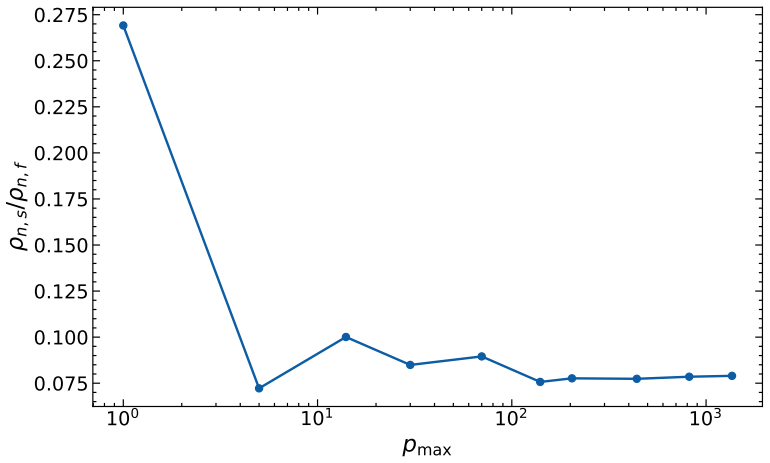
Brillouin-zone integrations To check our implementation of the special-point method and its accuracy, the body- centered cubic lattice Green’s function has been calculated for the tight-binding model de- fined by [69] G(E) = 1 ΩBZ Z BZ d3kkk E − ϵkkk , (A1) ϵkkk = ϵ0 − ϵ1 cos(kxa/2) cos(kya/2) cos(kza/2) , (A2) where ϵ0 and ϵ1 can be expressed in terms of...
-
[2]
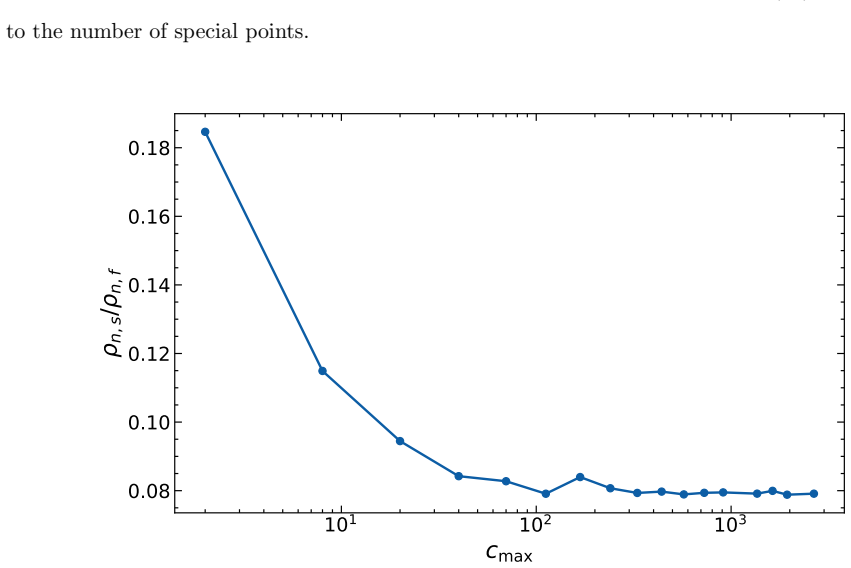
Fermi surface integrations To test our implementation of this method, the density of states has been calculated for the tight-binding model defined by D(E) = Z BZ d3kkk δ(E − ϵkkk) = Z dS |∇∇∇kkkϵkkk| ≈ cmaxX c=1 wc Sc |∇∇∇kckckcϵkckckc| (A9) with the band energy given by Eq. (A2). As shown in Fig. 12, results using 1360 cubic cells in the irreducible dom...
-
[3]
A. J. Leggett, Phys. Rev. Lett. 25, 1543 (1970)
work page 1970
-
[4]
N. Chamel and V. Allard, Phys. Rev. C 100, 065801 (2019). 35 1.00 0.75 0.50 0.25 0.00 0.25 0.50 0.75 1.00 E 0 200 400 600 800 1000 1200 1400 1600(E) FIG. 12. Density of states for the tight-binding model as calculated using the Gilat-Raubenheimer method with 1360 cubic cells (dots) and the fit (solid line) of Ref. [73]
work page 2019
- [5]
-
[6]
G. Chauveau, C. Maury, F. Rabec, C. Heintze, G. Brochier, S. Nascimbene, J. Dalibard, J. Beugnon, S. M. Roccuzzo, and S. Stringari, Phys. Rev. Lett. 130, 226003 (2023), URL https://link.aps.org/doi/10.1103/PhysRevLett.130.226003
-
[7]
J. Tao, M. Zhao, and I. B. Spielman, Phys. Rev. Lett. 131, 163401 (2023), URL https: //link.aps.org/doi/10.1103/PhysRevLett.131.163401
-
[8]
G. Biagioni, N. Antolini, B. Donelli, L. Pezz` e, A. Smerzi, M. Fattori, A. Fioretti, C. Gabbanini, M. Inguscio, L. Tanzi, et al., Nature 629, 773 (2024), ISSN 1476-4687, publisher: Nature Publishing Group, URL https://www.nature.com/articles/s41586-024-07361-9
work page 2024
-
[9]
E. Casotti, E. Poli, L. Klaus, A. Litvinov, C. Ulm, C. Politi, M. J. Mark, T. Bland, and F. Ferlaino, Nature (London) 635, 327 (2024), 2403.18510
-
[10]
G. Orso, Phys. Rev. Lett. 99, 250402 (2007), URL https://link.aps.org/doi/10.1103/ PhysRevLett.99.250402
work page 2007
-
[11]
G. Orso and S. Stringari, Phys. Rev. A 109, 023301 (2024), URL https://link.aps.org/ doi/10.1103/PhysRevA.109.023301
-
[12]
N. Chamel, Phd thesis, Universit´ e Pierre et Marie Curie - Paris VI, France (2004), URL https://theses.hal.science/tel-00011130. 36
work page 2004
- [13]
- [14]
- [15]
- [16]
- [17]
-
[18]
D. Blaschke and N. Chamel, in Astrophysics and Space Science Library , edited by L. Rezzolla, P. Pizzochero, D. I. Jones, N. Rea, and I. Vida˜ na (2018), vol. 457 of Astrophysics and Space Science Library, p. 337
work page 2018
-
[19]
C. J. Pethick, N. Chamel, and S. Reddy, Progress of Theoretical Physics Supplement 186, 9 (2010)
work page 2010
- [20]
- [21]
-
[22]
Chamel, Journal of Low Temperature Physics 189, 328 (2017)
N. Chamel, Journal of Low Temperature Physics 189, 328 (2017)
work page 2017
-
[23]
N. Andersson, K. Glampedakis, W. C. G. Ho, and C. M. Espinoza, Phys. Rev. Lett. 109, 241103 (2012)
work page 2012
- [24]
-
[25]
T. Delsate, N. Chamel, N. G¨ urlebeck, A. F. Fantina, J. M. Pearson, and C. Ducoin, Phys. Rev. D 94, 023008 (2016)
work page 2016
-
[26]
D. Antonopoulou, B. Haskell, and C. M. Espinoza, Reports on Progress in Physics 85, 126901 (2022)
work page 2022
-
[27]
S. Zhou, E. G¨ ugercino˘ glu, J. Yuan, M. Ge, and C. Yu, Universe8, 641 (2022)
work page 2022
- [28]
-
[29]
R. I. Epstein, ApJ 333, 880 (1988)
work page 1988
-
[30]
A. D. Sedrakian, Astrophys. Space Sci. 236, 267 (1996)
work page 1996
- [31]
-
[32]
T. Okihashi and M. Matsuo, Progress of Theoretical and Experimental Physics 2021, 023D03 (2020), https://academic.oup.com/ptep/article-pdf/2021/2/023D03/36455177/ptaa174.pdf, URL https://doi.org/10.1093/ptep/ptaa174
- [33]
- [34]
-
[35]
K. Sekizawa, S. Kobayashi, and M. Matsuo, Phys. Rev. C 105, 045807 (2022)
work page 2022
- [36]
- [37]
-
[38]
G. Almirante and M. Urban, Phys. Rev. C 110, 065802 (2024), URL https://link.aps. org/doi/10.1103/PhysRevC.110.065802
-
[39]
J. Blaizot and G. Ribka, Quantum Theory of Finite Systems (The MIT Press, 1986)
work page 1986
-
[40]
Bulgac, Physica Status Solidi B Basic Research 256, 1800592 (2019)
A. Bulgac, Physica Status Solidi B Basic Research 256, 1800592 (2019)
work page 2019
-
[41]
M. Bender, P.-H. Heenen, and P.-G. Reinhard, Reviews of Modern Physics 75, 121 (2003)
work page 2003
-
[42]
J. M. Pearson and N. Chamel, Phys. Rev. C 105, 015803 (2022)
work page 2022
-
[43]
J. Dobaczewski, H. Flocard, and J. Treiner, Nucl. Phys. A 422, 103 (1984)
work page 1984
-
[44]
Y. M. Engel, D. M. Brink, K. Goeke, S. J. Krieger, and D. Vautherin, Nucl. Phys. A 249, 215 (1975)
work page 1975
-
[45]
J. Dobaczewski and J. Dudek, Phys. Rev. C 52, 1827 (1995), URL https://link.aps.org/ doi/10.1103/PhysRevC.52.1827
- [46]
-
[47]
Kittel, Quantum Theory of Solids (John Wiley and Sons, 1966)
C. Kittel, Quantum Theory of Solids (John Wiley and Sons, 1966)
work page 1966
- [48]
- [49]
-
[50]
L. P. Pitaevskii, S. Stringari, and G. Orso, Phys. Rev. A 71, 053602 (2005), URL https: //link.aps.org/doi/10.1103/PhysRevA.71.053602
-
[51]
M. Onsi, A. K. Dutta, H. Chatri, S. Goriely, N. Chamel, and J. M. Pearson, Phys. Rev. C 77, 065805 (2008)
work page 2008
- [52]
-
[53]
M. Shelley and A. Pastore, Universe 6 (2020), ISSN 2218-1997, URL https://www.mdpi. com/2218-1997/6/11/206
work page 2020
-
[54]
D. P¸ ecak, A. Zdanowicz, N. Chamel, P. Magierski, and G. Wlaz lowski, Phys. Rev. X 14, 041054 (2024), URL https://link.aps.org/doi/10.1103/PhysRevX.14.041054
-
[55]
P. Magierski and P.-H. Heenen, Phys. Rev. C 65, 045804 (2002), URL https://link.aps. org/doi/10.1103/PhysRevC.65.045804
-
[56]
P. G¨ ogelein and H. M¨ uther, Phys. Rev. C76, 024312 (2007), URL https://link.aps.org/ doi/10.1103/PhysRevC.76.024312. 38
-
[57]
B. Schuetrumpf, G. Mart´ ınez-Pinedo, M. Afibuzzaman, and H. M. Aktulga, Phys. Rev. C 100, 045806 (2019), URL https://link.aps.org/doi/10.1103/PhysRevC.100.045806
-
[58]
W. G. Newton, S. Cantu, S. Wang, A. Stinson, M. A. Kaltenborn, and J. R. Stone, Phys. Rev. C 105, 025806 (2022), URL https://link.aps.org/doi/10.1103/PhysRevC.105.025806
-
[59]
Neutron specific heat in the crust of neutron stars from the nuclear band theory
N. Chamel, J. Margueron, and E. Khan, Phys. Rev. C 79, 012801 (2009), 0812.4389
work page internal anchor Pith review Pith/arXiv arXiv 2009
-
[60]
L. G. Cao, U. Lombardo, C. W. Shen, and N. V. Giai, Phys. Rev. C 73, 014313 (2006)
work page 2006
-
[61]
J. M. Pearson, N. Chamel, S. Goriely, and C. Ducoin, Phys. Rev. C 85, 065803 (2012)
work page 2012
-
[62]
D. J. Chadi and M. L. Cohen, Phys. Rev. B 8, 5747 (1973)
work page 1973
-
[63]
J. Hama and M. Watanabe, Journal of Physics Condensed Matter 4, 4583 (1992)
work page 1992
- [64]
- [65]
-
[66]
J. F. Janak, in Computational methods in band theory , edited by P. M. Marcus, J. F. Janak, and A. R. Williams (Plenum, New York, 1971), pp. 323–339
work page 1971
- [67]
- [68]
- [69]
-
[70]
V. Allard and N. Chamel, Phys. Rev. Lett. 132, 181001 (2024), URL https://link.aps. org/doi/10.1103/PhysRevLett.132.181001
-
[71]
E. N. Economou, Green ’s Functions in Quantum Physics , vol. 7 (2006)
work page 2006
-
[72]
A. A. Maradudin, E. W. Montroll, G. H. Weiss, R. Herman, and H. W. Milnes, Acad. Roy. de Belgique XIV, 1 (1960)
work page 1960
-
[73]
G. N. Watson, The Quarterly Journal of Mathematics 1, 266 (1939)
work page 1939
- [74]
-
[75]
Jelitto, Journal of Physics and Chemistry of Solids 30, 609 (1969)
R. Jelitto, Journal of Physics and Chemistry of Solids 30, 609 (1969). 39
work page 1969
discussion (0)
Sign in with ORCID, Apple, or X to comment. Anyone can read and Pith papers without signing in.