REVIEW 4 major objections 5 minor 54 references
Remix-DiT: Mixing Diffusion Transformers for Multi-Expert Denoising
T0 review · 4 major / 5 minor · reviewed 2026-08-11 · deepseek-v4-flash
Pith's one-line read Remix-DiT argues that four shared basis transformers, mixed by learned coefficients into twenty timestep experts, improve ImageNet image quality at the same per-step inference cost as a single diffusion transformer.
desk verdict Remix-DiT is a clean, honest empirical paper that shows real FID gains by mixing a few shared DiT bases into many timestep experts, though the size of the improvement over the best-controlled baseline is modest and single-run results leave some uncertainty. read the letter →
The pith
A machine-rendered reading of the paper's core claim, the machinery that carries it, and where it could break.
The reading
What carries the argument
The load-bearing object is the mixing identity $\Theta_{N\times P}=\alpha_{N\times K}\beta_{K\times P}$: an $N\times K$ matrix of softmax-normalized logits, implemented as an embedding layer, multiplied by K flattened basis parameter sets. This lets the number of experts grow without growing trained parameters. It is paired with a construction trick that packs the K bases into one DiT whose linear layers are K times wider, so a forward pass first performs the weighted average and then runs a standard-width linear layer; once experts are precomputed, per-step inference cost matches a plain DiT. A one-hot prior on the coefficients, annealed away during training, forces the K bases to separate early instead of stalling as near-identical copies of the pretrained checkpoint, and hierarchical sampling of an expert interval followed by a timestep within it lets all bases receive gradients at every step.
What would settle it
Train K=4 bases from the same initialization on a domain where low- and high-noise denoising require qualitatively different operations, such as text or audio, then check whether the mixed experts can match per-interval loss of experts trained independently on single intervals; any interval where the mixture is systematically worse would falsify the simplex-span assumption.
Extended reading notes
Core claim
The core discovery is that expert denoisers for different noise intervals can be manufactured rather than trained. Writing every expert parameter vector as a linear mixture $\theta_i = \sum_k \alpha_{ik}\beta_k$ of K basis vectors, and learning the coefficients together with the bases, produces experts that specialize by interval while sharing all parameters with a single K-times-wider DiT. On ImageNet 256 by 256, a 100K-step fine-tune with K=4 and N=20 improves FID from 10.11 to 9.02 for DiT-B/2 and from 26.51 to 22.84 for DiT-S/2 relative to the pretrained checkpoints. The learned coefficients concentrate near one-hot at low-noise timesteps and blend bases at high-noise timesteps, and each mixed expert attains its lowest prediction loss inside its own interval, indicating specialization rather than a generic average. Because redundant intervals learn similar coefficients, the method also removes the need to guess the optimal partition of timesteps in advance.
Load-bearing premise
The load-bearing premise is that every useful timestep specialist can be written as a weighted average of a small number K of shared basis networks, and that four bases starting from identical pretrained weights can diverge enough in 100K fine-tuning steps to cover those specialists.
Editorial extensions
If this is right
- A pretrained diffusion transformer can be improved by a 100K-step fine-tune that mixes four copies of its own weights, without changing the architecture used at inference.
- The number of experts becomes a free design choice: with K=4, increasing N from 4 to 20 improves FID, while N=1000 hurts, so the limit on quality is the span of the bases rather than the number of experts.
- Because only one expert is active per step and precomputed experts have the same per-step cost as the original model, the inference budget of the improved model matches the standard DiT.
- The learned coefficient pattern, one-hot at low-noise steps and blended at high-noise steps, identifies which stages of denoising need dedicated capacity and offers a learned alternative to hand-designed interval partitions.
Reading between the lines
- Beyond the paper, the learned coefficient table reads like a schedule of denoising difficulty and might transfer across datasets or checkpoints without retraining.
- Beyond the paper, the reported N=1000 degradation suggests a testable scaling law: at fixed K, quality should plateau and then fall as N grows, because the bottleneck is the span of K bases, not the resolution of the timestep partition.
- Beyond the paper, layer-wise coefficient routing remains an open avenue: the paper's local mixer underperformed its global mixer in a short 10K-step comparison, but with longer training the extra expressiveness of per-layer mixing could reverse that ordering.
Editorial analysis
A structured set of objections, weighed in public.
Referee Report
Summary. The paper proposes Remix-DiT, a method to construct N denoising experts for different timestep intervals from K (K<N) basis DiT models via learnable mixing coefficients. The experts are parameter-weighted averages of the basis models; a softmax over mixing logits ensures convexity, and a one-hot prior with linear annealing encourages basis specialization. The models are initialized from a pretrained DiT by replicating weights K times and then fine-tuned for 100K steps. Experiments on ImageNet 256x256 with DiT-S/B/L report FID/IS gains over the base DiT, continual training, and an 8-expert independently trained multi-expert baseline. Ablations address mixer type, global vs local coefficients, and choices of N and K, with an efficiency table comparing training/inference latency and memory.
Significance. If the results hold, the method offers a practical way to obtain part of the benefit of multi-expert denoising while training only K shared bases and keeping inference FLOPs comparable to a single DiT. The paper ships code, spans three model sizes, and includes systematic ablations over mixer type, N, and K, which are useful for the community. The learned coefficient patterns provide qualitative evidence that the method discovers a soft timestep specialization. The main risk is that the central comparison to independently trained experts is confounded by the number of gradient updates each parameter receives, and the expressiveness of the K-basis convex hull is never directly tested.
major comments (4)
- [§5.2, Table 1] The comparison to the 'Multi Experts' baseline is confounded. In Table 1, the 8 independent experts are each trained for 12.5K steps (100K total), whereas each of the 4 Remix bases receives 100K gradient-updating steps because every basis is updated at every training step. The reported FID advantage of Remix (e.g., 9.02 vs 9.28 for DiT-B) could therefore be caused by the larger number of updates per parameter set rather than by the mixing parameterization. The paper should add a matched-budget baseline in which independent experts are trained for the same total compute with equal per-expert steps (e.g., 8 experts × 100K steps or 4 experts × 100K steps), as well as a Remix variant with N=8 to separate the effect of the number of experts from the mixing mechanism.
- [§5.4, Table 2] The Onehot Mixer ablation does not control for per-basis update counts. With N=20 and K=4 under uniform interval sampling, each one-hot basis is updated only about 2.5K of the 10K fine-tuning steps, whereas every softmax basis is updated at every step. The FID difference between Onehot (32.00) and Softmax (31.11) may therefore reflect the number of gradient updates each basis receives, not the expressiveness of softmax mixing. To support the claim that the mixing mechanism itself is responsible, the authors should report a one-hot mixer with matched per-basis updates (e.g., an independent 4-expert baseline trained for 10K steps per expert, or a one-hot setup with interval sampling proportional to basis assignment).
- [§4, Eq. (4)] The central claim that Remix-DiT 'achieves superior generation results compared to independently trained multiple expert models' rests on the assumption that useful timestep experts can be represented as convex combinations of K=4 basis parameter vectors. The paper offers no direct evidence for this representational assumption: it never measures how well the convex hull of learned bases can approximate independently trained experts, and the non-monotonic behavior in Table 2 (Remix-S-2-20: 31.67, Remix-S-4-20: 31.11, Remix-S-8-20: 32.05) is hard to reconcile with a pure expressiveness story. A direct test, such as fitting independently pretrained experts with the mixing model and reporting approximation error, or comparing against an unconstrained low-rank factorization of expert parameters, would substantiate the claim and clarify the role of K.
- [§5 and NeurIPS checklist answer 7] All FID/IS/Precision/Recall numbers are single-run measurements, and the authors explicitly answer 'No' to the statistical-significance question. Many of the reported margins are small (e.g., FID 9.02 vs 9.28 in Table 1, and 31.11 vs 31.21 in the Global/Local ablation). Without error bars or a significance test, the robustness of these improvements is unassessed. The authors should provide at least three seeds with standard deviations for the main tables, or a paired test across samples, to establish that the observed gains are not noise.
minor comments (5)
- [§4, Eq. (5)] The gradient formula appears to contain a typo: the right-hand side sums over k but the left-hand side has a fixed k, and the element-wise product with β_k should be an inner product for the scalar coefficient gradient. Please correct the equation and the surrounding explanation.
- [§5.4, paragraph before Table 2] The text uses 'RemixDiT' and 'Remix-DiT' inconsistently (also 'Remix-B' vs 'Remix-B/2-4-20'). Please unify the notation across the paper.
- [Figure 3 caption] The word 'Comparision' should be 'Comparison'.
- [§5.1] The paper does not specify the FID computation for Table 1 (number of generated samples, sampling steps, and whether FID-10K or FID-50K is used). Please add this information for reproducibility.
- [§5.2 / Table 3] When precomputing N experts for inference, the storage cost is N× the model parameters; Table 3 reports only training GPU memory and per-step latency. Please include the inference storage requirement and clarify the trade-off between runtime mixing and precomputation.
Circularity Check
No significant circularity: Remix-DiT's central claims are supported by external benchmark measurements; self-citations are motivational only.
full rationale
The paper's derivation chain is empirical and self-contained. The central object, Eq. 4, defines each expert as a weighted average of K learned basis parameter sets, with the mixing coefficients trained by minimizing the standard denoising objective (Eqs. 1 and 2) on ImageNet; no coefficient is fit to the evaluation metric (FID/IS). The reported quality numbers are external benchmark measurements comparing against standard DiT, continual training, and multi-expert baselines, so the central claim of improved generation quality does not reduce to the model's own definition. The cited works [36] and [38], including self-citations, motivate parameter fusion and the width-expansion packing trick, but they are not used to derive the empirical gains; those gains are measured directly. The one-hot prior in Eq. 6 is an initialization and a regularization term that is annealed to zero, and the observed 'specialization' of experts is a post-hoc analysis rather than a predicted quantity derived from the prior. The skeptic's concern that four basis models may not span the useful expert manifold, or that the budget comparison favors shared bases, is a representational-capacity and experimental-fairness question, not a circularity. Therefore no circular step is present.
Assumptions & free parameters
free parameters (3)
- K (number of basis models) =
4
- N (number of experts) =
20
- gamma and its annealing schedule =
not specified in text
assumptions (3)
- standard math DDPM denoising objective (Eq. 1) and timestep-conditional network are taken from prior work [13,29].
- domain assumption Parameter-space averaging of networks preserves or improves the denoising function.
- ad hoc to paper One-hot prior regularization forces bases to specialize, with annealing to gamma=0 keeping diversity.
Cite this review
Pith. "Pith review of Remix-DiT: Mixing Diffusion Transformers for Multi-Expert Denoising." pith.science (2026). https://pith.science/paper/A6CLN7ZI
@misc{pith2026241205628,
  author       = {Pith},
  title        = {Pith review of: Remix-DiT: Mixing Diffusion Transformers for Multi-Expert Denoising},
  year         = {2026},
  howpublished = {\url{https://pith.science/paper/A6CLN7ZI}},
  note         = {Machine review of arXiv:2412.05628}
}
read the original abstract
Transformer-based diffusion models have achieved significant advancements across a variety of generative tasks. However, producing high-quality outputs typically necessitates large transformer models, which result in substantial training and inference overhead. In this work, we investigate an alternative approach involving multiple experts for denoising, and introduce Remix-DiT, a novel method designed to enhance output quality at a low cost. The goal of Remix-DiT is to craft N diffusion experts for different denoising timesteps, yet without the need for expensive training of N independent models. To achieve this, Remix-DiT employs K basis models (where K < N) and utilizes learnable mixing coefficients to adaptively craft expert models. This design offers two significant advantages: first, although the total model size is increased, the model produced by the mixing operation shares the same architecture as a plain model, making the overall model as efficient as a standard diffusion transformer. Second, the learnable mixing adaptively allocates model capacity across timesteps, thereby effectively improving generation quality. Experiments conducted on the ImageNet dataset demonstrate that Remix-DiT achieves promising results compared to standard diffusion transformers and other multiple-expert methods. The code is available at https://github.com/VainF/Remix-DiT.
Figures


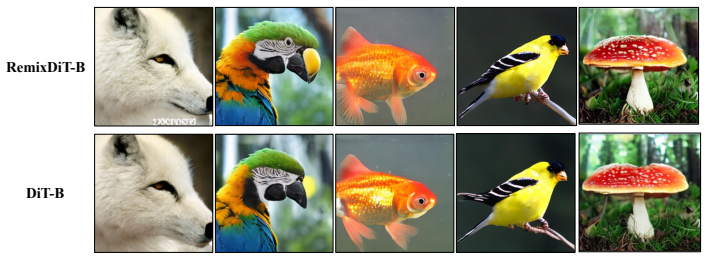
Figures from the paper (2 more)

Reference graph
Works this paper leans on
-
[1]
ediff-i: Text-to-image diffusion models with an ensemble of expert denoisers
Yogesh Balaji, Seungjun Nah, Xun Huang, Arash Vahdat, Jiaming Song, Qinsheng Zhang, Karsten Kreis, Miika Aittala, Timo Aila, Samuli Laine, et al. ediff-i: Text-to-image diffusion models with an ensemble of expert denoisers. arXiv preprint arXiv:2211.01324, 2022
arXiv 2022
-
[2]
All are worth words: A vit backbone for diffusion models
Fan Bao, Shen Nie, Kaiwen Xue, Yue Cao, Chongxuan Li, Hang Su, and Jun Zhu. All are worth words: A vit backbone for diffusion models. In Proceedings of the IEEE/CVF Conference on Computer Vision and Pattern Recognition, pages 22669–22679, 2023
2023
-
[3]
Video generation models as world simulators
Tim Brooks, Bill Peebles, Connor Holmes, Will DePue, Yufei Guo, Li Jing, David Schnurr, Joe Taylor, Troy Luhman, Eric Luhman, Clarence Ng, Ricky Wang, and Aditya Ramesh. Video generation models as world simulators. 2024
2024
-
[4]
Exploring Vision Transformers as Diffusion Learners
He Cao, Jianan Wang, Tianhe Ren, Xianbiao Qi, Yihao Chen, Yuan Yao, and Lei Zhang. Exploring vision transformers as diffusion learners. arXiv preprint arXiv:2212.13771, 2022
work page Pith review arXiv 2022
-
[5]
Gentron: Delving deep into diffusion transformers for image and video generation
Shoufa Chen, Mengmeng Xu, Jiawei Ren, Yuren Cong, Sen He, Yanping Xie, Animesh Sinha, Ping Luo, Tao Xiang, and Juan-Manuel Perez-Rua. Gentron: Delving deep into diffusion transformers for image and video generation. arXiv preprint arXiv:2312.04557, 2023
arXiv 2023
-
[6]
Imagenet: A large-scale hierarchical image database
Jia Deng, Wei Dong, Richard Socher, Li-Jia Li, Kai Li, and Li Fei-Fei. Imagenet: A large-scale hierarchical image database. In 2009 IEEE conference on computer vision and pattern recognition, pages 248–255. Ieee, 2009
2009
-
[7]
Diffusion models beat gans on image synthesis
Prafulla Dhariwal and Alexander Nichol. Diffusion models beat gans on image synthesis. Advances in neural information processing systems, 34:8780–8794, 2021
2021
-
[8]
An image is worth 16x16 words: Transformers for image recognition at scale
Alexey Dosovitskiy, Lucas Beyer, Alexander Kolesnikov, Dirk Weissenborn, Xiaohua Zhai, Thomas Unterthiner, Mostafa Dehghani, Matthias Minderer, Georg Heigold, Sylvain Gelly, et al. An image is worth 16x16 words: Transformers for image recognition at scale. arXiv preprint arXiv:2010.11929, 2020
arXiv 2010
Show all 54 references
-
[9]
Structural pruning for diffusion models
Gongfan Fang, Xinyin Ma, and Xinchao Wang. Structural pruning for diffusion models. In Advances in Neural Information Processing Systems, 2023
2023
-
[10]
Masked diffusion transformer is a strong image synthesizer
Shanghua Gao, Pan Zhou, Ming-Ming Cheng, and Shuicheng Yan. Masked diffusion transformer is a strong image synthesizer. In Proceedings of the IEEE/CVF International Conference on Computer Vision, pages 23164–23173, 2023
2023
-
[11]
Vector quantized diffusion model for text-to-image synthesis
Shuyang Gu, Dong Chen, Jianmin Bao, Fang Wen, Bo Zhang, Dongdong Chen, Lu Yuan, and Baining Guo. Vector quantized diffusion model for text-to-image synthesis. In Proceedings of the IEEE/CVF Conference on Computer Vision and Pattern Recognition, pages 10696–10706, 2022
2022
-
[12]
Masked autoencoders are scalable vision learners
Kaiming He, Xinlei Chen, Saining Xie, Yanghao Li, Piotr Dollár, and Ross Girshick. Masked autoencoders are scalable vision learners. In Proceedings of the IEEE/CVF conference on computer vision and pattern recognition, pages 16000–16009, 2022
2022
-
[14]
Denoising diffusion probabilistic models
Jonathan Ho, Ajay Jain, and Pieter Abbeel. Denoising diffusion probabilistic models. Advances in neural information processing systems, 33:6840–6851, 2020
2020
-
[15]
U-dit tts: U-diffusion vision transformer for text-to-speech
Xin Jing, Yi Chang, Zijiang Yang, Jiangjian Xie, Andreas Triantafyllopoulos, and Bjoern W Schuller. U-dit tts: U-diffusion vision transformer for text-to-speech. In Speech Communication; 15th ITG Conference, pages 56–60. VDE, 2023
2023
-
[16]
Multi- architecture multi-expert diffusion models
Yunsung Lee, JinYoung Kim, Hyojun Go, Myeongho Jeong, Shinhyeok Oh, and Seungtaek Choi. Multi- architecture multi-expert diffusion models. InProceedings of the AAAI Conference on Artificial Intelligence, volume 38, pages 13427–13436, 2024
2024
-
[17]
Dlt: Conditioned layout generation with joint discrete-continuous diffusion layout transformer
Elad Levi, Eli Brosh, Mykola Mykhailych, and Meir Perez. Dlt: Conditioned layout generation with joint discrete-continuous diffusion layout transformer. In Proceedings of the IEEE/CVF International Conference on Computer Vision, pages 2106–2115, 2023
2023
-
[18]
Oms-dpm: Optimizing the model schedule for diffusion probabilistic models
Enshu Liu, Xuefei Ning, Zinan Lin, Huazhong Yang, and Yu Wang. Oms-dpm: Optimizing the model schedule for diffusion probabilistic models. arXiv preprint arXiv:2306.08860, 2023
2023 arXiv
-
[19]
Vit-tts: visual text-to-speech with scalable diffusion transformer
Huadai Liu, Rongjie Huang, Xuan Lin, Wenqiang Xu, Maozong Zheng, Hong Chen, Jinzheng He, and Zhou Zhao. Vit-tts: visual text-to-speech with scalable diffusion transformer. arXiv preprint arXiv:2305.12708, 2023
2023 arXiv
-
[20]
Vdt: General- purpose video diffusion transformers via mask modeling
Haoyu Lu, Guoxing Yang, Nanyi Fei, Yuqi Huo, Zhiwu Lu, Ping Luo, and Mingyu Ding. Vdt: General- purpose video diffusion transformers via mask modeling. In The Twelfth International Conference on Learning Representations, 2023
2023
-
[21]
Latte: Latent diffusion transformer for video generation
Xin Ma, Yaohui Wang, Gengyun Jia, Xinyuan Chen, Ziwei Liu, Yuan-Fang Li, Cunjian Chen, and Yu Qiao. Latte: Latent diffusion transformer for video generation. arXiv preprint arXiv:2401.03048, 2024. 11
2024 arXiv
-
[22]
Deepcache: Accelerating diffusion models for free
Xinyin Ma, Gongfan Fang, and Xinchao Wang. Deepcache: Accelerating diffusion models for free. arXiv preprint arXiv:2312.00858, 2023
2023 arXiv
-
[23]
Deepcache: Accelerating diffusion models for free
Xinyin Ma, Gongfan Fang, and Xinchao Wang. Deepcache: Accelerating diffusion models for free. In Proceedings of the IEEE/CVF Conference on Computer Vision and Pattern Recognition, pages 15762– 15772, 2024
2024
-
[24]
Snap video: Scaled spatiotemporal transformers for text-to-video synthesis
Willi Menapace, Aliaksandr Siarohin, Ivan Skorokhodov, Ekaterina Deyneka, Tsai-Shien Chen, Anil Kag, Yuwei Fang, Aleksei Stoliar, Elisa Ricci, Jian Ren, et al. Snap video: Scaled spatiotemporal transformers for text-to-video synthesis. arXiv preprint arXiv:2402.14797, 2024
2024 arXiv
-
[25]
Dit-3d: Exploring plain diffusion transformers for 3d shape generation.Advances in Neural Information Processing Systems, 36, 2024
Shentong Mo, Enze Xie, Ruihang Chu, Lanqing Hong, Matthias Niessner, and Zhenguo Li. Dit-3d: Exploring plain diffusion transformers for 3d shape generation.Advances in Neural Information Processing Systems, 36, 2024
2024
-
[26]
Improved denoising diffusion probabilistic models
Alexander Quinn Nichol and Prafulla Dhariwal. Improved denoising diffusion probabilistic models. In International conference on machine learning, pages 8162–8171. PMLR, 2021
2021
-
[27]
T-stitch: Accelerating sampling in pre-trained diffusion models with trajectory stitching
Zizheng Pan, Bohan Zhuang, De-An Huang, Weili Nie, Zhiding Yu, Chaowei Xiao, Jianfei Cai, and Anima Anandkumar. T-stitch: Accelerating sampling in pre-trained diffusion models with trajectory stitching. arXiv preprint arXiv:2402.14167, 2024
2024 arXiv
-
[28]
Denoising task routing for diffusion models
Byeongjun Park, Sangmin Woo, Hyojun Go, Jin-Young Kim, and Changick Kim. Denoising task routing for diffusion models. arXiv preprint arXiv:2310.07138, 2023
2023 arXiv
-
[29]
Scalable diffusion models with transformers
William Peebles and Saining Xie. Scalable diffusion models with transformers. In Proceedings of the IEEE/CVF International Conference on Computer Vision, pages 4195–4205, 2023
2023
-
[30]
High-resolution image synthesis with latent diffusion models
Robin Rombach, Andreas Blattmann, Dominik Lorenz, Patrick Esser, and Björn Ommer. High-resolution image synthesis with latent diffusion models. In Proceedings of the IEEE/CVF conference on computer vision and pattern recognition, pages 10684–10695, 2022
2022
-
[31]
U-net: Convolutional networks for biomedical image segmentation
Olaf Ronneberger, Philipp Fischer, and Thomas Brox. U-net: Convolutional networks for biomedical image segmentation. In Medical image computing and computer-assisted intervention–MICCAI 2015: 18th international conference, Munich, Germany, October 5-9, 2015, proceedings, part ...
2015
-
[32]
Denoising diffusion implicit models
Jiaming Song, Chenlin Meng, and Stefano Ermon. Denoising diffusion implicit models. arXiv preprint arXiv:2010.02502, 2020
2010 arXiv
-
[33]
Generative modeling by estimating gradients of the data distribution
Yang Song and Stefano Ermon. Generative modeling by estimating gradients of the data distribution. Advances in neural information processing systems, 32, 2019
2019
-
[34]
Score-based generative modeling through stochastic differential equations
Yang Song, Jascha Sohl-Dickstein, Diederik P Kingma, Abhishek Kumar, Stefano Ermon, and Ben Poole. Score-based generative modeling through stochastic differential equations. arXiv preprint arXiv:2011.13456, 2020
2011 arXiv
-
[35]
Attention is all you need
Ashish Vaswani, Noam Shazeer, Niki Parmar, Jakob Uszkoreit, Llion Jones, Aidan N Gomez, Łukasz Kaiser, and Illia Polosukhin. Attention is all you need. Advances in neural information processing systems, 30, 2017
2017
-
[36]
Factorizing knowledge in neural networks
Xingyi Yang, Jingwen Ye, and Xinchao Wang. Factorizing knowledge in neural networks. InEuropean Conference on Computer Vision, pages 73–91. Springer, 2022
2022
-
[37]
Diffusion probabilistic model made slim
Xingyi Yang, Daquan Zhou, Jiashi Feng, and Xinchao Wang. Diffusion probabilistic model made slim. In Proceedings of the IEEE/CVF Conference on Computer Vision and Pattern Recognition, pages 22552– 22562, 2023
2023
-
[38]
Deep model reassembly
Xingyi Yang, Daquan Zhou, Songhua Liu, Jingwen Ye, and Xinchao Wang. Deep model reassembly. Advances in neural information processing systems, 35:25739–25753, 2022
2022
-
[39]
Your vit is secretly a hybrid discriminative-generative diffusion model
Xiulong Yang, Sheng-Min Shih, Yinlin Fu, Xiaoting Zhao, and Shihao Ji. Your vit is secretly a hybrid discriminative-generative diffusion model. arXiv preprint arXiv:2208.07791, 2022
2022 arXiv
-
[40]
Fast training of diffusion models with masked transformers
Hongkai Zheng, Weili Nie, Arash Vahdat, and Anima Anandkumar. Fast training of diffusion models with masked transformers. arXiv preprint arXiv:2306.09305, 2023. 12
2023 arXiv
-
[41]
Guidelines: • The answer NA means that the abstract and introduction do not include the claims made in the paper
Claims Question: Do the main claims made in the abstract and introduction accurately reflect the paper’s contributions and scope? Answer: [Yes] Justification: This submission introduced a new method for multi-expert denoising. Guidelines: • The answer NA means that the abstrac...
-
[42]
Limitations
Limitations Question: Does the paper discuss the limitations of the work performed by the authors? Answer: [Yes] Justification: A limitation section is included. Guidelines: • The answer NA means that the paper has no limitation while the answer No means that the paper has lim...
-
[43]
Guidelines: 13 • The answer NA means that the paper does not include theoretical results
Theory Assumptions and Proofs Question: For each theoretical result, does the paper provide the full set of assumptions and a complete (and correct) proof? Answer: [NA] Justification: This work does not involve theoretical results. Guidelines: 13 • The answer NA means that the...
-
[44]
Guidelines: • The answer NA means that the paper does not include experiments
Experimental Result Reproducibility Question: Does the paper fully disclose all the information needed to reproduce the main ex- perimental results of the paper to the extent that it affects the main claims and/or conclusions of the paper (regardless of whether the code and da...
-
[45]
14 Guidelines: • The answer NA means that paper does not include experiments requiring code
Open access to data and code Question: Does the paper provide open access to the data and code, with sufficient instruc- tions to faithfully reproduce the main experimental results, as described in supplemental material? Answer: [Yes] Justification: Code is available in the su...
-
[46]
Guidelines: • The answer NA means that the paper does not include experiments
Experimental Setting/Details Question: Does the paper specify all the training and test details (e.g., data splits, hyper- parameters, how they were chosen, type of optimizer, etc.) necessary to understand the results? Answer: [Yes] Justification: Training details is summarize...
-
[47]
Guidelines: • The answer NA means that the paper does not include experiments
Experiment Statistical Significance Question: Does the paper report error bars suitably and correctly defined or other appropriate information about the statistical significance of the experiments? Answer: [No] Justification: This submission does not include error bars. Guidel...
-
[48]
Guidelines: • The answer NA means that the paper does not include experiments
Experiments Compute Resources Question: For each experiment, does the paper provide sufficient information on the com- puter resources (type of compute workers, memory, time of execution) needed to reproduce the experiments? Answer: [Yes] Justification: The number of GPUs, tra...
-
[49]
Guidelines: • The answer NA means that the authors have not reviewed the NeurIPS Code of Ethics
Code Of Ethics Question: Does the research conducted in the paper conform, in every respect, with the NeurIPS Code of Ethics https://neurips.cc/public/EthicsGuidelines? Answer: [Yes] Justification: The research was conducted with the NeurIPS Code of Ethics. Guidelines: • The a...
-
[50]
Guidelines: • The answer NA means that there is no societal impact of the work performed
Broader Impacts Question: Does the paper discuss both potential positive societal impacts and negative societal impacts of the work performed? Answer: [Yes] Justification: We discuss the societal impacts in the main paper. Guidelines: • The answer NA means that there is no soc...
-
[51]
Guidelines: • The answer NA means that the paper poses no such risks
Safeguards Question: Does the paper describe safeguards that have been put in place for responsible release of data or models that have a high risk for misuse (e.g., pretrained language models, image generators, or scraped datasets)? Answer: [NA] Justification: the paper poses...
-
[52]
Guidelines: • The answer NA means that the paper does not use existing assets
Licenses for existing assets Question: Are the creators or original owners of assets (e.g., code, data, models), used in the paper, properly credited and are the license and terms of use explicitly mentioned and properly respected? Answer: [Yes] Justification: All papers and a...
-
[53]
17 Guidelines: • The answer NA means that the paper does not release new assets
New Assets Question: Are new assets introduced in the paper well documented and is the documentation provided alongside the assets? Answer: [NA] Justification: the paper does not release new assets. 17 Guidelines: • The answer NA means that the paper does not release new asset...
-
[54]
Guidelines: • The answer NA means that the paper does not involve crowdsourcing nor research with human subjects
Crowdsourcing and Research with Human Subjects Question: For crowdsourcing experiments and research with human subjects, does the paper include the full text of instructions given to participants and screenshots, if applicable, as well as details about compensation (if any)? A...
-
[55]
Guidelines: • The answer NA means that the paper does not involve crowdsourcing nor research with human subjects
Institutional Review Board (IRB) Approvals or Equivalent for Research with Human Subjects Question: Does the paper describe potential risks incurred by study participants, whether such risks were disclosed to the subjects, and whether Institutional Review Board (IRB) approvals...
Reviewed August 11, 2026 · model on record in the stance chip above.
Discussion (0). Continue with ORCID to comment.