REVIEW 4 major objections 5 minor 71 references
Obstacle-aware Gaussian Process Regression
T0 review · 4 major / 5 minor · reviewed 2026-08-11 · deepseek-v4-flash
Pith's one-line read Obstacle-aware Gaussian process regression claims that marking forbidden targets as negative datapairs and maximizing their KL divergence from the GP lets a model fit positive data while avoiding obstacles, with better NLL and RMSE than…
desk verdict A promising KL-avoidance idea for GP regression, but the objective is undefined as written and the real-data evaluation uses shuffled labels, so the claims don't hold. read the letter →
The pith
A machine-rendered reading of the paper's core claim, the machinery that carries it, and where it could break.
The reading
What carries the argument
The central object is the negative datapair as a Gaussian blob $q(\bar{y}\mid\bar{x}) = \mathcal{N}(\bar{y}, \sigma_{\mathrm{neg}}^2)$ together with the log-KL penalty $\beta \log D_{\mathrm{KL}}(p(y\mid\theta,\bar{X}) \lVert q(\bar{y}\mid\bar{X}))$ appended to the GP marginal likelihood. The KL term is the avoidance mechanism: it grows when the GP's predictive distribution overlaps a blob, so optimizing it pushes the predictive mean away from $\bar{y}$ and inflates predictive variance near $\bar{x}$. The implementation uses the closed-form univariate Gaussian KL formula from Eq. (6), evaluated with the predictive mean and variance at the negative inputs, and updates kernel parameters by alternating between the negative-log-likelihood step and the KL step in Algorithm 1.
What would settle it
At the converged parameters from Algorithm 1, compute both the full multivariate KL divergence between $\mathcal{N}(E[f(\bar{X})], \mathrm{cov}(f(\bar{X})))$ and the product of the negative-blob Gaussians, and the sum of the univariate KL terms that Eq. (6) implements. If the two values are not equal, or are not monotonically related, then the objective the code maximizes is not the objective the paper derives, and the reported gains are for a different loss.
Extended reading notes
Core claim
The central claim is that optimizing the combined objective $L(\theta) = \arg\min_\theta [-\log p(y\mid\theta,X) - \beta \log D_{\mathrm{KL}}(p(y\mid\theta,\bar{X})\,\lVert\, q(\bar{y}\mid\bar{X}))]$ makes a GP fit positive datapairs while avoiding negative ones. In this formulation a negative datapair $(\bar{x}, \bar{y})$ is not a training point but an obstacle: it is represented as a Gaussian blob $q(\bar{y}\mid\bar{x}) = \mathcal{N}(\bar{y}, \sigma_{\mathrm{neg}}^2)$ whose radius is controlled by $\sigma_{\mathrm{neg}}$. The training objective minimizes the negative marginal likelihood on positive pairs and simultaneously maximizes a log-transformed KL divergence between the GP's predictive distribution at the negative inputs and the blobs, with strength $\beta$. The paper reports that this objective, updated alternately in Algorithm 1, outperforms classical GP, scalable variational GP, and parametric GP regression on negative log-likelihood and RMSE across datasets up to roughly 435,000 points, and that lowering $\beta$ or raising $\sigma_{\mathrm{neg}}$ weakens the avoidance effect.
Load-bearing premise
The load-bearing premise is that the KL divergence actually maximized in the implementation, computed with the univariate Gaussian formula at each negative point, is the same objective as the joint-distribution KL divergence written in Eq. (4), because the paper never specifies how the per-point penalties combine.
Editorial extensions
If this is right
- For navigation tasks, obstacles can be encoded directly as negative datapairs, so the GP trajectory bends around them without requiring a dense cloud of positive points near each obstacle.
- Because only the likelihood term changes, the same KL-avoidance penalty can be attached to exact GP, scalable variational GP, and parametric GP regression without changing the size of the covariance matrix.
- The two hyperparameters $\beta$ and $\sigma_{\mathrm{neg}}$ control the avoidance radius: smaller $\beta$ or larger $\sigma_{\mathrm{neg}}$ reduces the penalty's influence, giving practitioners a calibrated safety margin.
- On real-world regression benchmarks, adding pseudo-negative datapairs by shuffling labels improves NLL and RMSE and steepens the convergence curve as data size grows, suggesting the penalty also acts as a regularizer.
- The runtime overhead of the extra KL term stays modest relative to the underlying GP method, so the obstacle-aware variant inherits the scalability of the base regressor.
Reading between the lines
- Editorial extension: Eq. (4) is written for joint multivariate distributions while the implemented Eq. (6) is the univariate scalar-Gaussian KL, so the paper leaves unresolved whether the loss sums over the $m$ negative points or uses the full predictive covariance; the empirical results stand or fall with whichever the code actually computes.
- Editorial extension: on the six benchmark datasets the negative datapairs are random shuffled labels rather than spatial obstacles, so the reported gains may reflect regularization from the KL term more than genuine obstacle avoidance; a $\beta \to 0$ ablation would separate the two.
- Editorial extension: Algorithm 1 alternates the NLL and KL updates instead of jointly optimizing Eq. (5), so the faster convergence could come from the optimization schedule rather than the penalty itself; comparing joint and alternating optimization on the same objective would clarify this.
- Editorial extension: because the KL penalty uses only predictive mean and variance at a negative input, the mechanism is a local repulsive potential; one could test it against other forbidden-region shapes, such as intervals or uniform shells, to see whether the Gaussian-blob form is essential.
Editorial analysis
A structured set of objections, weighed in public.
Referee Report
Summary. The paper proposes GP-ND, an extension of Gaussian process regression in which, in addition to ordinary positive training pairs, the user supplies negative pairs (inputs with target values that the fitted curve must avoid). The negative pairs are represented as small Gaussian blobs, and the training objective combines the standard GP log marginal likelihood with a log-KL penalty that pushes the GP predictive distribution away from the blobs. The method is presented as a generic wrapper that can be applied to exact GP, SVGP, and PPGPR. Experiments include a synthetic 2D trajectory prediction task and six real-world regression datasets, reporting improved NLL and RMSE, faster convergence, and modest runtime overhead relative to classical GP regression.
Significance. If made mathematically coherent, the core idea is simple and potentially useful: a plug-in penalty that lets a GP user encode 'avoid this output value at this input' without enlarging the covariance matrix. The paper also deserves credit for being explicit about the alternating update scheme and for framing the extension as applicable to several scalable GP models. However, the central derivation currently has a gap between the stated multivariate KL objective and the implemented univariate formula, and the real-data experiments rely on randomly shuffled labels rather than genuine obstacles, so the significance of the claims cannot yet be assessed from the manuscript.
major comments (4)
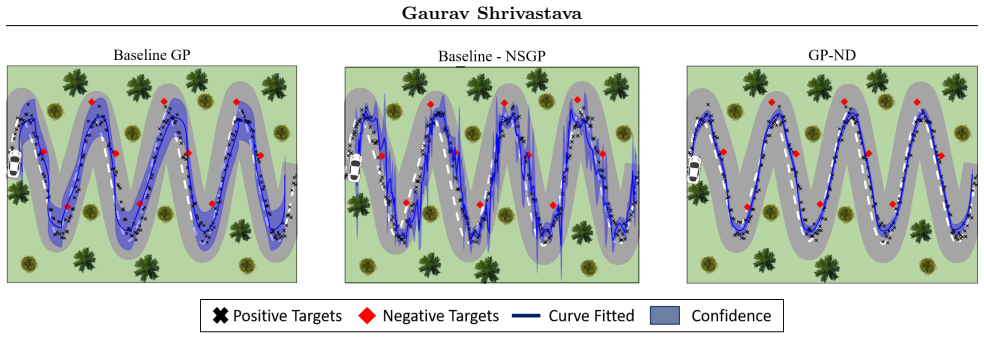
- [§3.3–§3.5 and Algorithm 1] The objective actually optimized is not well defined. Equation (4) denotes D_KL(p(y|θ, bar X) || q(bar y| bar X)), where p(y|θ, bar X) is the multivariate GP predictive distribution over the m negative inputs and therefore has a full covariance matrix. Equation (6), however, is the KL divergence between two univariate Gaussians, and the text immediately identifies p ≡ N(μ1, σ1) ≡ p(y|θ, bar X), collapsing the joint distribution to a single variance. The paper never states whether Algorithm 1 sums m univariate marginal KL divergences, uses a single marginal, or computes the joint KL with trace and log-determinant terms. These are different objectives with different gradients once the predictive covariance couples the negative points, so the experimental results cannot be attributed to the derivation in Eqs. (4)–(5). Please restate the objective consistently, for example as a sum of per-point KL terms, and specify exactly what Algorithm 1 computes.
- [§5.2, Random shuffling technique] The real-data experiments do not evaluate obstacle avoidance. Negative pairs are produced by randomly shuffling labels and pairing each input with a mismatched target; these are not obstacles in any task-defined sense, and the condition y(x)_True ≠ y(x)_Shuffled merely restates that the labels were shuffled. Separating the predictive distribution from random wrong targets is a form of regularization, not avoidance of a specified forbidden region, so the claim that GP-ND 'outperforms' classical GP on these datasets does not support the paper's central obstacle-avoidance setting. Either use datasets with genuine negative constraints, such as forbidden output regions or known unsafe targets, or explicitly reframe GP-ND as a regularizer and evaluate it on that basis.
- [Algorithm 1 and Eq. (5)] There is a mismatch between the stated objective and the training procedure. Equation (5) defines a joint minimization over the sum of the negative log likelihood and the β-weighted negative log-KL term, while Algorithm 1 alternates between minimizing the NLL and maximizing the KL divergence. The text states that alternating updates were found empirically more stable, but no comparison with joint optimization is reported. Since all reported results are produced by Algorithm 1, the paper must clarify whether the behavior reflects the joint objective or the alternating scheme, and should justify the alternation either theoretically or with an ablation.
- [§5.1 and Fig. 5] The headline empirical claims are not quantitatively supported. The trajectory comparison against NS GP in §5.1 is visual only, with no NLL or RMSE values reported for the three models. The real-world results in Fig. 4 are averages over 10 random splits without error bars or significance tests, and the 'faster convergence' claim in Fig. 5 is based on qualitative inspection of convergence curves. A table with means, standard deviations, and a significance test for the key comparisons, together with a quantitative convergence-rate statistic such as epochs to a fixed RMSE threshold, is needed to support the 'outperforms' and 'converges faster' claims.
minor comments (5)
- [§2, Eq. (3)] Equation (3) appears to be missing the factor −1/2 on the quadratic term; as written it is not the standard log marginal likelihood, and the sign convention is inconsistent with the '− log p(y|θ, X)' used in Eq. (5).
- [Algorithm 1] In Algorithm 1, 'NLL = - p(y|θ, X)' should read '-log p(y|θ, X)', and the KLdiv line should state explicitly whether β·log D_KL is summed over negative points or computed jointly; otherwise the pseudocode inherits the ambiguity raised in the first major comment.
- [§3.4–§3.5] The stated motivation for applying the logarithm to D_KL is not convincing as written: log(D_KL) is also unbounded above and tends to −∞ as D_KL → 0, so it does not 'fix' unboundedness. If the purpose is to change the gradient scale, the intended effect should be stated explicitly.
- [§3.6.2] Section 3.6.2 defers the PPGPR likelihood to the original paper and provides only the predictive equations, but PPGPR-ND is then evaluated in §5; the manuscript should at least give the exact loss being optimized for PPGPR-ND.
- [References] References [18] and [19] are duplicate entries for GPyTorch, and several references in Section 6 are not discussed in the body; the list should be trimmed to works actually used.
Circularity Check
Mild partial circularity: the toy-trajectory avoidance result is baked into the Eq. (5) objective, while the real-data NLL/RMSE benchmarks retain independent content.
-
self definitional
[Section 3.3 (Eq. 5) and Section 5.1 (Fig. 2)]
"we propose to fit the GP regression model on the positive datapairs along with maximizing the Kullback-Leibler (KL) divergence between the distributions of the GP regression model and the Gaussian distributions defined over the negative datapairs. ... L(θ) = argminθ[− log p(y|θ, X) − β log DKL(p(y|θ, ¯X)∥q(¯y| ¯X))] (5) ... our model GP -ND outperforms both of them in terms of a better curve-fit and avoidance of all the negative datapairs as shown in Fig 2.c."
The behavior used to validate the method in Fig. 2 is the literal definition of the training loss. Eq. (5) is constructed so that minimizing it maximizes DKL between the GP predictive distribution and the Gaussian blobs at the negative datapairs; any optimizer that succeeds on this objective must push the predicted curve away from those blobs. Showing that GP-ND avoids all the negative datapairs restates the objective rather than confirming a prediction derived from the model. The §5.2 NLL/RMSE results on positive test data are not forced by this construction, which is why the overall circularity is only partial.
full rationale
The paper's central derivation is a proposed objective, not a first-principles prediction. The one self-definitional aspect is the synthetic obstacle-avoidance demonstration: the KL penalty in Eq. (5) is exactly the mechanism that repels the GP from negative targets, so observing this repulsion is a sanity check on the optimizer, not independent evidence. The real-dataset benchmarks (Fig. 4-5) compare GP-ND against classical GP on test NLL/RMSE for positive target data using pseudo-negative pairs created by label shuffling; those outcomes are not determined by construction and provide independent content. A separate concern, not circularity, is the Eq. (4)/Eq. (6) mismatch: Eq. (4) writes DKL between the joint predictive distribution over negative inputs and the blob distribution, while Eq. (6) is the univariate scalar KL, and the text asserts p ≡ N(µ1,σ1) ≡ p(y|θ, ¯X). This makes the objective actually optimized in Algorithm 1 ambiguous, but it is an internal-consistency and correctness issue rather than a reduction of a result to its own input. Self-citations appear in the reference list but none is load-bearing for the GP-ND objective. Score 3 reflects the partial circularity of the toy-trajectory validation while acknowledging the independent real-data claims.
Assumptions & free parameters
free parameters (4)
- β (tradeoff weight) =
hand-chosen; values such as 0.1 and 3 shown in Fig. 3
- σ_neg (negative blob variance) =
hand-chosen; values such as 0.1 and 3 shown in Fig. 3
- Number of negative datapairs m =
200 for real datasets
- Kernel hyperparameters (lengthscale, outputscale, noise) =
not reported for real datasets
assumptions (4)
- domain assumption Negative datapairs are independent Gaussian blobs with fixed variance σ_neg
- ad hoc to paper The KL divergence in Eq. (4) can be computed with the univariate Gaussian KL formula of Eq. (6)
- ad hoc to paper Randomly shuffled labels form valid negative datapairs
- domain assumption Logarithmic scaling of the KL term is a valid way to balance the two objectives
invented entities (1)
-
Gaussian blob of influence around each negative datapair
Cite this review
Pith. "Pith review of Obstacle-aware Gaussian Process Regression." pith.science (2026). https://pith.science/paper/J65XSTB6
@misc{pith2026241206160,
  author       = {Pith},
  title        = {Pith review of: Obstacle-aware Gaussian Process Regression},
  year         = {2026},
  howpublished = {\url{https://pith.science/paper/J65XSTB6}},
  note         = {Machine review of arXiv:2412.06160}
}
read the original abstract
Obstacle-aware trajectory navigation is crucial for many systems. For example, in real-world navigation tasks, an agent must avoid obstacles, such as furniture in a room, while planning a trajectory. Gaussian Process (GP) regression, in its current form, fits a curve to a set of data pairs, with each pair consisting of an input point 'x' and its corresponding target regression value 'y(x)' (a positive data pair). However, to account for obstacles, we need to constrain the GP to avoid a target regression value 'y(x-)' for an input point 'x-' (a negative data pair). Our proposed approach, 'GP-ND' (Gaussian Process with Negative Datapairs), fits the model to the positive data pairs while avoiding the negative ones. Specifically, we model the negative data pairs using small blobs of Gaussian distribution and maximize their KL divergence from the GP. Our framework jointly optimizes for both positive and negative data pairs. Our experiments show that GP-ND outperforms traditional GP learning. Additionally, our framework does not affect the scalability of Gaussian Process regression and helps the model converge faster as the data size increases.
Figures


Figures from the paper (3 more)


Reference graph
Works this paper leans on
-
[1]
EnGRaiN: a supervised ensemble learning method for recovery of large-scale gene regulatory networks
Maneesha Aluru, Harsh Shrivastava, Sriram P Chockalingam, Shruti Shivakumar, and Srinivas Aluru. EnGRaiN: a supervised ensemble learning method for recovery of large-scale gene regulatory networks. Bioinformatics, 2021
work page 2021
-
[2]
Proba- bilistically safe motion planning to avoid dynamic obstacles with uncertain motion patterns
Georges S Aoude, Brandon D Luders, Joshua M Joseph, Nicholas Roy, and Jonathan P How. Proba- bilistically safe motion planning to avoid dynamic obstacles with uncertain motion patterns. Au- tonomous Robots, 35(1):51–76, 2013
work page 2013
-
[3]
Learning to discover sparse graphical models
Eugene Belilovsky, Kyle Kastner, Ga¨ el Varoquaux, and Matthew B Blaschko. Learning to discover sparse graphical models. In International Confer- ence on Machine Learning, pages 440–448. PMLR, 2017
work page 2017
-
[4]
ICU mortality prediction: a classi- fication algorithm for imbalanced datasets
Sakyajit Bhattacharya, Vaibhav Rajan, and Harsh Shrivastava. ICU mortality prediction: a classi- fication algorithm for imbalanced datasets. In Proceedings of the AAAI Conference on Artificial Intelligence, volume 31, 2017
work page 2017
-
[5]
Methods and systems for predicting mortality of a patient, November 5 2019
Sakyajit Bhattacharya, Vaibhav Rajan, and Harsh Shrivastava. Methods and systems for predicting mortality of a patient, November 5 2019. US Patent 10,463,312
work page 2019
-
[6]
Hierarchi- cal video prediction using relational layouts for human-object interactions
Navaneeth Bodla, Gaurav Shrivastava, Rama Chellappa, and Abhinav Shrivastava. Hierarchi- cal video prediction using relational layouts for human-object interactions. In Proceedings of the IEEE/CVF Conference on Computer Vision and Pattern Recognition, pages 12146–12155, 2021
work page 2021
-
[7]
SMOTE: syn- thetic minority over-sampling technique
Nitesh V Chawla, Kevin W Bowyer, Lawrence O Hall, and W Philip Kegelmeyer. SMOTE: syn- thetic minority over-sampling technique. Journal of artificial intelligence research , 16:321–357, 2002
work page 2002
-
[8]
S. Choi, E. Kim, K. Lee, and S. Oh. Leveraged non-stationary gaussian process regression for au- tonomous robot navigation. In 2015 IEEE Inter- national Conference on Robotics and Automation (ICRA), pages 473–478, 2015
work page 2015
Show all 71 references
-
[9]
Gaussian process models with parallelization and gpu acceleration
Zhenwen Dai, Andreas Damianou, James Hens- man, and Neil Lawrence. Gaussian process models with parallelization and gpu acceleration. In arXiv, 2014
2014
-
[10]
UCI machine learn- ing repository, 2017
Dheeru Dua and Casey Graff. UCI machine learn- ing repository, 2017
2017
-
[11]
Mod- elling pedestrian trajectory patterns with gaussian processes
David Ellis, Eric Sommerlade, and Ian Reid. Mod- elling pedestrian trajectory patterns with gaussian processes. In 2009 IEEE 12th International Con- ference on Computer Vision Workshops, ICCV Workshops, pages 1229–1234. IEEE, 2009
2009
-
[12]
Self- supervised representation learning by rotation fea- ture decoupling
Zeyu Feng, Chang Xu, and Dacheng Tao. Self- supervised representation learning by rotation fea- ture decoupling. In Proceedings of the IEEE/CVF Conference on Computer Vision and Pattern Recognition (CVPR), June 2019
2019
-
[13]
Self-supervised video rep- resentation learning with odd-one-out networks
Basura Fernando, Hakan Bilen, Efstratios Gavves, and Stephen Gould. Self-supervised video rep- resentation learning with odd-one-out networks. In Proceedings of the IEEE Conference on Com- puter Vision and Pattern Recognition (CVPR) , July 2017
2017
-
[14]
Inferring pop- ulation dynamics from single-cell rna-sequencing time series data
David S Fischer, Anna K Fiedler, Eric M Kern- feld, Ryan MJ Genga, Aim´ ee Bastidas-Ponce, Mostafa Bakhti, Heiko Lickert, Jan Hasenauer, Rene Maehr, and Fabian J Theis. Inferring pop- ulation dynamics from single-cell rna-sequencing time series data. Nature biotechnology, 37(4...
2019
-
[15]
Geodict: an inte- grated gazetteer
Jacques Fize, Gaurav Shrivastava, and Pierre Andr´ e M´ enard. Geodict: an inte- grated gazetteer. In Proceedings of Language, Ontology, Terminology and Knowledge Structures Workshop (LOTKS 2017) , 2017
2017
-
[16]
Sparse inverse covariance estimation with the graphical lasso
Jerome Friedman, Trevor Hastie, and Robert Tib- shirani. Sparse inverse covariance estimation with the graphical lasso. Biostatistics, 9(3):432–441, 2008
2008
-
[17]
Ras- mussen
Yarin Gal, Mark van der Wilk, and Carl E. Ras- mussen. Distributed variational inference in sparse gaussian process regression and latent variable models. In arXiv, 2014
2014
-
[18]
Gaurav Shrivastava Gpytorch: Blackbox matrix-matrix gaussian pro- cess inference with gpu acceleration
Jacob R Gardner, Geoff Pleiss, David Bindel, Kil- ian Q Weinberger, and Andrew Gordon Wilson. Gaurav Shrivastava Gpytorch: Blackbox matrix-matrix gaussian pro- cess inference with gpu acceleration. In Advances in Neural Information Processing Systems , 2018
2018
-
[19]
Gardner, Geoff Pleiss, David Bindel, Kil- ian Q
Jacob R. Gardner, Geoff Pleiss, David Bindel, Kil- ian Q. Weinberger, and Andrew Gordon Wilson. Gpytorch: Blackbox matrix-matrix gaussian pro- cess inference with gpu acceleration. In arXiv, 2019
2019
-
[20]
S. A. Goli, B. H. Far, and A. O. Fapojuwo. Ve- hicle trajectory prediction with gaussian process regression in connected vehicle environment ⋆. In 2018 IEEE Intelligent Vehicles Symposium (IV) , pages 550–555, 2018
2018
-
[21]
Network lasso: Clustering and optimization in large graphs
David Hallac, Jure Leskovec, and Stephen Boyd. Network lasso: Clustering and optimization in large graphs. In Proceedings of the 21th ACM SIGKDD international conference on knowledge discovery and data mining , pages 387–396, 2015
2015
-
[22]
A bayesian analysis of kriging
Mark S Handcock and Michael L Stein. A bayesian analysis of kriging. Technometrics, 35(4):403–410, 1993
1993
-
[23]
Harley, Shrinidhi K
Adam W. Harley, Shrinidhi K. Lakshmikanth, Fangyu Li, Xian Zhou, Hsiao-Yu Fish Tung, and Katerina Fragkiadaki. Learning from unlabelled videos using contrastive predictive neural 3d map- ping. In arXiv, 2020
2020
-
[24]
Momentum contrast for unsu- pervised visual representation learning
Kaiming He, Haoqi Fan, Yuxin Wu, Saining Xie, and Ross Girshick. Momentum contrast for unsu- pervised visual representation learning. In arXiv, 2020
2020
-
[25]
Lawrence
James Hensman, Nicolo Fusi, and Neil D. Lawrence. Gaussian processes for big data. In arXiv, 2013
2013
-
[26]
On simulation and tra- jectory prediction with gaussian process dynamics
Lukas Hewing, Elena Arcari, Lukas P Fr¨ ohlich, and Melanie N Zeilinger. On simulation and tra- jectory prediction with gaussian process dynamics. In Learning for Dynamics and Control , pages 424–
-
[27]
Parametric gaussian process regressors
Martin Jankowiak, Geoff Pleiss, and Jacob R Gard- ner. Parametric gaussian process regressors. arXiv, pages arXiv–1910, 2019
1910
-
[28]
Stochastic processes and filtering theory
Andrew H Jazwinski. Stochastic processes and filtering theory. Courier Corporation, 2007
2007
-
[29]
Probabilistic graphical models: principles and techniques
Daphne Koller and Nir Friedman. Probabilistic graphical models: principles and techniques . MIT press, 2009
2009
-
[30]
Continuous-state hmms for modeling time-series single-cell rna-seq data
Chieh Lin and Ziv Bar-Joseph. Continuous-state hmms for modeling time-series single-cell rna-seq data. Bioinformatics, 35(22):4707–4715, 2019
2019
-
[31]
Obstacle-aware adap- tive informative path planning for uav-based target search
Ajith Anil Meera, Marija Popovic, Alexander Mil- lane, and Roland Siegwart. Obstacle-aware adap- tive informative path planning for uav-based target search. In arXiv.cs.RO, 2019
2019
-
[32]
Distributed representa- tions of words and phrases and their composition- ality
Tomas Mikolov, Ilya Sutskever, Kai Chen, Greg S Corrado, and Jeff Dean. Distributed representa- tions of words and phrases and their composition- ality. In C. J. C. Burges, L. Bottou, M. Welling, Z. Ghahramani, and K. Q. Weinberger, editors, Advances in Neural Information Proc...
2013
-
[33]
Self- supervised learning of pretext-invariant represen- tations
Ishan Misra and Laurens van der Maaten. Self- supervised learning of pretext-invariant represen- tations. In Proceedings of the IEEE/CVF Confer- ence on Computer Vision and Pattern Recognition, pages 6707–6717, 2020
2020
-
[34]
Shuffle and learn: unsupervised learning using temporal order verification
Ishan Misra, C Lawrence Zitnick, and Martial Hebert. Shuffle and learn: unsupervised learning using temporal order verification. In European Conference on Computer Vision , pages 527–544. Springer, 2016
2016
-
[35]
Learning word embeddings efficiently with noise-contrastive estimation
Andriy Mnih and Koray Kavukcuoglu. Learning word embeddings efficiently with noise-contrastive estimation. In Advances in neural information processing systems, pages 2265–2273, 2013
2013
-
[36]
Learning to learn graph topologies
Xingyue Pu, Tianyue Cao, Xiaoyun Zhang, Xi- aowen Dong, and Siheng Chen. Learning to learn graph topologies. Advances in Neural Information Processing Systems, 34, 2021
2021
-
[37]
Ad- dressing the class imbalance problem in medical datasets
M Mostafizur Rahman and Darryl N Davis. Ad- dressing the class imbalance problem in medical datasets. International Journal of Machine Learn- ing and Computing , 3(2):224, 2013
2013
-
[38]
Antman: Sparse low-rank compres- sion to accelerate rnn inference
Samyam Rajbhandari, Harsh Shrivastava, and Yuxiong He. Antman: Sparse low-rank compres- sion to accelerate rnn inference. arXiv preprint arXiv:1910.01740, 2019
1910 arXiv
-
[39]
Gaussian processes in machine learning
Carl Edward Rasmussen. Gaussian processes in machine learning. In Summer school on machine learning, pages 63–71. Springer, 2003
2003
-
[40]
Occam’s razor
Carl Edward Rasmussen and Zoubin Ghahramani. Occam’s razor. In In Advances in Neural Informa- tion Processing Systems 13 , pages 294–300. MIT Press, 2001
2001
-
[41]
Valorcarn-tetis: Terms extracted with biotex
Mathieu Roche, Maguelonne Teisseire, and Gaurav Shrivastava. Valorcarn-tetis: Terms extracted with biotex. 2017. Obstacle-aware Gaussian Process Regression
2017
-
[42]
Iterative thresholding algorithm for sparse inverse covari- ance estimation
Benjamin Rolfs, Bala Rajaratnam, Dominique Guillot, Ian Wong, and Arian Maleki. Iterative thresholding algorithm for sparse inverse covari- ance estimation. Advances in Neural Information Processing Systems, 25:1574–1582, 2012
2012
-
[43]
Recogniz- ing actions using object states
Nirat Saini, Bo He, Gaurav Shrivastava, Sai Saketh Rambhatla, and Abhinav Shrivastava. Recogniz- ing actions using object states. In ICLR2022 Workshop on the Elements of Reasoning: Objects, Structure and Causality , 2022
2022
-
[44]
Sermanet, C
P. Sermanet, C. Lynch, Y. Chebotar, J. Hsu, E. Jang, S. Schaal, S. Levine, and G. Brain. Time- contrastive networks: Self-supervised learning from video. In 2018 IEEE International Confer- ence on Robotics and Automation (ICRA) , pages 1134–1141, 2018
2018
-
[45]
Diverse Video Generation
Gaurav Shrivastava. Diverse Video Generation . PhD thesis, University of Maryland, College Park, 2021
2021
-
[46]
PhD thesis, University of Maryland, College Park, 2024
Gaurav Shrivastava.Advanced video modeling tech- niques for generation and enhancement tasks . PhD thesis, University of Maryland, College Park, 2024
2024
-
[47]
Video dynamics prior: An internal learning approach for robust video enhancements
Gaurav Shrivastava, Ser-Nam Lim, and Abhinav Shrivastava. Video dynamics prior: An internal learning approach for robust video enhancements. In Thirty-seventh Conference on Neural Informa- tion Processing Systems, 2023
2023
-
[48]
Video decomposition prior: Editing videos layer by layer
Gaurav Shrivastava, Ser-Nam Lim, and Abhinav Shrivastava. Video decomposition prior: Editing videos layer by layer. In The Twelfth International Conference on Learning Representations, 2024
2024
-
[49]
Di- verse video generation using a Gaussian process trigger
Gaurav Shrivastava and Abhinav Shrivastava. Di- verse video generation using a Gaussian process trigger. arXiv preprint arXiv:2107.04619 , 2021
2021 arXiv
-
[50]
Video prediction by modeling videos as contin- uous multi-dimensional processes
Gaurav Shrivastava and Abhinav Shrivastava. Video prediction by modeling videos as contin- uous multi-dimensional processes. In Proceedings of the IEEE/CVF Conference on Computer Vision and Pattern Recognition, pages 7236–7245, 2024
2024
-
[51]
On Using Inductive Biases for Designing Deep Learning Architectures
Harsh Shrivastava. On Using Inductive Biases for Designing Deep Learning Architectures. PhD thesis, Georgia Institute of Technology, 2020
2020
-
[52]
Cooperative neural networks (CoNN): Exploiting prior indepen- dence structure for improved classification
Harsh Shrivastava, Eugene Bart, Bob Price, Han- jun Dai, Bo Dai, and Srinivas Aluru. Cooperative neural networks (CoNN): Exploiting prior indepen- dence structure for improved classification. arXiv preprint arXiv:1906.00291, 2019
1906 arXiv
-
[53]
Methods for recovering conditional indepen- dence graphs: A survey
Harsh Shrivastava and Urszula Chajewska. Methods for recovering conditional indepen- dence graphs: A survey. arXiv preprint arXiv:2211.06829, 2022
2022 arXiv
-
[54]
Neural graphical models
Harsh Shrivastava and Urszula Chajewska. Neural graphical models. arXiv preprint arXiv:2210.00453, 2022
2022 arXiv
-
[55]
A deep learning ap- proach to recover conditional independence graphs
Harsh Shrivastava, Urszula Chajewska, Robin Abraham, and Xinshi Chen. A deep learning ap- proach to recover conditional independence graphs. In NeurIPS 2022 Workshop: New Frontiers in Graph Learning, 2022
2022
-
[56]
uGLAD: Sparse graph recovery by optimizing deep unrolled networks
Harsh Shrivastava, Urszula Chajewska, Robin Abraham, and Xinshi Chen. uGLAD: Sparse graph recovery by optimizing deep unrolled networks. arXiv preprint arXiv:2205.11610 , 2022
2022 arXiv
-
[57]
GLAD: Learning sparse graph recovery
Harsh Shrivastava, Xinshi Chen, Binghong Chen, Guanghui Lan, Srinvas Aluru, Han Liu, and Le Song. GLAD: Learning sparse graph recovery. arXiv preprint arXiv:1906.00271 , 2019
1906 arXiv
-
[58]
Classification with imbalance: A similarity-based method for predicting respiratory failure
Harsh Shrivastava, Vijay Huddar, Sakyajit Bhat- tacharya, and Vaibhav Rajan. Classification with imbalance: A similarity-based method for predicting respiratory failure. In 2015 IEEE international conference on bioinformatics and biomedicine (BIBM), pages 707–714. IEEE, 2015
2015
-
[59]
System and method for predicting health condition of a patient, Au- gust 10 2021
Harsh Shrivastava, Vijay Huddar, Sakyajit Bhat- tacharya, and Vaibhav Rajan. System and method for predicting health condition of a patient, Au- gust 10 2021. US Patent 11,087,879
2021
-
[60]
GRNUlar: Gene regulatory net- work reconstruction using unrolled algorithm from single cell RNA-sequencing data
Harsh Shrivastava, Xiuwei Zhang, Srinivas Aluru, and Le Song. GRNUlar: Gene regulatory net- work reconstruction using unrolled algorithm from single cell RNA-sequencing data. bioRxiv, 2020
2020
-
[61]
GRNUlar: A deep learning frame- work for recovering single-cell gene regulatory net- works
Harsh Shrivastava, Xiuwei Zhang, Le Song, and Srinivas Aluru. GRNUlar: A deep learning frame- work for recovering single-cell gene regulatory net- works. Journal of Computational Biology, 29(1):27– 44, 2022
2022
-
[62]
Monthly streamflow forecasting using gaussian process regression
Alexander Y Sun, Dingbao Wang, and Xianli Xu. Monthly streamflow forecasting using gaussian process regression. Journal of Hydrology , 511:72– 81, 2014
2014
-
[63]
Gard- ner, Stephen Tyree, Kilian Q
Ke Alexander Wang, Geoff Pleiss, Jacob R. Gard- ner, Stephen Tyree, Kilian Q. Weinberger, and Andrew Gordon Wilson. Exact gaussian processes on a million data points. In arXiv, 2019. Gaurav Shrivastava
2019
-
[64]
Bayesian learn- ing via stochastic gradient langevin dynamics
Max Welling and Yee W Teh. Bayesian learn- ing via stochastic gradient langevin dynamics. In Proceedings of the 28th international conference on machine learning (ICML-11) , pages 681–688, 2011
2011
-
[65]
Gaussian Process Modelling for Audio Signals
W Wilkinson. Gaussian Process Modelling for Audio Signals. PhD thesis, Queen Mary University of London, 2019
2019
-
[66]
Thoughts on massively scalable gaussian processes
Andrew Gordon Wilson, Christoph Dann, and Hannes Nickisch. Thoughts on massively scalable gaussian processes. In arXiv, 2015
2015
-
[67]
Andrew Gordon Wilson, Zhiting Hu, Ruslan Salakhutdinov, and Eric P. Xing. Stochastic vari- ational deep kernel learning. In arXiv, 2016
2016
-
[68]
Ker- nel interpolation for scalable structured gaussian processes (kiss-gp)
Andrew Gordon Wilson and Hannes Nickisch. Ker- nel interpolation for scalable structured gaussian processes (kiss-gp). In arXiv, 2015
2015
-
[69]
Diverse trajectory fore- casting with determinantal point processes
Ye Yuan and Kris Kitani. Diverse trajectory fore- casting with determinantal point processes. In arXiv, 2019
2019
-
[70]
DAGs with NO TEARS: Continuous optimization for structure learning
Xun Zheng, Bryon Aragam, Pradeep K Raviku- mar, and Eric P Xing. DAGs with NO TEARS: Continuous optimization for structure learning. Advances in Neural Information Processing Sys- tems, 31:9472–9483, 2018
2018
-
[71]
Learning sparse non- parametric DAGs
Xun Zheng, Chen Dan, Bryon Aragam, Pradeep Ravikumar, and Eric Xing. Learning sparse non- parametric DAGs. In International Conference on Artificial Intelligence and Statistics , pages 3414–
Reviewed August 11, 2026 · model on record in the stance chip above.
Discussion (0). Continue with ORCID to comment.