REVIEW 3 major objections 6 minor 1 cited by
U-Know-DiffPAN: An Uncertainty-aware Knowledge Distillation Diffusion Framework with Details Enhancement for PAN-Sharpening
T0 review · 3 major / 6 minor · reviewed 2026-08-11 · deepseek-v4-flash
Pith's one-line read This paper claims that learning a pixel-wise uncertainty map alongside a diffusion teacher's denoising lets a lightweight student match or beat state-of-the-art PAN-sharpening models on three satellite datasets at a fraction of the compute.
desk verdict A solid, well-executed diffusion teacher-student system for pansharpening with strong numbers, but the uncertainty-weighting mechanism has a sign-flip ambiguity that needs addressing before the central claim is fully trustworthy. read the letter →
The pith
A machine-rendered reading of the paper's core claim, the machinery that carries it, and where it could break.
The reading
What carries the argument
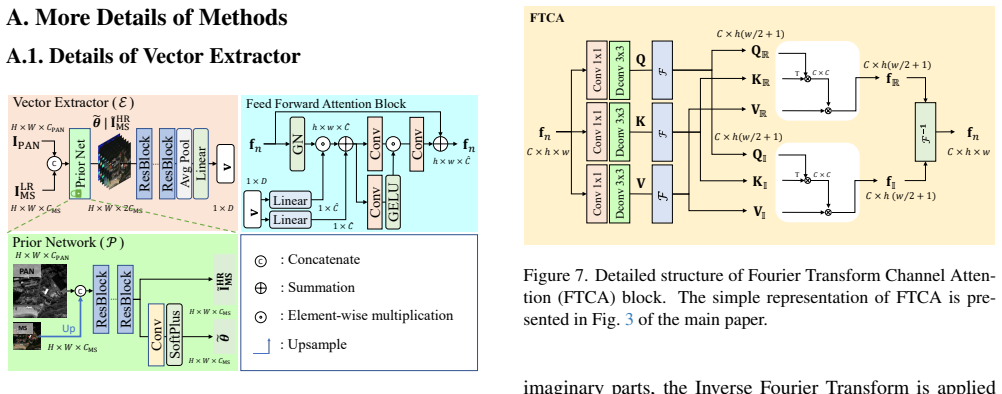
The central mechanism is the uncertainty map $\hat{\theta}$: the teacher's diffusion loss has the form $\mathcal{L}_{\text{U-Diff}} = \| \frac{1}{2\hat{\theta}} \odot |\hat{X}_0 - X_0| + \frac{1}{2} \log \hat{\theta} \|_1$, which makes the network estimate a per-pixel variance while minimizing prediction error, so $\hat{\theta}$ ends up bright in the edge-heavy regions the teacher finds hard. This map splits the student's distillation loss: high-uncertainty pixels are trained against ground truth with weight $\tau + \hat{\theta}$, and low-uncertainty pixels against the teacher's output with weight $\tau - \hat{\theta}$. The supporting machinery is the teacher's frequency conditioning: Feed Forward Attention blocks that inject a compact vector summarizing the PAN and LRMS images, and High Quality Frequency Enhancement blocks that combine Fourier-transform channel attention with stationary-wavelet cross-attention (a shift-invariant wavelet decomposition), feeding the decoder the low-frequency multispectral component together with the high-frequency PAN components.
What would settle it
Freeze the trained teacher and train the student twice: once with the learned uncertainty map $\hat{\theta}$ as the loss weights, and once with the teacher's actual per-pixel training error as an oracle uncertainty map. If the oracle-weighted student does not beat the learned-map student on the test sets, the uncertainty map is not carrying the claimed information. A second check is cross-sensor transfer: train on WorldView-3, test on QuickBird and GaoFen-2, and see whether the U-Know loss gains survive the distribution shift.
Extended reading notes
Core claim
Stated on the paper's own terms: U-Know-DiffPAN is a two-stage teacher-student diffusion framework in which a high-capacity teacher (FSA-T) predicts the residual between the high-resolution multispectral image and the interpolated low-resolution one, conditioned through compact vector representations of the panchromatic (PAN) and low-resolution multispectral (LRMS) inputs in the encoder and through stationary-wavelet and Fourier frequency conditioning in the decoder. The teacher's uncertainty-driven diffusion loss also produces an uncertainty map $\hat{\theta}$ that flags the pixel regions the teacher finds hardest to restore. A lightweight student (FSA-S), built only from residual blocks and given no conditioning beyond the concatenated inputs, is then trained with an uncertainty-aware distillation loss that weights the ground-truth term by $\tau + \hat{\theta}$ and the teacher-mimicry term by $\tau - \hat{\theta}$, transferring the teacher's frequency-rich features while focusing the student on uncertain regions. The paper reports that the student attains the best or second-best reduced-resolution metrics across all three datasets (PSNR 37.93 dB on WV3 versus 37.48 dB for the best diffusion baseline, and 44.59 dB on GF2 versus 43.17 dB for the best non-diffusion baseline), and that on the harder datasets the student surpasses the teacher, which the paper reads as evidence that uncertainty-guided distillation improves generalization.
Load-bearing premise
The load-bearing premise is that the pixel-wise uncertainty map the teacher learns actually marks the regions where the teacher is unreliable, so reweighting the student's training toward ground truth in those regions improves results beyond the training set; the headline comparisons also assume that the re-implemented PanDiff and TMDiff baselines faithfully match the original trained models.
Editorial extensions
If this is right
- The distilled student FSA-S, with 9.1M parameters and 12.3 s inference, is about 17 times smaller and 5.5 times faster than the text-modulated diffusion baseline TMDiff while scoring higher on most reduced-resolution metrics, so diffusion-based pansharpening no longer requires a huge text-conditioned model.
- On the harder WorldView-3 and QuickBird sets the student edges out its own teacher on most metrics, so uncertainty-guided distillation can act as a generalization step rather than a pure compression step.
- The teacher ablations attribute the gains to pairing compact-vector conditioning (FFA) with wavelet and Fourier frequency conditioning (HQFE); either module alone helps, and the two together give the largest improvement.
- All reported results use 25-step DDIM (deterministic diffusion) sampling, so the accuracy claims hold for that sampler; the paper itself notes that multi-step diffusion remains slower than one-shot non-diffusion models, which bounds real-time use.
Reading between the lines
- The $\tau + \hat{\theta}$ versus $\tau - \hat{\theta}$ reweighting is a generic recipe: any restoration task whose teacher can emit a variance-like map (super-resolution, MRI reconstruction, denoising) could reuse it, and a direct test would swap in a different teacher while keeping the student and loss fixed.
- A natural extension the paper leaves implicit is distilling the student further into a single-step or few-step sampler; the 25-step DDIM schedule is the main remaining obstacle to real-time pansharpening.
- The reported standard deviations for FSA-S and FSA-T overlap on WorldView-3 and QuickBird, so a paired per-image significance test would show whether the student-over-teacher gain is systematic or within noise.
- Since the uncertainty map is learned only from training-set errors, its transfer to unseen sensors is untested; a cross-dataset run (train on one satellite, evaluate on another) would reveal whether the uncertainty weighting generalizes.
Signed reviews
Editorial analysis
A structured set of objections, weighed in public.
Referee Report
Summary. The paper proposes U-Know-DiffPAN, a diffusion-based pansharpening framework with two stages. A high-capacity teacher (FSA-T) is trained with an uncertainty-driven diffusion loss to predict both the residual HRMS image and a pixel-wise uncertainty map, using frequency-selective attention modules (FFA in the encoder, FTCA and SWTCA in the decoder). A lightweight student (FSA-S) is then trained with an uncertainty-weighted knowledge distillation loss combining hard, soft, and feature terms. Experiments on WV3, QB, and GF2 report state-of-the-art or second-best reduced-resolution metrics for FSA-S, with 9.1M parameters and 12.3 s inference time, outperforming recent diffusion and non-diffusion baselines.
Significance. If the results hold, the paper makes a practically relevant contribution: it is the first to combine uncertainty-aware knowledge distillation with diffusion-based pansharpening, and it demonstrates a credible efficiency/performance trade-off. The strengths include extensive experiments on three standard datasets, evaluation with eight metrics in both reduced- and full-resolution settings, clear architectural diagrams, and ablations of the main components (FFA, HQFE, SWT vs DWT, and the U-Know loss). The main uncertainty mechanism, however, has an internal consistency issue in the definition of the soft loss, and the claim that the student surpasses the teacher is not consistently supported by the full-resolution results. These issues need to be addressed before the central claims can be fully accepted.
major comments (3)
- [§3.4, Eq. (18)] The soft distillation weight (τ−θ̂) can become negative because θ̂ is the unbounded SoftPlus output of the teacher and is trained via Eq. (4). For fixed prediction X̂0, the per-pixel minimizer of Eq. (4) is θ̂ ≈ |X̂0 − X0|, so wherever the teacher's residual exceeds τ = 1, the soft loss in Eq. (18) is multiplied by a negative weight. This contradicts the text's description that high-uncertainty regions are handled by the hard loss alone; in fact, at those same pixels the student is pushed away from the teacher's output. The paper does not justify or separately ablate this repulsive regime, and Table 6 (L1 vs LKD vs LU-know) does not isolate it. Please clip or reparameterize θ̂ to [0, τ], or provide an explicit analysis and ablation of the negative-weight contribution.
- [§4.2 and Table 8] The statement that FSA-S surpasses FSA-T on the more complex WV3 and QB datasets is only partially supported. On QB full-resolution, FSA-S achieves HQNR 0.931 ± 0.029 versus 0.934 ± 0.029 for FSA-T, and on GF2 full-resolution FSA-S is markedly worse (HQNR 0.944 vs 0.953, with worse Dλ and Ds). Since the paper presents the U-Know strategy as enabling the student to address the teacher's spatial weaknesses, this pattern requires either a qualification of the 'FSA-S surpasses FSA-T' wording or an analysis of why the distillation advantage does not transfer to these full-resolution benchmarks.
- [§4.2] The comparisons against PanDiff and TMDiff rely on re-implementations rather than official code or checkpoints, as stated in the text. Given that TMDiff uses a CLIP text encoder and has substantially higher complexity (Table 4), the fidelity of these re-implementations directly affects the state-of-the-art claim. The authors should provide the re-implementation details, evaluation protocol, or release code/checkpoints so that these comparisons can be independently verified.
minor comments (6)
- [Figures 10–15] Several figure captions contain untranslated Korean annotations (e.g., 'Canconv, TMDiff : .164 서버 / Else : .110서버'), which should be removed or translated into English.
- [Throughout] There are typos that should be corrected, including 'freqeuncy' in the abstract and introduction, 'an novel' in §3.4, 'lev-erege' in §3.3, and 'these specialize components' in §3.3.
- [Eq. (19)] The notation √(∥fi − si∥2_1 + γ) is ambiguous; please write the expression explicitly (e.g., ∥fi − si∥² + γ or an ℓ1-based form) to clarify the feature loss.
- [Table 4] The table caption says 'Best values are highlighted in red' but no highlighting is visible, and for Params, FLOPs, Time, and Memory lower values are better; please clarify by bolding the minimum values.
- [§4.1] The hyperparameters λs, λf, τ, and αi are described as 'empirically found to yield excellent performance'; please state the validation selection protocol (e.g., dataset split, number of runs) because these weights directly influence the reported gains of the U-Know loss.
- [§4.3, Table 6] The U-Know ablation is reported only on the GF2 full-resolution set; adding reduced-resolution results and other datasets would strengthen the evidence that the observed improvement is not dataset-specific.
Circularity Check
No significant circularity: teacher-student training and all evaluations are anchored to external ground truth; no derivation reduces to its own inputs.
full rationale
The paper's derivation chain is self-contained against external benchmarks. The teacher FSA-T is trained with a heteroscedastic uncertainty loss (Eq. 4, built on externally cited works [35,41]) against ground-truth residuals; the student FSA-S is trained with a hard loss to ground truth (Eq. 17), a soft loss to teacher outputs (Eq. 18), and a feature loss (Eq. 19). All reported performance numbers in Tables 2-4 and 8 are measured against held-out reduced-resolution ground truth or the full-resolution HQNR protocol, not against any quantity constructed from the method itself. The uncertainty map only reweights training losses; it does not define the evaluation metric. Hyperparameters tau, lambda_s, and lambda_f are selected empirically, which is standard practice and not circular. There is no load-bearing self-citation: the paper cites external prior work for diffusion, wavelet conditioning, knowledge distillation, and uncertainty estimation, and it invokes no author-derived uniqueness theorem. The separate concern that theta-hat is SoftPlus-unbounded, so (tau - theta-hat) in Eq. 18 can become negative, is a technical correctness issue about the loss formulation rather than a circularity, because the student's final scores are externally evaluated and the ablation in Table 6 isolates the loss design against ground-truth-based metrics. No circular step can be exhibited from the paper's own equations or citations.
Assumptions & free parameters
free parameters (4)
- λs =
0.1
- λf =
0.001
- τ =
1
- αi =
1
assumptions (4)
- standard math DDPM forward noising process with a fixed variance schedule (Eq. 2)
- domain assumption Stationary Wavelet Transform decomposition yields shift-invariant frequency subbands that are useful for image fusion
- standard math The heteroscedastic uncertainty loss (Eq. 4) with SoftPlus positivity is a well-posed objective for learning an uncertainty map
- domain assumption The PanCollection benchmarks and the metrics PSNR, SSIM, SAM, ERGAS, SCC, Q4/Q8, and HQNR are valid measures of pansharpening quality
Cite this review
Pith. "Pith review of U-Know-DiffPAN: An Uncertainty-aware Knowledge Distillation Diffusion Framework with Details Enhancement for PAN-Sharpening." pith.science (2026). https://pith.science/paper/3FJ2JQOI
@misc{pith2026241206243,
  author       = {Pith},
  title        = {Pith review of: U-Know-DiffPAN: An Uncertainty-aware Knowledge Distillation Diffusion Framework with Details Enhancement for PAN-Sharpening},
  year         = {2026},
  howpublished = {\url{https://pith.science/paper/3FJ2JQOI}},
  note         = {Machine review of arXiv:2412.06243}
}
read the original abstract
Conventional methods for PAN-sharpening often struggle to restore fine details due to limitations in leveraging high-frequency information. Moreover, diffusion-based approaches lack sufficient conditioning to fully utilize Panchromatic (PAN) images and low-resolution multispectral (LRMS) inputs effectively. To address these challenges, we propose an uncertainty-aware knowledge distillation diffusion framework with details enhancement for PAN-sharpening, called U-Know-DiffPAN. The U-Know-DiffPAN incorporates uncertainty-aware knowledge distillation for effective transfer of feature details from our teacher model to a student one. The teacher model in our U-Know-DiffPAN captures frequency details through freqeuncy selective attention, facilitating accurate reverse process learning. By conditioning the encoder on compact vector representations of PAN and LRMS and the decoder on Wavelet transforms, we enable rich frequency utilization. So, the high-capacity teacher model distills frequency-rich features into a lightweight student model aided by an uncertainty map. From this, the teacher model can guide the student model to focus on difficult image regions for PAN-sharpening via the usage of the uncertainty map. Extensive experiments on diverse datasets demonstrate the robustness and superior performance of our U-Know-DiffPAN over very recent state-of-the-art PAN-sharpening methods.
Figures


Figures from the paper (11 more)




Forward citations
Cited by 1 Pith paper
-
PAN-Crafter: Learning Modality-Consistent Alignment for PAN-Sharpening
A new pansharpening architecture with joint PAN/MS reconstruction and local cross-modality attention reports the best published scores on WorldView-3, QuickBird, GaoFen-2, and zero-shot WorldView-2 benchmarks.
Reference graph
Works this paper leans on
-
[1]
Mtf-tailored multiscale fusion of high-resolution ms and pan imagery
Bruno Aiazzi, Luciano Alparone, Stefano Baronti, Andrea Garzelli, and Massimo Selva. Mtf-tailored multiscale fusion of high-resolution ms and pan imagery. Photogrammetric Engineering & Remote Sensing, 72(5):591–596, 2006. 2, 10
work page 2006
-
[2]
A survey of classical meth- ods and new trends in pansharpening of multispectral im- ages
Israa Amro, Javier Mateos, Miguel Vega, Rafael Molina, and Aggelos K Katsaggelos. A survey of classical meth- ods and new trends in pansharpening of multispectral im- ages. EURASIP Journal on Advances in Signal Processing , 2011:1–22, 2011. 1
work page 2011
-
[3]
Pitfalls of in-domain uncertainty es- timation and ensembling in deep learning
Arsenii Ashukha, Alexander Lyzhov, Dmitry Molchanov, and Dmitry Vetrov. Pitfalls of in-domain uncertainty es- timation and ensembling in deep learning. arXiv preprint arXiv:2002.06470, 2020. 11
arXiv 2002
-
[4]
A variational model for p+ xs image fusion
Coloma Ballester, Vicent Caselles, Laura Igual, Joan Verdera, and Bernard Roug ´e. A variational model for p+ xs image fusion. International Journal of Computer Vision, 69:43–58, 2006. 2
2006
-
[5]
A general and adaptive robust loss function
Jonathan T Barron. A general and adaptive robust loss function. In Proceedings of the IEEE/CVF conference on computer vision and pattern recognition, pages 4331–4339,
-
[6]
Hermite functions and fourier series
Enrico Celeghini, Manuel Gadella, and Mariano A del Olmo. Hermite functions and fourier series. Symmetry, 13(5):853,
-
[7]
Data uncertainty learning in face recognition
Jie Chang, Zhonghao Lan, Changmao Cheng, and Yichen Wei. Data uncertainty learning in face recognition. In Pro- ceedings of the IEEE/CVF conference on computer vision and pattern recognition, pages 5710–5719, 2020. 11
work page 2020
-
[8]
Knowledge distillation with feature maps for image classifi- cation
Wei-Chun Chen, Chia-Che Chang, and Che-Rung Lee. Knowledge distillation with feature maps for image classifi- cation. In Computer Vision–ACCV 2018: 14th Asian Confer- ence on Computer Vision, Perth, Australia, December 2–6, 2018, Revised Selected Papers, Part III 14 , pages 200–215. Springer, 2019. 3
work page 2018
Show all 75 references
-
[9]
A new adaptive component-substitution-based satellite image fusion by us- ing partial replacement
Jaewan Choi, Kiyun Yu, and Yongil Kim. A new adaptive component-substitution-based satellite image fusion by us- ing partial replacement. IEEE transactions on geoscience and remote sensing, 49(1):295–309, 2010. 2
2010
-
[10]
Pansharpening by convo- lutional neural networks in the full resolution framework
Matteo Ciotola, Sergio Vitale, Antonio Mazza, Giovanni Poggi, and Giuseppe Scarpa. Pansharpening by convo- lutional neural networks in the full resolution framework. IEEE Transactions on Geoscience and Remote Sensing , 60: 1–17, 2022. 2
2022
-
[11]
Hyperspectral pansharpening: Criti- cal review, tools and future perspectives
Matteo Ciotola, Giuseppe Guarino, Gemine Vivone, Gio- vanni Poggi, Jocelyn Chanussot, Antonio Plaza, and Giuseppe Scarpa. Hyperspectral pansharpening: Criti- cal review, tools and future perspectives. arXiv preprint arXiv:2407.01355, 2024. 1
2024 arXiv
-
[12]
Machine learning in pan- sharpening: A benchmark, from shallow to deep networks
Liang-Jian Deng, Gemine Vivone, Mercedes E Paoletti, Giuseppe Scarpa, Jiang He, Yongjun Zhang, Jocelyn Chanussot, and Antonio Plaza. Machine learning in pan- sharpening: A benchmark, from shallow to deep networks. IEEE Geoscience and Remote Sensing Magazine , 10(3): 279–315, 2...
2022
-
[13]
Adam: A method for stochastic opti- mization
P Kingma Diederik. Adam: A method for stochastic opti- mization. (No Title), 2014. 6
2014
-
[14]
Sscnet: Spectral-spatial consistency optimization of cnn for pansharpening
Kento Doi and Akira Iwasaki. Sscnet: Spectral-spatial consistency optimization of cnn for pansharpening. In IGARSS 2019-2019 IEEE International Geoscience and Re- mote Sensing Symposium, pages 3141–3144. IEEE, 2019. 2
2019
-
[15]
Content-adaptive non-local convolution for remote sensing pansharpening
Yule Duan, Xiao Wu, Haoyu Deng, and Liang-Jian Deng. Content-adaptive non-local convolution for remote sensing pansharpening. In Proceedings of the IEEE/CVF Conference on Computer Vision and Pattern Recognition, pages 27738– 27747, 2024. 1, 2, 7, 12
2024
-
[16]
A survey of pansharpening meth- ods with a new band-decoupled variational model
Joan Duran, Antoni Buades, Bartomeu Coll, Catalina Sbert, and Gwendoline Blanchet. A survey of pansharpening meth- ods with a new band-decoupled variational model. ISPRS Journal of Photogrammetry and Remote Sensing , 125:78– 105, 2017. 1
2017
-
[17]
Hypercomplex quality assessment of multi/hyperspectral images
Andrea Garzelli and Filippo Nencini. Hypercomplex quality assessment of multi/hyperspectral images. IEEE Geoscience and Remote Sensing Letters, 6(4):662–665, 2009. 6
2009
-
[18]
A residual dense generative adversarial network for pansharpening with geo- metrical constraints
Ana ¨ıs Gastineau, Jean-Franc ¸ois Aujol, Yannick Berthoumieu, and Christian Germain. A residual dense generative adversarial network for pansharpening with geo- metrical constraints. In 2020 IEEE International Conference on Image Processing (ICIP), pages 493–497. IEEE, 2020. 2
2020
-
[19]
Generative adversarial nets
Ian Goodfellow, Jean Pouget-Abadie, Mehdi Mirza, Bing Xu, David Warde-Farley, Sherjil Ozair, Aaron Courville, and Yoshua Bengio. Generative adversarial nets. Advances in neural information processing systems, 27, 2014. 2
2014
-
[20]
Gaussian error linear units (gelus)
Dan Hendrycks and Kevin Gimpel. Gaussian error linear units (gelus). arXiv preprint arXiv:1606.08415, 2016. 5
2016 arXiv
-
[21]
Distilling the knowledge in a neural net- work
Geoffrey Hinton. Distilling the knowledge in a neural net- work. arXiv preprint arXiv:1503.02531, 2015. 3
2015 arXiv
-
[22]
Denoising dif- fusion probabilistic models
Jonathan Ho, Ajay Jain, and Pieter Abbeel. Denoising dif- fusion probabilistic models. Advances in neural information processing systems, 33:6840–6851, 2020. 2, 3
2020
-
[23]
Pan-sharpening via multiscale dynamic convolutional neural network
Jianwen Hu, Pei Hu, Xudong Kang, Hui Zhang, and Shaosheng Fan. Pan-sharpening via multiscale dynamic convolutional neural network. IEEE Transactions on Geo- science and Remote Sensing, 59(3):2231–2244, 2020. 2
2020
-
[24]
A new pan-sharpening method with deep neu- ral networks
Wei Huang, Liang Xiao, Zhihui Wei, Hongyi Liu, and Songze Tang. A new pan-sharpening method with deep neu- ral networks. IEEE Geoscience and Remote Sensing Letters, 12(5):1037–1041, 2015. 2
2015
-
[25]
Comprehensive attention self-distillation for weakly- supervised object detection
Zeyi Huang, Yang Zou, BVK Kumar, and Dong Huang. Comprehensive attention self-distillation for weakly- supervised object detection. Advances in neural information processing systems, 33:16797–16807, 2020. 3
2020
-
[26]
Lagconv: Local-context adap- tive convolution kernels with global harmonic bias for pan- sharpening
Zi-Rong Jin, Tian-Jing Zhang, Tai-Xiang Jiang, Gemine Vivone, and Liang-Jian Deng. Lagconv: Local-context adap- tive convolution kernels with global harmonic bias for pan- sharpening. In Proceedings of the AAAI Conference on Arti- ficial Intelligence, pages 1113–1121, 2022. 2, 7, 12
2022
-
[27]
A style-based generator architecture for generative adversarial networks
Tero Karras, Samuli Laine, and Timo Aila. A style-based generator architecture for generative adversarial networks. In Proceedings of the IEEE/CVF conference on computer vi- sion and pattern recognition, pages 4401–4410, 2019. 2, 4
2019
-
[28]
What uncertainties do we need in bayesian deep learning for computer vision? Advances in neural information processing systems, 30, 2017
Alex Kendall and Yarin Gal. What uncertainties do we need in bayesian deep learning for computer vision? Advances in neural information processing systems, 30, 2017. 11 15
2017
-
[29]
Simple and scalable predictive uncertainty estima- tion using deep ensembles
Balaji Lakshminarayanan, Alexander Pritzel, and Charles Blundell. Simple and scalable predictive uncertainty estima- tion using deep ensembles. Advances in neural information processing systems, 30, 2017. 11
2017
-
[30]
Mun-gan: A multiscale unsu- pervised network for remote sensing image pansharpening
Xiaobo Liu, Xiang Liu, Haoran Dai, Xudong Kang, Anto- nio Plaza, and Wenjie Zu. Mun-gan: A multiscale unsu- pervised network for remote sensing image pansharpening. IEEE Transactions on Geoscience and Remote Sensing , 61: 1–18, 2023. 2
2023
-
[31]
Hyperspectral pansharpening: A review
Laetitia Loncan, Luis B De Almeida, Jos ´e M Bioucas- Dias, Xavier Briottet, Jocelyn Chanussot, Nicolas Dobigeon, Sophie Fabre, Wenzhi Liao, Giorgio A Licciardi, Miguel Simoes, et al. Hyperspectral pansharpening: A review. IEEE Geoscience and remote sensing magazine, 3(3):27–4...
2015
-
[32]
Pan-gan: An unsupervised pan-sharpening method for remote sensing image fusion
Jiayi Ma, Wei Yu, Chen Chen, Pengwei Liang, Xiaojie Guo, and Junjun Jiang. Pan-gan: An unsupervised pan-sharpening method for remote sensing image fusion. Information Fu- sion, 62:110–120, 2020. 2
2020
-
[33]
Pan- diff: A novel pansharpening method based on denoising diffusion probabilistic model
Qingyan Meng, Wenxu Shi, Sijia Li, and Linlin Zhang. Pan- diff: A novel pansharpening method based on denoising diffusion probabilistic model. IEEE Transactions on Geo- science and Remote Sensing , 61:1–17, 2023. 1, 2, 6, 7, 8, 12
2023
-
[34]
The station- ary wavelet transform and some statistical applications
Guy P Nason and Bernard W Silverman. The station- ary wavelet transform and some statistical applications. In Wavelets and statistics, pages 281–299. Springer, 1995. 3, 4, 5
1995
-
[35]
Uncertainty-driven loss for single image super- resolution
Qian Ning, Weisheng Dong, Xin Li, Jinjian Wu, and Guang- ming Shi. Uncertainty-driven loss for single image super- resolution. Advances in Neural Information Processing Sys- tems, 34:16398–16409, 2021. 4, 11
2021
-
[36]
Introduction of sensor spectral response into image fusion methods
Xavier Otazu, Mar ´ıa Gonz ´alez-Aud´ıcana, Octavi Fors, and Jorge N ´u˜nez. Introduction of sensor spectral response into image fusion methods. application to wavelet-based meth- ods. IEEE Transactions on Geoscience and Remote Sensing, 43(10):2376–2385, 2005. 2, 10
2005
-
[37]
Wavelet diffusion models are fast and scalable image generators
Hao Phung, Quan Dao, and Anh Tran. Wavelet diffusion models are fast and scalable image generators. In Proceed- ings of the IEEE/CVF conference on computer vision and pattern recognition, pages 10199–10208, 2023. 5, 9
2023
-
[38]
Learning transferable visual models from natural language supervi- sion
Alec Radford, Jong Wook Kim, Chris Hallacy, Aditya Ramesh, Gabriel Goh, Sandhini Agarwal, Girish Sastry, Amanda Askell, Pamela Mishkin, Jack Clark, et al. Learning transferable visual models from natural language supervi- sion. In International conference on machine learning, ...
2021
-
[39]
U- net: Convolutional networks for biomedical image segmen- tation
Olaf Ronneberger, Philipp Fischer, and Thomas Brox. U- net: Convolutional networks for biomedical image segmen- tation. In Medical image computing and computer-assisted intervention–MICCAI 2015: 18th international conference, Munich, Germany, October 5-9, 2015, proceedings, pa...
2015
-
[40]
Image super- resolution via iterative refinement
Chitwan Saharia, Jonathan Ho, William Chan, Tim Sali- mans, David J Fleet, and Mohammad Norouzi. Image super- resolution via iterative refinement. IEEE transactions on pattern analysis and machine intelligence, 45(4):4713–4726,
-
[41]
On the pitfalls of heteroscedastic uncertainty estimation with probabilistic neural networks.arXiv preprint arXiv:2203.09168, 2022
Maximilian Seitzer, Arash Tavakoli, Dimitrije Antic, and Georg Martius. On the pitfalls of heteroscedastic uncertainty estimation with probabilistic neural networks.arXiv preprint arXiv:2203.09168, 2022. 4, 11
2022 arXiv
-
[42]
Resdiff: Combining cnn and diffusion model for image super-resolution
Shuyao Shang, Zhengyang Shan, Guangxing Liu, LunQian Wang, XingHua Wang, Zekai Zhang, and Jinglin Zhang. Resdiff: Combining cnn and diffusion model for image super-resolution. In Proceedings of the AAAI Conference on Artificial Intelligence, pages 8975–8983, 2024. 5, 9
2024
-
[43]
The discrete wavelet transform: wed- ding the a trous and mallat algorithms
Mark J Shensa et al. The discrete wavelet transform: wed- ding the a trous and mallat algorithms. IEEE Transactions on signal processing, 40(10):2464–2482, 1992. 2
1992
-
[44]
Denoising diffusion implicit models
Jiaming Song, Chenlin Meng, and Stefano Ermon. Denoising diffusion implicit models. arXiv preprint arXiv:2010.02502, 2020. 2, 6
2010 arXiv
-
[45]
Learning scene structure guidance via cross- task knowledge transfer for single depth super-resolution
Baoli Sun, Xinchen Ye, Baopu Li, Haojie Li, Zhihui Wang, and Rui Xu. Learning scene structure guidance via cross- task knowledge transfer for single depth super-resolution. In Proceedings of the ieee/cvf conference on computer vision and pattern recognition, pages 7792–7801, 2021. 3
2021
-
[46]
Uncertainty estimation using a single deep de- terministic neural network
Joost Van Amersfoort, Lewis Smith, Yee Whye Teh, and Yarin Gal. Uncertainty estimation using a single deep de- terministic neural network. In International conference on machine learning, pages 9690–9700. PMLR, 2020. 11
2020
-
[47]
A critical comparison among pansharpening algorithms
Gemine Vivone, Luciano Alparone, Jocelyn Chanussot, Mauro Dalla Mura, Andrea Garzelli, Giorgio A Licciardi, Rocco Restaino, and Lucien Wald. A critical comparison among pansharpening algorithms. IEEE Transactions on Geoscience and Remote Sensing, 53(5):2565–2586, 2014. 6
2014
-
[48]
A new benchmark based on recent advances in multispectral pansharpening: Revisit- ing pansharpening with classical and emerging pansharpen- ing methods
Gemine Vivone, Mauro Dalla Mura, Andrea Garzelli, Rocco Restaino, Giuseppe Scarpa, Magnus O Ulfarsson, Luciano Alparone, and Jocelyn Chanussot. A new benchmark based on recent advances in multispectral pansharpening: Revisit- ing pansharpening with classical and emerging pansh...
2020
-
[49]
Lucien Wald. Quality of high resolution synthesised images: Is there a simple criterion? In Third conference” Fusion of Earth data: merging point measurements, raster maps and remotely sensed images”, pages 99–103. SEE/URISCA,
-
[50]
Fusion of satellite images of different spatial resolutions: Assessing the quality of resulting images
Lucien Wald, Thierry Ranchin, and Marc Mangolini. Fusion of satellite images of different spatial resolutions: Assessing the quality of resulting images. Photogrammetric engineer- ing and remote sensing, 63(6):691–699, 1997. 2
1997
-
[51]
Exploiting diffusion prior for real-world image super-resolution
Jianyi Wang, Zongsheng Yue, Shangchen Zhou, Kelvin CK Chan, and Chen Change Loy. Exploiting diffusion prior for real-world image super-resolution. International Journal of Computer Vision, pages 1–21, 2024. 2
2024
-
[52]
Dis- tilling object detectors with fine-grained feature imitation
Tao Wang, Li Yuan, Xiaopeng Zhang, and Jiashi Feng. Dis- tilling object detectors with fine-grained feature imitation. In Proceedings of the IEEE/CVF Conference on Computer Vi- sion and Pattern Recognition, pages 4933–4942, 2019. 3
2019
-
[53]
Recovering realistic texture in image super-resolution by deep spatial feature transform
Xintao Wang, Ke Yu, Chao Dong, and Chen Change Loy. Recovering realistic texture in image super-resolution by deep spatial feature transform. In Proceedings of the IEEE conference on computer vision and pattern recognition , pages 606–615, 2018. 4 16
2018
-
[54]
Image quality assessment: from error visibility to structural similarity
Zhou Wang, Alan C Bovik, Hamid R Sheikh, and Eero P Si- moncelli. Image quality assessment: from error visibility to structural similarity. IEEE transactions on image processing, 13(4):600–612, 2004. 6
2004
-
[55]
Data transmission by frequency-division multiplexing using the discrete fourier transform
Stephen Weinstein and Paul Ebert. Data transmission by frequency-division multiplexing using the discrete fourier transform. IEEE transactions on Communication Technol- ogy, 19(5):628–634, 1971. 2
1971
-
[56]
Dynamic cross feature fusion for remote sensing pan- sharpening
Xiao Wu, Ting-Zhu Huang, Liang-Jian Deng, and Tian-Jing Zhang. Dynamic cross feature fusion for remote sensing pan- sharpening. In Proceedings of the IEEE/CVF International Conference on Computer Vision, pages 14687–14696, 2021. 7, 12
2021
-
[57]
Group normalization
Yuxin Wu and Kaiming He. Group normalization. In Pro- ceedings of the European conference on computer vision (ECCV), pages 3–19, 2018. 5
2018
-
[58]
Diffir: Efficient diffusion model for image restoration
Bin Xia, Yulun Zhang, Shiyin Wang, Yitong Wang, Xing- long Wu, Yapeng Tian, Wenming Yang, and Luc Van Gool. Diffir: Efficient diffusion model for image restoration. In Proceedings of the IEEE/CVF International Conference on Computer Vision, pages 13095–13105, 2023. 2, 4
2023
-
[59]
Empower generaliz- ability for pansharpening through text-modulated diffusion model
Yinghui Xing, Litao Qu, Shizhou Zhang, Jiapeng Feng, Xiuwei Zhang, and Yanning Zhang. Empower generaliz- ability for pansharpening through text-modulated diffusion model. IEEE Transactions on Geoscience and Remote Sens- ing, 2024. 1, 2, 3, 6, 7, 8, 12
2024
-
[60]
Feature nor- malized knowledge distillation for image classification
Kunran Xu, Lai Rui, Yishi Li, and Lin Gu. Feature nor- malized knowledge distillation for image classification. In European conference on computer vision , pages 664–680. Springer, 2020. 3
2020
-
[61]
Pannet: A deep network architecture for pan-sharpening
Junfeng Yang, Xueyang Fu, Yuwen Hu, Yue Huang, Xinghao Ding, and John Paisley. Pannet: A deep network architecture for pan-sharpening. InProceedings of the IEEE international conference on computer vision, pages 5449–5457, 2017. 2, 7, 12
2017
-
[62]
Vitkd: Feature-based knowledge distillation for vision transformers
Zhendong Yang, Zhe Li, Ailing Zeng, Zexian Li, Chun Yuan, and Yu Li. Vitkd: Feature-based knowledge distillation for vision transformers. In Proceedings of the IEEE/CVF Con- ference on Computer Vision and Pattern Recognition, pages 1379–1388, 2024. 3
2024
-
[63]
G-detkd: Towards general distillation framework for object detectors via contrastive and semantic- guided feature imitation
Lewei Yao, Renjie Pi, Hang Xu, Wei Zhang, Zhenguo Li, and Tong Zhang. G-detkd: Towards general distillation framework for object detectors via contrastive and semantic- guided feature imitation. In Proceedings of the IEEE/CVF international conference on computer vision , pages...
2021
-
[64]
A multiscale and multidepth convolutional neural network for remote sensing imagery pan-sharpening
Qiangqiang Yuan, Yancong Wei, Xiangchao Meng, Huan- feng Shen, and Liangpei Zhang. A multiscale and multidepth convolutional neural network for remote sensing imagery pan-sharpening. IEEE Journal of Selected Topics in Ap- plied Earth Observations and Remote Sensing , 11(3):978...
2018
-
[65]
Discrimination among semi-arid landscape endmem- bers using the spectral angle mapper (sam) algorithm
Roberta H Yuhas, Alexander FH Goetz, and Joe W Board- man. Discrimination among semi-arid landscape endmem- bers using the spectral angle mapper (sam) algorithm. In JPL, Summaries of the Third Annual JPL Airborne Geo- science Workshop. Volume 1: AVIRIS Workshop, 1992. 6
1992
-
[66]
Restormer: Efficient transformer for high-resolution image restoration
Syed Waqas Zamir, Aditya Arora, Salman Khan, Mu- nawar Hayat, Fahad Shahbaz Khan, and Ming-Hsuan Yang. Restormer: Efficient transformer for high-resolution image restoration. In Proceedings of the IEEE/CVF conference on computer vision and pattern recognition, pages 5728–5739,
-
[67]
Pan- sharpening with wavelet-enhanced high-frequency informa- tion
Jie Zhang, Xuanhua He, Keyu Yan, Ke Cao, Rui Li, Chengjun Xie, Man Zhou, and Danfeng Hong. Pan- sharpening with wavelet-enhanced high-frequency informa- tion. IEEE Transactions on Geoscience and Remote Sensing, 62:1–14, 2024. 9
2024
-
[68]
Spatial-spectral dual back- projection network for pansharpening
Kai Zhang, Anfei Wang, Feng Zhang, Wenbo Wan, Jiande Sun, and Lorenzo Bruzzone. Spatial-spectral dual back- projection network for pansharpening. IEEE Transactions on Geoscience and Remote Sensing, 2023. 2, 7, 12
2023
-
[69]
Data-free knowledge dis- tillation for image super-resolution
Yiman Zhang, Hanting Chen, Xinghao Chen, Yiping Deng, Chunjing Xu, and Yunhe Wang. Data-free knowledge dis- tillation for image super-resolution. In Proceedings of the IEEE/CVF Conference on Computer Vision and Pattern Recognition, pages 7852–7861, 2021. 3
2021
-
[70]
Data upcycling knowledge distillation for image super-resolution
Yun Zhang, Wei Li, Simiao Li, Hanting Chen, Zhijun Tu, Wenjia Wang, Bingyi Jing, Shaohui Lin, and Jie Hu. Data upcycling knowledge distillation for image super-resolution. arXiv preprint arXiv:2309.14162, 2023. 3
2023 arXiv
-
[71]
An anisotropic variational pansharpening model with adap- tive coefficients
Yaqun Zhang, Zhichang Guo, Dazhi Zhang, and Boying Wu. An anisotropic variational pansharpening model with adap- tive coefficients. Inverse Problems and Imaging, pages 0–0,
-
[72]
Dcpnet: A dual-task collaborative promo- tion network for pansharpening
Yafei Zhang, Xuji Yang, Huafeng Li, Minghong Xie, and Zhengtao Yu. Dcpnet: A dual-task collaborative promo- tion network for pansharpening. IEEE Transactions on Geo- science and Remote Sensing, 62:1–16, 2024. 2, 7, 12
2024
-
[73]
Improving deep neural networks using softplus units
Hao Zheng, Zhanlei Yang, Wenju Liu, Jizhong Liang, and Yanpeng Li. Improving deep neural networks using softplus units. In 2015 International joint conference on neural net- works (IJCNN), pages 1–4. IEEE, 2015. 4
2015
-
[74]
Se- ssd: Self-ensembling single-stage object detector from point cloud
Wu Zheng, Weiliang Tang, Li Jiang, and Chi-Wing Fu. Se- ssd: Self-ensembling single-stage object detector from point cloud. In Proceedings of the IEEE/CVF conference on com- puter vision and pattern recognition , pages 14494–14503,
-
[75]
A wavelet transform method to merge landsat tm and spot panchromatic data
Jie Zhou, Daniel L Civco, and John A Silander. A wavelet transform method to merge landsat tm and spot panchromatic data. International journal of remote sensing , 19(4):743– 757, 1998. 5, 10 17
1998
Reviewed August 11, 2026 · model on record in the stance chip above.
Discussion (0). Continue with ORCID to comment.