REVIEW 3 major objections 6 minor 2 cited by
PRECISE: Pre-training Sequential Recommenders with Collaborative and Semantic Information
T0 review · 3 major / 6 minor · reviewed 2026-08-11 · deepseek-v4-flash
Pith's one-line read PRECISE claims that fusing item IDs with LLM semantic embeddings—gated by a Mixture-of-Experts network—and pre-training on all-scene behavior before target-scene fine-tuning improves sequential recommendation, including long-tail and…
desk verdict A real industrial contribution to ID+LLM fusion for sequential recommenders, with honest reporting — but the cold-start claim is untested on truly unseen items and the printed losses need fixing. read the letter →
The pith
A machine-rendered reading of the paper's core claim, the machinery that carries it, and where it could break.
The reading
What carries the argument
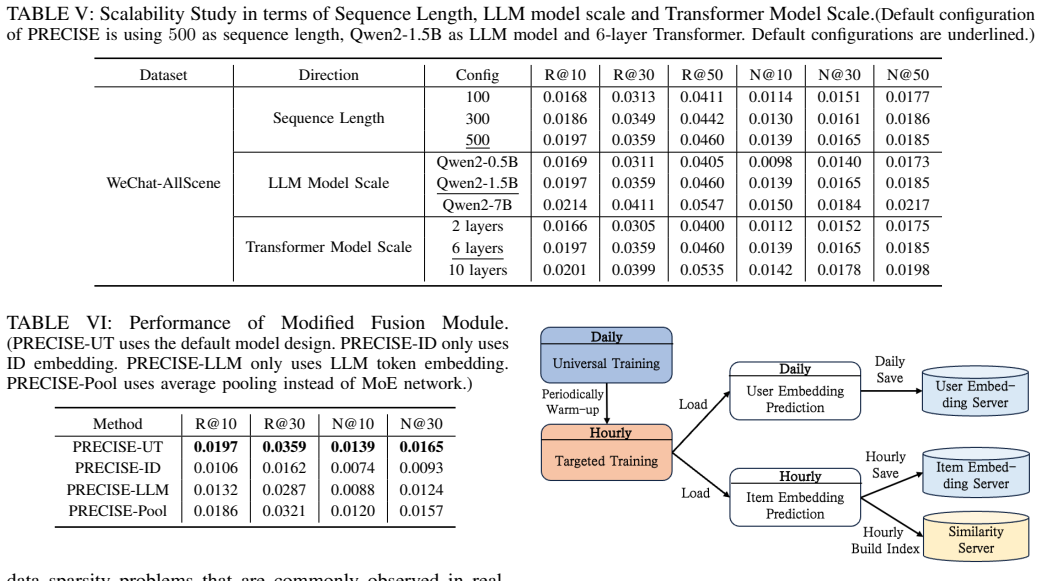
The load-bearing mechanism is the Embedding Fusion module: for each item, an ID embedding is concatenated with a semantic embedding produced by K attention-based expert networks, with a gating network that selects the top-k experts and weights their outputs. The MoE gate lets collaborative training decide how much each text token contributes, which is what distinguishes this from simple pooling. Around that, Universal Training uses a masked decoder-only Transformer with next-item prediction and sampled negatives over all-scene sequences, while Targeted Training warm-starts from those parameters, removes the attention mask, pools the final layer's item embeddings through an MLP, and optimizes BPR loss. Two training practices carry the industrial claim: periodically re-warming the targeted model from the universal model keeps newly published items benefiting from all-scene pre-training, and alternately freezing token embeddings while updating ID embeddings prevents the pre-trained text from starving collaborative ID learning.
What would settle it
Rerun the Amazon or WeChat evaluation on a held-out set of items with zero training instances and compare Recall@K against the strongest pure-ID baseline; if PRECISE does not win there, the cold-start claim is not supported. A second check: retrain with average pooling instead of the MoE gate; if offline metrics do not drop, the gating mechanism is not what carries the improvement.
Extended reading notes
Core claim
The paper's central claim is that semantic and collaborative information are complementary at the item-representation level, and that a universal-to-targeted training scheme lets one model serve many scenarios. Concretely, PRECISE concatenates a learnable item-ID embedding with a semantic embedding produced by a Mixture-of-Experts network that distills the item's LLM token embeddings into one vector. A decoder-only Transformer is pre-trained with a next-item prediction loss over all-scene behavior sequences, and its parameters are then transferred to a target task where bidirectional attention and a Bayesian Personalized Ranking loss adapt holistic user interests to the specific scenario. In offline experiments, PRECISE-UT, the universal-trained encoder, outperforms ID-only and text-only baselines on both Amazon and WeChat-AllScene, with the largest relative gains on the cold-item subset; the full PRECISE pipeline also beats universal-only and targeted-only training on click and share tasks.
Load-bearing premise
The load-bearing premise is that a long-tail item with a few interactions is a fair stand-in for a cold-start item: the paper's offline cold-item evaluation deliberately excludes items with zero training instances, and some online cold-start share metrics moved negatively.
Editorial extensions
If this is right
- The same pre-trained user and item embeddings can be plugged into recall, both user-to-item and user-to-item-to-item, and into ranking as input features, with reported online gains in active users, clicks, shares, and reading time.
- Semantic-plus-ID representation should beat pure ID models specifically on long-tail items, because the text channel carries signal before many interactions accumulate.
- Universal Training alone beats Targeted-only training on sparse target tasks, so cross-scene pre-training can substitute for some target-scene data.
- Scaling behavior sequence length, LLM size, and transformer depth each improve offline performance, implying the framework absorbs more data and parameters.
- Periodic warm-up keeps the fraction of pre-trained items above 70 percent, so continuous item production does not erode the benefit of universal training.
Reading between the lines
- The offline cold-item evaluation excludes items with zero training instances, so the evidence as presented supports infrequent items rather than truly unseen items; testing on zero-training items is a direct way to extend the claim.
- Because the MoE gate selects experts per item, an unstated implication is that the model learns which text parts matter for collaborative behavior; inspecting gate weights could test this.
- Since the framework accepts any token encoder, it should extend to video, live, and music items whose titles, hashtags, or transcribed speech are available as text—a natural deployment next step.
- The online cold-start results show a seesaw effect where click embeddings can reduce shares, suggesting multi-objective or task-specific fine-tuning when multiple business metrics matter.
Signed reviews
Editorial analysis
A structured set of objections, weighed in public.
Referee Report
Summary. PRECISE is a pre-training framework for sequential recommendation that combines collaborative item-ID embeddings with LLM-generated semantic token embeddings through an MoE-based fusion module, pre-trains a decoder-only Transformer on all-scene behavior sequences, and then adapts the model to target scenarios with a BPR-style objective. The paper reports offline gains over SAS-Rec, HSTU, LEARN, and HLLM on Amazon and WeChat-AllScene, ablation and scalability studies, and online A/B improvements in WeChat recall and ranking. The authors additionally describe periodic warm-up and alternate training strategies used in deployment.
Significance. If the empirical results hold, this is a valuable industrial-scale demonstration that combining collaborative and semantic information can improve sequential recommendation and transfer across scenarios. The paper's strengths include experiments on a very large industrial dataset, online deployment with statistical significance tests, ablations that isolate the contribution of each input component, and a scalability study. The main concerns are that the proposed cold-start advantage is not directly tested in the offline evaluation, the online cold-start results concern users rather than unseen items, and the two printed loss equations do not match the described training objectives. These issues need to be corrected before the stated claims can be accepted.
major comments (3)
- [Section IV-C, Eq. (5) and Section IV-D, Eq. (6)] The NIP loss in Eq. (5) is not the sampled softmax cross-entropy described in the text. As printed it is -sum log(pos)/(log(pos)+sum log(neg)), which is a ratio of log-dot-products rather than a cross-entropy over sampled candidates, and it is undefined whenever a dot product is non-positive. Similarly, Eq. (6) prints -log(pos - neg) for the BPR loss, whereas the standard BPR objective is -log sigma(pos - neg). Since these equations define the training objectives of the two main training stages, they are load-bearing and must be corrected or replaced with the actual objectives used in the experiments.
- [Section V-B, Table IV] The cold-item evaluation explicitly excludes the regime the paper claims to address. The text states 'for a fair comparison with ID-based models, new items with zero training instances were not included in the evaluation,' and Table IV evaluates items with fewer than 1,000 interactions. Such items still have training instances and learnable ID embeddings. The abstract and introduction motivate PRECISE by the inability of ID-based models to handle 'cold-start scenarios' and 'newly published items,' so the claimed advantage for truly unseen items is not supported by the offline experiments. Please either include zero-training items in the evaluation or revise the paper's claims to explicitly target long-tail items with limited but nonzero interactions.
- [Section VI-B, Table VIII and Table IX] The online experiments do not fill the cold-start item gap. Cold-start users are defined by low reading frequency in the Recommendation Box, and the reported metrics are user-side (active users, clicks, shares, reading time). No item-level cold-start breakdown is provided, and the online serving schemes retrieve items by embedding similarity rather than testing items never seen during training. The paper should either provide item-level cold-start evidence or clearly separate the supported claim (better recall and ranking for users and for long-tail items with limited interactions) from the unsupported claim about zero-training items.
minor comments (6)
- [Section II-A] The related-work text attributes the same reference [24] to both 'Li et. al.' and 'Zhang et. al.'; please verify the citation and attribute the work correctly.
- [Section V-A] Several hyperparameters that affect the reported results are not specified, including the number of MoE experts K, the top-k expert selection count, the number of negative samples per target item, the periodic warm-up cycle, and the alternate-training convergence criterion; please report these to make the experiments reproducible.
- [Section VI-B] The paragraph beginning 'We have deployed both U2I and U2I2I recall paradigms in the Article Recommendation task' is repeated almost verbatim immediately before the results discussion; please remove the duplicated passage.
- [Section VI-C] The sentence 'This result is consistent with our previous conclusions based on offline experiments in Section IV-A' refers to the wrong section; offline experiments are presented in Section V.
- [Section IV-B] There is a typo in the sentence preceding Eq. (3): 'sof tmaxfunction' should read 'softmax function.'
- [Table III] The 'Improve' row in Table III does not state the reference baseline; please specify explicitly that the improvement is computed against HLLM, the runner-up.
Circularity Check
No circularity: the paper's claims are empirical benchmark and A/B test results, not derivations, and the only overlapping-author citations are non-load-bearing baselines.
full rationale
PRECISE's central claims are empirical: Section V-B reports that PRECISE-UT outperforms baseline methods on Amazon and WeChat-AllScene, and Tables VIII and IX report online A/B lifts when PRECISE embeddings are added to recall and ranking. No quantity is derived from a fitted constant or defined in terms of the claimed outcome. The model equations (Eqs. 2-6) are standard composition rules (LLM token encoding, MoE gating, transformer blocks, NIP/BPR losses) and do not encode the experimental results. The ablation and scalability studies (Tables V-VII) compare trained variants, so they are not self-fulfilling predictions. References [19] and [41] have overlapping authors, but [19] appears only as related-work context and [41] is one of several online recall baselines alongside DSSM; the main comparisons are against independent methods (SAS-Rec, HSTU, LEARN, HLLM) and independent offline metrics, so the self-citations are not load-bearing and no uniqueness or ansatz claim is imported from them. The paper's cold-item evaluation does exclude zero-training items ('new items with zero training instances were not included in the evaluation', Section V-B), which is a legitimate evidence limitation for the cold-start motivation, but it is a correctness/evidence concern, not a circularity: the reported gains are still measured against held-out interactions of long-tail-but-seen items. For circularity purposes, the derivation chain is self-contained.
Assumptions & free parameters
free parameters (6)
- sequence_length =
500
- MoE_expert_count_and_topk =
Not reported
- negative_sample_count =
Not reported
- periodical_warmup_cycle =
Not reported
- alternate_training_convergence_criterion =
Not reported
- semantic_encoder_scale =
Qwen2-1.5B
assumptions (4)
- domain assumption Item text strings, including titles, hashtags, and speech-recognized text, carry sufficient semantic signal for all WeChat item modalities, including short video and live shows.
- domain assumption All recommendation scenarios share the same item ID space, so Universal Training on all-scene sequences transfers to a target scenario without cross-domain ID mapping, because the target scenario is a subset of the universal corpus.
- ad hoc to paper Periodically replacing Targeted Training weights with Universal Training checkpoints keeps the model able to represent items created after the original universal checkpoint, provided the pre-trained ratio stays above about 70 percent.
- ad hoc to paper The sampled cross-entropy loss in Equation (5) and the BPR loss in Equation (6), as printed, are valid training objectives.
Cite this review
Pith. "Pith review of PRECISE: Pre-training Sequential Recommenders with Collaborative and Semantic Information." pith.science (2026). https://pith.science/paper/OGLXYYKW
@misc{pith2026241206308,
  author       = {Pith},
  title        = {Pith review of: PRECISE: Pre-training Sequential Recommenders with Collaborative and Semantic Information},
  year         = {2026},
  howpublished = {\url{https://pith.science/paper/OGLXYYKW}},
  note         = {Machine review of arXiv:2412.06308}
}
read the original abstract
Real-world recommendation systems commonly offer diverse content scenarios for users to interact with. Considering the enormous number of users in industrial platforms, it is infeasible to utilize a single unified recommendation model to meet the requirements of all scenarios. Usually, separate recommendation pipelines are established for each distinct scenario. This practice leads to challenges in comprehensively grasping users' interests. Recent research endeavors have been made to tackle this problem by pre-training models to encapsulate the overall interests of users. Traditional pre-trained recommendation models mainly capture user interests by leveraging collaborative signals. Nevertheless, a prevalent drawback of these systems is their incapacity to handle long-tail items and cold-start scenarios. With the recent advent of large language models, there has been a significant increase in research efforts focused on exploiting LLMs to extract semantic information for users and items. However, text-based recommendations highly rely on elaborate feature engineering and frequently fail to capture collaborative similarities. To overcome these limitations, we propose a novel pre-training framework for sequential recommendation, termed PRECISE. This framework combines collaborative signals with semantic information. Moreover, PRECISE employs a learning framework that initially models users' comprehensive interests across all recommendation scenarios and subsequently concentrates on the specific interests of target-scene behaviors. We demonstrate that PRECISE precisely captures the entire range of user interests and effectively transfers them to the target interests. Empirical findings reveal that the PRECISE framework attains outstanding performance on both public and industrial datasets.
Figures


Figures from the paper (3 more)


Forward citations
Cited by 2 Pith papers
-
VRAgent-R1: Boosting Video Recommendation with MLLM-based Agents via Reinforcement Learning
VRAgent-R1 uses an MLLM agent to summarize videos and a reinforcement-learned agent to simulate user choices, improving video recommendation and user-decision simulation on MicroLens-100K.
-
Large Language Model Enhanced Recommender Systems: A Survey
A survey organizing LLM-enhanced recommender systems into knowledge, interaction, and model enhancement, and tracing a shift from explicit text to implicit embeddings and fine-tuned open-source LLMs.
Reference graph
Works this paper leans on
-
[1]
L. Zhang, X. Zhou, Z. Zeng, and Z. Shen, “Are id embeddings necessary? whitening pre-trained text embeddings for effective sequential recommendation,” 2024 IEEE 40th International Conference on Data Engineering (ICDE) , pp. 530–543, 2024. [Online]. Available: https://api.semanticscholar.org/CorpusID:267740149
work page 2024
-
[2]
J. Jia, Y . Wang, Y . Li, H. Chen, X. Bai, Z. Liu, J. Liang, Q. Chen, H. Li, P. Jiang, and K. Gai, “Knowledge adaptation from large language model to recommendation for practical industrial application,” 2024. [Online]. Available: https://arxiv.org/abs/2405.03988
arXiv 2024
-
[3]
J. Zhai, L. Liao, X. Liu, Y . Wang, R. Li, X. Cao, L. Gao, Z. Gong, F. Gu, J. He, Y . Lu, and Y . Shi, “Actions speak louder than words: Trillion- parameter sequential transducers for generative recommendations,” in Proceedings of the 41st International Conference on Machine Learning , ser. Proceedings of Machine Learning Research, R. Salakhutdinov, Z. Ko...
work page 2024
-
[5]
Scaling user modeling: Large-scale online user representations for ads personalization in meta,
W. Zhang, D. Li, C. Liang, F. Zhou, Z. Zhang, X. Wang, R. Li, Y . Zhou, Y . Huang, D. Liang, K. Wang, Z. Wang, Z. Chen, F. Wu, M. Chen, H. Li, Y . Wu, Z. Shu, M. Yuan, and S. Reddy, “Scaling user modeling: Large-scale online user representations for ads personalization in meta,” in Companion Proceedings of the ACM Web Conference 2024 , ser. WWW ’24. New Y...
arXiv 2024
-
[6]
Pinnerformer: Sequence modeling for user representation at pinterest,
N. Pancha, A. Zhai, J. Leskovec, and C. Rosenberg, “Pinnerformer: Sequence modeling for user representation at pinterest,” in Proceedings of the 28th ACM SIGKDD Conference on Knowledge Discovery and Data Mining , ser. KDD ’22. New York, NY , USA: Association for Computing Machinery, 2022, p. 3702–3712. [Online]. Available: https://doi.org/10.1145/3534678.3539156
arXiv 2022
-
[7]
Graph convolutional neural networks for web- scale recommender systems,
R. Ying, R. He, K. Chen, P. Eksombatchai, W. L. Hamilton, and J. Leskovec, “Graph convolutional neural networks for web- scale recommender systems,” in Proceedings of the 24th ACM SIGKDD International Conference on Knowledge Discovery & Data Mining , ser. KDD ’18. New York, NY , USA: Association for Computing Machinery, 2018, p. 974–983. [Online]. Availab...
arXiv 2018
-
[8]
Map: A model-agnostic pretraining framework for click-through rate prediction,
J. Lin, Y . Qu, W. Guo, X. Dai, R. Tang, Y . Yu, and W. Zhang, “Map: A model-agnostic pretraining framework for click-through rate prediction,” in Proceedings of the 29th ACM SIGKDD Conference on Knowledge Discovery and Data Mining , ser. KDD ’23. New York, NY , USA: Association for Computing Machinery, 2023, p. 1384–1395. [Online]. Available: https://doi...
-
[9]
Lightgcn: Simplifying and powering graph convolution network for recommendation,
X. He, K. Deng, X. Wang, Y . Li, Y . Zhang, and M. Wang, “Lightgcn: Simplifying and powering graph convolution network for recommendation,” in Proceedings of the 43rd International ACM SIGIR Conference on Research and Development in Information Retrieval, ser. SIGIR ’20. New York, NY , USA: Association for Computing Machinery, 2020, p. 639–648. [Online]. ...
arXiv 2020
Show all 41 references
-
[10]
HybridGNN: Learning Hybrid Representation for Recommendation in Multiplex Heterogeneous Networks ,
T. Gu, C. Wang, C. Wu, Y . Lou, J. Xu, C. Wang, K. Xu, C. Ye, and Y . Song, “ HybridGNN: Learning Hybrid Representation for Recommendation in Multiplex Heterogeneous Networks ,” in 2022 IEEE 38th International Conference on Data Engineering (ICDE) . Los Alamitos, CA, USA: IEEE...
2022
-
[11]
Instant Representation Learning for Recommendation over Large Dynamic Graphs ,
C. Wu, C. Wang, J. Xu, Z. Fang, T. Gu, C. Wang, Y . Song, K. Zheng, X. Wang, and G. Zhou, “ Instant Representation Learning for Recommendation over Large Dynamic Graphs ,” in 2023 IEEE 39th International Conference on Data Engineering (ICDE) . Los Alamitos, CA, USA: IEEE Compu...
2023
-
[12]
Recgpt: Generative personalized prompts for sequential recommendation via chatgpt training paradigm,
Y . Zhang, W. Yu, E. Zhang, X. Chen, L. Hu, P. Jiang, and K. Gai, “Recgpt: Generative personalized prompts for sequential recommendation via chatgpt training paradigm,” ArXiv, vol. abs/2404.08675, 2024. [Online]. Available: https://api.semanticscholar.org/CorpusID:269148580
2024 arXiv
-
[13]
Id-centric pre-training for recommendation,
Y . Wu, R. Xie, Z. Zhang, F. Zhuang, X. Zhang, L. Lin, Z. Kang, and Y . Xu, “Id-centric pre-training for recommendation,” ArXiv, vol. abs/2405.03562, 2024. [Online]. Available: https://api.semanticscholar. org/CorpusID:269605611
2024 arXiv
-
[14]
A multitask, multilingual, multimodal evaluation of ChatGPT on reasoning, hallucination, and interactivity,
Y . Bang, S. Cahyawijaya, N. Lee, W. Dai, D. Su, B. Wilie, H. Lovenia, Z. Ji, T. Yu, W. Chung, Q. V . Do, Y . Xu, and P. Fung, “A multitask, multilingual, multimodal evaluation of ChatGPT on reasoning, hallucination, and interactivity,” in Proceedings of the 13th International...
2023
-
[15]
Hllm: Enhancing sequential recommendations via hierarchical large language models for item and user modeling,
J. Chen, L. Chi, B. Peng, and Z. Yuan, “Hllm: Enhancing sequential recommendations via hierarchical large language models for item and user modeling,” 2024. [Online]. Available: https: //arxiv.org/abs/2409.12740
2024 arXiv
-
[16]
Adapting large language models by integrating collaborative semantics for recommendation,
B. Zheng, Y . Hou, H. Lu, Y . Chen, W. X. Zhao, M. Chen, and J.-R. Wen, “Adapting large language models by integrating collaborative semantics for recommendation,” in 2024 IEEE 40th International Conference on Data Engineering (ICDE) , 2024, pp. 1435–1448
2024
-
[17]
Llara: Large language-recommendation assistant,
J. Liao, S. Li, Z. Yang, J. Wu, Y . Yuan, X. Wang, and X. He, “Llara: Large language-recommendation assistant,” in Proceedings of the 47th International ACM SIGIR Conference on Research and Development in Information Retrieval , ser. SIGIR ’24. New York, NY , USA: Association ...
2024
-
[18]
Recommendation as language processing (rlp): A unified pretrain, personalized prompt & predict paradigm (p5),
S. Geng, S. Liu, Z. Fu, Y . Ge, and Y . Zhang, “Recommendation as language processing (rlp): A unified pretrain, personalized prompt & predict paradigm (p5),” in Proceedings of the 16th ACM Conference on Recommender Systems , ser. RecSys ’22. New York, NY , USA: Association fo...
2022
-
[19]
Trawl: External knowledge- enhanced recommendation with llm assistance,
W. Luo, C. Song, L. Yi, and G. Cheng, “Trawl: External knowledge- enhanced recommendation with llm assistance,” 2024. [Online]. Available: https://arxiv.org/abs/2403.06642
2024 arXiv
-
[20]
Towards open-world recommendation with knowledge augmentation from large language models,
Y . Xi, W. Liu, J. Lin, X. Cai, H. Zhu, J. Zhu, B. Chen, R. Tang, W. Zhang, and Y . Yu, “Towards open-world recommendation with knowledge augmentation from large language models,” in Proceedings of the 18th ACM Conference on Recommender Systems, ser. RecSys ’24. New York, NY ,...
2024
-
[21]
BERT: Pre- training of deep bidirectional transformers for language understanding,
J. Devlin, M.-W. Chang, K. Lee, and K. Toutanova, “BERT: Pre- training of deep bidirectional transformers for language understanding,” in Proceedings of the 2019 Conference of the North American Chapter of the Association for Computational Linguistics: Human Language Technolog...
2019
-
[22]
LEGAL-BERT: The muppets straight out of law school,
I. Chalkidis, M. Fergadiotis, P. Malakasiotis, N. Aletras, and I. Androutsopoulos, “LEGAL-BERT: The muppets straight out of law school,” in Findings of the Association for Computational Linguistics: EMNLP 2020 , T. Cohn, Y . He, and Y . Liu, Eds. Online: Association for Comput...
2020
-
[23]
Towards universal sequence representation learning for recommender systems,
Y . Hou, S. Mu, W. X. Zhao, Y . Li, B. Ding, and J.-R. Wen, “Towards universal sequence representation learning for recommender systems,” in KDD, 2022
2022
-
[24]
Multi- modality is all you need for transferable recommender systems,
Y . Li, H. Du, Y . Ni, P. Zhao, Q. Guo, F. Yuan, and X. Zhou, “Multi- modality is all you need for transferable recommender systems,” in 2024 IEEE 40th International Conference on Data Engineering (ICDE), 2024, pp. 5008–5021
2024
-
[25]
Collaborative word-based pre-trained item repre- sentation for transferable recommendation,
S. Yang, C. Wang, Y . Liu, K. Xu, W. Ma, Y . Liu, M. Zhang, H. Zeng, J. Feng, and C. Deng, “Collaborative word-based pre-trained item repre- sentation for transferable recommendation,” in 2023 IEEE International Conference on Data Mining (ICDM) . IEEE, 2023, pp. 728–737
2023
-
[26]
Multimodal pre-training 13 framework for sequential recommendation via contrastive learning,
L. Zhang, X. Zhou, Z. Zeng, and Z. Shen, “Multimodal pre-training 13 framework for sequential recommendation via contrastive learning,” arXiv preprint arXiv:2303.11879 , 2023
2023 arXiv
-
[27]
Missrec: Pre-training and transferring multi- modal interest-aware sequence representation for recommendation,
J. Wang, Z. Zeng, Y . Wang, Y . Wang, X. Lu, T. Li, J. Yuan, R. Zhang, H.- T. Zheng, and S.-T. Xia, “Missrec: Pre-training and transferring multi- modal interest-aware sequence representation for recommendation,” in Proceedings of the 31st ACM International Conference on Multi...
2023
-
[28]
Self-supervised graph learning for recommendation,
J. Wu, X. Wang, F. Feng, X. He, L. Chen, J. Lian, and X. Xie, “Self-supervised graph learning for recommendation,” in Proceedings of the 44th International ACM SIGIR Conference on Research and Development in Information Retrieval , ser. SIGIR ’21. New York, NY , USA: Associati...
2021
-
[29]
Self-supervised learning for large-scale item recommendations,
T. Yao, X. Yi, D. Z. Cheng, F. Yu, T. Chen, A. Menon, L. Hong, E. H. Chi, S. Tjoa, J. J. Kang, and E. Ettinger, “Self-supervised learning for large-scale item recommendations,” in Proceedings of the 30th ACM International Conference on Information & Knowledge Management, ser. ...
2021
-
[30]
Self-attentive sequential recommenda- tion,
W.-C. Kang and J. J. McAuley, “Self-attentive sequential recommenda- tion,” in ICDM. IEEE Computer Society, 2018, pp. 197–206
2018
-
[31]
Revisiting neural retrieval on accelerators,
J. Zhai, Z. Gong, Y . Wang, X. Sun, Z. Yan, F. Li, and X. Liu, “Revisiting neural retrieval on accelerators,” in Proceedings of the 29th ACM SIGKDD Conference on Knowledge Discovery and Data Mining, ser. KDD ’23. New York, NY , USA: Association for Computing Machinery, 2023, p...
2023
-
[32]
User-llm: Efficient llm contextualization with user embedding,
L. Ning, L. Liu, J. Wu, N. Wu, D. Berlowitz, S. Prakash, B. Green, S. O’Banion, and J. Xie, “User-llm: Efficient llm contextualization with user embedding,” Tech. Rep., 2024. [Online]. Available: https://arxiv.org/abs/2402.13598
2024 arXiv
-
[33]
Attention is all you need,
A. Vaswani, N. Shazeer, N. Parmar, J. Uszkoreit, L. Jones, A. N. Gomez, L. u. Kaiser, and I. Polosukhin, “Attention is all you need,” in Advances in Neural Information Processing Systems , I. Guyon, U. V . Luxburg, S. Bengio, H. Wallach, R. Fergus, S. Vishwanathan, and R. Garn...
2017
-
[34]
Meta-optimized joint generative and contrastive learning for sequential recommendation,
Y . Hao, P. Zhao, J. Fang, J. Qu, G. Liu, F. Zhuang, V . S. Sheng, and X. Zhou, “Meta-optimized joint generative and contrastive learning for sequential recommendation,” in 2024 IEEE 40th International Confer- ence on Data Engineering (ICDE) , 2024, pp. 705–718
2024
-
[35]
Bert4rec: Sequential recommendation with bidirectional encoder representations from transformer,
F. Sun, J. Liu, J. Wu, C. Pei, X. Lin, W. Ou, and P. Jiang, “Bert4rec: Sequential recommendation with bidirectional encoder representations from transformer,” in Proceedings of the 28th ACM International Conference on Information and Knowledge Management, ser. CIKM ’19. New Yo...
2019
-
[36]
Bpr: Bayesian personalized ranking from implicit feedback,
S. Rendle, C. Freudenthaler, Z. Gantner, and L. Schmidt-Thieme, “Bpr: Bayesian personalized ranking from implicit feedback,” in Proceedings of the Twenty-Fifth Conference on Uncertainty in Artificial Intelligence , ser. UAI ’09. Arlington, Virginia, USA: AUAI Press, 2009, p. 452–461
2009
-
[37]
Pareto’s 80/20 rule and the gaussian distribution,
K. Tanabe, “Pareto’s 80/20 rule and the gaussian distribution,” Physica A: Statistical Mechanics and its Applications , 2018. [Online]. Available: https://api.semanticscholar.org/CorpusID:126094790
2018
-
[38]
Qwen2 technical report,
A. Yang, B. Yang, B. Hui, B. Zheng, B. Yu, C. Zhou, C. Li, C. Li, D. Liu, F. Huang, G. Dong, H. Wei, H. Lin, J. Tang, J. Wang, J. Yang, J. Tu, J. Zhang, J. Ma, J. Xu, J. Zhou, J. Bai, J. He, J. Lin, K. Dang, K. Lu, K. Chen, K. Yang, M. Li, M. Xue, N. Ni, P. Zhang, P. Wang, R. ...
2024 arXiv
-
[39]
The faiss library,
M. Douze, A. Guzhva, C. Deng, J. Johnson, G. Szilvasy, P.-E. Mazar ´e, M. Lomeli, L. Hosseini, and H. J ´egou, “The faiss library,” 2024
2024
-
[40]
Learning deep structured semantic models for web search using clickthrough data,
P.-S. Huang, X. He, J. Gao, L. Deng, A. Acero, and L. Heck, “Learning deep structured semantic models for web search using clickthrough data,” in Proceedings of the 22nd ACM International Conference on Information & Knowledge Management , ser. CIKM ’13. New York, NY , USA: Ass...
2013
-
[41]
Dual interests-aligned graph auto-encoders for cross-domain recommendation in wechat,
J. Zheng, H. Gu, C. Song, D. Lin, L. Yi, and C. Chen, “Dual interests-aligned graph auto-encoders for cross-domain recommendation in wechat,” ser. CIKM ’23. New York, NY , USA: Association for Computing Machinery, 2023, p. 4988–4994. [Online]. Available: https://doi.org/10.114...
2023
-
[42]
Dcn v2: Improved deep & cross network and practical lessons for web-scale learning to rank systems,
R. Wang, R. Shivanna, D. Cheng, S. Jain, D. Lin, L. Hong, and E. Chi, “Dcn v2: Improved deep & cross network and practical lessons for web-scale learning to rank systems,” in Proceedings of the Web Conference 2021, ser. WWW ’21. New York, NY , USA: Association for Computing Ma...
2021
Reviewed August 11, 2026 · model on record in the stance chip above.
Discussion (0). Continue with ORCID to comment.