REVIEW 3 major objections 5 minor 1 cited by
Q-PnV: A Quantum Consensus Mechanism for Security Consortium Blockchains
T0 review · 3 major / 5 minor · reviewed 2026-08-11 · deepseek-v4-flash
Pith's one-line read Q-PnV makes consortium-blockchain consensus quantum-safe by putting votes in entangled states and leader choice in QRNGs.
desk verdict A concrete quantum-consensus composition for consortium blockchains, but the security claims are asserted, not derived, and the honest limitation note doesn't fill the gap. read the letter →
The pith
A machine-rendered reading of the paper's core claim, the machinery that carries it, and where it could break.
The reading
What carries the argument
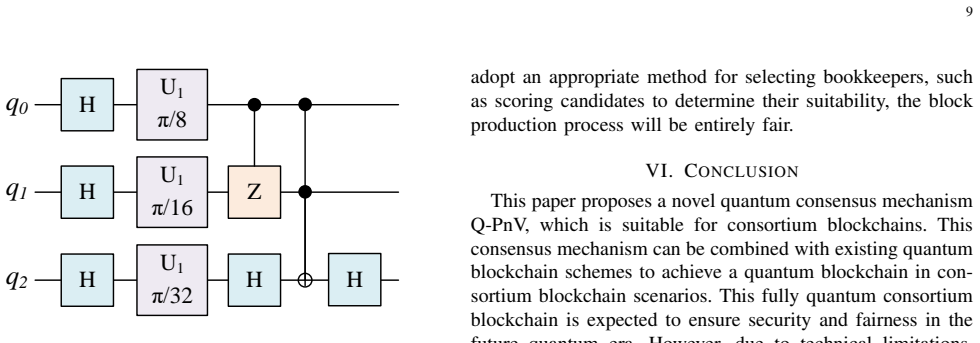
The engine of Q-PnV is the self-tallying quantum anonymous voting protocol based on two multipartite entangled states: |Xn>, whose n computational-basis outcomes sum to 0 modulo m while its Fourier-basis outcomes are all identical, and |Sn>, whose outcomes form a random permutation of the set {0,...,n-1} in either basis. These states serve as the ballot matrix and the ballot index: the first makes tampering detectable through parity and equality checks, and the second lets each voter hide which row of their ballot they modify. Around this engine, the protocol uses QKD-derived keys for identity authentication, a consortium-maintained QRNG for rotating-bookkeeper selection, and weighted-hypergraph states, in which qubits are vertices and multi-qubit Controlled-Z gates are weighted hyperedges, to entangle successive block qubits; the optimized hypergraph circuit from the quantum-blockchain literature supplies the actual entanglement operation.
What would settle it
Run the paper's four-voter example on a real or simulated quantum device under honest conditions and check the two security tests: the parity and equality checks on |Xn> and the permutation check on |Sn>. If even a small amount of noise makes the tests fail too often for a vote to complete, or if a single dishonest bookkeeper can choose the prepared states so that voters' choices are recoverable from the public tally, the protocol's claimed security and fairness would be disproved.
Extended reading notes
Core claim
The central claim, stated on the paper's own terms, is that consensus can be made quantum-safe by moving the security burden from number-theoretic cryptography to entanglement and measurement. In Q-PnV, a rotating bookkeeper prepares n-particle states |Xn> and |Sn> and distributes one particle to each voter; voters verify the states with parity and permutation tests, then cast an anonymous ballot by adding their choice modulo 2 to the row selected by a private |Sn> index. Because the tally is computed from the public matrix, the protocol is self-tallying and no voter's choice can be traced, while forged or altered states fail the security tests. The next bookkeeper is chosen by a consortium-supervised QRNG rather than by a hash of signatures and timestamps, and QKD-based identity authentication keeps impersonators out. Blocks whose qubits pass the voting threshold are entangled into the existing weighted-hypergraph chain, so the security argument rests on physical tamper-evidence rather than computational hardness.
Load-bearing premise
The whole protocol assumes a working quantum network already exists, one that can reliably create and send the interlinked quantum particles that votes and blocks are made of; without that, Q-PnV cannot be deployed at all.
Editorial extensions
If this is right
- A consortium blockchain running Q-PnV no longer needs classical digital signatures or hash-based randomness for its consensus path, removing the two attack surfaces that Shor's and Grover's algorithms target.
- If the QRNG is trusted and consortium-supervised, no coalition of bookkeepers can predict or manipulate the rotation order, so block-production rights stay fair across tenure cycles.
- Block tampering becomes physically evident: because blocks are entangled into a weighted-hypergraph state, altering one block's encoded phase disrupts the correlations of the whole chain.
- Voters can independently recount votes from the public ballot matrix, so a dishonest bookkeeper cannot silently alter the outcome of block validation or bookkeeper election.
Reading between the lines
- Editorial inference: the same |Xn> and |Sn> ballot machinery could be applied to other permissioned voting tasks inside a consortium, such as parameter changes or membership votes, without changing the consensus core.
- Editorial inference: the paper does not argue security against a dishonest state-preparing bookkeeper, so a practical deployment would need distributed preparation or verification that the bookkeeper cannot bias the |Xn> states before they are distributed.
- Editorial inference: because consortium networks are small and their operators are well-resourced, Q-PnV-type designs may be the first quantum-blockchain family to meet the quantum Internet's early-stage constraints, which is exactly where the paper positions its contribution.
- Editorial inference: a natural first test is a noisy few-qubit simulation of the paper's four-voter example, checking how often the parity and permutation tests pass; the paper's own conclusion acknowledges that no such experiment or simulation is yet available.
Editorial analysis
A structured set of objections, weighed in public.
Referee Report
Summary. The paper proposes Q-PnV, a quantum consensus mechanism for consortium blockchains that combines quantum voting (based on Wang et al.'s |Xn> and |Sn> entangled states), QKD-based identity authentication, and QRNG-based rotating-bookkeeper selection, and integrates this with a weighted-hypergraph quantum blockchain. The authors claim that, compared to classical PoV/PnV, the resulting scheme resists quantum attacks and significantly improves security and fairness. The protocol is described step-by-step and illustrated with a four-voter toy example, but the analysis section (Section V) is only two short qualitative paragraphs with no adversary model, no security proof, and no simulation.
Significance. If the security and fairness claims were rigorously established, Q-PnV would be a useful design blueprint for quantum-native consortium blockchains, filling a gap in the literature. The paper's concrete protocol description and worked example are valuable as a starting point. However, the central claims are asserted rather than demonstrated: there is no formal threat model, no analysis of the security tests, and no quantitative comparison with the classical baselines. The paper also explicitly assumes a practical distributed quantum network and trusted QRNGs, which limits its immediate applicability. As it stands, the contribution is a protocol sketch with unverified security properties, so the significance is moderate at best until the analysis is supplied.
major comments (3)
- [Section V.A] The security analysis is not a derivation but a qualitative summary. It asserts that attackers 'cannot tamper with the blocks or attack the consensus process' and that quantum voting prevents interference, but it provides no adversary model (e.g., which nodes may be malicious, what computational or quantum capabilities are assumed, whether the adversary can corrupt the rotating bookkeeper or voters), no concrete security bound, and no simulation or experimental validation. Since the paper's own conclusion states that 'the proposed scheme cannot yet be experimented with or simulated,' the central security claim is entirely unsupported and must be considered an open question.
- [Section III.C (S1-S2)] The rotating bookkeeper is the sole preparer and distributor of the ballot states |Xn> and |Sn>, and the protocol implicitly trusts that this node is honest in its preparation. However, the PoV model described in Section II.A.2 only requires at least one honest bookkeeper for liveness, not that the current rotating bookkeeper is trusted. A malicious rotating bookkeeper can prepare these states as purifications, keeping ancilla qubits that correlate with voters' subsequent measurement outcomes. The security tests in S1 and S2 use parameters δ0 and δ1, but the paper provides no bound on the adversary's cheating advantage as a function of δ0, δ1 and n, and no composable security proof. Without such a bound, the fairness and anonymity claims in Section V.B are not established: a dishonest bookkeeper could use the ancillas to recover each voter's ballot matrix after the voters publish their modified columns, thereby determining individual votes.
- [Section IV.A S2 and IV.B] The voting verification step only checks that a block's phase satisfies θp ∈ (0, π/2) and that the sum of phases is less than π/2, but it does not verify the equiproportionality condition of Eq. (6), θpi = 2^{-(i-1)} θp1. The numerical example in Section IV.B does follow Eq. (6), yet the general protocol does not enforce or verify this condition. Without this constraint, even if the sum condition holds, the phase angles may not correspond to a valid weighted-hypergraph state, and the claimed entanglement-based tamper detection may fail. The protocol should either require and verify Eq. (6) or prove that the weaker conditions are sufficient for the hypergraph-state construction.
minor comments (5)
- [Abstract] There is a typo in the abstract: 'better suit-ed' should be 'better suited'.
- [Section III.A] The subsection numbering is inconsistent: 'Quantum Internet' has no number, while the following subsection is labeled '2) Two Types of Quantum Multiparticle Entangled States in Voting Process', skipping '1)'.
- [Eq. (7)] The summation condition 'Pn−1 i=0 ji mod m=0' is ambiguous; it should be written as \(\sum_{i=0}^{n-1} j_i \equiv 0 \pmod{m}\) to be clear.
- [Section IV.A] The subsection title 'Determining the Rotating Bookkeeper' duplicates the title of Section III.D; the Section IV.A title should instead describe the construction of quantum blocks.
- [Table I] The table headers are confusing: the last column 'R' is not defined in the caption, and the entries for r'_{0,k} etc. mix notation with inline mod-2 computations; a separate column showing the final row sums would improve readability.
Circularity Check
No circular derivation: Q-PnV composes externally sourced quantum voting, QKD authentication, QRNG selection, and hypergraph-state blockchain primitives; no fitted quantity is relabeled as a prediction and no equation reduces to an input.
full rationale
The paper is a protocol construction rather than a fitted or derived prediction. The classical PoV/PnV framework is cited from the authors' earlier work ([14]-[17]), but it is used as an explicit starting point, not as evidence for the new quantum security claims. The quantum voting procedure is imported from Wang et al. [27]; QRNG technology from Mannalatha et al. [28]; the weighted-hypergraph quantum blockchain from Banerjee et al. [7], Li et al. [8], and Orts et al. [9]. None of these imported components is defined in terms of Q-PnV's own outputs, and no parameter is fitted to data and then called a prediction. The security and fairness statements in Section V are asserted rather than formally derived: the paper gives no adversarial model or cheating bound for the rotating bookkeeper who prepares and distributes the |Xn> and |Sn> states, and the conclusion explicitly says the scheme cannot yet be simulated. An unsupported assertion is a completeness or correctness risk, however, not a circular reduction. Therefore no load-bearing step reduces by definition or by self-citation, and the appropriate circularity score is 0.
Assumptions & free parameters
free parameters (3)
- delta_0 (security strength for ballot boxes)
- delta_1 (security strength for ballot indexes)
- theta_p1 (first quantum block phase)
assumptions (6)
- domain assumption A distributed quantum network capable of reliable qubit preparation, distribution, and measurement exists and operates at practical levels.
- domain assumption Consortium members jointly maintain QRNGs as trusted true quantum devices that do not behave dishonestly.
- standard math The properties of |Xn> and |Sn> entangled states, including the security tests, hold as described in Wang et al. [27].
- domain assumption QKD-based identity authentication is unconditionally secure.
- standard math Weighted-hypergraph quantum blockchain circuits from Banerjee et al. [7], Li et al. [8], and Orts et al. [9] entangle blocks correctly and preserve chain integrity.
- ad hoc to paper Modifying any block's encoded phase or data disrupts the entanglement chain in a detectable way, so attackers cannot tamper with blocks.
Cite this review
Pith. "Pith review of Q-PnV: A Quantum Consensus Mechanism for Security Consortium Blockchains." pith.science (2026). https://pith.science/paper/6EOFYWO2
@misc{pith2026241206325,
  author       = {Pith},
  title        = {Pith review of: Q-PnV: A Quantum Consensus Mechanism for Security Consortium Blockchains},
  year         = {2026},
  howpublished = {\url{https://pith.science/paper/6EOFYWO2}},
  note         = {Machine review of arXiv:2412.06325}
}
read the original abstract
Due to the rapid development of quantum computing, many classical blockchain technologies are now considered insecure. The emergence of quantum blockchain holds promise for addressing this issue. Various quantum consensus algorithms have been proposed so far, but there has not yet been a quantum consensus algorithm tailored specifically for consortium blockchain scenarios. In this paper, we propose a novel quantum consensus mechanism, named Q-PnV. This consensus mechanism is based on the classical Proof of Vote (PoV), integrating quantum voting, quantum digital signature and quantum random number generators (QRNGs). By combining Q-PnV with a quantum blockchain using weighted hypergraph states, we propose a comprehensive quantum blockchain solution for consortium blockchain scenarios. Compared to the classical method, the quantum blockchain based on Q-PnV can resist quantum attacks and shows significant improvements in security and fairness, making it better suit-ed for the future quantum era.
Figures


Figures from the paper (5 more)


Forward citations
Cited by 1 Pith paper
-
A technical solution for the rule of law, peace, security, and evolvability of global cyberspace -- solve the three genetic defects of IP network
The paper claims IP networks are inherently insecure and unable to evolve, and proposes the CoG-MIN architecture with blockchain governance and cyberspace customs as a complete replacement, backed by self-reported tes...
Reference graph
Works this paper leans on
-
[27]
Self-tallying quantum anonymous voting,
Q. Wang, C. Yu, F. Gao, H. Qi, and Q. Wen, “Self-tallying quantum anonymous voting,” Physical Review A , vol. 94, no. 2, p. 022333, Aug
-
[1]
Algorithms for quantum computation: discrete logarithms and factoring,
P. Shor, “Algorithms for quantum computation: discrete logarithms and factoring,” in Proceedings 35th Annual Symposium on F oundations of Computer Science . Santa Fe, NM, USA: IEEE Comput. Soc. Press, 1994, pp. 124–134. [Online]. Available: http://ieeexplore.ieee. org/document/365700/
work page 1994
-
[2]
Quantum Mechanics Helps in Searching for a Needle in a Haystack,
L. K. Grover, “Quantum Mechanics Helps in Searching for a Needle in a Haystack,” Physical Review Letters , vol. 79, no. 2, pp. 325–328, Jul
-
[3]
A Survey and Comparison of Post-Quantum and Quantum Blockchains,
Z. Yang, H. Alfauri, B. Farkiani, R. Jain, R. D. Pietro, and A. Erbad, “A Survey and Comparison of Post-Quantum and Quantum Blockchains,” IEEE Communications Surveys & Tutorials , vol. 26, no. 2, pp. 967–1002, 2024. [Online]. Available: https: //ieeexplore.ieee.org/document/10288193/
-
[4]
The Evolution of Quantum Key Distribution Networks: On the Road to the Qinternet,
Y . Cao, Y . Zhao, Q. Wang, J. Zhang, S. X. Ng, and L. Hanzo, “The Evolution of Quantum Key Distribution Networks: On the Road to the Qinternet,” IEEE Communications Surveys & Tutorials , vol. 24, no. 2, pp. 839–894, 2022. [Online]. Available: https: //ieeexplore.ieee.org/document/9684555/
-
[5]
E. O. Kiktenko, N. O. Pozhar, M. N. Anufriev, A. S. Trushechkin, R. R. Yunusov, Y . V . Kurochkin, A. I. Lvovsky, and A. K. Fedorov, “Quantum-secured blockchain,” Quantum Science and Technology , vol. 3, no. 3, p. 035004, Jul. 2018. [Online]. Available: https: //iopscience.iop.org/article/10.1088/2058-9565/aabc6b
-
[6]
Quantum Blockchain Using Entanglement in Time,
D. Rajan and M. Visser, “Quantum Blockchain Using Entanglement in Time,” Quantum Reports , vol. 1, no. 1, pp. 3–11, Apr. 2019. [Online]. Available: https://www.mdpi.com/2624-960X/1/1/2
work page 2019
-
[7]
Quantum blockchain using weighted hypergraph states,
S. Banerjee, A. Mukherjee, and P. K. Panigrahi, “Quantum blockchain using weighted hypergraph states,” Physical Review Research , vol. 2, no. 1, p. 013322, Mar. 2020. [Online]. Available: https://link.aps.org/ doi/10.1103/PhysRevResearch.2.013322 10
Show all 33 references
-
[8]
Efficient Quantum Blockchain With a Consensus Mechanism QDPoS,
Q. Li, J. Wu, J. Quan, J. Shi, and S. Zhang, “Efficient Quantum Blockchain With a Consensus Mechanism QDPoS,” IEEE Transactions on Information F orensics and Security , vol. 17, pp. 3264–3276, 2022. [Online]. Available: https://ieeexplore.ieee.org/document/9872051/
2022
-
[9]
Improving the implementation of quantum blockchain based on hypergraphs,
F. Orts, R. Paulavi ˇcius, and E. Filatovas, “Improving the implementation of quantum blockchain based on hypergraphs,” Quantum Information Processing, vol. 22, no. 9, p. 330, Sep. 2023. [Online]. Available: https://link.springer.com/10.1007/s11128-023-04096-w
2023 doi
-
[10]
Quantum Blockchain Based on Dimensional Lifting Generalized Gram-Schmidt Procedure,
K. Nilesh and P. K. Panigrahi, “Quantum Blockchain Based on Dimensional Lifting Generalized Gram-Schmidt Procedure,” IEEE Access, vol. 10, pp. 103 212–103 222, 2022. [Online]. Available: https://ieeexplore.ieee.org/document/9895383/
2022
-
[11]
Blockchain consensus mechanism based on quantum zero-knowledge proof,
X.-J. Wen, Y .-Z. Chen, X.-C. Fan, W. Zhang, Z.-Z. Yi, and J.-B. Fang, “Blockchain consensus mechanism based on quantum zero-knowledge proof,” Optics & Laser Technology , vol. 147, p. 107693, Mar
-
[12]
Blockchain Consensus Mechanism Based on Quantum Teleportation,
X. Wen, Y . Chen, W. Zhang, Z. L. Jiang, and J. Fang, “Blockchain Consensus Mechanism Based on Quantum Teleportation,” Mathematics, vol. 10, no. 14, p. 2385, Jul. 2022. [Online]. Available: https: //www.mdpi.com/2227-7390/10/14/2385
2022
-
[13]
Consensus algorithm based on verifiable quantum random numbers,
P. Wang, W. Chen, S. Lin, L. Liu, Z. Sun, and F. Zhang, “Consensus algorithm based on verifiable quantum random numbers,” International Journal of Intelligent Systems , vol. 37, no. 10, pp. 6857–6876, Oct
-
[14]
Proof of V ote: A High-Performance Consensus Protocol Based on V ote Mechanism & Consortium Blockchain,
K. Li, H. Li, H. Hou, K. Li, and Y . Chen, “Proof of V ote: A High-Performance Consensus Protocol Based on V ote Mechanism & Consortium Blockchain,” in 2017 IEEE 19th International Conference on High Performance Computing and Communications; IEEE 15th International Conference ...
2017
-
[15]
PoV: An Efficient V oting-Based Consensus Algorithm for Consortium Blockchains,
K. Li, H. Li, H. Wang, H. An, P. Lu, P. Yi, and F. Zhu, “PoV: An Efficient V oting-Based Consensus Algorithm for Consortium Blockchains,” Frontiers in Blockchain, vol. 3, p. 11, Mar. 2020. [Online]. Available: https://www.frontiersin.org/article/10.3389/fbloc.2020.00011/ full
2020
-
[16]
Available: https://onlinelibrary.wiley.com/doi/10.1002/ int.22865
[Online]. Available: https://onlinelibrary.wiley.com/doi/10.1002/ int.22865
-
[17]
PnV: An Efficient Parallel Consensus Protocol Integrating Proof and V oting,
H. Wang, H. Li, P. Fan, J. Kang, S. Deng, and X. Zhu, “PnV: An Efficient Parallel Consensus Protocol Integrating Proof and V oting,” Applied Sciences , vol. 14, no. 8, p. 3510, Apr. 2024. [Online]. Available: https://www.mdpi.com/2076-3417/14/8/3510
2024
-
[18]
Principles and Applications of Blockchain Sys- tems: How to Break Through Consensus Trilemma in Consortium Blockchains,
H. Wang and H. Li, “Principles and Applications of Blockchain Sys- tems: How to Break Through Consensus Trilemma in Consortium Blockchains,” in Wiley-IEEE Press, 2024, pp. 72–76, unpublished
2024
-
[19]
On Parallel Mechanism of Consortium Blockchain: Take PoV as an example,
Y . Bai, Y . Zhi, H. Li, H. Wang, P. Lu, and C. Ma, “On Parallel Mechanism of Consortium Blockchain: Take PoV as an example,” in 2021 The 3rd International Conference on Blockchain Technology . Shanghai China: ACM, Mar. 2021, pp. 147–154. [Online]. Available: https://dl.acm.or...
2021
-
[20]
Performance Modeling of PBFT Consensus Process for Permissioned Blockchain Network (Hyperledger Fabric),
H. Sukhwani, J. M. Martinez, X. Chang, K. S. Trivedi, and A. Rindos, “Performance Modeling of PBFT Consensus Process for Permissioned Blockchain Network (Hyperledger Fabric),” in 2017 IEEE 36th Symposium on Reliable Distributed Systems (SRDS) . Hong Kong, Hong Kong: IEEE, Sep....
2017
-
[21]
A Data Lightweight Scheme for Parallel Proof of V ote Consensus,
Z. Wang, H. Li, H. Wang, Z. Xiao, P. Lu, Z. Yang, M. Zhang, and P. H. J. Chong, “A Data Lightweight Scheme for Parallel Proof of V ote Consensus,” in 2021 IEEE International Conference on Big Data (Big Data) . Orlando, FL, USA: IEEE, Dec. 2021, pp. 3656–3662. [Online]. Availab...
2021
-
[22]
Practical byzantine fault tolerance,
M. Castro, B. Liskov, and others, “Practical byzantine fault tolerance,” in OsDI, vol. 99, 1999, pp. 173–186, issue: 1999
1999
-
[23]
Quantum hypergraph states,
M. Rossi, M. Huber, D. Bruß, and C. Macchiavello, “Quantum hypergraph states,” New Journal of Physics , vol. 15, no. 11, p. 113022, Nov. 2013. [Online]. Available: https://iopscience.iop.org/article/10. 1088/1367-2630/15/11/113022
2013
-
[24]
Encoding hypergraphs into quantum states,
R. Qu, J. Wang, Z.-s. Li, and Y .-r. Bao, “Encoding hypergraphs into quantum states,” Physical Review A—Atomic, Molecular , and Optical Physics, vol. 87, no. 2, p. 022311, 2013, publisher: APS
2013
-
[25]
Optimizing Parallel Proof of V ote Consensus Based on Mimic Security in Consortium Blockchains,
Z. Xiao, H. Li, H. Wang, G. Yang, Q. Ye, S. Zou, P. Lu, and Q. Lyu, “Optimizing Parallel Proof of V ote Consensus Based on Mimic Security in Consortium Blockchains,” in 2022 IEEE International Conference on Big Data (Big Data) . Osaka, Japan: IEEE, Dec. 2022, pp. 3215–3224. [O...
2022
-
[26]
Quantum internet: A vision for the road ahead,
S. Wehner, D. Elkouss, and R. Hanson, “Quantum internet: A vision for the road ahead,” Science, vol. 362, no. 6412, p. eaam9288, Oct
-
[28]
Quantum Internet—Applications, Functionalities, Enabling Technologies, Challenges, and Research Directions,
A. Singh, K. Dev, H. Siljak, H. D. Joshi, and M. Magarini, “Quantum Internet—Applications, Functionalities, Enabling Technologies, Challenges, and Research Directions,” IEEE Communications Surveys & Tutorials , vol. 23, no. 4, pp. 2218–2247, 2021. [Online]. Available: https://...
2021
-
[33]
A comprehensive review of quantum random number generators: concepts, classification and the origin of randomness,
V . Mannalatha, S. Mishra, and A. Pathak, “A comprehensive review of quantum random number generators: concepts, classification and the origin of randomness,” Quantum Information Processing , vol. 22, no. 12, p. 439, Dec. 2023. [Online]. Available: https: //link.springer.com/1...
2023 doi
-
[1997]
Available: https://link.aps.org/doi/10.1103/PhysRevLett
[Online]. Available: https://link.aps.org/doi/10.1103/PhysRevLett. 79.325
-
[2016]
Available: https://link.aps.org/doi/10.1103/PhysRevA
[Online]. Available: https://link.aps.org/doi/10.1103/PhysRevA. 94.022333
-
[2018]
Available: https://www.science.org/doi/10.1126/science
[Online]. Available: https://www.science.org/doi/10.1126/science. aam9288
-
[2022]
Available: https://linkinghub.elsevier.com/retrieve/pii/ S0030399221007817
[Online]. Available: https://linkinghub.elsevier.com/retrieve/pii/ S0030399221007817
Reviewed August 11, 2026 · model on record in the stance chip above.
Discussion (0). Continue with ORCID to comment.