REVIEW 4 major objections 4 minor 1 cited by
Modeling Complex Organic Molecules Formation in Cold Cores: Multi-phase Models with Non-thermal Mechanisms
T0 review · 4 major / 4 minor · reviewed 2026-08-11 · deepseek-v4-flash
Pith's one-line read Cosmic-ray radiolysis and sputtering together can explain the five oxygen-bearing complex organic molecules observed in TMC-1 to within a factor of 3.
desk verdict A plausible and well-documented port of radiolysis plus sputtering into a Monte Carlo multiphase code, but the factor-of-3 claim is contradicted by the paper's own Table 7. read the letter →
The pith
A machine-rendered reading of the paper's core claim, the machinery that carries it, and where it could break.
The reading
What carries the argument
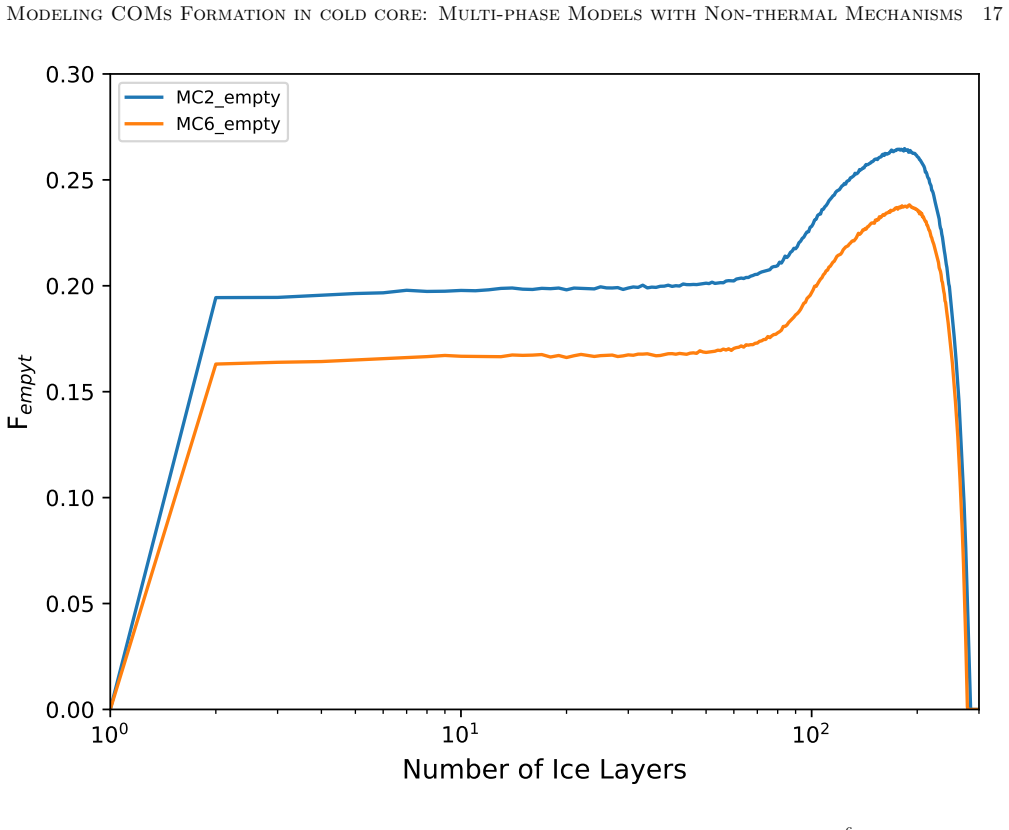
The load-bearing objects are the suprathermal reaction network and the sputtering rate law. In the network, 25 ice species can be excited by cosmic rays; an excited species reacts immediately with one neighbouring molecule selected by abundance-weighted probability, with 343 product channels (for example, $\mathrm{CH_3O^{*}} + \mathrm{HCO} \rightarrow \mathrm{HCOOCH_3}$). The multiphase model resolves the ice into a diffusive active surface layer, immobile normal sites, and mobile interstitial sites, and it is simulated with an accelerated Gillespie stochastic algorithm. Sputtering enters through $k_{scr} = (\zeta / 3 \times 10^{-17})\, Y_{eff}\, \pi r_d^2 / N_s$ with $Y_{eff} = \alpha(1-e^{-(n_{layers}/\beta)^{\gamma}})$, fitted to experimental yields for CO, $\mathrm{CO_2}$, and $\mathrm{H_2O}$ ices; the mixed-ice rate is composition-weighted in real time.
What would settle it
Irradiate mixed $\mathrm{H_2O}$-CO-$\mathrm{CO_2}$-$\mathrm{CH_3OH}$ ices with cosmic-ray-like particles at 10 K and measure whether excited methoxy plus formyl actually produces methyl formate with appreciable branching; alternatively, rerun the same model with depth-dependent radiolysis attenuation and only experimentally confirmed suprathermal channels and check whether the factor-of-3 agreement with TMC-1 survives.
Extended reading notes
Core claim
The central claim is that cosmic-ray radiolysis paired with sputtering closes the cold-core COM problem. When a cosmic ray strikes an ice molecule, the molecule enters a short-lived electronically excited state and reacts immediately with a neighbouring species instead of waiting for diffusion, which makes the reaction possible at 10 K. The resulting COMs accumulate in the bulk ice, where radicals are protected from rapid hydrogenation, and later sputtering desorbs them into the gas phase. The paper reports factor-of-3 agreement for the five key COMs ($\mathrm{CH_3OH}$, $\mathrm{HCOOCH_3}$, $\mathrm{CH_3OCH_3}$, $\mathrm{CH_3CHO}$, $\mathrm{C_2H_5OH}$), and shows that without sputtering the molecules stay trapped in the ice, while without both mechanisms most COMs are not formed at all.
Load-bearing premise
The load-bearing premise is that an excited ice molecule reacts with whichever neighbour it happens to touch and forms exactly the products listed in the 343-channel table, and that cosmic-ray radiolysis works uniformly through all ice layers with no depth attenuation; neither part is backed by experiment or theory.
Editorial extensions
If this is right
- Without sputtering, COMs formed inside the ice mantle cannot reach the gas phase; adding sputtering makes it the dominant desorption channel after about $10^5$ years, accounting for 58-89% of desorption depending on the model.
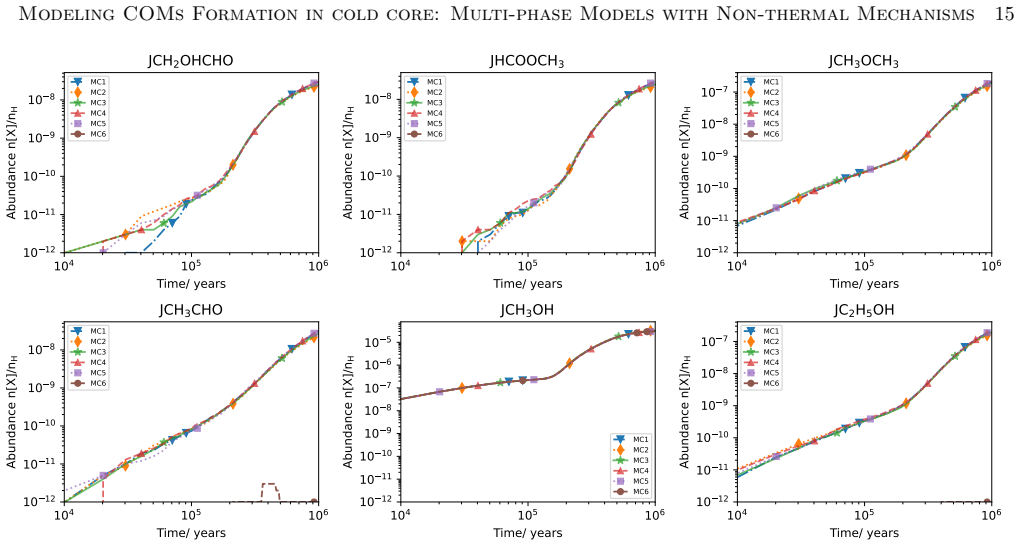
- Methyl formate and dimethyl ether are built almost entirely inside the bulk ice by suprathermal reactions, while acetaldehyde is built mostly in the gas phase from sputtered precursors such as $\mathrm{C_2H_5}$ and $\mathrm{C_2H_5OH}$.
- The new mechanisms widen the epoch over which carbon-chain molecules can form: after carbon is locked into CO, sputtering of $\mathrm{C_3}$ and other precursors from ice keeps hydrocarbons and cyanopolyynes abundant at late times.
- Changing the elemental C/O ratio has little effect on the fraction of reproduced species in the new models, unlike earlier rate-equation models where C/O changed the fit quality.
- A test model with 1% reactive desorption added changes mainly methanol, because the other COMs form below the surface where reactive desorption does not act.
Reading between the lines
- Beyond the paper, the same radiolysis-plus-sputtering mechanism should be testable in other cold cores such as L1544 and L1689B, where the same COMs are observed; the model's age at best fit (about 2-7 x 10^5 years) gives a concrete prediction for how COM abundances should track core age.
- Beyond the paper, if the 343 suprathermal channels are later found to have different branching ratios, the factor-of-3 claim would likely shift by orders of magnitude, so the network presently functions as a parameterization of unknown ice chemistry rather than a measured mechanism.
- Beyond the paper, the model's insensitivity to C/O suggests that in cold cores the ice mantle, not the initial gas composition, controls the carbon budget available to COM formation; direct ice observations toward TMC-1 could check whether mantle composition tracks the assumed model layers.
Signed reviews
Editorial analysis
A structured set of objections, weighed in public.
Referee Report
Summary. This paper presents a 0D multiphase Monte Carlo gas-grain astrochemical model of TMC-1 that adds cosmic-ray-induced radiolysis and sputtering desorption to the authors' earlier Lu et al. (2018) model. Six models (MC1-MC6) are run, differing in the assumed sputtering ice composition (mixed, CO, CO2, H2O) and in whether radiolysis and sputtering are included; a reactive-desorption variant of MC2 is also studied. The manuscript's central claims are (i) that models MC1-MC4 reproduce the observed gas-phase abundances of CH3OH, HCOOCH3, CH3OCH3, CH3CHO, and C2H5OH toward TMC-1 within a factor of 3 at a local best-fitting time, and (ii) that at a global best-fitting time 63 of 94 compared species (67.02%) agree within an order of magnitude for MC2/MC3. The paper also analyzes carbon-chain species and the effect of varying C/O ratios.
Significance. The paper is potentially significant because it applies a genuinely stochastic multiphase treatment to non-thermal COM formation, using experimental sputtering fits and an explicitly expanded suprathermal reaction network. The model description is unusually complete: Tables 3, 5, 7, 8, and 10 document the radiolysis reactions, sputtering parameters, abundance comparisons, and the 343 suprathermal channels; the authors also include a reactive-desorption sensitivity test and comparisons with seven previous models. These strengths make the manuscript a useful reference point for future work on cold-core COM chemistry. However, the central factor-of-3 claim is contradicted by the authors' own Table 7 for two model-species combinations, and the 343 suprathermal reactions that dominate COM production are assumed without experimental or theoretical validation. As it stands, the paper demonstrates that a specific assumed network can be tuned to match TMC-1, but it does not yet establish that the proposed mechanisms are responsible for the observed COM abundances.
major comments (4)
- [§3.3, Table 7] The statement in §3.3 that 'the simulation results for COMs in our models, MC1 to MC4, all deviated from the observed values by less than a factor of 3' is not supported by Table 7. At the local best-fitting time, MC3 gives C2H5OH = 4.46e-10 versus observed (1.1 ± 0.3)e-10, a ratio of about 4.1 even using the upper 1σ bound of 1.4e-10, and MC4 gives CH3CHO = 9.4e-11 versus observed (3.5 ± 0.2)e-10, a ratio of about 3.7 even against the lower 1σ bound of 3.3e-10. The factor-of-3 claim must be revised, or the definition of 'agreement' and the treatment of observational errors must be stated precisely.
- [§2.3 and Appendix A, Table 10] The dominant formation channels for the claimed COM detections are inserted as assumptions. The text states in §3.1.2 that about 99% of JHCOOCH3 is formed through radiative mechanisms, and Table 4 lists the product-forming reactions (e.g., JCH3O* + JHCO → HCOOCH3); §3.1.5 and §3.1.6 show that the main channels for CH3OCH3 and C2H5OH are likewise suprathermal reactions with specified COM products. The 343 reactions in Table 10 are taken to be barrierless and to proceed with equal probability based on neighbor abundance, with no branching ratios, experimental measurements, or theoretical calculations cited, and §2.3 concedes that radiolysis is assumed uniform in all ice layers 'due to limited knowledge.' Since the product COMs are inputs to the network rather than emergent consequences of the model, the reported factor-of-3 agreement is a test of the assumed channels' rates, not a validation of the mechanism. The authors should either supply external constraints for the suprathermal reactions or explicitly reframe the results as an exploration conditional on the network.
- [§2.2, §3.3, Table 8] The stochastic Monte Carlo results are presented without error bars or multiple realizations, yet the comparisons use abundance values at single times. Table 8 contains numerous 0.00(0) entries and the text describes 'notably large' abundance fluctuations in MC1 and MC4 (§3.1.3), so run-to-run scatter could plausibly affect the factor-of-3 and 67% statistics. In addition, the global best-fitting time is defined as the time that maximizes the number of matches, so the 67.02% figure is a best-case, in-sample statistic rather than a predictive accuracy measure. At minimum, the authors should report the stochastic uncertainty (e.g., multiple seeds or a Poisson error estimate) and state how the time-selection procedure affects the reported agreement.
- [§3.3, Eq. (15)] The local best-fitting time is selected by minimizing D(t) computed from the very five COMs that are then used to claim factor-of-3 agreement. This in-sample optimization inflates the apparent agreement; a fixed epoch (e.g., 1e6 years) or an out-of-sample comparison would be a more meaningful test. The authors should provide the abundance ratios at a common time or quantify the sensitivity of the conclusion to the chosen epoch.
minor comments (4)
- [Title and §4] The title contains a typo ('F ormation'), and Section 4 uses 'oxygen-obeying COMs' instead of 'oxygen-bearing COMs'.
- [§2.3] The formula for the layer distribution probability is garbled as 'Pji = SU M Kji/P jSU M Kji'; please reformat the equation and define the summation index.
- [Figure 7 caption] The caption says 'Model 1 and Model 6' but the figure compares MC2 and MC6; make the model labels consistent.
- [Table 8 and Table 9] There are notation inconsistencies, e.g., the CH2NH upper limit is given as '<3.6(-0.9)' and several entries use '0.00(0)' that is not defined; also Table 9 lists Carder et al. twice (rows 25 and 28) with the same reference.
Circularity Check
Headline COM agreement is reported at times fitted to the same species, and the 67% success statistic is the optimized objective itself, so the quantitative 'predictions' are partly fit reports rather than independent tests; the reaction-network assumptions are explicit inputs, not circular.
-
fitted input called prediction
[Section 3.3 (Eq. 15), Table 7]
"we defined the local best-fitting time as the moment when D(t) reaches its minimum ... D(t) = 1/Nobs Σ_i |log[n(X)_obs,i] − log[n(X)_mod,i(t)]| ... For the local best-fitting time, we only consider the five observed COMs: HCOOCH3, CH3OCH3, CH3CHO, CH3OH, and C2H5OH."
The time t is chosen by minimizing D(t) over exactly the five observed COM abundances that are later claimed to agree 'within a factor of 3' at that time (Table 7). The success metric and the selection criterion are therefore the same data set, so the factor-of-3 statement is a property of the optimized fit rather than an independent prediction for those five species. The circularity is partial because only one scalar parameter (the chemical age) is fitted; the model abundances are genuine outputs and the fit could still be poor, but the headline agreement is not an out-of-sample test.
-
fitted input called prediction
[Section 3.3, Table 8]
"we defined the global best-fitting time as the moment when, among the 94 species, the number of simulated species abundances and observed values within one order of magnitude was maximized ... MC2 and MC3 models each had 63 species closely matching the observed values, representing approximately 67.02%."
The 63/94 (67.02%) statistic is the objective function used to select the global best-fitting time: the time is defined as the one maximizing the number of species within one order of magnitude, and that same maximized count is then reported as evidence of agreement. The reported number is therefore optimal by construction as a fit-quality measure, not an independent agreement statistic. The model outputs and species inventory still carry independent content, so this is partial rather than total circularity.
full rationale
The central physical content of the paper is not circular: the multiphase model, radiolysis rates from Shingledecker et al. (2018), sputtering yields from Dartois et al. (2021), and the explicit suprathermal channel list in Table 10 are all inputs to a simulation, and the simulated abundances are emergent outputs compared with TMC-1 observations. Including a formation channel such as JHCO* + JCH3O -> JHCOOCH3 is an astrochemical assumption, not a self-derivation of the observed abundance from it. The paper's reliance on the authors' prior model (Lu et al. 2018) and Gillespie algorithm (Chang et al. 2017) is also provenance, not a load-bearing self-citation chain: no uniqueness theorem is invoked from those works. The genuine circularity is narrower and limited to the evaluation statistics: the 'within factor 3' COM claim is assessed at a 'local best-fitting time' obtained by minimizing D(t) over those same five COMs (Eq. 15, Section 3.3), and the 67.02% reproduction rate is the value of the objective function used to define the 'global best-fitting time.' Both are fitted quantities presented as agreement, so the quantitative headline is partly a fit report. Additionally, Table 7 itself shows MC3 C2H5OH (4.46e-10 vs observed 1.1e-10, factor ~4.05) and MC4 CH3CHO (9.4e-11 vs observed 3.5e-10, factor ~3.72) outside factor 3; this is an internal consistency problem, not a circularity, but it further weakens the headline claim. Overall, the derivation does not reduce to its inputs by definition, but the reported 'predictions' are partially forced by the time-fitting procedure, giving a score of 6.
Assumptions & free parameters
free parameters (3)
- Best-fitting evolutionary time (local and global) =
MC1 4.95e5, MC2 2.93e5, MC3 3.94e5, MC4 6.57e5 yr (local); global 2.42e5, 2.32e5, 2.63e5, 1.72e5 yr
- Sputtering yield parameters alpha, beta, gamma =
CO 40.1/75.8/0.69; CO2 21.9/56.3/0.60; H2O 3.63/3.25/0.57
- Mixed-ice sputtering weighting in MC1 =
abundance-weighted sum of CO, CO2, H2O rates (Eq. 11)
assumptions (6)
- domain assumption Radiolysis can occur in any ice layer without depth-dependent attenuation
- domain assumption Suprathermal species do not diffuse and react immediately with a neighbor chosen with probability proportional to its abundance in that layer
- domain assumption All radiolysis products enter interstitial sites
- ad hoc to paper The 343 suprathermal reaction channels in Table 10 are correct in products and barrierless
- ad hoc to paper Mixed-ice sputtering rate is the abundance-weighted sum of CO, CO2 and H2O sputtering rates
- standard math Gillespie algorithm and stochastic chemical kinetics correctly simulate the gas-grain network
Cite this review
Pith. "Pith review of Modeling Complex Organic Molecules Formation in Cold Cores: Multi-phase Models with Non-thermal Mechanisms." pith.science (2026). https://pith.science/paper/VXJSJRI7
@misc{pith2026241206397,
  author       = {Pith},
  title        = {Pith review of: Modeling Complex Organic Molecules Formation in Cold Cores: Multi-phase Models with Non-thermal Mechanisms},
  year         = {2026},
  howpublished = {\url{https://pith.science/paper/VXJSJRI7}},
  note         = {Machine review of arXiv:2412.06397}
}
read the original abstract
In recent years, a significant number of oxygen-bearing complex organic molecules (COMs) have been detected in the gas phase of cold dark clouds such as TMC-1. The formation of these COMs cannot be explained by diffusive mechanisms on grains and gas phase reactions. This study investigates the formation of oxygen-bearing COMs in cold dark clouds using multiphase gas-grain models that incorporate cosmic ray-induced non-diffusive radiation chemistry and non-thermal sputtering desorption mechanisms. Additionally, we present the effects of varying elemental C/O ratio and different sputtering rates. We utilized an accelerated Gillespie algorithm, based on the regular Gillespie algorithm. The results of our models for dimethyl ether (CH3OCH3), methyl formate (HCOOCH3), acetaldehyde (CH3CHO), ethanol (C2H5OH), and methanol (CH3OH) show reasonable agreement with observations toward TMC-1, within a factor of 3. Out of the 94 species compared with observations, 63 show agreement within 1 order of magnitude, accounting for 67.02%. Overall inclusion of non-thermal mechanisms in multi-phase models shows notable improvement of modeling on oxygen-bearing COMs in the interstellar medium.
Figures


Figures from the paper (9 more)



Forward citations
Cited by 1 Pith paper
-
Complex Organic Molecules towards the central molecular zone of NGC 253
Complex organic molecules in the center of NGC 253 emit from two gas components and most likely trace large-scale shocks, with nitrogen-bearing species depleted toward GMC 7.
Reference graph
Works this paper leans on
-
[1]
Abplanalp, M. J., Gozem, S., Krylov, A. I., et al. 2016, Proceedings of the National Academy of Science, 113, 7727, doi: 10.1073/pnas.1604426113 Ag´ undez, M., Cabezas, C., Marcelino, N., et al. 2022, A&A, 659, L9, doi: 10.1051/0004-6361/202243396 Ag´ undez, M., Cabezas, C., Tercero, B., et al. 2021a, A&A, 647, L10, doi: 10.1051/0004-6361/202140553 Ag´ un...
-
[2]
Tafalla, M. 2019, A&A, 625, A147, doi: 10.1051/0004-6361/201935164 Ag´ undez, M., Marcelino, N., Tercero, B., et al. 2021b, A&A, 649, L4, doi: 10.1051/0004-6361/202140978 Ag´ undez, M., Marcelino, N., Tercero, B., Jim´ enez-Serra, I., & Cernicharo, J. 2023a, A&A, 677, A106, doi: 10.1051/0004-6361/202347077 Ag´ undez, M., & Wakelam, V. 2013, Chemical Revie...
-
[3]
Andersson, S., & van Dishoeck, E. F. 2008, A&A, 491, 907, doi: 10.1051/0004-6361:200810374 Arslan, ¨O., Hocuk, S., Caselli, P., & K¨ u¸ c¨ uk,˙I. 2023, MNRAS, 518, 2050, doi: 10.1093/mnras/stac3196
-
[4]
2015, in EAS Publications
Bacmann, A., & Faure, A. 2015, in EAS Publications
2015
-
[5]
75-76, EAS Publications Series, 325–328, doi: 10.1051/eas/1575065
Series, Vol. 75-76, EAS Publications Series, 325–328, doi: 10.1051/eas/1575065
-
[6]
2016, A&A, 587, A130, doi: 10.1051/0004-6361/201526198
Bacmann, A., & Faure, A. 2016, A&A, 587, A130, doi: 10.1051/0004-6361/201526198
-
[7]
2012, A&A, 541, L12, doi: 10.1051/0004-6361/201219207
Ceccarelli, C. 2012, A&A, 541, L12, doi: 10.1051/0004-6361/201219207
-
[8]
2015, MNRAS, 449, L16, doi: 10.1093/mnrasl/slv009
Balucani, N., Ceccarelli, C., & Taquet, V. 2015, MNRAS, 449, L16, doi: 10.1093/mnrasl/slv009
Show all 107 references
-
[9]
T., M¨ uller, H
Belloche, A., Garrod, R. T., M¨ uller, H. S. P., & Menten, K. M. 2014, Science, 345, 1584, doi: 10.1126/science.1256678
2014 doi
-
[10]
2013, Astron
Comito, C. 2013, Astron. Astrophys., 559, A47, doi: 10.1051/0004-6361/201321096
2013 doi
-
[11]
J., & Kaiser, R
Bergantini, A., G´ obi, S., Abplanalp, M. J., & Kaiser, R. I. 2018, ApJ, 852, 70, doi: 10.3847/1538-4357/aa9ce2 40 Yang Lu et al
2018 doi
-
[12]
B., ¨Oberg, K
Bergner, J. B., ¨Oberg, K. I., & Rajappan, M. 2017, ApJ, 845, 29, doi: 10.3847/1538-4357/aa7d09
2017 doi
-
[13]
2016, ApJL, 817, L12, doi: 10.3847/2041-8205/817/2/L12
Bertin, M., Romanzin, C., Doronin, M., et al. 2016, ApJL, 817, L12, doi: 10.3847/2041-8205/817/2/L12
2016 doi
-
[14]
2013, A&A Rv, 21, 70, doi: 10.1007/s00159-013-0070-7
Blasi, P. 2013, A&A Rv, 21, 70, doi: 10.1007/s00159-013-0070-7
2013 doi
-
[15]
2004, Astrophys
Bottinelli, S., Ceccarelli, C., Lefloch, B., et al. 2004, Astrophys. J., 615, 354, doi: 10.1086/423952
2004 doi
-
[16]
M., Herbst, E., Kalenskii, S
Burkhardt, A. M., Herbst, E., Kalenskii, S. V., et al. 2018, MNRAS, 474, 5068, doi: 10.1093/mnras/stx2972
2018 doi
-
[17]
2022a, A&A, 659, L8, doi: 10.1051/0004-6361/202142972
Cabezas, C., Ag´ undez, M., Marcelino, N., et al. 2022a, A&A, 659, L8, doi: 10.1051/0004-6361/202142972
-
[18]
2021a, A&A, 646, L1, doi: 10.1051/0004-6361/202040210
Cabezas, C., Endo, Y., Roueff, E., et al. 2021a, A&A, 646, L1, doi: 10.1051/0004-6361/202040210
-
[19]
2021b, A&A, 650, L15, doi: 10.1051/0004-6361/202141371
Cabezas, C., Roueff, E., Tercero, B., et al. 2021b, A&A, 650, L15, doi: 10.1051/0004-6361/202141371
-
[20]
2021c, A&A, 650, L9, doi: 10.1051/0004-6361/202141274
Cabezas, C., Tercero, B., Ag´ undez, M., et al. 2021c, A&A, 650, L9, doi: 10.1051/0004-6361/202141274
-
[21]
2022b, A&A, 663, L2, doi: 10.1051/0004-6361/202244063
Cabezas, C., Ag´ undez, M., Fuentetaja, R., et al. 2022b, A&A, 663, L2, doi: 10.1051/0004-6361/202244063
-
[22]
2023, Laboratory and astronomical discovery of the cyanovinyl radical H2CCCN
Cabezas, C., Tang, J., Ag´ undez, M., et al. 2023, Laboratory and astronomical discovery of the cyanovinyl radical H2CCCN. https://arxiv.org/abs/2307.09127
2023 arXiv
-
[23]
T., Paulive, A., & Herbst, E
Carder, J. T., Paulive, A., & Herbst, E. 2023, MNRAS, 519, 4622, doi: 10.1093/mnras/stac3646
2023 doi
-
[24]
2021a, A&A, 656, L21, doi: 10.1051/0004-6361/202142634
Cernicharo, J., Ag´ undez, M., Cabezas, C., et al. 2021a, A&A, 656, L21, doi: 10.1051/0004-6361/202142634
-
[25]
I., et al
Cernicharo, J., Ag´ undez, M., Kaiser, R. I., et al. 2021b, A&A, 652, L9, doi: 10.1051/0004-6361/202141660
-
[26]
2021c, A&A, 650, L14, doi: 10.1051/0004-6361/202141297 —
Cernicharo, J., Cabezas, C., Endo, Y., et al. 2021c, A&A, 650, L14, doi: 10.1051/0004-6361/202141297 —. 2021d, A&A, 646, L3, doi: 10.1051/0004-6361/202040013
-
[27]
1987, A&A, 176, 299
Cernicharo, J., & Guelin, M. 1987, A&A, 176, 299
1987
-
[28]
2020a, A&A, 642, L8, doi: 10.1051/0004-6361/202039274 —
Cernicharo, J., Marcelino, N., Ag´ undez, M., et al. 2020a, A&A, 642, L8, doi: 10.1051/0004-6361/202039274 —. 2020b, A&A, 642, L17, doi: 10.1051/0004-6361/202039351
-
[29]
2012, ApJL, 759, L43, doi: 10.1088/2041-8205/759/2/L43
Cernicharo, J., Marcelino, N., Roueff, E., et al. 2012, ApJL, 759, L43, doi: 10.1088/2041-8205/759/2/L43
2012 doi
-
[30]
2018, ApJL, 853, L22, doi: 10.3847/2041-8213/aaa83a
Cernicharo, J., Lefloch, B., Ag´ undez, M., et al. 2018, ApJL, 853, L22, doi: 10.3847/2041-8213/aaa83a
2018 doi
-
[31]
2021e, A&A, 648, L3, doi: 10.1051/0004-6361/202140642
Cernicharo, J., Cabezas, C., Ag´ undez, M., et al. 2021e, A&A, 648, L3, doi: 10.1051/0004-6361/202140642
-
[32]
2021f, A&A, 647, L2, doi: 10.1051/0004-6361/202140434
Cernicharo, J., Ag´ undez, M., Cabezas, C., et al. 2021f, A&A, 647, L2, doi: 10.1051/0004-6361/202140434
-
[33]
2021g, A&A, 646, L7, doi: 10.1051/0004-6361/202040076
Cernicharo, J., Cabezas, C., Bailleux, S., et al. 2021g, A&A, 646, L7, doi: 10.1051/0004-6361/202040076
-
[34]
2022a, A&A, 663, L9, doi: 10.1051/0004-6361/202244399
Cernicharo, J., Fuentetaja, R., Ag´ undez, M., et al. 2022a, A&A, 663, L9, doi: 10.1051/0004-6361/202244399
-
[35]
2022b, A&A, 657, L16, doi: 10.1051/0004-6361/202142992
Cernicharo, J., Ag´ undez, M., Cabezas, C., et al. 2022b, A&A, 657, L16, doi: 10.1051/0004-6361/202142992
-
[36]
2012, ApJ, 759, 147, doi: 10.1088/0004-637X/759/2/147 —
Chang, Q., & Herbst, E. 2012, ApJ, 759, 147, doi: 10.1088/0004-637X/759/2/147 —. 2014, ApJ, 787, 135, doi: 10.1088/0004-637X/787/2/135 —. 2016, ApJ, 819, 145, doi: 10.3847/0004-637X/819/2/145
2012 doi
-
[37]
2017, ApJ, 851, 68, doi: 10.3847/1538-4357/aa99d9
Chang, Q., Lu, Y., & Quan, D. 2017, ApJ, 851, 68, doi: 10.3847/1538-4357/aa99d9
2017 doi
-
[38]
B., Tielens, A
Charnley, S. B., Tielens, A. G. G. M., & Millar, T. J. 1992, ApJL, 399, L71, doi: 10.1086/186609
1992 doi
-
[39]
2022a, MNRAS, 516, 4627, doi: 10.1093/mnras/stac2566
Chen, L.-F., Chang, Q., Wang, Y., & Li, D. 2022a, MNRAS, 516, 4627, doi: 10.1093/mnras/stac2566
-
[40]
2022b, ApJ, 928, 175, doi: 10.3847/1538-4357/ac5a45
Chen, L.-F., Li, D., Quan, D., et al. 2022b, ApJ, 928, 175, doi: 10.3847/1538-4357/ac5a45
-
[41]
L., & Evans, Neal J., I
Choi, Y., Lee, J.-E., Bourke, T. L., & Evans, Neal J., I. 2017, ApJS, 229, 38, doi: 10.3847/1538-4365/aa69ba
2017 doi
-
[42]
R., Xue, C., Changala, P
Cooke, I. R., Xue, C., Changala, P. B., et al. 2023, ApJ, 948, 133, doi: 10.3847/1538-4357/acc584
2023 doi
-
[43]
A., Mart ´ ın-Dom´ enech, R., Mu˜ noz Caro, G
Cruz-Diaz, G. A., Mart ´ ın-Dom´ enech, R., Mu˜ noz Caro, G. M., & Chen, Y. J. 2016, A&A, 592, A68, doi: 10.1051/0004-6361/201526761
2016 doi
-
[44]
C., Stone, E
Cummings, A. C., Stone, E. C., Heikkila, B. C., et al. 2016, ApJ, 831, 18, doi: 10.3847/0004-637X/831/1/18
2016 doi
-
[45]
M., van Dishoeck, E
Cuppen, H. M., van Dishoeck, E. F., Herbst, E., & Tielens, A. G. G. M. 2009, A&A, 508, 275, doi: 10.1051/0004-6361/200913119
2009 doi
-
[46]
2020, A&A, 634, A103, doi: 10.1051/0004-6361/201936934
Dartois, E., Chabot, M., Bacmann, A., et al. 2020, A&A, 634, A103, doi: 10.1051/0004-6361/201936934
2020 doi
-
[47]
2018, A&A, 618, A173, doi: 10.1051/0004-6361/201833277 —
Dartois, E., Chabot, M., Id Barkach, T., et al. 2018, A&A, 618, A173, doi: 10.1051/0004-6361/201833277 —. 2019, A&A, 627, A55, doi: 10.1051/0004-6361/201834787 —. 2021, A&A, 647, A177, doi: 10.1051/0004-6361/202039535
2018 doi
-
[48]
2015, Nuclear Instruments and Methods in Physics Research B, 365, 472, doi: 10.1016/j.nimb.2015.08.053
Dartois, E., Aug´ e, B., Rothard, H., et al. 2015, Nuclear Instruments and Methods in Physics Research B, 365, 472, doi: 10.1016/j.nimb.2015.08.053
2015 doi
-
[49]
Dartois, E., Chabot, M., da Costa, C. A. P., et al. 2023, A&A, 671, A156, doi: 10.1051/0004-6361/202245383
2023 doi
-
[50]
2013, Scientific Reports, 3, 1338, doi: 10.1038/srep01338
Dulieu, F., Congiu, E., Noble, J., et al. 2013, Scientific Reports, 3, 1338, doi: 10.1038/srep01338
2013 doi
-
[51]
2022a, A&A, 667, L4, doi: 10.1051/0004-6361/202245018
Fuentetaja, R., Ag´ undez, M., Cabezas, C., et al. 2022a, A&A, 667, L4, doi: 10.1051/0004-6361/202245018
-
[52]
2022b, A&A, 663, L3, doi: 10.1051/0004-6361/202243857
Fuentetaja, R., Cabezas, C., Ag´ undez, M., et al. 2022b, A&A, 663, L3, doi: 10.1051/0004-6361/202243857
-
[53]
2024, ApJ, 974, 115, doi: 10.3847/1538-4357/ad6b20
Furuya, K. 2024, ApJ, 974, 115, doi: 10.3847/1538-4357/ad6b20
2024 doi
-
[54]
T., & Herbst, E
Garrod, R. T., & Herbst, E. 2006, Astron. Astrophys., 457, 927, doi: 10.1051/0004-6361:20065560 Modeling COMs Formation in cold core: Multi-phase Models with Non-thermal Mechanisms41
2006 doi
-
[55]
T., Wakelam, V., & Herbst, E
Garrod, R. T., Wakelam, V., & Herbst, E. 2007a, A&A, 467, 1103, doi: 10.1051/0004-6361:20066704 —. 2007b, A&A, 467, 1103, doi: 10.1051/0004-6361:20066704
-
[56]
T., Weaver, S
Garrod, R. T., Weaver, S. L. W., & Herbst, E. 2008, Astrophys. J., 682, 283, doi: 10.1086/588035
2008 doi
-
[57]
2020, MNRAS, 497, 3306, doi: 10.1093/mnras/staa2098
Ge, J., Mardones, D., Inostroza, N., & Peng, Y. 2020, MNRAS, 497, 3306, doi: 10.1093/mnras/staa2098
2020 doi
-
[58]
2016, ApJS, 225, 25, doi: 10.3847/0067-0049/225/2/25
Gratier, P., Majumdar, L., Ohishi, M., et al. 2016, ApJS, 225, 25, doi: 10.3847/0067-0049/225/2/25
2016 doi
-
[59]
I., Herbst, E., & Leung, C
Hasegawa, T. I., Herbst, E., & Leung, C. M. 1992, ApJS, 82, 167, doi: 10.1086/191713
1992 doi
-
[60]
Herbst, E., & van Dishoeck, E. F. 2009, ARA&A, 47, 427, doi: 10.1146/annurev-astro-082708-101654
2009 doi
-
[61]
2011, A&A, 530, A61, doi: 10.1051/0004-6361/201016328
Hincelin, U., Wakelam, V., Hersant, F., et al. 2011, A&A, 530, A61, doi: 10.1051/0004-6361/201016328
2011 doi
-
[62]
2018, A&A, 615, A20, doi: 10.1051/0004-6361/201732486
Iqbal, W., & Wakelam, V. 2018, A&A, 615, A20, doi: 10.1051/0004-6361/201732486
2018 doi
-
[63]
F., Wilson, M
Jenniskens, P., Blake, D. F., Wilson, M. A., & Pohorille, A. 1995, ApJ, 455, 389, doi: 10.1086/176585 Jim´ enez-Serra, I., Vasyunin, A. I., Spezzano, S., et al. 2021, ApJ, 917, 44, doi: 10.3847/1538-4357/ac024c Jim´ enez-Serra, I., Vasyunin, A. I., Caselli, P., et al. 2016, Ap...
1995 doi
-
[64]
Jin, M., & Garrod, R. T. 2020, ApJS, 249, 26, doi: 10.3847/1538-4365/ab9ec8 Jørgensen, J. K., Favre, C., Bisschop, S. E., et al. 2012, Astrophys. J. Lett., 757, L4, doi: 10.1088/2041-8205/757/1/L4
2020 doi
-
[65]
J., Zhang, Q., ¨Oberg, K
Law, C. J., Zhang, Q., ¨Oberg, K. I., et al. 2021, ApJ, 909, 214, doi: 10.3847/1538-4357/abdeb8
2021 doi
-
[66]
2016, MNRAS, 456, 4101, doi: 10.1093/mnras/stv2866
Loison, J.-C., Ag´ undez, M., Marcelino, N., et al. 2016, MNRAS, 456, 4101, doi: 10.1093/mnras/stv2866
2016 doi
-
[67]
2017, MNRAS, 470, 4075, doi: 10.1093/mnras/stx1265
Loison, J.-C., Ag´ undez, M., Wakelam, V., et al. 2017, MNRAS, 470, 4075, doi: 10.1093/mnras/stx1265
2017 doi
-
[68]
2018, ApJ, 869, 165, doi: 10.3847/1538-4357/aaeed8
Lu, Y., Chang, Q., & Aikawa, Y. 2018, ApJ, 869, 165, doi: 10.3847/1538-4357/aaeed8
2018 doi
-
[69]
M., Wenger, T
Maffucci, D. M., Wenger, T. V., Le Gal, R., & Herbst, E. 2018, ApJ, 868, 41, doi: 10.3847/1538-4357/aae70c
2018 doi
-
[70]
2017, MNRAS, 466, 4470, doi: 10.1093/mnras/stw3360
Majumdar, L., Gratier, P., Ruaud, M., et al. 2017, MNRAS, 466, 4470, doi: 10.1093/mnras/stw3360
2017 doi
-
[71]
2020, A&A, 643, L6, doi: 10.1051/0004-6361/202039251
Marcelino, N., Ag´ undez, M., Tercero, B., et al. 2020, A&A, 643, L6, doi: 10.1051/0004-6361/202039251
2020 doi
-
[72]
J., et al
McElroy, D., Walsh, C., Markwick, A. J., et al. 2013, A&A, 550, A36, doi: 10.1051/0004-6361/201220465
2013 doi
-
[73]
A., Burkhardt, A
McGuire, B. A., Burkhardt, A. M., Loomis, R. A., et al. 2020, ApJL, 900, L10, doi: 10.3847/2041-8213/aba632
2020 doi
-
[74]
M., Ag´ undez, M., Cernicharo, J., & Kaiser, R
Mebel, A. M., Ag´ undez, M., Cernicharo, J., & Kaiser, R. I. 2023, ApJL, 945, L40, doi: 10.3847/2041-8213/acbf41 Mej ´ ıa, C., Bender, M., Severin, D., et al. 2015, Nuclear Instruments and Methods in Physics Research B, 365, 477, doi: 10.1016/j.nimb.2015.09.039
2023 doi
-
[75]
J., Walsh, C., Van de Sande, M., & Markwick, A
Millar, T. J., Walsh, C., Van de Sande, M., & Markwick, A. J. 2024, A&A, 682, A109, doi: 10.1051/0004-6361/202346908
2024 doi
-
[76]
2016, A&A, 585, A24, doi: 10.1051/0004-6361/201525981
Minissale, M., Dulieu, F., Cazaux, S., & Hocuk, S. 2016, A&A, 585, A24, doi: 10.1051/0004-6361/201525981
2016 doi
-
[77]
2024, A&A, 688, A150, doi: 10.1051/0004-6361/202449604 ¨Oberg, K
Molpeceres, G., Furuya, K., & Aikawa, Y. 2024, A&A, 688, A150, doi: 10.1051/0004-6361/202449604 ¨Oberg, K. I., Bottinelli, S., Jørgensen, J. K., & van
2024 doi
-
[78]
Dishoeck, E. F. 2010, ApJ, 716, 825, doi: 10.1088/0004-637X/716/1/825 ¨Oberg, K. I., Fuchs, G. W., Awad, Z., et al. 2007, ApJL, 662, L23, doi: 10.1086/519281
2010 doi
-
[79]
T., & Herbst, E
Paulive, A., Carder, J. T., & Herbst, E. 2022, MNRAS, 516, 4097, doi: 10.1093/mnras/stac2507
2022 doi
-
[80]
N., & Herbst, E
Paulive, A., Shingledecker, C. N., & Herbst, E. 2021, MNRAS, 500, 3414, doi: 10.1093/mnras/staa3458
2021 doi
-
[81]
N., Burkhardt, A
Remijan, A., Scolati, H. N., Burkhardt, A. M., et al. 2023, ApJL, 944, L45, doi: 10.3847/2041-8213/acb648
2023 doi
-
[82]
2002, A&A, 395, 233, doi: 10.1051/0004-6361:20021280
Roberts, H., & Herbst, E. 2002, A&A, 395, 233, doi: 10.1051/0004-6361:20021280
2002 doi
-
[83]
C., Hickson, K
Ruaud, M., Loison, J. C., Hickson, K. M., et al. 2015, MNRAS, 447, 4004, doi: 10.1093/mnras/stu2709
2015 doi
-
[84]
2016, MNRAS, 459, 3756, doi: 10.1093/mnras/stw887
Ruaud, M., Wakelam, V., & Hersant, F. 2016, MNRAS, 459, 3756, doi: 10.1093/mnras/stw887
2016 doi
-
[85]
2010, A&A, 522, A42, doi: 10.1051/0004-6361/201015149
Semenov, D., Hersant, F., Wakelam, V., et al. 2010, A&A, 522, A42, doi: 10.1051/0004-6361/201015149
2010 doi
-
[86]
Dishoeck, E. F. 2004, A&A, 415, 203, doi: 10.1051/0004-6361:20031669
2004 doi
-
[87]
N., & Herbst, E
Shingledecker, C. N., & Herbst, E. 2018, Physical Chemistry Chemical Physics (Incorporating Faraday Transactions), 20, 5359, doi: 10.1039/C7CP05901A
2018 doi
-
[88]
N., Tennis, J., Le Gal, R., & Herbst, E
Shingledecker, C. N., Tennis, J., Le Gal, R., & Herbst, E. 2018, ApJ, 861, 20, doi: 10.3847/1538-4357/aac5ee
2018 doi
-
[89]
A., Lee, K
Siebert, M. A., Lee, K. L. K., Remijan, A. J., et al. 2022, ApJ, 924, 21, doi: 10.3847/1538-4357/ac3238
2022 doi
-
[90]
Silva, W. G. D. P., Cernicharo, J., Schlemmer, S., et al. 2023, A&A, 676, L1, doi: 10.1051/0004-6361/202347174
2023 doi
-
[91]
Smith, I. W. M., Herbst, E., & Chang, Q. 2004, MNRAS, 350, 323, doi: 10.1111/j.1365-2966.2004.07656.x
2004
-
[92]
2018, ApJS, 237, 3, doi: 10.3847/1538-4365/aac8db
Suzuki, T., Ohishi, M., Saito, M., et al. 2018, ApJS, 237, 3, doi: 10.3847/1538-4365/aac8db
2018 doi
-
[93]
1998, A&A, 329, 1156
Takano, S., Masuda, A., Hirahara, Y., et al. 1998, A&A, 329, 1156
1998
- [94]
-
[95]
2016, ApJ, 817, 147, doi: 10.3847/0004-637X/817/2/147
Taniguchi, K., Ozeki, H., Saito, M., et al. 2016, ApJ, 817, 147, doi: 10.3847/0004-637X/817/2/147
2016 doi
-
[96]
S., Charnley, S
Taquet, V., Wirstr¨ om, E. S., Charnley, S. B., et al. 2017, A&A, 607, A20, doi: 10.1051/0004-6361/201630023 van Gelder, M. L., Tabone, B., Tychoniec, L., et al. 2020, A&A, 639, A87, doi: 10.1051/0004-6361/202037758
2017 doi
-
[97]
2014, ApJL, 795, L2, doi: 10.1088/2041-8205/795/1/L2
Vastel, C., Ceccarelli, C., Lefloch, B., & Bachiller, R. 2014, ApJL, 795, L2, doi: 10.1088/2041-8205/795/1/L2
2014 doi
-
[98]
I., Caselli, P., Dulieu, F., & Jim´ enez-Serra, I
Vasyunin, A. I., Caselli, P., Dulieu, F., & Jim´ enez-Serra, I. 2017, ApJ, 842, 33, doi: 10.3847/1538-4357/aa72ec
2017 doi
-
[99]
I., Semenov, D
Vasyunin, A. I., Semenov, D. A., Wiebe, D. S., & Henning, T. 2009, ApJ, 691, 1459, doi: 10.1088/0004-637X/691/2/1459
2009 doi
-
[100]
Vidal, T. H. G., Loison, J.-C., Jaziri, A. Y., et al. 2017, MNRAS, 469, 435, doi: 10.1093/mnras/stx828
2017 doi
-
[101]
2021, A&A, 652, A63, doi: 10.1051/0004-6361/202039855
Wakelam, V., Dartois, E., Chabot, M., et al. 2021, A&A, 652, A63, doi: 10.1051/0004-6361/202039855
2021 doi
-
[102]
2010, A&A, 517, A21, doi: 10.1051/0004-6361/200913856
Wakelam, V., Herbst, E., Le Bourlot, J., et al. 2010, A&A, 517, A21, doi: 10.1051/0004-6361/200913856
2010 doi
-
[103]
2006, A&A, 451, 551, doi: 10.1051/0004-6361:20054682
Wakelam, V., Herbst, E., & Selsis, F. 2006, A&A, 451, 551, doi: 10.1051/0004-6361:20054682
2006 doi
-
[104]
C., Mereau, R., & Ruaud, M
Wakelam, V., Loison, J. C., Mereau, R., & Ruaud, M. 2017, Molecular Astrophysics, 6, 22, doi: 10.1016/j.molap.2017.01.002
2017 doi
-
[105]
Walsh, C., Harada, N., Herbst, E., & Millar, T. J. 2009, ApJ, 700, 752, doi: 10.1088/0004-637X/700/1/752
2009 doi
-
[106]
2019, A&A, 622, A185, doi: 10.1051/0004-6361/201834276
Wang, Y., Chang, Q., & Wang, H. 2019, A&A, 622, A185, doi: 10.1051/0004-6361/201834276
2019 doi
-
[107]
2021, A&A, 648, A72, doi: 10.1051/0004-6361/202140411
Wang, Y., Du, F., Semenov, D., Wang, H., & Li, J. 2021, A&A, 648, A72, doi: 10.1051/0004-6361/202140411
2021 doi
Reviewed August 11, 2026 · model on record in the stance chip above.
Discussion (0). Continue with ORCID to comment.