REVIEW 3 major objections 5 minor 97 references
Modeling Dual-Exposure Quad-Bayer Patterns for Joint Denoising and Deblurring
T0 review · 3 major / 5 minor · reviewed 2026-08-11 · deepseek-v4-flash
Pith's one-line read The paper claims that a single dual-exposure Quad-Bayer RAW frame contains complementary short- and long-exposure information that a convolutional network can exploit to jointly denoise and deblur, outperforming prior methods with a…
desk verdict Solid engineering paper on dual-exposure Quad-Bayer imaging; the synthetic-to-real gap is a real concern but the central claim holds up. read the letter →
The pith
A machine-rendered reading of the paper's core claim, the machinery that carries it, and where it could break.
The reading
What carries the argument
The load-bearing object is the dual-exposure Quad-Bayer CFA: a 4×4 color filter array in which half the pixels integrate a short exposure and half a long exposure, with both starting at the same time. Its companion mechanism is B2QB, a sampling scheme that turns paired short- and long-exposure Bayer RAW images into synthetic Quad-Bayer mosaics by sampling pixels according to the Quad-Bayer layout, so training pairs can be produced without a physical Quad-Bayer camera. The network side is carried by Pixel Unshuffle (which separates the mosaic into 16 exposure/color channels), the input enhancement block (which merges three average-pooled branches with the unshuffled channels via channel attention to reduce downsampling artifacts), and the five-level hierarchical feature extraction with inter-level connections. The frequency loss adds high-frequency supervision. Together these pieces let a single degraded RAW frame be mapped directly to a clean RGB image.
What would settle it
A decisive check would be to capture true dual-exposure Quad-Bayer images of a static scene with a controllable sensor, measure the actual per-pixel noise distribution of the short-exposure pixels, and compare it with the synthetic sta/A approximation used in training; if QRNet trained on the measured statistics does not match or beat QRNet trained on B2QB data, or if its real-image output quality drops sharply as ISO increases, the synthetic-to-real assumption is the weak link.
Extended reading notes
Core claim
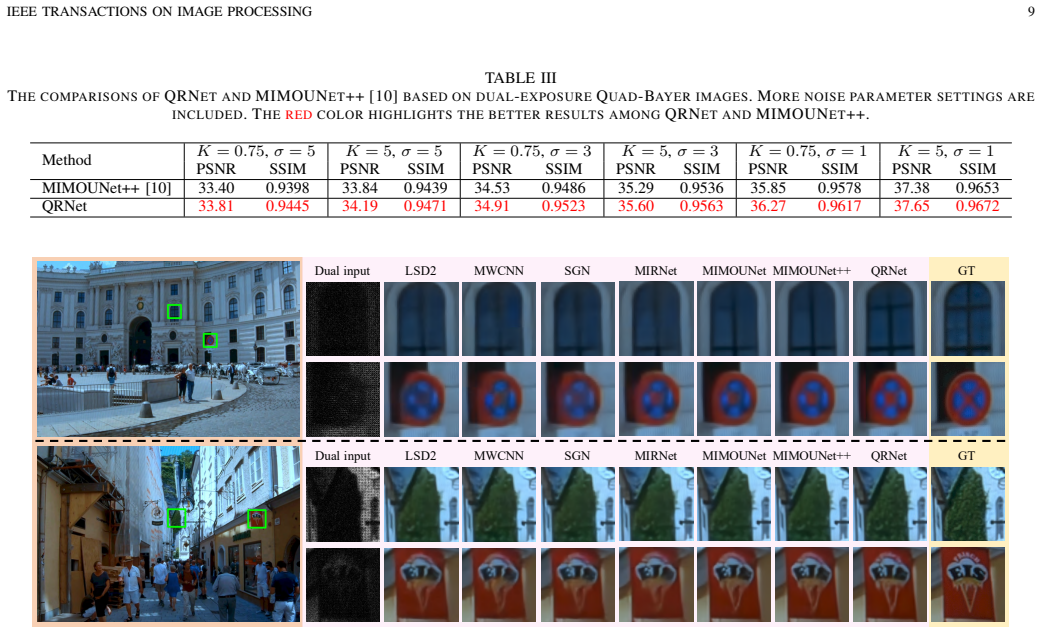
The paper's central claim is that a dual-exposure Quad-Bayer sensor—where each 4×4 CFA block contains both short- and long-exposure pixels that start exposing at the same time—makes joint denoising and deblurring possible from a single RAW image. The short-exposure pixels record sharp but noisy motion information, and the long-exposure pixels record low-noise, color-accurate but blurred information, so one mosaic already contains the complementary cues that burst methods gather from multiple frames. To exploit this, the authors build QRNet: Pixel Unshuffle reorganizes the mosaic into 16 exposure/color channels, an input enhancement block smooths discontinuities created by downsampling, and a five-level hierarchy with inter-level feature interactions restores the RGB image under an L1 plus frequency loss. Because long- and short-exposure pixels are captured in the same frame, the paper argues there is no readout delay or misalignment, and the blur scale of long pixels can be inferred from neighboring short pixels. The authors also contribute B2QB, a Bayer-to-Quad-Bayer sampling scheme, and the 731-pair QR dataset, and report that QRNet outperforms existing methods on both synthetic and real Quad-Bayer data while using about 5% of the MACs of the strongest deblurring baseline.
Load-bearing premise
The load-bearing premise is that the synthetic B2QB training data faithfully represents real dual-exposure Quad-Bayer captures: the paper creates a 'short exposure' by taking a one-second, noise-free static image and dividing its intensities by the exposure ratio A=4, whereas a genuine short exposure has different photon shot noise, read noise, and motion behavior.
Editorial extensions
If this is right
- A camera equipped with a dual-exposure Quad-Bayer sensor can perform joint denoising and deblurring from a single captured frame, so the motion-alignment and ghosting problems of burst-based methods disappear.
- Because the short and long exposures share one readout, there is no readout delay between them, and the network can use neighboring short-exposure pixels to estimate the blur of long-exposure pixels.
- The B2QB pipeline lets researchers generate large aligned Quad-Bayer training sets from ordinary Bayer captures, removing the need for a controllable Quad-Bayer camera during data collection.
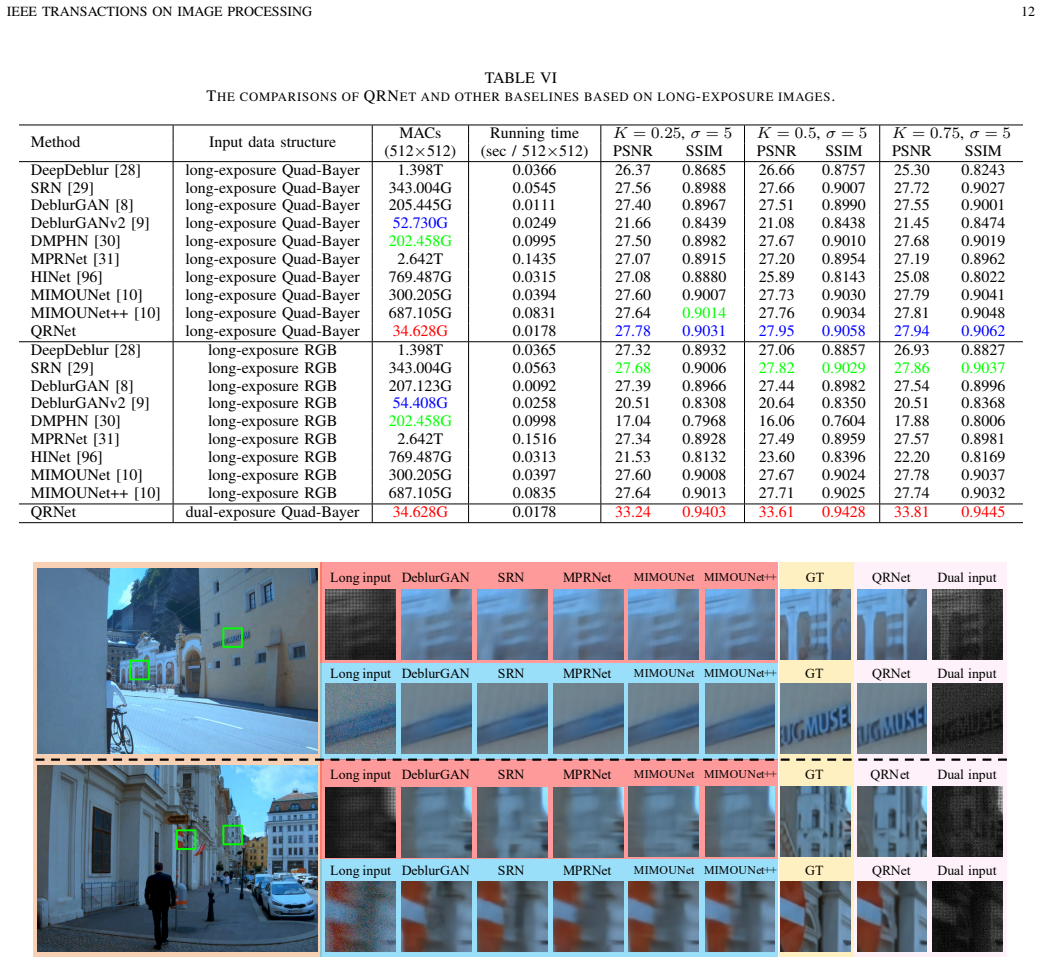
- With 34.6G MACs on a 512×512 patch, QRNet is substantially cheaper than the compared deblurring networks, suggesting the approach can run on power-constrained devices at interactive speeds.
- Restoring the Quad-Bayer RAW directly rather than RGB leaves white balance, tone mapping, and color adjustment to the downstream ISP, which the paper demonstrates with its RAW-restoration experiments.
Reading between the lines
- Beyond the paper: the same mosaic-level fusion idea generalizes to other dual- or multi-exposure CFA layouts, such as RGBW or tri-exposure Quad-Bayer patterns, where a Pixel-Unshuffle-style reorganization plus enhancement block could be reused with minimal change.
- Inference: a direct sensor-calibration study comparing true short-exposure pixel statistics on a Quad-Bayer sensor with the synthetic sta/A approximation would show how much of the reported gain survives the simulation-to-reality gap; the paper's real-image results are qualitative only.
- A testable extension would be to sweep the exposure ratio A during training and inference; if the network is robust to A, the method could adapt online to changing light, which the current fixed-ratio dataset does not explore.
Editorial analysis
A structured set of objections, weighed in public.
Referee Report
Summary. The paper proposes a dual-exposure Quad-Bayer sensor pattern in which short- and long-exposure pixels are interleaved in a single RAW mosaic. It introduces a Bayer-to-Quad-Bayer (B2QB) synthesis pipeline that creates a QR dataset from paired Bayer captures, and a hierarchical convolutional network QRNet that maps the Quad-Bayer RAW input to a clean, sharp RGB image (or RAW output). On the synthetic QR validation set, QRNet reports higher PSNR/SSIM than a range of deblurring and denoising baselines while using fewer MACs, and on four real IMX586 images it reports higher no-reference LIQE values. The code, model, and dataset are promised to be public.
Significance. The dual-exposure Quad-Bayer idea is timely and practically motivated: a single-frame CFA that contains both short and long exposures could avoid burst misalignment while supplying complementary noise-blur information. The B2QB dataset is a concrete resource for the community, and QRNet is a reasonably efficient architecture with a sensible multi-level design. The paper also makes its code, model, and dataset available, which increases reproducibility. However, the central claims rest on a synthetic degradation model whose short-exposure channel is not a physical short exposure, and the real-camera evidence is very thin. As presented, the experimental support is not yet strong enough to establish the abstract's claim of superior performance on real-world datasets.
major comments (3)
- [IV (Data capturing) and V-B (Noise modeling)] The synthetic short-exposure data do not represent a physical short exposure. In Section IV the authors set sta' = sta/A by dividing a 1 s static, noise-free capture by A=4, so the short-exposure pixels are perfectly sharp and merely scaled in intensity. A true 1/4 s exposure of the moving scene would contain motion blur (less than the long exposure but non-zero) and different shot-noise and read-noise statistics. Moreover, the noise model in Eq. (6) is applied to this pre-scaled static image and then amplified by A in the pre-processing of Section III-B, which does not match the sensor's photon-limited noise process. Because Tables II-IV and the central claim that dual-exposure Quad-Bayer carries complementary noise-blur information are evaluated on this synthetic distribution, the reported gains may substantially overstate real-world performance. Additionally, the long-exposure channel is captured with a static camera viewing a monitor, so the only motion is scene motion; camera shake, which is typically dominant in handheld photography, is absent from the training data.
- [V-C (Evaluation with Dual-exposure-based Methods)] The real-camera evaluation is insufficient to validate transfer from the synthetic QR dataset. Only 24 indoor IMX586 images were captured, four are shown, there is no ground truth, and the quality claim relies entirely on the no-reference LIQE measure. The noise parameters are said to be 'estimated on real Quad-Bayer images based on [4]' without reporting a fidelity check, confidence bounds, or a sensitivity analysis. This evidence cannot support the abstract's claim of state-of-the-art performance on real-world datasets; the synthetic-to-real gap remains open.
- [V-B (Experiment settings) and Tables II-VI] The paper never states how the baseline networks consume a dual-exposure Quad-Bayer input. The 'Input data structure' column only labels the input as 'dual-exposure Quad-Bayer', but DeblurGAN, MPRNet, SRN, and similar architectures are designed for single-channel RGB or for a specific pre-processing. If all baselines were given the same 16-channel Pixel-Unshuffled tensor, that is a nonstandard input for them; if they were given the raw single-channel mosaic, they are at a disadvantage. The statement that 'the data selection scheme, training epochs, and batch size are identical to QRNet' does not address this, so the relative performance in Tables II-VI is not fully interpretable.
minor comments (5)
- [Figure 7 and Section V-F] The method name 'DPMHN' is a typo for 'DMPHN' in the Figure 7 caption and again in the method list of Section V-F.
- [Section IV (Data capturing)] The phrase 'All other lighting sources are closed except the monitor' should be reworded to 'turned off' or 'switched off' for clarity.
- [Section III-B (Pre-processing)] The notation NM(x)=x+n is imprecise because the noise term in Eq. (6) depends on the signal x; writing NM(x)=x+n(x) would clarify the signal-dependent nature of the shot noise.
- [Table I and Eq. (6)] In Table I, 'qu' is defined as a noise parameter, but Eq. (6) uses 'qu' as the quantization step; these notations should be aligned.
- [Section V-E (Short-exposure comparison)] Table V contains two QRNet rows (short-exposure and dual-exposure); the text says 'when changing the input data structure to the short-exposure Quad-Bayer for the QRNet, it still outperforms other methods,' which is confusing because QRNet is proposed for dual-exposure input. Consider labeling this clearly as an ablation-style comparison.
Circularity Check
No significant circularity: QRNet's claims rest on external benchmarks and a physically motivated synthetic pipeline; self-citations are not load-bearing.
full rationale
The paper contains no derivation in which a predicted quantity is defined from the quantity it predicts. The B2QB dataset generation uses a standard noise model [4] and an exposure-ratio scaling A to synthesize Quad-Bayer inputs, but the subsequent network is trained and evaluated on held-out validation pairs produced by the same pipeline, plus 24 real IMX586 images without ground truth and LIQE comparisons. Training and testing on the same synthetic degradation model is a standard benchmark practice and is not a circular reduction; the real-image evaluation is an external check, albeit thin. Self-citations [13] (D2HNet) and [61] (DSWN) are used only as related work and baselines, not to justify the core claim. The claim that dual-exposure contains complementary information is embedded in the sensor pattern being modeled (short pixels are a dark sharp version, long pixels are bright blurred), but this is an assumption about the sensor, not a 'prediction' derived from the network; the paper's contribution is showing a network can exploit it. No uniqueness theorem, no fitted-parameter-as-prediction, no ansatz smuggled via citation. Concerns about synthetic-to-real transfer are validity risks, not circularity.
Assumptions & free parameters
free parameters (3)
- Exposure ratio A =
4
- Noise model hyperparameters K and sigma =
K in {0.25, 0.5, 0.75}, sigma=5 for synthetic; K=5, sigma=1 for real
- White balance gain ranges =
wg=1, wr in [1.6,1.8], wb in [1.4,1.6]
assumptions (4)
- domain assumption The physical noise formation model in [4] (Poisson shot noise, Gaussian read noise, uniform quantization) accurately describes real Quad-Bayer RAW noise.
- domain assumption A real short exposure can be approximated by a 1-second static, noise-free capture divided by exposure ratio A=4.
- domain assumption Motion blur produced by filming moving video on a monitor with a 1-second shutter is representative of real camera motion blur.
- domain assumption Interleaving independently captured long- and short-exposure Bayer frames produces a valid dual-exposure Quad-Bayer image, and both exposures start at the same time.
Cite this review
Pith. "Pith review of Modeling Dual-Exposure Quad-Bayer Patterns for Joint Denoising and Deblurring." pith.science (2026). https://pith.science/paper/XTV56X2G
@misc{pith2026241207256,
  author       = {Pith},
  title        = {Pith review of: Modeling Dual-Exposure Quad-Bayer Patterns for Joint Denoising and Deblurring},
  year         = {2026},
  howpublished = {\url{https://pith.science/paper/XTV56X2G}},
  note         = {Machine review of arXiv:2412.07256}
}
read the original abstract
Image degradation caused by noise and blur remains a persistent challenge in imaging systems, stemming from limitations in both hardware and methodology. Single-image solutions face an inherent tradeoff between noise reduction and motion blur. While short exposures can capture clear motion, they suffer from noise amplification. Long exposures reduce noise but introduce blur. Learning-based single-image enhancers tend to be over-smooth due to the limited information. Multi-image solutions using burst mode avoid this tradeoff by capturing more spatial-temporal information but often struggle with misalignment from camera/scene motion. To address these limitations, we propose a physical-model-based image restoration approach leveraging a novel dual-exposure Quad-Bayer pattern sensor. By capturing pairs of short and long exposures at the same starting point but with varying durations, this method integrates complementary noise-blur information within a single image. We further introduce a Quad-Bayer synthesis method (B2QB) to simulate sensor data from Bayer patterns to facilitate training. Based on this dual-exposure sensor model, we design a hierarchical convolutional neural network called QRNet to recover high-quality RGB images. The network incorporates input enhancement blocks and multi-level feature extraction to improve restoration quality. Experiments demonstrate superior performance over state-of-the-art deblurring and denoising methods on both synthetic and real-world datasets. The code, model, and datasets are publicly available at https://github.com/zhaoyuzhi/QRNet.
Figures


Figures from the paper (9 more)






Reference graph
Works this paper leans on
-
[4]
A physics-based noise formation model for extreme low-light raw denoising,
K. Wei, Y . Fu, J. Yang, and H. Huang, “A physics-based noise formation model for extreme low-light raw denoising,” in Proc. CVPR, 2020, pp. 2758–2767
2020
-
[1]
Unprocessing images for learned raw denoising,
T. Brooks, B. Mildenhall, T. Xue, J. Chen, D. Sharlet, and J. T. Barron, “Unprocessing images for learned raw denoising,” in Proc. CVPR, 2019, pp. 11 036–11 045
2019
-
[2]
Cycleisp: Real image restoration via improved data synthesis,
S. W. Zamir, A. Arora, S. Khan, M. Hayat, F. S. Khan, M.-H. Yang, and L. Shao, “Cycleisp: Real image restoration via improved data synthesis,” in Proc. CVPR, 2020, pp. 2696–2705
2020
-
[3]
Noise flow: Noise modeling with conditional normalizing flows,
A. Abdelhamed, M. A. Brubaker, and M. S. Brown, “Noise flow: Noise modeling with conditional normalizing flows,” in Proc. ICCV, 2019, pp. 3165–3173
2019
-
[5]
Practical deep raw image denoising on mobile devices,
Y . Wang, H. Huang, Q. Xu, J. Liu, Y . Liu, and J. Wang, “Practical deep raw image denoising on mobile devices,” in Proc. ECCV , 2020, pp. 1–16
2020
-
[6]
Rethinking noise synthesis and modeling in raw denoising,
Y . Zhang, H. Qin, X. Wang, and H. Li, “Rethinking noise synthesis and modeling in raw denoising,” in Proc. ICCV, 2021, pp. 4593–4601
2021
-
[7]
Noise2noiseflow: Realistic camera noise modeling without clean im- ages,
A. Maleky, S. Kousha, M. S. Brown, and M. A. Brubaker, “Noise2noiseflow: Realistic camera noise modeling without clean im- ages,” in Proc. CVPR, 2022, pp. 17 611–17 620
2022
-
[8]
Deblurgan: Blind motion deblurring using conditional adversarial net- works,
O. Kupyn, V . Budzan, M. Mykhailych, D. Mishkin, and J. Matas, “Deblurgan: Blind motion deblurring using conditional adversarial net- works,” in Proc. CVPR, 2018, pp. 8183–8192
2018
Show all 97 references
-
[9]
Deblurgan-v2: Deblur- ring (orders-of-magnitude) faster and better,
O. Kupyn, T. Martyniuk, J. Wu, and Z. Wang, “Deblurgan-v2: Deblur- ring (orders-of-magnitude) faster and better,” in Proc. ICCV, 2019, pp. 8878–8887
2019
-
[10]
Rethinking coarse-to-fine approach in single image deblurring,
S.-J. Cho, S.-W. Ji, J.-P. Hong, S.-W. Jung, and S.-J. Ko, “Rethinking coarse-to-fine approach in single image deblurring,” in Proc. ICCV , 2021, pp. 4641–4650
2021
-
[11]
Lsd2 - joint denoising and deblurring of short and long exposure images with convolutional neural networks,
J. Mustaniemi, J. Kannala, J. Matas, S. S ¨arkk¨a, and J. Heikkil ¨a, “Lsd2 - joint denoising and deblurring of short and long exposure images with convolutional neural networks,” in Proc. BMVC, 2020
2020
-
[12]
Low-light image restoration with short-and long-exposure raw pairs,
M. Chang, H. Feng, Z. Xu, and Q. Li, “Low-light image restoration with short-and long-exposure raw pairs,” IEEE Trans. Multimedia , vol. 24, pp. 702–714, 2021
2021
-
[13]
D2hnet: Joint denoising and deblurring with hierarchical network for robust night image restoration,
Y . Zhao, Y . Xu, Q. Yan, D. Yang, X. Wang, and L.-M. Po, “D2hnet: Joint denoising and deblurring with hierarchical network for robust night image restoration,” in Proc. ECCV, 2022, pp. 91–110
2022
-
[14]
Under display camera quad bayer raw image restoration using deep learning,
I. Kim, Y . Choi, H. Ko, D. Lim, Y . Seo, J. Lee, G. Lee, E. Heo, S. Song, and S. Lim, “Under display camera quad bayer raw image restoration using deep learning,” Electronic Imaging , vol. 2021, no. 7, pp. 67–1, 2021
2021
-
[15]
Hdr video reconstruction with tri- exposure quad-bayer sensors,
Y . Jiang, I. Choi, J. Jiang, and J. Gu, “Hdr video reconstruction with tri- exposure quad-bayer sensors,” arXiv preprint arXiv:2103.10982 , 2021
2021 arXiv
-
[16]
Real-time single image and video super- resolution using an efficient sub-pixel convolutional neural network,
W. Shi, J. Caballero, F. Husz ´ar, J. Totz, A. P. Aitken, R. Bishop, D. Rueckert, and Z. Wang, “Real-time single image and video super- resolution using an efficient sub-pixel convolutional neural network,” in Proc. CVPR, 2016, pp. 1874–1883
2016
-
[17]
Color imaging array,
B. E. Bayer, “Color imaging array,” U.S. Patent 3971065, Jul. 1976
1976
-
[18]
Color filter arrays: Design and performance analysis,
R. Lukac and K. N. Plataniotis, “Color filter arrays: Design and performance analysis,” IEEE Transactions on Consumer Electronics , vol. 51, no. 4, pp. 1260–1267, 2005
2005
-
[19]
Solid state camera,
S. Yamanaka, “Solid state camera,” U.S. Patent 4054906, Nov. 1977
1977
-
[20]
A perceptually based design methodology for color filter arrays [image reconstruction],
M. Parmar and S. J. Reeves, “A perceptually based design methodology for color filter arrays [image reconstruction],” in Proc. ICASSP, vol. 3, 2004, pp. iii–473
2004
-
[21]
Bayesian-based iterative method of image restora- tion,
W. H. Richardson, “Bayesian-based iterative method of image restora- tion,” JoSA, vol. 62, no. 1, pp. 55–59, 1972
1972
-
[22]
Removing camera shake from a single photograph,
R. Fergus, B. Singh, A. Hertzmann, S. T. Roweis, and W. T. Freeman, “Removing camera shake from a single photograph,” in Proc. ACM SIGGRAPH, 2006, pp. 787–794
2006
-
[23]
Edge-based blur kernel estimation using patch priors,
L. Sun, S. Cho, J. Wang, and J. Hays, “Edge-based blur kernel estimation using patch priors,” in Proc. ICCP, 2013, pp. 1–8
2013
-
[24]
Blind deconvolution using a normalized sparsity measure,
D. Krishnan, T. Tay, and R. Fergus, “Blind deconvolution using a normalized sparsity measure,” in Proc. CVPR, 2011, pp. 233–240
2011
-
[25]
Deblurring text images via l0-regularized intensity and gradient prior,
J. Pan, Z. Hu, Z. Su, and M.-H. Yang, “Deblurring text images via l0-regularized intensity and gradient prior,” in Proc. CVPR , 2014, pp. 2901–2908
2014
-
[26]
Learning a convolutional neural network for non-uniform motion blur removal,
J. Sun, W. Cao, Z. Xu, and J. Ponce, “Learning a convolutional neural network for non-uniform motion blur removal,” in Proc. CVPR , 2015, pp. 769–777
2015
-
[27]
From motion blur to motion flow: a deep learning solution for removing heterogeneous motion blur,
D. Gong, J. Yang, L. Liu, Y . Zhang, I. Reid, C. Shen, A. Van Den Hengel, and Q. Shi, “From motion blur to motion flow: a deep learning solution for removing heterogeneous motion blur,” in Proc. CVPR, 2017, pp. 2319–2328
2017
-
[28]
Deep multi-scale convolutional neural network for dynamic scene deblurring,
S. Nah, T. Hyun Kim, and K. Mu Lee, “Deep multi-scale convolutional neural network for dynamic scene deblurring,” in Proc. CVPR , 2017, pp. 3883–3891
2017
-
[29]
Scale-recurrent network for deep image deblurring,
X. Tao, H. Gao, X. Shen, J. Wang, and J. Jia, “Scale-recurrent network for deep image deblurring,” in Proc. CVPR, 2018, pp. 8174–8182. IEEE TRANSACTIONS ON IMAGE PROCESSING 15
2018
-
[30]
Deep stacked hierarchical multi-patch network for image deblurring,
H. Zhang, Y . Dai, H. Li, and P. Koniusz, “Deep stacked hierarchical multi-patch network for image deblurring,” in Proc. CVPR , 2019, pp. 5978–5986
2019
-
[31]
Multi-stage progressive image restoration,
S. W. Zamir, A. Arora, S. Khan, M. Hayat, F. S. Khan, M.-H. Yang, and L. Shao, “Multi-stage progressive image restoration,” in Proc. CVPR , 2021, pp. 14 821–14 831
2021
-
[32]
Dynamic scene deblurring using spatially variant recurrent neural networks,
J. Zhang, J. Pan, J. Ren, Y . Song, L. Bao, R. W. Lau, and M.-H. Yang, “Dynamic scene deblurring using spatially variant recurrent neural networks,” in Proc. CVPR, 2018, pp. 2521–2529
2018
-
[33]
Efficient dynamic scene deblurring using spatially variant deconvolution network with optical flow guided training,
Y . Yuan, W. Su, and D. Ma, “Efficient dynamic scene deblurring using spatially variant deconvolution network with optical flow guided training,” in Proc. CVPR, 2020, pp. 3555–3564
2020
-
[34]
Multi-temporal recurrent neural networks for progressive non-uniform single image deblurring with incremental temporal training,
D. Park, D. U. Kang, J. Kim, and S. Y . Chun, “Multi-temporal recurrent neural networks for progressive non-uniform single image deblurring with incremental temporal training,” in Proc. ECCV , 2020, pp. 327– 343
2020
-
[35]
Hierarchical integration diffusion model for realistic image deblurring,
Z. Chen, Y . Zhang, D. Liu, B. Xia, J. Gu, L. Kong, and X. Yuan, “Hierarchical integration diffusion model for realistic image deblurring,” in Proc. NeurIPS, 2022, pp. 29 114–29 125
2022
-
[36]
Generative adversarial nets,
I. Goodfellow, J. Pouget-Abadie, M. Mirza, B. Xu, D. Warde-Farley, S. Ozair, A. Courville, and Y . Bengio, “Generative adversarial nets,” in Proc. NeurIPS, 2014, pp. 2672–2680
2014
-
[37]
Reblur2deblur: Deblurring videos via self-supervised learning,
H. Chen, J. Gu, O. Gallo, M.-Y . Liu, A. Veeraraghavan, and J. Kautz, “Reblur2deblur: Deblurring videos via self-supervised learning,” in Proc. ICCP, 2018, pp. 1–9
2018
-
[38]
Unsupervised class- specific deblurring,
T. M. Nimisha, K. Sunil, and A. Rajagopalan, “Unsupervised class- specific deblurring,” in Proc. ECCV, 2018, pp. 353–369
2018
-
[39]
Deblurring by realistic blurring,
K. Zhang, W. Luo, Y . Zhong, L. Ma, B. Stenger, W. Liu, and H. Li, “Deblurring by realistic blurring,” in Proc. CVPR, 2020, pp. 2737–2746
2020
-
[40]
Neural blind deconvolution using deep priors,
D. Ren, K. Zhang, Q. Wang, Q. Hu, and W. Zuo, “Neural blind deconvolution using deep priors,” in Proc. CVPR, 2020, pp. 3341–3350
2020
-
[41]
Test-time fast adaptation for dynamic scene deblurring via meta-auxiliary learning,
Z. Chi, Y . Wang, Y . Yu, and J. Tang, “Test-time fast adaptation for dynamic scene deblurring via meta-auxiliary learning,” in Proc. CVPR, 2021, pp. 9137–9146
2021
-
[42]
Scale-space and edge detection using anisotropic diffusion,
P. Perona and J. Malik, “Scale-space and edge detection using anisotropic diffusion,” IEEE Trans. Pattern Anal. Mach. Intell. , vol. 12, no. 7, pp. 629–639, 1990
1990
-
[43]
Nonlinear total variation based noise removal algorithms,
L. I. Rudin, S. Osher, and E. Fatemi, “Nonlinear total variation based noise removal algorithms,” Physica D: nonlinear phenomena , vol. 60, no. 1-4, pp. 259–268, 1992
1992
-
[44]
Noise removal via bayesian wavelet coring,
E. P. Simoncelli and E. H. Adelson, “Noise removal via bayesian wavelet coring,” in Proc. ICIP, vol. 1, 1996, pp. 379–382
1996
-
[45]
A non-local algorithm for image denoising,
A. Buades, B. Coll, and J.-M. Morel, “A non-local algorithm for image denoising,” in Proc. CVPR, vol. 2, 2005, pp. 60–65
2005
-
[46]
New insights into the noise reduction wiener filter,
J. Chen, J. Benesty, Y . Huang, and S. Doclo, “New insights into the noise reduction wiener filter,” IEEE/ACM Trans. Audio, Speech, Language Process., vol. 14, no. 4, pp. 1218–1234, 2006
2006
-
[47]
K-svd: An algorithm for designing overcomplete dictionaries for sparse representation,
M. Aharon, M. Elad, and A. Bruckstein, “K-svd: An algorithm for designing overcomplete dictionaries for sparse representation,” IEEE Trans. Signal Process. , vol. 54, no. 11, pp. 4311–4322, 2006
2006
-
[48]
Image denoising via sparse and redundant representations over learned dictionaries,
M. Elad and M. Aharon, “Image denoising via sparse and redundant representations over learned dictionaries,” IEEE Trans. Image Process. , vol. 15, no. 12, pp. 3736–3745, 2006
2006
-
[49]
Non-local sparse models for image restoration,
J. Mairal, F. Bach, J. Ponce, G. Sapiro, and A. Zisserman, “Non-local sparse models for image restoration,” in Proc. ICCV , 2009, pp. 2272– 2279
2009
-
[50]
Image denoising by sparse 3-d transform-domain collaborative filtering,
K. Dabov, A. Foi, V . Katkovnik, and K. Egiazarian, “Image denoising by sparse 3-d transform-domain collaborative filtering,” IEEE Trans. Image Process., vol. 16, no. 8, pp. 2080–2095, 2007
2007
-
[51]
Image denoising and inpainting with deep neural networks,
J. Xie, L. Xu, and E. Chen, “Image denoising and inpainting with deep neural networks,” in Proc. NeurIPS, 2012, pp. 341–349
2012
-
[52]
Image restoration using very deep convolutional encoder-decoder networks with symmetric skip connec- tions,
X. Mao, C. Shen, and Y .-B. Yang, “Image restoration using very deep convolutional encoder-decoder networks with symmetric skip connec- tions,” in Proc. NeurIPS, 2016, pp. 2802–2810
2016
-
[53]
Trainable nonlinear reaction diffusion: A flexible framework for fast and effective image restoration,
Y . Chen and T. Pock, “Trainable nonlinear reaction diffusion: A flexible framework for fast and effective image restoration,” IEEE Trans. Pattern Anal. Mach. Intell. , vol. 39, no. 6, pp. 1256–1272, 2016
2016
-
[54]
Learning deep cnn denoiser prior for image restoration,
K. Zhang, W. Zuo, S. Gu, and L. Zhang, “Learning deep cnn denoiser prior for image restoration,” in Proc. CVPR, 2017, pp. 3929–3938
2017
-
[55]
Beyond a gaussian denoiser: Residual learning of deep cnn for image denoising,
K. Zhang, W. Zuo, Y . Chen, D. Meng, and L. Zhang, “Beyond a gaussian denoiser: Residual learning of deep cnn for image denoising,” IEEE Trans. Image Process. , vol. 26, no. 7, pp. 3142–3155, 2017
2017
-
[56]
Memnet: A persistent memory network for image restoration,
Y . Tai, J. Yang, X. Liu, and C. Xu, “Memnet: A persistent memory network for image restoration,” in Proc. ICCV, 2017, pp. 4539–4547
2017
-
[57]
Ffdnet: Toward a fast and flexible solution for cnn-based image denoising,
K. Zhang, W. Zuo, and L. Zhang, “Ffdnet: Toward a fast and flexible solution for cnn-based image denoising,” IEEE Trans. Image Process. , vol. 27, no. 9, pp. 4608–4622, 2018
2018
-
[58]
Multi-level wavelet- cnn for image restoration,
P. Liu, H. Zhang, K. Zhang, L. Lin, and W. Zuo, “Multi-level wavelet- cnn for image restoration,” in Proc. CVPRW, 2018, pp. 773–782
2018
-
[59]
Real image denoising with feature attention,
S. Anwar and N. Barnes, “Real image denoising with feature attention,” in Proc. ICCV, 2019, pp. 3155–3164
2019
-
[60]
Attention-guided cnn for image denoising,
C. Tian, Y . Xu, Z. Li, W. Zuo, L. Fei, and H. Liu, “Attention-guided cnn for image denoising,” Neural Networks , vol. 124, pp. 117–129, 2020
2020
-
[61]
Densely self-guided wavelet network for image denoising,
W. Liu, Q. Yan, and Y . Zhao, “Densely self-guided wavelet network for image denoising,” in Proc. CVPRW, 2020, pp. 432–433
2020
-
[62]
Learning enriched features for real image restoration and enhancement,
S. W. Zamir, A. Arora, S. Khan, M. Hayat, F. S. Khan, M.-H. Yang, and L. Shao, “Learning enriched features for real image restoration and enhancement,” in Proc. ECCV, 2020, pp. 492–511
2020
-
[63]
Nbnet: Noise basis learning for image denoising with subspace projection,
S. Cheng, Y . Wang, H. Huang, D. Liu, H. Fan, and S. Liu, “Nbnet: Noise basis learning for image denoising with subspace projection,” in Proc. CVPR, 2021, pp. 4896–4906
2021
-
[64]
U-net: Convolutional networks for biomedical image segmentation,
O. Ronneberger, P. Fischer, and T. Brox, “U-net: Convolutional networks for biomedical image segmentation,” in Proc. MICCAI, 2015, pp. 234– 241
2015
-
[65]
Deep residual learning for image recognition,
K. He, X. Zhang, S. Ren, and J. Sun, “Deep residual learning for image recognition,” in Proc. CVPR, 2016, pp. 770–778
2016
-
[66]
Toward robust image denoising via flow-based joint image and noise model,
L. Guo, S. Huang, H. Liu, and B. Wen, “Toward robust image denoising via flow-based joint image and noise model,” IEEE Trans. Circuits Syst. Video Technol., vol. 34, pp. 6105–6115, 2024
2024
-
[67]
Denoising diffusion models for plug-and-play image restoration,
Y . Zhu, K. Zhang, J. Liang, J. Cao, B. Wen, R. Timofte, and L. V . Gool, “Denoising diffusion models for plug-and-play image restoration,” in Proc. CVPRW, 2023, pp. 1219–1229
2023
-
[68]
Toward convolutional blind denoising of real photographs,
S. Guo, Z. Yan, K. Zhang, W. Zuo, and L. Zhang, “Toward convolutional blind denoising of real photographs,” in Proc. CVPR, 2019, pp. 1712– 1722
2019
-
[69]
Variational denoising network: Toward blind noise modeling and removal,
Z. Yue, H. Yong, Q. Zhao, D. Meng, and L. Zhang, “Variational denoising network: Toward blind noise modeling and removal,” Proc. NeurIPS, vol. 32, pp. 1690–1701, 2019
2019
-
[70]
Transfer learning from synthetic to real-noise denoising with adaptive instance normalization,
Y . Kim, J. W. Soh, G. Y . Park, and N. I. Cho, “Transfer learning from synthetic to real-noise denoising with adaptive instance normalization,” in Proc. CVPR, 2020, pp. 3482–3492
2020
-
[71]
Noise2noise: Learning image restoration without clean data,
J. Lehtinen, J. Munkberg, J. Hasselgren, S. Laine, T. Karras, M. Aittala, and T. Aila, “Noise2noise: Learning image restoration without clean data,” in Proc. ICML, 2018, pp. 2965–2974
2018
-
[72]
Noise2self: Blind denoising by self- supervision,
J. Batson and L. Royer, “Noise2self: Blind denoising by self- supervision,” in Proc. ICML, 2019, pp. 524–533
2019
-
[73]
Noise2void-learning denoising from single noisy images,
A. Krull, T.-O. Buchholz, and F. Jug, “Noise2void-learning denoising from single noisy images,” in Proc. CVPR, 2019, pp. 2129–2137
2019
-
[74]
Unpaired learning of deep image denoising,
X. Wu, M. Liu, Y . Cao, D. Ren, and W. Zuo, “Unpaired learning of deep image denoising,” in Proc. ECCV, 2020, pp. 352–368
2020
-
[75]
Learning invariant representation for unsupervised image restoration,
W. Du, H. Chen, and H. Yang, “Learning invariant representation for unsupervised image restoration,” in Proc. CVPR , 2020, pp. 14 483– 14 492
2020
-
[76]
Legacy photo editing with learned noise prior,
Y . Zhao, L.-M. Po, T. Lin, X. Wang, K. Liu, Y . Zhang, W.-Y . Yu, P. Xian, and J. Xiong, “Legacy photo editing with learned noise prior,” in Proc. WACV, 2021, pp. 2103–2112
2021
-
[77]
Zero-shot noise2noise: Efficient image denoising without any data,
Y . Mansour and R. Heckel, “Zero-shot noise2noise: Efficient image denoising without any data,” in Proc. CVPR, 2023, pp. 14 018–14 027
2023
-
[78]
Adam: A method for stochastic optimization,
D. P. Kingma and J. Ba, “Adam: A method for stochastic optimization,” in Proc. ICLR, 2014
2014
-
[79]
Image deblurring with blurred/noisy image pairs,
L. Yuan, J. Sun, L. Quan, and H.-Y . Shum, “Image deblurring with blurred/noisy image pairs,” in Proc. ACM SIGGRAPH , 2007, pp. 1–es
2007
-
[80]
Non-uniform deblurring for shaken images,
O. Whyte, J. Sivic, A. Zisserman, and J. Ponce, “Non-uniform deblurring for shaken images,” Int. J. Comput. Vis. , vol. 98, no. 2, pp. 168–186, 2012
2012
-
[81]
Rgb-nir imaging with exposure bracketing for joint denoising and deblurring of low-light color images,
H. Yamashita, D. Sugimura, and T. Hamamoto, “Rgb-nir imaging with exposure bracketing for joint denoising and deblurring of low-light color images,” in Proc. ICASSP, 2017, pp. 6055–6059
2017
-
[82]
Deformable convolutional networks,
J. Dai, H. Qi, Y . Xiong, Y . Li, G. Zhang, H. Hu, and Y . Wei, “Deformable convolutional networks,” in Proc. ICCV, 2017, pp. 764–773
2017
-
[83]
Spatial temporal video enhancement using alternating exposures,
W. Shen, M. Cheng, G. Lu, G. Zhai, L. Chen, M. S. Asif, and Z. Gao, “Spatial temporal video enhancement using alternating exposures,” IEEE Trans. Circuits Syst. Video Technol., vol. 32, no. 8, pp. 4912–4926, 2021
2021
-
[84]
Learning to see in the dark,
C. Chen, Q. Chen, J. Xu, and V . Koltun, “Learning to see in the dark,” in Proc. CVPR, 2018, pp. 3291–3300
2018
-
[85]
Raw image deblur- ring,
C.-H. Liang, Y .-A. Chen, Y .-C. Liu, and W. Hsu, “Raw image deblur- ring,” IEEE Trans. Multimedia , vol. 24, pp. 61–72, 2022
2022
-
[86]
Deep joint demo- saicking and denoising,
M. Gharbi, G. Chaurasia, S. Paris, and F. Durand, “Deep joint demo- saicking and denoising,” ACM Trans. on Graphics , vol. 35, no. 6, pp. 1–12, 2016
2016
-
[87]
Saliency map- aided generative adversarial network for raw to rgb mapping,
Y . Zhao, L.-M. Po, T. Zhang, Z. Liao, X. Shi et al. , “Saliency map- aided generative adversarial network for raw to rgb mapping,” in Proc. ICCVW, 2019, pp. 3449–3457. IEEE TRANSACTIONS ON IMAGE PROCESSING 16
2019
-
[88]
Joint demosaicing and denoising with self guidance,
L. Liu, X. Jia, J. Liu, and Q. Tian, “Joint demosaicing and denoising with self guidance,” in Proc. CVPR, 2020, pp. 2240–2249
2020
-
[89]
End-to-end learning for joint image demosaicing, denoising and super-resolution,
W. Xing and K. Egiazarian, “End-to-end learning for joint image demosaicing, denoising and super-resolution,” in Proc. CVPR, 2021, pp. 3507–3516
2021
-
[90]
Squeeze-and-excitation networks,
J. Hu, L. Shen, and G. Sun, “Squeeze-and-excitation networks,” in Proc. CVPR, 2018, pp. 7132–7141
2018
-
[91]
Self-guided network for fast image denoising,
S. Gu, Y . Li, L. V . Gool, and R. Timofte, “Self-guided network for fast image denoising,” in Proc. ICCV, 2019, pp. 2511–2520
2019
-
[92]
Demosaicing with directional filtering and a posteriori decision,
D. Menon, S. Andriani, and G. Calvagno, “Demosaicing with directional filtering and a posteriori decision,” IEEE Trans. Image Process., vol. 16, no. 1, pp. 132–141, 2006
2006
-
[93]
Blind image quality assessment via vision-language correspondence: A multitask learning perspective,
W. Zhang, G. Zhai, Y . Wei, X. Yang, and K. Ma, “Blind image quality assessment via vision-language correspondence: A multitask learning perspective,” in Proc. CVPR, 2023, pp. 14 071–14 081
2023
-
[94]
Image quality assessment: from error visibility to structural similarity,
Z. Wang, A. C. Bovik, H. R. Sheikh, and E. P. Simoncelli, “Image quality assessment: from error visibility to structural similarity,” IEEE Trans. Image Process. , vol. 13, no. 4, pp. 600–612, 2004
2004
-
[95]
Pytorch-opcounter,
“Pytorch-opcounter,” https://github.com/Lyken17/pytorch-OpCounter, accessed: Sep. 30, 2021. [Online]
2021
-
[96]
Hinet: Half instance normalization network for image restoration,
L. Chen, X. Lu, J. Zhang, X. Chu, and C. Chen, “Hinet: Half instance normalization network for image restoration,” in Proc. CVPRW , 2021, pp. 182–192. Yuzhi Zhao (S’19) received the B.Eng. degree in Electronic and Information Engineering from Huazhong University of Science and...
2021
-
[2013]
Xin Ye received the B.S
He also served on the Organizing Committee, of the IEEE International Conference on Acoustics, Speech and Signal Processing in 2003, and the IEEE International Conference on Image Processing in 2010. Xin Ye received the B.S. degree in physics from Zhejiang University in 2014 a...
2003
Reviewed August 11, 2026 · model on record in the stance chip above.
Discussion (0). Continue with ORCID to comment.