REVIEW 3 major objections 5 minor 1 cited by
Subtopic-aware View Sampling and Temporal Aggregation for Long-form Document Matching
T0 review · 3 major / 5 minor · reviewed 2026-08-11 · deepseek-v4-flash
Pith's one-line read The SST framework claims that sampling multiple subtopic views and training on a fresh view each epoch improves long-form document matching beyond single-view content selection.
desk verdict Consistent gains from subtopic-aware view sampling, but the 'temporal aggregation' framing needs a control that isolates schedule from multi-view exposure. read the letter →
The pith
A machine-rendered reading of the paper's core claim, the machinery that carries it, and where it could break.
The reading
What carries the argument
The machinery is a two-part training procedure. First, the combined sentence set of the query and candidate is clustered into 'subtopics'—semantic fragments—using either spectral clustering on a TextRank-style similarity matrix or an adaptive neural clustering head trained with a Jensen–Shannon alignment loss $\mathcal{L}_p$ and an orthogonality loss $\mathcal{L}_n$. Second, three sampling strategies (uniform, hard, and soft) construct document views—partial documents of $k$ sampled sentences—that balance aligned and complementary subtopics. Third, temporal aggregation feeds a different sampled view at each training epoch, so the model integrates views gradually over training, and at inference combines scores over a small view pool (max for classification, mean for ranking). The temporal step is inspired by Dropout's random sub-network sampling, treating each view as a sampled sub-network to be ensembled during training.
What would settle it
Re-run the ablation on CNSE and COLIEE 2023 with a tuned attention aggregator over the same view pool—reporting its architecture, heads, and hyperparameters—and compare against temporal aggregation. If tuned attention reaches or exceeds 87.65 accuracy on CNSE or 38.57 NDCG@10 on COLIEE, the paper's central claim that temporal aggregation is needed would be falsified.
Extended reading notes
Core claim
The central discovery is that representative document views for matching must combine aligned subtopics with complementary subtopics, and that such views are best integrated over training time rather than by spatial attention. Concretely, with adaptive clustering and soft sampling (SST-as), BERT reaches 87.65 accuracy on CNSE and 93.45 on CNSS, versus 83.97 and 89.63 for plain BERT and 86.32 and 91.28 for Match-Ignition. On legal retrieval, SAILER+SST-as reaches 53.19 NDCG@10 on LeCaRDv2 versus 50.87 for the two-stage SAILER baseline, and 38.57 NDCG@10 on COLIEE 2023 versus 36.51 for SAILER. The ablation attributes the gains to the temporal aggregation step: removing it drops CNSE accuracy to 85.37, and replacing it with an attention aggregator drops it to 80.77, below plain BERT.
Load-bearing premise
The paper's case that temporal aggregation is the right way to combine views rests on a single, under-described attention baseline in the ablation study; if that baseline were properly implemented and tuned, temporal aggregation might show no advantage over standard multi-view training.
Editorial extensions
If this is right
- On news duplication, BERT+SST-as improves accuracy over plain BERT by about 3.7 points on CNSE and 3.8 points on CNSS, and it also beats the previous strong content-selection baseline Match-Ignition.
- On legal case retrieval, SAILER+SST-as raises NDCG@10 on LeCaRDv2 from 50.87 to 53.19 and improves COLIEE 2023 NDCG@10 from 36.51 to 38.57.
- Removing temporal aggregation or replacing it with attention aggregation degrades results, with the attention variant falling below plain BERT on CNSE, which supports the paper's claim that spatial aggregation is poorly suited to heterogeneous views.
- Soft sampling generally outperforms hard sampling, suggesting that views with moderate heterogeneity combined with aligned salient content are the most representative.
- The framework helps on both long and short document pairs, indicating that the gain comes from view diversity and training dynamics rather than simply extending the input window.
Reading between the lines
- Inference: A testable extension the paper leaves implicit is whether ordering the view pool by salience or difficulty, rather than using a fixed random order, sharpens the curriculum effect of temporal aggregation; the paper does not explore view ordering.
- Inference: Because temporal aggregation is model-independent and only changes training, it should combine with long-context encoders or LLM-based rankers; the paper tests only BERT and SAILER, so this is an extrapolation.
- Inference: The strong collapse of the attention baseline might reflect overfitting to noisy views rather than a general failure of spatial aggregation; a matched-capacity comparison with a properly tuned attention aggregator would clarify the mechanism.
Signed reviews
Editorial analysis
A structured set of objections, weighed in public.
Referee Report
Summary. The paper proposes SST, a learning framework for long-form document matching. SST first discovers document-pair subtopics by clustering sentences (with a direct spectral-clustering variant and an adaptive, learned variant), then constructs multiple document views via uniform, hard, or soft sampling from the resulting subtopic clusters, and finally trains a matching model with a 'temporal aggregation' strategy: each training epoch uses a different view from a pre-sampled view pool, and at inference the model aggregates scores over a small view pool. Experiments on two news-duplication datasets (CNSE, CNSS) and two legal case retrieval datasets (LeCaRDv2, COLIEE 2023) show consistent improvements over several strong baselines, with the best variant (BERT+SST_as) reaching 87.65 Acc on CNSE and (SAILER+SST_as) 53.19 NDCG@10 on LeCaRDv2. The main positive result is that the subtopic-aware multi-view sampling strategy improves over content-selection baselines such as Match-Ignition and OPT-Match. The distinctive claim, however, is that 'temporal aggregation' is preferable to 'spatial aggregation' (attention); this claim is not supported by the current ablations.
Significance. If the reported gains are robust, the view-sampling component is a useful contribution: it is model-agnostic, consistently improves over content-selection baselines in two domains, and the paper ships an anonymous code release, reports hyperparameter analyses, evaluates against LLM baselines, and includes statistical significance tests for the top results. These strengths make the empirical contribution credible as a multi-view training framework. The significance of the specifically 'temporal' mechanism, however, is not established: the paper's central narrative that temporal aggregation is preferable to spatial attention aggregation rests on ablations that do not isolate the temporal schedule, and on an under-specified attention baseline. The paper's value therefore currently lies in subtopic-aware view sampling plus inference-time aggregation, not in a demonstrated temporal mechanism.
major comments (3)
- [§3.4, Eq. (10); Table 4] The experimental design does not isolate the 'temporal' component from the multi-view exposure. In Eq. (10), the model is trained on view v^t at epoch t, but the views are drawn from a pre-sampled pool without any ordering or dependency between successive views; the ablation 'w/o temporal aggregation' in Table 4 removes all multi-view training, so its drop measures the value of seeing many views over training, not the value of a temporal schedule. To support the central claim that temporal aggregation is preferable, the authors should add a control that holds the number of views per training run fixed and varies only the schedule, e.g., randomly resampling a view each batch or each epoch without a fixed sequence, and compare against the fixed per-epoch schedule. Without such a control, the reported gains are equally explained by standard multi-view data augmentation.
- [§5.2, Table 4 (row 'w attention')] The attention aggregation baseline is under-specified. The paper reports only that attention is used 'as [43]' and the row collapses to 80.77 Acc on CNSE, worse than plain BERT, but provides no architecture description, training setup, hyperparameter tuning, or variance over runs. Because the title and abstract claim that temporal aggregation is preferable to spatial aggregation, this comparison is load-bearing; if the attention baseline were implemented or tuned more carefully, the collapse might not occur. The authors should report the full configuration, tuning procedure, and multiple random seeds, or temper the claim.
- [§3.2, Eqs. (4)-(6)] The adaptive clustering component is not unsupervised as stated. L_p in Eq. (4) uses the JS divergence between the cluster distributions of positive document pairs, and L_n in Eq. (5) is applied to negative pairs, so the clustering head is trained with the same document-pair relevance labels used for the matching model. This is a form of supervised view construction that should be acknowledged and discussed; without an analysis of how much of the gain comes from label-informed clustering, the comparison to content selection baselines that do not use labels is not apples-to-apples.
minor comments (5)
- [§3.2, Eq. (4)] The notation is unclear: 'Max' is described as max-pooling, but the expression 'Max(B_i)' suggests a scalar per sentence, and the displayed sums over P_cq and P_cd do not make the cluster dimension explicit; the description of the JS-divergence loss would be clearer with dimensions spelled out.
- [Table 4] The grouping of ablation rows is confusing: the header 'w/o aggregation' is followed by 'w/o L_n' and 'w/o L_p', which appear to refer to removing the adaptive clustering losses, not to removing aggregation; renaming the groups (e.g., 'w/o adaptive clustering losses') would prevent misreading.
- [Appendix B] The training view pool size is not specified: the paper says 'receptive field of models is 40 sentences' and later 'view pool size as 3' for inference, but the number of views used during training (the pool V(q,d) in Eq. (10)) is never explicitly given, making the training-time exposure unclear.
- [Figure 7] The y-axis labels are duplicated on both sides ('F-1 on CNSS' appears on the left and right), and the sentence 'we sort the samples in descending order according to their similarity... Generally, the more similar a view to the whole document, the more primary information it contains' would be clearer if the direction of the sort were tied to the x-axis explicitly.
- [Abstract and §1] The phrase 'temporal aggregation' is introduced as a mechanism that 'effectively integrates different views gradually as the training progresses,' but the method in §3.4 only uses a different pre-sampled view per epoch without any gradual or adaptive ordering; the wording should be revised to match the actual mechanism or the mechanism should be extended.
Circularity Check
No significant circularity: the SST results are benchmark-tested against external baselines, and no load-bearing claim reduces to its own inputs or to the authors' prior work.
full rationale
The paper is an empirical systems paper, not a derivation. The matching score in Eq. (10) is a standard cross-entropy/InfoNCE loss on token sequences sampled from documents, and the reported gains are measured against independent baselines (BERT, Match-Ignition, SAILER, etc.), so the central effectiveness claim is not forced by construction. The subtopic discovery step defines clusters as subtopics and samples views from them; although the adaptive variant uses document-pair labels in its auxiliary losses (Eqs. 4-6), this is a label-conditioned preprocessing step rather than a fitted parameter renamed as a prediction, and the final classifier still must generalize from text to held-out labels. The temporal aggregation of Eq. (10) is a training schedule over a pre-sampled view pool; whether this schedule is genuinely better than ordinary multi-view augmentation is an experimental-validity question (the 'w/o temporal aggregation' ablation removes all multi-view exposure, and the attention baseline is underspecified), not a circularity. The only author overlap with prior citations is reference [51], which appears in the related-work survey and is not load-bearing; there is no invoked uniqueness theorem or ansatz smuggled in by self-citation. The score of 2 reflects this incidental self-citation rather than any circular step.
Assumptions & free parameters
free parameters (5)
- lambda =
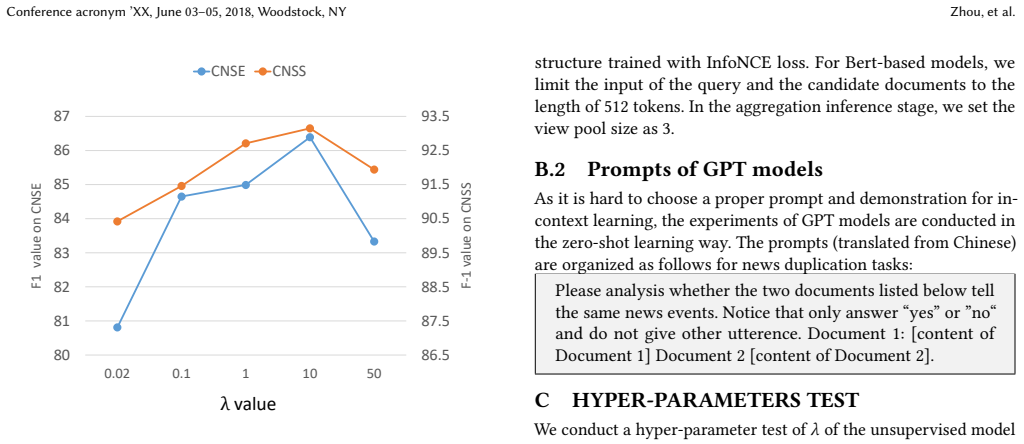
not reported for main results; tuned in {0.1, 1, 10}, robust from 0.02 to 50 (Fig. 9)
- average cluster size =
6 sentences (default), varied 5-9/7-11 (Fig. 6)
- view pool size (inference aggregation) =
3
- view size (sampled sentences per view) =
not explicitly reported; receptive field set to 40 sentences
- max training epochs E =
not reported, only view pool training range up to 40 in Fig. 7
assumptions (4)
- domain assumption Sentences in the same cluster reflect aligned subtopics; different clusters of the same document reflect complementary subtopics.
- domain assumption The adaptive clustering loss L_p using positive pair labels does not distort the unsupervised nature of subtopic discovery.
- domain assumption A larger cluster contains more information, so the largest aligned subtopic is the most representative (hard sampling).
- domain assumption Max-pooling is appropriate for classification aggregation because it is insensitive to noise; mean-pooling suits ranking.
Cite this review
Pith. "Pith review of Subtopic-aware View Sampling and Temporal Aggregation for Long-form Document Matching." pith.science (2026). https://pith.science/paper/YRLEIRSM
@misc{pith2026241207573,
  author       = {Pith},
  title        = {Pith review of: Subtopic-aware View Sampling and Temporal Aggregation for Long-form Document Matching},
  year         = {2026},
  howpublished = {\url{https://pith.science/paper/YRLEIRSM}},
  note         = {Machine review of arXiv:2412.07573}
}
read the original abstract
Long-form document matching aims to judge the relevance between two documents and has been applied to various scenarios. Most existing works utilize hierarchical or long context models to process documents, which achieve coarse understanding but may ignore details. Some researchers construct a document view with similar sentences about aligned document subtopics to focus on detailed matching signals. However, a long document generally contains multiple subtopics. The matching signals are heterogeneous from multiple topics. Considering only the homologous aligned subtopics may not be representative enough and may cause biased modeling. In this paper, we introduce a new framework to model representative matching signals. First, we propose to capture various matching signals through subtopics of document pairs. Next, We construct multiple document views based on subtopics to cover heterogeneous and valuable details. However, existing spatial aggregation methods like attention, which integrate all these views simultaneously, are hard to integrate heterogeneous information. Instead, we propose temporal aggregation, which effectively integrates different views gradually as the training progresses. Experimental results show that our learning framework is effective on several document-matching tasks, including news duplication and legal case retrieval.
Figures


Figures from the paper (5 more)


Forward citations
Cited by 1 Pith paper
-
QBD-RankedDataGen: Generating Custom Ranked Datasets for Improving Query-By-Document Search Using LLM-Reranking with Reduced Human Effort
LLM-generated rankings for query-by-document search do not improve BM25 tuning over default parameters unless validated by human ground truth.
Reference graph
Works this paper leans on
-
[43]
Liu Yang, Mingyang Zhang, Cheng Li, Michael Bendersky, and Marc Najork. 2020. Beyond 512 tokens: Siamese multi-depth transformer-based hierarchical encoder for long-form document matching. In Proceedings of the 29th ACM International Conference on Information & Knowledge Management . 1725–1734
work page 2020
-
[1]
Sophia Althammer, Sebastian Hofstätter, Mete Sertkan, Suzan Verberne, and Allan Hanbury. 2022. PARM: A Paragraph Aggregation Retrieval Model for Dense Document-to-Document Retrieval. In Advances in Information Retrieval, Matthias Hagen, Suzan Verberne, Craig Macdonald, Christin Seifert, Krisztian Balog, Kjetil Nørvåg, and Vinay Setty (Eds.). Springer Inte...
work page 2022
-
[2]
Sebastian Arnold, Rudolf Schneider, Philippe Cudré-Mauroux, Felix A Gers, and Alexander Löser. 2019. SECTOR: A neural model for coherent topic segmentation and classification. Transactions of the Association for Computational Linguistics 7 (2019), 169–184
work page 2019
-
[3]
Arian Askari, Suzan Verberne, Amin Abolghasemi, Wessel Kraaij, and Gabriella Pasi. 2024. Retrieval for Extremely Long Queries and Documents with RPRS: A Highly Efficient and Effective Transformer-based Re-Ranker. ACM Trans. Inf. Syst. 42, 5 (2024), 115:1–115:32. https://doi.org/10.1145/3631938
-
[4]
Haitao Bai, Pinghui Wang, Ruofei Zhang, and Zhou Su. 2023. SegFormer: a topic segmentation model with controllable range of attention. In Proceedings of the Thirty-Seventh AAAI Conference on Artificial Intelligence and Thirty-Fifth Con- ference on Innovative Applications of Artificial Intelligence and Thirteenth Sympo- sium on Educational Advances in Arti...
-
[5]
Filippo Maria Bianchi, Daniele Grattarola, and Cesare Alippi. 2020. Spectral clus- tering with graph neural networks for graph pooling. In International conference on machine learning. PMLR, 874–883
2020
-
[6]
Deyu Bo, Xiao Wang, Chuan Shi, Meiqi Zhu, Emiao Lu, and Peng Cui. 2020. Structural deep clustering network. In Proceedings of the web conference 2020 . 1400–1410
work page 2020
-
[7]
Zhirui Deng, Zhicheng Dou, Zhan Su, and Ji-Rong Wen. 2024. Multi-grained Document Modeling for Search Result Diversification. ACM Transactions on Information Systems 42, 5 (2024), 1–22
work page 2024
Show all 53 references
-
[8]
Jacob Devlin, Ming-Wei Chang, Kenton Lee, and Kristina Toutanova. 2019. BERT: Pre-training of Deep Bidirectional Transformers for Language Understanding. In Proceedings of the 2019 Conference of the North American Chapter of the Association for Computational Linguistics: Human...
2019
-
[9]
Qian Dong, Yiding Liu, Qingyao Ai, Zhijing Wu, Haitao Li, Yiqun Liu, Shuaiqiang Wang, Dawei Yin, and Shaoping Ma. 2024. Unsupervised Large Language Model Alignment for Information Retrieval via Contrastive Feedback. In Proceedings of the 47th International ACM SIGIR Conference...
2024
-
[10]
Dvir Ginzburg, Itzik Malkiel, Oren Barkan, Avi Caciularu, and Noam Koenig- stein. 2021. Self-Supervised Document Similarity Ranking via Contextualized Language Models and Hierarchical Inference. In Findings of the Association for Computational Linguistics: ACL/IJCNLP 2021, Onl...
2021 doi
-
[11]
Goran Glavaš, Federico Nanni, and Simone Paolo Ponzetto. 2016. Unsupervised text segmentation using semantic relatedness graphs. In Proceedings of the Fifth Joint Conference on Lexical and Computational Semantics . Association for Com- putational Linguistics, 125–130
2016
-
[12]
Randy Goebel, Yoshinobu Kano, Mi-Young Kim, Juliano Rabelo, Ken Satoh, and Masaharu Yoshioka. 2023. Summary of the Competition on Legal Information, Ex- traction/Entailment (COLIEE) 2023. In Proceedings of the Nineteenth International Conference on Artificial Intelligence and ...
2023
-
[13]
Maarten Grootendorst. 2022. BERTopic: Neural topic modeling with a class-based TF-IDF procedure. arXiv preprint arXiv:2203.05794 (2022)
2022 arXiv
-
[14]
Marti A Hearst and Christian Plaunt. 1993. Subtopic structuring for full-length document access. In Proceedings of the 16th annual international ACM SIGIR conference on Research and development in information retrieval . 59–68
1993
-
[15]
Sebastian Hofstätter, Bhaskar Mitra, Hamed Zamani, Nick Craswell, and Allan Hanbury. 2021. Intra-Document Cascading: Learning to Select Passages for Neural Document Ranking. In SIGIR ’21: The 44th International ACM SIGIR Conference on Research and Development in Information Re...
2021 doi
-
[16]
Akshita Jha, Vineeth Rakesh, Jaideep Chandrashekar, Adithya Samavedhi, and Chandan K. Reddy. 2023. Supervised Contrastive Learning for Interpretable Long-Form Document Matching. ACM Trans. Knowl. Discov. Data 17, 2 (2023), 27:1–27:17. https://doi.org/10.1145/3542822
2023 doi
-
[17]
Jyun-Yu Jiang, Mingyang Zhang, Cheng Li, Michael Bendersky, Nadav Golbandi, and Marc Najork. 2019. Semantic Text Matching for Long-Form Documents. In The World Wide Web Conference, WWW 2019, San Francisco, CA, USA, May 13-17, 2019, Ling Liu, Ryen W. White, Amin Mantrach, Fabri...
2019
-
[18]
Jurek Leonhardt, Koustav Rudra, and Avishek Anand. 2023. Extractive explana- tions for interpretable text ranking. ACM Transactions on Information Systems 41, 4 (2023), 1–31
2023
-
[19]
Haitao Li, Qingyao Ai, Jia Chen, Qian Dong, Yueyue Wu, Yiqun Liu, Chong Chen, and Qi Tian. 2023. SAILER: Structure-aware Pre-trained Language Model for Legal Case Retrieval. In Proceedings of the 46th International ACM SIGIR Conference on Research and Development in Informatio...
2023
-
[20]
Haitao Li, Yunqiu Shao, Yueyue Wu, Qingyao Ai, Yixiao Ma, and Yiqun Liu. 2024. LeCaRDv2: A Large-Scale Chinese Legal Case Retrieval Dataset. In Proceedings of the 47th International ACM SIGIR Conference on Research and Development in Information Retrieval. 2251–2260
2024
-
[21]
Adam Lipowski and Dorota Lipowska. 2012. Roulette-wheel selection via sto- chastic acceptance. Physica A: Statistical Mechanics and its Applications 391, 6 (2012), 2193–2196
2012
-
[22]
Bang Liu, Di Niu, Haojie Wei, Jinghong Lin, Yancheng He, Kunfeng Lai, and Yu Xu. 2019. Matching Article Pairs with Graphical Decomposition and Convolu- tions. In Proceedings of the 57th Conference of the Association for Computational Linguistics, ACL 2019, Florence, Italy, Jul...
2019 doi
-
[23]
Xueguang Ma, Liang Wang, Nan Yang, Furu Wei, and Jimmy Lin. 2024. Fine- tuning llama for multi-stage text retrieval. In Proceedings of the 47th International ACM SIGIR Conference on Research and Development in Information Retrieval . 2421–2425
2024
-
[24]
Yixiao Ma, Yueyue Wu, Qingyao Ai, Yiqun Liu, Yunqiu Shao, Min Zhang, and Shaoping Ma. 2023. Incorporating Structural Information into Legal Case Re- trieval. ACM Transactions on Information Systems 42, 2 (2023), 1–28
2023
-
[25]
Rada Mihalcea and Paul Tarau. 2004. Textrank: Bringing order into text. In Pro- ceedings of the 2004 conference on empirical methods in natural language processing. 404–411
2004
-
[26]
Malte Ostendorff, Nils Rethmeier, Isabelle Augenstein, Bela Gipp, and Georg Rehm. 2022. Neighborhood Contrastive Learning for Scientific Document Rep- resentations with Citation Embeddings. In Proceedings of the 2022 Conference on Empirical Methods in Natural Language Processi...
2022 doi
-
[27]
Liang Pang, Yanyan Lan, and Xueqi Cheng. 2021. Match-Ignition: Plugging PageRank into Transformer for Long-form Text Matching. In CIKM ’21: The 30th ACM International Conference on Information and Knowledge Management, Virtual Event, Queensland, Australia, November 1 - 5, 2021...
2021
-
[28]
Martin Riedl and Chris Biemann. 2012. TopicTiling: a text segmentation algorithm based on LDA. In Proceedings of ACL 2012 student research workshop . 37–42
2012
-
[29]
Stephen Robertson, Hugo Zaragoza, et al . 2009. The probabilistic relevance framework: BM25 and beyond. Foundations and Trends® in Information Retrieval 3, 4 (2009), 333–389
2009
-
[30]
Yunqiu Shao, Jiaxin Mao, Yiqun Liu, Weizhi Ma, Ken Satoh, Min Zhang, and Shaoping Ma. 2020. BERT-PLI: Modeling Paragraph-Level Interactions for Legal Case Retrieval. In Proceedings of the Twenty-Ninth International Joint Conference on Artificial Intelligence, IJCAI 2020 , Chri...
2020 doi
-
[31]
Jianbo Shi and Jitendra Malik. 2000. Normalized cuts and image segmentation. IEEE Transactions on pattern analysis and machine intelligence 22, 8 (2000), 888– 905
2000
-
[32]
Amanpreet Singh, Mike D’Arcy, Arman Cohan, Doug Downey, and Sergey Feld- man. 2023. SciRepEval: A Multi-Format Benchmark for Scientific Document Representations. In Proceedings of the 2023 Conference on Empirical Methods in Natural Language Processing. 5548–5566
2023
-
[33]
Nitish Srivastava, Geoffrey Hinton, Alex Krizhevsky, Ilya Sutskever, and Ruslan Salakhutdinov. 2014. Dropout: a simple way to prevent neural networks from overfitting. The journal of machine learning research 15, 1 (2014), 1929–1958
2014
-
[34]
Weiwei Sun, Lingyong Yan, Xinyu Ma, Shuaiqiang Wang, Pengjie Ren, Zhumin Chen, Dawei Yin, and Zhaochun Ren. 2023. Is ChatGPT Good at Search? Investi- gating Large Language Models as Re-Ranking Agents. In Proceedings of the 2023 Conference on Empirical Methods in Natural Langua...
2023
-
[35]
Anton Tsitsulin, John Palowitch, Bryan Perozzi, and Emmanuel Müller. 2023. Graph clustering with graph neural networks. Journal of Machine Learning Research 24, 127 (2023), 1–21
2023
-
[36]
Szymon Tworkowski, Konrad Staniszewski, Mikołaj Pacek, Yuhuai Wu, Henryk Michalewski, and Piotr Miłoś. 2024. Focused transformer: Contrastive training for context scaling. Advances in Neural Information Processing Systems 36 (2024)
2024
-
[37]
Xiaojun Wan and Jianwu Yang. 2008. Multi-document summarization using cluster-based link analysis. In Proceedings of the 31st annual international ACM SIGIR conference on Research and development in information retrieval . 299–306. Subtopic-aware View Sampling and Temporal Agg...
2008
-
[38]
Zhijing Wu, Jiaxin Mao, Yiqun Liu, Jingtao Zhan, Yukun Zheng, Min Zhang, and Shaoping Ma. 2020. Leveraging passage-level cumulative gain for document ranking. In Proceedings of The Web Conference 2020 . 2421–2431
2020
-
[39]
Zhijing Wu, Jiaxin Mao, Yiqun Liu, Min Zhang, and Shaoping Ma. 2019. Investigat- ing Passage-level Relevance and Its Role in Document-level Relevance Judgment. In Proceedings of the 42nd International ACM SIGIR Conference on Research and Development in Information Retrieval, S...
2019
-
[40]
Jinxiong Xia and Houfeng Wang. 2023. A Sequence-to-Sequence Approach with Mixed Pointers to Topic Segmentation and Segment Labeling. In Proceedings of the 29th ACM SIGKDD Conference on Knowledge Discovery and Data Mining . 2683–2693
2023
-
[41]
Chaojun Xiao, Xueyu Hu, Zhiyuan Liu, Cunchao Tu, and Maosong Sun. 2021. Lawformer: A pre-trained language model for chinese legal long documents. AI Open 2 (2021), 79–84
2021
-
[42]
Aiyuan Yang, Bin Xiao, Bingning Wang, Borong Zhang, Ce Bian, Chao Yin, Chenxu Lv, Da Pan, Dian Wang, Dong Yan, et al. 2023. Baichuan 2: Open large- scale language models. arXiv preprint arXiv:2309.10305 (2023)
2023 arXiv
-
[44]
Zhilin Yang, Zihang Dai, Yiming Yang, Jaime Carbonell, Russ R Salakhutdinov, and Quoc V Le. 2019. Xlnet: Generalized autoregressive pretraining for language understanding. Advances in neural information processing systems 32 (2019)
2019
-
[45]
Hai Yu, Chong Deng, Qinglin Zhang, Jiaqing Liu, Qian Chen, and Wen Wang
-
[46]
Weijie Yu, Liang Pang, Jun Xu, Bing Su, Zhenhua Dong, and Ji-Rong Wen. 2022. Optimal Partial Transport Based Sentence Selection for Long-form Document Matching. In Proceedings of the 29th International Conference on Computational Linguistics, COLING 2022, Gyeongju, Republic of...
2022
-
[47]
ChengXiang Zhai. 2008. Statistical language models for information retrieval. Synthesis lectures on human language technologies 1, 1 (2008), 1–141
2008
-
[48]
ChengXiang Zhai, William W Cohen, and John Lafferty. 2015. Beyond indepen- dent relevance: methods and evaluation metrics for subtopic retrieval. In Acm sigir forum, Vol. 49. ACM New York, NY, USA, 2–9
2015
-
[49]
Xin Zheng, Aixin Sun, Jing Li, and Karthik Muthuswamy. 2019. Subtopic-driven multi-document summarization. In Proceedings of the 2019 conference on empirical methods in natural language processing and the 9th international joint conference on natural language processing (EMNLP...
2019
-
[50]
Xuhui Zhou, Nikolaos Pappas, and Noah A. Smith. 2020. Multilevel Text Alignment with Cross-Document Attention. In Proceedings of the 2020 Con- ference on Empirical Methods in Natural Language Processing, EMNLP 2020, Online, November 16-20, 2020 , Bonnie Webber, Trevor Cohn, Yu...
2020 doi
-
[51]
Youchao Zhou, Heyan Huang, and Zhijing Wu. 2023. Boosting legal case retrieval by query content selection with large language models. In Annual International ACM SIGIR Conference on Research and Development in Information Retrieval in the Asia Pacific Region, SIGIR-AP 2023, Be...
2023
-
[52]
yes” or
Honglei Zhuang, Zhen Qin, Rolf Jagerman, Kai Hui, Ji Ma, Jing Lu, Jianmo Ni, Xuanhui Wang, and Michael Bendersky. 2023. Rankt5: Fine-tuning t5 for text ranking with ranking losses. In Proceedings of the 46th International ACM SIGIR Conference on Research and Development in Inf...
2023
-
[2023]
In Proceedings of the 2023 Conference on Empirical Methods in Natural Language Processing
Improving Long Document Topic Segmentation Models With Enhanced Coherence Modeling. In Proceedings of the 2023 Conference on Empirical Methods in Natural Language Processing . 5592–5605
2023
Reviewed August 11, 2026 · model on record in the stance chip above.
Discussion (0). Continue with ORCID to comment.