REVIEW 4 major objections 4 minor 62 references
Dynamic Modality-Camera Invariant Clustering for Unsupervised Visible-Infrared Person Re-identification
T0 review · 4 major / 4 minor · reviewed 2026-08-11 · deepseek-v4-flash
Pith's one-line read The paper claims that camera-aware distance expansion and a dynamic clustering schedule push unsupervised visible-infrared person re-identification to 86.31% Rank-1 on RegDB and 65.24% on SYSU-MM01, narrowing the gap to supervised methods.
desk verdict MIE is a sensible small idea and the ablations are credible, but the DNC scheduler is under-specified to the point of non-reproducibility, so the headline numbers need code and a clear update rule before they can be trusted. read the letter →
The pith
A machine-rendered reading of the paper's core claim, the machinery that carries it, and where it could break.
The reading
What carries the argument
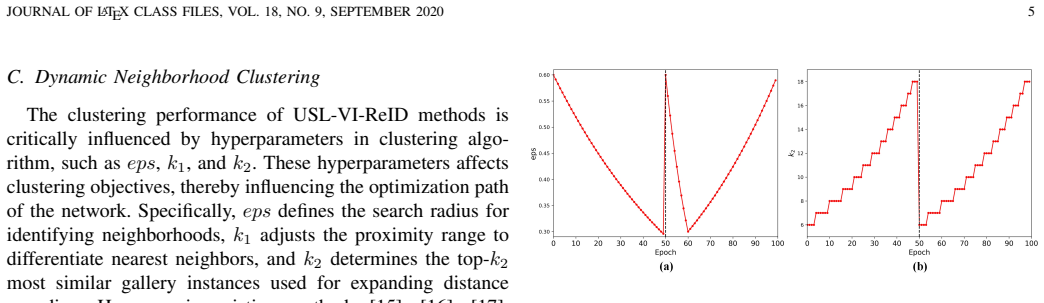
The load-bearing object is the expanded distance encoding used as the input to DBSCAN. MIE replaces the standard k-reciprocal encoding expansion of Eq. (3) with a per-camera averaged version (Eqs. (6)-(7)), so that the embedding for each instance receives equal contribution from every camera before Jaccard distances are computed. DNC then controls two clustering hyperparameters, the DBSCAN radius eps and the expansion neighborhood size k2, through exponential schedulers (Eqs. (8)-(10)): eps shrinks to purify clusters early and grows later to merge cross-camera and cross-modality samples, while k2 follows the opposite path to gradually widen affinities. These two mechanisms change the pseudo-label generation itself rather than adding a loss term, and HMCL turns the resulting labels into training signal through cluster-level and instance-level contrastive memories.
What would settle it
Run the full DMIC training on SYSU-MM01 using the scheduler constants reported for RegDB, with no other changes; if Rank-1 falls back to the level of the vanilla clustering baseline (around 42%), the dynamic schedule is not transferring and the central claim is not general. Alternatively, tune the scheduler constants on a held-out subset of identities and report the held-out Rank-1; if the gain over DCCL mostly vanishes, the reported test-set numbers are inflated by selection.
Extended reading notes
Core claim
The central claim is that cross-camera variation, not just cross-modality variation, is what breaks clustering in USL-VI-ReID, and that a clustering procedure which explicitly balances distance evidence across cameras and modalities produces pseudo-labels clean enough for contrastive learning to nearly close the gap to supervised training. The paper argues that this is achieved by Modality-Camera Invariant Expansion (MIE), which averages k-reciprocal distance encodings separately per camera before fusing them, by Dynamic Neighborhood Clustering (DNC), which shrinks then expands the DBSCAN radius and the neighborhood size on an exponential schedule, and by Hybrid Modality Contrastive Learning (HMCL), which trains with intra-modality and inter-modality cluster- and instance-level losses. The reported evidence is a large improvement in Rank-1 and mAP over prior unsupervised methods on RegDB and SYSU-MM01, together with ablations showing MIE contributes roughly 10-15% mAP and DNC a further 2-5%.
Load-bearing premise
The load-bearing premise is that the hand-set schedules for the clustering radius and neighborhood size, with different starting values chosen for each dataset, are what produce the reported gains; the paper does not describe how these values were selected, so if they were tuned on the test sets the improvement would partly reflect parameter selection.
Editorial extensions
If this is right
- Clustering-based USL-VI-ReID can treat camera identity as first-class information at the distance level instead of adding camera proxy losses.
- The dynamic schedule lets a single global DBSCAN pass replace per-camera clustering while still controlling identity splitting.
- The reported RegDB results imply unsupervised cross-modal Re-ID can reach performance comparable to several supervised methods without any identity annotations.
- Because MIE and DNC change only the clustering input and hyperparameters, they can be dropped into other unsupervised Re-ID frameworks that rely on DBSCAN pseudo-labels.
Reading between the lines
- If the mechanism is as general as the paper suggests, the camera-balanced distance expansion should also help single-modality unsupervised Re-ID, where camera splitting is a known failure mode but is currently handled by proxy losses rather than by changing the clustering input.
- A direct transfer test would be to fix the scheduler constants (pi1, pi2, epsilons, sigmas) on RegDB and run SYSU-MM01 without re-tuning; the paper reports per-dataset values, so its claim that the schedule is parameter-free requires this to still work.
- The exponential schedule has only three rates and three bounds, so a small grid search on a held-out validation split could determine how much of the gain is due to the dynamic mechanism itself versus to choosing favorable endpoints.
- Future work could replace the hand-set schedule with an adaptive criterion based on cluster purity or inter-cluster stability, which would test whether the specific exponential form is essential.
Editorial analysis
A structured set of objections, weighed in public.
Referee Report
Summary. The paper proposes DMIC, an unsupervised visible-infrared person re-identification method built from three components: Modality-Camera Invariant Expansion (MIE), which modifies k-reciprocal distance encoding by averaging over cameras; Dynamic Neighborhood Clustering (DNC), which schedules the DBSCAN radius eps and the expansion neighbor count k2 over two training phases; and Hybrid Modality Contrastive Learning (HMCL), combining intra- and inter-modality cluster/instance-level losses. The method is evaluated on SYSU-MM01 and RegDB, reporting Rank-1 of 86.31% on RegDB (vs 78.28% for DCCL) and 65.24% on SYSU-MM01 under batch size 128, and the authors claim this significantly reduces the gap to supervised methods.
Significance. If the reported results are reproducible, the contribution is practically relevant: the method addresses a known failure mode of clustering-based USL-VI-ReID, namely identity splitting caused by cross-camera and cross-modality variation, and the ablation tables consistently show each component adding measurable improvement. The paper also provides useful diagnostics such as cluster-count evolution and t-SNE visualizations. However, the central quantitative claims currently rest on an under-specified scheduler, per-dataset hyperparameter choices, single-run results without error bars, and an inconsistency between the text and Table I regarding which batch size supports the SOTA claim. The idea is credible and the components are clearly motivated, but the evidence as presented is not yet at the level required to certify the headline numbers.
major comments (4)
- [III-C, Eqs. (8)-(10) and IV-B] The DNC scheduler equations are self-referential as written. Eq. (8) sets π1 = π2·σ_n^epochs and Eq. (9) sets π2 = π1·σ_b^epochs; for the reported settings (SYSU-MM01: σ_n=0.5, σ_b=2; RegDB: σ_n=2/3, σ_b=1.5), σ_b = 1/σ_n, so the two equations are algebraically identical and determine neither bound independently. A literal geometric-decay reading gives eps = 0.6·0.5^50 ≈ 5×10^-16 after 50 epochs, far below the stated lower bound π1=0.3. The two-phase interpretation (shrink, then expand) appears in the text and Fig. 4, but no piecewise formula or per-phase epoch indexing is provided. Since DNC is the component credited with refining pseudo labels and its ablation gain is central to the paper, the reported Rank-1 86.31% and 65.24% cannot be reproduced from the manuscript alone. Please provide an explicit per-epoch update rule for eps and k2 for each of the two training phases.
- [IV-C, Table I] The text claims, "we achieve SOTA performance ... we outperform GUR by 2.06%/1.3% in Rank-1 and 0.38%/0.95% in mAP under both testing modes." In Table I, DMIC(ours) with batch size 64 has all-search Rank-1 60.26% and mAP 57.82%, which is below GUR (63.51%/61.63%) and DCCL (63.18%/58.62%); the margin over GUR exists only for DMIC† with batch size 128 (65.24%/62.01%). On RegDB, however, batch size 128 degrades performance relative to batch size 64 (Rank-1 83.97% vs 86.31%). The paper therefore does not identify a single primary configuration, and the headline SOTA claim depends on a non-default setting whose effect is opposite on the two datasets. Please clarify which configuration is the primary result and discuss the batch-size sensitivity.
- [IV-B, IV-D] The manuscript reports no error bars, no multiple seeds, and no validation/sensitivity analysis for the hyperparameters that define DNC. Section IV-B lists nine dataset-specific values (π2, π1, ε3, ε2, ε1, σ_n, σ_b, σ_k, k1), and the ablation in Table IV attributes only about 2-5% mAP to DNC. Given that single runs of ReID training can easily vary by more than one Rank-1 point, the claimed margin over GUR on SYSU-MM01 (1.73 points at batch 128) is not established as real. In addition, since the scheduler bounds and rates are hand-tuned per dataset, a sensitivity study (e.g., varying σ_n, π1, π2 around the chosen values) is necessary to show the method is robust rather than tuned to the two test sets. At minimum, report mean and standard deviation over several seeds.
- [III-B, Eqs. (6)-(7)] The MIE per-camera expansion is undefined when a camera has no representative among the k2 reciprocal neighbors: Eq. (7) divides by n_c^i, which can be zero, and the text does not specify how missing cameras are handled in the average over nc cameras in Eq. (6). Since k2 can be as small as ε1=6, zero-count cameras will occur in practice, especially for the infrared cameras or minority cameras on SYSU-MM01. Please state the exact fallback used (e.g., skip absent cameras and renormalize, or compute over cameras present in the reciprocal neighbor set).
minor comments (4)
- [III-C] There are several typographical errors: "stragegy" should be "strategy," "schedular" should be "scheduler," "unlabled" should be "unlabeled," and "oberve" should be "observe."
- [III-D, Eq. (13)] The InfoNCE denominator in Eq. (13) sums over k=0 to I, but cluster indices appear to start at 1; the positive cluster is also included in the denominator, which is non-standard. Please clarify the indexing and whether the positive term is excluded.
- [IV-D, Tables III and IV] The checkmark format in the ablation tables is ambiguous because the column headers do not align with the row entries after typesetting. Please add an explicit legend or a textual description of which components are present in each row.
- [Table I] In the supervised section of Table I, the row labeled "MPANet [24]" cites reference [24], but reference [24] in the bibliography is the Channel Augmented Joint Learning paper; the MPANet attribution appears to be a citation error.
Circularity Check
No significant circularity; one self-referential DNC scheduler pair underdetermines the dynamic schedule, but the empirical claims rest on held-out test evaluations.
-
self definitional
[Section III-C, Eqs. (8)-(9); hyperparameter values in Section IV-B]
"π1 = π2 ∗ σepochs n (8) π2 = π1 ∗ σepochs b (9) where σn ∈ [0, 1) denote the decay ratio, while σb ∈ (1, +∞] ... indicate growth ratio. ... For the SYSU-MM01 dataset, π2, π1, ϵ3, ϵ2, ϵ1, σn, σb, σk and k1 are set to 0.6, 0.3, 32, 18, 6, 0.5, 2, 3 and 40 respectively. For the RegDB dataset, these values are configured as 0.3, 0.2, 18, 12, 6, 2/3, 1.5, 2 and 38."
Substituting Eq. (8) into Eq. (9) yields π2 = π2·(σn·σb)^epochs. With the reported settings (0.5×2 on SYSU-MM01 and 2/3×1.5 on RegDB), σn·σb = 1, so the system reduces to the identity π2 = π2. The two scheduler equations therefore do not define two independent dynamic bounds; each bound is expressed in terms of the other and neither determines a time-varying eps. The shrink-then-expand schedule is supplied only by prose and Fig. 4. Because DNC is the module credited with refining pseudo-labels and with the Table IV gains, the central mechanism is formally underdetermined by the equations as written. This is a self-definitional flaw; it does not by itself force the held-out test metrics.
full rationale
The paper's central claim is empirical: a clustering pipeline achieves SOTA Rank-1/mAP on SYSU-MM01 and RegDB. There is no first-principles derivation of those numbers. Pseudo-labels come from DBSCAN over MIE embeddings, and the model is trained with HMCL contrastive losses; evaluation uses disjoint test identities, so metrics are not forced by construction. MIE (Eqs. 6-7) is a camera-averaged extension of k-reciprocal encoding and is independently specified; HMCL (Eqs. 13-22) is a standard cluster/instance contrastive objective with random memory updates. Neither component defines its target result into its inputs. Co-authored references ([7], [49]) appear only as related-work discussion or as comparison baselines, not as load-bearing support. The one genuine formal self-reference is the DNC scheduler: Eqs. (8)-(9) define π1 through π2 and π2 through π1, and with the reported reciprocal σ values the pair collapses to an identity. The intended schedule is recoverable from the prose and Fig. 4, so this is a notation/reproducibility defect rather than a case of a prediction being equivalent to its input. Per-dataset hand-set hyperparameters, missing error bars, and absent code are correctness and reproducibility concerns, not circularity. Overall, no claimed prediction reduces by construction, so the circularity score is low.
Assumptions & free parameters
free parameters (6)
- k1 (reciprocal neighbor range) =
40 (SYSU-MM01), 38 (RegDB)
- eps bounds pi1, pi2 =
0.6/0.3 (SYSU), 0.3/0.2 (RegDB)
- k2 bounds epsilon1, epsilon2, epsilon3 =
6/18/32 (SYSU), 6/12/18 (RegDB)
- scheduler rates sigma_n, sigma_b, sigma_k =
0.5/2/3 (SYSU), 2/3/1.5/2 (RegDB)
- loss weights phi1, phi2 =
0.1, 1.0
- temperature tau =
0.05
assumptions (5)
- standard math K-reciprocal encoding and Jaccard distance (Eqs. 1-5) provide a meaningful similarity for clustering
- domain assumption Camera labels are available for every training image
- domain assumption DBSCAN with hand-set eps produces usable pseudo-labels
- domain assumption ImageNet-pretrained AGW backbone gives a reasonable starting feature space
- ad hoc to paper The dynamic scheduler shape (exponential decay then growth over fixed 10/40 epoch split) is a good curriculum
Cite this review
Pith. "Pith review of Dynamic Modality-Camera Invariant Clustering for Unsupervised Visible-Infrared Person Re-identification." pith.science (2026). https://pith.science/paper/4BKRGB7G
@misc{pith2026241208231,
  author       = {Pith},
  title        = {Pith review of: Dynamic Modality-Camera Invariant Clustering for Unsupervised Visible-Infrared Person Re-identification},
  year         = {2026},
  howpublished = {\url{https://pith.science/paper/4BKRGB7G}},
  note         = {Machine review of arXiv:2412.08231}
}
read the original abstract
Unsupervised learning visible-infrared person re-identification (USL-VI-ReID) offers a more flexible and cost-effective alternative compared to supervised methods. This field has gained increasing attention due to its promising potential. Existing methods simply cluster modality-specific samples and employ strong association techniques to achieve instance-to-cluster or cluster-to-cluster cross-modality associations. However, they ignore cross-camera differences, leading to noticeable issues with excessive splitting of identities. Consequently, this undermines the accuracy and reliability of cross-modal associations. To address these issues, we propose a novel Dynamic Modality-Camera Invariant Clustering (DMIC) framework for USL-VI-ReID. Specifically, our DMIC naturally integrates Modality-Camera Invariant Expansion (MIE), Dynamic Neighborhood Clustering (DNC) and Hybrid Modality Contrastive Learning (HMCL) into a unified framework, which eliminates both the cross-modality and cross-camera discrepancies in clustering. MIE fuses inter-modal and inter-camera distance coding to bridge the gaps between modalities and cameras at the clustering level. DNC employs two dynamic search strategies to refine the network's optimization objective, transitioning from improving discriminability to enhancing cross-modal and cross-camera generalizability. Moreover, HMCL is designed to optimize instance-level and cluster-level distributions. Memories for intra-modality and inter-modality training are updated using randomly selected samples, facilitating real-time exploration of modality-invariant representations. Extensive experiments have demonstrated that our DMIC addresses the limitations present in current clustering approaches and achieve competitive performance, which significantly reduces the performance gap with supervised methods.
Figures


Figures from the paper (5 more)


Reference graph
Works this paper leans on
-
[1]
Structured Domain Adaptation With Online Relation Regularization for Unsuper- vised Person Re-ID,
Y . Ge, F. Zhu, D. Chen, R. Zhao, X. Wang and H. Li, “Structured Domain Adaptation With Online Relation Regularization for Unsuper- vised Person Re-ID,” in IEEE Trans. NNLS, vol. 35, no. 1, pp. 258–271, 2024
work page 2024
-
[2]
Q. Wu, J. Li, P. Dai, Q. Ye, L. Cao, Y . Wu and R. Ji, “Unsupervised Domain Adaptation on Person Reidentification via Dual-Level Asym- metric Mutual Learning,” in IEEE Trans. NNLS , 2023, Early Access
work page 2023
-
[3]
Deep learning for person re-identification: A survey and outlook,
M. Ye, J. Shen, G. Lin, T. Xiang, L. Shao, and S. C. Hoi, “Deep learning for person re-identification: A survey and outlook,” IEEE Trans. PAMI, vol. 44, no. 6, pp. 2872–2893, 2021
work page 2021
-
[4]
Person re- identification by camera correlation aware feature augmentation,
Y .-C. Chen, X. Zhu, W.-S. Zheng, and J.-H. Lai, “Person re- identification by camera correlation aware feature augmentation,” IEEE Trans. PAMI, vol. 40, no. 2, pp. 392–408, 2017
work page 2017
-
[5]
Unsupervised person re- identification by deep asymmetric metric embedding,
H.-X. Yu, A. Wu, and W.-S. Zheng, “Unsupervised person re- identification by deep asymmetric metric embedding,” IEEE Trans. PAMI, vol. 42, no. 4, pp. 956–973, 2018
work page 2018
-
[6]
Cross-modality person re- identification via modality-aware collaborative ensemble learning,
M. Ye, X. Lan, Q. Leng, and J. Shen, “Cross-modality person re- identification via modality-aware collaborative ensemble learning,” IEEE Trans. IP , vol. 29, pp. 9387–9399, 2020
work page 2020
-
[7]
Tri-level modality-information disentangle- ment for visible-infrared person re-identification,
Z. Lu, R. Lin, and H. Hu, “Tri-level modality-information disentangle- ment for visible-infrared person re-identification,” IEEE Trans. MM , 2023, Early Access
work page 2023
-
[8]
S. Choi, S. Lee, Y . Kim, T. Kim, and C. Kim, “Hi-cmd: Hierar- chical cross-modality disentanglement for visible-infrared person re- identification,” in CVPR, 2020, pp. 10 257–10 266
work page 2020
Show all 62 references
-
[9]
Learn- ing to reduce dual-level discrepancy for infrared-visible person re- identification,
Z. Wang, Z. Wang, Y . Zheng, Y .-Y . Chuang, and S. Satoh, “Learn- ing to reduce dual-level discrepancy for infrared-visible person re- identification,” in CVPR, 2019, pp. 618–626
2019
-
[10]
Unsupervised person re- identification: Clustering and fine-tuning,
H. Fan, L. Zheng, C. Yan and Y . Yang, “Unsupervised person re- identification: Clustering and fine-tuning,” ACM Trans. OMM , vol. 14, no. 4, pp. 1–18, 2018. JOURNAL OF LATEX CLASS FILES, VOL. 18, NO. 9, SEPTEMBER 2020 13
2018
-
[11]
Dynamic Clustering and Cluster Contrastive Learning for Unsupervised Person Re-Id With Feature Distribution Alignment,
Z. He, M. Xue, Y . Du, Z. Zhao and F. Su, “Dynamic Clustering and Cluster Contrastive Learning for Unsupervised Person Re-Id With Feature Distribution Alignment,” ICASSP, 2024, pp. 3610–3614
2024
-
[12]
Ester, H
M. Ester, H. Kriegel, et al, ”A density-based algorithm for discovering clusters in large spatial databases with noise,” in KDD, 1996, pp. 226- 231
1996
-
[13]
Learning to adapt invariance in memory for person re-identification,
Z. Zhong, L. Zheng, Z. Luo, S. Li, and Y . Yang, “Learning to adapt invariance in memory for person re-identification,” IEEE Trans. PAMI, vol. 43, no. 8, pp. 2723–2738, 2020
2020
-
[14]
Camstyle: A novel data augmentation method for person re-identification,
Z. Zhong, L. Zheng, Z. Zheng, S. Li, and Y . Yang, “Camstyle: A novel data augmentation method for person re-identification,”IEEE Trans. IP, vol. 28, no. 3, pp. 1176–1190, 2018
2018
-
[15]
Augmented dual-contrastive aggregation learning for unsupervised visible-infrared person re- identification,
B. Yang, M. Ye, J. Chen, and Z. Wu, “Augmented dual-contrastive aggregation learning for unsupervised visible-infrared person re- identification,” in ACM MM, 2022, pp. 2843–2851
2022
-
[16]
Unsupervised visible-infrared person re- identification via progressive graph matching and alternate learning,
Z. Wu and M. Ye, “Unsupervised visible-infrared person re- identification via progressive graph matching and alternate learning,” in CVPR, 2023, pp. 9548–9558
2023
-
[17]
Cross-modality hierarchical clustering and refinement for unsupervised visible-infrared person re-identification,
Z. Pang, C. Wang, L. Zhao, Y . Liu, and G. Sharma, “Cross-modality hierarchical clustering and refinement for unsupervised visible-infrared person re-identification,” IEEE Trans. CSVT , 2023, Early Access
2023
-
[18]
Homogeneous-to- heterogeneous: Unsupervised learning for rgb-infrared person re- identification,
W. Liang, G. Wang, J. Lai, and X. Xie, “Homogeneous-to- heterogeneous: Unsupervised learning for rgb-infrared person re- identification,” IEEE Trans. IP , vol. 30, pp. 6392–6407, 2021
2021
-
[19]
Translation, association and augmentation: Learning cross-modality re-identification from single- modality annotation,
B. Yang, J. Chen, X. Ma, and M. Ye, “Translation, association and augmentation: Learning cross-modality re-identification from single- modality annotation,” IEEE Trans. IP , 2023
2023
-
[20]
Optimal transport for label-efficient visible-infrared person re-identification,
J. Wang, Z. Zhang, M. Chen, Y . Zhang, C. Wang, B. Sheng, Y . Qu, and Y . Xie, “Optimal transport for label-efficient visible-infrared person re-identification,” in ECCV. Springer, 2022, pp. 93–109
2022
-
[21]
A real-time memory updating strategy for unsupervised person re-identification,
J. Yin, X. Zhang, Z. Ma, J. Guo, and Y . Liu, “A real-time memory updating strategy for unsupervised person re-identification,” IEEE Trans. IP, 2023
2023
-
[22]
Diverse embedding expansion network and low-light cross-modality benchmark for visible-infrared person re- identification,
Y . Zhang and H. Wang, “Diverse embedding expansion network and low-light cross-modality benchmark for visible-infrared person re- identification,” in CVPR, 2023, pp. 2153–2162
2023
-
[23]
Cross-modality person re- identification via modality confusion and center aggregation,
X. Hao, S. Zhao, M. Ye, and J. Shen, “Cross-modality person re- identification via modality confusion and center aggregation,” in ICCV, 2021, pp. 16 403–16 412
2021
-
[24]
Channel augmented joint learning for visible-infrared recognition,
M. Ye, W. Ruan, B. Du, and M. Z. Shou, “Channel augmented joint learning for visible-infrared recognition,” in ICCV, 2021, pp. 13 567– 13 576
2021
-
[25]
Infrared-visible cross-modal person re-identification with an x modality,
D. Li, X. Wei, X. Hong, and Y . Gong, “Infrared-visible cross-modal person re-identification with an x modality,” in AAAI, vol. 34, no. 04, 2020, pp. 4610–4617
2020
-
[26]
Towards a unified middle modality learning for visible-infrared person re-identification,
Y . Zhang, Y . Yan, Y . Lu, and H. Wang, “Towards a unified middle modality learning for visible-infrared person re-identification,” in ACM MM, 2021, pp. 788–796
2021
-
[27]
Rgb- infrared cross-modality person re-identification via joint pixel and feature alignment,
G. Wang, T. Zhang, J. Cheng, S. Liu, Y . Yang, and Z. Hou, “Rgb- infrared cross-modality person re-identification via joint pixel and feature alignment,” in ICCV, 2019, pp. 3623–3632
2019
-
[28]
A generative-based image fusion strategy for visible-infrared person re-identification,
J. Qi, T. Liang, W. Liu, Y . Li, and Y . Jin, “A generative-based image fusion strategy for visible-infrared person re-identification,” IEEE Trans. CSVT , 2023, Early Access
2023
-
[29]
Self-paced contrastive learning with hybrid memory for domain adaptive object re-id,
Y . Ge, F. Zhu, D. Chen, R. Zhao et al., “Self-paced contrastive learning with hybrid memory for domain adaptive object re-id,” NeurIPS, vol. 33, pp. 11 309–11 321, 2020
2020
-
[30]
Cluster contrast for unsupervised person re-identification,
Z. Dai, G. Wang, W. Yuan, S. Zhu, and P. Tan, “Cluster contrast for unsupervised person re-identification,” in ACCV, 2022, pp. 1142–1160
2022
-
[31]
Momentum contrast for unsupervised visual representation learning,
K. He, H. Fan, Y . Wu, S. Xie, and R. Girshick, “Momentum contrast for unsupervised visual representation learning,” in CVPR, 2020, pp. 9729–9738
2020
-
[32]
Learning to purification for unsupervised person re-identification,
L. Lan, X. Teng, J. Zhang, X. Zhang, and D. Tao, “Learning to purification for unsupervised person re-identification,” IEEE Trans. IP , 2023, Early Access
2023
-
[33]
Intra-inter domain similarity for unsupervised person re-identification,
S. Xuan and S. Zhang, “Intra-inter domain similarity for unsupervised person re-identification,” IEEE Trans. PAMI , 2022, Early Access
2022
-
[34]
Cam- era contrast learning for unsupervised person re-identification,
G. Zhang, H. Zhang, W. Lin, A. K. Chandran, and X. Jing, “Cam- era contrast learning for unsupervised person re-identification,” IEEE Trans. CSVT, 2023, Early Access
2023
-
[35]
Ice: Inter-instance contrastive encoding for unsupervised person re-identification,
H. Chen, B. Lagadec, and F. Bremond, “Ice: Inter-instance contrastive encoding for unsupervised person re-identification,” in ICCV, 2021, pp. 14 960–14 969
2021
-
[36]
Dual Consistency-Constrained Learning for Unsupervised Visible-Infrared Person Re-Identification,
B. Yang, J. Chen, C. Chen and M. Ye, “Dual Consistency-Constrained Learning for Unsupervised Visible-Infrared Person Re-Identification,” IEEE Trans. IFS , vol. 19, pp. 1767–1779, 2024
2024
-
[37]
Towards grand unified representation learning for unsupervised visible-infrared person re- identification,
B. Yang, J. Chen, C. Chen and M. Ye, “Towards grand unified representation learning for unsupervised visible-infrared person re- identification,” ICCV, 2023, pp. 11069–11079
2023
-
[38]
A bottom-up clustering approach to unsupervised person re-identification,
Y . Lin, X. Dong, L. Zheng, Y . Yan, and Y . Yang “A bottom-up clustering approach to unsupervised person re-identification,” AAAI, 2019, pp. 8738–8745
2019
-
[39]
Re-ranking person re- identification with k-reciprocal encoding,
Z. Zhong, L. Zheng, D. Cao, and S. Li, “Re-ranking person re- identification with k-reciprocal encoding,” in CVPR, 2017, pp. 1318– 1327
2017
-
[40]
Camera-aware style separation and contrastive learning for unsupervised person re- identification,
X. Li, T. Liang, Y . Jin, Tao. Wang, and Y . Li, “Camera-aware style separation and contrastive learning for unsupervised person re- identification,” in ICME, 2022, pp. 1–6
2022
-
[41]
Rgb-infrared cross-modality person re-identification,
A. Wu, W.-S. Zheng, H.-X. Yu, S. Gong, and J. Lai, “Rgb-infrared cross-modality person re-identification,” in ICCV, 2017, pp. 5380– 5389
2017
-
[42]
Person recognition system based on a combination of body images from visible light and thermal cameras,
D. T. Nguyen, H. G. Hong, K. W. Kim, and K. R. Park, “Person recognition system based on a combination of body images from visible light and thermal cameras,” Sensors, vol. 17, no. 3, p. 605, 2017
2017
-
[43]
Deep residual learning for image recognition,
K. He, X. Zhang, S. Ren, and J. Sun, “Deep residual learning for image recognition,” in CVPR, 2016, pp. 770–778
2016
-
[44]
Imagenet: A large-scale hierarchical image database,
J. Deng, W. Dong, R. Socher, L.-J. Li, K. Li, and L. Fei-Fei, “Imagenet: A large-scale hierarchical image database,” in CVPR, 2009, pp. 248– 255
2009
-
[45]
Bi-directional center- constrained top-ranking for visible thermal person re-identification,
M. Ye, X. Lan, Z. Wang, and P. C. Yuen, “Bi-directional center- constrained top-ranking for visible thermal person re-identification,” IEEE Trans. IFS , vol. 15, pp. 407–419, 2019
2019
-
[46]
Dynamic dual-attentive aggregation learning for visible-infrared person re- identification,
M. Ye, J. Shen, D. J. Crandall, L. Shao, and J. Luo, “Dynamic dual-attentive aggregation learning for visible-infrared person re- identification,” in ECCV. Springer, 2020, pp. 229–247
2020
-
[47]
Discover cross-modality nuances for visible-infrared person re- identification,
Q. Wu, P. Dai, J. Chen, C.-W. Lin, Y . Wu, F. Huang, B. Zhong, and R. Ji, “Discover cross-modality nuances for visible-infrared person re- identification,” in CVPR, 2021, pp. 4330–4339
2021
-
[48]
Structure-aware positional transformer for visible-infrared person re-identification,
C. Chen, M. Ye, M. Qi, J. Wu, J. Jiang, and C.-W. Lin, “Structure-aware positional transformer for visible-infrared person re-identification,” IEEE Trans. IP , vol. 31, pp. 2352–2364, 2022
2022
-
[49]
Adversarial decoupling and modality-invariant representation learning for visible-infrared per- son re-identification,
W. Hu, B. Liu, H. Zeng, Y . Hou, and H. Hu, “Adversarial decoupling and modality-invariant representation learning for visible-infrared per- son re-identification,” IEEE Trans. CSVT , vol. 32, no. 8, pp. 5095– 5109, 2022
2022
-
[50]
Farewell to mutual information: Variational distillation for cross-modal person re- identification,
X. Tian, Z. Zhang, S. Lin, Y . Qu, Y . Xie, and L. Ma, “Farewell to mutual information: Variational distillation for cross-modal person re- identification,” in CVPR, 2021, pp. 1522–1531
2021
-
[51]
Mso: Multi-feature space joint optimization network for rgb-infrared person re-identification,
Y . Gao, T. Liang, Y . Jin, X. Gu, W. Liu, Y . Li, and C. Lang, “Mso: Multi-feature space joint optimization network for rgb-infrared person re-identification,” in ACM MM, 2021, pp. 5257–5265
2021
-
[52]
Fmcnet: Feature-level modality compensation for visible-infrared person re-identification,
Q. Zhang, C. Lai, J. Liu, N. Huang, and J. Han, “Fmcnet: Feature-level modality compensation for visible-infrared person re-identification,” in CVPR, 2022, pp. 7349–7358
2022
-
[53]
Learning memory-augmented unidirectional metrics for cross-modality person re-identification,
J. Liu, Y . Sun, F. Zhu, H. Pei, Y . Yang, and W. Li, “Learning memory-augmented unidirectional metrics for cross-modality person re-identification,” in CVPR, 2022, pp. 19 366–19 375
2022
-
[54]
Mutual mean-teaching: Pseudo label re- finery for unsupervised domain adaptation on person re-identification,
Y . Ge, D. Chen, and H. Li, “Mutual mean-teaching: Pseudo label re- finery for unsupervised domain adaptation on person re-identification,” arXiv preprint arXiv:2001.01526 , 2020
2001 arXiv
-
[55]
Camera-aware proxies for unsupervised person re-identification,
M. Wang, B. Lai, J. Huang, X. Gong, and X.-S. Hua, “Camera-aware proxies for unsupervised person re-identification,” in AAAI, vol. 35, no. 4, 2021, pp. 2764–2772
2021
-
[56]
Part-based pseudo label refinement for unsupervised person re-identification,
Y . Cho, W. J. Kim, S. Hong, and S.-E. Yoon, “Part-based pseudo label refinement for unsupervised person re-identification,” in CVPR, 2022, pp. 7308–7318
2022
-
[57]
Implicit sample extension for unsupervised person re- identification,
X. Zhang, D. Li, Z. Wang, J. Wang, E. Ding, J. Q. Shi, Z. Zhang, and J. Wang, “Implicit sample extension for unsupervised person re- identification,” in CVPR, 2022, pp. 7369–7378
2022
-
[58]
Self- similarity grouping: A simple unsupervised cross domain adaptation approach for person re-identification,
Y . Fu, Y . Wei, G. Wang, Y . Zhou, H. Shi, and T. S. Huang, “Self- similarity grouping: A simple unsupervised cross domain adaptation approach for person re-identification,” in ICCV, 2019, pp. 6112–6121
2019
-
[59]
Invariance matters: Exemplar memory for domain adaptive person re-identification,
Z. Zhong, L. Zheng, Z. Luo, S. Li, and Y . Yang, “Invariance matters: Exemplar memory for domain adaptive person re-identification,” in CVPR, 2019, pp. 598–607
2019
-
[60]
Intra-inter camera similarity for unsupervised person re-identification,
S. Xuan and S. Zhang, “Intra-inter camera similarity for unsupervised person re-identification,” in CVPR, 2021, pp. 11 926–11 935
2021
-
[61]
Unveiling the power of clip in unsupervised visible-infrared person re-identification,
Z. Chen, Z. Zhang, X. Tian, Y . Qu, and Y . Xie, “Unveiling the power of clip in unsupervised visible-infrared person re-identification,” in ACM MM, 2023, pp. 3667–3675
2023
-
[62]
Visualizing data using t-sne,
Laurens Van der Maaten and Geoffrey Hinton, “Visualizing data using t-sne,” JMLR, 9(11), 2008
2008
Reviewed August 11, 2026 · model on record in the stance chip above.
Discussion (0). Continue with ORCID to comment.