REVIEW 4 major objections 5 minor 58 references
From Text to Trajectory: Exploring Complex Constraint Representation and Decomposition in Safe Reinforcement Learning
T0 review · 4 major / 5 minor · reviewed 2026-08-11 · deepseek-v4-flash
Pith's one-line read This paper introduces TTCT, which turns natural-language safety constraints into per-step costs for reinforcement learning, and reports that policies trained on its predicted costs violate constraints less often than policies trained on…
desk verdict The alignment part is a real step forward, but the cost assignment component is trained without any violation label, so the dense-cost advantage may be generic rather than semantic. read the letter →
The pith
A machine-rendered reading of the paper's core claim, the machinery that carries it, and where it could break.
The reading
What carries the argument
The central mechanism is the text–trajectory alignment carried by TTCT: a causal Transformer encodes the state-action sequence into embeddings $H_1,\dots,H_T$, a language model encodes the textual constraint into $L$, and scaled cosine similarity $\operatorname{sim}(\tau,y)=e^\alpha H_T^{\top}L/(\|H_T\|\|L\|)$ measures whether a trajectory $\tau$ violates constraint $y$. Three losses train it end-to-end: a multimodal contrastive (MC) KL loss that pulls matching trajectory-text pairs together and pushes non-matching pairs apart, a within-trajectory (WT) loss that makes the final time step's embedding maximally similar to the text while earlier steps are dissimilar, and a cost-assignment (CA) loss that forces the sum of per-step predicted costs $\sum_{t=1}^{T-1}\hat{c}(s_t,a_t,y,\tau_t)$ to match the predicted episodic cost $\hat{C}(y)$. At deployment, a violation is flagged when $\operatorname{sim}(\tau,y)\ge\beta$, where $\beta$ is the best ROC threshold, and non-violation steps receive the decomposed cost. This turns sparse, end-of-episode safety feedback into dense per-action cost while keeping the manual cost function out of the loop.
What would settle it
Train TTCT only on the paper's template-generated constraints, then evaluate it on a held-out set of genuinely free-form natural-language constraints written by humans (not templates) with manually verified trajectory labels; if violation-prediction AUC drops well below 0.98 or the trained policy's average episodic cost is no longer lower than the ground-truth-cost policy's, the replacement claim and zero-shot generalization are refuted.
Extended reading notes
Core claim
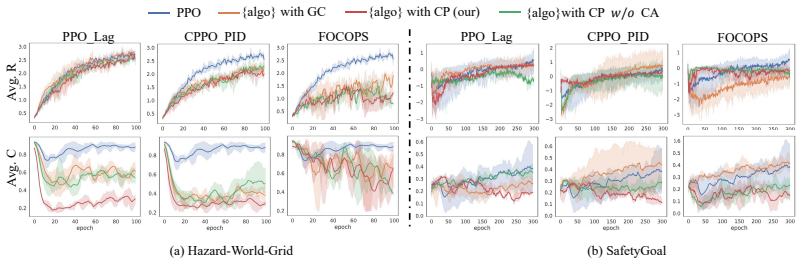
On the paper's own terms, the central claim is that a single learned model, TTCT, can replace the manually designed cost function for safe RL with natural-language constraints. TTCT aligns a causal-transformer trajectory encoder with a pretrained language model through multimodal contrastive learning and a within-trajectory loss, so that the final trajectory embedding sits close to the text embedding of a constraint the trajectory violates; a violation is declared when the scaled cosine similarity exceeds a threshold chosen from the ROC curve. A cost-assignment head then uses attention scores between each state-action embedding and the text embedding to spread the episodic violation cost across time steps, giving non-violation actions informative cost signals. The paper reports violation-prediction accuracy and AUC of 0.98, and shows that across PPO-Lagrangian, CPPO_PID, and FOCOPS, policies using TTCT's predicted cost reach lower average episodic cost than the same algorithms with ground-truth cost while keeping reward comparable, and that the trained TTCT transfers without fine-tuning to a new environment with different hazards.
Load-bearing premise
TTCT is trained on labels produced by hand-written violation-checking functions applied to template-generated constraint sentences, so its ability to replace manual cost design rests on those checkers being available and accurate for every constraint and on the templates being representative of real constraints.
Editorial extensions
If this is right
- A single TTCT trained once can provide cost signals for any textual constraint in the same environment, so users only need to write the constraint in natural language instead of designing a cost function for each one.
- Because the episodic cost is decomposed into per-state-action costs, agents learn which early behaviors escalate risk even though the underlying constraint is only violated at the final step.
- Across three safe-RL algorithms (PPO-Lagrangian, CPPO_PID, FOCOPS), replacing the ground-truth cost with TTCT's predicted cost yields lower average episodic cost and comparable reward, so the benefit is not tied to one policy optimizer.
- Zero-shot transfer holds for constraint-shift: a TTCT trained in Hazard-World-Grid, applied to LavaWall without fine-tuning, keeps a violation rate comparable to a policy trained with the ground-truth cost.
Reading between the lines
- The paper leaves implicit that the same trajectory-text alignment could serve as an offline safety auditor: because it labels full trajectories with AUC 0.98, it could flag dangerous rollouts in a dataset without ever running a new policy.
- A stronger test of the zero-shot claim would evaluate TTCT on genuinely free-form constraints written by humans rather than the template-generated sentences used in training; the current test split comes from the same template distribution, so out-of-template generalization remains unmeasured.
- The attention-based cost assignment suggests a built-in per-step risk attribution; comparing those attribution scores against human judgments or ground-truth risk gradients would be a natural next experiment.
Editorial analysis
A structured set of objections, weighed in public.
Referee Report
Summary. The paper introduces TTCT, a framework that uses natural language constraints as both the task specification and the training signal for safe reinforcement learning. It has two main components: a text-trajectory alignment component trained with contrastive and within-trajectory losses to predict whether a trajectory violates a given textual constraint, and a cost assignment component that decomposes an episodic cost prediction into per-step costs. TTCT is trained on offline data with template-generated constraints and then used as the cost provider in several safe RL algorithms. Experiments on Hazard-World-Grid and SafetyGoal show that policies trained with TTCT's predicted costs achieve lower violation rates than those trained with ground-truth cost functions, and a zero-shot transfer experiment to LavaWall is reported.
Significance. If validated, the work addresses a practical limitation of safe RL: the need for manually designed cost functions. The dual use of text as both constraint and supervision is a clean idea, and the paper includes a reasonable set of experiments covering multiple algorithms, ablations, and a zero-shot transfer. The reported AUC of 0.98 for violation prediction is strong. However, the central claim that the cost assignment component provides meaningful dense costs is undermined by the absence of a supervised training signal for the episodic cost prediction, and the lack of an empirical comparison with the closest prior methods [14, 27] leaves the contribution's advantage unquantified.
major comments (4)
- [Section 4.2, Eq. (11)] The cost assignment loss L_CA is a consistency loss between the predicted episodic cost \hat{C}(y) and the sum of per-step costs. Since \hat{C}(y) is computed from the text embedding only and is never trained against the true episodic cost (0 or 1) that is available in the offline dataset, the global minimum includes the trivial solution \hat{C}(y)=0 and all \hat{c}_t=0. The dense costs used in Eq. (13) are therefore not anchored to violation status. Please add a supervised loss for \hat{C}(y) against the true episodic cost and report the resulting cost calibration, or otherwise provide quantitative evidence that the per-step costs correlate with actual violation risk.
- [Section 6 (Baselines, Table 5)] The experimental section does not compare TTCT with the closest prior natural-language cost methods, namely [14] (Safe RL with natural language constraints) and [27] (Safe RL with free-form natural language constraints and pre-trained language models). Because the paper's central claim is that TTCT outperforms the standard cost function and prior approaches, a direct comparison on the same tasks is necessary to support this claim.
- [Appendix A.1, Conclusion] All constraints are generated from predefined templates (Appendix A.1) and require hand-written violation checkers. The paper claims to handle 'total free-form and complex textual constraints' (Conclusion), but the experiments do not test with human-written, unseen constraint phrasings. The zero-shot transfer to LavaWall also uses constraints from the same template distribution. Please clarify the scope and include an evaluation with more diverse constraints to support the generalization claim.
- [Section 5, Eq. (13), Appendix B.1] Equation (13) uses a single threshold beta determined from the ROC curve of the full-trajectory violation prediction (Appendix B.1). During policy training, the same threshold is applied to prefixes of trajectories at every time step, even though the alignment component was trained on complete trajectories up to the violation time. The appropriateness of this threshold for prefixes is not analyzed. Please provide an analysis or ablation of the threshold choice for intermediate time steps.
minor comments (5)
- [Section 4.1] The text states that the final embedding H_T is used as the representation for the entire trajectory, but the cost assignment component in Section 4.2 also uses all intermediate embeddings H_t; this distinction could be clarified.
- [Figure 3 caption] The caption says 'The blue bars are our proposed cost prediction (CP) mode performance and the orange bars are the ground-truth cost (GC) mode performance,' but the explanation of the black dashed line is given only in the text; adding it to the caption would aid readability.
- [Table 5] The header 'PPO' appears without a corresponding 'GC'/'CP' split, and the table's shaded cells are not visible in the text; please ensure the table is self-contained.
- [Appendix B.1] The threshold beta is described as the best cutoff value of the ROC curve, but the ROC curve appears to be computed on the test set; please specify whether the threshold is chosen on a validation set to avoid optimistic bias.
- [Introduction] The paper mentions 'up to 4.0x' lower violation rates in the introduction, but the reported numbers in Table 5 show ratios around 2-3x; please reconcile these figures.
Circularity Check
The 'mutual prediction' cost-assignment loss in Eq. (11) defines episodic and per-step costs only through each other, so the dense-cost prediction is a fitted quantity rather than a supervised prediction.
-
fitted input called prediction
[Section 4.2, Eq. (11); test-time Eq. (13); pseudocode Figure 9]
"We expect the episodic cost can be considered as the sum of cost on all non-violation state-action pairs: ˆC(y)= ∑_{t=1}^{T−1} ˆc(st, at, y, τt). ... LCA = E(τ,y)∼D[(∑_{t=1}^{T−1} ˆc(st, at, y, τt)− ˆC(y))2]. This mutual prediction loss function LCA is only used to update the episodic-cost prediction layer and cost assignment layer, and not to update the parameters of the trajectory encoder or text encoder during backpropagation."
L_CA contains no supervision from the true violation cost: there is no term regressing the episodic-cost prediction \hat C(y) or the per-step costs \hat c_t to the manual checker's cost label. The two quantities are trained only to equal each other, so any pair with \hat C(y)=sum_t \hat c_t (e.g., all outputs equal to the same constant) minimizes L_CA, and the decomposition is unidentifiable. These unconstrained outputs are then used as the predicted cost in Eq. (13) for policy training, and the resulting violation-rate reduction is attributed to TTCT's textual comprehension. The dense cost is thus a fitted quantity renamed as a 'prediction'; its apparent success does not by itself derive from the ground-truth constraint semantics.
full rationale
The trajectory-text alignment component is not circular: it is trained with MC and WT losses against ground-truth pair labels (from hand-written violation checkers) and evaluated on held-out pairs (AUC 0.98), and the zero-shot LavaWall test is an external transfer check. The circularity is confined to the cost-assignment component: Eq. (11) is a 'mutual prediction' between the episodic-cost head and the single-step-cost head, with no target from the true cost function. Since any pair of equal values can drive L_CA to zero, the per-step costs are unconstrained by violation status, yet they are presented as 'accurate single-step cost predictions' and used as the policy's cost signal. This makes the dense-cost explanation for the lower violation rates partially circular or unsupported, while the main violation-prediction claim retains independent content.
Assumptions & free parameters
free parameters (3)
- threshold beta =
best ROC cutoff (e.g., 7.09 in Figure 11)
- temperature alpha =
learnable
- trajectory length =
200
assumptions (4)
- domain assumption The manually designed violation-checking functions correctly identify all violations and are used to label the training pairs.
- domain assumption Template-generated textual constraints are representative of the trajectory-level constraints the authors claim to be universal.
- domain assumption Offline trajectories from a random policy cover the state-action regions relevant to violating the constraints.
- domain assumption A dense per-step cost learned only to sum to the episodic cost is a valid proxy for true per-step risk.
Cite this review
Pith. "Pith review of From Text to Trajectory: Exploring Complex Constraint Representation and Decomposition in Safe Reinforcement Learning." pith.science (2026). https://pith.science/paper/3ZYOFHPQ
@misc{pith2026241208920,
  author       = {Pith},
  title        = {Pith review of: From Text to Trajectory: Exploring Complex Constraint Representation and Decomposition in Safe Reinforcement Learning},
  year         = {2026},
  howpublished = {\url{https://pith.science/paper/3ZYOFHPQ}},
  note         = {Machine review of arXiv:2412.08920}
}
read the original abstract
Safe reinforcement learning (RL) requires the agent to finish a given task while obeying specific constraints. Giving constraints in natural language form has great potential for practical scenarios due to its flexible transfer capability and accessibility. Previous safe RL methods with natural language constraints typically need to design cost functions manually for each constraint, which requires domain expertise and lacks flexibility. In this paper, we harness the dual role of text in this task, using it not only to provide constraint but also as a training signal. We introduce the Trajectory-level Textual Constraints Translator (TTCT) to replace the manually designed cost function. Our empirical results demonstrate that TTCT effectively comprehends textual constraint and trajectory, and the policies trained by TTCT can achieve a lower violation rate than the standard cost function. Extra studies are conducted to demonstrate that the TTCT has zero-shot transfer capability to adapt to constraint-shift environments.
Figures


Figures from the paper (13 more)


Reference graph
Works this paper leans on
-
[14]
Safe reinforcement learning with natural language constraints,
T.-Y . Yang, M. Y . Hu, Y . Chow, P. J. Ramadge, and K. Narasimhan, “Safe reinforcement learning with natural language constraints,” Advances in Neural Information Processing Systems, vol. 34, pp. 13 794–13 808, 2021
work page 2021
-
[27]
X. Lou, J. Zhang, Z. Wang, K. Huang, and Y . Du, “Safe reinforcement learning with free-form natural language constraints and pre-trained language models,”arXiv preprint arXiv:2401.07553, 2024
arXiv 2024
-
[1]
Constrained policy optimization,
J. Achiam, D. Held, A. Tamar, and P. Abbeel, “Constrained policy optimization,” inInternational conference on machine learning. PMLR, 2017, pp. 22–31
2017
-
[2]
Mastering the game of go with deep neural networks and tree search,
D. Silver, A. Huang, C. J. Maddison, A. Guez, L. Sifre, G. Van Den Driessche, J. Schrittwieser, I. Antonoglou, V . Panneershelvam, M. Lanctotet al., “Mastering the game of go with deep neural networks and tree search,” nature, vol. 529, no. 7587, pp. 484–489, 2016
2016
-
[3]
A review of safe reinforcement learning: Methods, theory and applications,
S. Gu, L. Yang, Y . Du, G. Chen, F. Walter, J. Wang, Y . Yang, and A. Knoll, “A review of safe reinforcement learning: Methods, theory and applications,” arXiv preprint arXiv:2205.10330, 2022
arXiv 2022
-
[4]
Mastering the game of go without human knowledge,
D. Silver, J. Schrittwieser, K. Simonyan, I. Antonoglou, A. Huang, A. Guez, T. Hubert, L. Baker, M. Lai, A. Bolton et al., “Mastering the game of go without human knowledge,” nature, vol. 550, no. 7676, pp. 354–359, 2017
work page 2017
-
[5]
End-to-end training of deep visuomotor policies,
S. Levine, C. Finn, T. Darrell, and P. Abbeel, “End-to-end training of deep visuomotor policies,” Journal of Machine Learning Research, vol. 17, no. 39, pp. 1–40, 2016
work page 2016
-
[6]
Benchmarking safe exploration in deep reinforcement learning,
A. Ray, J. Achiam, and D. Amodei, “Benchmarking safe exploration in deep reinforcement learning,” arXiv preprint arXiv:1910.01708, vol. 7, no. 1, p. 2, 2019
arXiv 1910
Show all 58 references
-
[7]
Constrained update projection approach to safe policy optimization,
L. Yang, J. Ji, J. Dai, L. Zhang, B. Zhou, P. Li, Y . Yang, and G. Pan, “Constrained update projection approach to safe policy optimization,” Advances in Neural Information Processing Systems, vol. 35, pp. 9111–9124, 2022
2022
-
[8]
Responsive safety in reinforcement learning by pid lagrangian methods,
A. Stooke, J. Achiam, and P. Abbeel, “Responsive safety in reinforcement learning by pid lagrangian methods,” in International Conference on Machine Learning. PMLR, 2020, pp. 9133–9143
2020
-
[9]
First order constrained optimization in policy space,
Y . Zhang, Q. Vuong, and K. Ross, “First order constrained optimization in policy space,” Advances in Neural Information Processing Systems, vol. 33, pp. 15 338–15 349, 2020
2020
-
[10]
Lyapunov-based safe policy optimization for continuous control,
Y . Chow, O. Nachum, A. Faust, E. Duenez-Guzman, and M. Ghavamzadeh, “Lyapunov-based safe policy optimization for continuous control,” arXiv preprint arXiv:1901.10031, 2019
1901 arXiv
-
[11]
Projection-based constrained policy optimization,
T.-Y . Yang, J. Rosca, K. Narasimhan, and P. J. Ramadge, “Projection-based constrained policy optimization,” arXiv preprint arXiv:2010.03152, 2020
2010 arXiv
-
[12]
Beating atari with natural language guided reinforcement learning,
R. Kaplan, C. Sauer, and A. Sosa, “Beating atari with natural language guided reinforcement learning,” arXiv preprint arXiv:1704.05539, 2017
2017 arXiv
-
[13]
Guiding safe rein- forcement learning policies using structured language constraints
B. Prakash, N. R. Waytowich, A. Ganesan, T. Oates, and T. Mohsenin, “Guiding safe rein- forcement learning policies using structured language constraints.” in SafeAI@ AAAI, 2020, pp. 153–161
2020
-
[15]
Learning by playing solving sparse reward tasks from scratch,
M. Riedmiller, R. Hafner, T. Lampe, M. Neunert, J. Degrave, T. Wiele, V . Mnih, N. Heess, and J. T. Springenberg, “Learning by playing solving sparse reward tasks from scratch,” in International conference on machine learning. PMLR, 2018, pp. 4344–4353
2018
-
[16]
Attention is all you need,
A. Vaswani, N. Shazeer, N. Parmar, J. Uszkoreit, L. Jones, A. N. Gomez, Ł. Kaiser, and I. Polosukhin, “Attention is all you need,”Advances in neural information processing systems, vol. 30, 2017
2017
-
[17]
Language models are few-shot learners,
T. Brown, B. Mann, N. Ryder, M. Subbiah, J. D. Kaplan, P. Dhariwal, A. Neelakantan, P. Shyam, G. Sastry, A. Askell et al., “Language models are few-shot learners,” Advances in neural information processing systems, vol. 33, pp. 1877–1901, 2020
1901
-
[18]
Bert: Pre-training of deep bidirectional transformers for language understanding,
J. Devlin, M.-W. Chang, K. Lee, and K. Toutanova, “Bert: Pre-training of deep bidirectional transformers for language understanding,” arXiv preprint arXiv:1810.04805, 2018. 11
2018 arXiv
-
[19]
Contrastive representation learning: A framework and review,
P. H. Le-Khac, G. Healy, and A. F. Smeaton, “Contrastive representation learning: A framework and review,”Ieee Access, vol. 8, pp. 193 907–193 934, 2020
2020
-
[20]
Learning transferable visual models from natural language supervi- sion,
A. Radford, J. W. Kim, C. Hallacy, A. Ramesh, G. Goh, S. Agarwal, G. Sastry, A. Askell, P. Mishkin, J. Clark et al., “Learning transferable visual models from natural language supervi- sion,” in International conference on machine learning. PMLR, 2021, pp. 8748–8763
2021
-
[21]
R. S. Sutton, Temporal credit assignment in reinforcement learning . University of Mas- sachusetts Amherst, 1984
1984
-
[22]
A comprehensive survey on safe reinforcement learning,
J. Garcıa and F. Fernández, “A comprehensive survey on safe reinforcement learning,”Journal of Machine Learning Research, vol. 16, no. 1, pp. 1437–1480, 2015
2015
-
[23]
A reduction of imitation learning and structured prediction to no-regret online learning,
S. Ross, G. Gordon, and D. Bagnell, “A reduction of imitation learning and structured prediction to no-regret online learning,” in Proceedings of the fourteenth international conference on artificial intelligence and statistics. JMLR Workshop and Conference Proceedings, 2011, ...
2011
-
[24]
Learn- ing complex dexterous manipulation with deep reinforcement learning and demonstrations,
A. Rajeswaran, V . Kumar, A. Gupta, G. Vezzani, J. Schulman, E. Todorov, and S. Levine, “Learn- ing complex dexterous manipulation with deep reinforcement learning and demonstrations,” arXiv preprint arXiv:1709.10087, 2017
2017 arXiv
-
[25]
Autonomous helicopter aerobatics through apprenticeship learning,
P. Abbeel, A. Coates, and A. Y . Ng, “Autonomous helicopter aerobatics through apprenticeship learning,” The International Journal of Robotics Research , vol. 29, no. 13, pp. 1608–1639, 2010
2010
-
[26]
Grounded language learning in a simulated 3d world,
K. M. Hermann, F. Hill, S. Green, F. Wang, R. Faulkner, H. Soyer, D. Szepesvari, W. M. Czarnecki, M. Jaderberg, D. Teplyashin et al., “Grounded language learning in a simulated 3d world,” arXiv preprint arXiv:1706.06551, 2017
2017 arXiv
-
[28]
Vime: Variational information maximizing exploration,
R. Houthooft, X. Chen, Y . Duan, J. Schulman, F. De Turck, and P. Abbeel, “Vime: Variational information maximizing exploration,” Advances in neural information processing systems , vol. 29, 2016
2016
-
[29]
Using natural language for reward shaping in rein- forcement learning,
P. Goyal, S. Niekum, and R. J. Mooney, “Using natural language for reward shaping in rein- forcement learning,” arXiv preprint arXiv:1903.02020, 2019
1903 arXiv
-
[30]
Sequence modeling of temporal credit assignment for episodic reinforcement learning,
Y . Liu, Y . Luo, Y . Zhong, X. Chen, Q. Liu, and J. Peng, “Sequence modeling of temporal credit assignment for episodic reinforcement learning,” arXiv preprint arXiv:1905.13420, 2019
1905 arXiv
-
[31]
Altman, Constrained Markov decision processes
E. Altman, Constrained Markov decision processes. Routledge, 2021
2021
-
[32]
Model-free episodic control,
C. Blundell, B. Uria, A. Pritzel, Y . Li, A. Ruderman, J. Z. Leibo, J. Rae, D. Wierstra, and D. Hassabis, “Model-free episodic control,” arXiv preprint arXiv:1606.04460, 2016
2016 arXiv
-
[33]
Exploration in deep reinforcement learning: A survey,
P. Ladosz, L. Weng, M. Kim, and H. Oh, “Exploration in deep reinforcement learning: A survey,” Information Fusion, vol. 85, pp. 1–22, 2022
2022
-
[34]
On information and sufficiency,
S. Kullback and R. A. Leibler, “On information and sufficiency,”The annals of mathematical statistics, vol. 22, no. 1, pp. 79–86, 1951
1951
-
[35]
Actionclip: A new paradigm for video action recognition,
M. Wang, J. Xing, and Y . Liu, “Actionclip: A new paradigm for video action recognition,”arXiv preprint arXiv:2109.08472, 2021
2021 arXiv
-
[36]
Lora: Low-rank adaptation of large language models,
E. J. Hu, Y . Shen, P. Wallis, Z. Allen-Zhu, Y . Li, S. Wang, L. Wang, and W. Chen, “Lora: Low-rank adaptation of large language models,” 2021
2021
-
[37]
Safety gymnasium: A unified safe reinforcement learning benchmark,
J. Ji, B. Zhang, J. Zhou, X. Pan, W. Huang, R. Sun, Y . Geng, Y . Zhong, J. Dai, and Y . Yang, “Safety gymnasium: A unified safe reinforcement learning benchmark,” Advances in Neural Information Processing Systems, vol. 36, 2023. 12
2023
-
[38]
Proximal policy optimization algorithms,
J. Schulman, F. Wolski, P. Dhariwal, A. Radford, and O. Klimov, “Proximal policy optimization algorithms,” arXiv preprint arXiv:1707.06347, 2017
2017 arXiv
-
[39]
Fudenberg and J
D. Fudenberg and J. Tirole, Game theory. MIT press, 1991
1991
-
[40]
Minigrid & miniworld: Modular & customizable reinforcement learning environments for goal-oriented tasks,
M. Chevalier-Boisvert, B. Dai, M. Towers, R. Perez-Vicente, L. Willems, S. Lahlou, S. Pal, P. S. Castro, and J. Terry, “Minigrid & miniworld: Modular & customizable reinforcement learning environments for goal-oriented tasks,” Advances in Neural Information Processing Systems,...
2024
-
[41]
Adam: A method for stochastic optimization,
D. P. Kingma and J. Ba, “Adam: A method for stochastic optimization,” arXiv preprint arXiv:1412.6980, 2014
2014 arXiv
-
[42]
An introduction to roc analysis,
T. Fawcett, “An introduction to roc analysis,” Pattern recognition letters, vol. 27, no. 8, pp. 861–874, 2006
2006
-
[43]
Meta-learning in neural networks: A survey,
T. Hospedales, A. Antoniou, P. Micaelli, and A. Storkey, “Meta-learning in neural networks: A survey,”IEEE transactions on pattern analysis and machine intelligence, vol. 44, no. 9, pp. 5149–5169, 2021
2021
-
[44]
Champion-level drone racing using deep reinforcement learning,
E. Kaufmann, L. Bauersfeld, A. Loquercio, M. Müller, V . Koltun, and D. Scaramuzza, “Champion-level drone racing using deep reinforcement learning,” Nature, vol. 620, no. 7976, pp. 982–987, 2023
2023
-
[45]
A soft artificial muscle driven robot with reinforcement learning,
T. Yang, Y . Xiao, Z. Zhang, Y . Liang, G. Li, M. Zhang, S. Li, T.-W. Wong, Y . Wang, T. Liet al., “A soft artificial muscle driven robot with reinforcement learning,” Scientific reports, vol. 8, no. 1, p. 14518, 2018
2018
-
[46]
Dense reinforcement learning for safety validation of autonomous vehicles,
S. Feng, H. Sun, X. Yan, H. Zhu, Z. Zou, S. Shen, and H. X. Liu, “Dense reinforcement learning for safety validation of autonomous vehicles,” Nature, vol. 615, no. 7953, pp. 620–627, 2023
2023
-
[47]
Long short-term memory,
S. Hochreiter and J. Schmidhuber, “Long short-term memory,” Neural computation, vol. 9, no. 8, pp. 1735–1780, 1997
1997
-
[48]
Accelerating safe reinforcement learning with constraint-mismatched policies,
T.-Y . Yang, J. Rosca, K. Narasimhan, and P. J. Ramadge, “Accelerating safe reinforcement learning with constraint-mismatched policies,” arXiv preprint arXiv:2006.11645, 2020
2006 arXiv
-
[49]
Policy learning with constraints in model-free reinforcement learning: A survey,
Y . Liu, A. Halev, and X. Liu, “Policy learning with constraints in model-free reinforcement learning: A survey,” in The 30th international joint conference on artificial intelligence (ijcai), 2021
2021
-
[50]
Reinforcement learning of non-markov decision processes,
S. D. Whitehead and L.-J. Lin, “Reinforcement learning of non-markov decision processes,” Artificial intelligence, vol. 73, no. 1-2, pp. 271–306, 1995
1995
-
[51]
Language models are unsupervised multitask learners,
A. Radford, J. Wu, R. Child, D. Luan, D. Amodei, I. Sutskever et al., “Language models are unsupervised multitask learners,” OpenAI blog, vol. 1, no. 8, p. 9, 2019. 13 A Dataset and Training Details A.1 Dataset In our task setting, humans need to provide high-level textual ins...
2019
-
[52]
Quantitative textual constraint describes a quantitative relationship in which an entity in the environment cannot be touched beyond a specific number of times, which can be interpreted as the entity’s tolerance threshold, and when the threshold is exceeded, the entity may exp...
-
[53]
For instance, it’s safe to drink or drive when they happen independently, but when they occur in sequence (i.e., drinking first and then driving), it becomes dangerous
Sequential textual constraint describes a sequence-based relationship, where the occurrence of two or more distinct actions independently may not pose a risk, but when they occur in sequence, it does. For instance, it’s safe to drink or drive when they happen independently, bu...
-
[54]
Relational textual constraint describes constraints on the relationships between an agent and entities in its environment, such as maintaining a certain distance, always being in front of that entity, or not staying too far from it
-
[55]
This type of constraint thereby presents a higher cognitive burden for our TTCT to comprehend
Mathematical textual constraints often do not provide explicit instructions to the agent regarding what actions to avoid, but rather present logical descriptions that demand the model’s ability to reason mathematically. This type of constraint thereby presents a higher cogniti...
-
[56]
The environment is a 12× 12 grid, with the gray walls surrounding the perimeter
Hazard-World-Grid. The environment is a 12× 12 grid, with the gray walls surrounding the perimeter. The agent can only explore within the grid. Inside the grid, some items provide rewards: blue keys, red balls, and yellow boxes. Collecting all of these items will be considered...
-
[57]
Robot navigation task, the environment has a navigation target, which is completed when the robot reaches the target
SafetyGoal. Robot navigation task, the environment has a navigation target, which is completed when the robot reaches the target. The environment also contains vases (cyan squares) and Hazards (Mediumslateblue circles). The vases can be moved by the robot and hazards are fixed
-
[58]
You only have 20 HP . Lava and grass are dangerous, they will make you lose 3 and 2 HP , respectively. However, water can regenerate 1 HP . Please don’t die
LavaWall. The LavaWall environment shares the same task goal as Hazard-World-Grid but with different hazardous materials. Whenever the environment is initialized, a random lava wall with only one entrance is generated in the grid, and the agent must learn to obtain the reward ...
Reviewed August 11, 2026 · model on record in the stance chip above.
Discussion (0). Continue with ORCID to comment.