REVIEW 4 major objections 5 minor 50 references
UFO: Enhancing Diffusion-Based Video Generation with a Uniform Frame Organizer
T0 review · 4 major / 5 minor · reviewed 2026-08-11 · deepseek-v4-flash
Pith's one-line read Diffusion video models can be made more temporally consistent and less blurry by a small plug-in trained on static images.
desk verdict A cheap, novel static-frame-trained adapter trick that likely works by slowing the video down, with an evaluation that doesn't control for motion suppression. read the letter →
The pith
A machine-rendered reading of the paper's core claim, the machinery that carries it, and where it could break.
The reading
What carries the argument
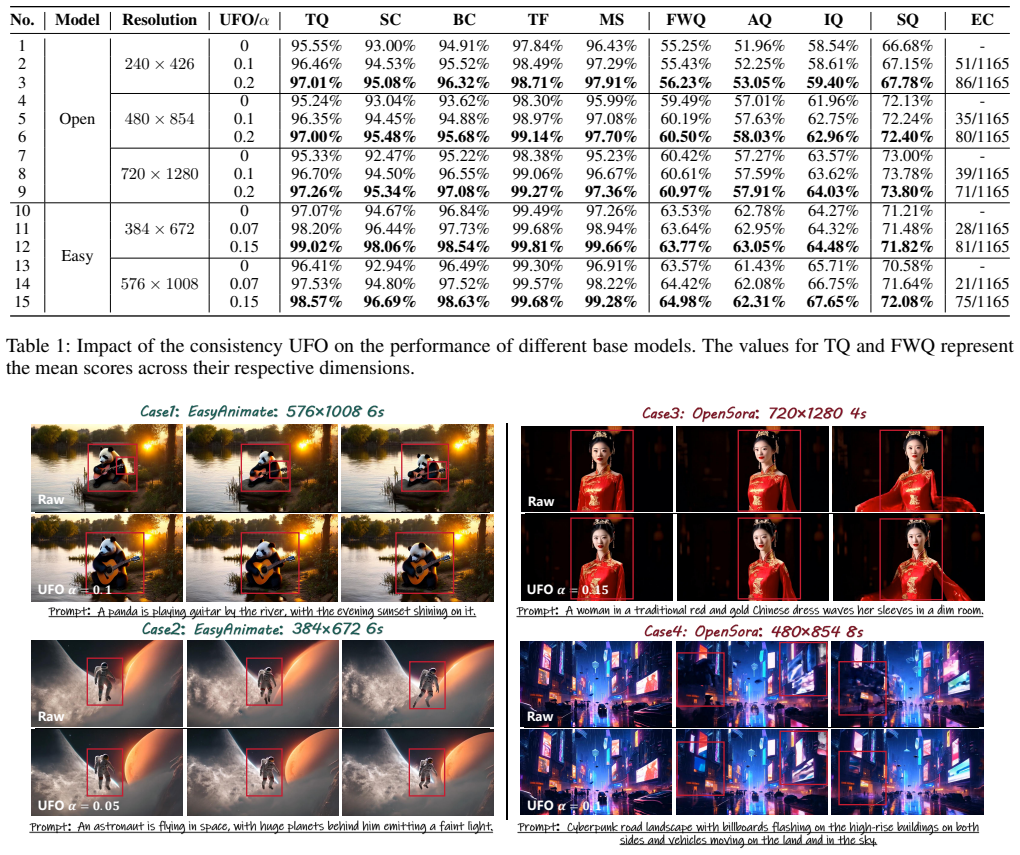
The load-bearing mechanism is the pair of detection and correction layers, $v_{\rm det} \in \mathbb{R}^{n\times d}$ and $v_{\rm cor} \in \mathbb{R}^{m\times d}$ with small rank $d$, injected into each mapping layer of the diffusion transformer, together with the identity $\Delta y_n = W\Delta x_n + \alpha\beta\,\Delta(v_{\rm det}^{\top}x \cdot v_{\rm cor})$. Training at $\alpha=1$ with duplicated frames imposes $\Delta y_n=0$, so the adapter learns to produce exactly the negative of the base model's inter-frame variation; at inference, scaling by a low $\alpha$ leaves the base motion mostly intact while inheriting the learned correction. The evaluation protocol also includes an Excluded Count that removes near-static videos from the averaged metrics, defined via an optical-flow threshold.
What would settle it
Re-run the Table 1 evaluation without excluding any near-static videos (drop the EC criterion); if the reported TQ and FWQ improvements shrink by more than half or disappear, the central quality claim depends on discarding the plug-in's worst outputs.
Extended reading notes
Core claim
On the paper's own terms, the discovery is that exposing a frozen diffusion video model to a 'static video' training objective teaches lightweight adapters a correction that survives at low intensity. For a module parameterized by $W \in \mathbb{R}^{m\times n}$, the UFO modifies the output as $y = Wx + \alpha\beta(v_{\rm det}^{\top}x)\, v_{\rm cor}$, where $v_{\rm det}$ locates features responsible for inconsistency, $v_{\rm cor}$ repairs them, $\alpha$ is a user-set intensity, and $\beta$ is a learned per-adapter strength. Training forces all frames to be identical, $\Delta y_n=0$, so the adapter must compensate for every inter-frame variation; with $\alpha$ small during inference, the original motion $\Delta y_n \approx W\Delta x_n$ is retained while the correction term removes the inconsistencies. The authors show this raises temporal consistency and frame quality on VBench, that one adapter transfers between OpenSora and EasyAnimate models of the same specification, and that it combines with style adapters trained on a few hundred videos to produce personalized, consistent video generators.
Load-bearing premise
The reported gains are averages over the videos that survive the exclusion of near-static outputs; if the excluded failures were counted, the improvement over the base model would be smaller.
Editorial extensions
If this is right
- A single trained UFO can be applied to any diffusion video model of the same architecture without retraining, with nearly identical performance to training on the target model.
- Because training needs only duplicated image-text pairs, video-consistency enhancement no longer requires video-text data or expensive full fine-tuning.
- Merging a consistency UFO with any of several style UFOs yields videos that are simultaneously stylized and temporally coherent.
- The gains grow with video duration, so the plug-in is most valuable for long-form generation where inconsistency and blur typically accumulate.
- Users can dial the intensity $\alpha$ to trade motion fidelity against consistency; at high intensities the model tends toward static video, which the paper records but excludes from headline metrics.
Reading between the lines
- Editorial: the EC-based reporting means the headline numbers answer 'how much do surviving videos improve' rather than 'how much does the average generated video improve'; reporting an unconditional mean or a motion-consistency Pareto curve would give users the full picture.
- Editorial: the static-frame training objective is a general recipe for teaching adapters a temporal prior without video data, so the same approach could be tested on frame interpolation, video inpainting, or other frame-sequence diffusion tasks.
- Editorial: the transfer results suggest the adapter learns a corrective function tied to layer dimensions, not to a specific model's weights; the natural stress test is whether a UFO trained on one DiT width works on a model with different hidden size.
Editorial analysis
A structured set of objections, weighed in public.
Referee Report
Summary. The paper proposes UFO, a plug-in of lightweight rank-1 adapters attached to intermediate layers of diffusion-based video generation models. UFO is trained by freezing the base model and optimizing the adapters to reproduce static videos made from duplicated image frames, with an intensity factor α controlling the strength of the correction at inference. Experiments on EasyAnimate-V2 and OpenSora-V1.2 report improvements on VBench temporal-quality (TQ) and frame-wise-quality (FWQ) metrics, as well as transferability across same-architecture models and composability with style adapters. The central claim is that UFO non-invasively enhances temporal consistency and image quality without modifying base parameters and without requiring video-text pairs for training.
Significance. If the reported gains are genuine and not merely the result of motion suppression, UFO is a simple, inexpensive, and practical plug-in: it trains in 3000 steps on static image-text pairs, adds only a small number of parameters, and offers an adjustable intensity for a consistency-quality trade-off. The paper has several strengths: it provides an explicit mathematical formulation of the adapter (Section 3.1), describes the training and inference protocols in reasonable detail, reports exclusion counts (EC) rather than hiding them, and includes transferability and dimension ablations. However, the mechanism analysis and the evaluation protocol leave open the possibility that the method primarily attenuates motion, and the absence of comparisons with other consistency methods or with simple motion-reduction baselines prevents the results from supporting the paper's stronger claims. The empirical improvements are real on the reported metrics, but the central claim that UFO learns to specifically identify and correct inconsistencies is not yet established.
major comments (4)
- [Section 3.1 (display equation for the adapter and the two-frame difference derivation)] The derivation shows that the adapter's correction term is a rank-1 linear function of the inter-frame latent difference. With α=1 during training, the objective drives βΔ(v_det^T x · v_cor) ≈ −WΔx_n. Substituting this learned relation back into the inference expression with α<1 gives Δy_n ≈ (1−α)WΔx_n. In other words, the mechanism is a global attenuation of essentially all frame-to-frame latent differences, not a selective repair of inconsistencies. The claim that v_det 'locates features affecting video consistency' and that the adapter 'adaptively identify and fill the variations' is unsupported by the mathematical form. The paper should either provide evidence that the learned rank-1 term is not equivalent to a simple scaling of WΔx_n, or replace the 'targeted repair' narrative with a motion-control interpretation. A concrete experiment comparing UFO with a baseline that simply scales inter-frame latent differences by (1−α) would settle this point.
- [Section 4.1, 'Evaluation Metrics' and the supplementary 'Excluded Count Metric'] The headline TQ and FWQ numbers in Table 1 are computed on a selected subset: videos whose optical-flow threshold (OFT) drops below 1 and decreases by more than 1.5× relative to the raw model are excluded, with EC ranging from 28 to 86 out of 1165 videos at the recommended α values. This post-hoc exclusion removes the most motion-degraded outputs from the averaged metrics. The threshold OFT < 1 is arbitrary, and no information is provided about the distribution of OFT for the retained videos; they may still have substantially reduced motion. In addition, the text says these videos are excluded from 'the evaluation,' which appears to include FWQ even though frame-wise quality is independent of motion. The authors should report the mean and standard deviation of OFT (or another motion statistic) for both retained and excluded sets at each α, and should provide a sensitivity analysis with respect to the exclusion threshold. Without this, the Table 1 gains are not interpretable as evidence of consistency improvement beyond motion suppression.
- [Section 4.2, Table 1 and the Quantitative Results text] All comparisons are UFO at α>0 against the same base model at α=0. No comparison is made to existing temporal-consistency methods, such as training-free noise-reshaping techniques, temporal smoothing, or other adapter-based consistency plug-ins. Because the mechanism in Section 3.1 appears to be a global motion attenuator, a trivial baseline that reduces motion by low-pass filtering or by interpolating frames might reproduce or even exceed the reported TQ gains. The abstract and contributions claim that UFO 'demonstrates superiority in public video generation benchmarks,' but a superiority claim requires at least one competitive baseline. The paper should add comparisons against a motion-reduction control and at least one prior consistency-enhancement method, and it should report motion-preservation metrics to show that the chosen low α retains the original video dynamics.
- [Section 3.2 (training objective) and Section 4.1 (evaluation dimensions)] There is a partial circularity in the experimental design: the UFO is trained to reproduce static videos (duplicated image frames), and the evaluation metrics SC, BC, TF, and MS all improve when inter-frame differences are reduced. The paper's own Figure 5 and Figure 11 acknowledge that increasing α slows motion and that aggressive settings make videos near-static. To separate 'consistency' from 'staticness,' the retained set should be evaluated with a motion-sensitive metric (e.g., average optical flow, dynamic degree, or the motion component of VBench) and the results should be compared between raw and UFO at the same level of motion. The current evaluation does not rule out the trivial explanation that UFO improves TQ simply by slowing the video.
minor comments (5)
- [Section 4.3 heading] 'Ablition studies' should be corrected to 'Ablation studies.'
- [Table 4 caption] The caption contains a typo: 'cideo durations' should be 'video durations.'
- [Abstract and Table 2] The abstract states the adapters occupy '0.005×' the size of the original model's parameters, whereas Table 2 reports relative parameter counts between 0.24% and 1.44% depending on d and the base model; please reconcile these numbers and state the specific configuration used for the 0.005 claim.
- [Section 3.2] The sentence 'Since both q and pθ are Gaussian, the DKL term is determined by the mean µθ and covariance Σθ' is missing a verb form; it should read 'is determined by' (the 'd' of 'determined' is missing in the rendered text).
- [Throughout] The use of 'OpenSoraV1.2' and 'OpenSora-V1.2' is inconsistent; please use a single spelling. The same applies to 'PLLaV A,' which should be 'PLLaVA.'
Circularity Check
No significant circularity: the UFO training objective (static frames) and the VBench temporal-quality evaluation are aligned but not identical, and all central claims are supported by external benchmark experiments rather than by self-citation or definitional equivalence.
full rationale
The paper's derivation chain is self-contained. The adapter output is defined explicitly as y = Wx + αβ(v_det^T x)v_cor, and the training target (Δy_n = 0 on duplicated static images) is stated openly. The inference behavior at low α follows from the same equations rather than from a hidden fitted parameter: if the learned correction satisfies βΔ(v_det^T x · v_cor) ≈ −WΔx_n, then Δy_n ≈ (1−α)WΔx_n, meaning the plug-in attenuates inter-frame latent differences. This is the designed mechanism, and the paper does not disguise it as a first-principles prediction; it reports empirical gains on the external VBench suite. The training data are static image-text pairs, while the evaluation measures temporal quality on generated videos, so the TQ improvements are not the same quantity as the training loss by construction. The EC exclusion and the deferred supplementary criteria are methodological limitations that could affect the strength of the reported gains, but they do not make the derivation circular. There are no load-bearing self-citations, no imported uniqueness theorems, and no ansatz smuggled in via prior work. The motion-attenuation concern is a substantive correctness risk, not a circularity.
Assumptions & free parameters
free parameters (4)
- Intensity α =
0.07 / 0.1 / 0.15 / 0.2 depending on model and strategy
- Adapter dimension d =
4
- Exclusion threshold (OFT) =
OFT < 1 and >1.5× decrease
- Learning rates =
2e-4 (Open), 1e-4 (Easy)
assumptions (4)
- domain assumption Vbench temporal-quality metrics are valid proxies for video consistency and quality.
- domain assumption Training on static frames teaches a correction direction that, at low α, preserves motion while improving consistency.
- domain assumption The two base models (OpenSora-V1.2 and EasyAnimate-V2) are representative of 'any diffusion-based video generation model'.
- standard math Standard diffusion and VAE mathematics from cited works (Ho et al. 2020; Nichol and Dhariwal 2021; Kingma and Welling 2013) are correct and applicable.
Cite this review
Pith. "Pith review of UFO: Enhancing Diffusion-Based Video Generation with a Uniform Frame Organizer." pith.science (2026). https://pith.science/paper/DNBWEHLU
@misc{pith2026241209389,
  author       = {Pith},
  title        = {Pith review of: UFO: Enhancing Diffusion-Based Video Generation with a Uniform Frame Organizer},
  year         = {2026},
  howpublished = {\url{https://pith.science/paper/DNBWEHLU}},
  note         = {Machine review of arXiv:2412.09389}
}
read the original abstract
Recently, diffusion-based video generation models have achieved significant success. However, existing models often suffer from issues like weak consistency and declining image quality over time. To overcome these challenges, inspired by aesthetic principles, we propose a non-invasive plug-in called Uniform Frame Organizer (UFO), which is compatible with any diffusion-based video generation model. The UFO comprises a series of adaptive adapters with adjustable intensities, which can significantly enhance the consistency between the foreground and background of videos and improve image quality without altering the original model parameters when integrated. The training for UFO is simple, efficient, requires minimal resources, and supports stylized training. Its modular design allows for the combination of multiple UFOs, enabling the customization of personalized video generation models. Furthermore, the UFO also supports direct transferability across different models of the same specification without the need for specific retraining. The experimental results indicate that UFO effectively enhances video generation quality and demonstrates its superiority in public video generation benchmarks. The code will be publicly available at https://github.com/Delong-liu-bupt/UFO.
Figures


Figures from the paper (9 more)


Reference graph
Works this paper leans on
-
[1]
, " * write output.state after.block = add.period write newline
ENTRY address archivePrefix author booktitle chapter edition editor eid eprint howpublished institution isbn journal key month note number organization pages publisher school series title type volume year label extra.label sort.label short.list INTEGERS output.state before.all mid.sentence after.sentence after.block FUNCTION init.state.consts #0 'before.a...
-
[2]
write newline
" write newline "" before.all 'output.state := FUNCTION n.dashify 't := "" t empty not t #1 #1 substring "-" = t #1 #2 substring "--" = not "--" * t #2 global.max substring 't := t #1 #1 substring "-" = "-" * t #2 global.max substring 't := while if t #1 #1 substring * t #2 global.max substring 't := if while FUNCTION word.in bbl.in capitalize " " * FUNCT...
-
[3]
Bain, M.; Nagrani, A.; Varol, G.; and Zisserman, A. 2021. Frozen in time: A joint video and image encoder for end-to-end retrieval. In Proceedings of the IEEE/CVF international conference on computer vision, 1728--1738
2021
-
[4]
Chen, H.; Xia, M.; He, Y.; Zhang, Y.; Cun, X.; Yang, S.; Xing, J.; Liu, Y.; Chen, Q.; Wang, X.; Weng, C.; and Shan, Y. 2023 a . VideoCrafter1: Open Diffusion Models for High-Quality Video Generation. arXiv:2310.19512
arXiv 2023
-
[5]
Chen, H.; Zhang, Y.; Cun, X.; Xia, M.; Wang, X.; Weng, C.; and Shan, Y. 2024. VideoCrafter2: Overcoming Data Limitations for High-Quality Video Diffusion Models. arXiv:2401.09047
arXiv 2024
-
[6]
Chen, W.; Ji, Y.; Wu, J.; Wu, H.; Xie, P.; Li, J.; Xia, X.; Xiao, X.; and Lin, L. 2023 b . Control-a-video: Controllable text-to-video generation with diffusion models. arXiv preprint arXiv:2305.13840
arXiv 2023
-
[7]
Chen, X.; Wang, Y.; Zhang, L.; Zhuang, S.; Ma, X.; Yu, J.; Wang, Y.; Lin, D.; Qiao, Y.; and Liu, Z. 2023 c . Seine: Short-to-long video diffusion model for generative transition and prediction. In The Twelfth International Conference on Learning Representations
work page 2023
-
[8]
Du, Z.; Chen, Q.; Zhang, S.; Hu, K.; Lu, H.; Yang, Y.; Hu, H.; Zheng, S.; Gu, Y.; Ma, Z.; et al. 2024. CosyVoice: A Scalable Multilingual Zero-shot Text-to-speech Synthesizer based on Supervised Semantic Tokens. arXiv preprint arXiv:2407.05407
arXiv 2024
Show all 50 references
-
[9]
Esser, P.; Chiu, J.; Atighehchian, P.; Granskog, J.; and Germanidis, A. 2023. Structure and content-guided video synthesis with diffusion models. In Proceedings of the IEEE/CVF International Conference on Computer Vision, 7346--7356
2023
-
[10]
Esser, P.; Kulal, S.; Blattmann, A.; Entezari, R.; M \"u ller, J.; Saini, H.; Levi, Y.; Lorenz, D.; Sauer, A.; Boesel, F.; et al. 2024. Scaling rectified flow transformers for high-resolution image synthesis. In Forty-first International Conference on Machine Learning
2024
-
[11]
P.; Poole, B.; Norouzi, M.; Fleet, D
Ho, J.; Chan, W.; Saharia, C.; Whang, J.; Gao, R.; Gritsenko, A.; Kingma, D. P.; Poole, B.; Norouzi, M.; Fleet, D. J.; et al. 2022. Imagen video: High definition video generation with diffusion models. arXiv preprint arXiv:2210.02303
2022 arXiv
-
[12]
Ho, J.; Jain, A.; and Abbeel, P. 2020. Denoising diffusion probabilistic models. Advances in neural information processing systems, 33: 6840--6851
2020
-
[13]
J.; Wallis, P.; Allen-Zhu, Z.; Li, Y.; Wang, S.; Wang, L.; Chen, W.; et al
Hu, E. J.; Wallis, P.; Allen-Zhu, Z.; Li, Y.; Wang, S.; Wang, L.; Chen, W.; et al. 2022. LoRA: Low-Rank Adaptation of Large Language Models. In International Conference on Learning Representations
2022
-
[14]
Huang, Z.; He, Y.; Yu, J.; Zhang, F.; Si, C.; Jiang, Y.; Zhang, Y.; Wu, T.; Jin, Q.; Chanpaisit, N.; Wang, Y.; Chen, X.; Wang, L.; Lin, D.; Qiao, Y.; and Liu, Z. 2024. VBench : Comprehensive Benchmark Suite for Video Generative Models. In Proceedings of the IEEE/CVF Conference...
2024
-
[15]
Karras, J.; Holynski, A.; Wang, T.-C.; and Kemelmacher-Shlizerman, I. 2023. Dreampose: Fashion image-to-video synthesis via stable diffusion. In 2023 IEEE/CVF International Conference on Computer Vision (ICCV), 22623--22633. IEEE
2023
-
[16]
Khachatryan, L.; Movsisyan, A.; Tadevosyan, V.; Henschel, R.; Wang, Z.; Navasardyan, S.; and Shi, H. 2023 a . Text2video-zero: Text-to-image diffusion models are zero-shot video generators. In Proceedings of the IEEE/CVF International Conference on Computer Vision, 15954--15964
2023
-
[17]
Khachatryan, L.; Movsisyan, A.; Tadevosyan, V.; Henschel, R.; Wang, Z.; Navasardyan, S.; and Shi, H. 2023 b . Text2video-zero: Text-to-image diffusion models are zero-shot video generators. In Proceedings of the IEEE/CVF International Conference on Computer Vision, 15954--15964
2023
-
[18]
P.; and Welling, M
Kingma, D. P.; and Welling, M. 2013. Auto-encoding variational bayes. arXiv preprint arXiv:1312.6114
2013 arXiv
-
[19]
Li, X.; Yuan, K.; Pei, Y.; Lu, Y.; Sun, M.; Zhou, C.; Chen, Z.; Timofte, R.; Sun, W.; Wu, H.; et al. 2024. NTIRE 2024 challenge on short-form UGC video quality assessment: Methods and results. In Proceedings of the IEEE/CVF Conference on Computer Vision and Pattern Recognition...
2024
-
[20]
H.; Yan, H.; Zhang, J.; Xu, Z.; and Feng, J
Liew, J. H.; Yan, H.; Zhang, J.; Xu, Z.; and Feng, J. 2023. Magicedit: High-fidelity and temporally coherent video editing. arXiv preprint arXiv:2308.14749
2023 arXiv
-
[21]
Lu, H.; Yang, G.; Fei, N.; Huo, Y.; Lu, Z.; Luo, P.; and Ding, M. 2024. VDT: General-purpose Video Diffusion Transformers via Mask Modeling. In The Twelfth International Conference on Learning Representations
2024
-
[22]
Luo, Z.; Chen, D.; Zhang, Y.; Huang, Y.; Wang, L.; Shen, Y.; Zhao, D.; Zhou, J.; and Tan, T. 2023. Videofusion: Decomposed diffusion models for high-quality video generation. In 2023 IEEE/CVF Conference on Computer Vision and Pattern Recognition (CVPR), 10209--10218. IEEE
2023
-
[23]
Ma, X.; Wang, Y.; Jia, G.; Chen, X.; Liu, Z.; Li, Y.-F.; Chen, C.; and Qiao, Y. 2024 a . Latte: Latent diffusion transformer for video generation. arXiv preprint arXiv:2401.03048
2024 arXiv
-
[24]
Ma, Y.; He, Y.; Cun, X.; Wang, X.; Chen, S.; Li, X.; and Chen, Q. 2024 b . Follow your pose: Pose-guided text-to-video generation using pose-free videos. In Proceedings of the AAAI Conference on Artificial Intelligence, volume 38, 4117--4125
2024
-
[25]
Q.; and Dhariwal, P
Nichol, A. Q.; and Dhariwal, P. 2021. Improved denoising diffusion probabilistic models. In International conference on machine learning, 8162--8171. PMLR
2021
-
[26]
Q.; Dhariwal, P.; Ramesh, A.; Shyam, P.; Mishkin, P.; Mcgrew, B.; Sutskever, I.; and Chen, M
Nichol, A. Q.; Dhariwal, P.; Ramesh, A.; Shyam, P.; Mishkin, P.; Mcgrew, B.; Sutskever, I.; and Chen, M. 2022. GLIDE: Towards Photorealistic Image Generation and Editing with Text-Guided Diffusion Models. In International Conference on Machine Learning, 16784--16804. PMLR
2022
-
[27]
OpenAI. 2023. ChatGPT-4. https://openai.com/chatgpt. Software
2023
-
[28]
OpenAI. 2024. Video generation models as world simulators. https://openai.com/index/video-generation-models-as-world-simulators/
2024
-
[29]
Ouyang, H.; Wang, Q.; Xiao, Y.; Bai, Q.; Zhang, J.; Zheng, K.; Zhou, X.; Chen, Q.; and Shen, Y. 2024. Codef: Content deformation fields for temporally consistent video processing. In Proceedings of the IEEE/CVF Conference on Computer Vision and Pattern Recognition, 8089--8099
2024
-
[30]
Pfeiffer, J.; Kamath, A.; R \"u ckl \'e , A.; Cho, K.; and Gurevych, I. 2020. Adapterfusion: Non-destructive task composition for transfer learning. arXiv preprint arXiv:2005.00247
2020 arXiv
-
[31]
Pika-Labs. 2023. Pika Labs. https://www.pika.art/. Accessed June 10, 2024
2023
-
[32]
PKU-Yuan-Lab; and Tuzhan-AI. 2024. Open-Sora-Plan
2024
-
[33]
Raffel, C.; Shazeer, N.; Roberts, A.; Lee, K.; Narang, S.; Matena, M.; Zhou, Y.; Li, W.; and Liu, P. J. 2020. Exploring the limits of transfer learning with a unified text-to-text transformer. Journal of machine learning research, 21(140): 1--67
2020
-
[34]
Ramesh, A.; Dhariwal, P.; Nichol, A.; Chu, C.; and Chen, M. 2022. Hierarchical text-conditional image generation with clip latents. arXiv preprint arXiv:2204.06125, 1(2): 3
2022 arXiv
-
[35]
Schuhmann, C.; Beaumont, R.; Vencu, R.; Gordon, C.; Wightman, R.; Cherti, M.; Coombes, T.; Katta, A.; Mullis, C.; Wortsman, M.; et al. 2022. Laion-5b: An open large-scale dataset for training next generation image-text models. Advances in Neural Information Processing Systems,...
2022
-
[36]
P.; Kumar, A.; Ermon, S.; and Poole, B
Song, Y.; Sohl-Dickstein, J.; Kingma, D. P.; Kumar, A.; Ermon, S.; and Poole, B. 2021. Score-Based Generative Modeling through Stochastic Differential Equations. In International Conference on Learning Representations
2021
-
[37]
Teed, Z.; and Deng, J. 2020. Raft: Recurrent all-pairs field transforms for optical flow. In Computer Vision--ECCV 2020: 16th European Conference, Glasgow, UK, August 23--28, 2020, Proceedings, Part II 16, 402--419. Springer
2020
-
[38]
Wang, J.; Yuan, H.; Chen, D.; Zhang, Y.; Wang, X.; and Zhang, S. 2023 a . Modelscope text-to-video technical report. arXiv preprint arXiv:2308.06571
2023 arXiv
-
[39]
Wang, X.; Yuan, H.; Zhang, S.; Chen, D.; Wang, J.; Zhang, Y.; Shen, Y.; Zhao, D.; and Zhou, J. 2024. Videocomposer: Compositional video synthesis with motion controllability. Advances in Neural Information Processing Systems, 36
2024
-
[40]
Wang, Y.; Chen, X.; Ma, X.; Zhou, S.; Huang, Z.; Wang, Y.; Yang, C.; He, Y.; Yu, J.; Yang, P.; et al. 2023 b . Lavie: High-quality video generation with cascaded latent diffusion models. arXiv preprint arXiv:2309.15103
2023 arXiv
-
[41]
Wang, Y.; He, Y.; Li, Y.; Li, K.; Yu, J.; Ma, X.; Li, X.; Chen, G.; Chen, X.; Wang, Y.; et al. 2023 c . Internvid: A large-scale video-text dataset for multimodal understanding and generation. arXiv preprint arXiv:2307.06942
2023 arXiv
-
[42]
Wu, H.; Zhang, E.; Liao, L.; Chen, C.; Hou, J.; Wang, A.; Sun, W.; Yan, Q.; and Lin, W. 2023. Exploring video quality assessment on user generated contents from aesthetic and technical perspectives. In Proceedings of the IEEE/CVF International Conference on Computer Vision, 20...
2023
-
[43]
Xing, Z.; Feng, Q.; Chen, H.; Dai, Q.; Hu, H.; Xu, H.; Wu, Z.; and Jiang, Y.-G. 2023. A survey on video diffusion models. arXiv preprint arXiv:2310.10647
2023 arXiv
-
[44]
Xu, J.; Zou, X.; Huang, K.; Chen, Y.; Liu, B.; Cheng, M.; Shi, X.; and Huang, J. 2024 a . EasyAnimate: A High-Performance Long Video Generation Method based on Transformer Architecture. arXiv preprint arXiv:2405.18991
2024
-
[45]
K.; and Feng, J
Xu, L.; Zhao, Y.; Zhou, D.; Lin, Z.; Ng, S. K.; and Feng, J. 2024 b . PLLaVA : Parameter-free LLaVA Extension from Images to Videos for Video Dense Captioning. arXiv:2404.16994
2024 arXiv
-
[46]
Yin, S.; Wu, C.; Liang, J.; Shi, J.; Li, H.; Ming, G.; and Duan, N. 2023. Dragnuwa: Fine-grained control in video generation by integrating text, image, and trajectory. arXiv preprint arXiv:2308.08089
2023 arXiv
-
[47]
Zhang, L.; Rao, A.; and Agrawala, M. 2023. Adding conditional control to text-to-image diffusion models. In Proceedings of the IEEE/CVF International Conference on Computer Vision, 3836--3847
2023
-
[48]
Zhang, Y.; Wei, Y.; Jiang, D.; ZHANG, X.; Zuo, W.; and Tian, Q. 2024. ControlVideo: Training-free Controllable Text-to-video Generation. In The Twelfth International Conference on Learning Representations
2024
-
[49]
X.; Zhou, K.; Li, J.; Tang, T.; Wang, X.; Hou, Y.; Min, Y.; Zhang, B.; Zhang, J.; Dong, Z.; et al
Zhao, W. X.; Zhou, K.; Li, J.; Tang, T.; Wang, X.; Hou, Y.; Min, Y.; Zhang, B.; Zhang, J.; Dong, Z.; et al. 2023. A survey of large language models. arXiv preprint arXiv:2303.18223
2023 arXiv
-
[50]
Zheng, Z.; Peng, X.; Yang, T.; Shen, C.; Li, S.; Liu, H.; Zhou, Y.; Li, T.; and You, Y. 2024. Open-Sora: Democratizing Efficient Video Production for All
2024
Reviewed August 11, 2026 · model on record in the stance chip above.
Discussion (0). Continue with ORCID to comment.