REVIEW 3 major objections 5 minor 2 cited by
Extended Skyrme effective interactions with higher-order momentum-dependence for transport models and neutron stars
T0 review · 3 major / 5 minor · reviewed 2026-08-11 · deepseek-v4-flash
Pith's one-line read This paper shows that a Skyrme pseudopotential extended to N5LO, with momentum dependence up to $p^{10}$, describes the empirical nucleon optical potential up to 2 GeV and, in the same framework, produces interactions consistent with…
desk verdict Useful formal extension of the Skyrme pseudopotential to N5LO, but the 2 GeV optical-potential claim is fit to an extrapolation, not to data. read the letter →
The pith
A machine-rendered reading of the paper's core claim, the machinery that carries it, and where it could break.
The reading
What carries the argument
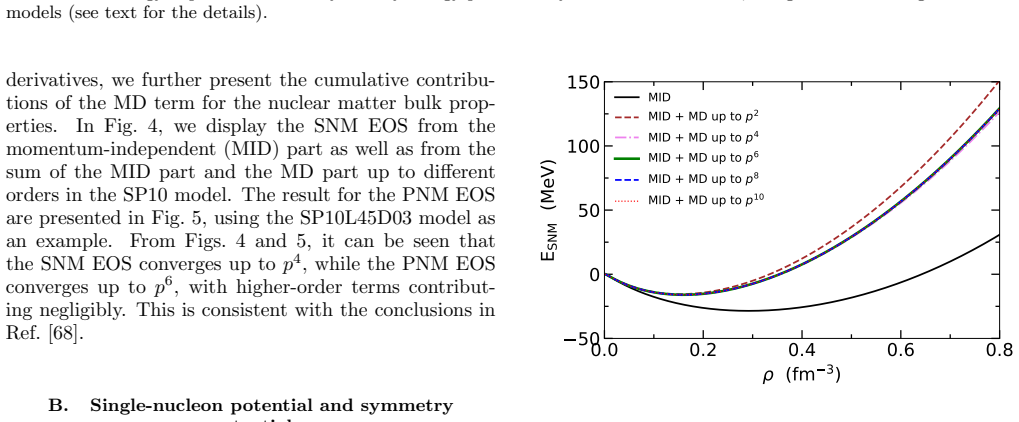
The load-bearing object is the NnLO Skyrme central pseudopotential, obtained by assuming that the $2n$th-order derivative term is proportional to the binomial expansion $(\hat A+\hat B)^n$, where $\hat A$ is the even relative-momentum operator and $\hat B$ the odd one. The split into even and odd powers of $\hat B$ fixes two coupling families, and after Hartree-Fock averaging it generates momentum-dependent and gradient terms in the Hamiltonian density. In the single-nucleon potential the momentum dependence is a polynomial in $p^2$ whose coefficients $a_n$ and $b_n$ can be fitted directly to the optical potential; the polynomial form factors the $\vec p$-dependence out of the phase-space integral, which is what keeps high-order terms computationally affordable in transport simulations. The density-dependent part follows a Fermi-momentum expansion $\rho^{(2n-1)/3}$, giving independent control of the saturation and symmetry-energy expansion coefficients up to fifth order.
What would settle it
Measure or reliably extract the real part of the nucleon optical potential in symmetric nuclear matter at saturation density for nucleon kinetic energies between 1 and 2 GeV, for example from high-quality proton-nucleus elastic-scattering data; if the extracted potential differs from the N5LO prediction by more than the fitting tolerance across that range, the central claim fails.
Extended reading notes
Core claim
The central claim is that a Skyrme pseudopotential whose central term is built from the binomial expansion $(\hat A+\hat B)^n$ produces a single-nucleon potential with polynomial momentum dependence up to $p^{2n}$, and that at N5LO ($p^{10}$) this polynomial stays close to the empirical nucleon optical potential up to about 2 GeV kinetic energy, including the saturated behavior above 1 GeV. The same construction at N3LO and N4LO reproduces the optical potential only up to about 1 GeV and 1.5 GeV, respectively, with rapid growth beyond those energies. With the Fermi-momentum-expanded density-dependent terms, the interactions give a flexible description of symmetric nuclear matter, the symmetry energy (through $E_{\rm sym}$, $L$, $K_{\rm sym}$, $J_{\rm sym}$, $I_{\rm sym}$, $H_{\rm sym}$), pure neutron matter, and neutron-star masses and radii compatible with current multimessenger constraints. The paper also reports that the N5LO interaction, used in a lattice-Hamiltonian transport solver, reproduces proton directed, elliptic, triangular, and quadrangular flow data from Au+Au collisions at 1.23 GeV per nucleon.
Load-bearing premise
The load-bearing premise is that the extrapolation of the empirical optical potential above 1 GeV, used as fitting data for the $a_8$ and $a_{10}$ coefficients, faithfully represents the true single-nucleon potential between 1 and 2 GeV; if it does not, the 2 GeV claim has no experimental footing.
Editorial extensions
If this is right
- Transport simulations for heavy-ion collisions at incident energies up to about 2 GeV per nucleon can use the N5LO mean field without the fast potential rise that limited the N3LO interaction to energies below 1 GeV.
- The N5LO interactions provide six independent characteristic parameters for symmetric nuclear matter and six for the symmetry energy, so future data can constrain the equation of state at suprasaturation densities rather than only around saturation.
- All 24 constructed interactions satisfy current flow constraints on the symmetric-matter pressure, microscopic pure-neutron-matter predictions, pulsar mass-radius measurements, and the gravitational-wave upper limit on the 1.4-solar-mass tidal deformability.
- The proton elliptic flow $v_2$ responds to both the isoscalar effective mass and the high-momentum slope of the single-nucleon potential: a larger effective mass weakens $v_2$, while a rapidly rising potential strengthens it.
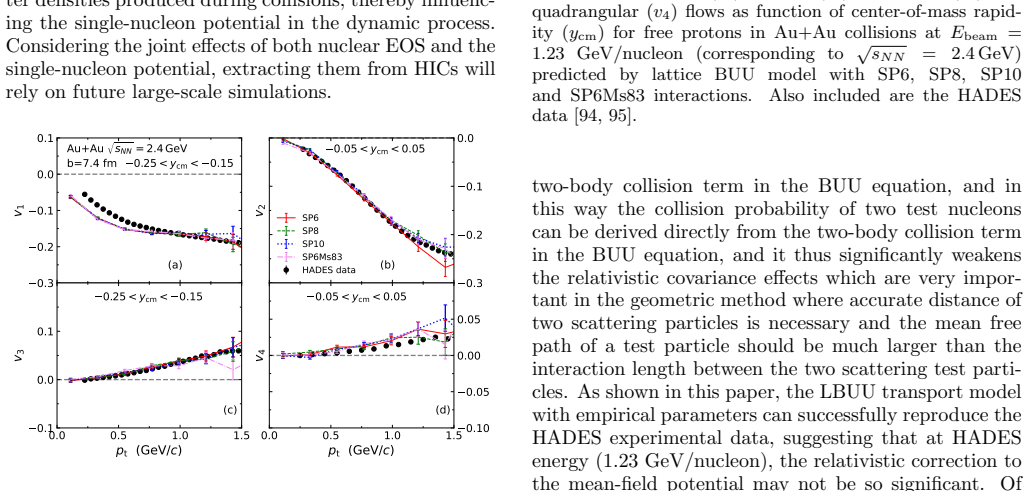
- The benchmark Au+Au simulation at 1.23 GeV per nucleon reproduces the measured proton $v_1$, $v_2$, $v_3$, and $v_4$, establishing that the extended interactions are usable transport inputs above 1 GeV per nucleon.
Reading between the lines
- Because the high-order coefficients $a_8$ and $a_{10}$ contribute negligibly to bulk nuclear-matter properties near saturation but dominate the single-nucleon potential above 1.5 GeV/c, the optical-potential fit and the equation-of-state fit are almost decoupled; this separation could let future analyses constrain the high-momentum mean field and the dense-matter EOS independently from the same co
- If direct 1-2 GeV elastic-scattering data confirm the N5LO potential, the same binomial construction could be extended to N6LO and beyond, although each added coefficient increases the extrapolation risk.
- The symmetry-potential family is generated by a single scaling constant through a cosine-like Taylor expansion, so the eight effective-mass-splitting scenarios do not exhaust the possible high-momentum symmetry potentials; testing other shapes of the higher coefficients would clarify how much of the flow agreement depends on that choice.
- A fully relativistic mean-field treatment is the natural stress test of the claimed 2 GeV applicability, since the transport kinematics are relativistic while the Skyrme potential itself is nonrelativistic.
Editorial analysis
A structured set of objections, weighed in public.
Referee Report
Summary. This paper generalizes the previously constructed N3LO Skyrme pseudopotential to general NnLO order by including central-term derivative operators up to 2n-th order, and derives the corresponding Hamiltonian density and single-nucleon potential in the Hartree-Fock approximation under nonequilibrium conditions. The authors construct 24 new interactions from three models (N3LO, N4LO, N5LO) and eight symmetry potentials characterized by linear isospin-splitting coefficients Δm*_1(ρ0), study their predictions for nuclear matter, neutron stars, and the symmetry energy, and perform lattice BUU simulations of Au+Au collisions at 1.23 GeV/nucleon, comparing proton flow harmonics with HADES data. The central quantitative claim is that the N5LO single-nucleon potential, with momentum dependence up to p^10, gives a good description of the empirical nucleon optical potential up to 2 GeV kinetic energy.
Significance. If accepted at face value, the framework would be a useful step for transport simulations of heavy-ion collisions in the 1-2 GeV/nucleon regime: the polynomial form of the mean-field potential retains a computational advantage (the p-dependence is factored out of the test-particle sums, as shown in Appendix A), and the extended density-dependent terms provide flexible equations of state that can simultaneously accommodate microscopic neutron-matter calculations, neutron-star radii from NICER, and the tidal deformability constraint from GW170817. The paper is also strong in its systematic formal derivations and in the transparency of the parameter tables and fitting procedure. The HADES benchmark, although limited in scope, is a constructive addition that demonstrates the potential applicability of the constructed interactions.
major comments (3)
- [Section III, Eq. (57), Table II] The headline claim that the N5LO single-nucleon potential 'can give a nice description for the empirical nucleon optical potential up to energy of 2 GeV' is not established by the fit described in Eq. (57). The fitting functional explicitly includes 'its extrapolation above 1 GeV' with equal weights and no practical errors, and the N5LO fit extends to 2.5 GeV/c, approximately corresponding to 2 GeV kinetic energy. The coefficients a8 and a10 in Table II are therefore fixed by the analytic continuation of the Hama et al. parametrization, not by measured proton-nucleus scattering data in the 1-2 GeV range. If the true high-energy potential differs from that continuation, the fitted high-order coefficients and the claimed saturated behavior above 1 GeV would change. The abstract, Section IV.B, and Section VI should be reworded to state that the N5LO potential reproduces the Hama et al. parametrization including its extrapolation, or the authors should add a quantitative robustness test against alternative high-energy extrapolations and restrict the empirical claim accordingly.
- [Section IV.B, Eq. (59), Fig. 7] The agreement between the predicted symmetry potential and the global optical-model analyses is partly preselected by construction. The coefficients bn are generated by the cosine-like expansion of Eq. (59) with the single scale A tuned to produce the chosen Δm*_1(ρ0) values; the observation that the Δm*_1 = 0.3 and 0.5 curves are consistent with the optical-model value (0.41 ± 0.15)δ is therefore a consequence of the parametrization, not an independent measurement. The text should state explicitly that Eq. (59) is an assumed functional form and that the comparison in Fig. 7 is a consistency check, not a determination of the isospin splitting of the effective mass. A sensitivity study varying the assumed shape of the symmetry-potential momentum dependence would materially strengthen the paper.
- [Section V.B, Figs. 12-13] The HADES benchmark is presented as providing 'good predictions' of proton collective flows, but it does not isolate the 1-2 GeV single-nucleon potential. The simulations use only four interactions with Δm*_1(ρ0) = 0.3 fixed, a single beam energy 1.23 GeV/nucleon, a fixed impact parameter b = 7.4 fm, and a transport model containing many additional ingredients including the collision term, nucleon resonances, Δ single-particle potentials, and the gradient parameter E[2] fitted to the 197Au binding energy. Agreement with the flow data is therefore a global consistency check of the whole LBUU setup rather than a direct validation of the high-momentum behavior of the mean field. The claims in Section VI should be softened accordingly, and the text should state that the flow comparison provides at most qualitative support for the constructed interactions.
minor comments (5)
- [Section III, Eq. (59) and Table III] The dimensional status of Eq. (59) is unclear: since bn has units MeV fm^n, the factor (π/10)^n and the scale A need their units specified; as written, a single A value cannot generate coefficients with different fm^n units for n = 2, 4, 6, 8, 10.
- [Section IV.B, Fig. 6(a)] The figure and caption should distinguish more clearly between the Hama et al. data points and their extrapolated curve, for example by using different symbols and by stating in the text that the portion above 1 GeV is the extrapolation rather than the measured optical potential.
- [Section III, Eq. (57)] The quantity in Eq. (57) is called a weighted squared difference χ2, but the text immediately states that there are no practical errors σ_i and that equal weights are assigned. This is not a statistical chi-square; please describe it as an unweighted least-squares measure and report residuals or a goodness-of-fit metric.
- [Section VI] There is a grammatical error in 'we have constructed a parameter sets'; this should read 'a parameter set' or 'parameter sets'. Similar small language issues appear in a few other places, e.g., 'mainly due to its polynomial structure' in the introduction could be made more precise.
- [Table II] Several entries contain stray spaces in the numeric values, for example '8 .133 × 10−4'; please correct the formatting throughout the tables.
Circularity Check
The headline 2 GeV optical-potential agreement is a fit to the very curve it claims to describe, and the neutron-star compatibility is inherited from a self-cited fitted parameter set.
-
fitted input called prediction
[Section III, Eq. (57); Section IV.B, Fig. 6(a)]
"Next, we use GEKKO optimization suite [124] to minimize the weighted squared difference χ2 between U0 in Eq. (37) and the nucleon optical potential data Uopt [70, 71] and its extrapolation above 1 GeV: χ2 = Σ (U0,i − Uopt,i/σi)^2, (57) ... Since there are actually no practical errors σi here, we assign equal weights to each data point within the range of the nucleon momentum up to 1.5 GeV/c, 2.0 GeV/c, and 2.5 GeV/c (approximately corresponding to nucleon kinetic energy of 1 GeV, 1.5 GeV and 2 GeV) for N3LO, N4LO and N5LO models, respectively."
The N5LO coefficients a8 and a10 are the fitted parameters of this χ2 minimization, with the fit range deliberately extended to 2.5 GeV/c (about 2 GeV kinetic energy). The paper then reports in Sec. IV.B that 'through the optimization process we have performed in Sec. III, U0(ρ,p) conforms rather well to the empirical nucleon optical potential (and its extrapolation) for nucleon kinetic energy up to ... 2 GeV, with SP6, SP8, and SP10 models.' That statement is a description of the fit quality, not an independent validation. Above 1 GeV the fitted target is Hama et al.'s extrapolated curve, not measured proton-nucleus data, so calling the agreement 'empirical' up to 2 GeV also overstates the content of the check.
-
fitted input called prediction
[Section III (parameter choice from Ref. [88]); Section IV.C, Fig. 10]
"We set Esym(ρ0), L, Ksym, and Jsym to their values in parameter set 'SP6L45' from Ref. [88], namely Esym(ρ0) = 30 MeV, L = 45 MeV, Ksym = −110 MeV, and Jsym = 700 MeV, to simultaneously satisfy the theoretical prediction of the EOS of PNM and various neutron star observations. ... As shown in Fig. 10, all of the 24 interactions are compatible with the constraint for PSR J0030+0451, PSR J0437-4715 and PSR J0740+6620, falling within the 68.3% CI."
The SP6L45 parameter set was constructed in Ref. [88] by fitting to pure-neutron-matter microscopic calculations and neutron-star observations. The present paper fixes the lower-order density dependence of the symmetry energy to exactly those fitted values and sets the higher-order SNM/symmetry-energy coefficients to the corresponding N3LO values. The subsequent agreement of the mass-radius relations and tidal deformabilities with NICER and GW170817 is therefore inherited from the earlier fit rather than produced by the new N4LO/N5LO framework. Ref. [88] is supplying a fitted input that is then presented as independent confirmation, so the neutron-star compatibility claim is partially circular.
full rationale
The paper contains a genuine and largely self-contained formal development: the NnLO generalization of the Skyrme pseudopotential, the Hartree-Fock Hamiltonian density, the single-nucleon potential, and the lattice-BUU implementation are derived in detail, and the HADES flow comparison is an independent benchmark because the interactions were not tuned to those flow data. No uniqueness theorem or unsupported external authority is invoked for the formal steps. However, the central 2 GeV optical-potential claim reduces to a fit: Eq. (57) minimizes χ2 between U0 and Hama's Uopt including its extrapolation above 1 GeV, so the close agreement shown in Fig. 6(a) is a property of the optimization, not a prediction. Similarly, the neutron-star compatibility is largely inherited from the self-cited SP6L45 set of Ref. [88], whose symmetry-energy parameters were already fitted to PNM and neutron-star observations. These two reductions make the main empirical claims partially circular, while the formal framework and the HADES benchmark retain independent content. Overall circularity score: 6.
Assumptions & free parameters
free parameters (7)
- a_n coefficients of U0(rho0,p) for n=0,2,4,6,8,10 =
N5LO: -64.97, 7.104, -0.1628, 1.731e-3, -8.614e-6, 1.621e-8 in MeV fm^{2n}
- A (symmetry-potential scale in Eq. (59)) =
Values from 30.17 to -269.7 depending on Delta m*_1 (Table III)
- Delta m*_1(rho0) linear isospin splitting coefficient =
±0.1, ±0.3, ±0.5, ±0.7
- J0 (SNM skewness coefficient) =
-383 MeV
- I0 and H0 (SNM kurtosis and hyper-skewness) =
1818.9 MeV and -12065 MeV
- Esym(rho0), L, Ksym, Jsym =
30 MeV, 45 MeV, -110 MeV, 700 MeV
- Gradient parameter E[2] in BUU simulations =
-305, -300, -310, -310 MeV fm^5 for SP6, SP8, SP10, SP6Ms83
assumptions (8)
- ad hoc to paper The 2n-th order central term of the pseudopotential is built solely from the binomial expansion of (A+B)^n, with [A,B]=0 and the specific parity forms of Eq. (A13).
- domain assumption The Hartree-Fock approximation with spin-averaged quantities is valid, and spin-orbit and tensor terms do not contribute to the studied observables.
- domain assumption The real part of the empirical nucleon-nucleus optical potential (Schroedinger equivalent potential) represents the single-nucleon potential in symmetric nuclear matter at saturation density.
- domain assumption The density-dependent terms follow the Fermi-momentum expansion proposed in Ref. [88].
- ad hoc to paper The symmetry potential momentum dependence is parametrized by a cosine-like Taylor expansion, Eq. (59), with a single scale A.
- domain assumption Neutron-star cores are composed of npe mu matter without phase transitions, hyperons, or other exotic degrees of freedom.
- domain assumption A non-relativistic mean-field potential combined with relativistic kinematics is adequate for transport simulations up to about 2 GeV per nucleon.
- ad hoc to paper The extrapolation of the Hama optical potential above 1 GeV is a valid fit target for the N4LO and N5LO models.
Cite this review
Pith. "Pith review of Extended Skyrme effective interactions with higher-order momentum-dependence for transport models and neutron stars." pith.science (2026). https://pith.science/paper/ASK3S3O5
@misc{pith2026241209393,
  author       = {Pith},
  title        = {Pith review of: Extended Skyrme effective interactions with higher-order momentum-dependence for transport models and neutron stars},
  year         = {2026},
  howpublished = {\url{https://pith.science/paper/ASK3S3O5}},
  note         = {Machine review of arXiv:2412.09393}
}
abstract
The recently developed extended Skyrme effective interaction based on the so-called N3LO Skyrme pseudopotential is generalized to the general N$n$LO case by incorporating the derivative terms up to 2$n$th-order into the central term of the pseudopotential. The corresponding expressions of Hamiltonian density and single-nucleon potential are derived within the Hartree-Fock approximation under general nonequilibrium conditions. The inclusion of the higher-order derivative terms provides additional higher-order momentum dependence for the single-nucleon potential, and in particular, we find that the N5LO single-nucleon potential with momentum dependent terms up to $p^{10}$ can give a nice description for the empirical nucleon optical potential up to energy of $2$ GeV. At the same time, the density-dependent terms in the extended Skyrme effective interaction are extended correspondingly in the spirit of the Fermi momentum expansion, which allows highly flexible variation of density behavior for both the symmetric nuclear matter equation of state and the symmetry energy. Based on the Skyrme pseudopotential up to N3LO, N4LO and N5LO, we construct a series of interactions with the nucleon optical potential having different high-momentum behaviors and with the symmetry potentials featuring different linear isospin-splitting coefficients for nucleon effective mass, by which we study the properties of nuclear matter and neutron stars. Furthermore, within the lattice BUU transport model, some benchmark simulations with selected interactions are performed for the Au+Au collisions at a beam energy of $1.23$ GeV/nucleon, and the predicted collective flows for protons are found to nicely agree with the data measured by HADES collaboration.
Figures


Figures from the paper (9 more)


Forward citations
Cited by 2 Pith papers
-
Effects of light-cluster degrees of freedom on collective flows in heavy-ion collisions at FOPI energies
Explicitly propagating light clusters in a Boltzmann-Uehling-Uhlenbeck transport model substantially modifies predicted proton v1-v4 flows at low FOPI energies (120-400 A MeV) but not above 600 A MeV.
-
Neutron Star Equation of State with Nucleon Short-Range Correlations: A Concise Review and Open Issues
A review of how short-range-correlation-induced high-momentum tails modify the nuclear equation of state and neutron-star observables, with open questions about supra-saturation densities.
Reference graph
Works this paper leans on
-
[2]
Single-nucleon potential with the extended Skyrme interaction Within the framework of Landau Fermi liquid theory, the nth-order single-nucleon potential U [2n] τ can be expressed as: U [2n] τ (⃗ r, ⃗ p) = δ R H[2n](⃗ r)d⃗ r δfτ (⃗ r, ⃗ p) = δ R HMD [2n](⃗ r)d⃗ r δfτ (⃗ r, ⃗ p) + 2nX m=0 (−1)m∇m ∂HGD [2n](⃗ r) ∂ [∇mρτ (⃗ r)] . (A35) The variation of the nt...
-
[1]
(⃗ p− ⃗ p′)2 + ⃗ q− ⃗ q′ 2 2#n−m
Hamiltonian density with the extended Skyrme interaction in one-body transport model of HICs In the transport model, considering the system being out of equilibrium, the Hamiltonian density needs to be expressed as a function of the Wigner function f (⃗ r, ⃗ p), which can be though as the quantum analogy of classical phase-space distribution function. The...
-
[3]
B.-A. Li, C. M. Ko, and W. Bauer, Isospin physics in heavy ion collisions at intermediate-energies, Int. J. Mod. Phys. E 7, 147 (1998), arXiv:nucl-th/9707014
arXiv 1998
-
[4]
J. M. Lattimer and M. Prakash, Nuclear matter and its 31 TABLE IX. The 22 parameters of the interactions SP10L45X. Here the recombination of Skyrme parameters defined in Eq. (A26) and Eq. (A27) are used. The units of parameters: t0: MeV fm3; t[n] 3 (n = 1, 3, 5, 7, 9), C [n] and D[n] (n = 2, 4, 6, 8, 10): MeV fmn+3; x0 and x[n] 3 (n = 1, 3, 5, 7, 9) are d...
arXiv 2000
-
[5]
P. Danielewicz, R. Lacey, and W. G. Lynch, Determi- nation of the equation of state of dense matter, Science 298, 1592 (2002), arXiv:nucl-th/0208016
arXiv 2002
-
[6]
J. M. Lattimer and M. Prakash, The physics of neutron stars, Science 304, 536 (2004), arXiv:astro-ph/0405262
arXiv 2004
- [7]
-
[8]
A. W. Steiner, M. Prakash, J. M. Lattimer, and P. J. Ellis, Isospin asymmetry in nuclei and neutron stars, Phys. Rept. 411, 325 (2005), arXiv:nucl-th/0410066
arXiv 2005
Show all 182 references
-
[9]
Li, L.-W
B.-A. Li, L.-W. Chen, and C. M. Ko, Recent Progress and New Challenges in Isospin Physics with Heavy-Ion Reactions, Phys. Rept. 464, 113 (2008), arXiv:0804.3580 [nucl-th]
2008 arXiv
-
[10]
Oertel, M
M. Oertel, M. Hempel, T. Kl¨ ahn, and S. Typel, Equa- tions of state for supernovae and compact stars, Rev. Mod. Phys. 89, 015007 (2017), arXiv:1610.03361 [astro- ph.HE]
2017 arXiv
-
[11]
J. P. Blaizot, Nuclear Compressibilities, Phys. Rept. 64, 171 (1980)
1980
-
[12]
D. H. Youngblood, H. L. Clark, and Y. W. Lui, Incom- pressibility of Nuclear Matter from the Giant Monopole Resonance, Phys. Rev. Lett. 82, 691 (1999)
1999
-
[13]
Li et al., Isotopic dependence of the giant monopole resonance in the even-A Sn-112 - Sn-124 isotopes and the asymmetry term in nuclear incompressibility, Phys
T. Li et al., Isotopic dependence of the giant monopole resonance in the even-A Sn-112 - Sn-124 isotopes and the asymmetry term in nuclear incompressibility, Phys. Rev. Lett. 99, 162503 (2007), arXiv:0709.0567 [nucl-ex]
2007 arXiv
-
[14]
Z. Z. Li, Y. F. Niu, and G. Col` o, Toward a Uni- fied Description of Isoscalar Giant Monopole Res- onances in a Self-Consistent Quasiparticle-Vibration Coupling Approach, Phys. Rev. Lett. 131, 082501 (2023), arXiv:2211.01264 [nucl-th]
2023 arXiv
-
[15]
Shlomo, V
S. Shlomo, V. M. Kolomietz, and G. Col` o, Deducing the nuclear-matter incompressibility coefficient from data on isoscalar compression modes, Eur. Phys. J. A 30, 23 (2006)
2006
-
[16]
Garg and G
U. Garg and G. Col` o, The compression-mode giant res- onances and nuclear incompressibility, Prog. Part. Nucl. Phys. 101, 55 (2018), arXiv:1801.03672 [nucl-ex]
2018 arXiv
-
[17]
Le F` evre, Y
A. Le F` evre, Y. Leifels, W. Reisdorf, J. Aichelin, and C. Hartnack, Constraining the nuclear matter equation of state around twice saturation density, Nucl. Phys. A 945, 112 (2016), arXiv:1501.05246 [nucl-ex]
2016 arXiv
-
[18]
Aichelin and C
J. Aichelin and C. M. Ko, Subthreshold Kaon Produc- tion as a Probe of the Nuclear Equation of State, Phys. Rev. Lett. 55, 2661 (1985)
1985
-
[19]
Fuchs, A
C. Fuchs, A. Faessler, E. Zabrodin, and Y.-M. Zheng, Probing the nuclear equation of state by K+ production in heavy ion collisions, Phys. Rev. Lett.86, 1974 (2001), arXiv:nucl-th/0011102
2001 arXiv
-
[20]
Hartnack, H
C. Hartnack, H. Oeschler, and J. Aichelin, Hadronic matter is soft, Phys. Rev. Lett. 96, 012302 (2006), arXiv:nucl-th/0506087
2006 arXiv
-
[21]
Fuchs, Kaon production in heavy ion reactions at intermediate energies, Prog
C. Fuchs, Kaon production in heavy ion reactions at intermediate energies, Prog. Part. Nucl. Phys. 56, 1 (2006), arXiv:nucl-th/0507017
2006 arXiv
-
[22]
L.-W. Chen, C. M. Ko, and B.-A. Li, Nuclear mat- ter symmetry energy and the neutron skin thickness 32 of heavy nuclei, Phys. Rev. C 72, 064309 (2005), arXiv:nucl-th/0509009
2005 arXiv
-
[23]
Centelles, X
M. Centelles, X. Roca-Maza, X. Vinas, and M. Warda, Nuclear symmetry energy probed by neutron skin thick- ness of nuclei, Phys. Rev. Lett. 102, 122502 (2009), arXiv:0806.2886 [nucl-th]
2009 arXiv
-
[24]
L.-W. Chen, C. M. Ko, B.-A. Li, and J. Xu, Density slope of the nuclear symmetry energy from the neutron skin thickness of heavy nuclei, Phys. Rev. C 82, 024321 (2010), arXiv:1004.4672 [nucl-th]
2010 arXiv
-
[25]
B. K. Agrawal, J. N. De, and S. K. Samaddar, Deter- mining the density content of symmetry energy and neu- tron skin: an empirical approach, Phys. Rev. Lett. 109, 262501 (2012), arXiv:1212.0292 [nucl-th]
2012 arXiv
-
[26]
Zhang and L.-W
Z. Zhang and L.-W. Chen, Constraining the symmetry energy at subsaturation densities using isotope binding energy difference and neutron skin thickness, Phys. Lett. B 726, 234 (2013), arXiv:1302.5327 [nucl-th]
2013 arXiv
-
[27]
B. A. Brown, Constraints on the Skyrme Equations of State from Properties of Doubly Magic Nuclei, Phys. Rev. Lett. 111, 232502 (2013), arXiv:1308.3664 [nucl- th]
2013 arXiv
-
[28]
Roca-Maza, M
X. Roca-Maza, M. Brenna, B. K. Agrawal, P. F. Bor- tignon, G. Col` o, L.-G. Cao, N. Paar, and D. Vretenar, Giant Quadrupole Resonances in 208Pb, the nuclear symmetry energy and the neutron skin thickness, Phys. Rev. C 87, 034301 (2013), arXiv:1212.4377 [nucl-th]
2013 arXiv
-
[29]
Zhang and L.-W
Z. Zhang and L.-W. Chen, Constraining the density slope of nuclear symmetry energy at subsaturation den- sities using electric dipole polarizability in 208Pb, Phys. Rev. C 90, 064317 (2014), arXiv:1407.8054 [nucl-th]
2014 arXiv
-
[30]
Danielewicz and J
P. Danielewicz and J. Lee, Symmetry Energy II: Iso- baric Analog States, Nucl. Phys. A 922, 1 (2014), arXiv:1307.4130 [nucl-th]
2014 arXiv
-
[31]
Zhang and L.-W
Z. Zhang and L.-W. Chen, Electric dipole polarizability in 208Pb as a probe of the symmetry energy and neutron matter around ρ0/3, Phys. Rev. C 92, 031301 (2015), arXiv:1504.01077 [nucl-th]
2015 arXiv
-
[32]
Danielewicz, P
P. Danielewicz, P. Singh, and J. Lee, Symmetry En- ergy III: Isovector Skins, Nucl. Phys. A 958, 147 (2017), arXiv:1611.01871 [nucl-th]
2017 arXiv
-
[33]
J. Xu, J. Zhou, Z. Zhang, W.-J. Xie, and B.-A. Li, Con- straining isovector nuclear interactions with giant reso- nances within a Bayesian approach, Phys. Lett. B 810, 135820 (2020), arXiv:2006.05217 [nucl-th]
2020 arXiv
-
[34]
Qiu, B.-J
M. Qiu, B.-J. Cai, L.-W. Chen, C.-X. Yuan, and Z. Zhang, Bayesian model averaging for nuclear symme- try energy from effective proton-neutron chemical po- tential difference of neutron-rich nuclei, Phys. Lett. B 849, 138435 (2024), arXiv:2312.07031 [nucl-th]
2024 arXiv
-
[35]
L.-W. Chen, C. M. Ko, and B.-A. Li, Determination of the stiffness of the nuclear symmetry energy from isospin diffusion, Phys. Rev. Lett. 94, 032701 (2005), arXiv:nucl-th/0407032
2005 arXiv
-
[36]
Li and L.-W
B.-A. Li and L.-W. Chen, Nucleon-nucleon cross sec- tions in neutron-rich matter and isospin transport in heavy-ion reactions at intermediate energies, Phys. Rev. C 72, 064611 (2005), arXiv:nucl-th/0508024
2005 arXiv
-
[37]
Kowalski et al., Experimental determination of the symmetry energy of a low density nuclear gas, Phys
S. Kowalski et al., Experimental determination of the symmetry energy of a low density nuclear gas, Phys. Rev. C 75, 014601 (2007), arXiv:nucl-ex/0602023
2007 arXiv
-
[38]
D. V. Shetty, S. J. Yennello, and G. A. Souliotis, Density dependence of the symmetry energy and the equation of state of isospin asymmetric nuclear matter, Phys. Rev. C 75, 034602 (2007), arXiv:nucl-ex/0505011
2007 arXiv
-
[39]
M. B. Tsang, Y. Zhang, P. Danielewicz, M. Famiano, Z. Li, W. G. Lynch, and A. W. Steiner, Constraints on the density dependence of the symmetry energy, Phys. Rev. Lett. 102, 122701 (2009), arXiv:0811.3107 [nucl- ex]
2009 arXiv
-
[40]
Wada et al., The Nuclear Matter Symmetry Energy at 0.03 ≤ ρ/ρ0 ≤ 0.2, Phys
R. Wada et al., The Nuclear Matter Symmetry Energy at 0.03 ≤ ρ/ρ0 ≤ 0.2, Phys. Rev. C 85, 064618 (2012), arXiv:1110.3341 [nucl-ex]
2012 arXiv
-
[41]
Morfouace et al., Constraining the symmetry energy with heavy-ion collisions and Bayesian analyses, Phys
P. Morfouace et al., Constraining the symmetry energy with heavy-ion collisions and Bayesian analyses, Phys. Lett. B 799, 135045 (2019), arXiv:1904.12471 [nucl-ex]
2019 arXiv
-
[42]
Zhang, M
Y. Zhang, M. Liu, C.-J. Xia, Z. Li, and S. K. Biswal, Constraints on the symmetry energy and its associated parameters from nuclei to neutron stars, Phys. Rev. C 101, 034303 (2020), arXiv:2002.10884 [nucl-th]
2020 arXiv
-
[43]
I. Tews, T. Kr¨ uger, K. Hebeler, and A. Schwenk, Neu- tron matter at next-to-next-to-next-to-leading order in chiral effective field theory, Phys. Rev. Lett.110, 032504 (2013), arXiv:1206.0025 [nucl-th]
2013 arXiv
-
[44]
Wlaz lowski, J
G. Wlaz lowski, J. W. Holt, S. Moroz, A. Bulgac, and K. J. Roche, Auxiliary-Field Quantum Monte Carlo Simulations of Neutron Matter in Chiral Effec- tive Field Theory, Phys. Rev. Lett. 113, 182503 (2014), arXiv:1403.3753 [nucl-th]
2014 arXiv
-
[45]
Akmal, V
A. Akmal, V. R. Pandharipande, and D. G. Raven- hall, The Equation of state of nucleon matter and neu- tron star structure, Phys. Rev. C 58, 1804 (1998), arXiv:nucl-th/9804027
1998 arXiv
-
[46]
Baldo and K
M. Baldo and K. Fukukawa, Nuclear Matter from Ef- fective Quark-Quark Interaction, Phys. Rev. Lett. 113, 242501 (2014), arXiv:1409.7206 [nucl-th]
2014 arXiv
-
[47]
Carbone, A
A. Carbone, A. Rios, and A. Polls, Correlated density- dependent chiral forces for infinite matter calculations within the Green’s function approach, Phys. Rev. C 90, 054322 (2014), arXiv:1408.0717 [nucl-th]
2014 arXiv
-
[48]
Fiorella Burgio and A
G. Fiorella Burgio and A. F. Fantina, Nuclear Equa- tion of state for Compact Stars and Supernovae, Astro- phys. Space Sci. Libr.457, 255 (2018), arXiv:1804.03020 [nucl-th]
2018 arXiv
-
[49]
Zhang and B.-A
N.-B. Zhang and B.-A. Li, Extracting Nuclear Sym- metry Energies at High Densities from Observations of Neutron Stars and Gravitational Waves, Eur. Phys. J. A 55, 39 (2019), arXiv:1807.07698 [nucl-th]
2019 arXiv
-
[50]
Zhou, L.-W
Y. Zhou, L.-W. Chen, and Z. Zhang, Equation of state of dense matter in the multimessenger era, Phys. Rev. D 99, 121301 (2019), arXiv:1901.11364 [nucl-th]
2019 arXiv
-
[51]
Zhou and L.-W
Y. Zhou and L.-W. Chen, Ruling out the supersoft high- density symmetry energy from the discovery of PSR J0740+6620 with mass 2.14+0.10 −0.09M⊙, Astrophys. J. 886, 52 (2019), arXiv:1907.12284 [nucl-th]
2019 arXiv
-
[52]
Li, B.-J
B.-A. Li, B.-J. Cai, W.-J. Xie, and N.-B. Zhang, Progress in Constraining Nuclear Symmetry Energy Us- ing Neutron Star Observables Since GW170817, Uni- verse 7, 182 (2021), arXiv:2105.04629 [nucl-th]
2021 arXiv
-
[53]
P. G. Krastev, Translating Neutron Star Observations to Nuclear Symmetry Energy via Deep Neural Net- works, Galaxies 10, 16 (2022), arXiv:2112.04089 [nucl- th]
2022 arXiv
-
[54]
Yue, L.-W
T.-G. Yue, L.-W. Chen, Z. Zhang, and Y. Zhou, Con- straints on the symmetry energy from PREX-II in the multimessenger era, Phys. Rev. Res. 4, L022054 (2022), arXiv:2102.05267 [nucl-th]
2022 arXiv
-
[55]
Koehn et al., An overview of existing and new nuclear 33 and astrophysical constraints on the equation of state of neutron-rich dense matter, (2024), arXiv:2402.04172 [astro-ph.HE]
H. Koehn et al., An overview of existing and new nuclear 33 and astrophysical constraints on the equation of state of neutron-rich dense matter, (2024), arXiv:2402.04172 [astro-ph.HE]
2024 arXiv
-
[56]
Lovato et al., Long Range Plan: Dense matter the- ory for heavy-ion collisions and neutron stars (2022), arXiv:2211.02224 [nucl-th]
A. Lovato et al., Long Range Plan: Dense matter the- ory for heavy-ion collisions and neutron stars (2022), arXiv:2211.02224 [nucl-th]
2022 arXiv
-
[57]
Sorensen et al., Dense nuclear matter equation of state from heavy-ion collisions, Prog
A. Sorensen et al., Dense nuclear matter equation of state from heavy-ion collisions, Prog. Part. Nucl. Phys. 134, 104080 (2024), arXiv:2301.13253 [nucl-th]
2024 arXiv
-
[58]
G. F. Bertsch and S. Das Gupta, A Guide to micro- scopic models for intermediate-energy heavy ion colli- sions, Phys. Rept. 160, 189 (1988)
1988
-
[59]
Aichelin, ’Quantum’ molecular dynamics: A Dynami- cal microscopic n body approach to investigate fragment formation and the nuclear equation of state in heavy ion collisions, Phys
J. Aichelin, ’Quantum’ molecular dynamics: A Dynami- cal microscopic n body approach to investigate fragment formation and the nuclear equation of state in heavy ion collisions, Phys. Rept. 202, 233 (1991)
1991
-
[60]
Xu et al
J. Xu et al. (TMEP), Understanding transport simula- tions of heavy-ion collisions at 100A and 400A MeV: Comparison of heavy-ion transport codes under con- trolled conditions, Phys. Rev. C 93, 044609 (2016), arXiv:1603.08149 [nucl-th]
2016 arXiv
-
[61]
Zhang et al
Y.-X. Zhang et al. (TMEP), Comparison of heavy-ion transport simulations: Collision integral in a box, Phys. Rev. C 97, 034625 (2018), arXiv:1711.05950 [nucl-th]
2018 arXiv
-
[62]
Ono et al
A. Ono et al. (TMEP), Comparison of heavy-ion trans- port simulations: Collision integral with pions and ∆ resonances in a box, Phys. Rev. C 100, 044617 (2019), arXiv:1904.02888 [nucl-th]
2019 arXiv
-
[63]
Colonna et al
M. Colonna et al. (TMEP), Comparison of heavy-ion transport simulations: Mean-field dynamics in a box, Phys. Rev. C 104, 024603 (2021), arXiv:2106.12287 [nucl-th]
2021 arXiv
-
[64]
Wolter et al
H. Wolter et al. (TMEP), Transport model compar- ison studies of intermediate-energy heavy-ion colli- sions, Prog. Part. Nucl. Phys. 125, 103962 (2022), arXiv:2202.06672 [nucl-th]
2022
-
[65]
Xu et al
J. Xu et al. (TMEP), Comparing pion production in transport simulations of heavy-ion collisions at 270AMeV under controlled conditions, Phys. Rev. C 109, 044609 (2024), arXiv:2308.05347 [nucl-th]
2024 arXiv
-
[66]
B. G. Carlsson, J. Dobaczewski, and M. Kortelainen, Local nuclear energy density functional at next-to- next-to-next-to-leading order, Phys. Rev. C 78, 044326 (2008), [Erratum: Phys.Rev.C 81, 029904 (2010)], arXiv:0807.4925 [nucl-th]
2008 arXiv
-
[67]
Raimondi, B
F. Raimondi, B. G. Carlsson, and J. Dobaczewski, Ef- fective pseudopotential for energy density functionals with higher order derivatives, Phys. Rev. C 83, 054311 (2011), arXiv:1103.0682 [nucl-th]
2011 arXiv
-
[68]
B. G. Carlsson and J. Dobaczewski, Convergence of density-matrix expansions for nuclear interactions, Phys. Rev. Lett. 105, 122501 (2010), arXiv:1003.2543 [nucl-th]
2010 arXiv
-
[69]
Dobaczewski, B
J. Dobaczewski, B. G. Carlsson, and M. Kortelainen, The Negele-Vautherin density matrix expansion applied to the Gogny force, J. Phys. G 37, 075106 (2010), arXiv:1002.3646 [nucl-th]
2010 arXiv
-
[70]
Davesne, P
D. Davesne, P. Becker, A. Pastore, and J. Navarro, In- finite matter properties and zero-range limit of non- relativistic finite-range interactions, Annals Phys. 375, 288 (2016), arXiv:1607.00835 [nucl-th]
2016 arXiv
-
[71]
Wang, L.-W
R. Wang, L.-W. Chen, and Y. Zhou, Extended Skyrme interactions for transport model simulations of heavy-ion collisions, Phys. Rev. C 98, 054618 (2018), arXiv:1806.03278 [nucl-th]
2018 arXiv
-
[72]
S. Hama, B. C. Clark, E. D. Cooper, H. S. Sherif, and R. L. Mercer, Global Dirac optical potentials for elastic proton scattering from heavy nuclei, Phys. Rev. C 41, 2737 (1990)
1990
-
[73]
E. D. Cooper, S. Hama, B. C. Clark, and R. L. Mercer, Global Dirac phenomenology for proton nucleus elastic scattering, Phys. Rev. C 47, 297 (1993)
1993
-
[74]
Wang, L.-W
R. Wang, L.-W. Chen, and Z. Zhang, Nuclear collective dynamics in the lattice Hamiltonian Vlasov method, Phys. Rev. C 99, 044609 (2019), arXiv:1902.01256 [nucl- th]
2019 arXiv
-
[75]
R. Wang, Z. Zhang, L.-W. Chen, C. M. Ko, and Y.-G. Ma, Constraining the in-medium nucleon-nucleon cross section from the width of nuclear giant dipole resonance, Phys. Lett. B 807, 135532 (2020), arXiv:2007.12011 [nucl-th]
2020 arXiv
-
[76]
R. Wang, Z. Zhang, L.-W. Chen, and Y.-G. Ma, Nuclear Collective Dynamics in Transport Model With the Lat- tice Hamiltonian Method, Front. in Phys. 8, 330 (2020), arXiv:2010.07790 [nucl-th]
2020 arXiv
-
[77]
Y.-D. Song, R. Wang, Z. Zhang, and Y.-G. Ma, Nuclear giant quadruple resonance within a transport approach and its constraint on the nucleon effective mass, Phys. Rev. C 104, 044603 (2021), arXiv:2109.07092 [nucl-th]
2021 arXiv
-
[78]
Y.-D. Song, R. Wang, Z. Zhang, and Y.-G. Ma, In- medium nucleon-nucleon cross sections from character- istics of nuclear giant resonances and nuclear stopping power, Phys. Rev. C 108, 064603 (2023)
2023
-
[79]
Wang, Y.-G
R. Wang, Y.-G. Ma, L.-W. Chen, C. M. Ko, K.-J. Sun, and Z. Zhang, Kinetic approach of light-nuclei produc- tion in intermediate-energy heavy-ion collisions, Phys. Rev. C 108, L031601 (2023), arXiv:2305.02988 [nucl- th]
2023 arXiv
-
[80]
Reisdorf et al
W. Reisdorf et al. (FOPI), Systematics of central heavy ion collisions in the 1A GeV regime, Nucl. Phys. A 848, 366 (2010), arXiv:1005.3418 [nucl-ex]
2010 arXiv
-
[81]
J. Yang, X. Chen, Y. Cui, Y. Liu, Z. Li, and Y. Zhang, Extended Skyrme momentum-dependent potential in asymmetric nuclear matter and transport models, Phys. Rev. C 109, 054624 (2024), arXiv:2311.04026 [nucl-th]
2024 arXiv
-
[82]
B. P. Abbott et al. (LIGO Scientific, Virgo), GW170817: Measurements of neutron star radii and equation of state, Phys. Rev. Lett. 121, 161101 (2018), arXiv:1805.11581 [gr-qc]
2018 arXiv
-
[83]
H. T. Cromartie et al. (NANOGrav), Relativistic Shapiro delay measurements of an extremely mas- sive millisecond pulsar, Nature Astron. 4, 72 (2019), arXiv:1904.06759 [astro-ph.HE]
2019 arXiv
-
[84]
Fonseca et al., Refined Mass and Geometric Measure- ments of the High-mass PSR J0740+6620, Astrophys
E. Fonseca et al., Refined Mass and Geometric Measure- ments of the High-mass PSR J0740+6620, Astrophys. J. Lett. 915, L12 (2021), arXiv:2104.00880 [astro-ph.HE]
2021 arXiv
-
[85]
T. E. Riley et al., A N ICERView of PSR J0030+0451: Millisecond Pulsar Parameter Estimation, Astrophys. J. Lett. 887, L21 (2019), arXiv:1912.05702 [astro-ph.HE]
2019 arXiv
-
[86]
M. C. Miller et al., PSR J0030+0451 Mass and Radius from N ICERData and Implications for the Properties of Neutron Star Matter, Astrophys. J. Lett. 887, L24 (2019), arXiv:1912.05705 [astro-ph.HE]
2019 arXiv
-
[87]
T. E. Riley et al., A NICER View of the Massive Pul- sar PSR J0740+6620 Informed by Radio Timing and XMM-Newton Spectroscopy, Astrophys. J. Lett. 918, L27 (2021), arXiv:2105.06980 [astro-ph.HE]
2021 arXiv
-
[88]
M. C. Miller et al., The Radius of PSR J0740+6620 from 34 NICER and XMM-Newton Data, Astrophys. J. Lett. 918, L28 (2021), arXiv:2105.06979 [astro-ph.HE]
2021 arXiv
-
[89]
Choudhury et al., A NICER View of the Nearest and Brightest Millisecond Pulsar: PSR J0437–4715, Astro- phys
D. Choudhury et al., A NICER View of the Nearest and Brightest Millisecond Pulsar: PSR J0437–4715, Astro- phys. J. Lett. 971, L20 (2024), arXiv:2407.06789 [astro- ph.HE]
2024 arXiv
-
[90]
S.-P. Wang, R. Wang, J.-T. Ye, and L.-W. Chen, Ex- tended Skyrme effective interactions for transport mod- els and neutron stars, Phys. Rev. C 109, 054623 (2024), arXiv:2312.17105 [nucl-th]
2024 arXiv
-
[91]
N. K. Patra, S. M. A. Imam, B. K. Agrawal, A. Mukherjee, and T. Malik, Nearly model-independent constraints on dense matter equation of state in a Bayesian approach, Phys. Rev. D 106, 043024 (2022), arXiv:2203.08521 [nucl-th]
2022 arXiv
-
[92]
J. C. Yang et al., High Intensity heavy ion Accelerator Facility (HIAF) in China, Nucl. Instrum. Meth. B 317, 263 (2013)
2013
-
[93]
Xiaohong, Physics Opportunities at the New Facility HIAF, Nucl
Z. Xiaohong, Physics Opportunities at the New Facility HIAF, Nucl. Phys. Rev. 35, 339 (2018)
2018
-
[94]
Agakishiev et al
G. Agakishiev et al. (HADES), The High-Acceptance Dielectron Spectrometer HADES, Eur. Phys. J. A 41, 243 (2009), arXiv:0902.3478 [nucl-ex]
2009 arXiv
-
[95]
Adamczewski-Musch et al
J. Adamczewski-Musch et al. (HADES), Central- ity determination of Au + Au collisions at 1.23A GeV with HADES, Eur. Phys. J. A 54, 85 (2018), arXiv:1712.07993 [nucl-ex]
2018 arXiv
-
[96]
Adamczewski-Musch et al
J. Adamczewski-Musch et al. (HADES), Directed, El- liptic, and Higher Order Flow Harmonics of Pro- tons, Deuterons, and Tritons in Au + Au Collisions at √sN N = 2 .4 GeV, Phys. Rev. Lett. 125, 262301 (2020), arXiv:2005.12217 [nucl-ex]
2020 arXiv
-
[97]
Adamczewski-Musch et al
J. Adamczewski-Musch et al. (HADES), Proton, deuteron and triton flow measurements in Au+Au colli- sions at √sNN = 2.4 GeV, Eur. Phys. J. A59, 80 (2023), arXiv:2208.02740 [nucl-ex]
2023 arXiv
-
[98]
Sturm, B
C. Sturm, B. Sharkov, and H. St¨ ocker, 1, 2, 3 . . . F AIR !, Nucl. Phys. A 834, 682c (2010)
2010
-
[99]
Ablyazimov et al
T. Ablyazimov et al. (CBM), Challenges in QCD matter physics –The scientific programme of the Compressed Baryonic Matter experiment at F AIR, Eur. Phys. J. A 53, 60 (2017), arXiv:1607.01487 [nucl-ex]
2017 arXiv
-
[100]
Sako et al., Towards the heavy-ion program at J- PARC, Nucl
H. Sako et al., Towards the heavy-ion program at J- PARC, Nucl. Phys. A 931, 1158 (2014)
2014
-
[101]
Sako et al
H. Sako et al. (J-PARC Heavy-Ion), Studies of high den- sity baryon matter with high intensity heavy-ion beams at J-PARC, Nucl. Phys. A 956, 850 (2016)
2016
-
[102]
Sako (J-PARC-HI), Studies of extremely dense mat- ter in heavy-ion collisions at J-PARC, Nucl
H. Sako (J-PARC-HI), Studies of extremely dense mat- ter in heavy-ion collisions at J-PARC, Nucl. Phys. A 982, 959 (2019)
2019
-
[103]
Kekelidze, A
V. Kekelidze, A. Kovalenko, R. Lednicky, V. Matveev, I. Meshkov, A. Sorin, and G. Trubnikov, Prospects for the dense baryonic matter research at NICA, Nucl. Phys. A 956, 846 (2016)
2016
-
[104]
Kapishin (BM@N), The fixed target experiment for studies of baryonic matter at the Nuclotron (BM@N), Eur
M. Kapishin (BM@N), The fixed target experiment for studies of baryonic matter at the Nuclotron (BM@N), Eur. Phys. J. A 52, 213 (2016)
2016
-
[105]
Li, High density behavior of nuclear symmetry energy and high-energy heavy ion collisions, Nucl
B.-A. Li, High density behavior of nuclear symmetry energy and high-energy heavy ion collisions, Nucl. Phys. A 708, 365 (2002), arXiv:nucl-th/0206053
2002 arXiv
-
[106]
K. A. Brueckner and J. Dabrowski, Symmetry Energy and the Isotopic Spin Dependence of the Single-Particle Potential in Nuclear Matter, Phys. Rev. 134, B722 (1964)
1964
-
[107]
Dabrowski and P
J. Dabrowski and P. Haensel, Spin and isospin depen- dence of the single-particle potential in nuclear matter, Phys. Lett. B 42, 163 (1972)
1972
-
[108]
Dabrowski and P
J. Dabrowski and P. Haensel, Spin and Spin-Isospin Symmetry Energy of Nuclear Matter, Phys. Rev. C 7, 916 (1973)
1973
-
[109]
Xu, B.-A
C. Xu, B.-A. Li, and L.-W. Chen, Symmetry energy, its density slope, and neutron-proton effective mass split- ting at normal density extracted from global nucleon optical potentials, Phys. Rev. C 82, 054607 (2010), arXiv:1006.4321 [nucl-th]
2010 arXiv
-
[110]
Xu, B.-A
C. Xu, B.-A. Li, L.-W. Chen, and C. M. Ko, Analytical relations between nuclear symmetry energy and single- nucleon potentials in isospin asymmetric nuclear mat- ter, Nucl. Phys. A 865, 1 (2011), arXiv:1004.4403 [nucl- th]
2011 arXiv
-
[111]
Chen, B.-J
R. Chen, B.-J. Cai, L.-W. Chen, B.-A. Li, X.-H. Li, and C. Xu, Single-nucleon potential decomposition of the nuclear symmetry energy, Phys. Rev. C 85, 024305 (2012), arXiv:1112.2936 [nucl-th]
2012 arXiv
-
[112]
N. M. Hugenholtz and L. van Hove, A theorem on the single particle energy in a Fermi gas with interaction, Physica 24, 363 (1958)
1958
-
[113]
Satpathy, V
L. Satpathy, V. Maheswari, and R. Nayak, Finite nuclei to nuclear matter: a leptodermous approach, Physics Reports 319, 85 (1999)
1999
-
[114]
Davesne, A
D. Davesne, A. Pastore, and J. Navarro, Skyrme effec- tive pseudopotential up to the next-to-next-to-leading order, J. Phys. G 40, 095104 (2013), arXiv:1307.2349 [nucl-th]
2013 arXiv
-
[115]
Davesne, A
D. Davesne, A. Pastore, and J. Navarro, Fitting N3LO pseudo-potentials through central plus tensor Landau parameters, J. Phys. G 41, 065104 (2014), arXiv:1401.7914 [nucl-th]
2014 arXiv
-
[116]
Davesne, J
D. Davesne, J. Meyer, A. Pastore, and J. Navarro, Par- tial wave decomposition of the N3LO equation of state, Phys. Scripta 90, 114002 (2015), arXiv:1412.1934 [nucl- th]
2015 arXiv
-
[117]
Davesne, J
D. Davesne, J. Navarro, P. Becker, R. Jodon, J. Meyer, and A. Pastore, Extended Skyrme pseudopotential de- duced from infinite nuclear matter properties, Phys. Rev. C 91, 064303 (2015), arXiv:1503.01370 [nucl-th]
2015 arXiv
-
[118]
Davesne, A
D. Davesne, A. Pastore, and J. Navarro, Ex- tended Skyrme Equation of State in asymmetric nu- clear matter, Astron. Astrophys. 585, A83 (2016), arXiv:1509.05744 [nucl-th]
2016 arXiv
-
[119]
B. G. Carlsson, J. Dobaczewski, J. Toivanen, and P. Vesely, Solution of self-consistent equations for the N3LO nuclear energy density functional in spherical symmetry. The program HOSPHE (v1.00), Comput. Phys. Commun. 181, 1641 (2010), arXiv:0912.3230 [nucl-th]
2010 arXiv
-
[120]
Becker, D
P. Becker, D. Davesne, J. Meyer, J. Navarro, and A. Pa- store, Solution of Hartree-Fock-Bogoliubov equations and fitting procedure using the N2LO Skyrme pseu- dopotential in spherical symmetry, Phys. Rev. C 96, 044330 (2017), arXiv:1707.08622 [nucl-th]
2017 arXiv
-
[121]
Zhang and L.-W
Z. Zhang and L.-W. Chen, Bayesian inference of the symmetry energy and the neutron skin in Ca48 and Pb208 from CREX and PREX-2, Phys. Rev. C 108, 024317 (2023), arXiv:2207.03328 [nucl-th]
2023 arXiv
-
[122]
V. M. Kolomietz and S. Shlomo, Bulk and isospin insta- bilities in hot nuclear matter, Phys. Rev. C 95, 054613 (2017). 35
2017
-
[123]
Lane, Isobaric spin dependence of the optical poten- tial and quasi-elastic (p, n) reactions, Nucl
A. Lane, Isobaric spin dependence of the optical poten- tial and quasi-elastic (p, n) reactions, Nucl. Phys. 35, 676 (1962)
1962
-
[124]
Jaminon and C
M. Jaminon and C. Mahaux, Effective Masses in Rela- tivistic Approaches to the Nucleon Nucleus Mean Field, Phys. Rev. C 40, 354 (1989)
1989
-
[125]
Li, B.-J
B.-A. Li, B.-J. Cai, L.-W. Chen, and J. Xu, Nucleon Effective Masses in Neutron-Rich Matter, Prog. Part. Nucl. Phys. 99, 29 (2018), arXiv:1801.01213 [nucl-th]
2018 arXiv
-
[126]
L. Beal, D. Hill, R. Martin, and J. Hedengren, Gekko optimization suite, Processes 6, 106 (2018)
2018
-
[127]
Ter Haar and R
B. Ter Haar and R. Malfliet, Nucleons, Mesons and Deltas in Nuclear Matter. A Relativistic Dirac-Bruckner Approach, Phys. Rept. 149, 207 (1987)
1987
-
[128]
Li, W.-J
X.-H. Li, W.-J. Guo, B.-A. Li, L.-W. Chen, F. J. Fat- toyev, and W. G. Newton, Neutron–proton effective mass splitting in neutron-rich matter at normal density from analyzing nucleon–nucleus scattering data within an isospin dependent optical model, Phys. Lett. B 743, 408 (201...
2015 arXiv
-
[129]
Zhang and L.-W
Z. Zhang and L.-W. Chen, Isospin splitting of the nu- cleon effective mass from giant resonances in 208Pb, Phys. Rev. C 93, 034335 (2016), arXiv:1507.04675 [nucl- th]
2016 arXiv
-
[130]
J. Pu, Z. Zhang, and L.-W. Chen, Nuclear mat- ter fourth-order symmetry energy in nonrelativistic mean-field models, Phys. Rev. C 96, 054311 (2017), arXiv:1708.02132 [nucl-th]
2017 arXiv
-
[131]
Xu, L.-W
J. Xu, L.-W. Chen, B.-A. Li, and H.-R. Ma, Nuclear constraints on properties of neutron star crusts, As- trophys. J. 697, 1549 (2009), arXiv:0901.2309 [astro- ph.SR]
2009 arXiv
-
[132]
Carriere, C
J. Carriere, C. J. Horowitz, and J. Piekarewicz, Low mass neutron stars and the equation of state of dense matter, Astrophys. J. 593, 463 (2003), arXiv:nucl- th/0211015
2003
-
[133]
Xu, L.-W
J. Xu, L.-W. Chen, B.-A. Li, and H.-R. Ma, Locating the inner edge of neutron star crust using terrestrial nu- clear laboratory data, Phys. Rev. C 79, 035802 (2009), arXiv:0807.4477 [nucl-th]
2009 arXiv
-
[134]
G. Baym, C. Pethick, and P. Sutherland, The Ground State of Matter at High Densities: Equation of State and Stellar Models, Astrophys. J. 170, 299 (1971)
1971
-
[135]
R. C. Tolman, Static solutions of Einstein’s field equa- tions for spheres of fluid, Phys. Rev. 55, 364 (1939)
1939
-
[136]
J. R. Oppenheimer and G. M. Volkoff, On massive neu- tron cores, Phys. Rev. 55, 374 (1939)
1939
-
[137]
Hillmann, J
P. Hillmann, J. Steinheimer, T. Reichert, V. Gaebel, M. Bleicher, S. Sombun, C. Herold, and A. Limphi- rat, First, second, third and fourth flow harmonics of deuterons and protons in Au+Au reactions at 1.23 AGeV, J. Phys. G 47, 055101 (2020), arXiv:1907.04571 [nucl-th]
2020 arXiv
-
[138]
Parfenov, Model Study of the Energy Dependence of Anisotropic Flow in Heavy-Ion Collisions at √sN N = 2–4.5 GeV, Particles 5, 561 (2022)
P. Parfenov, Model Study of the Energy Dependence of Anisotropic Flow in Heavy-Ion Collisions at √sN N = 2–4.5 GeV, Particles 5, 561 (2022)
2022
-
[139]
Du, G.-F
H. Du, G.-F. Wei, and G.-C. Yong, Directed and ellip- tic flows of protons and deuterons in HADES Au+Au collisions at sNN=2.4 GeV, Phys. Lett. B 839, 137823 (2023), arXiv:2302.07037 [nucl-th]
2023 arXiv
-
[140]
Fang, Y.-G
L.-M. Fang, Y.-G. Ma, and S. Zhang, Simulation of col- lective flow of protons and deuterons in Au+Au colli- sions at Ebeam=1.23A GeV with the isospin-dependent quantum molecular dynamics model, Phys. Rev. C 107, 044904 (2023), arXiv:2301.04279 [nucl-th]
2023 arXiv
-
[141]
Li and W.-J
B.-A. Li and W.-J. Xie, Bayesian inference of in-medium baryon-baryon scattering cross sections from HADES proton flow data, Nucl. Phys. A 1039, 122726 (2023), arXiv:2303.10474 [nucl-th]
2023 arXiv
-
[142]
Liu, H.-G
H.-J. Liu, H.-G. Cheng, and Z.-Q. Feng, Collective flows of clusters and pions in heavy-ion collisions at GeV energies, Phys. Rev. C 108, 024614 (2023), arXiv:2304.03913 [nucl-th]
2023 arXiv
-
[143]
J. Mohs, S. Spies, and H. Elfner, Constraints on the Equation of State of Nuclear Matter from Systemati- cally Comparing SMASH Calculations to HADES Data, (2024), arXiv:2409.16927 [nucl-th]
2024 arXiv
-
[144]
S. Lan, Z. Liu, L. Liu, and S. Shi, Elliptic and quadran- gular flow of protons in the high baryon density region, (2024), arXiv:2411.06196 [nucl-th]
2024 arXiv
-
[145]
Steinheimer, T
J. Steinheimer, T. Reichert, Y. Nara, and M. Bleicher, Momentum dependent potentials from a parity doubling CMF model in UrQMD: Results on flow and particle production, (2024), arXiv:2410.01742 [hep-ph]
2024 arXiv
-
[146]
Kireyeu, V
V. Kireyeu, V. Voronyuk, M. Winn, S. Gl¨ aßel, J. Aiche- lin, C. Blume, E. Bratkovskaya, G. Coci, and J. Zhao, Constraints on the equation-of-state from low energy heavy-ion collisions within the PHQMD microscopic ap- proach with momentum-dependent potential, (2024), arXiv:241...
2024 arXiv
-
[147]
Reichert and J
T. Reichert and J. Aichelin, Untangling the interplay of the Equation-of-State and the Collision Term towards the generation of Directed and Elliptic Flow at interme- diate energies, (2024), arXiv:2411.12908 [nucl-th]
2024 arXiv
-
[148]
Wong, Dynamics of nuclear fluid
C.-Y. Wong, Dynamics of nuclear fluid. VIII. Time- dependent Hartree-Fock approximation from a classical point of view, Phys. Rev. C 25, 1460 (1982)
1982
-
[149]
R. J. Lenk and V. R. Pandharipande, Nuclear mean field dynamics in the lattice Hamiltonian Vlasov method, Phys. Rev. C 39, 2242 (1989)
1989
-
[150]
Aichelin, A
J. Aichelin, A. Rosenhauer, G. Peilert, H. Stoecker, and W. Greiner, Importance of Momentum Dependent In- teractions for the Extraction of the Nuclear Equation of State From High-energy Heavy Ion Collisions, Phys. Rev. Lett. 58, 1926 (1987)
1987
-
[151]
Zhang and Z
Y. Zhang and Z. Li, Elliptic flow and system size de- pendence of transition energies at intermediate energies, Phys. Rev. C 74, 014602 (2006), arXiv:nucl-th/0606004
2006 arXiv
-
[152]
Feng, Momentum dependence of the symmetry potential and its influence on nuclear reactions, Phys
Z.-Q. Feng, Momentum dependence of the symmetry potential and its influence on nuclear reactions, Phys. Rev. C 84, 024610 (2011), arXiv:1106.3797 [nucl-th]
2011 arXiv
-
[153]
Y. Wang, C. Guo, Q. Li, H. Zhang, Y. Leifels, and W. Trautmann, Constraining the high-density nuclear symmetry energy with the transverse-momentum de- pendent elliptic flow, Phys. Rev. C 89, 044603 (2014), arXiv:1403.7041 [nucl-th]
2014 arXiv
-
[154]
Y. Liu, Y. Wang, Y. Cui, C.-J. Xia, Z. Li, Y. Chen, Q. Li, and Y. Zhang, Insights into the pion produc- tion mechanism and the symmetry energy at high den- sity, Phys. Rev. C103, 014616 (2021), arXiv:2006.15861 [nucl-th]
2021 arXiv
-
[155]
C. B. Das, S. D. Gupta, C. Gale, and B.-A. Li, Momen- tum dependence of symmetry potential in asymmetric nuclear matter for transport model calculations, Phys. Rev. C 67, 034611 (2003), arXiv:nucl-th/0212090
2003 arXiv
-
[156]
M. Isse, A. Ohnishi, N. Otuka, P. K. Sahu, and Y. Nara, Mean-field effects on collective flows in high-energy heavy-ion collisions from AGS to SPS energies, Phys. 36 Rev. C 72, 064908 (2005), arXiv:nucl-th/0502058
2005 arXiv
-
[157]
Rizzo, M
J. Rizzo, M. Colonna, V. Baran, M. Di Toro, H. H. Wolter, and M. Zielinska-Pfabe, Isospin dynamics in peripheral heavy ion collisions at Fermi energies, Nucl. Phys. A 806, 79 (2008)
2008
-
[158]
M. D. Cozma, Y. Leifels, W. Trautmann, Q. Li, and P. Russotto, Toward a model-independent constraint of the high-density dependence of the symmetry energy, Phys. Rev. C 88, 044912 (2013), arXiv:1305.5417 [nucl- th]
2013 arXiv
-
[159]
J. Su, L. Zhu, C.-Y. Huang, W.-J. Xie, and F.-S. Zhang, Correlation between symmetry energy and ef- fective k -mass splitting with an improved isospin- and momentum-dependent interaction, Phys. Rev. C 94, 034619 (2016)
2016
-
[160]
Ikeno and A
N. Ikeno and A. Ono, Collision integral with momentum-dependent potentials and its impact on pion production in heavy-ion collisions, Phys. Rev. C 108, 044601 (2023), arXiv:2307.02395 [nucl-th]
2023 arXiv
-
[161]
Danielewicz and G
P. Danielewicz and G. F. Bertsch, Production of deuterons and pions in a transport model of energetic heavy ion reactions, Nucl. Phys. A 533, 712 (1991)
1991
-
[162]
Cugnon, J
J. Cugnon, J. Vandermeulen, and D. L’Hote, Simple parametrization of cross-sections for nuclear transport studies up to the GeV range, Nucl. Instrum. Meth. B 111, 215 (1996)
1996
-
[163]
Weil et al
J. Weil et al. (SMASH), Particle production and equi- librium properties within a new hadron transport ap- proach for heavy-ion collisions, Phys. Rev. C94, 054905 (2016), arXiv:1606.06642 [nucl-th]
2016 arXiv
-
[164]
Drago, A
A. Drago, A. Lavagno, G. Pagliara, and D. Pigato, Early appearance of ∆ isobars in neutron stars, Phys. Rev. C 90, 065809 (2014), arXiv:1407.2843 [astro-ph.SR]
2014 arXiv
-
[165]
B.-J. Cai, F. J. Fattoyev, B.-A. Li, and W. G. New- ton, Critical density and impact of ∆(1232) resonance formation in neutron stars, Phys. Rev. C 92, 015802 (2015), arXiv:1501.01680 [nucl-th]
2015 arXiv
-
[166]
M. D. Cozma, The impact of energy conservation in transport models on the π−/π+ multiplicity ratio in heavy-ion collisions and the symmetry energy, Phys. Lett. B 753, 166 (2016), arXiv:1409.3110 [nucl-th]
2016 arXiv
-
[167]
Li, Symmetry potential of ∆(1232) resonance and its effects on the π−/π+ ratio in heavy-ion collisions near the pion-production threshold, Phys
B.-A. Li, Symmetry potential of ∆(1232) resonance and its effects on the π−/π+ ratio in heavy-ion collisions near the pion-production threshold, Phys. Rev. C 92, 034603 (2015), arXiv:1507.03279 [nucl-th]
2015 arXiv
-
[168]
V. S. Uma Maheswari, C. Fuchs, A. Faessler, Z. S. Wang, and D. S. Kosov, Role of isospin dependent mean field in pion production in heavy ion reactions, Phys. Rev. C 57, 922 (1998), arXiv:nucl-th/9708047
1998 arXiv
-
[169]
Li, Probing the high density behavior of nu- clear symmetry energy with high-energy heavy ion col- lisions, Phys
B.-A. Li, Probing the high density behavior of nu- clear symmetry energy with high-energy heavy ion col- lisions, Phys. Rev. Lett. 88, 192701 (2002), arXiv:nucl- th/0205002
2002
-
[170]
Ferini, M
G. Ferini, M. Colonna, T. Gaitanos, and M. Di Toro, Aspects of particle production in charge asymmetric matter, Nucl. Phys. A 762, 147 (2005), arXiv:nucl- th/0504032
2005
-
[171]
Song and C
T. Song and C. M. Ko, Modifications of the pion- production threshold in the nuclear medium in heavy ion collisions and the nuclear symmetry energy, Phys. Rev. C 91, 014901 (2015)
2015
-
[172]
Zhang and C
Z. Zhang and C. M. Ko, Effects of energy con- servation on equilibrium properties of hot asymmet- ric nuclear matter, Phys. Rev. C 97, 014610 (2018), arXiv:1712.03286 [nucl-th]
2018 arXiv
-
[173]
A. M. Poskanzer and S. A. Voloshin, Methods for ana- lyzing anisotropic flow in relativistic nuclear collisions, Phys. Rev. C 58, 1671 (1998), arXiv:nucl-ex/9805001
1998 arXiv
-
[174]
L.-W. Chen, C. M. Ko, and Z.-W. Lin, Partonic effects on high order anisotropic flows in relativistic heavy ion collisions, Phys. Rev. C 69, 031901 (2004), arXiv:nucl- th/0312124
2004
-
[175]
L.-W. Chen, V. Greco, C. M. Ko, and P. F. Kolb, Pseu- dorapidity dependence of anisotropic flows in relativis- tic heavy-ion collisions, Phys. Lett. B 605, 95 (2005), arXiv:nucl-th/0408021
2005 arXiv
-
[176]
Wei and Y.-L
G.-F. Wei and Y.-L. Zhao, Kaon production in the HADES experiment in Au+Au collisions at sNN=2.4 GeV, Phys. Rev. C 110, 054615 (2024), arXiv:2402.13570 [nucl-th]
2024 arXiv
-
[177]
Yong, B.-A
G.-C. Yong, B.-A. Li, Z.-G. Xiao, and Z.-W. Lin, Prob- ing the high-density nuclear symmetry energy with the Ξ−/Ξ0 ratio in heavy-ion collisions at sNN ≈3 GeV, Phys. Rev. C 106, 024902 (2022), arXiv:2206.10766 [nucl-th]
2022 arXiv
-
[178]
LI, Z.-x
Q.-f. LI, Z.-x. LI, E.-g. Zhao, and R. K. Gupta, Sigma- /Sigma+ ratio as a candidate for probing the density dependence of the symmetry potential at high nuclear densities, Phys. Rev. C 71, 054907 (2005), arXiv:nucl- th/0504065
2005
-
[179]
Y. Ye, Y. Wang, J. Steinheimer, Y. Nara, H.-j. Xu, P. Li, D. Lu, Q. Li, and H. Stoecker, Cumulants of the baryon number from central Au+Au collision at Elab = 1.23 GeV/nucleon reveal the nuclear mean-field potentials, Phys. Rev. C 98, 054620 (2018), arXiv:1808.06342 [nucl- th]
2018 arXiv
-
[180]
Y. Wang, Q. Li, Y. Leifels, and A. Le F` evre, Study of the nuclear symmetry energy from the rapidity- dependent elliptic flow in heavy-ion collisions around 1 GeV/nucleon regime, Phys. Lett. B 802, 135249 (2020)
2020
-
[181]
Liu, J.-P
Y.-Y. Liu, J.-P. Yang, Y.-J. Wang, Q.-F. Li, Z.-X. Li, C.-J. Xia, and Y.-X. Zhang, A perspective on describing nucleonic flow and pionic observables within the ultra- relativistic quantum molecular dynamics model, Nucl. Sci. Tech. 36, 45 (2025)
2025
-
[182]
Feng, Nuclear dynamics and particle production near threshold energies in heavy-ion collisions, Nucl
Z.-Q. Feng, Nuclear dynamics and particle production near threshold energies in heavy-ion collisions, Nucl. Sci. Tech. 29, 40 (2018), arXiv:1802.10294 [nucl-th]
2018 arXiv
Reviewed August 11, 2026 · model on record in the stance chip above.
Discussion (0). Continue with ORCID to comment.