REVIEW 2 major objections 4 minor 54 references
OGLE-2015-BLG-1609Lb: Sub-jovian planet orbiting a low-mass stellar or brown dwarf host
T0 review · 2 major / 4 minor · reviewed 2026-08-11 · deepseek-v4-flash
Pith's one-line read This paper establishes that the microlensing event OGLE-2015-BLG-1609 contains a sub-Jovian planet of about $0.24\,M_{\rm Jup}$ around a very low-mass host of about $0.17\,M_\odot$, which is most likely an M-dwarf but has a 34% chance of…
desk verdict A robust new microlensing planet whose host-mass claim is a prior-dependent estimate, not a measurement: the 34% brown-dwarf probability rests on a weakly constrained source radius and Galactic-model evidence weights. read the letter →
The pith
A machine-rendered reading of the paper's core claim, the machinery that carries it, and where it could break.
The reading
What carries the argument
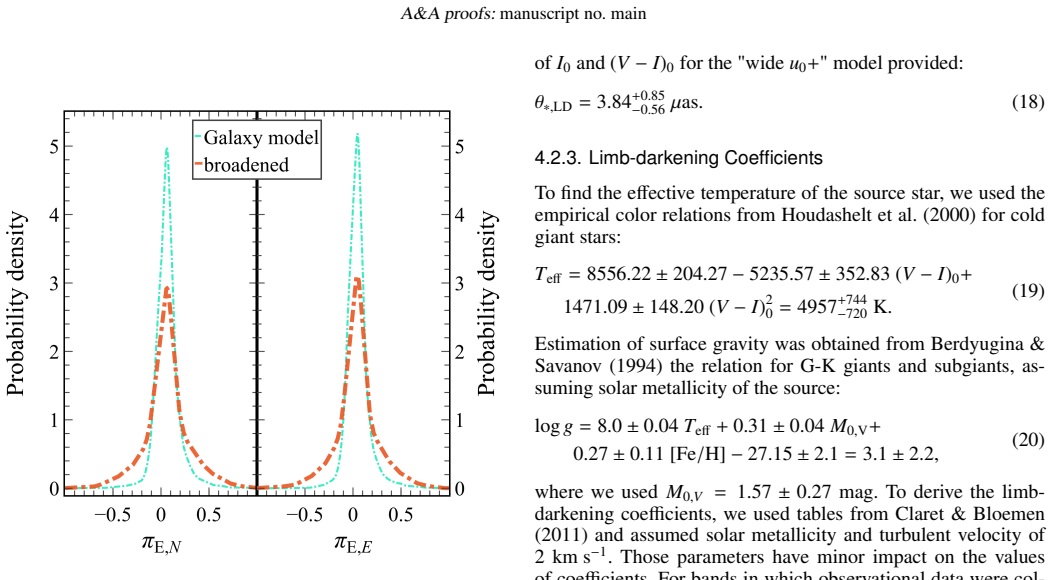
The central machinery is the binary-lens single-source (2L1S) microlensing model: the transient brightening of a background star by a foreground star-plus-planet system, described by the projected separation $s$, mass ratio $q$, trajectory angle $\alpha$, and the source radius in Einstein units $\rho$, together with the microlensing parallax vector $\pi_E$. A grid search over $\log s$ and $\log q$ isolates three anomaly topologies ('close', 'medium', 'wide'), and a Galactic-model prior built from simulated events keeps the poorly measured parallax component astrophysically plausible. The source's angular radius $\theta_*$ is derived from its dereddened color and brightness, so the Einstein radius is $\theta_E = \theta_*/\rho$; the lens mass then follows from $M_L = \theta_E/(\kappa\pi_E)$ with $\kappa \simeq 8.144\,{\rm mas}\,M_\odot^{-1}$. Bayesian evidence computed with the same Galactic model is used to compare the topologies.
What would settle it
Take a high-angular-resolution image of the field in 2027 or later, when the lens should be offset from the source by roughly $60$ mas. If the lens is detected with a near-infrared flux matching a main-sequence star above $80\,M_{\rm Jup}$, the brown-dwarf hypothesis is refuted; a flux below that boundary supports it.
Extended reading notes
Core claim
On the paper's own terms, the central claim is that the anomaly in OGLE-2015-BLG-1609 is unambiguously planetary and that the system consists of a sub-Jovian companion orbiting a host whose mass straddles the stellar/substellar boundary. For the favored 'wide' topology, $M_h = 0.17^{+0.63}_{-0.12}\,M_\odot$ and $M_c = 0.24^{+0.90}_{-0.17}\,M_{\rm Jup}$, derived by combining the finite-source radius with the microlensing parallax. Because the Bayesian evidence for the 'close' and 'wide' topologies is comparable, the host is assessed as an M-dwarf with 66% probability and a brown dwarf with 34% probability. The paper positions this as one of a small set of planet candidates around a suspected brown-dwarf host and as an event detectable by survey data alone, which makes it usable in survey-based occurrence-rate studies.
Load-bearing premise
The load-bearing premise is that the source star is a bulge red giant at $D_S = 8.54$ kpc whose angular radius follows the adopted color-radius relation; the finite-source size $\rho$ is only weakly constrained in the favored topology, so if the source distance or the color-radius conversion is wrong, the host mass estimate could shift entirely into the stellar or entirely into the substellar regime.
Editorial extensions
If this is right
- The planet is securely detected, with the binary-lens model favored over the single-lens model by $\Delta\chi^2 \approx 460$ in the new survey reductions, so it can enter planetary occurrence-rate samples built from survey data alone.
- For the favored wide solution, the companion mass is about a quarter of Jupiter's mass, placing the system in the sub-Jovian regime that microlensing is uniquely sensitive to.
- The host is more likely a low-mass M-dwarf (66%) than a brown dwarf (34%), so the system straddles the stellar/substellar boundary and is one of very few microlensing planets with a suspected brown-dwarf host.
- Because the three topologies have similar photometric quality, additional observations, not more modeling of the current light curve, are needed to pin down the physical parameters.
Reading between the lines
- A future direct measurement of the source distance would tighten the host mass enough to decide whether this is a star or a brown dwarf; the current 34% probability is almost entirely driven by the adopted $D_S=8.54$ kpc and the weakly constrained $\rho$.
- Because 'close' and 'wide' topologies carry nearly equal evidence, other survey-detected planetary anomalies without caustic crossings may hide the same host-mass ambiguity; grouping such events could reveal how often microlensing masses land on the stellar/substellar boundary.
- If adaptive-optics imaging resolves the lens at the predicted offset, the measured lens brightness would turn the 34% brown-dwarf probability into a near-certainty either way, and would also provide an independent check of the color-radius relation used for bulge red giants.
Signed reviews
Editorial analysis
A structured set of objections, weighed in public.
Referee Report
Summary. The paper presents a comprehensive analysis of the microlensing event OGLE-2015-BLG-1609, whose planetary anomaly was detected independently by the OGLE and MOA surveys. The authors model the light curve with binary-lens single-source (2L1S) models including parallax and finite-source effects, using data from OGLE, MOA, RoboNet, and MiNDSTEp. They identify three viable topologies (close, medium, wide), with the medium topology favored by Δχ² ≈ 10 but driven by a single night of OGLE data that the authors themselves suspect is overfit. For the favored wide topology they derive θ_E = 0.46^{+1.06}_{-0.24} mas from a weakly constrained finite-source radius ρ = 0.0085^{+0.0089}_{-0.0060}, leading to a host mass M_h = 0.17^{+0.63}_{-0.12} M_sun and a companion mass M_c = 0.24^{+0.90}_{-0.17} M_Jup. Combining topology-specific substellar probabilities with Bayesian evidence weights from a Galactic model, they report an overall 34% probability that the host is a brown dwarf and 66% that it is a low-mass star.
Significance. If the planet detection alone is considered, this is a valuable addition to the small sample of microlensing planets detected from survey data only, with a robust 2L1S-versus-1L1S Δχ² exceeding 230 in each dataset (Table 2). The paper also demonstrates careful data-reduction work, including new OGLE reference images, error renormalization with per-dataset coefficients, and explicit handling of systematics. However, the central physical claim—the host being a brown dwarf with 34% probability or a low-mass star with 66%—is not supported at the same level of robustness. The finite-source radius for the favored topology is only marginally detected, and the topology weighting relies on Bayesian evidence computed from the same Galactic-model family used to construct the parallax priors. The true value of the paper lies in the unambiguous planet detection and in its methodological transparency, but the host-mass probability should be presented as a prior-dependent estimate rather than a measured result.
major comments (2)
- [§4.2.4, Eq. (22) and Table 5] The lens mass and the derived substellar probability are controlled by the finite-source radius ρ, which is only weakly detected for the favored wide topology: Table 5 gives ρ = 0.0085^{+0.0089}_{-0.0060}, i.e., about 1.4σ above zero. This propagates directly into θ_E = 0.46^{+1.06}_{-0.24} mas and M_h = 0.17^{+0.63}_{-0.12} M_sun, whose posterior straddles the hydrogen-burning limit. As a result, the 25% substellar probability for the wide topology is effectively set by the prior—both the adopted color–angular-radius relation (Eq. 17) and the Galactic parallax prior—rather than by a strong data constraint. The authors should explicitly quantify how the substellar probability changes under alternative θ_* relations and alternative parallax priors, and the abstract should be reworded so that the 34% figure is not presented as a robust measurement.
- [§4.3, Eq. (27) and Table 8] The overall 34% brown-dwarf probability is obtained by weighting the three topologies with Bayesian evidence Z computed from a Galactic-model simulation (Eq. 27), using input settings from Table 3. Those settings include t_E, I_S, (V-I)_S, and extinction values derived from the same analysis that produced the parallax priors in §3.3. Additionally, the authors state that the medium topology's Δχ² advantage comes from a single night (HJD 2457267) and that the perfect fit there 'indicates overfitting'. Because the evidence weighting is both model-dependent and potentially sensitive to this one night, the 34% is not a robust number. I request a sensitivity analysis: recompute the evidence and the substellar probability after (a) excluding the HJD 2457267 OGLE points, and (b) varying the Galactic-model prior broadening factor. Without such tests, the claimed overall probability is not defensible as a central result.
minor comments (4)
- [Figure 3 caption] The caption refers to the 'OGLE-2016-BLG-1609 event', but the event is OGLE-2015-BLG-1609; please correct the year.
- [§3.3] The text contains the typo 'xarallap' twice; this should be 'xallarap'.
- [Table 8 and Eq. (27)] Table 8 reports logZ values (e.g., 6.46), while Eq. (27) uses Z as a linear weight; please clarify the notation or specify that weights are exp(logZ).
- [§5] The statement that 80 M_J is the hydrogen-burning mass limit is made without a reference; please add a citation for this substellar boundary.
Circularity Check
No significant circularity: the planet detection and mass ratio come directly from the light curve, and the prior-dependent 34% brown-dwarf probability is a transparent Bayesian estimate, not a by-construction reduction.
full rationale
The derivation chain is not circular. The planet detection is established by the photometry itself: the 2L1S models beat the 1L1S models by Delta-chi^2 = 461.5 (OGLE new reductions) and 236.2 (MOA) in Table 2, and the mass ratio q is fitted from the anomaly light curve without input from the conclusions. The host mass comes from the standard relations M_L = theta_E/(kappa*pi_E) (Eq. 23) and theta_E = theta_*/rho (Eq. 22); rho and pi_E are fitted from the light curve (Table 5), theta_* follows from the externally calibrated Adams et al. (2018) color-radius relation (Eq. 17), and the limb-darkening coefficients use Claret & Bloemen (2011). The assumed source distance D_S = 8.54 kpc enters only D_L (Eq. 26), not M_L (Eq. 23), so the host-mass probability does not inherit that assumption. The co-authored Koshimoto et al. (2021a) Galactic model is used twice, as a deliberately 4x-broadened parallax prior (Section 3.3) and as the simulation for the topology evidence Z (Eq. 27), but both uses are declared, and that model is independent support in the sense of rule 4: it is peer-reviewed, its genulens code is open source, and its assumptions (Milky Way structure, mass function, event rates) do not embed the target result that this host is a brown dwarf. The final multi-instrument host-mass values quoted in Table 8 do not use the Section 3.3 prior. The headline 34% is admittedly weakly anchored: rho is only about 1.4 sigma above zero for the wide topology (Table 5), so theta_E and M_L are broad, and the per-topology substellar fractions (25-85%) combined with the Z weights dominate the mixture. That is a statistical-robustness caveat, and the paper is explicit that the host may be a star (66%), not a self-definitional or by-construction reduction.
Assumptions & free parameters
free parameters (6)
- q (mass ratio) =
close: 0.00123, medium: 0.000225, wide: 0.00133
- s (projected separation) =
close: 1.069, medium: 1.211, wide: 1.416
- rho (source radius in Einstein units) =
close: 0.018, medium: 0.0469, wide: 0.0085
- pi_E,N and pi_E,E (parallax components) =
Table 5: pi_E,N ~ 0.2 +/- 0.6, pi_E,E ~ -0.03 to -0.06
- Galactic prior broadening parameters (mu, sigma scaled by 4) =
mu_N=0.05, sigma_N=0.30, mu_E=0.03, sigma_E=0.28 (after scaling)
- Per-dataset error-bar scaling k and e_min =
See Table 6, varies by dataset and topology
assumptions (4)
- domain assumption The source star is at DS = 8.54 kpc
- domain assumption Color-radius relation of Adams et al. (2018) and color-color transformation of Bessell & Brett (1988) are valid for the source
- domain assumption Galactic model of Koshimoto et al. (2021a) describes the priors on lens distance, velocity, and mass
- standard math Standard binary-lens microlensing theory (Paczynski 1986; Mao & Paczynski 1991) applies
Cite this review
Pith. "Pith review of OGLE-2015-BLG-1609Lb: Sub-jovian planet orbiting a low-mass stellar or brown dwarf host." pith.science (2026). https://pith.science/paper/EGWOPYFZ
@misc{pith2026241209676,
  author       = {Pith},
  title        = {Pith review of: OGLE-2015-BLG-1609Lb: Sub-jovian planet orbiting a low-mass stellar or brown dwarf host},
  year         = {2026},
  howpublished = {\url{https://pith.science/paper/EGWOPYFZ}},
  note         = {Machine review of arXiv:2412.09676}
}
read the original abstract
We present a comprehensive analysis of a planetary microlensing event OGLE-2015-BLG-1609. The planetary anomaly was detected by two survey telescopes, OGLE and MOA. Each of these surveys collected enough data over the planetary anomaly to allow for an unambiguous planet detection. Such survey detections of planetary anomalies are needed to build a robust sample of planets that could improve studies on the microlensing planetary occurrence rate by reducing biases and statistical uncertainties. In this work, we examined different methods for modeling microlensing events using individual datasets, particularly we incorporated a Galactic model prior to better constrain poorly defined microlensing parallax. Ultimately, we fitted a comprehensive model to all available data, identifying three potential typologies, with two showing comparably high Bayesian evidence. Our analysis indicates that the host of the planet is a brown dwarf with a probability of 34%, or a low-mass stellar object (M-dwarf) with the probability of 66%.
Figures


Figures from the paper (4 more)



Reference graph
Works this paper leans on
-
[1]
D., Boyajian, T
Adams, A. D., Boyajian, T. S., & von Braun, K. 2018, MNRAS, 473, 3608
2018
-
[2]
& Lupton, R
Alard, C. & Lupton, R. H. 1998, ApJ, 503, 325
1998
-
[3]
An, J. H. & Gould, A. 2001, ApJ, 563, L111
work page 2001
-
[4]
Berdyugina, S. V . & Savanov, I. S. 1994, Astronomy Letters, 20, 755
work page 1994
-
[5]
Bessell, M. S. & Brett, J. M. 1988, PASP, 100, 1134
work page 1988
-
[6]
W., Beaulieu, J
Blackman, J. W., Beaulieu, J. P., Bennett, D. P., et al. 2021, Nature, 598, 272
2021
-
[7]
A., Abe, F., Dodd, R
Bond, I. A., Abe, F., Dodd, R. J., et al. 2001, MNRAS, 327, 868
2001
-
[8]
Bramich, D. M. 2008, MNRAS, 386, L77
work page 2008
Show all 54 references
-
[9]
& Bloemen, S
Claret, A. & Bloemen, S. 2011, A&A, 529, A75
2011
-
[10]
Crotts, A. P. S. & Tomaney, A. B. 1996, ApJ, 473, L87
1996
-
[11]
G., Rattenbury, N
Dominik, M., Jørgensen, U. G., Rattenbury, N. J., et al. 2010, Astronomische Nachrichten, 331, 671
2010
-
[12]
W., Lang, D., & Goodman, J
Foreman-Mackey, D., Hogg, D. W., Lang, D., & Goodman, J. 2013, PASP, 125, 306 Gaia Collaboration, Vallenari, A., Brown, A. G. A., et al. 2023, A&A, 674, A1
2013
-
[13]
& Weare, J
Goodman, J. & Weare, J. 2010, Communications in Applied Mathematics and Computational Science, 5, 65
2010
-
[14]
S., et al
Gould, A., Dong, S., Gaudi, B. S., et al. 2010, ApJ, 720, 1073
2010
-
[15]
2022, A&A, 664, A13
Gould, A., Han, C., Zang, W., et al. 2022, A&A, 664, A13
2022
-
[16]
2024, A&A, 692, A106
Han, C., Ryu, Y ., Lee, C., et al. 2024, A&A, 692, A106
2024
-
[17]
L., Bell, R
Houdashelt, M. L., Bell, R. A., & Sweigart, A. V . 2000, AJ, 119, 1448
2000
-
[18]
2022, AJ, 163, 43
Hwang, K.-H., Zang, W., Gould, A., et al. 2022, AJ, 163, 43
2022
-
[19]
K., Gould, A., Zang, W., et al
Jung, Y . K., Gould, A., Zang, W., et al. 2019, AJ, 157, 72
2019
-
[20]
K., Zang, W., Han, C., et al
Jung, Y . K., Zang, W., Han, C., et al. 2022, AJ, 164, 262
2022
-
[21]
K., Zang, W., Wang, H., et al
Jung, Y . K., Zang, W., Wang, H., et al. 2023, AJ, 165, 226
2023
-
[22]
& Ranc, C
Koshimoto, N. & Ranc, C. 2022, nkoshimoto/genulens: Release version 1.2
2022
-
[23]
Y ., Lu, J
Lam, C. Y ., Lu, J. R., Hosek, Matthew W., J., Dawson, W. A., & Golovich, N. R. 2020, ApJ, 889, 31
2020
-
[24]
S., Zang, W., Udalski, A., et al
Li, S. S., Zang, W., Udalski, A., et al. 2019, MNRAS, 488, 3308
2019
-
[25]
& Paczynski, B
Mao, S. & Paczynski, B. 1991, ApJ, 374, L37 Mróz, M., Pietrukowicz, P., Poleski, R., et al. 2023, Acta Astron., 73, 127 Mróz, P. & Poleski, R. 2024, Exoplanet Occurrence Rates from Microlensing Surveys (Cham: Springer International Publishing), 1–23
1991
-
[26]
M., Gonzalez, O
Nataf, D. M., Gonzalez, O. A., Casagrande, L., et al. 2016, MNRAS, 456, 2692
2016
-
[27]
M., Gould, A., Fouqué, P., et al
Nataf, D. M., Gould, A., Fouqué, P., et al. 2013, ApJ, 769, 88
2013
-
[28]
2024, ApJ, 967, 77
Nunota, K., Koshimoto, N., Suzuki, D., et al. 2024, ApJ, 967, 77
2024
-
[29]
1986, ApJ, 304, 1
Paczynski, B. 1986, ApJ, 304, 1
1986
-
[30]
T., Henderson, C
Penny, M. T., Henderson, C. B., & Clanton, C. 2016, ApJ, 830, 150
2016
-
[31]
& Yee, J
Poleski, R. & Yee, J. C. 2019, Astronomy and Computing, 26, 35
2019
-
[32]
C., et al
Ryu, Y .-H., Udalski, A., Yee, J. C., et al. 2024, AJ, 167, 88
2024
-
[33]
1968, ApJ, 151, 393
Schmidt, M. 1968, ApJ, 151, 393
1968
-
[34]
C., Zang, W., et al
Shin, I.-G., Yee, J. C., Zang, W., et al. 2024, AJ, 167, 269
2024
-
[35]
C., Zang, W., et al
Shin, I.-G., Yee, J. C., Zang, W., et al. 2023, AJ, 166, 104
2023
-
[36]
M., Hundertmark, M., et al
Skottfelt, J., Bramich, D. M., Hundertmark, M., et al. 2015, A&A, 574, A54
2015
-
[37]
2016, Acta Astron., 66, 1
Skowron, J., Udalski, A., Kozłowski, S., et al. 2016, Acta Astron., 66, 1
2016
-
[38]
P., Sumi, T., et al
Suzuki, D., Bennett, D. P., Sumi, T., et al. 2016, ApJ, 833, 145
2016
-
[39]
K., Beaulieu, J.-P., Bennett, D
Terry, S. K., Beaulieu, J.-P., Bennett, D. P., et al. 2024, AJ, 168, 72
2024
-
[40]
2018, Geosciences, 8, 365
Tsapras, Y . 2018, Geosciences, 8, 365
2018
-
[41]
2009, Astronomische Nachrichten, 330, 4
Tsapras, Y ., Street, R., Horne, K., et al. 2009, Astronomische Nachrichten, 330, 4
2009
-
[42]
2003, Acta Astron., 53, 291
Udalski, A. 2003, Acta Astron., 53, 291
2003
-
[43]
H., Sajadian, S., et al
Udalski, A., Ryu, Y . H., Sajadian, S., et al. 2018, Acta Astron., 68, 1
2018
-
[44]
K., Soszynski, I., & Poleski, R
Udalski, A., Szymanski, M. K., Soszynski, I., & Poleski, R. 2008, Acta Astron., 58, 69
2008
-
[45]
K., & Szyma´nski, G
Udalski, A., Szyma´nski, M. K., & Szyma´nski, G. 2015, Acta Astron., 65, 1
2015
-
[46]
P., et al
Vandorou, A., Dang, L., Bennett, D. P., et al. 2023, arXiv e-prints, arXiv:2302.01168
2023 arXiv
-
[47]
2022, MNRAS, 510, 1778
Wang, H., Zang, W., Zhu, W., et al. 2022, MNRAS, 510, 1778
2022
-
[48]
Wozniak, P. R. 2000, Acta Astron., 50, 421 Wyrzykowski, Ł., Kruszy´nska, K., Rybicki, K. A., et al. 2023, A&A, 674, A23
2000
-
[49]
2020, AJ, 159, 98
Yang, H., Zhang, X., Hwang, K.-H., et al. 2020, AJ, 159, 98
2020
-
[50]
C., Shvartzvald, Y ., Gal-Yam, A., et al
Yee, J. C., Shvartzvald, Y ., Gal-Yam, A., et al. 2012, ApJ, 755, 102
2012
-
[51]
2021, AJ, 162, 163
Zang, W., Hwang, K.-H., Udalski, A., et al. 2021, AJ, 162, 163
2021
-
[52]
K., Yang, H., et al
Zang, W., Jung, Y . K., Yang, H., et al. 2023, AJ, 165, 103
2023
-
[53]
2022, MNRAS, 515, 928 1 Astronomical Observatory, University of Warsaw, Al
Zang, W., Yang, H., Han, C., et al. 2022, MNRAS, 515, 928 1 Astronomical Observatory, University of Warsaw, Al. Ujazdowskie 4, 00-478 Warszawa, Poland 2 Department of Earth and Space Science, Graduate School of Sci- ence, Osaka University,Toyonaka, Osaka 560-0043, Japan 3 Zent...
2022
-
[54]
Copenhagen, Jagtvej 155, 2200 Copenhagen, Denmark 30 Centro de Astronomía (CITEV A), Universidad de Antofagasta, Avda. U. de Antofagasta 02800, Antofagasta, Chile 31 Instituto de Astrofísica e Ciências do Espaço, Universidade de Coimbra, 3040-004 Coimbra, Portugal 32 Centre fo...
2015
Reviewed August 11, 2026 · model on record in the stance chip above.
Discussion (0). Continue with ORCID to comment.