REVIEW 4 major objections 6 minor 40 references
RP-SLAM: Real-time Photorealistic SLAM with Efficient 3D Gaussian Splatting
T0 review · 4 major / 6 minor · reviewed 2026-08-11 · deepseek-v4-flash
Pith's one-line read RP-SLAM reports state-of-the-art photorealistic mapping in real time by separating camera tracking from Gaussian map optimization, initializing monocular maps from sparse points, and pruning redundant Gaussians.
desk verdict Useful 3DGS-SLAM contribution with a genuinely interesting monocular initialization scheme; the SOTA claim is mostly credible but needs code, error bars, and a few robustness details. read the letter →
The pith
A machine-rendered reading of the paper's core claim, the machinery that carries it, and where it could break.
The reading
What carries the argument
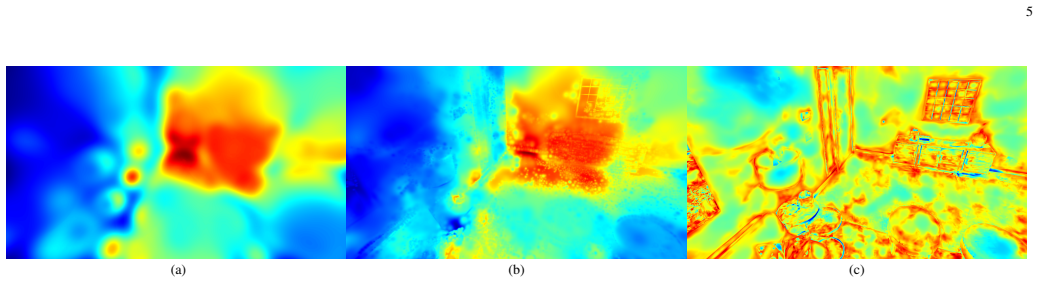
The load-bearing object is the set of 3D Gaussian primitives, each an ellipsoid with a position, covariance (scale and quaternion), color, and opacity, rasterized by $\alpha$-blending. The argument is carried by three mechanisms attached to that object: quadtree-based adaptive sampling, where each keyframe is subdivided until a gradient-variance threshold or a minimum cell size is reached and sampled pixels are back-projected into candidate primitives; KNN-based primitive filtering, which discards a new primitive when it lies within a scaled radius $\lambda r_i$ of all $k=3$ nearest existing primitives; and a dynamic keyframe window, which each iteration forms $\mathcal{W} = \{K_{new}\} \cup S_1 \cup S_2$ from $k_1$ co-visible and $k_2$ non-co-visible keyframes so optimization revisits old regions. In monocular mode, a fourth mechanism uses the tracker's sparse point cloud to place initial primitives and render a provisional depth via $\alpha$-blended rasterization, which then feeds the adaptive sampling.
What would settle it
Run the monocular pipeline on a low-texture indoor corridor where the feature tracker produces only a handful of points per keyframe; if the rendered depth used for initialization is visibly empty or wrong and final PSNR falls far below the RGB-D result on the same scene, the sparse-point-cloud initialization is the step that fails.
Extended reading notes
Core claim
On its own terms, the discovery is that the three failure modes of 3DGS-based SLAM—redundant primitives, forgetting during continuous optimization, and lack of geometric depth for monocular initialization—can be handled without sacrificing real-time speed. The paper proposes an incremental mapping stage that samples pixels with a quadtree guided by local gradient variance, so textured regions get more samples, and then filters new Gaussian primitives by a KNN test that discards any candidate lying within a scaled radius of all its three nearest neighbors. It replaces the fixed keyframe window with a dynamic window that randomly draws a fixed number of co-visible and non-co-visible keyframes each iteration, preserving both local and global consistency. For monocular cameras, it initializes Gaussians from the sparse point cloud of the feature tracker, renders an initial depth map, and uses that depth to densify the new region. The reported experiments claim state-of-the-art rendering accuracy on Replica, TUM, and ScanNet++ in both RGB-D and monocular modes, with model sizes several times smaller than most baselines.
Load-bearing premise
The load-bearing premise is that the sparse point cloud from the feature tracker is dense and accurate enough, especially in monocular mode, that the depth image rendered from it is a reliable geometric foundation for initializing new Gaussians; where features are scarce or scale is wrong, this foundation weakens.
Editorial extensions
If this is right
- On Replica RGB-D, the system reports the highest average PSNR (37.12) and lowest LPIPS (0.056) among compared methods, at 18.3 FPS with a 10.0 MB model.
- In monocular mode on Replica, it reports 35.31 dB PSNR, substantially above the compared coupled and densification-based monocular systems, while keeping model size near 11 MB.
- On ScanNet++, the highest PSNR is reported for both training and novel views, with roughly a quarter of the model size of the next-best compared method.
- The full ablation on Replica office 0 shows the three modules are complementary: together they raise PSNR from 34.87 to 37.74 dB and cut model size from 19.3 to 11.8 MB.
Reading between the lines
- A consequence the authors leave implicit is that the same quadtree sampling plus KNN filter could be dropped into any 3DGS mapping front-end, not only SLAM, wherever incremental dense reconstruction is needed.
- The monocular initialization could be stress-tested by combining it with a learned dense depth prior; the paper only uses the sparse tracker points, so scenes with few features are the natural failure boundary.
- The dynamic window could be made deterministic by selecting keyframes with maximal information gain or forgetting risk rather than random draws, which would make the consistency gain more reproducible on a single run.
- A testable extension would be to measure forgetting directly: render revisited regions at the end of a long trajectory and compare PSNR to their first-render values, since the paper reports only aggregate quality.
Editorial analysis
A structured set of objections, weighed in public.
Referee Report
Summary. The paper presents RP-SLAM, a decoupled 3D Gaussian Splatting SLAM system for monocular and RGB-D cameras. Camera poses are obtained from ORB-SLAM3, while the map is represented by Gaussian primitives that are optimized with three proposed components: an efficient incremental mapping module (quadtree-based adaptive sampling plus KNN-based Gaussian filtering), a dynamic keyframe window that randomly selects co-visible and non-co-visible keyframes to mitigate forgetting, and a monocular keyframe initialization that uses ORB-SLAM3 sparse points to bootstrap Gaussian placement and a rendered depth map. The authors evaluate on Replica, TUM, and ScanNet++ in both monocular and RGB-D settings, reporting state-of-the-art rendering accuracy (e.g., Replica RGB-D average PSNR 37.12 and LPIPS 0.056), compact model sizes around 10--11 MB, and real-time frame rates around 17--18 FPS. Ablation studies on Replica office0 support the contribution of each module, and a minimum-cell-size ablation shows the expected quality-efficiency trade-off.
Significance. If the claims are substantiated, RP-SLAM would be a useful step for real-time photorealistic mapping: it demonstrates that decoupling tracking from Gaussian optimization can yield compact maps with high rendering quality, and it offers a concrete monocular initialization mechanism that improves on random-depth initialization. The experimental breadth across three datasets and the use of official baseline implementations are strengths. However, the monocular bootstrap has an underspecified handling of undefined rendered depths, the reported averages have no error bars despite randomized keyframe selection, and the minimum cell size is tuned per dataset. These issues make the current evidence promising rather than definitive, and they are load-bearing for the central state-of-the-art claim.
major comments (4)
- [Section III-D, Eq. (2), Eq. (6)] The monocular keyframe initialization depends on rendering an initial depth map from a sparse set of Gaussians and then using that depth to back-project adaptively sampled pixels via Eq. (6). The paper never specifies how pixels for which Eq. (2) yields no depth are treated during back-projection or KNN filtering. If such pixels are skipped, texture-rich but initially unobserved regions are never filled; if arbitrary depths are assigned, misplaced Gaussians are optimized under Eq. (4) and the error compounds. This is the geometric foundation for the monocular results in Tables I and III, yet the only supporting evidence is the qualitative Fig. 3, with no sensitivity analysis to sparse-point density or accuracy. The authors should specify the exact depth-handling rule and provide a robustness study (e.g., degrading or densifying the ORB-SLAM3 point cloud) to support the monocular claim.
- [Section IV-A, Tables I--IV] The paper states that all results are averages of three runs, but no standard deviations or per-run values are reported. This matters because the dynamic keyframe window in Eq. (8) uses random selection, and several headline margins are small: for example, on TUM RGB-D the PSNR advantage over CaRtGS is 23.09 versus 22.11, and on Replica monocular the LPIPS difference is 0.067 versus 0.068. Without variance information, the reader cannot determine whether the reported improvements are statistically meaningful. Adding error bars or per-sequence variance tables is necessary to support the state-of-the-art claim.
- [Section IV-A (Implementation Details), Table VI] The minimum cell size c is set to 8 on Replica and TUM but to 4 on ScanNet++, and Table VI shows that c strongly controls both PSNR (37.12 to 42.08) and model size (5.8 to 29.4 MB) on Replica office0. The paper gives this as a deliberate choice for high-resolution details but does not provide a selection rule or show that the ScanNet++ comparison is robust to this choice. Since the ScanNet++ results in Table IV are a major part of the claimed advantage, the authors should either report results under the same default hyperparameter or justify the per-dataset choice with a principled criterion rather than post hoc tuning.
- [Section IV-E, Table V] The module ablation is performed on a single scene (Replica office0) in monocular mode only. This is too limited to establish that the proposed modules generalize across sequences, sensor modes, and scene types, especially because the EIM-only configuration reduces PSNR relative to the all-disabled baseline (34.23 versus 34.87), indicating that EIM is primarily an efficiency mechanism. The paper should include ablations on at least one additional Replica scene and one real-world sequence, and should report SSIM, LPIPS, ATE, and FPS in the ablation to verify that the quality improvements are not confined to PSNR on one scene.
minor comments (6)
- [Section I] The text uses "3D Gaussian Sputtering" instead of "3D Gaussian Splatting"; please correct this typo.
- [Section IV-A] "Datesets" should be "Datasets" in the experimental setup heading.
- [Eq. (4)] The RGB-D loss term contains the typo "Lgoe"; this should read "Lgeo".
- [Section III-B] The notation for the quadtree stopping criteria is confusing: the text defines "adaptive minimum cell size cth = ηc" and "adaptive threshold τth = ητ", but the subdivision condition is then stated as a variance comparison V(C) > τ. Please clarify how cth and τth are used, and whether c itself is a minimum cell size in pixels or a dimensionless parameter.
- [Tables I--IV] The ATE units are stated in the text as centimeters, but the tables do not repeat the units; please add the unit to the table headers or captions.
- [Authorship and reproducibility] The paper does not mention a code release. Given that the implementation builds on the MonoGS codebase and several hyperparameters (τ, λ, k1, k2, c) are introduced, a code release or detailed implementation note would substantially improve reproducibility.
Circularity Check
No significant circularity: the central claims are benchmarked against external baselines, and the only self-citation is a non-load-bearing related-work mention.
full rationale
The paper's derivation chain is empirical rather than deductive. The three proposed components—quadtree-adaptive sampling (Sec. III-B), dynamic keyframe window (Sec. III-C), and monocular keyframe initialization from ORB-SLAM3 sparse points (Sec. III-D)—are heuristic mechanisms whose value is established by rendering metrics on Replica, TUM, and ScanNet++ against baseline methods run from their official code. The monocular pipeline seeds Gaussians from sparse points, renders an initial depth via Eq. (2), and back-projects sampled pixels via Eq. (6); this is a self-contained initialization bootstrap, not a prediction, and the final evaluated quantity is photometric fidelity against external ground-truth images. The ablations in Tab. V replace each proposed module with the corresponding MonoGS component (random depth initialization, random sampling, fixed keyframe window), providing genuine control comparisons rather than circular ones. The only self-citation, reference [9] (NEB-SLAM), appears in a related-work list of NeRF methods and is not used as evidence for any RP-SLAM claim, so it is not load-bearing. A separate robustness concern—the paper does not specify how undefined rendered depth is handled in textureless monocular regions—is a correctness-risk issue, not a circularity issue. Overall, no claimed result reduces by construction to its own input. The score reflects solely the presence of one minor, non-load-bearing self-citation.
Assumptions & free parameters
free parameters (5)
- minimum cell size c =
8 on Replica/TUM; 4 on ScanNet++
- gradient variance threshold tau =
15
- KNN filtering factor lambda =
1.0
- dynamic window sizes k1, k2 =
5, 3
- loss weights lambda_pho, lambda_iso =
0.9, 10
assumptions (4)
- domain assumption 3D Gaussian splatting is differentiable and renders images via alpha-blending as in Kerbl et al.
- domain assumption The photometric, geometric, and isotropic losses from MonoGS are suitable for scene optimization.
- domain assumption ORB-SLAM3 provides accurate camera poses, keyframes, covisibility, and a sparse point cloud.
- domain assumption In monocular mode, the sparse point cloud from ORB-SLAM3 is dense and accurate enough to initialize Gaussian primitives for each new keyframe.
Cite this review
Pith. "Pith review of RP-SLAM: Real-time Photorealistic SLAM with Efficient 3D Gaussian Splatting." pith.science (2026). https://pith.science/paper/XQLED6L7
@misc{pith2026241209868,
  author       = {Pith},
  title        = {Pith review of: RP-SLAM: Real-time Photorealistic SLAM with Efficient 3D Gaussian Splatting},
  year         = {2026},
  howpublished = {\url{https://pith.science/paper/XQLED6L7}},
  note         = {Machine review of arXiv:2412.09868}
}
read the original abstract
3D Gaussian Splatting has emerged as a promising technique for high-quality 3D rendering, leading to increasing interest in integrating 3DGS into realism SLAM systems. However, existing methods face challenges such as Gaussian primitives redundancy, forgetting problem during continuous optimization, and difficulty in initializing primitives in monocular case due to lack of depth information. In order to achieve efficient and photorealistic mapping, we propose RP-SLAM, a 3D Gaussian splatting-based vision SLAM method for monocular and RGB-D cameras. RP-SLAM decouples camera poses estimation from Gaussian primitives optimization and consists of three key components. Firstly, we propose an efficient incremental mapping approach to achieve a compact and accurate representation of the scene through adaptive sampling and Gaussian primitives filtering. Secondly, a dynamic window optimization method is proposed to mitigate the forgetting problem and improve map consistency. Finally, for the monocular case, a monocular keyframe initialization method based on sparse point cloud is proposed to improve the initialization accuracy of Gaussian primitives, which provides a geometric basis for subsequent optimization. The results of numerous experiments demonstrate that RP-SLAM achieves state-of-the-art map rendering accuracy while ensuring real-time performance and model compactness.
Figures


Figures from the paper (4 more)


Reference graph
Works this paper leans on
-
[1]
Orb-slam3: An accurate open-source library for visual, visual– inertial, and multimap slam,
C. Campos, R. Elvira, J. J. G. Rodr ´ıguez, J. M. Montiel, and J. D. Tard´os, “Orb-slam3: An accurate open-source library for visual, visual– inertial, and multimap slam,” IEEE Transactions on Robotics , vol. 37, no. 6, pp. 1874–1890, 2021
2021
-
[2]
Droid-slam: Deep visual slam for monocular, stereo, and rgb-d cameras,
Z. Teed and J. Deng, “Droid-slam: Deep visual slam for monocular, stereo, and rgb-d cameras,” Advances in neural information processing systems, vol. 34, pp. 16 558–16 569, 2021
2021
-
[3]
Direct sparse odometry,
J. Engel, V . Koltun, and D. Cremers, “Direct sparse odometry,” IEEE transactions on pattern analysis and machine intelligence, vol. 40, no. 3, pp. 611–625, 2017
2017
-
[4]
Lsd-slam: Large-scale direct monocular slam,
J. Engel, T. Sch ¨ops, and D. Cremers, “Lsd-slam: Large-scale direct monocular slam,” in European conference on computer vision. Springer, 2014, pp. 834–849
2014
-
[5]
Nerf: Representing scenes as neural radiance fields for view synthesis,
B. Mildenhall, P. P. Srinivasan, M. Tancik, J. T. Barron, R. Ramamoorthi, and R. Ng, “Nerf: Representing scenes as neural radiance fields for view synthesis,” Communications of the ACM , vol. 65, no. 1, pp. 99–106, 2021
2021
-
[6]
imap: Implicit mapping and positioning in real-time,
E. Sucar, S. Liu, J. Ortiz, and A. J. Davison, “imap: Implicit mapping and positioning in real-time,” in Proceedings of the IEEE/CVF international conference on computer vision , 2021, pp. 6229–6238
work page 2021
-
[7]
Nice-slam: Neural implicit scalable encoding for slam,
Z. Zhu, S. Peng, V . Larsson, W. Xu, H. Bao, Z. Cui, M. R. Oswald, and M. Pollefeys, “Nice-slam: Neural implicit scalable encoding for slam,” in Proceedings of the IEEE/CVF conference on computer vision and pattern recognition, 2022, pp. 12 786–12 796
work page 2022
-
[8]
Nerf-slam: Real-time dense monocular slam with neural radiance fields,
A. Rosinol, J. J. Leonard, and L. Carlone, “Nerf-slam: Real-time dense monocular slam with neural radiance fields,” in 2023 IEEE/RSJ International Conference on Intelligent Robots and Systems (IROS) . IEEE, 2023, pp. 3437–3444
2023
Show all 40 references
-
[9]
Neb-slam: Neural blocks-based salable rgb-d slam for unknown scenes,
L. Bai, C. Tian, J. Yang, S. Zhang, and W. Liang, “Neb-slam: Neural blocks-based salable rgb-d slam for unknown scenes,” arXiv preprint arXiv:2405.15151, 2024
2024 arXiv
-
[10]
Co-slam: Joint coordinate and sparse parametric encodings for neural real-time slam,
H. Wang, J. Wang, and L. Agapito, “Co-slam: Joint coordinate and sparse parametric encodings for neural real-time slam,” inProceedings of the IEEE/CVF Conference on Computer Vision and Pattern Recognition, 2023, pp. 13 293–13 302. 13
2023
-
[11]
Instant neural graphics primitives with a multiresolution hash encoding,
T. M ¨uller, A. Evans, C. Schied, and A. Keller, “Instant neural graphics primitives with a multiresolution hash encoding,” ACM transactions on graphics (TOG), vol. 41, no. 4, pp. 1–15, 2022
2022
-
[12]
3d gaussian splatting for real-time radiance field rendering,
B. Kerbl, G. Kopanas, T. Leimk ¨uhler, and G. Drettakis, “3d gaussian splatting for real-time radiance field rendering,” ACM Trans. Graph. , vol. 42, no. 4, July 2023
2023
-
[13]
Splatam: Splat track & map 3d gaussians for dense rgb-d slam,
N. Keetha, J. Karhade, K. M. Jatavallabhula, G. Yang, S. Scherer, D. Ramanan, and J. Luiten, “Splatam: Splat track & map 3d gaussians for dense rgb-d slam,” in Proceedings of the IEEE/CVF Conference on Computer Vision and Pattern Recognition , 2024, pp. 21 357–21 366
2024
-
[14]
Gaussian splatting slam,
H. Matsuki, R. Murai, P. H. Kelly, and A. J. Davison, “Gaussian splatting slam,” in Proceedings of the IEEE/CVF Conference on Computer Vision and Pattern Recognition, 2024, pp. 18 039–18 048
2024
-
[15]
Rtg- slam: Real-time 3d reconstruction at scale using gaussian splatting,
Z. Peng, T. Shao, Y . Liu, J. Zhou, Y . Yang, J. Wang, and K. Zhou, “Rtg- slam: Real-time 3d reconstruction at scale using gaussian splatting,” in ACM SIGGRAPH 2024 Conference Papers , 2024, pp. 1–11
2024
-
[16]
Photo-slam: Real- time simultaneous localization and photorealistic mapping for monocular stereo and rgb-d cameras,
H. Huang, L. Li, H. Cheng, and S.-K. Yeung, “Photo-slam: Real- time simultaneous localization and photorealistic mapping for monocular stereo and rgb-d cameras,” in Proceedings of the IEEE/CVF Conference on Computer Vision and Pattern Recognition , 2024, pp. 21 584–21 593
2024
-
[17]
Rgbd gs-icp slam,
S. Ha, J. Yeon, and H. Yu, “Rgbd gs-icp slam,” in European Conference on Computer Vision . Springer, 2025, pp. 180–197
2025
-
[18]
Kinectfusion: Real-time dense surface mapping and tracking,
R. A. Newcombe, S. Izadi, O. Hilliges, D. Molyneaux, D. Kim, A. J. Davison, P. Kohi, J. Shotton, S. Hodges, and A. Fitzgibbon, “Kinectfusion: Real-time dense surface mapping and tracking,” in 2011 10th IEEE international symposium on mixed and augmented reality . Ieee, 2011, p...
2011
-
[19]
Generalized-icp
A. Segal, D. Haehnel, and S. Thrun, “Generalized-icp.” in Robotics: science and systems , vol. 2, no. 4. Seattle, W A, 2009, p. 435
2009
-
[20]
Cartgs: Computational alignment for real-time gaussian splatting slam,
D. Feng, Z. Chen, Y . Yin, S. Zhong, Y . Qi, and H. Chen, “Cartgs: Computational alignment for real-time gaussian splatting slam,” arXiv preprint arXiv:2410.00486, 2024
2024 arXiv
-
[21]
A benchmark for the evaluation of rgb-d slam systems,
J. Sturm, N. Engelhard, F. Endres, W. Burgard, and D. Cremers, “A benchmark for the evaluation of rgb-d slam systems,” in 2012 IEEE/RSJ international conference on intelligent robots and systems. IEEE, 2012, pp. 573–580
2012
-
[22]
The replica dataset: A digital replica of indoor spaces,
J. Straub, T. Whelan, L. Ma, Y . Chen, E. Wijmans, S. Green, J. J. Engel, R. Mur-Artal, C. Ren, S. Verma et al. , “The replica dataset: A digital replica of indoor spaces,” arXiv preprint arXiv:1906.05797 , 2019
1906 arXiv
-
[23]
Scannet++: A high- fidelity dataset of 3d indoor scenes,
C. Yeshwanth, Y .-C. Liu, M. Nießner, and A. Dai, “Scannet++: A high- fidelity dataset of 3d indoor scenes,” in Proceedings of the IEEE/CVF International Conference on Computer Vision , 2023, pp. 12–22
2023
-
[24]
Orb-slam: a versatile and accurate monocular slam system,
R. Mur-Artal, J. M. M. Montiel, and J. D. Tardos, “Orb-slam: a versatile and accurate monocular slam system,” IEEE transactions on robotics , vol. 31, no. 5, pp. 1147–1163, 2015
2015
-
[25]
Orb-slam2: An open-source slam system for monocular, stereo, and rgb-d cameras,
R. Mur-Artal and J. D. Tard ´os, “Orb-slam2: An open-source slam system for monocular, stereo, and rgb-d cameras,” IEEE transactions on robotics, vol. 33, no. 5, pp. 1255–1262, 2017
2017
-
[26]
Dtam: Dense tracking and mapping in real-time,
R. A. Newcombe, S. J. Lovegrove, and A. J. Davison, “Dtam: Dense tracking and mapping in real-time,” in 2011 international conference on computer vision. IEEE, 2011, pp. 2320–2327
2011
-
[27]
A volumetric method for building complex models from range images,
B. Curless and M. Levoy, “A volumetric method for building complex models from range images,” in Proceedings of the 23rd annual confer- ence on Computer graphics and interactive techniques , 1996, pp. 303– 312
1996
-
[28]
Real-time 3d reconstruction at scale using voxel hashing,
M. Nießner, M. Zollh ¨ofer, S. Izadi, and M. Stamminger, “Real-time 3d reconstruction at scale using voxel hashing,” ACM Transactions on Graphics (ToG), vol. 32, no. 6, pp. 1–11, 2013
2013
-
[29]
Very high frame rate volumetric integration of depth images on mobile devices,
O. K ¨ahler, V . A. Prisacariu, C. Y . Ren, X. Sun, P. Torr, and D. Murray, “Very high frame rate volumetric integration of depth images on mobile devices,” IEEE transactions on visualization and computer graphics , vol. 21, no. 11, pp. 1241–1250, 2015
2015
-
[30]
Scalable real-time volumetric surface reconstruction
J. Chen, D. Bautembach, and S. Izadi, “Scalable real-time volumetric surface reconstruction.” ACM Trans. Graph., vol. 32, no. 4, pp. 113–1, 2013
2013
-
[31]
Octree-based fusion for realtime 3d reconstruction,
M. Zeng, F. Zhao, J. Zheng, and X. Liu, “Octree-based fusion for realtime 3d reconstruction,” Graphical Models, vol. 75, no. 3, pp. 126– 136, 2013
2013
-
[32]
Efficient octree-based volumetric slam supporting signed-distance and occupancy mapping,
E. Vespa, N. Nikolov, M. Grimm, L. Nardi, P. H. Kelly, and S. Leuteneg- ger, “Efficient octree-based volumetric slam supporting signed-distance and occupancy mapping,” IEEE Robotics and Automation Letters, vol. 3, no. 2, pp. 1144–1151, 2018
2018
-
[33]
inerf: Inverting neural radiance fields for pose estimation,
L. Yen-Chen, P. Florence, J. T. Barron, A. Rodriguez, P. Isola, and T.-Y . Lin, “inerf: Inverting neural radiance fields for pose estimation,” in 2021 IEEE/RSJ International Conference on Intelligent Robots and Systems (IROS). IEEE, 2021, pp. 1323–1330
2021
-
[34]
Barf: Bundle-adjusting neural radiance fields,
C.-H. Lin, W.-C. Ma, A. Torralba, and S. Lucey, “Barf: Bundle-adjusting neural radiance fields,” in Proceedings of the IEEE/CVF international conference on computer vision , 2021, pp. 5741–5751
2021
-
[35]
Go-slam: Global optimization for consistent 3d instant reconstruction,
Y . Zhang, F. Tosi, S. Mattoccia, and M. Poggi, “Go-slam: Global optimization for consistent 3d instant reconstruction,” in Proceedings of the IEEE/CVF International Conference on Computer Vision , 2023, pp. 3727–3737
2023
-
[36]
Gaussian-slam: Photo-realistic dense slam with gaussian splatting,
V . Yugay, Y . Li, T. Gevers, and M. R. Oswald, “Gaussian-slam: Photo-realistic dense slam with gaussian splatting,” arXiv preprint arXiv:2312.10070, 2023
2023 arXiv
-
[37]
Loop- splat: Loop closure by registering 3d gaussian splats,
L. Zhu, Y . Li, E. Sandstr ¨om, K. Schindler, and I. Armeni, “Loop- splat: Loop closure by registering 3d gaussian splats,” arXiv preprint arXiv:2408.10154, 2024
2024 arXiv
-
[38]
Splat-slam: Globally optimized rgb-only slam with 3d gaussians,
E. Sandstr ¨om, K. Tateno, M. Oechsle, M. Niemeyer, L. Van Gool, M. R. Oswald, and F. Tombari, “Splat-slam: Globally optimized rgb-only slam with 3d gaussians,” arXiv preprint arXiv:2405.16544 , 2024
2024 arXiv
-
[39]
Ig-slam: Instant gaussian slam,
F. A. Sarikamis and A. A. Alatan, “Ig-slam: Instant gaussian slam,” arXiv preprint arXiv:2408.01126 , 2024
2024 arXiv
-
[40]
Accelerating 3d deep learning with pytorch3d,
N. Ravi, J. Reizenstein, D. Novotny, T. Gordon, W.-Y . Lo, J. Johnson, and G. Gkioxari, “Accelerating 3d deep learning with pytorch3d,” arXiv:2007.08501, 2020
2007 arXiv
Reviewed August 11, 2026 · model on record in the stance chip above.
Discussion (0). Continue with ORCID to comment.