REVIEW 3 major objections 5 minor 3 cited by
Mass-transferring binary stars as progenitors of interacting hydrogen-free supernovae
T0 review · 3 major / 5 minor · reviewed 2026-08-11 · deepseek-v4-flash
Pith's one-line read This paper argues that a second phase of mass transfer in helium-star/main-sequence binaries, starting less than about 20,000 years before core collapse, can eject up to 0.8 solar masses of hydrogen-free material that forms a circumbinary…
desk verdict Plausible new binary channel for Type Ibn SNe, but the headline rate rests on an unresolved mass-transfer stability criterion. read the letter →
The pith
A machine-rendered reading of the paper's core claim, the machinery that carries it, and where it could break.
The reading
What carries the argument
The load-bearing mechanism is Case BC RLOF: a second phase of Roche-lobe overflow that begins after core helium exhaustion, when the stripped helium star (a HeS with mass below ~3.4 M_sun) expands by 1-2 orders of magnitude in radius within a few thousand years. The mass lost in this phase is clocked by how early the star starts filling its Roche lobe; the paper maps that duration to the transferred mass (about 0.8 M_sun if overflow begins 20 kyr before collapse). The companion accretes almost nothing, so the unaccreted helium-rich gas is lost from the binary, and, if it is ejected through the outer Lagrangian point, it settles into a circumbinary disk whose inner radius is a few times the binary separation. A simple momentum-conserving collision model between the supernova ejecta and this disk, with a density profile and half-opening angle, yields the interaction luminosity that shapes the light curve.
What would settle it
A converged binary evolution model of a qi = 0.5, 12-14 solar-mass binary that applies the Marchant (2017) radiation-driven ejection limit and finds the system merges during Case B RLOF would falsify the channel and its ~10-12% rate prediction, because all the rerun models in this paper would then be unstable.
Extended reading notes
Core claim
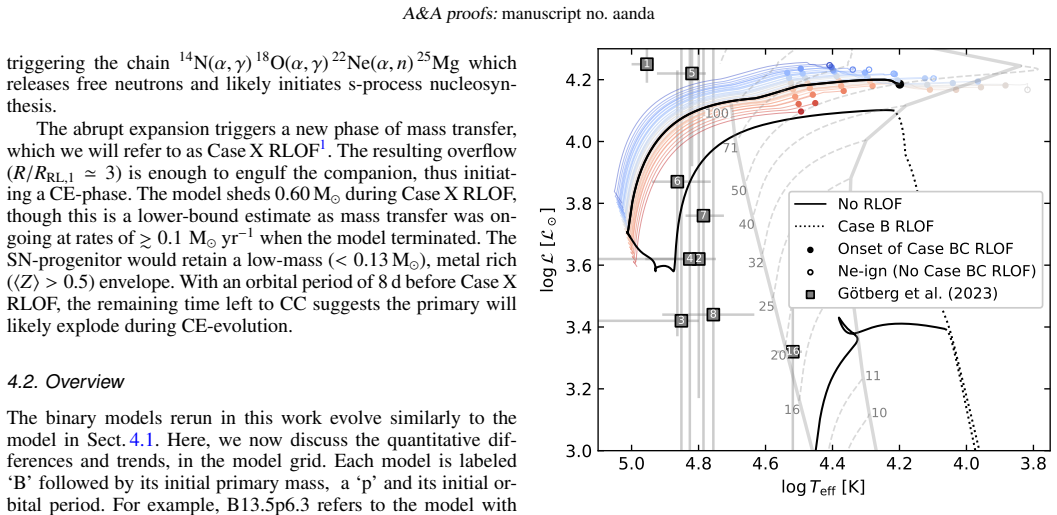
The central discovery is that low-mass helium stars (below about 3.4 solar masses at core helium exhaustion) expand dramatically in the last ~20,000 years before core collapse, and in a binary this expansion can restart Roche-lobe overflow (Case BC mass transfer) onto a main-sequence companion. The donor loses 0.1 to 0.8 solar masses of hydrogen-free material, almost all of which escapes the binary because the companion is already spinning at critical rotation. If this material forms a bound circumbinary disk, a simple inelastic-collision model shows that the ejecta of the exploding donor convert up to tens of percent of their kinetic energy into radiation, reproducing the circumstellar masses, ejecta masses, CSM radii, and bell-shaped light curves inferred for many Type Ibn supernovae and a few Type Icn events. Mapping the mass-loss onto a full binary grid and weighting by the initial mass function gives up to ~12% of stripped-envelope supernovae from this channel, in line with the observed ~9.2% Type Ibn fraction.
Load-bearing premise
The rate claim stands on the assumption that the first mass-transfer phase (Case B RLOF) leaves the binary bound; the paper adopts a stability criterion (Pauli et al.) under which the rerun binaries survive, whereas the stricter Marchant (2017) criterion would make all of the qi = 0.5 rerun models merge and remove the channel entirely.
Editorial extensions
If this is right
- Type Ibn supernovae with low ejecta mass and high CSM mass (Mej ~ 1 M_sun, MCSM 0.1-1 M_sun) are plausibly the explosions of these Case BC binaries rather than of single stars.
- The CSM around many interacting H-poor SNe is expected to be disk-like rather than spherical, with interaction delayed by hours to about a day as the ejecta reach the inner disk edge.
- About one in ten stripped-envelope supernovae should show interaction features of the kind the channel predicts, matching the observed Type Ibn fraction.
- Systems that start mass transfer earlier strip more mass: 20 kyr before collapse gives ~0.8 M_sun of CSM, while 1 kyr gives ~0.1 M_sun, producing a spread in interaction strength.
- The surviving binaries after the supernova should often be Be X-ray binaries or, later, merged neutron-star/white-dwarf pairs, a testable population prediction.
Reading between the lines
- If the disk geometry is confirmed by spectropolarimetry or line-profile modeling of Type Ibn SNe, the channel would simultaneously explain their light curves and their uncommon narrow-line persistence, which spherical CSM models struggle to reproduce.
- The rate estimate depends on the adopted Case B stability criterion; settling that criterion observationally (e.g., through the number of Be-star secondaries near stripped stars) would sharpen the prediction.
- A direct extension would be to compute spectral synthesis of these exploding donors with the CBD included; the paper leaves that to future work, but it is the decisive next test.
- The same mass-transfer clock should apply to Type Icn/Ic-CSM SNe with Mej < 1.5 M_sun, since those also fall in the model parameter space, implying a continuum between Ibn and some Icn events from one binary channel.
Editorial analysis
A structured set of objections, weighed in public.
Referee Report
Summary. The paper proposes that H-free (helium-star) donors in close binaries with main-sequence companions can undergo a late phase of Roche-lobe overflow (Case BC RLOF) within ~20 kyr of core collapse, ejecting up to ~0.8 Msun of H-free material that forms a circumbinary disk. The authors argue that this channel can explain the inferred CSM masses, radii, ejecta masses, and light-curve morphologies of many Type Ibn SNe and some Type Icn SNe, and that population synthesis of a large binary grid yields about 10-12% of stripped-envelope SNe from this channel, matching the observed Type Ibn fraction of ~9.2%. The paper is based on 44 rerun binary models with improved physics and a mapping method to estimate Case BC RLOF properties across the full grid.
Significance. If the channel is robust, this would identify a specific, quantitative binary progenitor for a class of interacting H-poor supernovae, connecting binary evolution models to observed transients and providing a testable rate. The manuscript is strong in several respects: the binary evolution calculations are detailed and the authors transparently discuss uncertainties; the mapping method in Sect. 5.1 and Appendix B is a practical tool for extrapolating from rerun models to a large grid; and the comparison with observed MCSM, Mej, and RCSM in Sect. 6 is systematic and clearly presented. The paper also explicitly flags its own limitations, including the unresolved mass-transfer stability criterion and the numerical origin of Case X RLOF, which is commendable but also means the central quantitative claims are less secure than the abstract suggests.
major comments (3)
- [Sect. 7.2.2 and Sect. 5.6] The central rate claim (up to ~12% of stripped-envelope SNe, Sect. 5.6 and Conclusions) is contingent on the stability of Case B RLOF, which the authors themselves show is unresolved. In Sect. 7.2.2, the Marchant (2017) criterion (Eq. 5) is applied to the rerun models with qi = 0.5, and all of them are flagged as unstable during Case B RLOF (Fig. 16), implying merger rather than survival to Case BC RLOF. The less stringent Pauli (2020) criterion leaves most of the rerun models stable, but the manuscript does not establish which criterion is correct. The population synthesis in Sect. 5.6 uses the grid's stability criteria from Sect. 2.4, which do not include the Marchant limit, so the reported rate does not account for the possibility that most of the parameter space is removed. This is a load-bearing issue: the 12% figure and the claimed agreement with the observed ~9.2% Type Ibn fraction would collapse if the Marchant criterion holds. I request a quantitative exploration of this dependence, e.g., recomputing the rate under the Marchant criterion or providing a compelling argument for why the Pauli criterion is preferred.
- [Sect. 4.2.3 and Sect. 7.3.2] Half of the rerun models undergo Case X RLOF and fail to reach core collapse, and the manuscript states that the small-scale over/undershooting of 0.008 H_P introduced after core C burning is the direct cause of this behavior (Sect. 7.3.2), noting that these numerical settings 'lack physical backing' and were introduced for convergence. While the paper excludes the effect of Case X on the SN properties by using data at 1 yr before termination (Sect. 4.3), this does not resolve the physical fate of those systems: if Case X RLOF is a numerical artifact, the affected models would likely evolve differently and not explode with the proposed CSM structure; if it is real, the explosion during CE evolution would produce qualitatively different observational signatures. Since half of the rerun models are affected, this uncertainty propagates to the population estimate and the comparison with observed SNe. The paper should quantify how the exclusion or reclassification of Case X models affects the rate (Sect. 5.6) and the MCSM-Mej distributions (Fig. 11).
- [Sect. 5.5 and Fig. 13] The claimed qualitative agreement with Type Ibn light curves is based on a simplified model in which the CBD parameters (half-opening angle θ, density slope s, inner and outer radii, and explosion energy Ekin) are freely chosen. The manuscript itself describes this as 'very crude' and notes that radiation transport is neglected (Sect. 5.5). As a proof of concept this is acceptable, but the paper's abstract and conclusions present the light-curve morphology match as supporting evidence for the channel. Since the parameter space is large, the current analysis does not demonstrate that the models make distinctive, falsifiable predictions beyond what a generic disk-like CSM with adjustable parameters would produce. I recommend either reframing the light-curve comparison explicitly as an existence proof, or providing a more systematic exploration showing what range of θ, s, and Rin-Rout is required to match the observed Type Ibn sample and which observed events cannot be accommodated under any plausible choices.
minor comments (5)
- [Abstract and Sect. 5.6] The abstract states 'up to ~10%' of stripped-envelope SNe while Sect. 5.6 and the Conclusions state ~12%; please make these numbers consistent and report the uncertainty or range.
- [General] There are several typographical errors, including 'particularily' (Sects. 4.2.1 and 5.5), 'sorrunding' (Sect. 6.1), 'mash' for 'match' (Sect. 5.5), and '6end' in Table 1 note. A careful proofreading pass is needed.
- [Sect. 5.3] The notation fM is used both for the mass fraction in Eq. (2) and for the angle-dependent fraction in Eq. (4) with different definitions; please disambiguate these symbols to avoid confusion.
- [Fig. 12] The bar chart of spatial distributions is dense and difficult to read, especially the overlapping hatched regions; consider presenting the key radii and masses in a table or in separate panels for clarity.
- [Sect. 3.3] The phrase 'in logarithmic steps of 0.01' for initial mass is ambiguous; please specify whether the step is 0.01 dex or 0.01 Msun.
Circularity Check
No significant circularity found: the channel's CSM masses and rate come from stellar and binary evolution models and are compared with observed Type Ibn/Icn properties after the fact; the unconstrained CBD geometry and unresolved Case B stability criterion are acknowledged uncertainties, not fitted inputs.
full rationale
The central derivation chain is self-contained rather than circular. The binary evolution models produce H-free donors that expand and fill their Roche lobes shortly before core collapse, and the unaccreted transferred mass provides an upper limit on CSM mass; this quantity is computed from stellar structure and binary evolution, not from the observed SNe. The population-synthesis estimate of roughly 12% of stripped-envelope SNe is obtained by assigning an IMF and flat log-period and mass-ratio distributions to the binary grid and counting Case BC RLOF systems, and the observed 9.2% Type Ibn fraction is used only as a post-hoc comparison, not as a fitted target. The light-curve models in Sect. 5.5 explicitly introduce half-opening angle, density slope, and disk radii as parameters 'not constrained by our models' and present the result as a 'proof of concept,' so the qualitative bell-shape agreement is a demonstration of plausibility rather than a hidden parameter fit. The main caveats, namely the sensitivity to the Marchant versus Pauli Case B stability criterion in Sect. 7.2.2 and the uncertain CSM geometry, are openly discussed physical uncertainties and do not reduce any prediction to its own input. No load-bearing self-citation chain is used: the previous papers by the authors provide numerical settings and the underlying grid, but the key comparisons are against independent observed events and externally published stability criteria.
Assumptions & free parameters
free parameters (6)
- Circumbinary disk half-opening angle θ =
5°, 10°, 15°, 30°, 90°
- Circumbinary disk density slope s =
-1 (fiducial), 0, -2
- Circumbinary disk inner radius R_in =
10^13 cm
- Circumbinary disk outer radius R_out =
10^15 cm
- CSM expansion velocity v_CSM =
10 km/s, with 5 and 20 km/s tests
- Neutron star mass M_ns =
1.35 Msun, range 1.20 to 1.50
assumptions (8)
- domain assumption MESA (r10398) with approx21 network adequately models late-stage evolution to core collapse
- domain assumption Case B RLOF is stable for the rerun qi = 0.5 models
- domain assumption Case BC RLOF is completely inefficient (f = 0); all transferred mass leaves the binary
- domain assumption Unaccreted mass exits through the outer Lagrangian point and forms a bound circumbinary disk retaining at least 80 percent of the mass
- ad hoc to paper Small-scale over/undershooting of 0.008 H_P after core C burning
- domain assumption Yoon (2017) / Nugis & Lamers (2000) wind mass-loss prescription for He stars
- domain assumption Salpeter IMF with flat log P and log q initial distributions for population synthesis
- domain assumption Explosion energies, nickel masses, and NS masses from 1D explosion recipes
Cite this review
Pith. "Pith review of Mass-transferring binary stars as progenitors of interacting hydrogen-free supernovae." pith.science (2026). https://pith.science/paper/QBWK6NXJ
@misc{pith2026241209893,
  author       = {Pith},
  title        = {Pith review of: Mass-transferring binary stars as progenitors of interacting hydrogen-free supernovae},
  year         = {2026},
  howpublished = {\url{https://pith.science/paper/QBWK6NXJ}},
  note         = {Machine review of arXiv:2412.09893}
}
abstract
Stripped-envelope supernovae (SNe) are H-poor transients produced at the end of the life of massive stars that previously lost their H-rich envelope. Their progenitors are thought to be donor stars in mass-transferring binary systems, which were stripped of their H-rich envelopes some $10^6$yr before core collapse. A subset of the stripped-envelope SNe exhibit spectral and photometric features indicative of interaction between their ejecta and nearby circumstellar material (CSM). We examine whether mass transfer during, or shortly before, core collapse in massive binary systems can produce the CSM inferred from the observations of interacting H-poor SNe. We select 44 models from a comprehensive grid of detailed binary evolution models in which the mass donors are H-free and explode while transferring mass to a main-sequence companion. We find that in these models, mass transfer starts less than $\sim20$kyr before, and often continues until the core collapse of the donor star. Up to $0.8M_\odot$ of H-free material are removed from the donor star during this phase, which may produce a He-rich circumbinary material. We explore plausible assumptions for its spatial distribution at the time of explosion. When assuming that the CSM accumulates in a circumbinary disk, we find qualitative agreement with the supernova and CSM properties inferred from observed Type Ibn SNe, and to a lesser extent with constraints from Type Icn SNe. We find that our mass transferring stripped envelope SN progenitor models may produce up to $\sim$10% of all stripped envelope supernovae. The binary channel proposed in this work can qualitatively account for the observed key properties and rate of interacting H-poor SNe. Models for the evolution of the circumbinary material and the spectral evolution of exploding progenitors from this channel are needed to further test its significance.
Figures


Figures from the paper (13 more)



Forward citations
Cited by 3 Pith papers
-
Population Synthesis Study on the Binary Origin of Type Ibn Supernovae
Binary population synthesis shows low-mass helium stars in close binaries can account for the observed Type Ibn supernova rate, but He star compact object mergers cannot.
-
The progenitors and circumstellar environments of stripped-envelope interacting supernovae from BPASS
Using BPASS, only binary progenitors whose mass loss forms a circum-binary disc reproduce the luminosities and rise times of stripped-envelope interacting supernovae.
-
Stellar Tidal Disruptions by Newborn Neutron Stars or Black Holes: A Mechanism for Hydrogen-poor (Super)luminous Supernovae and Fast Blue Optical Transients
A newborn compact object that tidally disrupts its binary companion can power hydrogen-poor superluminous supernovae and fast blue optical transients at roughly the observed rates.
Reference graph
Works this paper leans on
-
[1]
, " * write output.state after.block = add.period write newline
ENTRY address archiveprefix author booktitle chapter edition editor howpublished institution eprint journal key month note number organization pages publisher school series title type volume year label extra.label sort.label short.list INTEGERS output.state before.all mid.sentence after.sentence after.block FUNCTION init.state.consts #0 'before.all := #1 ...
-
[2]
write newline
" write newline "" before.all 'output.state := FUNCTION n.dashify 't := "" t empty not t #1 #1 substring "-" = t #1 #2 substring "--" = not "--" * t #2 global.max substring 't := t #1 #1 substring "-" = "-" * t #2 global.max substring 't := while if t #1 #1 substring * t #2 global.max substring 't := if while FUNCTION word.in bbl.in " " * FUNCTION format....
-
[3]
R., Langer , N., Antoniadis , J., et al
Aguilera-Dena , D. R., Langer , N., Antoniadis , J., et al. 2022, , 661, A60
2022
-
[4]
R., Langer , N., Moriya , T
Aguilera-Dena , D. R., Langer , N., Moriya , T. J., & Schootemeijer , A. 2018, , 858, 115
2018
-
[5]
R., M \"u ller , B., Antoniadis , J., et al
Aguilera-Dena , D. R., M \"u ller , B., Antoniadis , J., et al. 2023, , 671, A134
2023
-
[6]
& Lubow , S
Artymowicz , P. & Lubow , S. H. 1994, , 421, 651
1994
-
[7]
M., & Grevesse , N
Asplund , M., Amarsi , A. M., & Grevesse , N. 2021, , 653, A141
2021
-
[8]
C., Kulkarni , S
Bellm , E. C., Kulkarni , S. R., Graham , M. J., et al. 2019, , 131, 018002
2019
Show all 164 references
-
[9]
A., et al
Ben-Ami , S., Gal-Yam , A., Mazzali , P. A., et al. 2014, , 785, 37
2014
-
[10]
2023, , 946, 30
Ben-Ami , T., Arcavi , I., Newsome , M., et al. 2023, , 946, 30
2023
-
[11]
& Langer , N
Braun , H. & Langer , N. 1995, , 297, 483
1995
-
[12]
J., Sollerman , J., Irani , I., et al
Brennan , S. J., Sollerman , J., Irani , I., et al. 2024, , 684, L18
2024
-
[13]
2022, , 939, 105
Brethauer , D., Margutti , R., Milisavljevic , D., et al. 2022, , 939, 105
2022
-
[14]
Burrows , A., Hayes , J., & Fryxell , B. A. 1995, , 450, 830
1995
-
[15]
C., & Vinko , J
Chatzopoulos , E., Wheeler , J. C., & Vinko , J. 2012, , 746, 121
2012
-
[16]
C., Vinko , J., Horvath , Z
Chatzopoulos , E., Wheeler , J. C., Vinko , J., Horvath , Z. L., & Nagy , A. 2013, , 773, 76
2013
-
[17]
2024, , 625, 253
Chen , P., Gal-Yam , A., Sollerman , J., et al. 2024, , 625, 253
2024
-
[18]
Chugai , N. N. 2009, , 400, 866
2009
-
[19]
Chugai , N. N. 2022, Astronomy Letters, 48, 163
2022
-
[20]
N., Blinnikov , S
Chugai , N. N., Blinnikov , S. I., Cumming , R. J., et al. 2004, , 352, 1213
2004
-
[21]
Claeys , J. S. W., de Mink , S. E., Pols , O. R., Eldridge , J. J., & Baes , M. 2011, , 528, A131
2011
-
[22]
2020, , 492, 2208
Clark , P., Maguire , K., Inserra , C., et al. 2020, , 492, 2208
2020
-
[23]
Darwin , G. H. 1879, Proceedings of the Royal Society of London Series I, 29, 168
-
[24]
W., Taggart , K., Tinyanont , S., et al
Davis , K. W., Taggart , K., Tinyanont , S., et al. 2023, , 523, 2530
2023
-
[25]
P., Ercolino , A., Jin , H., & Langer , N
Dessart , L., Guti \'e rrez , C. P., Ercolino , A., Jin , H., & Langer , N. 2024, , 685, A169
2024
-
[26]
& Hillier , D
Dessart , L. & Hillier , D. J. 2022, , 660, L9
2022
-
[27]
J., & Kuncarayakti , H
Dessart , L., Hillier , D. J., & Kuncarayakti , H. 2022, , 658, A130
2022
-
[28]
J., Li , C., & Woosley , S
Dessart , L., Hillier , D. J., Li , C., & Woosley , S. 2012, , 424, 2139
2012
-
[29]
J., Livne , E., et al
Dessart , L., Hillier , D. J., Livne , E., et al. 2011, , 414, 2985
2011
-
[30]
J., Sukhbold , T., Woosley , S
Dessart , L., Hillier , D. J., Sukhbold , T., Woosley , S. E., & Janka , H. T. 2021, , 656, A61
2021
-
[31]
J., Woosley , S
Dessart , L., Hillier , D. J., Woosley , S. E., & Kuncarayakti , H. 2023, , 677, A7
2023
-
[32]
R., & Langer , N
Dessart , L., Yoon , S.-C., Aguilera-Dena , D. R., & Langer , N. 2020, , 642, A106
2020
-
[33]
Dewi , J. D. M. & Pols , O. R. 2003, , 344, 629
2003
-
[34]
2024, arXiv e-prints, arXiv:2405.04583
Dong , Y., Tsuna , D., Valenti , S., et al. 2024, arXiv e-prints, arXiv:2405.04583
2024 arXiv
-
[35]
R., G \"o tberg , Y., Ludwig , B
Drout , M. R., G \"o tberg , Y., Ludwig , B. A., et al. 2023, Science, 382, 1287
2023
-
[36]
L., Langer , N., Dunstall , P
Dufton , P. L., Langer , N., Dunstall , P. R., et al. 2013, , 550, A109
2013
-
[37]
2024, , 685, A58
Ercolino , A., Jin , H., Langer , N., & Dessart , L. 2024, , 685, A58
2024
-
[38]
E., Sukhbold , T., & Janka , H
Ertl , T., Woosley , S. E., Sukhbold , T., & Janka , H. T. 2020, , 890, 51
2020
-
[39]
E., Petermann , I., et al
Farmer , R., Fields , C. E., Petermann , I., et al. 2016, , 227, 22
2016
-
[40]
2022, , 601, 201
Gal-Yam , A., Bruch , R., Schulze , S., et al. 2022, , 601, 201
2022
-
[41]
2020, , 889, 170
Gangopadhyay , A., Misra , K., Hiramatsu , D., et al. 2020, , 889, 170
2020
-
[42]
2022, , 930, 127
Gangopadhyay , A., Misra , K., Hosseinzadeh , G., et al. 2022, , 930, 127
2022
-
[43]
1990, , 245, 597
Gautschy , A., Glatzel , W., Gautschy , A., & Glatzel , W. 1990, , 245, 597
1990
-
[44]
& Saio , H
Gautschy , A. & Saio , H. 1995, , 33, 75
1995
-
[45]
S., Eldridge , J
Gilkis , A., Vink , J. S., Eldridge , J. J., & Tout , C. A. 2019, , 486, 4451
2019
-
[46]
R., Ji , A
G \"o tberg , Y., Drout , M. R., Ji , A. P., et al. 2023, , 959, 125
2023
-
[47]
A., et al
Guillochon , J., Nicholl , M., Villar , V. A., et al. 2018, , 236, 6
2018
-
[48]
2024, , 530, 4461
Guo , Y.-L., Wang , B., Chen , W.-C., et al. 2024, , 530, 4461
2024
-
[49]
Habets , G. M. H. J. 1986, , 165, 95
1986
-
[50]
2014, , 565, A27
Hainich , R., R \"u hling , U., Todt , H., et al. 2014, , 565, A27
2014
-
[51]
R., Gr \"a fener , G., & Liermann , A
Hamann , W. R., Gr \"a fener , G., & Liermann , A. 2006, , 457, 1015
2006
-
[52]
Hastings , B., Langer , N., Wang , C., Schootemeijer , A., & Milone , A. P. 2021, , 653, A144
2021
-
[53]
Heger , A., Langer , N., & Woosley , S. E. 2000, , 528, 368
2000
-
[54]
2023, , 523, 6011
Hirai , R. 2023, , 523, 6011
2023
-
[55]
2018, , 864, 119
Hirai , R., Podsiadlowski , P., & Yamada , S. 2018, , 864, 119
2018
-
[56]
Ho , A. Y. Q., Perley , D. A., Gal-Yam , A., et al. 2023, , 949, 120
2023
-
[57]
1994, , 428, 654
Hollenbach , D., Johnstone , D., Lizano , S., & Shu , F. 1994, , 428, 654
1994
-
[58]
2017, , 836, 158
Hosseinzadeh , G., Arcavi , I., Valenti , S., et al. 2017, , 836, 158
2017
-
[59]
M., Tyson , J
Ivezi \'c , Z ., Kahn , S. M., Tyson , J. A., et al. 2019, , 873, 111
2019
-
[60]
2017, , 837, 84
Janka , H.-T. 2017, , 837, 84
2017
-
[61]
M., M \"u ller , B., & Li , X.-D
Jiang , L., Chen , W.-C., Tauris , T. M., M \"u ller , B., & Li , X.-D. 2023, , 945, 90
2023
-
[62]
M., Chen , W.-C., & Fuller , J
Jiang , L., Tauris , T. M., Chen , W.-C., & Fuller , J. 2021, , 920, L36
2021
-
[63]
J., & Proffitt , C
Jin , H., Langer , N., Lennon , D. J., & Proffitt , C. R. 2024, , 690, A135
2024
-
[64]
2021, , 649, A163
Karamehmetoglu , E., Fransson , C., Sollerman , J., et al. 2021, , 649, A163
2021
-
[65]
2018, , 481, L141
Kleiser , I., Fuller , J., & Kasen , D. 2018, , 481, L141
2018
-
[66]
2022, , 662, A56
Klencki , J., Istrate , A., Nelemans , G., & Pols , O. 2022, , 662, A56
2022
-
[67]
S., Shappee , B
Kochanek , C. S., Shappee , B. J., Stanek , K. Z., et al. 2017, , 129, 104502
2017
-
[68]
& Ritter , H
Kolb , U. & Ritter , H. 1990, , 236, 385
1990
-
[69]
C., Karamehmetoglu , E., Sollerman , J., et al
Kool , E. C., Karamehmetoglu , E., Sollerman , J., et al. 2021, , 652, A136
2021
-
[70]
U., Tauris , T
Kruckow , M. U., Tauris , T. M., Langer , N., Kramer , M., & Izzard , R. G. 2018, , 481, 1908
2018
-
[71]
Kulkarni , S. R. 2013, The Astronomer's Telegram, 4807, 1
2013
-
[72]
E., Justham , S., & Farmer , R
Laplace , E., G \"o tberg , Y., de Mink , S. E., Justham , S., & Farmer , R. 2020, , 637, A6
2020
-
[73]
M., Kulkarni , S
Law , N. M., Kulkarni , S. R., Dekany , R. G., et al. 2009, , 121, 1395
2009
-
[74]
K., & Han , Z
Liu , Z.-W., R \"o pke , F. K., & Han , Z. 2023, Research in Astronomy and Astrophysics, 23, 082001
2023
-
[75]
M., R \"o pke , F
Liu , Z.-W., Tauris , T. M., R \"o pke , F. K., et al. 2015, , 584, A11
2015
-
[76]
2023, , 519, 1409
Lu , W., Fuller , J., Quataert , E., & Bonnerot , C. 2023, , 519, 1409
2023
-
[77]
Lucy , L. B. 1991, , 383, 308
1991
-
[78]
& Moriya , T
Maeda , K. & Moriya , T. J. 2022, , 927, 25
2022
-
[79]
& M \"u ller , B
Mandel , I. & M \"u ller , B. 2020, , 499, 3214
2020
-
[80]
2017, PhD thesis, Rheinische Friedrich Wilhelms University of Bonn, Germany
Marchant , P. 2017, PhD thesis, Rheinische Friedrich Wilhelms University of Bonn, Germany
2017
-
[81]
M., & Moriya , T
Marchant , P., Langer , N., Podsiadlowski , P., Tauris , T. M., & Moriya , T. J. 2016, , 588, A50
2016
-
[82]
Marchant , P., Pappas , K. M. W., Gallegos-Garcia , M., et al. 2021, , 650, A107
2021
-
[83]
D., Chornock , R., et al
Margutti , R., Metzger , B. D., Chornock , R., et al. 2019, , 872, 18
2019
-
[84]
& Sawada , R
Matsuoka , T. & Sawada , R. 2024, , 963, 105
2024
-
[85]
Mattila , S., Meikle , W. P. S., Lundqvist , P., et al. 2008, , 389, 141
2008
-
[86]
J., Nicholl , M., et al
Moore , T., Smartt , S. J., Nicholl , M., et al. 2023, , 956, L31
2023
-
[87]
M \"u ller , B., Heger , A., Liptai , D., & Cameron , J. B. 2016, , 460, 742
2016
-
[88]
J., Jerkstrand , A., et al
Nicholl , M., Smartt , S. J., Jerkstrand , A., et al. 2015, , 452, 3869
2015
-
[89]
& Lamers , H
Nugis , T. & Lamers , H. J. G. L. M. 2000, , 360, 227
2000
-
[90]
& Ott , C
O'Connor , E. & Ott , C. D. 2011, , 730, 70
2011
-
[91]
2021, , 505, 2485
Ogata , M., Hirai , R., & Hijikawa , K. 2021, , 505, 2485
2021
-
[92]
& Maeda , K
Ouchi , R. & Maeda , K. 2017, , 840, 90
2017
-
[93]
1971, , 21, 1
Paczy \'n ski , B. 1971, , 21, 1
1971
-
[94]
J., et al
Pastorello , A., Benetti , S., Brown , P. J., et al. 2015 a , , 449, 1921
2015
-
[95]
J., Mattila , S., et al
Pastorello , A., Smartt , S. J., Mattila , S., et al. 2007, , 447, 829
2007
-
[96]
2015 b , , 449, 1941
Pastorello , A., Wyrzykowski , ., Valenti , S., et al. 2015 b , , 449, 1941
2015
-
[97]
2020, Master's thesis, Rheinische Friedrich Wilhelms University of Bonn, Germany
Pauli , D. 2020, Master's thesis, Rheinische Friedrich Wilhelms University of Bonn, Germany
2020
-
[98]
R., Wang , C., & Marchant , P
Pauli , D., Langer , N., Aguilera-Dena , D. R., Wang , C., & Marchant , P. 2022, , 667, A58
2022
-
[99]
& Ivanova , N
Pavlovskii , K. & Ivanova , N. 2015, , 449, 4415
2015
-
[100]
2011, , 192, 3
Paxton , B., Bildsten , L., Dotter , A., et al. 2011, , 192, 3
2011
-
[101]
2013, , 208, 4
Paxton , B., Cantiello , M., Arras , P., et al. 2013, , 208, 4
2013
-
[102]
2015, , 220, 15
Paxton , B., Marchant , P., Schwab , J., et al. 2015, , 220, 15
2015
-
[103]
B., et al
Paxton , B., Schwab , J., Bauer , E. B., et al. 2018, , 234, 34
2018
-
[104]
2019, , 243, 10
Paxton , B., Smolec , R., Schwab , J., et al. 2019, , 243, 10
2019
-
[105]
D., & Tomida , K
Pejcha , O., Metzger , B. D., & Tomida , K. 2016, , 455, 4351
2016
-
[106]
A., Terreran , G., et al
Pellegrino , C., Howell , D. A., Terreran , G., et al. 2022 a , , 938, 73
2022
-
[107]
A., Vink \'o , J., et al
Pellegrino , C., Howell , D. A., Vink \'o , J., et al. 2022 b , , 926, 125
2022
-
[108]
2024, arXiv e-prints, arXiv:2407.18291
Pellegrino , C., Modjaz , M., Takei , Y., et al. 2024, arXiv e-prints, arXiv:2407.18291
2024 arXiv
-
[109]
A., Fremling , C., Sollerman , J., et al
Perley , D. A., Fremling , C., Sollerman , J., et al. 2020, , 904, 35
2020
-
[110]
A., Sollerman , J., Schulze , S., et al
Perley , D. A., Sollerman , J., Schulze , S., et al. 2022, , 927, 180
2022
-
[111]
Petrovic , J., Langer , N., & van der Hucht , K. A. 2005, , 435, 1013
2005
-
[112]
C., & Hsu , J
Podsiadlowski , P., Joss , P. C., & Hsu , J. J. L. 1992, , 391, 246
1992
-
[113]
J., Maguire , K., Boian , I., et al
Prentice , S. J., Maguire , K., Boian , I., et al. 2020, , 499, 1450
2020
-
[114]
2023, , 959, L10
Pursiainen , M., Leloudas , G., Schulze , S., et al. 2023, , 959, L10
2023
-
[115]
2024, arXiv e-prints, arXiv:2409.10869
Qin , Y., Zhu , J.-P., Meynet , G., et al. 2024, arXiv e-prints, arXiv:2409.10869
2024 arXiv
-
[116]
& Shiode , J
Quataert , E. & Shiode , J. 2012, , 423, L92
2012
-
[117]
2024, arXiv e-prints, arXiv:2411.03000
Richards , S., Eldridge , J., Ghodla , S., & Briel , M. 2024, arXiv e-prints, arXiv:2411.03000
2024
-
[118]
C., & Cox , J
Saio , H., Wheeler , J. C., & Cox , J. P. 1984, , 281, 318
1984
-
[119]
Salpeter , E. E. 1955, , 121, 161
1955
-
[120]
E., de Koter , A., et al
Sana , H., de Mink , S. E., de Koter , A., et al. 2012, Science, 337, 444
2012
-
[121]
2024, arXiv e-prints, arXiv:2409.02054
Schulze , S., Gal-Yam , A., Dessart , L., et al. 2024, arXiv e-prints, arXiv:2409.02054
2024 arXiv
-
[122]
& Langer , N
Sch \"u rmann , C. & Langer , N. 2024, , 691, A174
2024
-
[123]
D., et al
Shivvers , I., Zheng , W., Van Dyk , S. D., et al. 2017, , 471, 4381
2017
-
[124]
2017, in Handbook of Supernovae, ed
Smith , N. 2017, in Handbook of Supernovae, ed. A. W. Alsabti & P. Murdin , 403
2017
-
[125]
& Arnett , W
Smith , N. & Arnett , W. D. 2014, , 785, 82
2014
-
[126]
D., Mauerhan , J
Smith , N., Kilpatrick , C. D., Mauerhan , J. C., et al. 2017, , 466, 3021
2017
-
[127]
E., Phinney , E
Soberman , G. E., Phinney , E. S., & van den Heuvel , E. P. J. 1997, , 327, 620
1997
-
[128]
2019, , 885, 130
Sravan , N., Marchant , P., & Kalogera , V. 2019, , 885, 130
2019
-
[129]
L., Ofek , E
Strotjohann , N. L., Ofek , E. O., Gal-Yam , A., et al. 2021, , 907, 99
2021
-
[130]
& Woosley , S
Sukhbold , T. & Woosley , S. E. 2014, , 783, 10
2014
-
[131]
J., & Takiwaki , T
Suzuki , A., Moriya , T. J., & Takiwaki , T. 2019, , 887, 249
2019
-
[132]
2024, , 961, 67
Takei , Y., Tsuna , D., Ko , T., & Shigeyama , T. 2024, , 961, 67
2024
-
[133]
M., Langer , N., Moriya , T
Tauris , T. M., Langer , N., Moriya , T. J., et al. 2013, , 778, L23
2013
-
[134]
M., Langer , N., & Podsiadlowski , P
Tauris , T. M., Langer , N., & Podsiadlowski , P. 2015, , 451, 2123
2015
-
[135]
D., Pols , O
Temmink , K. D., Pols , O. R., Justham , S., Istrate , A. G., & Toonen , S. 2023, , 669, A45
2023
-
[136]
2008, , 687, 1208
Tominaga , N., Limongi , M., Suzuki , T., et al. 2008, , 687, 1208
2008
-
[137]
L., Denneau , L., Heinze , A
Tonry , J. L., Denneau , L., Heinze , A. N., et al. 2018, , 130, 064505
2018
-
[138]
2016, , 833, 133
Tramper , F., Sana , H., & de Koter , A. 2016, , 833, 133
2016
-
[139]
& Metzger , B
Tuna , S. & Metzger , B. D. 2023, , 955, 125
2023
-
[140]
& Pastorello , A
Turatto , M. & Pastorello , A. 2014, in Supernova Environmental Impacts, ed. A. Ray & R. A. McCray , Vol. 296, 63--67
2014
-
[141]
J., Prieto , J
Vallely , P. J., Prieto , J. L., Stanek , K. Z., et al. 2018, , 475, 2344
2018
-
[142]
2024, , 688, A128
Valli , R., Tiede , C., Vigna-G \'o mez , A., et al. 2024, , 688, A128
2024
-
[143]
A., Berger , E., Metzger , B
Villar , V. A., Berger , E., Metzger , B. D., & Guillochon , J. 2017, , 849, 70
2017
-
[144]
J., Vigna-G \'o mez , A., et al
Vinciguerra , S., Neijssel , C. J., Vigna-G \'o mez , A., et al. 2020, , 498, 4705
2020
-
[145]
Vink , J. S. 2017, , 607, L8
2017
-
[146]
2016, , 458, 1253
Vlasis , A., Dessart , L., & Audit , E. 2016, , 458, 1253
2016
-
[147]
2024, , 530, 3906
Wang , Q., Goel , A., Dessart , L., et al. 2024, , 530, 3906
2024
-
[148]
2024, arXiv e-prints, arXiv:2409.14147
Warwick , B., Lyman , J., Pursiainen , M., et al. 2024, arXiv e-prints, arXiv:2409.14147
2024 arXiv
-
[149]
Wei , D., Schneider , F. R. N., Podsiadlowski , P., et al. 2024, , 688, A87
2024
-
[150]
& Langer , N
Wellstein , S. & Langer , N. 1999, , 350, 148
1999
-
[151]
2023, , 958, 138
Willcox , R., MacLeod , M., Mandel , I., & Hirai , R. 2023, , 958, 138
2023
-
[152]
Woosley , S. E. 2019, , 878, 49
2019
-
[153]
Woosley , S. E. & Heger , A. 2015, , 810, 34
2015
-
[154]
E., Langer , N., & Weaver , T
Woosley , S. E., Langer , N., & Weaver , T. A. 1995, , 448, 315
1995
-
[155]
E., Sukhbold , T., & Kasen , D
Woosley , S. E., Sukhbold , T., & Kasen , D. N. 2021, , 913, 145
2021
-
[156]
E., Weaver , T
Woosley , S. E., Weaver , T. A., & Taam , R. E. 1980, in Texas Workshop on Type I Supernovae, ed. J. C. Wheeler , 96--112
1980
-
[157]
& Fuller , J
Wu , S. & Fuller , J. 2021, , 906, 3
2021
-
[158]
Wu , S. C. & Fuller , J. 2022 a , , 940, L27
2022
-
[159]
Wu , S. C. & Fuller , J. 2022 b , , 930, 119
2022
-
[160]
T., Melson , T., & Heger , A
Yadav , N., M \"u ller , B., Janka , H. T., Melson , T., & Heger , A. 2020, , 890, 94
2020
-
[161]
M., et al
Yao , Y., De , K., Kasliwal , M. M., et al. 2020, , 900, 46
2020
-
[162]
2017, , 470, 3970
Yoon , S.-C. 2017, , 470, 3970
2017
-
[163]
2017, , 840, 10
Yoon , S.-C., Dessart , L., & Clocchiatti , A. 2017, , 840, 10
2017
-
[164]
C., Woosley , S
Yoon , S. C., Woosley , S. E., & Langer , N. 2010, , 725, 940
2010
Reviewed August 11, 2026 · model on record in the stance chip above.
Discussion (0). Continue with ORCID to comment.