REVIEW 4 major objections 6 minor 50 references
ROUTE: Robust Multitask Tuning and Collaboration for Text-to-SQL
T0 review · 4 major / 6 minor · reviewed 2026-08-11 · deepseek-v4-flash
Pith's one-line read Multitask tuning and prompting push open LLMs to lead Text2SQL
desk verdict A well-ablated multitask SFT + collaborative prompting recipe for open-source Text2SQL; the core result holds up, but the 'leading performance' claim outruns the significance testing and the baseline comparison is not fully controlled. read the letter →
The pith
A machine-rendered reading of the paper's core claim, the machinery that carries it, and where it could break.
The reading
What carries the argument
The load-bearing mechanism is the four-task MSFT objective followed by the three-step MCP loop. The central object is a fused simplified database $\tilde{d}_i$ from Equation (2): the model's schema linking output is merged with tables and columns fuzzy-matched from a pseudo-SQL query generated on the full schema. That merged schema is fed to a Text2SQL step, whose output goes through noise correction that consults execution exceptions and, for hard or failing queries, continuation writing from a truncated prefix. The merge operation $\uplus$ is what prevents the pseudo-SQL from silently dropping relevant entities; the paper's ablations show this schema-linking step contributes the largest share of the MCP improvement, with noise correction and continuation writing adding the rest.
What would settle it
Take a held-out set of questions in a new domain, run ROUTE, and compare the tables and columns in the fused simplified database $\tilde{d}_i$ with the tables and columns appearing in the ground-truth SQL. If a substantial fraction of wrong answers have ground-truth columns missing from $\tilde{d}_i$, the load-bearing schema-linking assumption fails; if the fused schema has full recall and EX is still low, the bottleneck lies elsewhere.
Extended reading notes
Core claim
ROUTE's central claim is that the reason small open-source models lag behind closed ones on Text2SQL is not lack of SQL knowledge alone, but a mismatch between the single task they are trained for and the several subtasks that accurate SQL generation requires. By fine-tuning one model on Text2SQL, schema linking, noise correction, and continuation writing, and then at inference linking the schema, generating SQL, checking the generated query against execution errors, and rewriting difficult queries from a prefix, the same model can outperform single-task SFT and narrow the gap with GPT-4-based prompting. The strongest reported evidence is Table 1: ROUTE with Qwen2.5-14B scores 87.3 EX on SPIDER dev and 60.9 EX on BIRD dev, versus 84.9 and 58.5 for CODES-15B and 83.2 and 51.8 for SENSE-7B in the same table.
Load-bearing premise
The approach relies on the first rough SQL guess being good enough that the simplified database built from it does not drop a table or column the true answer needs.
Editorial extensions
If this is right
- A single open model can carry the whole Text2SQL pipeline, so deployment does not need a separate schema-linking model the way DTS-SQL does.
- Training on one task alone erodes the other SQL-related skills; the paper's MSFT is what keeps schema linking, noise correction, and continuation writing usable, and without them MCP gains shrink.
- The MCP prompting stage transfers across models and sizes, improving 7B code models such as CodeLlama and Deepseek-Coder and also 70B-class Llama3 and Qwen2.5, with the largest average gains on BIRD.
- Schema linking is the dominant contributor to MCP's gains, and an ideal schema-linking oracle would lift ROUTE with Llama3-8B to 87.4 EX on SPIDER and 69.6 EX on BIRD, indicating where future work should focus.
Reading between the lines
- Editorial extension: the four-task recipe is not SQL-specific in its mechanism, so the same MSFT-plus-collaboration design is a plausible template for other schema-grounded generation tasks, such as text-to-Pandas or text-to-GraphQL, where hallucination follows from schema misalignment.
- Editorial extension: the paper's Table 5 implies a cheap diagnostic: measure recall of the fused simplified database's columns against the ground-truth SQL's columns; failures that coincide with omitted columns would identify exactly which questions are at risk before execution.
- Editorial extension: because the ablations give each MCP component's marginal contribution, one could build a budget-aware variant that runs schema linking and Text2SQL always, noise correction only on execution failure, and continuation writing only on hard queries, sacrificing a little accuracy for fewer LLM calls.
- Editorial extension: noisy correspondence filtering helps SPIDER but slightly hurts BIRD in the ablations, suggesting the filtering threshold could be tuned per dataset or replaced by a curriculum that keeps hard examples late in training.
Editorial analysis
A structured set of objections, weighed in public.
Referee Report
Summary. The paper proposes ROUTE, a two-stage method for improving Text2SQL performance of open-source LLMs. In the first stage, Multitask Supervised Fine-Tuning (MSFT) trains a single model on four SQL-related tasks: Text2SQL, schema linking, noise correction, and continuation writing, with synthetic data derived from the SPIDER and BIRD training folds. In the second stage, Multitask Collaboration Prompting (MCP) combines these capabilities at inference: schema linking plus pseudo-SQL-based database simplification, SQL-executor feedback with noise correction, and continuation writing for hard queries. The paper reports execution accuracy and test-suite accuracy on five benchmarks, with the strongest result being ROUTE with Qwen2.5-14B reaching 87.3 EX on SPIDER dev and 60.9 EX on BIRD dev, exceeding several open-source fine-tuning baselines and closing part of the gap with GPT-4-based prompting methods. The central claim is that multitask tuning plus collaborative prompting makes open-source models practical for Text2SQL without relying on closed-source APIs.
Significance. If the reported results hold, ROUTE is a practically valuable recipe for on-premises Text2SQL: it uses only open-source models, derives training data programmatically from public training sets, and shows strong transfer across multiple base LLMs and robustness benchmarks. The paper has several genuine strengths: evaluation on five benchmarks and eight open-source LLMs, including Dr.Spider variants; a detailed ablation study isolating the contributions of MSFT, MCP, and each prompting component; explicit prompt templates and training settings in the appendix; and released code and synthetic data. There is no circularity in the evaluation setup: training uses the public training folds and held-out dev sets are used for testing. However, the head-to-head claim of outperforming prior open-source fine-tuning methods is not yet conclusive, because the reported margins are small, no uncertainty estimates are given, and the comparison mixes different inference budgets and potentially different training settings.
major comments (4)
- [Section 4.1, Table 1] The central empirical claim that ROUTE outperforms existing open-source fine-tuning methods is not supported with uncertainty quantification. The reported margins over CODES are small (1.9 EX on SPIDER dev and 2.4 EX on BIRD dev for Qwen2.5-14B), and the paper reports a single run per configuration at temperature 0.01. Fine-tuning is sensitive to seed, data ordering, and evaluation-harness differences, and temperature 0.01 does not control those sources of variance. I ask for at least three independent fine-tuning runs per main configuration, or a justified alternative such as confidence intervals or bootstrap significance testing, so that the reader can assess whether the reported margins are meaningful.
- [Section 3.3 and Table 1] The comparison against CODES and SENSE is not fully controlled: ROUTE's inference pipeline includes SQL-executor exception feedback in the noise-correction step and continuation writing, whereas the fine-tuning baselines are reported as single-pass SQL generators. Part of the observed gain may therefore come from additional inference-time computation rather than from the proposed multitask training. Please provide a controlled experiment in which the same multi-step inference procedure, including executor feedback and continuation writing, is applied to the fine-tuned baselines, or report ROUTE without NC and CW to match the baseline inference budget. This attribution is load-bearing for the claim that multitask training, rather than extra compute, drives the improvement.
- [Section 3.3, Eq. (2), Table 5] The enhanced schema-linking strategy depends on the accuracy of the pseudo-SQL generated by the model on the full schema. Table 5 shows that relying on SL_sigma_t alone can degrade SPIDER EX from 69.3 to 64.5 on base Llama3-8B, and the paper's fusion mitigates this on the tested benchmarks. The generalization risk remains for new domains where the pseudo-SQL is inaccurate and the simplified database may omit relevant entities. I request a direct analysis of pseudo-SQL quality, for example the execution-match rate against ground-truth SQL or a qualitative study of cases where the fusion drops a needed table or column, together with a statement of the conditions under which the simplification is safe. This is a correctness-risk concern rather than a claim that the method fails on the evaluated benchmarks.
- [Section 4.1 and Table 1] The baseline comparison is not fully controlled in terms of training data and evaluation protocol. DTS-SQL is marked as re-evaluated with an open-source repository, but CODES and SENSE results appear to be taken from their original papers, which may use different training sets, different base-model checkpoints, and different evaluation settings. Please state explicitly for every fine-tuning baseline which training folds were used, which checkpoints were used, and whether the numbers are re-evaluated or quoted; where feasible, retrain and evaluate the baselines under identical conditions so that the margins in Table 1 are directly comparable.
minor comments (6)
- [Section 4.3] The text says "Table 5 shows the performance on the benchmarks derived from SPIDER," but the correct reference is Table 2.
- [Section 4.2 and Appendix A.3] The BIRD dev EX score for ROUTE with Qwen2.5-14B is reported as 60.8 in Section 4.2 and in Table 11, but Table 1 reports 60.9; please make these consistent.
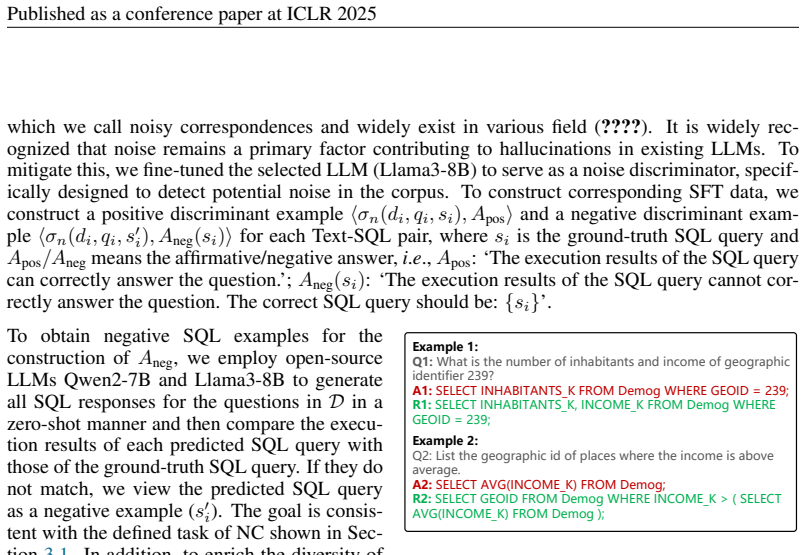
- [Section 3.2] The sentence containing "widely exist in various field ( ???? )" has a malformed citation placeholder and should be corrected or removed.
- [Appendix A.4 and A.6] There are typos such as "demonstartes" and "Precession" for "Precision." Also, Appendix A.3 misspells "Gemini" as "Gimini" and "CHASE-SQL" as "CHASS-SQL."
- [Abstract and Appendix A.3] The abstract claims "leading performance," but Appendix A.3 shows CHASE-SQL + Gemini 1.5 outperforming ROUTE on both SPIDER and BIRD; please soften the claim to "competitive with closed-source prompting methods" or clearly contextualize the comparison.
- [Table 2] The header row for Table 2 is difficult to parse because the column labels for SYN, Realistic, and DK are interleaved with the metric names; consider restructuring the table so each metric is clearly aligned with its column.
Circularity Check
No significant circularity found; the evaluation is self-contained against external benchmarks and the derivation chain does not reduce to its own inputs.
full rationale
The paper's central claim is that multitask supervised fine-tuning (MSFT) plus multitask collaboration prompting (MCP) improves open-source LLM Text2SQL performance. I walked the derivation chain and found no step where an output is equivalent to an input by construction. The MSFT data are synthesized programmatically from the public SPIDER/BIRD training folds: Text2SQL responses are ground-truth SQL, schema-linking labels are parsed from ground-truth SQL via f(s_i,d_i), noise-correction labels are built from execution-success/failure comparisons, and continuation-writing responses are truncated ground-truth SQL. None of these use the development-set answers that are later reported. The MCP schema-linking fusion in Eq. (2) combines the model's schema linking with entities parsed from a pseudo-SQL generated on the full schema; the final SQL is then generated on the simplified schema. This is a two-stage pipeline, not a tautology: the pseudo-SQL is produced before the schema is simplified, and the final query is generated anew on the simplified schema. The ablation tables (Tables 4 and 5) decompose the contribution of each MCP component and of SL_sigma_s versus SL_sigma_t, showing that neither component alone equals the full method, so the reported gain is not just a relabeled fit. The upper-bound experiments in Table 7 use oracle inputs (ground-truth simplified schema or half of the ground-truth SQL) and are explicitly presented as upper bounds, not as predictions. The paper's citations to prior work are external, not self-citations forming a load-bearing chain, and no uniqueness theorem or forced-choice argument is imported. The skeptical concerns about small margins over CODES/SENSE and lack of error bars are legitimate threats to the strength of the empirical claim, but they are statistical-evidence issues, not circularity: the dev-set evaluations are held out, the training data come from public training folds, and no fitted parameter is renamed as a prediction. I therefore find no specific reduction of the claimed results to the paper's own inputs or to self-citation, and the appropriate circularity score is 0.
Assumptions & free parameters
free parameters (6)
- Number of synthetic auxiliary samples per task =
10,000 each
- Hardness threshold for continuation writing =
>2 tables
- Noise filtering discriminator criterion =
unspecified
- Artificial error type probabilities =
certain probability, unspecified
- Inference-time truncation position for CW =
not specified
- Schema merging operation in Eq. 2 =
not specified
assumptions (6)
- domain assumption Supervised fine-tuning on the synthesized multitask data transfers to held-out SPIDER and BIRD dev sets
- domain assumption Execution-result matching is a valid correctness metric for Text2SQL
- domain assumption The remaining training pairs after noisy correspondence filtering are clean and correct
- domain assumption The pseudo-SQL generated on the full schema is accurate enough for entity extraction
- domain assumption Continuation writing from truncated SQL is easier for LLMs and training on ground-truth truncations transfers to model-generated SQL
- domain assumption Base LLMs have not memorized SPIDER and BIRD dev answers during pretraining
Cite this review
Pith. "Pith review of ROUTE: Robust Multitask Tuning and Collaboration for Text-to-SQL." pith.science (2026). https://pith.science/paper/XTXHSKF2
@misc{pith2026241210138,
  author       = {Pith},
  title        = {Pith review of: ROUTE: Robust Multitask Tuning and Collaboration for Text-to-SQL},
  year         = {2026},
  howpublished = {\url{https://pith.science/paper/XTXHSKF2}},
  note         = {Machine review of arXiv:2412.10138}
}
read the original abstract
Despite the significant advancements in Text-to-SQL (Text2SQL) facilitated by large language models (LLMs), the latest state-of-the-art techniques are still trapped in the in-context learning of closed-source LLMs (e.g., GPT-4), which limits their applicability in open scenarios. To address this challenge, we propose a novel RObust mUltitask Tuning and collaboration mEthod (ROUTE) to improve the comprehensive capabilities of open-source LLMs for Text2SQL, thereby providing a more practical solution. Our approach begins with multi-task supervised fine-tuning (SFT) using various synthetic training data related to SQL generation. Unlike existing SFT-based Text2SQL methods, we introduced several additional SFT tasks, including schema linking, noise correction, and continuation writing. Engaging in a variety of SQL generation tasks enhances the model's understanding of SQL syntax and improves its ability to generate high-quality SQL queries. Additionally, inspired by the collaborative modes of LLM agents, we introduce a Multitask Collaboration Prompting (MCP) strategy. This strategy leverages collaboration across several SQL-related tasks to reduce hallucinations during SQL generation, thereby maximizing the potential of enhancing Text2SQL performance through explicit multitask capabilities. Extensive experiments and in-depth analyses have been performed on eight open-source LLMs and five widely-used benchmarks. The results demonstrate that our proposal outperforms the latest Text2SQL methods and yields leading performance.
Figures


Figures from the paper (6 more)


Reference graph
Works this paper leans on
-
[1]
Josh Achiam, Steven Adler, Sandhini Agarwal, Lama Ahmad, Ilge Akkaya, Florencia Leoni Aleman, Diogo Almeida, Janko Altenschmidt, Sam Altman, Shyamal Anadkat, et al. Gpt-4 technical report. arXiv preprint arXiv:2303.08774, 2023
arXiv 2023
-
[2]
Representing Schema Structure with Graph Neural Networks for Text-to-SQL Parsing
Ben Bogin, Matt Gardner, and Jonathan Berant. Representing schema structure with graph neural networks for text-to-sql parsing. arXiv preprint arXiv:1905.06241, 2019
work page Pith review arXiv 1905
-
[3]
Shuaichen Chang, Jun Wang, Mingwen Dong, Lin Pan, Henghui Zhu, Alexander Hanbo Li, Wuwei Lan, Sheng Zhang, Jiarong Jiang, Joseph Lilien, et al. Dr. spider: A diagnostic evaluation benchmark towards text-to-sql robustness. arXiv preprint arXiv:2301.08881, 2023
arXiv 2023
-
[4]
Teaching large language models to self-debug
Xinyun Chen, Maxwell Lin, Nathanael Sch \"a rli, and Denny Zhou. Teaching large language models to self-debug. arXiv preprint arXiv:2304.05128, 2023
arXiv 2023
-
[5]
Structure-grounded pretraining for text-to-sql
Xiang Deng, Ahmed Hassan Awadallah, Christopher Meek, Oleksandr Polozov, Huan Sun, and Matthew Richardson. Structure-grounded pretraining for text-to-sql. arXiv preprint arXiv:2010.12773, 2020
arXiv 2010
-
[6]
C3: Zero-shot text-to-sql with chatgpt
Xuemei Dong, Chao Zhang, Yuhang Ge, Yuren Mao, Yunjun Gao, Jinshu Lin, Dongfang Lou, et al. C3: Zero-shot text-to-sql with chatgpt. arXiv preprint arXiv:2307.07306, 2023
arXiv 2023
-
[7]
Miga: a unified multi-task generation framework for conversational text-to-sql
Yingwen Fu, Wenjie Ou, Zhou Yu, and Yue Lin. Miga: a unified multi-task generation framework for conversational text-to-sql. In Proceedings of the AAAI Conference on Artificial Intelligence, volume 37, pp.\ 12790--12798, 2023
work page 2023
-
[8]
Towards robustness of text-to-sql models against synonym substitution
Yujian Gan, Xinyun Chen, Qiuping Huang, Matthew Purver, John R Woodward, Jinxia Xie, and Pengsheng Huang. Towards robustness of text-to-sql models against synonym substitution. arXiv preprint arXiv:2106.01065, 2021 a
arXiv 2021
Show all 50 references
-
[9]
Exploring underexplored limitations of cross-domain text-to-sql generalization
Yujian Gan, Xinyun Chen, and Matthew Purver. Exploring underexplored limitations of cross-domain text-to-sql generalization. arXiv preprint arXiv:2109.05157, 2021 b
2021 arXiv
-
[10]
Text-to-sql empowered by large language models: A benchmark evaluation
Dawei Gao, Haibin Wang, Yaliang Li, Xiuyu Sun, Yichen Qian, Bolin Ding, and Jingren Zhou. Text-to-sql empowered by large language models: A benchmark evaluation. Proceedings of the VLDB Endowment, 17 0 (5): 0 1132--1145, 2024 a
2024
-
[11]
Xiyan-sql: A multi-generator ensemble framework for text-to-sql
Yingqi Gao, Yifu Liu, Xiaoxia Li, Xiaorong Shi, Yin Zhu, Yiming Wang, Shiqi Li, Wei Li, Yuntao Hong, Zhiling Luo, Jinyang Gao, Liyu Mou, and Yu Li. Xiyan-sql: A multi-generator ensemble framework for text-to-sql. arXiv preprint arXiv:2411.08599, 2024 b . URL https://arxiv.org/...
2024 arXiv
-
[12]
Interleaving pre-trained language models and large language models for zero-shot nl2sql generation
Zihui Gu, Ju Fan, Nan Tang, Songyue Zhang, Yuxin Zhang, Zui Chen, Lei Cao, Guoliang Li, Sam Madden, and Xiaoyong Du. Interleaving pre-trained language models and large language models for zero-shot nl2sql generation. arXiv preprint arXiv:2306.08891, 2023
2023 arXiv
-
[13]
Deepseek-coder: When the large language model meets programming--the rise of code intelligence
Daya Guo, Qihao Zhu, Dejian Yang, Zhenda Xie, Kai Dong, Wentao Zhang, Guanting Chen, Xiao Bi, Yu Wu, YK Li, et al. Deepseek-coder: When the large language model meets programming--the rise of code intelligence. arXiv preprint arXiv:2401.14196, 2024
2024 arXiv
-
[14]
Mistral 7b
Albert Q Jiang, Alexandre Sablayrolles, Arthur Mensch, Chris Bamford, Devendra Singh Chaplot, Diego de las Casas, Florian Bressand, Gianna Lengyel, Guillaume Lample, Lucile Saulnier, et al. Mistral 7b. arXiv preprint arXiv:2310.06825, 2023
-
[15]
A deep dive into deep learning approaches for text-to-sql systems
George Katsogiannis-Meimarakis and Georgia Koutrika. A deep dive into deep learning approaches for text-to-sql systems. In Proceedings of the 2021 International Conference on Management of Data, pp.\ 2846--2851, 2021
2021
-
[16]
Gonzalez, Hao Zhang, and Ion Stoica
Woosuk Kwon, Zhuohan Li, Siyuan Zhuang, Ying Sheng, Lianmin Zheng, Cody Hao Yu, Joseph E. Gonzalez, Hao Zhang, and Ion Stoica. Efficient memory management for large language model serving with pagedattention. In Proceedings of the ACM SIGOPS 29th Symposium on Operating Systems...
2023
-
[17]
Mcs-sql: Leveraging multiple prompts and multiple-choice selection for text-to-sql generation
Dongjun Lee, Choongwon Park, Jaehyuk Kim, and Heesoo Park. Mcs-sql: Leveraging multiple prompts and multiple-choice selection for text-to-sql generation. arXiv preprint arXiv:2405.07467, 2024
2024 arXiv
-
[18]
The dawn of natural language to sql: Are we fully ready? arXiv preprint arXiv:2406.01265, 2024 a
Boyan Li, Yuyu Luo, Chengliang Chai, Guoliang Li, and Nan Tang. The dawn of natural language to sql: Are we fully ready? arXiv preprint arXiv:2406.01265, 2024 a
2024 arXiv
-
[19]
Resdsql: Decoupling schema linking and skeleton parsing for text-to-sql
Haoyang Li, Jing Zhang, Cuiping Li, and Hong Chen. Resdsql: Decoupling schema linking and skeleton parsing for text-to-sql. In Proceedings of the AAAI Conference on Artificial Intelligence, volume 37, pp.\ 13067--13075, 2023 a
2023
-
[20]
Codes: Towards building open-source language models for text-to-sql
Haoyang Li, Jing Zhang, Hanbing Liu, Ju Fan, Xiaokang Zhang, Jun Zhu, Renjie Wei, Hongyan Pan, Cuiping Li, and Hong Chen. Codes: Towards building open-source language models for text-to-sql. Proceedings of the ACM on Management of Data, 2 0 (3): 0 1--28, 2024 b
2024
-
[21]
Graphix-t5: Mixing pre-trained transformers with graph-aware layers for text-to-sql parsing
Jinyang Li, Binyuan Hui, Reynold Cheng, Bowen Qin, Chenhao Ma, Nan Huo, Fei Huang, Wenyu Du, Luo Si, and Yongbin Li. Graphix-t5: Mixing pre-trained transformers with graph-aware layers for text-to-sql parsing. In Proceedings of the AAAI Conference on Artificial Intelligence, v...
2023
-
[22]
Can llm already serve as a database interface? a big bench for large-scale database grounded text-to-sqls
Jinyang Li, Binyuan Hui, Ge Qu, Jiaxi Yang, Binhua Li, Bowen Li, Bailin Wang, Bowen Qin, Ruiying Geng, Nan Huo, et al. Can llm already serve as a database interface? a big bench for large-scale database grounded text-to-sqls. Advances in Neural Information Processing Systems, ...
2024
-
[23]
Starcoder: may the source be with you! Transactions on Machine Learning Research
Raymond Li, Yangtian Zi, Niklas Muennighoff, Denis Kocetkov, Chenghao Mou, Marc Marone, Christopher Akiki, LI Jia, Jenny Chim, Qian Liu, et al. Starcoder: may the source be with you! Transactions on Machine Learning Research
-
[24]
Pet-sql: A prompt-enhanced two-stage text-to-sql framework with cross-consistency
Zhishuai Li, Xiang Wang, Jingjing Zhao, Sun Yang, Guoqing Du, Xiaoru Hu, Bin Zhang, Yuxiao Ye, Ziyue Li, Rui Zhao, et al. Pet-sql: A prompt-enhanced two-stage text-to-sql framework with cross-consistency. arXiv preprint arXiv:2403.09732, 2024 d
2024 arXiv
-
[25]
A comprehensive evaluation of chatgpt's zero-shot text-to-sql capability
Aiwei Liu, Xuming Hu, Lijie Wen, and Philip S Yu. A comprehensive evaluation of chatgpt's zero-shot text-to-sql capability. arXiv preprint arXiv:2303.13547, 2023
2023 arXiv
-
[26]
The death of schema linking? text-to-sql in the age of well-reasoned language models
Karime Maamari, Fadhil Abubaker, Daniel Jaroslawicz, and Amine Mhedhbi. The death of schema linking? text-to-sql in the age of well-reasoned language models. arXiv preprint arXiv:2408.07702, 2024
2024 arXiv
-
[27]
Din-sql: Decomposed in-context learning of text-to-sql with self-correction
Mohammadreza Pourreza and Davood Rafiei. Din-sql: Decomposed in-context learning of text-to-sql with self-correction. Advances in Neural Information Processing Systems, 36, 2024 a
2024
-
[28]
Dts-sql: Decomposed text-to-sql with small large language models
Mohammadreza Pourreza and Davood Rafiei. Dts-sql: Decomposed text-to-sql with small large language models. arXiv preprint arXiv:2402.01117, 2024 b
2024 arXiv
-
[29]
Chase-sql: Multi-path reasoning and preference optimized candidate selection in text-to-sql
Mohammadreza Pourreza, Hailong Li, Ruoxi Sun, Yeounoh Chung, Shayan Talaei, Gaurav Tarlok Kakkar, Yu Gan, Amin Saberi, Fatma Ozcan, and Sercan O Arik. Chase-sql: Multi-path reasoning and preference optimized candidate selection in text-to-sql. arXiv preprint arXiv:2410.01943, 2024
-
[30]
Direct preference optimization: Your language model is secretly a reward model
Rafael Rafailov, Archit Sharma, Eric Mitchell, Christopher D Manning, Stefano Ermon, and Chelsea Finn. Direct preference optimization: Your language model is secretly a reward model. Advances in Neural Information Processing Systems, 36, 2024
2024
-
[31]
Evaluating the text-to-sql capabilities of large language models
Nitarshan Rajkumar, Raymond Li, and Dzmitry Bahdanau. Evaluating the text-to-sql capabilities of large language models. arXiv preprint arXiv:2204.00498, 2022
2022 arXiv
-
[32]
Code llama: Open foundation models for code
Baptiste Roziere, Jonas Gehring, Fabian Gloeckle, Sten Sootla, Itai Gat, Xiaoqing Ellen Tan, Yossi Adi, Jingyu Liu, Romain Sauvestre, Tal Remez, et al. Code llama: Open foundation models for code. arXiv preprint arXiv:2308.12950, 2023
2023 arXiv
-
[33]
Exploring chain-of-thought style prompting for text-to-sql
Chang-You Tai, Ziru Chen, Tianshu Zhang, Xiang Deng, and Huan Sun. Exploring chain-of-thought style prompting for text-to-sql. arXiv preprint arXiv:2305.14215, 2023
2023 arXiv
-
[34]
Chess: Contextual harnessing for efficient sql synthesis
Shayan Talaei, Mohammadreza Pourreza, Yu-Chen Chang, Azalia Mirhoseini, and Amin Saberi. Chess: Contextual harnessing for efficient sql synthesis. arXiv preprint arXiv:2405.16755, 2024
2024 arXiv
-
[35]
Qwen2.5: A party of foundation models, September 2024
Qwen Team. Qwen2.5: A party of foundation models, September 2024. URL https://qwenlm.github.io/blog/qwen2.5/
2024
-
[36]
Llama: Open and efficient foundation language models
Hugo Touvron, Thibaut Lavril, Gautier Izacard, Xavier Martinet, Marie-Anne Lachaux, Timoth \'e e Lacroix, Baptiste Rozi \`e re, Naman Goyal, Eric Hambro, Faisal Azhar, et al. Llama: Open and efficient foundation language models. arXiv preprint arXiv:2302.13971, 2023
2023 arXiv
-
[37]
Mac-sql: Multi-agent collaboration for text-to-sql
Bing Wang, Changyu Ren, Jian Yang, Xinnian Liang, Jiaqi Bai, Qian-Wen Zhang, Zhao Yan, and Zhoujun Li. Mac-sql: Multi-agent collaboration for text-to-sql. arXiv preprint arXiv:2312.11242, 2023
2023 arXiv
-
[38]
Bridging language & data: Optimizing text-to-sql generation in large language models, 2024
Niklas Wretblad and Fredrik Gordh Riseby. Bridging language & data: Optimizing text-to-sql generation in large language models, 2024
2024
-
[39]
Understanding the effects of noise in text-to-sql: An examination of the bird-bench benchmark
Niklas Wretblad, Fredrik Gordh Riseby, Rahul Biswas, Amin Ahmadi, and Oskar Holmstr \"o m. Understanding the effects of noise in text-to-sql: An examination of the bird-bench benchmark. arXiv preprint arXiv:2402.12243, 2024
2024 arXiv
-
[40]
Sequence-based structured prediction for semantic parsing
Chunyang Xiao, Marc Dymetman, and Claire Gardent. Sequence-based structured prediction for semantic parsing. In Annual meeting of the Association for Computational Linguistics (ACL), pp.\ 1341--1350, 2016
2016
-
[41]
Qwen2 technical report
An Yang, Baosong Yang, Binyuan Hui, Bo Zheng, Bowen Yu, Chang Zhou, Chengpeng Li, Chengyuan Li, Dayiheng Liu, Fei Huang, et al. Qwen2 technical report. arXiv preprint arXiv:2407.10671, 2024 a
2024 arXiv
-
[42]
Synthesizing text-to-sql data from weak and strong llms
Jiaxi Yang, Binyuan Hui, Min Yang, Jian Yang, Junyang Lin, and Chang Zhou. Synthesizing text-to-sql data from weak and strong llms. In Proceedings of the 62nd Annual Meeting of the Association for Computational Linguistics (Volume 1: Long Papers), pp.\ 7864--7875, 2024 b
2024
-
[43]
Spider: A large-scale human-labeled dataset for complex and cross-domain semantic parsing and text-to-sql task
Tao Yu, Rui Zhang, Kai Yang, Michihiro Yasunaga, Dongxu Wang, Zifan Li, James Ma, Irene Li, Qingning Yao, Shanelle Roman, et al. Spider: A large-scale human-labeled dataset for complex and cross-domain semantic parsing and text-to-sql task. arXiv preprint arXiv:1809.08887, 2018
2018 arXiv
-
[44]
Act-sql: In-context learning for text-to-sql with automatically-generated chain-of-thought
Hanchong Zhang, Ruisheng Cao, Lu Chen, Hongshen Xu, and Kai Yu. Act-sql: In-context learning for text-to-sql with automatically-generated chain-of-thought. In The 2023 Conference on Empirical Methods in Natural Language Processing
2023
-
[45]
A survey of table reasoning with large language models
Xuanliang Zhang, Dingzirui Wang, Longxu Dou, Qingfu Zhu, and Wanxiang Che. A survey of table reasoning with large language models. arXiv preprint arXiv:2402.08259, 2024
2024 arXiv
-
[46]
Llamafactory: Unified efficient fine-tuning of 100+ language models
Yaowei Zheng, Richong Zhang, Junhao Zhang, Yanhan Ye, Zheyan Luo, Zhangchi Feng, and Yongqiang Ma. Llamafactory: Unified efficient fine-tuning of 100+ language models. In Proceedings of the 62nd Annual Meeting of the Association for Computational Linguistics (Volume 3: System ...
2024 arXiv
-
[47]
write newline
" write newline "" before.all 'output.state := FUNCTION n.dashify 't := "" t empty not t #1 #1 substring "-" = t #1 #2 substring "--" = not "--" * t #2 global.max substring 't := t #1 #1 substring "-" = "-" * t #2 global.max substring 't := while if t #1 #1 substring * t #2 gl...
-
[48]
@esa (Ref
\@ifxundefined[1] #1\@undefined \@firstoftwo \@secondoftwo \@ifnum[1] #1 \@firstoftwo \@secondoftwo \@ifx[1] #1 \@firstoftwo \@secondoftwo [2] @ #1 \@temptokena #2 #1 @ \@temptokena \@ifclassloaded agu2001 natbib The agu2001 class already includes natbib coding, so you should ...
-
[49]
\@lbibitem[] @bibitem@first@sw\@secondoftwo \@lbibitem[#1]#2 \@extra@b@citeb \@ifundefined br@#2\@extra@b@citeb \@namedef br@#2 \@nameuse br@#2\@extra@b@citeb \@ifundefined b@#2\@extra@b@citeb @num @parse #2 @tmp #1 NAT@b@open@#2 NAT@b@shut@#2 \@ifnum @merge>\@ne @bibitem@firs...
-
[50]
@open @close @open @close and [1] URL: #1 \@ifundefined chapter * \@mkboth \@ifxundefined @sectionbib * \@mkboth * \@mkboth\@gobbletwo \@ifclassloaded amsart * \@ifclassloaded amsbook * \@ifxundefined @heading @heading NAT@ctr thebibliography [1] @ \@biblabel @NAT@ctr \@bibset...
Reviewed August 11, 2026 · model on record in the stance chip above.
Discussion (0). Continue with ORCID to comment.