REVIEW 3 major objections 3 minor 70 references
RapidNet: Multi-Level Dilated Convolution Based Mobile Backbone
T0 review · 3 major / 3 minor · reviewed 2026-08-11 · deepseek-v4-flash
Pith's one-line read A pure-CNN mobile backbone using parallel dilated convolutions claims to beat ViT, ViG, and hybrid models on accuracy or speed.
desk verdict A solid empirical mobile backbone paper whose accuracy claims hold up but whose speed claims rest on thinner evidence than the headline suggests. read the letter →
The pith
A machine-rendered reading of the paper's core claim, the machinery that carries it, and where it could break.
The reading
What carries the argument
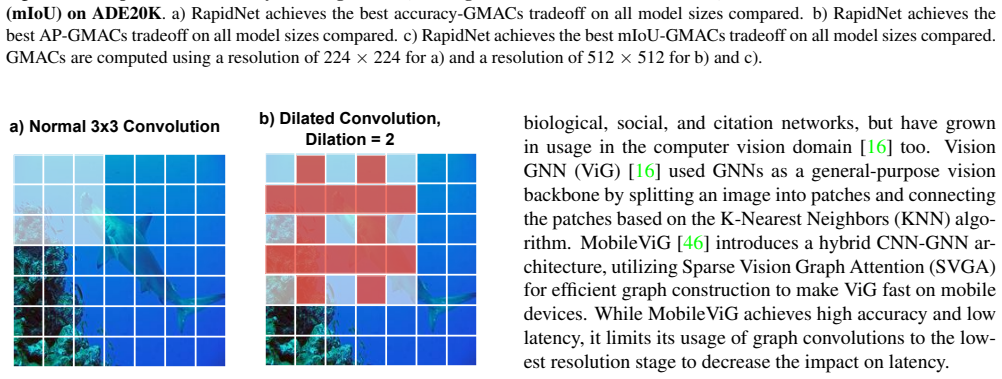
The load-bearing mechanism is the Multi-Level Dilated Convolution (MLDC) block: a reparameterizable 7x7 depthwise convolution followed by a pointwise convolution and two parallel 3x3 dilated convolutions with dilation factors 2 and 3, whose outputs are summed after batch normalization and GeLU activation. A 3x3 dilated convolution with dilation factor $d$ has theoretical receptive field $((3-1)d+1)^2$, so the two branches see 5x5 and 7x7 fields while each branch costs only a 3x3 kernel. The block is paired with a large-kernel feedforward network (a 7x7 depthwise convolution between two pointwise layers), and the whole Dilated Convolution Block occupies the last two stages, where MobileViG used graph convolution. This gives a pure-CNN path to the long-range feature mixing that attention and graph constructions provide.
What would settle it
Profile the same baseline set on a second mobile device or compiler stack with per-model optimized inference graphs; if MobileViG-Ti or MobileNetV2x1.4 runs at or below RapidNet-Ti's 0.9 ms, the speed claim is falsified. On the mechanism side, an effective-receptive-field analysis showing that MLDC's field is no wider than a plain stacked 3x3 CNN would undercut the long-range-interaction explanation.
Extended reading notes
Core claim
The paper's central discovery is that the graph-convolution block in MobileViG can be replaced by Multi-Level Dilated Convolutions with no loss of theoretical receptive field and a gain in efficiency. At the lowest-resolution stage, MobileViG's Sparse Vision Graph Attention with K=2 reaches a 7x7 theoretical receptive field over the image; a single 3x3 convolution with dilation 3 reaches exactly the same 7x7 field, and running it in parallel with a dilation-2 branch gives two scales of context at the parameter cost of two 3x3 kernels. RapidNet stacks inverted residual blocks for local processing in all four stages, then adds MLDC blocks plus reparameterizable 7x7 depthwise convolutions and a large-kernel feedforward network in the last two stages. Empirically, RapidNet-Ti outperforms MobileViG-Ti by 0.6% top-1 at the same 0.9 ms latency, RapidNet-M reaches 81.0% top-1, 42.0 AP box on COCO, and 41.5 mIoU on ADE20K, and ablations attribute the gains to the multi-level dilated branch rather than to capacity alone.
Load-bearing premise
The speed comparisons rest on the assumption that converting every model to CoreML and timing it on one iPhone 13 Mini gives a fair, implementation-neutral ranking of mobile latency.
Editorial extensions
If this is right
- At the tiny scale, RapidNet-Ti reaches 76.3% top-1 on ImageNet-1K at 0.9 ms, beating MobileViG-Ti by 0.6% at the same latency and MobileNetV2x1.4 by 1.6% at lower latency.
- At the medium scale, RapidNet-M reaches 81.0% top-1, 42.0 AP box on COCO object detection, 38.3 AP mask on instance segmentation, and 41.5 mIoU on ADE20K, outperforming comparable hybrids such as EfficientFormer and PoolFormer.
- The same backbone transfers to dense prediction: Mask R-CNN with RapidNet-M beats FastViT-SA12 by 3.1 AP box and PoolFormer-S12 by 4.7 AP box on COCO.
- Ablations show that replacing single-level dilated convolution with MLDC adds 0.3% top-1 at only 0.1 GMACs, and that dilation factors 2 and 3 beat 3 and 4, supporting the design choice.
Reading between the lines
- Editorial inference: if the latency ordering persists across other mobile compilers and devices, MLDC could serve as a cheap drop-in global mixer for other CNN backbones without changing their training pipeline.
- Editorial inference: the equality of theoretical receptive fields between dilation-3 3x3 convolutions and MobileViG's SVGA does not guarantee equal effective receptive fields; a layer-wise effective-receptive-field analysis would test whether MLDC truly captures long-range interactions or mainly adds local multi-scale context.
- Editorial inference: RapidNet-Ti has 6.6 million parameters versus MobileViG-Ti's 5.2 million, so the accuracy gain is not purely architectural; a matched-parameter comparison would isolate the MLDC contribution from the extra width.
- Editorial inference: since dilation factors 2 and 3 outperformed 3 and 4, the optimal dilation appears resolution-dependent; a testable extension is per-stage dilation scheduling or input-adaptive dilation.
Editorial analysis
A structured set of objections, weighed in public.
Referee Report
Summary. RapidNet proposes Multi-Level Dilated Convolutions (MLDC), a purely CNN-based mobile backbone in which parallel 3×3 convolutions with dilation factors 2 and 3 are combined with a reparameterizable 7×7 depthwise convolution and a large-kernel FFN. The paper reports ImageNet-1K classification, COCO object detection and instance segmentation, and ADE20K semantic segmentation results, together with iPhone 13 Mini NPU latencies, and claims that RapidNet outperforms state-of-the-art mobile CNN, ViT, ViG, and hybrid architectures in terms of accuracy and/or speed at several model sizes. The central accuracy claim is supported by a broad set of benchmarks, while the speed half rests on a lightly documented CoreML/ModelBench latency measurement.
Significance. If the reported results hold, this is a useful contribution: it shows that a carefully designed pure CNN can match or exceed recent hybrid CNN-ViT and CNN-ViG mobile backbones on accuracy-latency tradeoffs. The paper provides broad experimental coverage across four tasks, ablations for each major design choice, and a public code repository. The main weakness is that the speed component of the headline claim depends on latency numbers whose protocol is under-specified and whose decisive gaps are very small, so the 'and/or speed' claim is not yet established at the same level as the accuracy claim.
major comments (3)
- [§4.1, Table 2] The speed component of the central claim ('and/or speed') is not established because the latency protocol is under-specified. The paper reports only that all models were packaged as MLModels using CoreML and profiled on an iPhone 13 Mini (iOS 16) with ModelBench, 50 inference rounds, 50 inferences per round, and a low/high trim of 10. It does not report the CoreML converter version, the compute-unit configuration (NPU/CPU/GPU), whether official or author-converted models were used, whether baseline inference graphs preserved their optimized rewrites (e.g., FastViT's structural reparameterization or MobileViG's graph construction), per-run variance, or thermal state. Many decisive comparisons are ties or gaps of 0.1–0.2 ms (RapidNet-Ti 0.9 ms vs. MobileViG-Ti 0.9 ms; RapidNet-S 1.1 ms vs. MobileNetV2x1.4 1.1 ms), so these omissions leave the speed ordering unsupported. Please provide a fully reproducible protocol, per-model conversion settings, variance across multiple runs, and preferably measurements on more than one device.
- [Abstract vs. Table 2] The abstract states that RapidNet-Ti is 'faster and more accurate than MobileNetV2x1.4 (74.7% top-1 with 1.0 ms latency)', but Table 2 lists MobileNetV2x1.4 at 1.1 ms latency. This numerical inconsistency must be corrected, and all latency numbers should be checked for rounding consistency.
- [§4.4, Tables 5–6] The justifications for core architectural choices rest on very small accuracy deltas. Table 5 reports that CPE adds 0.1%, LKFFN adds 0.1%, and MLDC adds 0.3%, with results averaged over only two runs; Table 6 reports a 0.1% gain for 5×5 kernels at +2.0M parameters and a 0.4% loss for dilation factors 3,4 or deformable convolution. These differences are within typical ImageNet training noise, yet they are used to select the final design. Please report per-run results, error bars or at least more runs, and consider whether the observed differences are statistically meaningful; as written, the component-level claims are not fully convincing.
minor comments (3)
- [§3.2, Eqs. (4)–(7)] The notation Y, Z, Out ∈ R^{N×N} omits the channel dimension and is inconsistent with the pointwise convolutions and fully connected layers in the same equations. Please use a notation such as R^{C×H×W} or describe the channel dimension explicitly.
- [§3.2, §3.4] The description of the MLDC block ordering is inconsistent: §3.2 says the two dilated convolutions are followed immediately by GeLU, while §3.4 mentions an additional pointwise convolution and BN after the dilated branches. Please align the text and equations with Figure 3f.
- [§4, experimental setup] The hardware description 'NVIDIA RTX 6000 Ada generation GPUs' should read 'NVIDIA RTX 6000 Ada Generation GPUs' or 'Ada Lovelace GPUs', and the reference list should be checked for consistent formatting of author initials.
Circularity Check
No significant circularity: RapidNet's claims rest on external benchmarks and independent design comparisons, not on self-referential derivations.
full rationale
The paper makes an empirical claim: RapidNet outperforms SOTA mobile architectures on standard benchmarks (ImageNet-1K, COCO, ADE20K) and on CoreML latency. The MLDC block is defined by explicit equations (Eqs. 4-6) and motivated by comparing theoretical receptive fields (Eq. 1) with MobileViG's graph convolution; this is design reasoning, not a derivation that presupposes the conclusion. Dilation factors and kernel sizes are chosen via ablations on the same ImageNet validation benchmark, which is a hyperparameter selection procedure rather than a fitted parameter renamed as a prediction. MobileViG [46], a prior paper by the same group, is used as a baseline and design reference, but the comparisons are reproduced on public datasets and the cited work is externally published, so the self-citation is not load-bearing. The latency measurement relies on a single CoreML/ModelBench setup on one iPhone 13 Mini with undisclosed conversion details; this is a legitimate measurement-fairness and reproducibility concern, but it is not circularity because the speed claim is not derived from the model's own architecture definition or from a self-citation chain. No circular step can be exhibited with the paper's own equations reducing to its inputs.
Assumptions & free parameters
free parameters (6)
- MLDC dilation factors =
2 and 3
- MLDC dilated kernel size =
3x3
- Large kernel depthwise size =
7x7
- IRB expansion ratio =
4
- Stage widths and depths =
Ti/S/M/B configurations in Table 1
- Training hyperparameters =
300 epochs, lr 2e-3, RegNetY-16GF teacher, RandAugment/Mixup/Cutmix
assumptions (5)
- standard math Theoretical receptive field of a dilated convolution is ((k-1)d+1)^2 (Eq. 1).
- domain assumption CoreML/ModelBench NPU latency on an iPhone 13 Mini is a valid and comparable efficiency metric.
- domain assumption Knowledge distillation from RegNetY-16GF and a shared augmentation and training recipe give fair comparisons across all baselines.
- domain assumption Single-run ImageNet/COCO/ADE20K accuracy differences of 0.1% to 1% are treated as meaningful without reported error bars.
- ad hoc to paper The train-time identity branch in the reparameterizable 7x7 depthwise convolution can be exactly fused at inference time.
invented entities (1)
-
Multi-Level Dilated Convolution (MLDC) block
independent evidence
Cite this review
Pith. "Pith review of RapidNet: Multi-Level Dilated Convolution Based Mobile Backbone." pith.science (2026). https://pith.science/paper/IMJAMRVV
@misc{pith2026241210995,
  author       = {Pith},
  title        = {Pith review of: RapidNet: Multi-Level Dilated Convolution Based Mobile Backbone},
  year         = {2026},
  howpublished = {\url{https://pith.science/paper/IMJAMRVV}},
  note         = {Machine review of arXiv:2412.10995}
}
read the original abstract
Vision transformers (ViTs) have dominated computer vision in recent years. However, ViTs are computationally expensive and not well suited for mobile devices; this led to the prevalence of convolutional neural network (CNN) and ViT-based hybrid models for mobile vision applications. Recently, Vision GNN (ViG) and CNN hybrid models have also been proposed for mobile vision tasks. However, all of these methods remain slower compared to pure CNN-based models. In this work, we propose Multi-Level Dilated Convolutions to devise a purely CNN-based mobile backbone. Using Multi-Level Dilated Convolutions allows for a larger theoretical receptive field than standard convolutions. Different levels of dilation also allow for interactions between the short-range and long-range features in an image. Experiments show that our proposed model outperforms state-of-the-art (SOTA) mobile CNN, ViT, ViG, and hybrid architectures in terms of accuracy and/or speed on image classification, object detection, instance segmentation, and semantic segmentation. Our fastest model, RapidNet-Ti, achieves 76.3\% top-1 accuracy on ImageNet-1K with 0.9 ms inference latency on an iPhone 13 mini NPU, which is faster and more accurate than MobileNetV2x1.4 (74.7\% top-1 with 1.0 ms latency). Our work shows that pure CNN architectures can beat SOTA hybrid and ViT models in terms of accuracy and speed when designed properly.
Figures


Figures from the paper (1 more)

Reference graph
Works this paper leans on
-
[1]
Scal- ing graph convolutions for mobile vision
William Avery, Mustafa Munir, and Radu Marculescu. Scal- ing graph convolutions for mobile vision. In Proceedings of the IEEE/CVF Conference on Computer Vision and Pattern Recognition (CVPR) Workshops , pages 5857–5865, June
-
[2]
Large scale gan training for high fidelity natural image synthesis
Andrew Brock, Jeff Donahue, and Karen Simonyan. Large scale gan training for high fidelity natural image synthesis. arXiv preprint arXiv:1809.11096, 2018. 1
arXiv 2018
-
[3]
End-to- end object detection with transformers
Nicolas Carion, Francisco Massa, Gabriel Synnaeve, Nicolas Usunier, Alexander Kirillov, and Sergey Zagoruyko. End-to- end object detection with transformers. InProceedings of the European Conference on Computer Vision, pages 213–229. Springer, 2020. 1
work page 2020
-
[4]
Deeplab: Semantic image segmentation with deep convolutional nets, atrous convolu- tion, and fully connected crfs
Liang-Chieh Chen, George Papandreou, Iasonas Kokkinos, Kevin Murphy, and Alan L Yuille. Deeplab: Semantic image segmentation with deep convolutional nets, atrous convolu- tion, and fully connected crfs. IEEE transactions on pattern analysis and machine intelligence, 40(4):834–848, 2017. 1
2017
-
[5]
Mobile- former: Bridging mobilenet and transformer
Yinpeng Chen, Xiyang Dai, Dongdong Chen, Mengchen Liu, Xiaoyi Dong, Lu Yuan, and Zicheng Liu. Mobile- former: Bridging mobilenet and transformer. In Proceed- ings of the IEEE/CVF Conference on Computer Vision and Pattern Recognition, pages 5270–5279, 2022. 1
work page 2022
-
[6]
Conditional po- sitional encodings for vision transformers
Xiangxiang Chu, Zhi Tian, Bo Zhang, Xinlong Wang, Xi- aolin Wei, Huaxia Xia, and Chunhua Shen. Conditional po- sitional encodings for vision transformers. arXiv preprint arXiv:2102.10882, 2021. 2, 5
arXiv 2021
-
[7]
Randaugment: Practical automated data augmenta- tion with a reduced search space
Ekin D Cubuk, Barret Zoph, Jonathon Shlens, and Quoc V Le. Randaugment: Practical automated data augmenta- tion with a reduced search space. In Proceedings of the IEEE/CVF Conference on Computer Vision and Pattern Recognition Workshops, pages 702–703, 2020. 6
2020
-
[8]
Deformable convolutional networks
Jifeng Dai, Haozhi Qi, Yuwen Xiong, Yi Li, Guodong Zhang, Han Hu, and Yichen Wei. Deformable convolutional networks. In Proceedings of the IEEE international confer- ence on computer vision, pages 764–773, 2017. 4, 1
work page 2017
Show all 70 references
-
[9]
Imagenet: A large-scale hierarchical image database
Jia Deng, Wei Dong, Richard Socher, Li-Jia Li, Kai Li, and Li Fei-Fei. Imagenet: A large-scale hierarchical image database. In 2009 IEEE Conference on Computer Vision and Pattern Recognition, pages 248–255, 2009. 2, 6, 1
2009
-
[10]
Diffusion models beat gans on image synthesis
Prafulla Dhariwal and Alexander Nichol. Diffusion models beat gans on image synthesis. Advances in Neural Informa- tion Processing Systems, 34:8780–8794, 2021. 1
2021
-
[11]
Scaling up your kernels to 31x31: Revisiting large kernel design in cnns
Xiaohan Ding, Xiangyu Zhang, Jungong Han, and Guiguang Ding. Scaling up your kernels to 31x31: Revisiting large kernel design in cnns. In Proceedings of the IEEE/CVF Con- ference on Computer Vision and Pattern Recognition, pages 11963–11975, 2022. 2
2022
-
[12]
Repvgg: Making vgg-style convnets great again
Xiaohan Ding, Xiangyu Zhang, Ningning Ma, Jungong Han, Guiguang Ding, and Jian Sun. Repvgg: Making vgg-style convnets great again. In Proceedings of the IEEE/CVF Con- ference on Computer Vision and Pattern Recognition, pages 13733–13742, 2021. 4
2021
-
[13]
An image is worth 16x16 words: Transformers for image recognition at scale
Alexey Dosovitskiy et al. An image is worth 16x16 words: Transformers for image recognition at scale. arXiv preprint arXiv:2010.11929, 2020. 1
2010 arXiv
-
[14]
Structure and content-guided video synthesis with diffusion models
Patrick Esser, Johnathan Chiu, Parmida Atighehchian, Jonathan Granskog, and Anastasis Germanidis. Structure and content-guided video synthesis with diffusion models. In Proceedings of the IEEE/CVF International Conference on Computer Vision, pages 7346–7356, 2023. 1
2023
-
[15]
Generative adversarial nets
Ian Goodfellow, Jean Pouget-Abadie, Mehdi Mirza, Bing Xu, David Warde-Farley, Sherjil Ozair, Aaron Courville, and Yoshua Bengio. Generative adversarial nets. Advances in Neural Information Processing Systems, 27, 2014. 1
2014
-
[16]
Vision gnn: An image is worth graph of nodes
Kai Han, Yunhe Wang, Jianyuan Guo, Yehui Tang, and En- hua Wu. Vision gnn: An image is worth graph of nodes. arXiv preprint arXiv:2206.00272, 2022. 1, 3
2022 arXiv
-
[17]
Vision hgnn: An image is more than a graph of nodes
Yan Han, Peihao Wang, Souvik Kundu, Ying Ding, and Zhangyang Wang. Vision hgnn: An image is more than a graph of nodes. In Proceedings of the IEEE/CVF Interna- tional Conference on Computer Vision, pages 19878–19888,
-
[18]
Mask r-cnn
Kaiming He, Georgia Gkioxari, Piotr Doll ´ar, and Ross Gir- shick. Mask r-cnn. In Proceedings of the IEEE International Conference on Computer Vision, pages 2961–2969, 2017. 7
2017
-
[19]
Deep residual learning for image recognition
Kaiming He, Xiangyu Zhang, Shaoqing Ren, and Jian Sun. Deep residual learning for image recognition. In Proceed- ings of the IEEE/CVF Conference on Computer Vision and Pattern Recognition, pages 770–778, 2016. 1, 7, 8
2016
-
[20]
Gaussian error linear units (gelus)
Dan Hendrycks and Kevin Gimpel. Gaussian error linear units (gelus). arXiv preprint arXiv:1606.08415, 2016. 5
2016 arXiv
-
[21]
Denoising diffu- sion probabilistic models
Jonathan Ho, Ajay Jain, and Pieter Abbeel. Denoising diffu- sion probabilistic models. Advances in Neural Information Processing Systems, 33:6840–6851, 2020. 1
2020
-
[22]
Augment your batch: Improving generalization through instance repetition
Elad Hoffer, Tal Ben-Nun, Itay Hubara, Niv Giladi, Torsten Hoefler, and Daniel Soudry. Augment your batch: Improving generalization through instance repetition. In Proceedings of the IEEE/CVF Conference on Computer Vision and Pattern Recognition, pages 8129–8138, 2020. 6
2020
-
[23]
A real-time algorithm for signal analysis with the help of the wavelet transform
Matthias Holschneider, Richard Kronland-Martinet, Jean Morlet, and Ph Tchamitchian. A real-time algorithm for signal analysis with the help of the wavelet transform. In Wavelets: Time-Frequency Methods and Phase Space Pro- ceedings of the International Conference, Marseille, F...
1987
-
[24]
Mobilenets: Efficient convolu- tional neural networks for mobile vision applications
Andrew G Howard, Menglong Zhu, Bo Chen, Dmitry Kalenichenko, Weijun Wang, Tobias Weyand, Marco An- dreetto, and Hartwig Adam. Mobilenets: Efficient convolu- tional neural networks for mobile vision applications. arXiv preprint arXiv:1704.04861, 2017. 1, 2
2017 arXiv
-
[25]
Densely connected convolutional networks
Gao Huang, Zhuang Liu, Laurens Van Der Maaten, and Kilian Q Weinberger. Densely connected convolutional networks. In Proceedings of the IEEE/CVF Conference on Computer Vision and Pattern Recognition , pages 4700– 4708, 2017. 1
2017
-
[26]
An introduction to image synthesis with generative adversarial nets
He Huang, Philip S Yu, and Changhu Wang. An introduction to image synthesis with generative adversarial nets. arXiv preprint arXiv:1803.04469, 2018. 1
2018 arXiv
-
[27]
Iandola, Song Han, Matthew W
Forrest N. Iandola, Song Han, Matthew W. Moskewicz, Khalid Ashraf, William J. Dally, and Kurt Keutzer. Squeezenet: Alexnet-level accuracy with 50x fewer param- eters and <0.5mb model size. arXiv:1602.07360, 2016. 2, 3 9
2016 arXiv
-
[28]
Batch normalization: Accelerating deep network training by reducing internal co- variate shift
Sergey Ioffe and Christian Szegedy. Batch normalization: Accelerating deep network training by reducing internal co- variate shift. In International Conference on Machine Learn- ing, pages 448–456. pmlr, 2015. 5
2015
-
[29]
Adam: A method for stochastic optimization
Diederik P Kingma and Jimmy Ba. Adam: A method for stochastic optimization. arXiv preprint arXiv:1412.6980 ,
-
[30]
Panoptic feature pyramid networks
Alexander Kirillov, Ross Girshick, Kaiming He, and Piotr Doll´ar. Panoptic feature pyramid networks. In Proceedings of the IEEE/CVF Conference on Computer Vision and Pat- tern Recognition, pages 6399–6408, 2019. 8
2019
-
[31]
Gradient-based learning applied to document recog- nition
Yann LeCun, L ´eon Bottou, Yoshua Bengio, and Patrick Haffner. Gradient-based learning applied to document recog- nition. Proceedings of the IEEE , 86(11):2278–2324, 1998. 1
1998
-
[32]
Deepgcns: Can gcns go as deep as cnns? In Proceedings of the IEEE/CVF International Conference on Computer Vision, pages 9267–9276, 2019
Guohao Li, Matthias Muller, Ali Thabet, and Bernard Ghanem. Deepgcns: Can gcns go as deep as cnns? In Proceedings of the IEEE/CVF International Conference on Computer Vision, pages 9267–9276, 2019. 4
2019
-
[33]
Next- vit: Next generation vision transformer for efficient de- ployment in realistic industrial scenarios
Jiashi Li, Xin Xia, Wei Li, Huixia Li, Xing Wang, Xue- feng Xiao, Rui Wang, Min Zheng, and Xin Pan. Next- vit: Next generation vision transformer for efficient de- ployment in realistic industrial scenarios. arXiv preprint arXiv:2207.05501, 2022. 7
2022 arXiv
-
[34]
Re- thinking vision transformers for mobilenet size and speed
Yanyu Li, Ju Hu, Yang Wen, Georgios Evangelidis, Kamyar Salahi, Yanzhi Wang, Sergey Tulyakov, and Jian Ren. Re- thinking vision transformers for mobilenet size and speed. arXiv preprint arXiv:2212.08059, 2022. 3, 6, 7, 8
2022 arXiv
-
[35]
Effi- cientformer: Vision transformers at mobilenet speed
Yanyu Li, Geng Yuan, Yang Wen, Eric Hu, Georgios Evan- gelidis, Sergey Tulyakov, Yanzhi Wang, and Jian Ren. Effi- cientformer: Vision transformers at mobilenet speed. arXiv preprint arXiv:2206.01191, 2022. 3, 5, 7, 8
2022 arXiv
-
[36]
Microsoft coco: Common objects in context
Tsung-Yi Lin, Michael Maire, Serge Belongie, James Hays, Pietro Perona, Deva Ramanan, Piotr Doll´ar, and C Lawrence Zitnick. Microsoft coco: Common objects in context. In Proceedings of the European Conference on Computer Vi- sion, pages 740–755. Springer, 2014. 2, 6, 7, 8
2014
-
[37]
Generative adversarial networks for image and video synthesis: Algorithms and applications
Ming-Yu Liu, Xun Huang, Jiahui Yu, Ting-Chun Wang, and Arun Mallya. Generative adversarial networks for image and video synthesis: Algorithms and applications. Proceedings of the IEEE, 109(5):839–862, 2021. 1
2021
-
[38]
Swin transformer: Hierarchical vision transformer using shifted windows
Ze Liu, Yutong Lin, Yue Cao, Han Hu, Yixuan Wei, Zheng Zhang, Stephen Lin, and Baining Guo. Swin transformer: Hierarchical vision transformer using shifted windows. In Proceedings of the IEEE/CVF International Conference on Computer Vision, pages 10012–10022, 2021. 1, 7, 8
2021
-
[39]
A convnet for the 2020s
Zhuang Liu, Hanzi Mao, Chao-Yuan Wu, Christoph Feicht- enhofer, Trevor Darrell, and Saining Xie. A convnet for the 2020s. In Proceedings of the IEEE/CVF Conference on Com- puter Vision and Pattern Recognition , pages 11976–11986,
-
[40]
Decoupled weight decay regularization
Ilya Loshchilov and Frank Hutter. Decoupled weight decay regularization. arXiv preprint arXiv:1711.05101, 2017. 6, 7, 8
2017 arXiv
-
[41]
Shufflenet v2: Practical guidelines for efficient cnn architec- ture design
Ningning Ma, Xiangyu Zhang, Hai-Tao Zheng, and Jian Sun. Shufflenet v2: Practical guidelines for efficient cnn architec- ture design. In Proceedings of the European conference on computer vision (ECCV), pages 116–131, 2018. 2
2018
-
[42]
Towards robust vision transformer
Xiaofeng Mao, Gege Qi, Yuefeng Chen, Xiaodan Li, Ranjie Duan, Shaokai Ye, Yuan He, and Hui Xue. Towards robust vision transformer. In Proceedings of the IEEE/CVF Con- ference on Computer Vision and Pattern Recognition, pages 12042–12051, 2022. 5
2022
-
[43]
Mobilevit: light- weight, general-purpose, and mobile-friendly vision trans- former
Sachin Mehta and Mohammad Rastegari. Mobilevit: light- weight, general-purpose, and mobile-friendly vision trans- former. arXiv preprint arXiv:2110.02178, 2021. 1, 3
2021 arXiv
-
[44]
Separable self- attention for mobile vision transformers
Sachin Mehta and Mohammad Rastegari. Separable self- attention for mobile vision transformers. arXiv preprint arXiv:2206.02680, 2022. 1, 3, 7
2022 arXiv
-
[45]
Espnet: Efficient spatial pyramid of dilated convolutions for semantic segmentation
Sachin Mehta, Mohammad Rastegari, Anat Caspi, Linda Shapiro, and Hannaneh Hajishirzi. Espnet: Efficient spatial pyramid of dilated convolutions for semantic segmentation. In Proceedings of the European Conference on Computer Vi- sion, pages 552–568, 2018. 2
2018
-
[46]
Mo- bilevig: Graph-based sparse attention for mobile vision ap- plications
Mustafa Munir, William Avery, and Radu Marculescu. Mo- bilevig: Graph-based sparse attention for mobile vision ap- plications. In Proceedings of the IEEE/CVF Conference on Computer Vision and Pattern Recognition Workshops, pages 2211–2219, 2023. 1, 3, 4, 5, 6, 7, 8
2023
-
[47]
Greedyvig: Dynamic axial graph construction for efficient vision gnns
Mustafa Munir, William Avery, Md Mostafijur Rahman, and Radu Marculescu. Greedyvig: Dynamic axial graph construction for efficient vision gnns. In Proceedings of the IEEE/CVF Conference on Computer Vision and Pattern Recognition (CVPR), pages 6118–6127, June 2024. 1
2024
-
[48]
Three decades of low power: From watts to wisdom
Mustafa Munir, Saloni Modi, Geffen Cooper, HunTae Kim, and Radu Marculescu. Three decades of low power: From watts to wisdom. IEEE Access, 2024. 1
2024
-
[49]
Edgevits: Competing light-weight cnns on mo- bile devices with vision transformers
Junting Pan, Adrian Bulat, Fuwen Tan, Xiatian Zhu, Lukasz Dudziak, Hongsheng Li, Georgios Tzimiropoulos, and Brais Martinez. Edgevits: Competing light-weight cnns on mo- bile devices with vision transformers. In Proceedings of the European Conference on Computer Vision, pages ...
2022
-
[50]
Pytorch: An imperative style, high- performance deep learning library
Adam Paszke et al. Pytorch: An imperative style, high- performance deep learning library. Advances in Neural In- formation Processing Systems, 32, 2019. 6, 7
2019
-
[51]
Designing network design spaces
Ilija Radosavovic, Raj Prateek Kosaraju, Ross Girshick, Kaiming He, and Piotr Doll ´ar. Designing network design spaces. In Proceedings of the IEEE/CVF Conference on Computer Vision and Pattern Recognition , pages 10428– 10436, 2020. 6, 7
2020
-
[52]
Mobilenetv2: Inverted residuals and linear bottlenecks
Mark Sandler, Andrew Howard, Menglong Zhu, Andrey Zh- moginov, and Liang-Chieh Chen. Mobilenetv2: Inverted residuals and linear bottlenecks. In Proceedings of the IEEE conference on computer vision and pattern recogni- tion, pages 4510–4520, 2018. 1, 2, 3, 5, 7
2018
-
[53]
Efficientnet: Rethinking model scaling for convolutional neural networks
Mingxing Tan and Quoc Le. Efficientnet: Rethinking model scaling for convolutional neural networks. In International Conference on Machine Learning, pages 6105–6114. PMLR,
-
[54]
Efficientnetv2: Smaller models and faster training
Mingxing Tan and Quoc Le. Efficientnetv2: Smaller models and faster training. In International Conference on Machine Learning, pages 10096–10106. PMLR, 2021. 2
2021
-
[55]
Mlp-mixer: An all-mlp architecture for vision
Ilya O Tolstikhin, Neil Houlsby, Alexander Kolesnikov, Lu- cas Beyer, Xiaohua Zhai, Thomas Unterthiner, Jessica Yung, 10 Andreas Steiner, Daniel Keysers, Jakob Uszkoreit, et al. Mlp-mixer: An all-mlp architecture for vision. Advances in Neural Information Processing Systems, 3...
-
[56]
Resmlp: Feedforward networks for image classification with data-efficient training
Hugo Touvron, Piotr Bojanowski, Mathilde Caron, Matthieu Cord, Alaaeldin El-Nouby, Edouard Grave, Gautier Izac- ard, Armand Joulin, Gabriel Synnaeve, Jakob Verbeek, et al. Resmlp: Feedforward networks for image classification with data-efficient training. IEEE Transactions on ...
2022
-
[57]
An improved one millisecond mobile backbone
Pavan Kumar Anasosalu Vasu, James Gabriel, Jeff Zhu, On- cel Tuzel, and Anurag Ranjan. An improved one millisecond mobile backbone. arXiv preprint arXiv:2206.04040, 2022. 6
2022 arXiv
-
[58]
Fastvit: A fast hybrid vision transformer using structural reparameterization
Pavan Kumar Anasosalu Vasu, James Gabriel, Jeff Zhu, On- cel Tuzel, and Anurag Ranjan. Fastvit: A fast hybrid vision transformer using structural reparameterization. In Proceed- ings of the IEEE/CVF International Conference on Com- puter Vision, 2023. 2, 5, 7, 8
2023
-
[59]
Attention is all you need
Ashish Vaswani, Noam Shazeer, Niki Parmar, Jakob Uszko- reit, Llion Jones, Aidan N Gomez, Łukasz Kaiser, and Illia Polosukhin. Attention is all you need. Advances in Neural Information Processing Systems, 30, 2017. 1
2017
-
[60]
Repvit: Revisiting mobile cnn from vit perspective
Ao Wang, Hui Chen, Zijia Lin, Hengjun Pu, and Guiguang Ding. Repvit: Revisiting mobile cnn from vit perspective. arXiv preprint arXiv:2307.09283, 2023. 4, 6, 7, 8
2023 arXiv
-
[61]
Pyramid vision transformer: A versatile backbone for dense prediction without convolutions
Wenhai Wang, Enze Xie, Xiang Li, Deng-Ping Fan, Kaitao Song, Ding Liang, Tong Lu, Ping Luo, and Ling Shao. Pyramid vision transformer: A versatile backbone for dense prediction without convolutions. In Proceedings of the IEEE/CVF International Conference on Computer Vision , p...
2021
-
[62]
Can cnns be more robust than transformers? arXiv preprint arXiv:2206.03452, 2022
Zeyu Wang, Yutong Bai, Yuyin Zhou, and Cihang Xie. Can cnns be more robust than transformers? arXiv preprint arXiv:2206.03452, 2022. 5
2022 arXiv
-
[63]
PyTorch Image Models
Ross Wightman. PyTorch Image Models. https : / / github . com / rwightman / pytorch - image - models, 2019. 6, 7
2019
-
[64]
Multi-scale context aggregation by dilated convolutions
Fisher Yu and Vladlen Koltun. Multi-scale context aggregation by dilated convolutions. arXiv preprint arXiv:1511.07122, 2015. 1, 2
2015 arXiv
-
[65]
Metaformer is actually what you need for vision
Weihao Yu, Mi Luo, Pan Zhou, Chenyang Si, Yichen Zhou, Xinchao Wang, Jiashi Feng, and Shuicheng Yan. Metaformer is actually what you need for vision. In Proceedings of the IEEE/CVF Conference on Computer Vision and Pattern Recognition, pages 10819–10829, 2022. 1, 7, 8
2022
-
[66]
Cutmix: Regular- ization strategy to train strong classifiers with localizable fea- tures
Sangdoo Yun, Dongyoon Han, Seong Joon Oh, Sanghyuk Chun, Junsuk Choe, and Youngjoon Yoo. Cutmix: Regular- ization strategy to train strong classifiers with localizable fea- tures. In Proceedings of the IEEE/CVF International Con- ference on Computer Vision, pages 6023–6032, 2019. 6
2019
-
[67]
Dauphin, and David Lopez-Paz
Hongyi Zhang, Moustapha Cisse, Yann N. Dauphin, and David Lopez-Paz. mixup: Beyond empirical risk minimiza- tion. In International Conference on Learning Representa- tions, 2018. 6
2018
-
[68]
Shufflenet: An extremely efficient convolutional neural net- work for mobile devices
Xiangyu Zhang, Xinyu Zhou, Mengxiao Lin, and Jian Sun. Shufflenet: An extremely efficient convolutional neural net- work for mobile devices. In Proceedings of the IEEE con- ference on computer vision and pattern recognition , pages 6848–6856, 2018. 2, 3
2018
-
[69]
Random erasing data augmentation
Zhun Zhong, Liang Zheng, Guoliang Kang, Shaozi Li, and Yi Yang. Random erasing data augmentation. InProceedings of the AAAI conference on artificial intelligence, volume 34, pages 13001–13008, 2020. 6
2020
-
[70]
Scene parsing through ade20k dataset
Bolei Zhou, Hang Zhao, Xavier Puig, Sanja Fidler, Adela Barriuso, and Antonio Torralba. Scene parsing through ade20k dataset. In Proceedings of the IEEE/CVF Confer- ence on Computer Vision and Pattern Recognition , pages 633–641, 2017. 2, 6, 8 11 RapidNet: Multi-Level Dilated ...
2017
Reviewed August 11, 2026 · model on record in the stance chip above.
Discussion (0). Continue with ORCID to comment.