REVIEW 3 major objections 5 minor 45 references
Learning to Navigate in Mazes with Novel Layouts using Abstract Top-down Maps
T0 review · 3 major / 5 minor · reviewed 2026-08-11 · deepseek-v4-flash
Pith's one-line read A model-based agent can navigate a never-before-seen maze layout zero-shot by reading an abstract 2-D top-down map, without exploring or retraining.
desk verdict A solid empirical methods paper whose central zero-shot result holds up, but the unstated map-generation process undercuts the stronger 'novel layout' generalization claim. read the letter →
The pith
A machine-rendered reading of the paper's core claim, the machinery that carries it, and where it could break.
The reading
What carries the argument
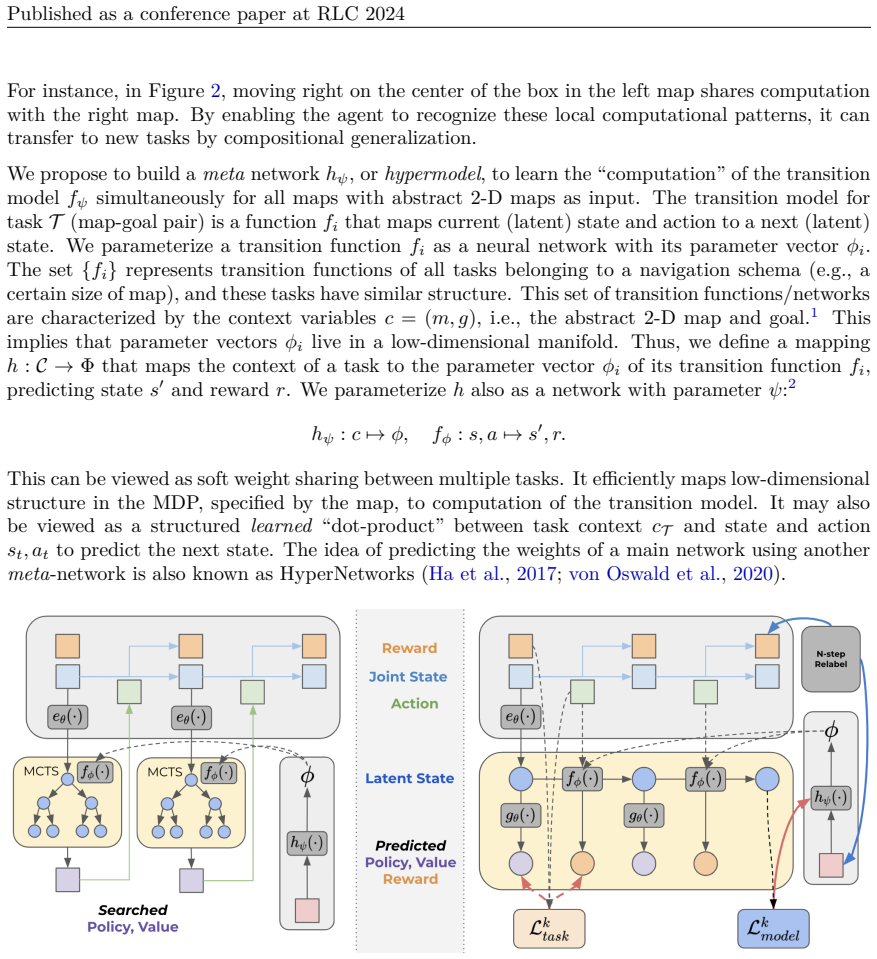
The load-bearing object is the task-conditioned hypermodel: a meta-network $h_\psi$ maps a task context $c$ (downsampled global occupancy map, cropped local occupancy map, and one-hot start/goal grids) to the parameter vector $\phi$ of a small transition network $f_\phi(s,a)=(s',r)$. Because $\phi$ is generated per map-goal pair rather than selected from a finite set, the transition model can recombine local wall/gap patterns seen in training maps into a dynamics model for an unseen layout. The second component is MuZero-style MCTS over this hypermodel, with a task-conditioned value/policy network $g_\theta(s,c)$; training uses an $n$-step hindsight goal-relabeling scheme and an auxiliary transition-prediction loss that maximizes mutual information between the context and predicted trajectories. The use of the agent's own action space inside the latent model is what lets planned trajectories transfer to the environment without explicit localization.
What would settle it
Generate a separate set of evaluation mazes using a different procedural rule that creates local motifs absent from the 20 training maps, such as diagonal wall segments, isolated pillars, or staggered T-junctions, then run MMN zero-shot on them; the central claim is falsified if success rate and SPL drop to roughly the random baseline on these maps while remaining high on maps that merely recombine training patches.
Extended reading notes
Core claim
On a 3-D maze simulator with continuous pose and velocity states, the paper trains a MuZero-style planner whose transition network weights are produced by a hypermodel $h_\psi(c) = \phi$ from the abstract map and goal context $c = (m,g)$. Planning runs Monte Carlo tree search in a learned latent state space that keeps the agent's original action space, so the resulting action sequences can be executed directly without solving the 2-D-to-3-D correspondence problem. At zero-shot evaluation on 20 unseen $13\times 13$ maps, MMN beats the map-conditioned Ape-X HER DQN baseline MAH, especially for start-goal distances beyond the training range; with a landmark oracle providing subgoals, MMN reaches 16 of 20 global goals, including all 9 that MAH reaches. The paper also reports that MMN remains effective when the abstract map is flipped with noise, the map-to-environment scaling is perturbed, or the reported position is corrupted, whereas a deterministic planner with perfect information fails under the same localization noise.
Load-bearing premise
The method assumes that every never-before-seen maze is built from local wall and corridor patterns that already appeared in the 20 training maps, so that a model trained on those patches can predict how the new maze behaves.
Editorial extensions
If this is right
- On 20 unseen $13\times 13$ maps, MMN achieves higher zero-shot success than the model-free MAH baseline across start-goal distances, with the gap widening at longer distances even though training only used distances of 1 to 5.
- With landmark-generated subgoals, MMN reaches 16 of 20 global goals and achieves SPL around 0.6, covering all 9 successes of MAH; MAH reaches 9 of 20 with SPL around 0.28.
- When trained on larger maps ($15\times 15$ up to $21\times 21$), MMN shows the same pattern: local training transfers to unseen layouts but distant goals remain harder.
- Under map flips, perspective/scaling perturbations, and localization noise up to 50 units (half a cell width), MMN's SPL degrades gradually, while a hand-crafted deterministic planner with perfect information gets stuck when localization is noisy.
- Both map-conditioned agents outperform a single-task DQN and random actions, indicating that the map and goal context, not the base algorithm alone, carry the zero-shot transfer.
Reading between the lines
- Inference: The same weight-prediction mechanism should transfer to other multi-task model-based settings where a family of MDPs is indexed by a compact context, such as manipulation with different object layouts or navigation from raw pixels, a direction the paper flags as future work.
- Inference: The compositional premise suggests a testable scaling law: as the vocabulary of local wall/corridor patches in training maps grows, zero-shot success on recombined layouts should improve, and deliberately constructed maps with out-of-distribution local motifs should define the method's failure boundary.
- Inference: Because MMN tolerates half-cell localization noise without training on noise, the learned planner appears to rely on coarse map structure rather than precise metric alignment; adding pose noise during training would likely extend this tolerance further.
Signed reviews
Editorial analysis
A structured set of objections, weighed in public.
Referee Report
Summary. The paper studies zero-shot navigation in novel maze layouts in DeepMind Lab. The agent is given an abstract 2-D occupancy map plus start/goal indicators and must reach the goal in an unseen layout without exploration. The proposed method, MMN, extends MuZero with a hypermodel h_psi that maps the task context (map and goal grids) to the weights of a latent transition model, and planning is done by MCTS in that learned model. A model-free baseline MAH (map-conditioned Ape-X DQN with HER) and a single-task DQN are compared. On 20 held-out 13x13 maps, MMN outperforms MAH especially for long distances; with a landmark oracle for hierarchical navigation, MMN reaches 16/20 global goals versus 9/20 for MAH. Appendix B studies robustness to map flips, action-mapping perturbations, and localization noise, comparing MMN to a deterministic planner. The paper claims MMN generalizes to novel layouts via compositional generalization over local map patches and is more robust to noise.
Significance. If the claims hold, the contribution is a meaningful step: it demonstrates that a model-based planner conditioned on an abstract map can transfer to unseen layouts in a continuous 3-D environment without exploration, with a large empirical gap over a map-conditioned model-free baseline. The hierarchical result (16/20 vs 9/20, including all MAH successes) is a strong and clean comparison. The auxiliary-loss derivation in Appendix A.2 is a standard variational lower bound for mutual information and is not circular; the headline result is measured on unseen maps, so it is not a test-set-fitting artifact. The main limitations are that the map-generation process is unspecified, so the novelty of the held-out layouts is not established, and the robustness comparison in the abstract is supported only against a hard-coded planner, not against the learned baseline.
major comments (3)
- [§4, §5.1] The central generalization claim rests on challenge (ii) in §4: the method must achieve compositional generalization from existing map patches to novel combinations of patches. However, the paper never specifies the map-generation algorithm or a characterization of the local patch distribution; §3 and §5.1 only state that maps are 'generated' and made fully connected. If the 20 evaluation maps are fresh draws from the same generator as the 20 training maps, their local n×n wall/gap patterns may substantially overlap with training patches, and the 16/20 success rate in §5.3 would demonstrate within-distribution generalization rather than recombination to genuinely novel local structures. Please provide the generator (or code) and an analysis of train/eval patch coverage, e.g., the fraction of local n×n patches in the evaluation maps that also appear in training maps for the patch sizes used by the hypermodel.
- [Abstract, Appendix B] The abstract claims that MMN is 'more robust to noise', but Appendix B compares MMN only with a hard-coded deterministic planner that assumes perfect localization and landmarks; there is no comparison with MAH under the same map-flip, action-mapping, or location-noise perturbations. Since the robustness claim is one of the two headline contributions, it should be evaluated against the same learned baseline, or the claim should be restricted to robustness relative to the deterministic planner. In addition, Table 2 and Figure 6 report no confidence intervals or significance tests, so the qualitative 'graceful degradation' statement is not quantified.
- [§5.1, Appendix A] The experimental section omits most implementation details needed to assess or reproduce the method: the hypermodel and encoder architectures, the dimensionality of the latent space and of the predicted weight vector, the number of MCTS simulations, the HER horizon n, the training hyperparameters, and the perturbation magnitudes (flip ratios, noise levels) are not given. Without these, the reader cannot judge whether the reported gap between MMN and MAH could be sensitive to, for example, the MCTS budget or the HER horizon; at minimum, an ablation over the MCTS budget and n is needed to support the claim that the improvement comes from model-based planning rather than from more favorable tuning of the model-based agent.
minor comments (5)
- [§3] The text says 'nagivable spaces'; this should be 'navigable spaces'.
- [Figure 1 caption] The caption contains a duplicated phrase: 'The map provides a rough solution solution'; one 'solution' should be removed.
- [References] The reference list contains several typos: 'Schrittweiser' in Beattie et al., 'Davod Silver' in Wayne et al., and 'W ong' in the author affiliation appears to have an inserted space.
- [§4.1] The transition function is first described as predicting state and reward, but then defined as f_phi: S×A→S only; please clarify whether the reward is part of the hypermodel output or computed separately in the MCTS node.
- [Table 1] The evaluation-metrics paragraph in §5.1 mentions 95% confidence intervals, but Table 1 does not report intervals for the success rate; please add the intervals or state the per-cell sample size.
Circularity Check
No significant circularity: the central zero-shot claim is evaluated on unseen maps, and the auxiliary losses are standard variational/transition-prediction objectives rather than inputs renamed as outputs.
full rationale
I walked the paper's claimed derivation chain: a hypermodel h_psi maps an abstract map and goal context to weights of a latent transition model; MCTS plans with that learned model; training uses n-step hindsight relabeling plus an auxiliary model loss. The auxiliary model loss is derived as a variational lower bound on mutual information I(c_T; tau_T) and reduces to minimizing the prediction error between predicted and true next states; this is a standard bounding argument, not a result that is equivalent to its input by construction. Zero-shot evaluation is conducted on 20 unseen maps with no further training, so the headline result (16/20 hierarchical goals) is not a fitted value on the evaluation set. The hierarchical experiment chooses landmark distance 5 because the agent was trained on start-goal distances <= 5; this does place subgoal navigation within the training-distance distribution, but completing a chain of subgoals on novel layouts is still an independent behavioral claim and is not forced by construction. The numerous self-citations to Zhao et al. appear in related-work and background passages and are not load-bearing for the method's central premise; no uniqueness theorem or prior-work mandate is invoked to forbid alternatives. The unspecified map-generation process is a legitimate generalization-support concern, but under the stated rules it is a missing-support issue rather than circularity. No self-definitional step, fitted-input-called-prediction step, load-bearing self-citation, ansatz-smuggled-via-citation step, or renaming of a known result was identified.
Assumptions & free parameters
free parameters (8)
- MCTS simulation budget
- n-step HER horizon n
- Goal area size =
100x100 world units per abstract cell
- Action repeat =
10
- Number of training maps =
20
- Landmark distance for hierarchical navigation =
5
- Network architectures
- Training hyperparameters
assumptions (6)
- domain assumption Transitions are deterministic in the learning setting.
- domain assumption The abstract 2-D occupancy map and one-hot start/goal grids contain sufficient information to specify the task-specific transition and reward structure.
- ad hoc to paper Unseen maps can be handled by compositional generalization of local map patches seen in 20 training maps.
- ad hoc to paper A neural hypermodel h_psi can map task context to transition-network weights such that the resulting transition model predicts the next latent state accurately.
- ad hoc to paper The learned encoder maps observed 12-dimensional joint states into a latent space where the transition model is accurate and MCTS planning transfers to the real environment.
- domain assumption A landmark oracle is available and provides correct subgoals for hierarchical navigation when used.
Cite this review
Pith. "Pith review of Learning to Navigate in Mazes with Novel Layouts using Abstract Top-down Maps." pith.science (2026). https://pith.science/paper/27FP4AMJ
@misc{pith2026241212024,
  author       = {Pith},
  title        = {Pith review of: Learning to Navigate in Mazes with Novel Layouts using Abstract Top-down Maps},
  year         = {2026},
  howpublished = {\url{https://pith.science/paper/27FP4AMJ}},
  note         = {Machine review of arXiv:2412.12024}
}
abstract
Learning navigation capabilities in different environments has long been one of the major challenges in decision-making. In this work, we focus on zero-shot navigation ability using given abstract $2$-D top-down maps. Like human navigation by reading a paper map, the agent reads the map as an image when navigating in a novel layout, after learning to navigate on a set of training maps. We propose a model-based reinforcement learning approach for this multi-task learning problem, where it jointly learns a hypermodel that takes top-down maps as input and predicts the weights of the transition network. We use the DeepMind Lab environment and customize layouts using generated maps. Our method can adapt better to novel environments in zero-shot and is more robust to noise.
Figures


Figures from the paper (4 more)


Reference graph
Works this paper leans on
-
[1]
Peter Anderson, Angel Chang, Devendra Singh Chaplot, Alexey Dosovitskiy, Saurabh Gupta, Vladlen Koltun, Jana Kosecka, Jitendra Malik, Roozbeh Mottaghi, Manolis Savva, and Amir R. Zamir. On evaluation of embodied navigation agents. arXiv:1807.06757, 2018
arXiv 2018
-
[2]
Marcin Andrychowicz, Filip Wolski, Alex Ray, Jonas Schneider, Rachel Fong, Peter Welinder, Bob McGrew, Josh Tobin, Pieter Abbeel, and Wojciech Zaremba. Hindsight experience replay. In Neural Information Processing Systems, 2017
work page 2017
-
[3]
Andrea Banino, Caswell Barry, Benigno Uria, Charles Blundell, Timothy Lillicrap, Piotr Mirowski, Alexander Pritzel, Martin J. Chadwick, Thomas Degris, Joseph Modayil, Greg Wayne, Hubert Soyer, Fabio Viola, Brian Zhang, Ross Goroshin, Neil Rabinowitz, Razvan Pascanu, Charlie Beattie, Stig Petersen, Amir Sadik, Stephen Gaffney, Helen King, Koray Kavukcuoglu...
work page 2018
-
[4]
Charles Beattie, Joel Z Leibo, Denis Teplyashin, Tom Ward, Marcus Wainwright, Heinrich K \"u ttler, Andrew Lefrancq, Simon Green, V \' ctor Vald \'e s, Amir Sadik, Julian Schrittweiser, Keith Anderson, Sarah York, Max Cant, Adam Cain, Adrian Bolton, Stephen Gaffney, Helen King, Demis Hassabis, Shane Legg, and Stig Petersen. Deep M ind lab. arXiv:1612.03801, 2016
arXiv 2016
-
[5]
Teaching a machine to read maps with deep reinforcement learning
Gino Brunner, Oliver Richter, Yuyi Wang, and Roger Wattenhofer. Teaching a machine to read maps with deep reinforcement learning. In AAAI Conference on Artificial Intelligence , 2018
work page 2018
-
[6]
Learning to explore using active neural SLAM
Devendra Singh Chaplot, Dhiraj Gandhi, Saurabh Gupta, Abhinav Gupta, and Ruslan Salakhutdinov. Learning to explore using active neural SLAM . In International Conference on Learning Representations, 2020
work page 2020
-
[7]
Learning exploration policies for navigation
Tao Chen, Saurabh Gupta, and Abhinav Gupta. Learning exploration policies for navigation. In International Conference on Learning Representations, 2019
work page 2019
-
[8]
Deep reinforcement learning in a handful of trials using probabilistic dynamics models
Kurtland Chua, Roberto Calandra, Rowan McAllister, and Sergey Levine. Deep reinforcement learning in a handful of trials using probabilistic dynamics models. In Neural Information Processing Systems, 2018
work page 2018
Show all 45 references
-
[9]
Learning to act by predicting the future
Alexey Dosovitskiy and Vladlen Koltun. Learning to act by predicting the future. In International Conference on Learning Representations, 2017
2017
-
[10]
Leibo, and Charles Blundell
Meire Fortunato, Melissa Tan, Ryan Faulkner, Steven Hansen, Adri\` a Puigdom\` e nech Badia, Gavin Buttimore, Charlie Deck, Joel Z. Leibo, and Charles Blundell. Generalization of reinforcement learners with working and episodic memory. In Neural Information Processing Systems, 2019
2019
-
[11]
Cognitive mapping and planning for visual navigation
Saurabh Gupta, Varun Tolani, James Davidson, Sergey Levine, Rahul Sukthankar, and Jitendra Malik. Cognitive mapping and planning for visual navigation. International Journal on Computer Vision, 128: 0 1311--1330, 2020
2020
-
[12]
Hyper N etworks
David Ha, Andrew Dai, and Quoc V Le. Hyper N etworks. In International Conference on Learning Representations, 2017
2017
-
[13]
Learning latent dynamics for planning from pixels
Danijar Hafner, Timothy Lillicrap, Ian Fischer, Ruben Villegas, David Ha, Honglak Lee, and James Davidson. Learning latent dynamics for planning from pixels. In International Conference on Machine Learning, 2019
2019
-
[14]
Distributed prioritized experience replay
Dan Horgan, John Quan, David Budden, Gabriel Barth-Maron, Matteo Hessel, Hado van Hasselt, and David Silver. Distributed prioritized experience replay. In International Conference on Learning Representations, 2018
2018
-
[15]
Equivariant single view pose prediction via induced and restriction representations
Owen Howell, David Klee, Ondrej Biza, Linfeng Zhao, and Robin Walters. Equivariant single view pose prediction via induced and restriction representations. In A. Oh, T. Naumann, A. Globerson, K. Saenko, M. Hardt, and S. Levine (eds.), Advances in Neural Information Processing ...
2023
-
[16]
Continual model-based reinforcement learning with hypernetworks
Yizhou Huang, Kevin Xie, Homanga Bharadhwaj, and Florian Shkurti. Continual model-based reinforcement learning with hypernetworks. In IEEE International Conference on Robotics and Automation , 2021
2021
-
[17]
Reinforcement learning with unsupervised auxiliary tasks
Max Jaderberg, Volodymyr Mnih, Wojciech Marian Czarnecki, Tom Schaul, Joel Z Leibo, David Silver, and Koray Kavukcuoglu. Reinforcement learning with unsupervised auxiliary tasks. In International Conference on Learning Representations, 2017
2017
-
[18]
Open-vocabulary pick and place via patch-level semantic maps
Mingxi Jia, Haojie Huang, Zhewen Zhang, Chenghao Wang, Linfeng Zhao, Dian Wang, Jason Xinyu Liu, Robin Walters, Robert Platt, and Stefanie Tellex. Open-vocabulary pick and place via patch-level semantic maps. 2024. URL https://openreview.net/forum?id=cY3jXubzpR&referrer=
2024
-
[19]
Differentiable algorithm networks for composable robot learning
Peter Karkus, Xiao Ma, David Hsu, Leslie Pack Kaelbling, Wee Sun Lee, and Tom\' a s Lozano-P\' e rez. Differentiable algorithm networks for composable robot learning. In Robotics: Science and Systems, 2019
2019
-
[20]
Practice makes perfect: Planning to learn skill parameter policies
Nishanth Kumar, Tom Silver, Willie McClinton, Linfeng Zhao, Stephen Proulx, Tomás Lozano-Pérez, Leslie Pack Kaelbling, and Jennifer Barry. Practice makes perfect: Planning to learn skill parameter policies. arXiv preprint arXiv: 2402.15025, 2024
2024 arXiv
-
[21]
Playing FPS games with deep reinforcement learning
Guillaume Lample and Devendra Singh Chaplot. Playing FPS games with deep reinforcement learning. In AAAI Conference on Artificial Intelligence , 2017
2017
-
[22]
Gated path planning networks
Lisa Lee, Emilio Parisotto, Devendra Singh Chaplot, Eric Xing, and Ruslan Salakhutdinov. Gated path planning networks. In International Conference on Machine Learning, 2018
2018
-
[23]
Discriminative particle filter reinforcement learning for complex partial observations
Xiao Ma, Peter Karkus, David Hsu, Wee Sun Lee, and Nan Ye. Discriminative particle filter reinforcement learning for complex partial observations. In International Conference on Learning Representations, 2020
2020
-
[24]
Ballard, Andrea Banino, Misha Denil, Ross Goroshin, Laurent Sifre, Koray Kavukcuoglu, Dharshan Kumaran, and Raia Hadsell
Piotr Mirowski, Razvan Pascanu, Fabio Viola, Hubert Soyer, Andrew J. Ballard, Andrea Banino, Misha Denil, Ross Goroshin, Laurent Sifre, Koray Kavukcuoglu, Dharshan Kumaran, and Raia Hadsell. Learning to navigate in complex environments. In International Conference on Learning ...
2017
-
[25]
Learning to navigate in cities without a map
Piotr Mirowski, Matthew Koichi Grimes, Mateusz Malinowski, Karl Moritz Hermann, Keith Anderson, Denis Teplyashin, Karen Simonyan, Koray Kavukcuoglu, Andrew Zisserman, and Raia Hadsell. Learning to navigate in cities without a map. In Neural Information Processing Systems, 2018
2018
-
[26]
Rusu, Joel Veness, Marc G
Volodymyr Mnih, Koray Kavukcuoglu, David Silver, Andrei A. Rusu, Joel Veness, Marc G. Bellemare, Alex Graves, Martin Riedmiller, Andreas K. Fidjeland, Georg Ostrovski, Stig Petersen, Charles Beattie, Amir Sadik, Ioannis Antonoglou, Helen King, Dharshan Kumaran, Daan Wierstra, ...
2015
-
[27]
Goal-directed planning via hindsight experience replay
Lorenzo Moro, Amarildo Likmeta, Enrico Prati, and Marcello Restelli. Goal-directed planning via hindsight experience replay. In International Conference on Learning Representations, 2022
2022
-
[28]
Value prediction network
Junhyuk Oh, Satinder Singh, and Honglak Lee. Value prediction network. In Neural Information Processing Systems, 2017
2017
-
[29]
Neural map: Structured memory for deep reinforcement learning
Emilio Parisotto and Ruslan Salakhutdinov. Neural map: Structured memory for deep reinforcement learning. In International Conference on Learning Representations, 2018
2018
-
[30]
Learning symmetric embeddings for equivariant world models
Jung Yeon Park, Ondrej Biza, Linfeng Zhao, Jan Willem van de Meent, and Robin Walters. Learning symmetric embeddings for equivariant world models. In ICML, 2022
2022
-
[31]
Temporal difference models: Model-free deep RL for model-based control
Vitchyr Pong, Shixiang Gu, Murtaza Dalal, and Sergey Levine. Temporal difference models: Model-free deep RL for model-based control. In International Conference on Learning Representations, 2018
2018
-
[32]
Mastering A tari, G o, chess and shogi by planning with a learned model
Julian Schrittwieser, Ioannis Antonoglou, Thomas Hubert, Karen Simonyan, Laurent Sifre, Simon Schmitt, Arthur Guez, Edward Lockhart, Demis Hassabis, Thore Graepel, Timothy Lillicrap, and David Silver. Mastering A tari, G o, chess and shogi by planning with a learned model. Nat...
2020
-
[33]
Value iteration networks
Aviv Tamar, Yi Wu, Garrett Thomas, Sergey Levine, and Pieter Abbeel. Value iteration networks. In Neural Information Processing Systems, 2016
2016
-
[34]
Probabilistic Robotics
Sebastian Thrun, Wolfram Burgard, and Dieter Fox. Probabilistic Robotics. The MIT Press, Cambridge, MA, 2005
2005
-
[35]
Grewe, and Jo \ a o Sacramento
Johannes von Oswald, Christian Henning, Benjamin F. Grewe, and Jo \ a o Sacramento. Continual learning with hypernetworks. In International Conference on Learning Representations, 2020
2020
-
[36]
Greg Wayne, Chia-Chun Hung, David Amos, Mehdi Mirza, Arun Ahuja, Agnieszka Grabska-Barwinska, Jack Rae, Piotr Mirowski, Joel Z. Leibo, Adam Santoro, Mevlana Gemici, Malcolm Reynolds, Tim Harley, Josh Abramson, Shakir Mohamed, Danilo Rezende, David Saxton, Adam Cain, Chloe Hill...
2018 arXiv
-
[37]
Clara De Paolis Kaluza, Linfeng Zhao, Lawson Wong, and Rose Yu
Fan Xie, Alexander Chowdhury, M. Clara De Paolis Kaluza, Linfeng Zhao, Lawson Wong, and Rose Yu. Deep imitation learning for bimanual robotic manipulation. In H. Larochelle, M. Ranzato, R. Hadsell, M.F. Balcan, and H. Lin (eds.), Advances in Neural Information Processing Syste...
2020
-
[38]
Toward compositional generalization in object-oriented world modeling
Linfeng Zhao, Lingzhi Kong, Robin Walters, and Lawson LS Wong. Toward compositional generalization in object-oriented world modeling. In ICML, 2022
2022
-
[39]
Linfeng Zhao, Owen Howell, Jung Yeon Park, Xupeng Zhu, Robin Walters, and Lawson L. S. Wong. Can euclidean symmetry be leveraged in reinforcement learning and planning? arXiv preprint arXiv: 2307.08226, 2023 a
2023 arXiv
-
[40]
Linfeng Zhao, Huazhe Xu, and Lawson L.S. Wong. Scaling up and stabilizing differentiable planning with implicit differentiation. In International Conference on Learning Representations, 2023 b
2023
-
[41]
Linfeng Zhao, Xupeng Zhu, Lingzhi Kong, Robin Walters, and Lawson L.S. Wong. Integrating symmetry into differentiable planning with steerable convolutions. In International Conference on Learning Representations, 2023 c
2023
-
[42]
Linfeng Zhao, Owen Lewis Howell, Xupeng Zhu, Jung Yeon Park, Zhewen Zhang, Robin Walters, and Lawson L.S. Wong. Equivariant action sampling for reinforcement learning and planning. In The 16th International Workshop on the Algorithmic Foundations of Robotics, 2024 a . URL http...
2024
-
[43]
Linfeng Zhao, Hongyu Li, Taşkın Padır, Huaizu Jiang, and Lawson L.S. Wong. E(2) -equivariant graph planning for navigation. IEEE Robotics and Automation Letters, 9 0 (4): 0 3371--3378, 2024 b . doi:10.1109/LRA.2024.3360011
2024
-
[44]
RTFM : Generalising to new environment dynamics via reading
Victor Zhong, Tim Rockt\"aschel, and Edward Grefenstette. RTFM : Generalising to new environment dynamics via reading. In International Conference on Learning Representations, 2020
2020
-
[45]
write newline
" write newline "" before.all 'output.state := FUNCTION n.dashify 't := "" t empty not t #1 #1 substring "-" = t #1 #2 substring "--" = not "--" * t #2 global.max substring 't := t #1 #1 substring "-" = "-" * t #2 global.max substring 't := while if t #1 #1 substring * t #2 gl...
Reviewed August 11, 2026 · model on record in the stance chip above.
Discussion (0). Continue with ORCID to comment.