REVIEW 4 major objections 7 minor 1 cited by
Regulation of Language Models With Interpretability Will Likely Result In A Performance Trade-Off
T0 review · 4 major / 7 minor · reviewed 2026-08-11 · deepseek-v4-flash
Pith's one-line read This paper shows an LLM can be forced to reason only through human-defined legal concepts, at a measured 7.34-point accuracy cost that human users partly offset.
desk verdict Worth engaging, but the abstract oversells the certainty: the 7.34% trade-off is real as an architectural measurement, but whether it is a cost of semantic regulation is not established. read the letter →
The pith
A machine-rendered reading of the paper's core claim, the machinery that carries it, and where it could break.
The reading
What carries the argument
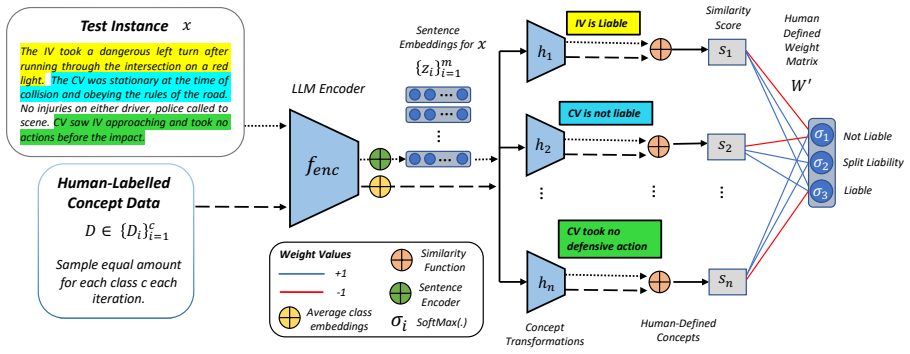
The central mechanism is a prototype layer: a set of concept prototypes $P = \{p_i\}$ built by averaging BERT sentence embeddings of human-labeled examples for each of the eight concepts, together with learned MLP projections $h_i$ that compress the embedding space from 768 to 16 dimensions before comparing each test sentence embedding $z_i$ to prototype $p_i$ with the similarity function $\mathrm{sim}(z_i, p_i) = \log\left(\frac{(z_i - p_i)^2 + 1}{(z_i - p_i)^2 + \epsilon}\right)$. The maximum similarity score for each concept is selected and combined by element-wise product with an expert-defined weight matrix $W'$ whose polarity is frozen, so each concept can only push for or against the classes the domain expert chose. Training minimizes a class cross-entropy loss and a human-concept cross-entropy loss together, which is what forces the LLM to use the regulatable features.
What would settle it
Take pairs of accident descriptions that match on all eight regulatable concepts but differ only in a legally forbidden attribute such as a name, gender, or neighborhood; if the regulated model's predictions shift systematically on such pairs, the constraint has failed and the model is using non-regulatable information.
Extended reading notes
Core claim
The central claim is that forcing an LLM to reason through a fixed set of human-vetted, legally permissible concepts is feasible and auditable, but it is not free: the model's accuracy drops by an average of 7.34 percentage points relative to the original black-box LLM (from 68.68% to 60.75% on insurance liability, and from 84.16% to 77.41% on the Beer Advocate dataset). The paper attributes this drop to the gap between the feature set a black-box model would learn and the regulatable feature set $R$, a subset of human-interpretable features; because $R$ is not guaranteed to coincide with the black-box feature set $B$, constraining the model can only maintain or reduce performance. Despite this, the user study suggests the regulated model improves human task performance speed and maintains appropriate confidence, so the trade-off is not simply accuracy-for-transparency but a transfer of some cost to the human-AI system level where it may be recovered.
Load-bearing premise
The load-bearing premise is that the prototype layer truly confines the model to the regulatable concepts, meaning the learned projections and noisy concept prototypes do not secretly use other information about the text, so the transparency is semantic rather than merely architectural.
Editorial extensions
If this is right
- Regulated LLMs are deployable in at least one high-stakes domain: the model can be made to use only legally permissible concepts, and its concept predictions are auditable through prototype activations.
- The average 7.34-point accuracy drop should be expected whenever a regulator constrains an LLM to a feature set smaller than the set the black-box model would naturally learn; the drop is not an artifact of this particular architecture.
- Because the unconstrained prototype model actually outperformed the black box (69.01% vs. 68.68% on insurance; 85.05% vs. 84.16% on Beer Advocate), interpretability alone does not imply a cost—the cost is specific to regulation constraints.
- Human-AI teams can recover part of the cost: in the pilot study, pooled decision time fell from 123.46 seconds to 110.40 seconds with AI assistance, and appropriate confidence was maintained.
- Concept classification quality is bounded by human label agreement; with 61.2% inter-rater agreement as the ceiling, the model's 45.90% Top-1 concept accuracy reaches about 75% of that practical ceiling.
Reading between the lines
- A testable extension would vary the overlap between the regulatable set $R$ and the black-box set $B$ in a synthetic domain and measure how the accuracy drop scales; the paper's set-containment argument predicts a monotone relationship.
- The framework's main bottleneck is the human-annotated concept dataset; comparing human labels with generative-model labels for the same concepts would show whether the 7.34-point cost is sensitive to label quality.
- If the pilot-study speed benefit replicates with more users, evaluations of regulated AI should include human-in-the-loop metrics rather than standalone accuracy, and regulators may reasonably accept some accuracy loss in exchange for auditable reasoning.
Editorial analysis
A structured set of objections, weighed in public.
Referee Report
Summary. The paper proposes an architecture for 'regulatable' LLM classification in an insurance-liability setting, in which class logits are computed from similarity scores between sentence embeddings and prototypes of eight human-defined legal concepts, with a fixed-polarity weight matrix W' connecting concepts to classes. The authors report that this regulatable model loses 7.34% average classification accuracy relative to a black-box BERT baseline, which they call the 'regulation performance trade-off.' They also report a pilot user study with eight insurance adjusters suggesting that the model speeds up human classification and improves confidence. The paper includes experiments on a proprietary liability dataset and the public Beer Advocate dataset, with concept-label accuracy and a human-subject pilot.
Significance. If the central claim is supported, the paper provides one of the first concrete quantifications of a performance cost for making LLM decisions auditable through human-defined concepts, and it offers evidence that human-AI collaboration can partially offset that cost. The paper has several strengths: the code is released, the concept-annotation protocol uses two vendors and reports inter-rater agreement, the method is tested on a public dataset in addition to proprietary data, and the pilot study uses real insurance adjusters in a realistic setting. The result is potentially significant for the interpretable-ML and AI-regulation communities. However, the significance is contingent on whether the architecture genuinely restricts the model to the intended semantic concepts, and on whether the reported accuracy drop and human-benefit claims survive additional statistical and conceptual scrutiny.
major comments (4)
- [Section 5.4 and Table 2] The central 7.34% average accuracy drop is computed relative to the 'original black-box accuracy' of 68.68% (Insurance) and 84.16% (Beer Advocate), which appears only in the text and not in Table 2. Every other entry in Table 2 reports mean ± standard error over three iterations, so the reader cannot evaluate the uncertainty of the drop or whether it is statistically distinguishable. Please include this baseline in Table 2 with the same error reporting, or explicitly justify why a single number is sufficient, and report a paired comparison or confidence interval for the drop.
- [Sections 4.2–4.3, Eqs. (1)–(3)] The architecture does not yet guarantee that the model is restricted to the regulatable feature set R. The class logits are computed from eight similarity scores, but those scores are produced by learned 16-dimensional MLP projections h_i of BERT embeddings, compared to prototypes that are averages of human-labeled sentences. The concept loss L_h only supervises concept classification on annotated data; it does not prevent h_i from encoding class-discriminative information unrelated to the legal concepts. The max-pooling in Eq. (2) can also be driven by a single sentence whose surface similarity to a prototype is high. As a result, the measured accuracy drop may reflect the architectural bottleneck (768→16→8) rather than semantic regulation. A concept-label shuffle test—retraining with shuffled concept labels and checking whether class accuracy changes—would help establish that the model is actually using the intended concepts semantically.
- [Section 6, Figure 3] The abstract and conclusion state that the system improves human task speed and appropriate confidence, but the pilot evidence is limited. The confidence improvement is not significant (p=0.094, n=3 vs 3), the pooled speed benefit (110.40 ± 14.61 vs 123.46 ± 29.61 seconds) is reported without a significance test, and the significant t(6)=3.59 comparison is between post-hoc subgroups split by whether users sped up or slowed down, not a test of an average benefit. The Limitations section acknowledges the small sample, but the abstract and conclusion present these as established findings. Please temper the claims, report effect sizes and confidence intervals, and clarify which conclusions are hypothesis-generating.
- [Section 2.2] The theoretical argument that constraining a model to R cannot improve performance over B is definitional once R is a subset of the latent space and the same frozen LLM is used. The empirical contribution is therefore the measured magnitude of the drop and the demonstration that the proposed architecture actually implements the R-restriction. The paper would benefit from stating this distinction explicitly, so that the 'trade-off' is not presented as an empirical discovery of a previously unknown phenomenon but as a quantification of a known-in-principle constraint.
minor comments (7)
- [Abstract] The phrase 'how it would effect model performance' should be 'how it would affect model performance.'
- [Section 3.2] There is a typo in 'The data can is summarized in Table 1'; it should read 'The data are summarized in Table 1.'
- [Section 5.1] The 'original black-box accuracy' appears not to be one of the Table 2 baselines (the 'Human Labels=No' entries are prototype models, not an unmodified BERT). Please clarify how the black-box accuracy was obtained and whether it is the same underlying encoder and fine-tuning procedure without the prototype layer.
- [Section 5.4] The statement that the model reaches 75% of the theoretical ceiling for concept classification compares a top-1 metric (45.90%) with an inter-rater percentage-agreement metric (61.2%) that has different units. Please clarify why these are comparable, or report a ceiling computed for the same top-1 metric.
- [Equations (1)–(3)] The logarithm in Eq. (1) has no specified base, and the role of the hyperparameter ε is described only as 'to avoid division by zero.' A sentence clarifying the sensitivity of the similarity scores to ε would help reproducibility.
- [Section 6.1] The statistical reporting for the user study is incomplete: the test for the confidence comparison should state whether it is a paired or two-sample test, and the pooled speed comparison should include a test statistic and p-value or be explicitly labeled as descriptive.
- [Section 3.2] The sentence describing the two vendors' agreement is slightly confusing: '2.65% precisely agreed... if we relax ... rises to 61.2%'—please clarify whether 61.2% is the exact-enveloping agreement or the relaxed agreement, since the text says 'if we relax the second constraint.'
Circularity Check
The qualitative regulation-performance trade-off is definitional (R is a subset of the optimal black-box feature space), though the 7.34% magnitude and human-study results are independently measured.
-
self definitional
[Section 2.2 'The Regulation Performance Trade-Off'; Section 5.4 and Table 2 caption]
"Note that R is not guaranteed to occupy the same space as B, and is necessarily a subset of I, given such constraints, a model relying only on R is guaranteed to have a performance equal to, or less than B or I (assuming B was trained well and we use R with the original LLM frozen). ... This resulted in lower accuracy on the class label compared to unsupervised baselines (i.e., Human Labels=No) as predicted in Section 2."
The 'prediction' of a trade-off is derived by construction from the paper's own definitions: B is defined as the feature set the LLM uses to optimize the task, and R is defined as a subset of the interpretable set I within the same latent space L. If a model genuinely uses only R, it cannot beat a well-trained B by definition. Section 5.4 then presents the measured accuracy drop as confirmation of this definitional guarantee ('as predicted in Section 2'), so the qualitative existence of the trade-off is not an empirical discovery. The quantitative magnitude (7.34%) and the user-study effects are independent empirical measurements, which is why the circularity is only partial.
full rationale
The paper's central empirical contribution is the measured 7.34% average classification drop and the pilot user study showing improved human speed and confidence. Those measurements are not themselves circular: they are compared against a black-box BERT baseline and, for concept accuracy, against the externally estimated 61.2% inter-rater agreement ceiling. The circular element is narrower: Section 2.2 defines the regulatable set R as a subset of the interpretable set I inside the latent space L, and defines B as the feature set that optimizes the task; the 'guarantee' that an R-only model cannot outperform B follows immediately from those definitions plus the optimality assumption. Reporting the later accuracy drop 'as predicted in Section 2' therefore presents a definitional consequence as an empirical confirmation of the trade-off's existence. The model's actual restriction to R is not proven—the learned 16-dimensional projections hi could encode information beyond the human-labelled concepts—but that is an empirical validity concern about the architecture, not a circularity in the derivation. The self-citations to Kenny et al. (2023) are used for context and regularization-effect attribution, and are not load-bearing for the measured trade-off. Overall, the qualitative trade-off is true by construction, while the quantitative and human-collaboration findings retain independent content, giving a partial circularity score of 4.
Assumptions & free parameters
free parameters (3)
- W' initial weights =
+1 or -1 per concept-class pair (magnitudes fine-tuned)
- MLP hidden size =
16
- Epsilon in similarity function =
not reported
assumptions (4)
- domain assumption Constraining a model to the regulatable feature set R (a subset of the latent space) cannot improve performance over the unconstrained black-box model.
- domain assumption The eight human-defined concepts and their sign polarity to the three liability classes are correct and complete for the task.
- domain assumption Frozen BERT embeddings plus learned 16-dimensional projections preserve enough concept and class information for the prototype similarity rule.
- domain assumption The union of two vendors' concept labels, despite 61.2% relaxed inter-rater agreement, is sufficiently reliable to supervise the concept loss.
Cite this review
Pith. "Pith review of Regulation of Language Models With Interpretability Will Likely Result In A Performance Trade-Off." pith.science (2026). https://pith.science/paper/UMMKH2DA
@misc{pith2026241212169,
  author       = {Pith},
  title        = {Pith review of: Regulation of Language Models With Interpretability Will Likely Result In A Performance Trade-Off},
  year         = {2026},
  howpublished = {\url{https://pith.science/paper/UMMKH2DA}},
  note         = {Machine review of arXiv:2412.12169}
}
read the original abstract
Regulation is increasingly cited as the most important and pressing concern in machine learning. However, it is currently unknown how to implement this, and perhaps more importantly, how it would effect model performance alongside human collaboration if actually realized. In this paper, we attempt to answer these questions by building a regulatable large-language model (LLM), and then quantifying how the additional constraints involved affect (1) model performance, alongside (2) human collaboration. Our empirical results reveal that it is possible to force an LLM to use human-defined features in a transparent way, but a "regulation performance trade-off" previously not considered reveals itself in the form of a 7.34% classification performance drop. Surprisingly however, we show that despite this, such systems actually improve human task performance speed and appropriate confidence in a realistic deployment setting compared to no AI assistance, thus paving a way for fair, regulatable AI, which benefits users.
Figures


Figures from the paper (5 more)


Forward citations
Cited by 1 Pith paper
-
Explainability of Large Language Models: Opportunities and Challenges toward Generating Trustworthy Explanations
LLM explanations split into local and mechanistic tracks; the paper argues they are trustworthy only if they pass causal and contrastive stress tests, adapt to the explainee, and satisfy eight trust principles.
Reference graph
Works this paper leans on
-
[1]
Diego Antognini and Boi Faltings. 2021. Rationalization through concepts. arXiv preprint arXiv:2105.04837
work page Pith review arXiv 2021
-
[2]
Yujia Bao, Shiyu Chang, Mo Yu, and Regina Barzilay. 2018. Deriving machine attention from human rationales. arXiv preprint arXiv:1808.09367
arXiv 2018
-
[3]
Alina Jade Barnett, Zhicheng Guo, Jin Jing, Wendong Ge, Peter W Kaplan, Wan Yee Kong, Ioannis Karakis, Aline Herlopian, Lakshman Arcot Jayagopal, Olga Taraschenko, et al. 2024. Improving clinician performance in classifying eeg patterns on the ictal--interictal injury continuum using interpretable machine learning. NEJM AI, 1(6):AIoa2300331
work page 2024
-
[4]
Yoshua Bengio, Geoffrey Hinton, Andrew Yao, Dawn Song, Pieter Abbeel, Trevor Darrell, Yuval Noah Harari, Ya-Qin Zhang, Lan Xue, Shai Shalev-Shwartz, et al. 2024. Managing extreme ai risks amid rapid progress. Science, page eadn0117
work page 2024
-
[5]
Yaniv Benhamou and Justine Ferland. 2020. Artificial intelligence & damages: assessing liability and calculating the damages. Leading Legal Disruption: Artificial Intelligence and a Toolkit for Lawyers and the Law, Forthcoming
work page 2020
-
[6]
Diane Bouchacourt and Ludovic Denoyer. 2019. Educe: Explaining model decisions through unsupervised concepts extraction. arXiv preprint arXiv:1905.11852
work page Pith review arXiv 2019
-
[7]
Jeremie Brecheisen. 2024. https://hbr.org/2024/05/research-what-companies-dont-know-about-how-workers-use-ai Research: What companies don’t know about how workers use ai . Harvard Business Review
work page 2024
-
[8]
Stephen Casper, Carson Ezell, Charlotte Siegmann, Noam Kolt, Taylor Lynn Curtis, Benjamin Bucknall, Andreas Haupt, Kevin Wei, J \'e r \'e my Scheurer, Marius Hobbhahn, et al. 2024. Black-box access is insufficient for rigorous ai audits. arXiv preprint arXiv:2401.14446
arXiv 2024
Show all 40 references
-
[9]
Aaron Chan, Shaoliang Nie, Liang Tan, Xiaochang Peng, Hamed Firooz, Maziar Sanjabi, and Xiang Ren. 2022. Frame: Evaluating simulatability metrics for free-text rationales. arXiv preprint arXiv:2207.00779
2022 arXiv
-
[10]
Chaofan Chen, Oscar Li, Daniel Tao, Alina Barnett, Cynthia Rudin, and Jonathan K Su. 2019. This looks like that: deep learning for interpretable image recognition. In Advances in Neural Information Processing Systems, pages 8928--8939
2019
-
[11]
Long Chen, Oleg Sinavski, Jan H \"u nermann, Alice Karnsund, Andrew James Willmott, Danny Birch, Daniel Maund, and Jamie Shotton. 2023. Driving with llms: Fusing object-level vector modality for explainable autonomous driving. arXiv preprint arXiv:2310.01957
2023 arXiv
-
[12]
Anubrata Das, Chitrank Gupta, Venelin Kovatchev, Matthew Lease, and Junyi Jessy Li. 2022. Prototex: Explaining model decisions with prototype tensors. In Proceedings of the 60th Annual Meeting of the Association for Computational Linguistics
2022
-
[13]
Jacob Devlin, Ming-Wei Chang, Kenton Lee, and Kristina Toutanova. 2018. Bert: Pre-training of deep bidirectional transformers for language understanding. arXiv preprint arXiv:1810.04805
2018 arXiv
-
[14]
Jiqian Dong, Sikai Chen, Mohammad Miralinaghi, Tiantian Chen, Pei Li, and Samuel Labi. 2023. Why did the ai make that decision? towards an explainable artificial intelligence (xai) for autonomous driving systems. Transportation research part C: emerging technologies, 156:104358
2023
-
[15]
Finale Doshi-Velez and Been Kim. 2017. Towards a rigorous science of interpretable machine learning. arXiv preprint arXiv:1702.08608
2017 arXiv
-
[16]
Keane, Eoin M
Mark T. Keane, Eoin M. Kenny, Eoin Delaney, and Barry Smyth. 2021. If only we had better counterfactual explanations: Five key deficits to rectify in the evaluation of counterfactual xai techniques. In Proceedings of the Thirtieth International Joint Conference on Artificial I...
2021
-
[17]
Kenny, Akshay Dharmavaram, Sang Uk Lee, Tung Phan-Minh, Shreyas Rajesh, Yunqing Hu, Laura Major, Momchil S
Eoin M. Kenny, Akshay Dharmavaram, Sang Uk Lee, Tung Phan-Minh, Shreyas Rajesh, Yunqing Hu, Laura Major, Momchil S. Tomov, and Julie A. Shah. 2024. https://arxiv.org/abs/2411.18714 Explainable deep learning improves human mental models of self-driving cars . Preprint, arXiv:2411.18714
2024
-
[18]
Eoin M Kenny, Courtney Ford, Molly Quinn, and Mark T Keane. 2021. Explaining black-box classifiers using post-hoc explanations-by-example: The effect of explanations and error-rates in xai user studies. Artificial Intelligence, page 103459
2021
-
[19]
Kenny, Mycal Tucker, and Julie Shah
Eoin M. Kenny, Mycal Tucker, and Julie Shah. 2023. https://openreview.net/forum?id=hWwY_Jq0xsN Towards interpretable deep reinforcement learning with human-friendly prototypes . In The Eleventh International Conference on Learning Representations
2023
-
[20]
Javier Canales Luna. 2023. https://www.datacamp.com/blog/what-is-bert-an-intro-to-bert-models. What is bert? an intro to bert models
2023
-
[21]
Scott M Lundberg, Bala Nair, Monica S Vavilala, Mayumi Horibe, Michael J Eisses, Trevor Adams, David E Liston, Daniel King-Wai Low, Shu-Fang Newman, Jerry Kim, et al. 2018. Explainable machine-learning predictions for the prevention of hypoxaemia during surgery. Nature biomedi...
2018
-
[22]
Jiaqi Ma. 2024. Regulatable ml @neurips2023. https://regulatableml.github.io/. [Online; accessed 03-March-2024]
2024
-
[23]
Julian McAuley, Jure Leskovec, and Dan Jurafsky. 2012. Learning attitudes and attributes from multi-aspect reviews. In 2012 IEEE 12th International Conference on Data Mining, pages 1020--1025. IEEE
2012
-
[24]
Yao Ming, Panpan Xu, Huamin Qu, and Liu Ren. 2019. Interpretable and steerable sequence learning via prototypes. In Proceedings of the 25th ACM SIGKDD International Conference on Knowledge Discovery & Data Mining, pages 903--913
2019
-
[25]
Giang Nguyen, Daeyoung Kim, and Anh Nguyen. 2021. The effectiveness of feature attribution methods and its correlation with automatic evaluation scores. Advances in Neural Information Processing Systems, 34:26422--26436
2021
-
[26]
Daria Onitiu, Sandra Wachter, and Brent Mittelstadt. 2023. How ai challenges the medical device regulation: Patient safety, benefits, and intended uses. Available at SSRN 4638548
2023
-
[27]
Cynthia Rudin. 2019. Stop explaining black box machine learning models for high stakes decisions and use interpretable models instead. Nature Machine Intelligence, 1(5):206--215
2019
-
[28]
Lindsay Sanneman and Julie A Shah. 2022. The situation awareness framework for explainable ai (safe-ai) and human factors considerations for xai systems. International Journal of Human--Computer Interaction, 38(18-20):1772--1788
2022
-
[29]
Nathalie A Smuha, Emma Ahmed-Rengers, Adam Harkens, Wenlong Li, James MacLaren, Riccardo Piselli, and Karen Yeung. 2021. How the eu can achieve legally trustworthy ai: a response to the european commission’s proposal for an artificial intelligence act. Available at SSRN 3899991
2021
-
[30]
Helen Toner and Tasha McCauley. 2024. https://www.economist.com/by-invitation/2024/05/26/ai-firms-mustnt-govern-themselves-say-ex-members-of-openais-board Ai firms mustn't govern themselves, say ex-members of openai's board . Accessed: 2024-05-31
2024
-
[31]
Betty Van Aken, Jens-Michalis Papaioannou, Marcel Naik, Georgios Eleftheriadis, Wolfgang Nejdl, Felix Gers, and Alexander Loeser. 2022. This patient looks like that patient: Prototypical networks for interpretable diagnosis prediction from clinical text. In Proceedings of the ...
2022
-
[32]
Ashish Vaswani, Noam Shazeer, Niki Parmar, Jakob Uszkoreit, Llion Jones, Aidan N Gomez, ukasz Kaiser, and Illia Polosukhin. 2017. Attention is all you need. Advances in neural information processing systems, 30
2017
-
[33]
Thomas Wischmeyer and Timo Rademacher. 2020. Regulating artificial intelligence. 1. Springer
2020
-
[34]
Sean Xie, Soroush Vosoughi, and Saeed Hassanpour. 2023. Proto-lm: A prototypical network-based framework for built-in interpretability in large language models. arXiv preprint arXiv:2311.01732
2023 arXiv
-
[35]
Chhavi Yadav. 2024. https://xai-in-action.github.io/ Explainable ai in action . Accessed: 2024-06-02
2024
-
[36]
Chanyuan Abigail Zhang, Soohyun Cho, and Miklos Vasarhelyi. 2022. Explainable artificial intelligence (xai) in auditing. International Journal of Accounting Information Systems, 46:100572
2022
-
[37]
Yazhou Zhang, Mengyao Wang, Chenyu Ren, Qiuchi Li, Prayag Tiwari, Benyou Wang, and Jing Qin. 2024. Pushing the limit of llm capacity for text classification. arXiv preprint arXiv:2402.07470
2024 arXiv
-
[38]
Qihuang Zhong, Liang Ding, Juhua Liu, Bo Du, and Dacheng Tao. 2023. Can chatgpt understand too? a comparative study on chatgpt and fine-tuned bert. arXiv preprint arXiv:2302.10198
2023 arXiv
-
[39]
online" 'onlinestring :=
ENTRY address archivePrefix author booktitle chapter edition editor eid eprint eprinttype howpublished institution journal key month note number organization pages publisher school series title type volume year doi pubmed url lastchecked label extra.label sort.label short.list...
-
[40]
write newline
" write newline "" before.all 'output.state := FUNCTION n.dashify 't := "" t empty not t #1 #1 substring "-" = t #1 #2 substring "--" = not "--" * t #2 global.max substring 't := t #1 #1 substring "-" = "-" * t #2 global.max substring 't := while if t #1 #1 substring * t #2 gl...
Reviewed August 11, 2026 · model on record in the stance chip above.
Discussion (0). Continue with ORCID to comment.