REVIEW 4 major objections 4 minor 49 references
Unsupervised Region-Based Image Editing of Denoising Diffusion Models
T0 review · 4 major / 4 minor · reviewed 2026-08-11 · deepseek-v4-flash
Pith's one-line read This paper claims that a coarse mask alone can steer semantic edits in a pretrained diffusion model by projecting the masked region's Jacobian orthogonal to the unmasked region's Jacobian, achieving local editing without labels or training.
desk verdict The core projection (Eq. 14) is a rank-one Gram-Schmidt step while the Jacobians are matrices, so the derivation does not support the paper's central claim of suppressing all outside-region changes. read the letter →
The pith
A machine-rendered reading of the paper's core claim, the machinery that carries it, and where it could break.
The reading
What carries the argument
The object carrying the argument is the Jacobian of the masked noise-prediction network with respect to the h-space latent, where h-space is the semantic latent space formed by the U-Net bottleneck skip connections. The load-bearing step is a single Gram-Schmidt-style orthogonal projection: the masked Jacobian is projected onto the unmasked Jacobian and the projection is subtracted, so the retained direction is the part of the masked sensitivity that is orthogonal to the non-masked sensitivity. Singular vectors of this projected Jacobian are approximated by power iteration, and the leading vector is applied as the edit direction during DDIM sampling.
What would settle it
For a fixed image and timestep, compute the masked and unmasked Jacobians, then compare the paper's projected direction with the direction that actually maximizes $\|J_m h\|/\|J_u h\|$, for instance the leading generalized eigenvector of $J_m^T J_m$ relative to $J_u^T J_u$. If the projected direction is not among the optimizers, the core equivalence fails; the test can be run on one CelebA-HQ image or on a small synthetic linear map.
Extended reading notes
Core claim
The paper's central claim is that a local semantic edit direction can be computed from two Jacobians of the denoising network. With $f(h_t)=\epsilon^\theta_t(x_t,h_t)$ the noise prediction, the masked Jacobian $J_m=\partial(\epsilon^\theta_t\odot M)/\partial h_t$ encodes the sensitivity of the region of interest, and $J_u$ encodes the sensitivity of the complement. The paper proposes $J = J_m - \frac{J_m\cdot J_u}{J_u\cdot J_u}J_u$, a single orthogonal projection of the masked direction onto the subspace orthogonal to the unmasked direction, and claims this solves the objective of maximizing masked-region change while minimizing change elsewhere. The resulting vector is used as an edit direction in h-space across selected denoising time steps. Because changes in h-space propagate to x-space through the noise prediction network, suppressing the unmasked Jacobian component is claimed to suppress unwanted global changes.
Load-bearing premise
The whole method rests on the assumption that one orthogonal projection of the masked Jacobian onto the unmasked Jacobian is equivalent to maximizing masked-region change while minimizing unmasked-region change, and the paper does not prove this equivalence.
Editorial extensions
If this is right
- A user can edit a local attribute with only a rough bounding box; no attribute labels, text prompt, or fine-tuning are needed.
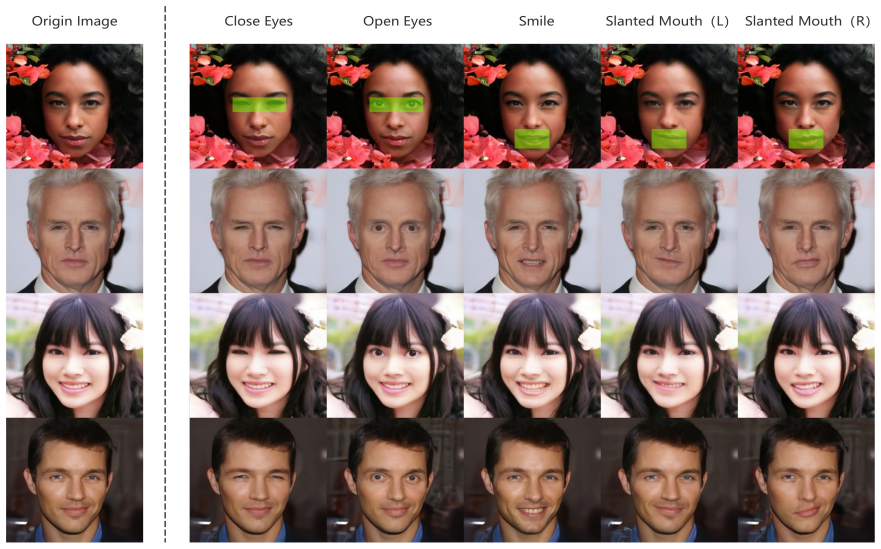
- The same mask can yield multiple distinct semantic edits, such as smile, left-slant, and right-slant for a mouth region.
- Outside-mask preservation should transfer across datasets and U-Net diffusion architectures, since the method relies only on h-space Jacobians.
- On smile editing, the unsupervised result can beat supervised edits on FID, identity similarity, and LPIPS, so supervision is not a prerequisite for high-quality local edits.
Reading between the lines
- The paper leaves implicit that the projection is only one Gram-Schmidt step against a single unmasked Jacobian; iterating it over several regional Jacobians or using a generalized eigenvector of $J_m^T J_m$ relative to $J_u^T J_u$ could satisfy the stated max/min objective more faithfully.
- A testable extension is that because only a coarse mask is required, the interface should transfer to region-constrained editing outside faces, such as object-level or medical-image editing, wherever a U-Net diffusion model is available.
- The paper also leaves implicit that h-space locality implies a family of timestep-dependent edit directions; checking whether a single direction stays optimal across all timesteps would clarify the robustness of the mask-only interface.
Editorial analysis
A structured set of objections, weighed in public.
Referee Report
Summary. The paper proposes Region-Based Editing (RBE), a training-free method for local semantic editing in the h-space of pretrained U-Net diffusion models. The user provides a mask, the method computes Jacobians of the masked and unmasked regions of the noise-prediction network, applies an orthogonal projection to suppress unmasked-region sensitivity, and injects the resulting semantic direction during DDIM reverse sampling. The authors report qualitative results on CelebA-HQ, LSUN-church, and LSUN-bedroom and compare quantitatively with Asyrp, Boundary Diffusion, and Semdiff on the smile attribute, claiming state-of-the-art performance and even superiority over supervised baselines.
Significance. The paper addresses a relevant and timely problem: training-free, mask-only semantic editing with preservation of the unmasked image content. If the projection step were rigorously justified, the method would be a useful and practical contribution, and the qualitative examples do suggest that outside-mask preservation is better than in the compared baselines. The paper also gives a clear statement of limitations in the Discussion. However, the central mathematical claim connecting the optimization objective to the projection is not established, and the quantitative evaluation is too narrow to support the headline claim of surpassing supervised methods. The potential is real, but the manuscript needs substantial revision before the contribution can be assessed reliably.
major comments (4)
- [Methodology, Eq. (13)-(14)] Equation (13) is not a well-defined optimization objective. It is written as 'arg max ... min ...' without specifying a norm, a scalarization, or the admissible set for h_t. Even if it is interpreted as 'maximize masked-region change while minimizing unmasked-region change,' the paper gives no derivation showing that the orthogonal projection in Eq. (14) optimizes this criterion. Because the entire method rests on this equivalence, the authors must either provide a rigorous proof under explicit assumptions or reformulate the objective and the projection as a heuristic and validate that heuristic experimentally.
- [Methodology, Eq. (14)] As written, Eq. (14) uses single-vector dot products, but J_t in Eq. (6) and J_masked in Eq. (12) are matrices, and J_m and J_u have different numbers of rows because they correspond to masked and unmasked pixel sets. If the intended operation is a Gram-Schmidt projection of one Jacobian vector against another, the formula cancels only one direction of unmasked sensitivity. For a Jacobian J_u of rank greater than one, the orthogonal complement of the unmasked subspace is not obtained by a single rank-one subtraction; the correct form is J_m - J_u (J_u^T J_u)^+ J_u^T J_m (or an equivalent basis projection). The authors should either use the full projection or explicitly state and empirically justify a rank-one approximation.
- [Experiments, Figure 3 and 'Unsupervised Editing through Jacobian'] The method can discover many right singular vectors for a masked region, but the paper never specifies how the vector corresponding to a desired attribute (e.g., 'smile' versus 'slanted mouth') is selected. Figure 3 shows that the same mouth mask yields different attributes, which suggests manual selection after the fact. Without a selection criterion, the method is not fully unsupervised, and the reported per-attribute results are not reproducible from the algorithmic description in the paper.
- [Experiments, Table 2] The headline claim of surpassing supervised methods is based on a single attribute ('smile') and a single dataset, with no standard deviations, no number of runs, and no significance test. In addition, the MSE values in Table 2 are not decomposed into in-mask and out-of-mask components, even though outside-mask preservation is the central contribution of the paper; that decomposition is only shown in Figure 7 for one comparison against Semdiff. The comparison needs more attributes, more datasets, and statistical support to justify the strength of the claim.
minor comments (4)
- [Background] There is a typo in 'Diffusion autuencoders'; it should be 'Diffusion autoencoders'.
- [Experiments, Figure 7] The paragraph preceding Figure 7 says 'The qualitative results in Figure 7 also prove this point,' but Figure 7 is a quantitative bar-chart comparison of pixel changes; the wording should say 'quantitative results.'
- [Experiments, Figure 3 caption] The caption states that the mask is used 'during training and do not need to add it during testing,' but the method is training-free; this should be rephrased as 'during editing' or the distinction should be clarified.
- [Experimental Setup] The acronym 'Asyrp' is used without being defined or cited; please provide the full method name and a reference.
Circularity Check
No significant circularity: the method is evaluated on held-out images with fixed pretrained models; the only minor issue is a non-load-bearing self-citation, while the unproven Eq. 14 projection is a correctness risk rather than a circular step.
full rationale
The paper's derivation chain is not circular in the problematic sense. The proposed direction is constructed from Jacobians of a fixed pretrained diffusion model with a user-supplied mask (Eqs. 11-14); no parameter is fitted to the reported FID, ID, MSE, or LPIPS values, and the evaluation uses held-out CelebA-HQ images and independently trained baseline checkpoints. The claim that Eq. 14 'solves' Eq. 13 is an unproven mathematical assertion: if the unmasked Jacobian J_u has rank greater than one, the single-vector Gram-Schmidt projection in Eq. 14 does not generally minimize unmasked changes. This is a substantive correctness concern, but it is not circularity because Eq. 14 is not equivalent to Eq. 13 by construction and the empirical comparisons are not forced by the construction. The paper also relies on the assumption that h-space is locally Euclidean and that directions transfer across timesteps, but these are stated assumptions, not renamings of the target result. The only self-citation identified is the related-work reference to 'Song et al. 2024' (Flow Factorized Representation Learning), which is likely a co-author citation but is not load-bearing: it is mentioned as one example of representation learning and does not support the paper's central claims. The unspecified choice of which discovered direction corresponds to 'smile' or 'slanted mouth' is a reporting and selection concern, and it could weaken the strength of the semantic-discovery claim, but it does not reduce the derivation to its inputs. Overall, the central contribution has independent empirical content, so no significant circularity is found; the score of 2 reflects only the minor, non-load-bearing self-citation and the mild selection-loop concern noted by the reader.
Assumptions & free parameters
free parameters (4)
- Edit strength (step size) α for semantic vector injection
- Edit timestep range in the reverse process
- Power iteration count for Jacobian approximation
- Mask region (bounding box or segmentation)
assumptions (4)
- domain assumption h-space has local Euclidean properties and consistency across timesteps.
- standard math The direction of maximum image change is given by the top right singular vector of the Jacobian Jt.
- ad hoc to paper The orthogonal projection in Eq. 14 solves the optimization objective in Eq. 13.
- domain assumption Masking the noise prediction with a Hadamard product and differentiating yields Jacobians whose top directions correspond to local semantic changes.
Cite this review
Pith. "Pith review of Unsupervised Region-Based Image Editing of Denoising Diffusion Models." pith.science (2026). https://pith.science/paper/ATV7OWSQ
@misc{pith2026241212912,
  author       = {Pith},
  title        = {Pith review of: Unsupervised Region-Based Image Editing of Denoising Diffusion Models},
  year         = {2026},
  howpublished = {\url{https://pith.science/paper/ATV7OWSQ}},
  note         = {Machine review of arXiv:2412.12912}
}
read the original abstract
Although diffusion models have achieved remarkable success in the field of image generation, their latent space remains under-explored. Current methods for identifying semantics within latent space often rely on external supervision, such as textual information and segmentation masks. In this paper, we propose a method to identify semantic attributes in the latent space of pre-trained diffusion models without any further training. By projecting the Jacobian of the targeted semantic region into a low-dimensional subspace which is orthogonal to the non-masked regions, our approach facilitates precise semantic discovery and control over local masked areas, eliminating the need for annotations. We conducted extensive experiments across multiple datasets and various architectures of diffusion models, achieving state-of-the-art performance. In particular, for some specific face attributes, the performance of our proposed method even surpasses that of supervised approaches, demonstrating its superior ability in editing local image properties.
Figures


Figures from the paper (3 more)


Reference graph
Works this paper leans on
-
[1]
, " * write output.state after.block = add.period write newline
ENTRY address archivePrefix author booktitle chapter edition editor eid eprint howpublished institution isbn journal key month note number organization pages publisher school series title type volume year label extra.label sort.label short.list INTEGERS output.state before.all mid.sentence after.sentence after.block FUNCTION init.state.consts #0 'before.a...
-
[2]
write newline
" write newline "" before.all 'output.state := FUNCTION n.dashify 't := "" t empty not t #1 #1 substring "-" = t #1 #2 substring "--" = not "--" * t #2 global.max substring 't := t #1 #1 substring "-" = "-" * t #2 global.max substring 't := while if t #1 #1 substring * t #2 global.max substring 't := if while FUNCTION word.in bbl.in capitalize " " * FUNCT...
-
[3]
Chen, J.; Cong, R.; Luo, Y.; Ip, H.; and Kwong, S. 2024. Saving 100x storage: prototype replay for reconstructing training sample distribution in class-incremental semantic segmentation. Advances in Neural Information Processing Systems, 36
work page 2024
-
[4]
Dalva, Y.; and Yanardag, P. 2024. Noiseclr: A contrastive learning approach for unsupervised discovery of interpretable directions in diffusion models. In Proceedings of the IEEE/CVF Conference on Computer Vision and Pattern Recognition, 24209--24218
work page 2024
-
[5]
Deng, J.; Guo, J.; Xue, N.; and Zafeiriou, S. 2019. Arcface: Additive angular margin loss for deep face recognition. In Proceedings of the IEEE/CVF conference on computer vision and pattern recognition, 4690--4699
2019
-
[6]
Ding, Z.; Xu, Y.; Xu, W.; Parmar, G.; Yang, Y.; Welling, M.; and Tu, Z. 2020. Guided variational autoencoder for disentanglement learning. In Proceedings of the IEEE/CVF conference on computer vision and pattern recognition, 7920--7929
work page 2020
- [7]
-
[8]
Haas, R.; Huberman-Spiegelglas, I.; Mulayoff, R.; Gra hof, S.; Brandt, S. S.; and Michaeli, T. 2024. Discovering interpretable directions in the semantic latent space of diffusion models. In 2024 IEEE 18th International Conference on Automatic Face and Gesture Recognition (FG), 1--9. IEEE
work page 2024
Show all 49 references
-
[9]
Heusel, M.; Ramsauer, H.; Unterthiner, T.; Nessler, B.; and Hochreiter, S. 2017. Gans trained by a two time-scale update rule converge to a local nash equilibrium. Advances in neural information processing systems, 30
2017
-
[10]
P.; Glorot, X.; Botvinick, M
Higgins, I.; Matthey, L.; Pal, A.; Burgess, C. P.; Glorot, X.; Botvinick, M. M.; Mohamed, S.; and Lerchner, A. 2017. beta-vae: Learning basic visual concepts with a constrained variational framework. ICLR (Poster), 3
2017
-
[11]
Ho, J.; Jain, A.; and Abbeel, P. 2020. Denoising diffusion probabilistic models. Advances in neural information processing systems, 33: 6840--6851
2020
-
[12]
J.; Shen, Y.; Wallis, P.; Allen-Zhu, Z.; Li, Y.; Wang, S.; Wang, L.; and Chen, W
Hu, E. J.; Shen, Y.; Wallis, P.; Allen-Zhu, Z.; Li, Y.; Wang, S.; Wang, L.; and Chen, W. 2021. Lora: Low-rank adaptation of large language models. arXiv preprint arXiv:2106.09685
2021 arXiv
-
[13]
T.; Zhang, W.; Tang, M.; Mettes, P.; Zhao, D.; and Snoek, C
Hu, V. T.; Zhang, W.; Tang, M.; Mettes, P.; Zhao, D.; and Snoek, C. 2024. Latent space editing in transformer-based flow matching. In Proceedings of the AAAI Conference on Artificial Intelligence, volume 38, 2247--2255
2024
-
[14]
Huang, N.; Tang, F.; Dong, W.; Lee, T.-Y.; and Xu, C. 2023 a . Region-aware diffusion for zero-shot text-driven image editing. arXiv preprint arXiv:2302.11797
2023 arXiv
-
[15]
W.; Ouyang, W.; and Zuo, W
Huang, T.; Dong, B.; Yang, Y.; Huang, X.; Lau, R. W.; Ouyang, W.; and Zuo, W. 2023 b . Clip2point: Transfer clip to point cloud classification with image-depth pre-training. In Proceedings of the IEEE/CVF International Conference on Computer Vision, 22157--22167
2023
-
[16]
Huang, Y.; Huang, J.; Liu, Y.; Yan, M.; Lv, J.; Liu, J.; Xiong, W.; Zhang, H.; Chen, S.; and Cao, L. 2024. Diffusion model-based image editing: A survey. arXiv preprint arXiv:2402.17525
2024 arXiv
-
[17]
Jiao, S.; Wei, Y.; Wang, Y.; Zhao, Y.; and Shi, H. 2023. Learning mask-aware clip representations for zero-shot segmentation. Advances in Neural Information Processing Systems, 36: 35631--35653
2023
-
[18]
Karras, T.; Laine, S.; and Aila, T. 2019. A style-based generator architecture for generative adversarial networks. In Proceedings of the IEEE/CVF conference on computer vision and pattern recognition, 4401--4410
2019
-
[19]
Karras, T.; Laine, S.; Aittala, M.; Hellsten, J.; Lehtinen, J.; and Aila, T. 2020. Analyzing and improving the image quality of stylegan. In Proceedings of the IEEE/CVF conference on computer vision and pattern recognition, 8110--8119
2020
-
[20]
Kim, G.; Kwon, T.; and Ye, J. C. 2022. Diffusionclip: Text-guided diffusion models for robust image manipulation. In Proceedings of the IEEE/CVF conference on computer vision and pattern recognition, 2426--2435
2022
-
[21]
Kim, H.; and Mnih, A. 2018. Disentangling by factorising. In International conference on machine learning, 2649--2658. PMLR
2018
-
[22]
Kumar, A.; Sattigeri, P.; and Balakrishnan, A. 2017. Variational inference of disentangled latent concepts from unlabeled observations. arXiv preprint arXiv:1711.00848
2017 arXiv
-
[23]
Kwon, M.; Jeong, J.; and Uh, Y. 2022. Diffusion models already have a semantic latent space. arXiv preprint arXiv:2210.10960
2022 arXiv
-
[24]
W.; Torralba, A.; and Fidler, S
Ling, H.; Kreis, K.; Li, D.; Kim, S. W.; Torralba, A.; and Fidler, S. 2021. Editgan: High-precision semantic image editing. Advances in Neural Information Processing Systems, 34: 16331--16345
2021
-
[25]
Liu, H.; Tan, Z.; Tan, C.; Wei, Y.; Wang, J.; and Zhao, Y. 2024. Forgery-aware adaptive transformer for generalizable synthetic image detection. In Proceedings of the IEEE/CVF Conference on Computer Vision and Pattern Recognition, 10770--10780
2024
-
[26]
Liu, Z.; Luo, P.; Wang, X.; and Tang, X. 2015. Deep Learning Face Attributes in the Wild. In Proceedings of International Conference on Computer Vision (ICCV)
2015
-
[27]
Mathieu, M.; Couprie, C.; and LeCun, Y. 2015. Deep multi-scale video prediction beyond mean square error. arXiv preprint arXiv:1511.05440
2015 arXiv
-
[28]
Mou, C.; Wang, X.; Song, J.; Shan, Y.; and Zhang, J. 2023. Dragondiffusion: Enabling drag-style manipulation on diffusion models. arXiv preprint arXiv:2307.02421
2023 arXiv
-
[29]
Nichol, A.; Dhariwal, P.; Ramesh, A.; Shyam, P.; Mishkin, P.; McGrew, B.; Sutskever, I.; and Chen, M. 2021. Glide: Towards photorealistic image generation and editing with text-guided diffusion models. arXiv preprint arXiv:2112.10741
2021 arXiv
-
[30]
Q.; and Dhariwal, P
Nichol, A. Q.; and Dhariwal, P. 2021. Improved denoising diffusion probabilistic models. In International conference on machine learning, 8162--8171. PMLR
2021
-
[31]
Park, Y.-H.; Kwon, M.; Choi, J.; Jo, J.; and Uh, Y. 2023. Understanding the latent space of diffusion models through the lens of riemannian geometry. Advances in Neural Information Processing Systems, 36: 24129--24142
2023
-
[32]
Preechakul, K.; Chatthee, N.; Wizadwongsa, S.; and Suwajanakorn, S. 2022. Diffusion autoencoders: Toward a meaningful and decodable representation. In Proceedings of the IEEE/CVF conference on computer vision and pattern recognition, 10619--10629
2022
-
[33]
W.; Hallacy, C.; Ramesh, A.; Goh, G.; Agarwal, S.; Sastry, G.; Askell, A.; Mishkin, P.; Clark, J.; et al
Radford, A.; Kim, J. W.; Hallacy, C.; Ramesh, A.; Goh, G.; Agarwal, S.; Sastry, G.; Askell, A.; Mishkin, P.; Clark, J.; et al. 2021. Learning transferable visual models from natural language supervision. In International conference on machine learning, 8748--8763. PMLR
2021
-
[34]
Ramesh, A.; Dhariwal, P.; Nichol, A.; Chu, C.; and Chen, M. 2022. Hierarchical text-conditional image generation with clip latents. arXiv preprint arXiv:2204.06125, 1(2): 3
2022 arXiv
-
[35]
Rombach, R.; Blattmann, A.; Lorenz, D.; Esser, P.; and Ommer, B. 2022. High-resolution image synthesis with latent diffusion models. In Proceedings of the IEEE/CVF conference on computer vision and pattern recognition, 10684--10695
2022
-
[36]
Song, J.; Meng, C.; and Ermon, S. 2020. Denoising diffusion implicit models. arXiv preprint arXiv:2010.02502
2020 arXiv
-
[37]
Song, Y.; Keller, A.; Sebe, N.; and Welling, M. 2024. Flow factorized representation learning. Advances in Neural Information Processing Systems, 36
2024
-
[38]
P.; Kumar, A.; Ermon, S.; and Poole, B
Song, Y.; Sohl-Dickstein, J.; Kingma, D. P.; Kumar, A.; Ermon, S.; and Poole, B. 2020. Score-based generative modeling through stochastic differential equations. arXiv preprint arXiv:2011.13456
2020 arXiv
-
[39]
Tan, C.; Tao, R.; Liu, H.; Gu, G.; Wu, B.; Zhao, Y.; and Wei, Y. 2024. C2P-CLIP: Injecting Category Common Prompt in CLIP to Enhance Generalization in Deepfake Detection. arXiv preprint arXiv:2408.09647
2024 arXiv
-
[40]
Wang, T.; Zhang, Y.; Fan, Y.; Wang, J.; and Chen, Q. 2022. High-fidelity gan inversion for image attribute editing. In Proceedings of the IEEE/CVF conference on computer vision and pattern recognition, 11379--11388
2022
-
[41]
Wu, A.; and Zheng, W.-S. 2024. Factorized Diffusion Autoencoder for Unsupervised Disentangled Representation Learning. In Proceedings of the AAAI Conference on Artificial Intelligence, volume 38, 5930--5939
2024
-
[42]
Yu, F.; Seff, A.; Zhang, Y.; Song, S.; Funkhouser, T.; and Xiao, J. 2015. Lsun: Construction of a large-scale image dataset using deep learning with humans in the loop. arXiv preprint arXiv:1506.03365
2015 arXiv
-
[43]
Zhang, G.; Wang, L.; Kang, G.; Chen, L.; and Wei, Y. 2023 a . Slca: Slow learner with classifier alignment for continual learning on a pre-trained model. In Proceedings of the IEEE/CVF International Conference on Computer Vision, 19148--19158
2023
-
[44]
Zhang, L.; Rao, A.; and Agrawala, M. 2023. Adding conditional control to text-to-image diffusion models. In Proceedings of the IEEE/CVF International Conference on Computer Vision, 3836--3847
2023
-
[45]
A.; Shechtman, E.; and Wang, O
Zhang, R.; Isola, P.; Efros, A. A.; Shechtman, E.; and Wang, O. 2018. The unreasonable effectiveness of deep features as a perceptual metric. In Proceedings of the IEEE conference on computer vision and pattern recognition, 586--595
2018
-
[46]
Zhang, Y.; Wei, Y.; Jiang, D.; Zhang, X.; Zuo, W.; and Tian, Q. 2023 b . Controlvideo: Training-free controllable text-to-video generation. arXiv preprint arXiv:2305.13077
2023 arXiv
-
[47]
H.; and Wei, Y
Zhang, Z.; Gao, G.; Jiao, J.; Liu, C. H.; and Wei, Y. 2023 c . Coinseg: Contrast inter-and intra-class representations for incremental segmentation. In Proceedings of the IEEE/CVF International Conference on Computer Vision, 843--853
2023
-
[48]
Zhu, H.; Wei, Y.; Liang, X.; Zhang, C.; and Zhao, Y. 2023. Ctp: Towards vision-language continual pretraining via compatible momentum contrast and topology preservation. In Proceedings of the IEEE/CVF International Conference on Computer Vision, 22257--22267
2023
-
[49]
Zhu, Y.; Wu, Y.; Deng, Z.; Russakovsky, O.; and Yan, Y. 2024. Boundary guided learning-free semantic control with diffusion models. Advances in Neural Information Processing Systems, 36
2024
Reviewed August 11, 2026 · model on record in the stance chip above.
Discussion (0). Continue with ORCID to comment.