REVIEW 3 major objections 5 minor 6 cited by
Policy Decorator: Model-Agnostic Online Refinement for Large Policy Model
T0 review · 3 major / 5 minor · reviewed 2026-08-11 · deepseek-v4-flash
Pith's one-line read A small residual policy trained online with sparse rewards can refine frozen imitation policies to near-perfect performance on eight manipulation tasks while preserving smooth motion.
desk verdict Solid empirical paper on residual RL for large imitation policies; the per-task hyperparameters and softened RLPD baseline are the main soft spots. read the letter →
The pith
A machine-rendered reading of the paper's core claim, the machinery that carries it, and where it could break.
The reading
What carries the argument
The load-bearing object is the bounded residual policy combined with the progressive exploration schedule. The residual is a small Gaussian network (MLP for state observations, CNN for images) trained by SAC; after a $\tanh$ squashing function and scaling by $\alpha$, its output lies in $(-\alpha,\alpha)$, so the correction is small by construction. The behavior policy executes $\pi_{\text{base}}(s)$ with probability $1-\epsilon$ and $\pi_{\text{base}}(s)+\pi_{\text{res}}(s)$ otherwise, with $\epsilon$ increasing linearly from 0 to 1 over $H$ environment steps. This design keeps the agent inside states where the sparse success signal is still reachable, which is what makes online refinement sample-efficient; because the base policy is only queried and never differentiated, the method works for any policy architecture that maps observations to actions.
What would settle it
Take a base policy whose rollouts on a target task land mostly in states far from the demonstration state distribution, measurable by the density of demonstrations around the states the policy visits. Run Policy Decorator with the paper's settings: if success does not rise substantially, or if the learned residual saturates at the $\alpha$ bound on most steps while reward stays near zero, the central 'small adjustments bring deviated trajectories back on track' premise is falsified for that policy.
Extended reading notes
Core claim
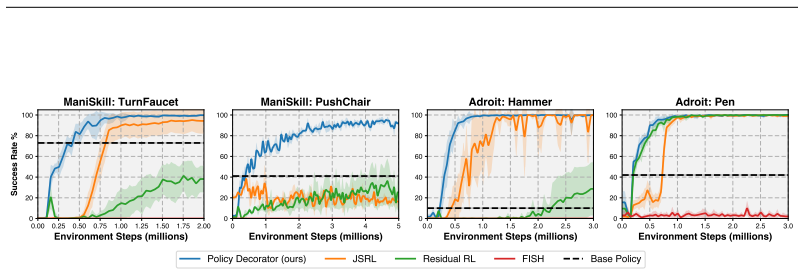
The central claim is that a frozen imitation policy $\pi_{\text{base}}$ can be wrapped, decorator-style, by a small learnable residual policy $\pi_{\text{res}}$ trained with Soft Actor-Critic on the environment's sparse success reward; the action executed in the environment is $\pi_{\text{base}}(s)+\pi_{\text{res}}(s)$. Two controls make this stable: the residual output is $\tanh$-squashed and scaled by $\alpha$ so that the combined trajectory stays near the base trajectory, and a progressive schedule mixes the residual in gradually, using the base policy alone at the start and increasing the probability of adding the residual over time. The paper reports near-perfect success on every task it evaluates with low-dimensional state observations (for Diffusion Policy, StackCube and Adroit Door were skipped because the base policy was already near-optimal), strong results with image observations, and consistent superiority over fine-tuning baselines (LoRA-based SAC, DIPO, Cal-QL, RLPD, ROT) and non-fine-tuning baselines (JSRL, Residual RL, FISH). The refined policy also keeps the base policy's smooth motion and, in the Behavior Transformer case, its multi-modal action distribution.
Load-bearing premise
The base policy must already be reasonably competent, since the method only learns small per-step corrections: if the policy has drifted into states far outside its demonstration distribution, a bounded action-level patch cannot recover and no sparse success signal will be available to train the residual.
Editorial extensions
If this is right
- Any frozen policy with reasonable initial performance—Behavior Transformer, Diffusion Policy, MLP, RNN, or CNN—can be improved online using only sparse success signals, without gradient access to the base model.
- Fine-tuning large imitation policies, which the paper finds prone to early unlearning and long-horizon reward starvation, can be replaced by forward-only refinement that costs a fraction of the wall-clock time (7h23m vs 33h52m on StackCube with Behavior Transformer).
- Refinement transfers to novel objects: on TurnFaucet and PushChair, base policies trained on source objects improved online on target objects not present in the demonstrations.
- The refined policy keeps the smooth, multi-modal motion of imitation learning rather than the jerky motion of pure RL policies, so large improvements in success need not sacrifice motion quality.
- The recipe is not tied to one RL algorithm or observation modality: it also works with PPO and with image observations, and on low-performing base checkpoints.
Reading between the lines
- The paper's assumptions imply a cheap rejection test: measure how far a base policy's rollouts wander from the demonstration manifold before investing in online refinement; success is only promised for policies whose failures are small local deviations.
- A natural extension is state-dependent residual bounds: replacing the global $\alpha$ with per-state or per-action-dimension caps could improve sample efficiency on high-precision tasks without changing the method.
- Because the base policy is never modified, the decorator framing suggests compositional refinement—several residuals trained for different objectives or constraints could be stacked or combined without retraining the base.
- The preservation of multi-modality should degrade as $\alpha$ grows large relative to the mode separation of the base policy; the paper's $\alpha$ ablations are consistent with this prediction, and a direct test would compute the combined action distribution's modality for increasing $\alpha$.
Signed reviews
Editorial analysis
A structured set of objections, weighed in public.
Referee Report
Summary. The paper proposes Policy Decorator, a method for improving a frozen, offline-trained imitation-learning policy through online reinforcement learning of a small residual policy. The residual action is added to the base-policy action, bounded by a hyperparameter alpha, and introduced through a progressive schedule that interpolates between the base policy alone and the combined policy. The method is evaluated on eight ManiSkill and Adroit tasks with Behavior Transformer and Diffusion Policy base policies, against fine-tuning and non-fine-tuning baselines, with ten seeds and extensive ablations. The headline claim is that Policy Decorator improves both base policies to near-perfect success on all evaluated tasks while preserving the smooth motion of the imitation policy.
Significance. If the empirical results hold, the paper makes a practically useful contribution: large, non-differentiable imitation policies can be improved online without backpropagating through the large model, which sidesteps both architectural incompatibility and the computational cost of fine-tuning. The evaluation is unusually thorough for this area: eight tasks, two base policy families, ten seeds, several strong baselines, a comparison with DPPO, visual-observation experiments, and detailed appendices analyzing why fine-tuning and non-fine-tuning baselines fail. The paper also provides concrete hyperparameter tables and a careful validation of the Cal-QL baseline implementation in Appendix F.3. The main caveats are the per-task tuning of the two key hyperparameters and the unquantified boundary of the assumption on base-policy quality; these limit the strength of the general claim but do not undermine the core demonstration.
major comments (3)
- [Sec. 5.4.2, Table 8] The headline results in Figs. 6-8 are produced with per-task values of the two key hyperparameters, the residual bound alpha and the schedule length H. Table 8 lists alpha from 0.03 to 0.8 and H from 30K to 8M across tasks, so there is no cross-task fixed setting. The ablations in Figs. 10-11 show robustness only on StackCube and PushChair, and even there the robust ranges differ between the two tasks. The abstract and Sec. 5.3 state that Policy Decorator 'improves the performance of both offline-trained policies to a near-perfect level on all tasks,' which is stronger than the evidence: the results demonstrate per-task tuned success, not general success without task-specific tuning. Please add an experiment with a fixed (alpha, H) across all tasks, or explicitly qualify the claim to per-task tuned settings.
- [Sec. 3, Assumption 3] The method's load-bearing premise is that base-policy failures are correctable by a bounded, per-step action residual. Assumption 3 formalizes this only as the base policy exhibiting 'reasonable initial performance,' and the paper never measures where base-policy failures actually occur relative to the demonstration-covered state manifold. Appendix D.2 tests one low-performing BeT checkpoint on TurnFaucet, which is a useful start, but it does not systematically vary base-policy quality or quantify the state deviation that an alpha-bounded residual can recover. The claim 'near-perfect on all tasks' is therefore demonstrated only for the particular base policies and tasks selected, and its boundary remains uncharacterized. Please add a systematic study of base-policy quality (e.g., checkpoints of varying success rates, with analysis of failure-state distances and required correction magnitudes), and soften the general claim accordingly.
- [Sec. 5.5] The paper advertises the preservation of smooth, natural motion as a key advantage over pure RL policies, but the evidence is qualitative: videos and the multi-modality analysis in Appendix J. No quantitative smoothness metric is reported across tasks or seeds. Since this property is part of the paper's central contribution, please add a measurable proxy such as action jerk, action total variation, or a power-spectral measure, and compare the refined policy with both the base policy and a pure-RL baseline.
minor comments (5)
- [Appendix J.1] The listed parameters for the illustrative bimodal distribution, mu1 = mu2 = 0.5 and sigma1 = sigma2 = 1, make the two Gaussian components identical, so the 'bimodal' base distribution is actually unimodal. Please correct the parameter values or the description so that the example matches the claim.
- [Fig. 17] The label 'Resiudual RL' contains a typo and should read 'Residual RL.'
- [Appendix B.2, Table 8] The row 'Adroit: Door (Diffusion Policy, visual)' has no corresponding curve in Fig. 8. Please clarify whether this experiment was run and, if so, where it is reported.
- [Abstract and Sec. 5.3] The phrase 'both offline-trained policies to a near-perfect level on all tasks' is too broad given that for Diffusion Policy, StackCube and Door were not tested because the base policy already achieves near-optimal performance. Please state explicitly that the claim concerns the tasks on which improvement was evaluated, or distinguish 'improved' from 'maintained near-perfect.'
- [Sec. 5.4.3] The bullet list references Appendix D.1, D.2, and D.3 without their titles; including the titles in the bullets would improve readability.
Circularity Check
No significant circularity: the paper's claims are empirical comparisons against measured environment success rates, not quantities derived from fitted parameters or self-citations.
full rationale
The derivation chain in Policy Decorator is an experiment, not a deduction: a frozen base policy is wrapped by a small residual policy trained online by SAC with sparse rewards, and the paper's central claims are success rates measured in the ManiSkill and Adroit environments. The tuned hyperparameters alpha and H affect learning dynamics, but they are not used to define or compute the success metric, so the near-perfect results are not forced by construction. The paper's premise that the base policy exhibits reasonable initial performance (Sec. 3, Assumption 3) is an explicitly stated scope assumption, and the bounded-residual design follows from that assumption; it is a limitation on applicability, not a circular derivation. The only self-referential elements are the authors' own ManiSkill benchmark and demonstration sets, which serve as a standard evaluation testbed and are not invoked as mathematical evidence for the method. No self-citation chain is used to justify the central mechanism, and no prediction is renamed from a fitted value. The unquantified boundary of Assumption 3 is a correctness and scope risk, not circularity.
Assumptions & free parameters
free parameters (2)
- alpha (residual action bound) =
per-task values in Table 8, from 0.03 to 0.8
- H (progressive exploration schedule length) =
per-task values in Table 8, from 30K to 8M environment steps
assumptions (4)
- domain assumption An online environment with a success signal (sparse reward) is available for interaction.
- domain assumption The base policy has reasonable initial performance and can make progress toward task completion.
- ad hoc to paper Small action-level corrections are sufficient to bring deviated trajectories back into demonstration-covered states.
- domain assumption SAC is a stable and sample-efficient RL algorithm for the combined policy.
Cite this review
Pith. "Pith review of Policy Decorator: Model-Agnostic Online Refinement for Large Policy Model." pith.science (2026). https://pith.science/paper/RIWLAU73
@misc{pith2026241213630,
  author       = {Pith},
  title        = {Pith review of: Policy Decorator: Model-Agnostic Online Refinement for Large Policy Model},
  year         = {2026},
  howpublished = {\url{https://pith.science/paper/RIWLAU73}},
  note         = {Machine review of arXiv:2412.13630}
}
read the original abstract
Recent advancements in robot learning have used imitation learning with large models and extensive demonstrations to develop effective policies. However, these models are often limited by the quantity, quality, and diversity of demonstrations. This paper explores improving offline-trained imitation learning models through online interactions with the environment. We introduce Policy Decorator, which uses a model-agnostic residual policy to refine large imitation learning models during online interactions. By implementing controlled exploration strategies, Policy Decorator enables stable, sample-efficient online learning. Our evaluation spans eight tasks across two benchmarks-ManiSkill and Adroit-and involves two state-of-the-art imitation learning models (Behavior Transformer and Diffusion Policy). The results show Policy Decorator effectively improves the offline-trained policies and preserves the smooth motion of imitation learning models, avoiding the erratic behaviors of pure RL policies. See our project page (https://policydecorator.github.io) for videos.
Figures


Figures from the paper (25 more)






Forward citations
Cited by 6 Pith papers
-
VINE: Taming Generative Control Policies for Reinforcement Learning
Reconstructing a fresh noisy interpolation state at every denoising step stabilizes end-to-end value-gradient training of multi-step flow-matching policies and yields state-of-the-art offline and real-robot results.
-
From Prior to Pro: Efficient Skill Mastery via Distribution Contractive RL Finetuning
Residual off-policy RL with selective BC regularization and value-guided sampling contracts a pretrained generative robot policy around successful actions, reaching high success on hard long-horizon tasks from pixels ...
-
LodeStar: Long-horizon Dexterity via Synthetic Data Augmentation from Human Demonstrations
LodeStar combines automatic skill segmentation with simulation-based reinforcement learning augmentation and a learned routing transformer to let a robotic hand complete long-horizon dexterous tasks from a few human demos.
-
Touch begins where vision ends: Generalizable policies for contact-rich manipulation
A localize-then-execute policy that combines vision-language reaching, semantic background augmentation, and residual reinforcement learning with tactile sensing reaches about 90% success on millimeter-precision manip...
-
Efficient Online RL Fine Tuning with Offline Pre-trained Policy Only
PORL fine-tunes a pre-trained policy online by first collecting epsilon-greedy interaction data and learning a fresh Q-function from scratch, removing the need for pre-trained critics or offline data.
-
SIME: Enhancing Policy Self-Improvement with Modal-level Exploration
Injecting annealed noise into the observation-encoder latent of a diffusion policy during inference increases rollout diversity and, combined with success- and value-based data selection, improves imitation-learned ro...
Reference graph
Works this paper leans on
-
[1]
Such a noisy gradient can easily cause the policy to deviate significantly from the initial weights
Random Critic Initialization: We believe the randomly initialized critic network cannot provide meaningful gradients to guide the policy. Such a noisy gradient can easily cause the policy to deviate significantly from the initial weights. Once the unlearning happens, it becomes very hard to relearn the policy since it cannot get the sparse reward signal a...
work page 2024
-
[2]
Long Task Horizon: Long task horizon also significantly increases the difficulty of fine-tuning, particularly in sparse reward settings. As the task horizon increases, the agent’s likelihood of discovering sparse rewards through random exploration diminishes. Additionally, the sparse reward signal requires more time to propagate through longer trajectorie...
work page 2024
-
[3]
Online Algorithm: The original Cal-QL paper uses Cal-QL algorithm in both offline and online stage. However, computing critic loss in Cal-QL algorithm requires querying the actor 20 times in each update, which is extremely time-consuming given that the actor is a large model in our settings. Therefore, we use SAC in the online phase instead of Cal-QL. To ...
-
[4]
Offline Dataset: The original Cal-QL paper uses an offline dataset consisting of 25 human teleoperation demonstrations and additional trajectories from a BC policy. Our Cal-QL baseline uses only 25 human demonstrations, ensuring fair comparison with other learning-from-demo baselines that only utilize demonstrations. We also made this assumption in Sec. 3
-
[5]
Actor Architecture: The original Cal-QL paper employs a small MLP as the actor, while we use a pre-trained Behavior Transformer (BeT) to align with our goal of improving the pre-trained base policy
-
[7]
Use a randomly initialized MLP
-
[8]
Use a randomly initialized GPT
-
[9]
Use the pre-trained GPT backbone from the actor, and add a randomly initialized value head As shown in Fig. 24, we experimented with all the aforementioned Q-function architectures in SAC fine-tuning experiments. The results indicate that fine-tuning with an MLP Q-function slightly improves the base policy, whereas fine-tuning with the other two Q-functio...
Show all 14 references
-
[10]
These deviations prevent the agent from receiving success signals necessary for guiding learning (see this video for an example)
During early training stages, random residual actions cause significant deviations from the base policy’s trajectory. These deviations prevent the agent from receiving success signals necessary for guiding learning (see this video for an example)
-
[11]
two-layer
The residual policy is designed to make minor corrections to the base policy. However, without explicit constraints, the magnitude of residual actions often exceeds that of the base policy actions, destroying the base policy’s behavior. Our ablation study (Fig. 10 and 11) supp...
2024
-
[13]
• The PDF of the Gaussian distribution (orange): fGaussian(x) = N (x; µ3, σ2 3)
+ w2 · N(x; µ2, σ2 2), 35 where N represents the Gaussian distribution. • The PDF of the Gaussian distribution (orange): fGaussian(x) = N (x; µ3, σ2 3). • The PDF of the sum of the two distributions (green) can be computed analytically: fsum(x) = w1 · N(x; µ4, σ2
-
[14]
• The parameters used in the plot are: w1 = 0.5, w 2 = 0.5, µ 1 = 0.5, µ 2 = 0.5, µ 3 = 3, σ 1 = 1, σ 2 = 1, σ 3 = 1
+ w2 · N(x; µ5, σ2 5), where: µ4 = µ1 + µ3, σ 4 = q σ2 1 + σ2 3, µ 5 = µ2 + µ3, σ 5 = q σ2 2 + σ2 3. • The parameters used in the plot are: w1 = 0.5, w 2 = 0.5, µ 1 = 0.5, µ 2 = 0.5, µ 3 = 3, σ 1 = 1, σ 2 = 1, σ 3 = 1. J.2 R EAL CASE STUDY FROM OUR EXPERIMENTS To demonstrate t...
2018
-
[2022]
However, its online performance is poor, as reported by Ren et al
represents a basic version of these methods, primarily used in offline RL settings. However, its online performance is poor, as reported by Ren et al. (2024). Consistency AC (Ding & Jin, 2023) distills diffusion models into consistency models, significantly shortening the grad...
2024
-
[2066]
calibrates
PMLR, 2015. Cheng Chi, Siyuan Feng, Yilun Du, Zhenjia Xu, Eric Cousineau, Benjamin Burchfiel, and Shu- ran Song. Diffusion policy: Visuomotor policy learning via action diffusion. arXiv preprint arXiv:2303.04137, 2023. Open X-Embodiment Collaboration. Open X-Embodiment: Roboti...
2023 arXiv
Reviewed August 11, 2026 · model on record in the stance chip above.
Discussion (0). Continue with ORCID to comment.